




Abstract
The aim of this study was to evaluate the effects of active hexose correlated compound intake on the immune competence in healthy volunteers. Thirty-four subjects were randomized to receive placebo or active hexose correlated compound at 1.0 g/d for 4 weeks in early winter. Natural killer cell activity was significantly increased in both groups during the study period, the natural killer cell number, however, was not altered in the active hexose correlated compound group while placebo group showed remarkable decline. In addition, the score of immunological vigor, an index of total immune competence, was maintained in the active hexose correlated compound group although that of placebo group lowered during the test period. These results suggested that the continuous active hexose correlated compound intake maintained the immune competence against the seasonal change.
Keywords
Introduction
The human immune system plays an important role in the host defense. If invasion of pathogenic bacteria and viruses takes place in human body, immune systems such as innate and adaptive immunity serve to protect against pathogens. The immunocompetent cells such as lymphoid cells (B cell, T cell, natural killer cell, etc), granulocytic cells (eosinophil, neutrophil, basophil, etc) and antigen-presenting cells (macrophage, monocyte, dendritic cell, etc) are involved in the defense reaction. However, activity of these cells is affected by various factors including aging, stress, malnutrition, and various stressors. 1 –3
Seasonal changes are also considered to alter the immune function. It is shown that it generally decreases during winter as a result of various factors. In studies of the seasonal patterns of human infection diseases, many are reported to be most epidemic in winter. 4,5 The higher incidence of disease in winter is suggested to be correlated with air temperature. It is suggested that the nasal airway is most cooled down, and susceptible when exposed to cold temperature. Therefore the mucociliary clearance and the immune response of the nasal airway are compromised. 6 In cold temperature, the sympathetic nervous activity is stimulated as homeostatic responses, and the number of granulocytes increases, leading to an increased secretion of adrenaline and noradrenaline from the adrenal gland.
Although activating the sympathetic nervous system contributes to increasing the body temperature for maintenance of homeostasis as counteraction, secreted adrenaline and noradrenaline result in an increase in the number of granulocytes which bear the adrenaline receptor. 7 Increased granulocytes generate reactive oxygen species which predispose to inflammation in each tissue and mucosa. 8,9 The local immune response is suppressed by inflammation in oral and intestinal mucosa, and associated with an increased risk of infection. 7 It is also known that the number of natural killer cells decreases by adaptive response to low temperature in winter season. 10 In order to activate the immune competence, it is desirable to remove factors causing a decrease in the activity of the immunocompetent cells. Intaking immunomodulatory nutraceuticals is one of the several ways to activate the immune function.
However, it is difficult to evaluate the effect of immunomodulatory nutraceutical on healthy people. The immunomodulatory effect of functional foods can be barely observed in healthy people as the baseline of the immune competence of healthy people is generally maintained high. To evaluate the comprehensive assessment of the immune competence, Hirokawa et al 11,12 described a method to comprehensively evaluate the immune function by using multiple parameters associated with T cells, not by only measuring the cytokine level and/or the number of the immunocompetent cells. In this method, 7 or 8 parameters significantly diminished by aging or stress are used as the criteria and unified as immunity score. Standardization of immunity score is carried out using a database that is created on the basis of measuring immunological parameters in many healthy subjects. This score system enables accurate measurement of minor differences in the immune competence of healthy subjects, and the results are shown as score of immunological vigor.
There are various kinds of functional foods that show immunomodulatory effect, one of which is active hexose correlated compound, which is a mixture of polysaccharides, amino acids, lipids, and minerals derived from mycelial culture of the basidiomycete, Lentinula edodes. Active hexose correlated compound has demonstrated positive effects on various parameters of the immune function in both rodents 13 –17 and humans. 18 –20 In the clinical trial on healthy subjects, the number of total dendritic cells in the active hexose correlated compound group was significantly higher after 4-week intake of active hexose correlated compound, when compared with the baseline and with the placebo group. 21 In the clinical trial on healthy elderly persons for 30 days, the results suggested that active hexose correlated compound can enhance CD4+ and CD8+ T cell immune responses via increasing the production of cytokines, interferon-γ, and tumor necrosis factor-α, from T cells. 22 When Roman et al 23 assayed the effect of active hexose correlated compound intake on the antibody response to influenza B vaccine in a clinical trial, active hexose correlated compound supplementation for 3 weeks after vaccination showed significant increase in antibody titer and CD8+ T cells when compared with a control group.
In this study, we performed a pilot study to evaluate the effect of active hexose correlated compound on seasonal suppression of the immune competence in healthy people. A double-blind randomized placebo-controlled clinical trial was performed in healthy subjects in the cold season, which is prone to suppression of the immune competence. Hirokawa’s immunity score system was used to comprehensively evaluate the immune competence of healthy individuals between active hexose correlated compound and placebo groups.
Materials and Methods
Study Design
The current study was a 4-week, randomized, double-blind, parallel-group, placebo-controlled clinical trial. The primary endpoint of the study was the assessment of the immune function (natural killer cell activity and score of immunological vigor; see explanation below). This study was conducted in accordance with the Declaration of Helsinki, and all procedures involving human subjects were approved by the Ethics Review Board, Hokkaido Information University (Ebetsu, Japan). Valid informed written consents were obtained from all subjects.
Study Participants
Healthy adult volunteers who had felt daily fatigue subjectively were included in this trial. Subjects were excluded from the study based on the following criteria: history of significant illness, current use of any prescribed medication and supplements for immune enhancement, any diagnosed medical condition which might confound the evaluation of safety, history of severe allergic reactions to food, and pregnancy. Thirty-four subjects were randomly assigned by using initial natural killer cell activity, into 2 groups, the active hexose correlated compound intake group (age range 31-73 years, mean age 54.8 years) and the placebo group (age range 30-73 years, mean age 54.2 years). All subjects took 4 capsules of active hexose correlated compound (250 mg/capsule) or placebo (250 mg dextrin only/capsule), daily for 4 weeks between November and December, 2013. Inspection was held 2 times, just before intake and 4 weeks after the commencement of sample intake. All subjects underwent peripheral blood test and the questionnaire by the visual analog scale method (see explanation below).
Dietary Supplements
Active hexose correlated compound freeze-dried powder was industrially manufactured by Amino Up Chemical Co, Ltd (Sapporo, Hokkaido, Japan). 24,25 The Lentinula edodes mushroom mycelia was cultured in liquid medium and then processed by separation, concentration, sterilization, and freeze-drying to the end fine granule powder of active hexose correlated compound under the Quality Management System standards of ISO 9001:2008, and ISO 22000:2005, and Good Manufacturing Practice from the Japan Health and Nutrition Food Association.
Natural Killer Cell Activity
Natural killer cell activity was assessed by chromium-51 release assay to measure radioactivity released from Chromium-51-loaded K562 target cells. This assay was done by SRL Inc (Tokyo, Japan) in a blind manner.
Score of Immunological Vigor
This score conceived by Hirokawa et al 12 was calculated based on lymphocyte subsets analysis by the flow cytometric method. This is a method of evaluating comprehensive immunity strength by scoring various immune indexes including the number of T cells, CD8+ CD28+ T cells, naïve T cells, B cells, and natural killer cells, CD4/CD8 T cell ratio, and naïve/memory T cell ratio. Each immune index is individually scored as three levels (1 is “needs improvement,” 2 is “needs observation,” and 3 is “safe”). Score of immunological vigor was determined from the sum of the 7 index scores, and therefore ranged from 7 to 21. 26
Complete Blood Count
The whole peripheral blood was collected from the antecubital vein of each subject. The complete blood count was performed at the health center of Hokkaido Information University and assessed for red blood cells, hemoglobin, hematocrit, platelets, white blood cells, and differential counts of white blood cell (neutrophil, lymphocyte, monocyte, eosinophil, and basophil).
Visual Analogue Scale
Subjects marked their perception of the current state of the items on 100-mm horizontal lines anchored by word descriptions of the state at each end. 27 The visual analogue scale score was determined by measuring in millimeters from the left end of the line to the point marked. The 7 items relating stress and fatigue were evaluated in this study, which were arousal, mood state, motivation, feeling, physical fatigue, concentration, and appetite.
Statistical Analysis
The Wilcoxon signed-rank test was used to determine whether the difference between before (pre) and after (post) 4 weeks of intake was significant. Also the changes between groups were compared using the Mann-Whitney U test. A P value less than .05 was considered to be significant, and a P value less than .10 but larger than .05 was considered to have tendency. These analyses were performed using statistical software StatView version 4.5. Results are expressed as mean ± standard error.
Results
General Characteristics of Study Subjects
Among the enrolled subjects (n = 34), 1 subject in the active hexose correlated compound group dropped out for no good-compliance on capsules consumption and 33 subjects completed the study. Throughout the 4-week study, the subjects reported no serious adverse events on health or any general health problems due to active hexose correlated compound or placebo supplementation and the compliance was more than 85%.
Table 1 presents the general parameters measured at the baseline of the study. There were no statistically significant differences with respect to all the characteristics of the study subjects between placebo and active hexose correlated compound groups.
Demographic Profile of the Study Subjects in Placebo and AHCC Groups.

Abbreviations: AHCC, active hexose correlated compound; SE, standard error.
Natural Killer Cell Count and Activity
As shown in Table 2, natural killer cell count did not change in the active hexose correlated compound group, while it tended to decrease in the placebo group (P = .0526). NK cell activity was significantly enhanced in the placebo and active hexose correlated compound groups (P = .0230 and P = .0053, respectively) during the study period. The increased levels of natural killer cell activity before and after the intervention were greater in the active hexose correlated compound group than the placebo group, but it was not statistically significant.
Comparison of NK Cell Count, NK Activity, and SIV Between the Placebo and AHCC Groups, and Pre- and Postintakes.a

Abbreviations: NK, natural killer; SIV, score of immunological vigor; AHCC, active hexose correlated compound; SE, standard error.
a Values are mean ± SE. *P < .05 and **P < .01 indicate a significant difference between pre- and postintakes in each group, while ***P < .1 indicates a tendency for difference. † P < .05 indicates a significant difference between the placebo group and the AHCC group.
Score of Immunological Vigor
Table 2 also shows the score of immunological vigor between the active hexose correlated compound group and the placebo group before and after the intervention. Initial levels of these scores of immunological vigor were not significantly different between the 2 groups. After the intervention, score of immunological vigor did not change in the active hexose correlated compound group, while it significantly decreased in the placebo group (P = .0053). Moreover, the changes of score of immunological vigor differed markedly between both groups (P = .0338).
Complete Blood Count
Changes in complete blood count with hematological and 5-part differential count parameters between the active hexose correlated compound group and the placebo group before and after the intervention are summarized in Table 3. Initial levels of these data were not significantly different between the 2 groups. After the intervention, in the placebo group, the percentage of neutrophils significantly increased (P = .0090), and the percentage of lymphocyte significantly decreased (P = .0117). On the other hand, in the active hexose correlated compound group, the percentage of differential count parameters did not show any significant differences during the intervention period. However, the changes of both neutrophil and lymphocyte parameters were significantly different between the 2 groups (P = .0190 and P = .0201, respectively).
Comparison of CBC Including the Differential Leukocyte Count Between the Placebo Group and the AHCC Group.a
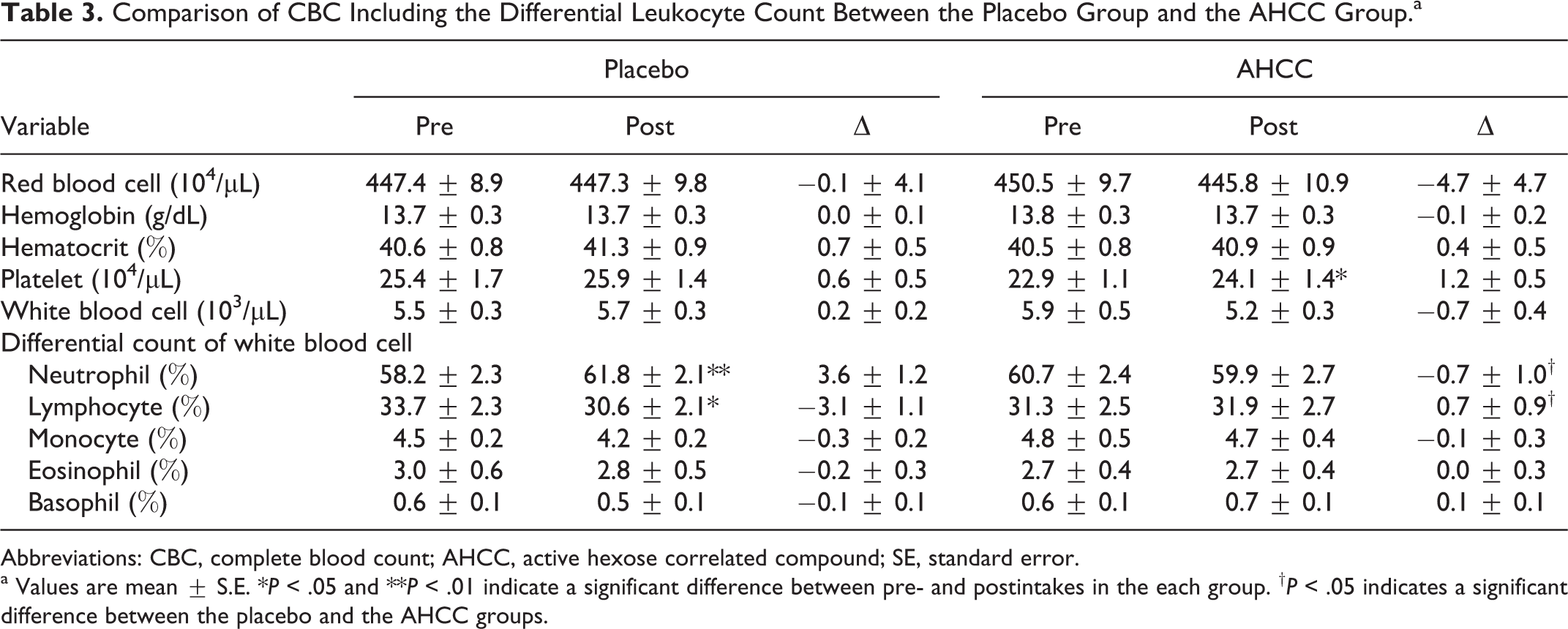
Abbreviations: CBC, complete blood count; AHCC, active hexose correlated compound; SE, standard error.
a Values are mean ± S.E. *P < .05 and **P < .01 indicate a significant difference between pre- and postintakes in the each group. † P < .05 indicates a significant difference between the placebo and the AHCC groups.
Visual Analogue Scale
Figure 1A and B shows the results of the visual analogue scale in the placebo group and active hexose correlated compound group, respectively. Six out of 7 visual analogue scale items in the active hexose correlated compound group seemed to slightly improve compared with the placebo group. In particular, 1 item “Concentration” showed significant improvement between pre- and postintake in the active hexose correlated compound group (P = .0380). There was no significant improvement in the placebo group.

Effect of AHCC intake on the 7 items related to stress and fatigue, arousal, mood state, motivation, feeling, physical fatigue, concentration, and appetite, before (gray and dash line) and after (black and solid line) the intervention. (A) and (B) show the placebo and AHCC group, respectively. *P < .05 indicates a significant difference between pre- and postintakes.
Discussion
In this study, we conducted the pilot clinical study recruiting healthy subjects from the beginning to the middle of winter to elucidate whether active hexose correlated compound modulates the seasonal variations of immunity.
Natural killer cell count and its activity were evaluated in this study as one of the main factors of innate immunity, which provides an initial defense against pathogen. Natural killer cell activities are controlled by specific signaling molecules such as interferon-α/-β/-γ and interleukin-2. 28,29 As results show in Table 2, the natural killer cell count tended to decrease in the placebo group, which may be consistent with the report that natural killer cells decrease in winter. 10 In the active hexose correlated compound group, the natural killer cell count decrease was observed but the difference was not significant, which suggested that active hexose correlated compound maintained the natural killer cell count against the seasonal reduction. The natural killer cell activities significantly increased in both groups which can be considered counteraction to the natural killer cell count decreases. The increase in level was higher in the active hexose correlated compound group than that of the placebo group. These results suggested that active hexose correlated compound attenuated the seasonal reduction of the natural killer cell count, and furthermore, enhanced the natural killer cell activity per cell.
The score of immunological vigor result showed that the immune competence was not altered in the active hexose correlated compound group while the placebo group demonstrated significant decrease during the study period (Table 2). It suggested that active hexose correlated compound maintained total immunity against the immune suppression caused by a seasonal change. The suggested maintaining-effect of active hexose correlated compound is also supported by the result that the change of score of immunological vigor in each group differed significantly when compared between groups.
Both neutrophil and lymphocyte counts are also the classical and important indices for immunocompetence. The balance between neutrophil and lymphocyte is maintained by the autonomic nervous system in the general condition. 30 However, it can be disturbed by various stressors—climate change is one of the factors. Abo et al 31 reported that when comparing the number of granulocyte and lymphocyte in the northern colder area and the southern warmer area, there was a tendency that the granulocyte was higher and the lymphocyte was lower in subjects of the northern colder area. It is also reported that lymphocyte decreases when temperature decreases. 32 In this study, conducted in the beginning of winter, the placebo group showed significant changes in the neutrophil increase and the lymphocyte decrease when compared before and after the intake, which are considered reasonable alteration in the study period (Table 3). This change that the neutrophil is dominant over the lymphocyte is considered stressful state 33 and may be caused by the temperature change in the study period. 32 However, both immune cells counts did not change in the active hexose correlated compound group, suggesting that it contributed in the maintenance of neutrophil/lymphocyte homeostasis. This homeostasis-maintaining effect of active hexose correlated compound is also supported by the results that the changes of both cells in each group were significantly different between groups. Besides, since the autonomic nerve is involved in the neutrophil/lymphocyte balance, active hexose correlated compound might affect the autonomic nerve status.
Recent studies reported that stress induces neuroinflammation and causes anxiety. 34 It is also suggested that immune modulation is effective in therapies of schizophrenia and mood disorders. 35 The visual analogue scale results suggested that active hexose correlated compound improved mood scores in the study period; especially the “Concentration” was significantly improved in the active hexose correlated compound group (Figure 1B). These results may be explained by the tentative mechanism of the immune modulating effect of active hexose correlated compound. Further studies are required for the full picture.
Conclusion
In conclusion, it was suggested that the continuous active hexose correlated compound ingestion can maintain the immunocompetence against the seasonal change and the temperature decrease. The potential of active hexose correlated compound to modulate the autonomic nerve balance is also suggested. The results of this clinical trial suggest that active hexose correlated compound contributes to the prevention of complaints during winter months such as common cold and influenza.
Footnotes
Acknowledgments
We would like to acknowledge the Northern Advancement Center for Science & Technology (Sapporo, Japan), for providing financial assistance.
Authors Contributions
JT, YH, and TM participated in the design of the study, contributed to data analysis, and drafted the article. KH drafted the article. TM and HN supervised the experiment. All authors read and approved the final version of the article.
Declaration of Conflicting Interests
The authors declared no potential conflicts of interest with respect to the research, authorship, and/or publication of this article.
Funding
The authors disclosed receipt of the following financial support for the research, authorship, and/or publication of this article: This work was supported by a research grant from the Northern Advancement Center for Science & Technology (Sapporo, Japan).
Ethical Approval
This study was conducted in accordance with the Declaration of Helsinki, and all procedures involving human subjects were approved by the Ethics Review Board, Hokkaido Information University (Ebetsu, Japan). Valid informed written consents were obtained from all subjects.