




Abstract
Traditional Persian medicine is based on humoral medical concepts. In the case of abundant blood in the body, tabi’at (body nature) deals with this imbalance by elimination of the morbid substances via some controlling mechanisms. If tabi’at could not react properly, the physician should prescribe an intervention to let the extra blood out. This can be done through phlebotomy, wet cupping, and the use of leech or scarification of the ears. Cupping with scarification may eliminate the morbid substance through the scarified skin, and cupping without scarification evacuates the morbid materials from the compromised organs. Wet cupping in health state is meant to be applied for preventing the blood humor dominance in susceptible individuals. In disease condition, wet cupping is defined as a treatment in which the patients confront the abundance of blood. Wet cupping may have harmful complications in extremely thin or obese patients. Wet cupping should be postponed in patients compromised by diseases especially in the thick phlegm abundance. In Asia, Iranian people, because of religious beliefs, are very interested in cupping therapy. Many unsupervised cupping procedures are performed in Iran, whereas benefits and risks of these procedures are undetermined by providers and clients. In this study, the most important indications and contraindications of wet cupping have been reviewed based on the traditional Persian medicine resources.
Keywords
Introduction
Based on humoral medicine and in the footsteps of Hippocrates and Galen, Persian physicians believed and reported that the balance among “4 humors” (phlegm, bile, black bile, and sanguine) in human body sustains the health preservation, while lack of this balance results in disease. 1 In this approach, disease conditions were divided into sue-mezaj (dystemperament), which is due to an imbalance among the 4 aforementioned humors, and taforrogh-e-ettesaal (separation in organs), owing to falling down, trauma, or other causes. The imbalance of humors can be either qualitative or quantitative. The qualitative imbalance refers to changes in the quality of warmness, coldness, wetness, and dryness, which could be modified and improved via special nutritional and medicinal approaches. On the other hand, quantitative imbalance is defined as changes in the amount of concerned humors and may be corrected by body’s natural forces (tabi’at) or manipulation and physical therapies (a’amal-e-yadavee). Generally, manipulation is prescribed by a traditional Persian medicine physician and performed by a person (hajja’m) experienced in a’amal-e-yadavee. Waste materials are naturally removed from the body via urination, defecation, sweating, sputum, as well as ear wax and nasal discharge. Tabi’at reacts to blood abundance (abundance of sanguine humor in relation to other humors) and evacuates the morbid substances through controlling mechanisms such as roaaf or epistaxis. Due to weakness of the body or dominance of the disease states in some conditions, tabi’at may not be able to restore the mentioned balance. Accordingly, physicians should prescribe an intervention to evacuate the extra blood. The said intervention is defined as phlebotomy, wet cupping (hijamat), using leeches or scarification of the ears. 2
There is an increasing trend to use complementary and alternative medicine, and despite the different views among medical doctors and complementary and alternative medicine providers, the present legal landscape permits the widespread use of complementary and alternative medicine therapies worldwide. 3 Many Chinese studies report that cupping therapy is a quick, reproducible, helpful, and safe modality, which is easy to learn. 4,5 However, many physicians are skeptical about the impact of cupping therapy in the management of various diseases. 6
Cupping therapy is often spoken as one of the oldest medical practices not used frequently in Western countries, but it is highly common in Asian societies. 1 According to ancient documents, blood drawing was a known life-saving medical intervention in ancient Egypt, Greece, and Rome in different forms including hijamat. The Egyptians were probably the first who applied the scarification procedure for bloodletting, and subsequently transferred the method to the West. 7,8 Additionally, cupping therapy is defined as an ancient form of complementary and alternative medicine practiced in almost all cultures. This process has been used for many conditions such as high blood pressure, infections, pain, mental disorders, heart illnesses, as well as a variety of common diseases and skin disorders. 9
There is scant information on the long-term clinical efficacy of cupping therapy. 10 Paucities of randomized clinical trials on cupping therapy interventions, small sample size, and weak methodology of the existing trials are some main reasons for bewildering of clinicians in confirming or refuting this intervention as an alternative treatment. 10
Despite the uncertain effectiveness and safety of wet cupping, the access of societies to this modality is feasible and inexpensive; hence, the legislators and officials should establish regulations to control the providers of these interventions in a safe manner. Complementary and alternative medicine providers lack enough uniformity credentialing the processes as other health care groups do. More consistent, national standards for licensing of complementary and alternative medicine providers help responsible physicians to refer the patients to more authoritative services and reduce referral to unqualified complementary and alternative medicine providers. 3 Islamic sayings (hadith) of the Prophet Muhammad, peace be upon him, the Prophet of Islam, have emphasized the usefulness of cupping for health. More than 600 hadith is quoted of the Muslim’s Prophet Muhammad (peace be upon him) on cupping benefits for the body. 11 According to some studies in Tehran, 4.3% to 5.9% of Iranian people used wet cupping at least one time throughout their life. 12 Due to religious beliefs, Iranian people are very interested in cupping therapy. 13 A study conducted by Yekta et al showed that only 13% of people consult with a physician before wet cupping. 14 Thus, many cupping procedures are being done without supervision of physicians, whereas indications and contraindications of these procedures are undetermined by providers and clients. 12 This problem may be attributable to lack of sufficient knowledge about traditional Persian medicine among the academicians and the public. Although the academicians, especially medical students, are interested in learning the principles of traditional Persian medicine, their knowledge about related interventions, particularly venesection, bloodletting, and leech therapy, is not much. 7,14 –18 It is considerable that benefits and hazards of recommended interventions are to be clearly remarked for patients. 19
Cupping therapy is traditionally defined as a safe procedure and useful in many circumstances. 20,21 However, long-term efficacy of cupping therapy on human body has not yet been clarified. On the other hand, wet cupping is widely recommended and applied by many schools including unani, ayurveda, and traditional Chinese medicine. But studies on the efficacy and effectiveness of this procedure are not adequate. Accordingly, the current research was carried out to render the medical considerations on cupping therapy with reference to traditional Persian medicine perspectives. To do this, the basics of traditional Persian medicine are reviewed briefly and benefits, hazards, indications, and contraindications of cupping therapy are discussed. We hope that our preliminary studies prompt researchers to design proper clinical trials in this field.
Methodology
Important traditional Persian medical manuscripts such as Al-Qanun Fil-Tibb (Canon of Medicine), Zakhireh Kharazmshahi (Treasure of Kharazmshah), kholasat-ol-hekmah (Summary of Hekmat), and Resale-ye-dallakieh (Treatise on Tonsorial) were reviewed. Subsequently, a distinct search through Medline, EMBASE, Scopus, Iranmedex, and Science Iranian Database (SID) focusing on the keywords “traditional medicine,” “cupping,” “bloodletting”, “hijamat,” “scarification,” and “complementary and alternative medicine” was performed to find any relevant information in this regard.
Definition
Hijamat (cupping with scarification) has been a manual procedure prescribed for various ill-health conditions since ancient times. Cupping with scarification and bloodletting are procedures in which the morbid substances are evacuated through the scarified skin. On the contrary, it is said that cupping without scarification removes the morbid substances from the compromised organs. 22
The person who performs hijamat is called “hajam,” the client of hijamat is “mohajam,” and the instrument used for cupping is called “mahjama.” 2,8 Latin synonym of cupping is curcurbita, which means like gourd. 23
Overall, cupping therapy is divided into dry and wet cupping. In dry cupping, the skin is pulled up into the suctioning cup, whereas in wet cupping scarification and then bloodletting would also be accomplished. 24 Cupping may be performed with fire (na’arieh) or without fire (qair-e-na’rieh) in order to establish a vacuum. 8
Hijamat ba shart (Cupping With Bloodletting)
Hijamat ba shart or the cupping with bloodletting is an ancient technique for cleansing the body from waste substances. In this procedure, the involved organ is cleansed and morbid substances are evacuated out of the respective organ. Despite phlebotomy and fasd (the technique of bloodletting in which a vein is opened with a lancet to permit the extra blood to be evacuated through the opened vein), hijamat does not cause weakness in the patient. It is reported that the best time for hijamat is the 16th and 17th days of the lunar month. 25
Scarification is performed with a special knife, and based on the purpose of cupping, the cups have different shapes. There are 2 types of cup. The first type has slight convexity and smaller round mouth with a long handle. The second type has a larger round mouth. The former is used when there is accumulation of morbid humors far from the skin. The latter attracts the morbid substances from the vast and scattered parts toward the place and is used for pain relief and opening of the obstructions influxes of humors. 1
Method
According to traditional Persian medicine, wet cupping has 3 stages. The first is cupping, in which morbid substances would be drawn toward the skin. The second stage is scarification, which will be followed by placing the cup again on the scarified skin in order to vacuum the accumulated morbid substances. The last 2 stages are common worldwide; however, traditional Persian medicine recommends the use of all 3 stages. The 3-stage modality excretes more morbid substances from deep inside compared to the 2-stage modality. 26,27
It was also reported that in the first step, the practitioner should apply proper oils on the skin (tadhin or anointing) before using the warmed cup. 25,26,28 The required low air pressure may be obtained by heating the inside of the cup with an open flame and replacing it on the skin. In this occasion, the skin would be distended toward the cup. 9 This preliminary and short time suction may cause the diversion of the blood to that side. 25,28 More recently, a mechanical suction pump has been connected to a one-way valve installed at the top of the cup. 9 In dry cupping, only the vacuum is applied. However, in wet cupping, the skin is pricked with needles or a scalpel, and the blood is sucked into the cup. The skin should be wounded deep and long without any damage to the epidermal layer. The process of blood suction might be repeated for 3, 5, or 7 times. 25,28 Depth and number of scarifications should be adjusted according to the patient’s skin, and the number and depth of scarification in patients with thicker skin can be increased. 2,8 Before scarification, massage should be given to the concerned site for cupping to attract the morbid substances toward the side of cupping. 2,8 It is recommended that dressing of the scarified area should be impregnated with honey. 25,26
Cautions
According to traditional Persian medicine, cupping therapy should be done under the direct observation of a competent physician. After a complete history taking and physical examination, they may order cupping therapy for the patients. Generally, there are some precautions to be considered by a cupping performer.
Before wet cupping: Cupping for anemic patient is prohibited. Anemia is called ghellat-e-dam in traditional Persian medicine, and the physician could diagnose it according to physical appearance and examining the pulse of the patients. Bloodletting should not be done in cold weather. In case of necessity, the least amount of blood should be drawn in the late morning. Bloodletting for pregnant women especially before the fifth month of pregnancy and menstruating women is inhibited. The patient should not be obese or very slim. Bloodletting is only permitted at least 12 hours after intercourse and 3 to 4 hours after meals. Children under 2 years of age and adults more than 60 years of age must not undergo bloodletting. Certain foods such as eggs should not be eaten before and after bloodletting (at least 4-6 hours).
2,25,26,28
If there is predominance of other humors, especially phlegm and black bile, first these humors should be evacuated by proper medications. If there is still an abundance of blood, bloodletting can be performed. As Persian practitioners believe, cupping at the commencement of the lunar month is banned. The best time is after the middle of the lunar month on days 16th or 17th when the moon is to increase and bad humors are still near the outer surface of the skin and good humors have returned inside. Cupping should be done in the second or third phases of the day and the most moderate time of the day (it was mentioned that a day can be divided in to 4 phases, noon and afternoon was defined as second and third phases). Cupping after bathing is banned except for those with thick skin. Patients should have enough rest before cupping to prevent weakness and lack of vital forces after the procedure.
2,8,25
After wet cupping: Patients should not eat for at least 3 to 4 hours and must avoid staying in the bathroom for a long time.
2
Patients should not scratch the site of cupping.
29
Patients who are slim and have warm and dry temperament (mezaj) should be advised to eat pomegranate juice or chicory with sugar; otherwise, they may develop bad humors in their stomach. Other groups should not eat anything up to 3 hours.
25,26
Furthermore, there are some precautions to be considered during the cupping procedure: Cupping procedure is forbidden to be performed on certain parts of the body including areas with thin muscles, hairy skins, and parts with insufficient space to put the cup. According to the place of cupping, a cup with proper size should be chosen. The cup should not be retained on the skin for more than 10 minutes. The rim of the cup should not be overheated. Bloodletting should not be performed on the skin areas with dermatitis, ulceration, swelling, enlarged blood vessels, varicose veins, thrombosis, aneurysms, advanced arteriosclerosis, a recently traumatized area, and an artery or the heart. Bloodletting should not be performed for patients with bleeding disorders such as aplastic anemia, hemophilia, leukemia, and so on.
29,30
It is not advisable to apply cupping to the abdominal, sacral, and breast regions of a pregnant woman.
26,29,30
Classification
According to the approaches of traditional Persian medicine, classification of wet cupping is based on the site of cupping. Cupping sites are also selected based on medical purposes. In the case of general cleansing, cupping should be performed between 2 scapulae in the backside. Other locations are usually selected based on the compromised organ and physician’s decision. The most common cupping sites include the areas between the 2 shoulders, calf, and low back (see Figure 1 and Table 1).
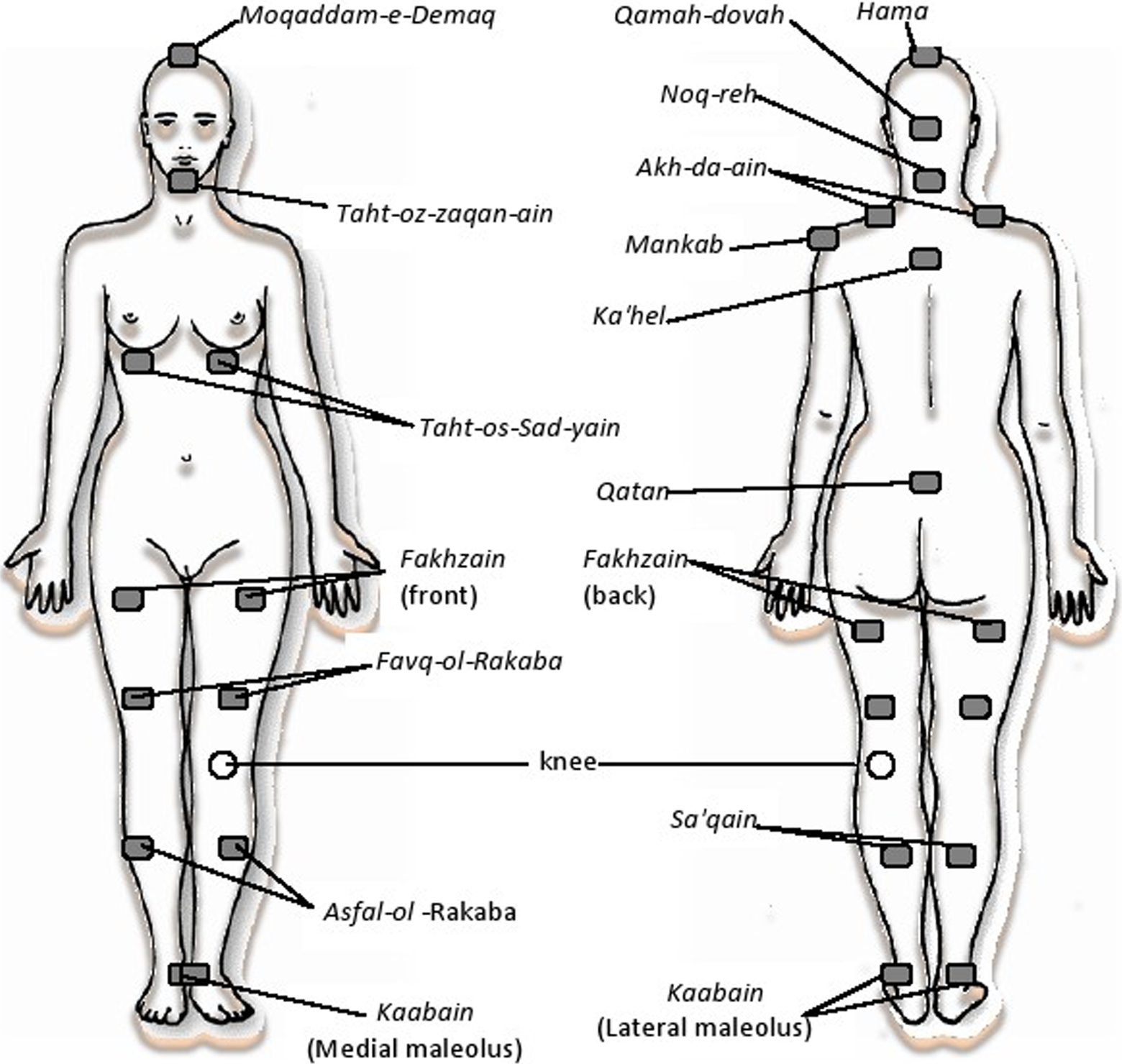
Places of putting cup.
Locations for Putting Cup, Medical Use, and Complications According to Traditional Persian Medicine.

Abbreviations: CNS, central nervous system; COPD, chronic obstructive pulmonary disease.
Mechanism
According to traditional Persian medicine, wet cupping is considered as a medical intervention for cleansing the morbid substances especially in the case of sanguine humor abundance, solely or in association with other humors. It was believed that accumulation and trapping of morbid humors may result in pain. In this regard, wet cupping has been recommended to alleviate pain through transferring or removing the regarded morbid substances. Similar to the idea of various body humors, a theory suggests that by increasing the circulation around the area of cupping and thus evacuating the toxins trapped in the tissues, pain may be alleviated. Another theory assumes the concept of “counter-irritation” as a process of transferring the pain and discomfort to another site, probably resulting in the cure of the original location. On the other hand, psychosomatic theories consider the impact of cupping as a placebo effect. 31
The analgesia system in the brain and spinal cord, endorphins and encephalin release, and inhibition of pain transmission via simultaneous tactile sensory signals are other recommended mechanisms for wet cupping in pain control. 32 Wet cupping may affect the coagulation–anticoagulation system via decreasing the level of hematological elements such as fibrinogen. As a principle in immunology, creating an artificial positional inflammation, affecting the thymus, and increasing the lymph flow through lymph vessels have a role to play. 24
Indications
There are several indications for prescribing wet cupping in the traditional Persian medicine approach. Wet cupping is recommended for both healthy people and those suffering from various ailments. In health condition, cupping was performed as prevention of the blood humor abundance in susceptible individuals, that is, those with high meat diet with a sedentary life. Spring has been indicated as the best season for wet cupping for these people. 25,26,28
On the other hand, in case of ailments, wet cupping was mentioned as a treatment for respective condition. In such circumstances, patients encounter blood humor abundance, having symptoms such as urticaria, flushing, headache, feeling of heaviness and fatigue, as well as skin redness and epistaxis. 26
Wet cupping has, in fact, been practiced in most cultures for various conditions including mental disorders, heart diseases, hypertension, infections, pains, and skin disorders. 9
Contraindications
Despite the scant evidence on the disadvantages of wet cupping in contemporary medicine, there are a few precautions presented by traditional Persian medicine. Accordingly, those who are not recommended to undergo wet cupping are the following: Patients with dried skin and constipation Patients with involuntary spasms Ill or weak patients with the risk of fainting Patients with fever, especially due to phlegm or black bile dominance People under 2 years old and over 60 years old Patients with acute abdomen or ileuses Very thin or very obese people (body mass index less than 18.5 and more than 30)
Medical Advantages
There are diverse opinions on the benefits of cupping therapy. Early Persian practitioners have listed a series of medical benefits for cupping. Of those, the most cited advantages are cleansing the body out of morbid humors, diverting the morbid substances from the vital organs (brain, heart, and liver), evacuating the involved body parts locally, and reestablishing the vital force 8,25 (Table 1).
Some studies suggest that wet cupping is associated with short-term clinical advantages in pain control than usual care. 32 Cupping is reported to have improvement effects on blood circulation and eliminates stasis and also can modulate heat, relieve pain, and alleviate symptoms of patients suffering from apoplexy, heat stroke, high fever, sore throat, lumbago, carbuncles, and erysipelas. 29
Cupping is also believed to be effective against acne, cough, and dyspnea 33 and can relieve pain in brachialgia paraesthetica nocturna, lumbar sprain, scapulohumeral periarthritis, mastitis, facial paralysis, soft tissue injury, arthritis, neurodermatitis, sciatica and myofascitis, chronic muscle pain, fibromyalgia, neuralgia pain, and chronic nonspecific neck pain. 10,34 –36
Traditional physicians reported that symptoms of chronic migraine or tension headache can be alleviated by wet cupping. 24 Cupping is also said to be a simple intervention for obtaining the graft in the treatment of Vitiligo. 37
On the other hand, a systematic review on the effectiveness of cupping in stroke rehabilitation did not find enough evidence. 38 Some studies revealed that cupping in the related segmental zones diminishes the symptoms of carpal tunnel syndrome. 39 Cupping is traditionally defined as an effective modality in alleviating the symptoms of chronic arthritis. 40 Investigations, of course, do not provide evidence on the effectiveness of cupping in management of hypertension. 41 Wet cupping may be an effective approach to reduce low-density lipoprotein cholesterol in men and consequently may have a preventive effect on atherosclerosis. 42 Wet cupping has some clinical advantages for primary care patients complaining of migraine headache. 24 A systematic review on the effectiveness of wet cupping in hypertension found no convincing evidence that cupping helps hypertensive patients in the control of their disease. 43
Complications
According to traditional Persian medicine, there are many complications that are usually related to the site of wet cupping. Some of these are due to the susceptibility of patients and regarding the weakness or problems in the involved organ. Others are owing to the frequency of the procedure and neglecting the contraindicated situations. Table 1 lists the most cited applications of wet cupping, complications, and precautions to be taken according to traditional Persian medicine.
According to the recent literature, most of the cupping therapy complications are preventable if trained and expert medical staffs perform cupping in line with safety guidelines. 20 Histological changes in epidermis may result from disruption of epidermal adhesion and vasodilatation, which may lead to fluid transudation. Similar changes may happen to the dermis with dermal bleeding and edema as a result of increased blood flow to the cupped region (hyperemia). 9 Clinicians should consider the dermal changes after cupping therapy to avoid the false diagnosis or abuses. Excluding this temporary skin bruising, which is due to blood drawing to the skin surface, cupping is spoken as a procedure with few complications, provided that it is performed in a fully sterile condition. 44 Cupping therapy may damage the superficial blood vessels in the papillary dermis and result in cutaneous circular lesions. Patients should be warned that the bruising may last for 7 days. Therefore, consent should be obtained before the procedure. 31
Some patients develop blisters or bleeding. Furthermore, all types of bruising are considered as normal reactions. 29 Cupping therapy may be associated with distinctive early and late clinical variations. However, most of the changes are reversible within 3 weeks. High tensile stresses of the skin below the cup may be the primary cause of ecchymosis. 4
According to traditional Persian medicine resources, use of cupping is considered risky in some locations. Cupping on the dorsal side of the skull might cause amnesia. 25,28 Wet cupping may have dangerous complications in extremely thin and extremely obese patients. 25,45 Due to the compromised dermal barrier, cupping therapy may increase the risk of infection. 31
Vasovagal syncope, 21 compartment syndrome in the thigh due to extensive bruising after cupping 46 anemia, herpes viral infection, skin pigmentation, as well as cardiac hypertrophy 20 and cervical epidural abscess 47 are reported as complications of wet cupping. In addition to these reports, cupping in the cervical region may cause hemorrhagic stroke. 48 Moreover, cases of panniculitis and Creutzfeldt-Jakob were reported following cupping therapy. 49,50 Finally, cupping has no significant effect on the level of anti-HBs Ab in the serum. 51
Hijamat bela-shart
Hijamat bela-shart or dry cupping is a relatively safe procedure and there are no specific considerations for this technique. Dry cupping is the same as wet cupping regarding the site of the procedure but without scarification and bloodletting. The aim of this approach is to attract the morbid substances from the compromised organs to the site of cupping in order to reduce the inflammation and pain. Sometimes, dry cupping is the preliminary stage of massage to increase local blood flow and enhance the medical advantages of massage therapy. It was believed that, regarding the transfer of unwanted humors from vital organs, dry cupping helps keep them safe. Alleviation of pain and replacing the displaced organs to the natural origin (reducing the hernia) are other traditional applications of this technique. 2,8,25 Nowadays, rather than the application of cupping glasses, physicians use pulsatile cupping. In this technique, the cupping glass is applied to a predefined skin area, and vacuum is generated via withdrawal by mechanical or thermal cooling the trapped air inside the cup. The skin is subsequently sucked into the glass, leading to redness and warmness of the affected area. 52 It has been found that dry cupping alleviates pain in patients suffering from arthritis. 22
Discussion and Conclusion
Randomized clinical trials to find safety and effectiveness of cupping therapy with respect to the designing condition are important. Trials with poor methodology or inadequate patient blinding may garble the results. Without control, complementary and alternative medicine may cause bizarre conditions. 19 Poor quality of systematic reviews in presenting the medical effectiveness of cupping therapy on complications such as stroke and hypertension reveals that we are in the initial stages. Excluding the pain relieving effects of cupping therapy, we have not documented other medical advantages of this modality. 53 Sporadic case reports about cupping therapy rare complications may be considered unimportant, while some of those were confirmed by traditional Persian medicine sources. Warning about body changes as considerable results of cupping therapy are somehow mentioned in related sources, while so far we are not aware of detailed data. In his Canon of medicine, Avicenna remarked that wet cupping in patients with blood and phlegm abundance may aggravate their condition and block the flux of blood in major organs. 25
Although, based on a various studies, wet cupping is considered as a safe technique, there are several considerations mentioned in traditional Persian medicine. These precautions are to be carefully considered according to the diagnostic and medical approach of traditional Persian medicine. Age, occupation, city, habits, current temperament (mezaj), temperament at time of birth, type of disease, mezaj of disease, season, and weather condition are the variables that should be considered prior to wet cupping. Wet cupping is contraindicated in subjects under 2 and over 60 years of age and in very slim and weak or extremely obese individuals. Individuals born with cold and dry temperament may not be proper candidates for wet cupping, unless the physician is obligated to prescribe wet cupping for some more important indications. Wet cupping should be postponed until the proper time in patients compromised by diseases, especially if they have the abundance of thick phlegm in their bodies. The risks of wet cupping for patients without considering these precautions are issues for future clinical trials.
Footnotes
Acknowledgments
The study was done at the Research Center for Traditional Medicine and History of Medicine, Shiraz University of Medical Sciences.
Author Contributions
MN wrote the draft and contributed in data gathering and writing the final version of the article. AM rewrote the draft and contributed in the revision of the final article. MMZ rewrote the first version of the article and contributed in data gathering and writing the final version of the article. The other coauthors contributed in the guidance, revision, and correction of the article.
Declaration of Conflicting Interests
The authors declared no potential conflicts of interest with respect to the research, authorship, and/or publication of this article.
Funding
The authors received no financial support for the research, authorship, and/or publication of this article.
Ethical Approval
Ethical approval is not required for this study as no human subjects were involved.