




Abstract
Ethnobotanical evidence suggests that herbs such as brahmi (Bacopa monnieri) and rosemary (Rosmarinus officinalis) may possess antioxidant and neuroprotective properties. We compared the antioxidant and neuroprotective effects of supercritical extract of Bacopa monnieri and rosemary antioxidant extract obtained from Rosmarinus officinalis as well as their combination to examine the effects on human glial (U-87 MG) and embryonic mouse hypothalamus cells. Bacopa monnieri extract, rosemary antioxidant extract, and their combination (1:1) are not cytotoxic in both glial and embryonic mouse hypothalamus cell lines up to 200 μg/mL concentration. The combination of extracts of Bacopa monnieri + rosemary antioxidant has better antioxidant potential and antilipid peroxidation activity than either agent alone. Although the extract of Bacopa monnieri + rosemary antioxidant showed almost similar inhibition of phospho tau expression as Bacopa monnieri or rosemary antioxidant extract alone, the combination has better inhibitory effect on amyloid precursor protein synthesis and higher brain-derived neurotrophic factor production in hypothalamus cells than single agents. These results suggest that the extract of Bacopa monnieri + rosemary antioxidant is more neuroprotective than Bacopa monnieri or rosemary antioxidant extract.
Keywords
Introduction
Several disorders of the central nervous system affecting humans have been the focus of research for the past several decades. Among these is the increasing prevalence of chronic neurodegenerative diseases, in part associated with an aging population with an increased life span. The clinical manifestations of most of these diseases include memory loss, learning disabilities, poor concentration/focus, and cognitive impairment. The mechanisms of neurodegeneration are varied but are known to be attributed to molecular pathways associated with oxidative stress, mitochondrial damage, protein aggregation, neuroinflammation, and so on. In addition to chronic disorders, neurodegeneration also occurs in the context of therapeutic management of cancer when neurotoxic chemotherapeutic agents are required.
Oxidative stress is recognized as a common factor in many neurodegenerative diseases and is a proposed mechanism for age-related degenerative processes as a whole. 1,2 Numerous studies have provided compelling evidence linking neuronal oxidative stress to Parkinson’s disease, 3 –7 Alzheimer’s disease, 8 –10 amyotrophic lateral sclerosis, 11,12 multiple sclerosis, 13,14 and other neurodegenerative diseases. Based on the premise that oxidative stress underlies a number of neurodegenerative diseases, the identification of novel antioxidants as potential therapeutics is an evolving area of neuroscience research. 15 –17 Among the most studied categories of antioxidants, dietary polyphenols and other natural antioxidants are gaining attention as viable candidates for therapeutic interventions in chronic neurodegenerative diseases and even disorders associated with acute neuronal injury such as stroke. 18 –20
Among the classes of secondary metabolites found in botanicals, polyphenols are common bioactive chemicals with antioxidant and/or neuroprotective properties. Examples include epigallocatechin 3-gallate from green tea and resveratrol from grapes. However, traditional medicine systems such as ayurveda and traditional Chinese medicine rely on extracts of medicinal botanicals that contain a spectrum of secondary plant metabolites like polyphenols. Bacopa monnieri Linn., commonly known as brahmi, is a herb that occurs naturally in India and has a long history of use in the ayurvedic medicine tradition for the treatment of many disorders, particularly those involving anxiety, intellect, and poor memory. 21 Research has shown that this herb contains many active constituents, including a number of alkaloids and saponins; however, the major constituents are the steroidal saponins, Bacosides A and B. 22,23 Rosmarinus officinalis, or rosemary, a potent antioxidant herb native to Mediterranean and Asian regions, is also used traditionally for improving memory. It contains a number of potentially and biologically active compounds, including antioxidants carnosic acid and rosmarinic acid. Both these compounds have been shown to be neuroprotective in both in vitro models of neuronal cell death and in vivo models of neurodegenerative diseases. 24 –26 In the present investigation, we have studied the neuroprotective and antioxidant properties of Bacopa monnieri high-pressure ethanol extract and Rosmarinus officinalis supercritical CO2 + ethanol cosolvent extract alone and in combination using brain cell lines.
Materials and Methods
Cell Lines
U-87 MG human brain tumor (glial) and normal mouse embryonic hypothalamus cell lines were used for the study. U-87 MG was purchased from American Type Culture Collection, Manassas, VA, and mouse embryonic hypothalamus cell line was purchased from CELLutions Biosystems, Inc, Burlington, Ontario, Canada. While U-87 MG cell line was cultured in RPMI medium, mouse embryonic hypothalamus was grown in DMEM, both supplemented with 10% fetal bovine serum and antibiotics in a humidified 5% CO2 incubator maintained at 37°C.
Preparation of Supercritical CO2 Extracts of Brahmi and Rosemary
Brahmi (Bacopa monnieri) high-pressure ethanol extract (organic) as well as rosemary antioxidant extract (Rosmarinus officinalis) containing 25% diterpene phenols were prepared by Flavex Naturextrakte GmbH, Rehlingen, Germany.
Preparation and Analysis of Bacopa monnieri
Brahmi plant material was purchased from India. The powdered herb was extracted with pure ethanol at 100 bar, 80°C, and a solvent ratio of 10 kg/kg. The dissolved extract was precipitated in the high-pressure ethanol extract process by supercritical CO2 removing the major ethanol portion. The concentrated extract was dried to a powder product in a vacuum oven at 60°C. Bacoside quantification was achieved in a Merck Hitachi high-performance liquid chromatography device with diode array detector on a Lichrospher 100 RP-18e (5 μm), 250-4 mm column following the protocol described in the literature. 27 Quantification was achieved by using a bacoside standard supplied by Fluka Sigma-Aldrich (Switzerland) of 96.3% purity composed of 5 bacosides, Bacopaside I, Bacoside A3, Bacopaside II, Jujubogenin, and Bacopasaponin C. These bacosides could be identified in the high-pressure ethanol extract and were analyzed as sum of bacosides representing a content of 8.9% in the product.
Preparation and Analysis of Rosemary Antioxidant
Rosemary antioxidant was obtained by supercritical CO2 + ethanol (95 + 5) cosolvent extraction of powdered rosemary leaves at 450 bar, 40°C, and a solvent ratio of 12 kg/kg. The crude extract was refined by countercurrent CO2 extraction in a column for removal of essential oil and ethanol, followed by centrifugation in order to take out cuticula waxes. The refined extract was standardized by addition of organic sunflower oil to contain an amount of 14% reference antioxidant compounds composed of 13% carnosic acid + 1% carnosol calculated as carnosic acid besides traces of other phenolic diterpenes, rosmarinic, ursolic, and oleanolic acids. Analysis was performed by reversed-phase high-performance liquid chromatography diode array detector using the equipment described above with methanol/water (buffer pH 3) as solvent. Carnosic acid standard was obtained from commercial supplier, Phytolab (Germany).
The stock solutions (100 mg/mL) of these 2 powdered products were prepared in dimethyl sulfoxide and subsequent dilutions were made in 10% dimethyl sulfoxide solution with phosphate-buffered saline.
Cytotoxicity
The cytotoxicity of Bacopa monnieri, rosemary antioxidant, and their combination in U-87 MG and mouse embryonic hypothalamus cell lines were analyzed by MTT assay using Cell Proliferation Kit I (Roche Biochemicals, Indianapolis, IN). 28
Antioxidant Assay
Both U-87 MG and mouse embryonic hypothalamus cells (2 × 10⁶ cells/5 mL) were treated with increasing concentrations of Bacopa monnieri, rosemary antioxidant, and Bacopa monnieri + rosemary antioxidant at 37°C for 72 hours. Cellular protein was extracted with Invitrogen extraction buffer. Anti-oxidant assay was performed with extracts having equal amount of protein using anti-oxidant assay kit (Sigma Aldrich, MO) according to the manufacturer’s protocol.
Lipid Peroxidation Assay
The measurement of peroxides in biological systems is an important factor in determining the degree of free radicals present in specific tissues. The anti-lipid peroxidation activity of U-87 MG and mouse embryonic hypothalamus cells treated with increasing concentrations of Bacopa monnieri, rosemary antioxidant and Bacopa monnieri + rosemary antioxidant were analyzed using PeroxiDetect kit (Sigma Aldrich, St Louis, MO). The cells were treated at 37°C for 72 hours and cellular protein was extracted using Invitrogen protein extraction buffer. Cellular extracts containing equal amount of protein was analyzed for lipid peroxidation activity and antilipid peroxidation activity calculated (%) based on untreated cells.
Analysis of Phospho Tau Protein Expression
Tau is a microtubule-associated protein found predominantly in neuronal axons of vertebrate brain. Tau stabilizes the microtubules and makes them rigid. Tau hyperphosphorylation impairs the microtubule binding function of Tau, resulting in the destabilization of microtubules in Alzheimer’s disease brains, ultimately leading to neuronal degeneration. Human glial (U-87-MG) and mouse embryonic hypothalamus cells (2 × 10⁶/5 mL) were incubated with increasing concentrations of Bacopa monnieri, rosemary antioxidant, and Bacopa monnieri + rosemary antioxidant extracts for 72 hours and cellular protein was extracted with Invitrogen protein extraction buffer at 4°C. The concentration of protein in each extract was determined and equal amount of protein (10 μg) was analyzed for the expression of phosphorylated form of Tau (pT231) protein by ELISA (Invitrogen, Cammarillo, CA).
Analysis of Amyloid Precursor Protein Expression
The cellular extract prepared for Tau study was also used for the expression studies with amyloid precursor protein using human amyloid precursor protein ELISA kit from Invitrogen Corporation.
Analysis of Brain-Derived Neurotrophic Factor Expression
The cellular extracts from mouse embryonic hypothalamus cells treated with increasing concentrations of Bacopa monnieri, rosemary antioxidant, as well as Bacopa monnieri + rosemary antioxidant were analyzed for the expression of brain-derived neurotrophic factor using the ELISA kit from Genway Biotech (San Diego, CA).
Statistical Analysis
Microsoft Excel was used to calculate the mean and standard deviation values of collected data. The data were analyzed using 1-way analysis of variance with Bonferroni’s multiple comparison test using GraphPad Prism software to determine the significant difference between various treatment groups. The calculated P values were used to compare the effects at identical concentrations of Bacopa monnieri, rosemary antioxidant, and Bacopa monnieri + rosemary antioxidant treatments. The significance levels (*P < .05; **P < .01; ***P < .001) were indicated in the figures that compare similar concentrations of Bacopa monnieri, rosemary antioxidant, and Bacopa monnieri + rosemary antioxidant.
The data were also analyzed by CompuSyn software (Compusyn Inc, Paramus, NJ) for determining the synergism, additive effect, or antagonism between Bacopa monnieri and rosemary antioxidant, 29,30 and the details of the methodology have been described earlier. 31,32 The combination index values at 90% effective dose (CI-ED90) level given in Table 1 indicate synergism, additive effect, or antagonism between Bacopa monnieri and rosemary antioxidant for each biomarkers, and the different levels of synergism and antagonism are shown as a footnote to the table. The drug reduction index at 90% effective dose (DRI-ED90) level is a measure of how many folds the dose of Bacopa monnieri or rosemary antioxidant may be reduced in a synergistic combination for a given effect level compared with their doses when used individually.
Dose–Effect Relationships Between Bacopa monnieri and Rosmarinus officinalis Supercritical Extracts.

Abbreviations: BM, supercritical extract of Bacopa monnieri; RA, supercritical extract of Rosmarinus officinalis; EMH, embryonic mouse hypothalamus; APP, amyloid precursor protein; BDNF, brain-derived neurotrophic factor; CI, combination index—a quantitative measure of the drug interaction in terms of synergism, additive effect, or antagonism for a given endpoint of the effect measurement 30 ; DRI, drug reduction index—a measure of how many folds the dose of BM or RA in a synergistic combination can be reduced at a given effect level when compared with the doses of each alone.
a CI values by Compusyn analysis: <0.1 = very strong synergism; 0.1-0.3 = strong synergism; 0.3-0.7 = synergism; 0.7-0.85 = moderate synergism; 0.85-0.90 = slight synergism; 0.90-1.10 = nearly additive; 1.10-1.20 = slight antagonism; 1.20-1.45 = moderate antagonism; 1.45-3.3 = antagonism; 3.3-10 = strong antagonism; >10 = very strong antagonism.
Results
Antioxidant Potential of Bacopa monnieri, Rosemary Antioxidant, and Bacopa monnieri + Rosemary Antioxidant Combination
Both Bacopa monnieri and rosemary antioxidant showed significant antioxidant activity in the glial cell line, although rosemary antioxidant was more effective than Bacopa monnieri (Figure 1). However, the combination of Bacopa monnieri + rosemary antioxidant exhibited higher antioxidant activity than either agent alone at every dose level. Bacopa monnieri + rosemary antioxidant combination at 50 μg/mL (25 μg each) induced a 155.9% increase in antioxidant activity. Bacopa monnieri and rosemary antioxidant as single agents showed about 100.3% and 113.4% increase in antioxidant activity at 50 μg/mL dose. The combination was also more effective than the single agents in the mouse embryonic hypothalamus cell line. Also Bacopa monnieri showed less antioxidant activity than rosemary antioxidant in mouse embryonic hypothalamus cells (Figure 2). CompuSyn analysis results given in Table 1 showed an additive effect between Bacopa monnieri and rosemary antioxidant on antioxidant activity in U-87 MG cell line and a very strong synergistic effect in mouse embryonic hypothalamus cell line with combination index value of 0.94 and 0.02, respectively. The drug reduction index showed a sizeable reduction of Bacopa monnieri dose for the combination effect.

Increase in the antioxidant activity of human glial (U-87 MG) cell line treated with BM, RA, and BM + RA extracts for 72 hours. Cellular protein was analyzed for antioxidant activity using Sigma Antioxidant assay kit. BM + RA combination increased the antioxidant activity of glial cells more than single agents at every concentration (**P < .01 and *P < .05 by 1-way ANOVA with Bonferroni’s multiple comparison test using GraphPad Prism software; the significant difference between identical concentrations among BM, RA, and BM + RA was compared with P values).

Increase in the antioxidant activity of mouse embryonic hypothalamus cell line (EMH) treated with escalating concentrations of BM, RA, and BM + RA extracts for 72 hours. Cellular protein was analyzed for antioxidant activity using Sigma Antioxidant assay kit. BM + RA combination increased the antioxidant activity of glial cells more than single agents at every concentration (**P < .01 by 1-way ANOVA with Bonferroni’s multiple comparison test using GraphPad Prism software; The significant difference among identical concentrations of BM, RA, and BM + RA was compared with P values).
Antilipid Peroxidation Activity
Lipid peroxidation is one of the major events occurring during oxidative damage. The antilipid peroxidation activity of Bacopa monnieri, rosemary antioxidant, and their combination is presented in Figures 3 and 4. Bacopa monnieri demonstrates antilipid peroxidation activity in both U-87MG glial (Figure 3) and hypothalamus (mouse embryonic hypothalamus) cell lines (Figure 4). In the U-87MG glial cell line, the optimal antilipid peroxidation effects for Bacopa monnieri and the Bacopa monnieri + rosemary antioxidant combination (there is no statistically significant difference) appear to occur at 20 μg/mL where the effect is substantially greater than for rosemary antioxidant. The efficacy of Bacopa monnieri + rosemary antioxidant and Bacopa monnieri is reduced at higher concentrations up to 50 μg/mL, the reduction in antilipid peroxidation efficacy is less pronounced for the Bacopa monnieri + rosemary antioxidant combination while the effect of rosemary antioxidant is increased. In the mouse embryonic hypothalamus cell line the optimal effects for Bacopa monnieri + rosemary antioxidant and Bacopa monnieri also occur at 20 μg/mL; however, only the effect of Bacopa monnieri is diminished at higher concentrations up to 50 μg/mL. The effect of rosemary antioxidant is relatively modest and shows no antilipid peroxidation efficacy at 50 μg/mL. The dose–effect relationship presented in Table 1 indicated a very strong synergism between Bacopa monnieri and rosemary antioxidant on antilipid peroxidation activity in both U-87 MG and mouse embryonic hypothalamus cell lines with combination index value of 0.07 and 0.03, respectively. Similarly the drug reduction index values indicated significant reduction in Bacopa monnieri and rosemary antioxidant doses in the combination for the desired level of antilipid peroxidation activity.

Modulating effect of BM, RA, and BM + RA extracts on inhibition of lipid peroxidation activity of U-87 MG glial cells. Antilipid peroxidation activity enhanced with increasing concentrations of extracts, BM + RA combination showing a better profile than single agents (**P < .01 and *P < .05 by 1-way ANOVA with Bonferroni’s multiple comparison test using GraphPad Prism software; the significant difference among identical concentrations of BM, RA, and BM + RA was compared with P values).
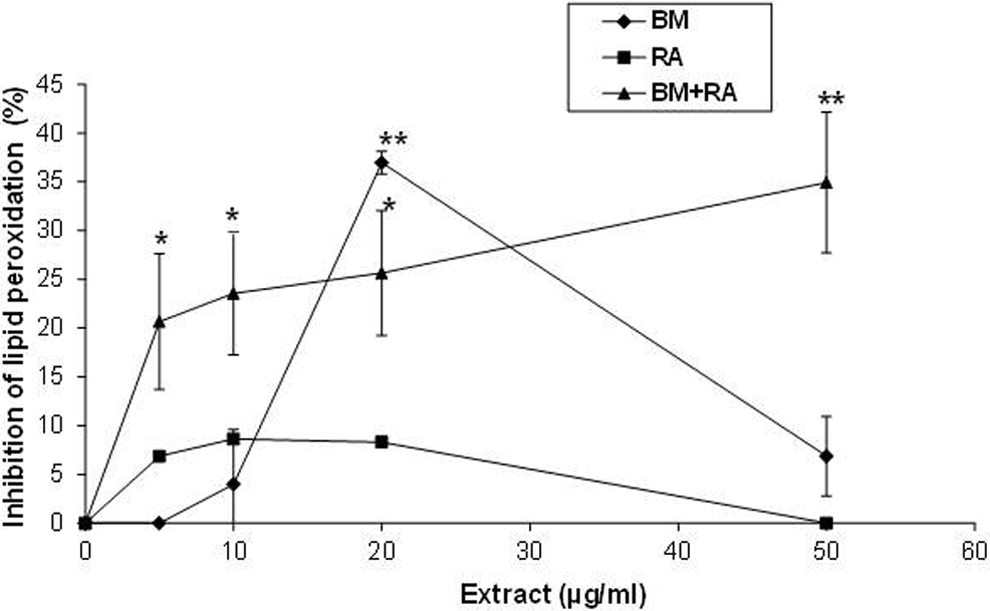
Modulating effect of BM, RA, and BM + RA extracts on inhibition of lipid peroxidation activity of mouse embryonic hypothalamus cell line (EMH) cell line. Antilipid peroxidation activity enhanced with increasing concentrations of extracts, BM + RA combination showing a better profile than single agents (**P < .01 and *P < .05 by 1-way ANOVA with Bonferroni’s multiple comparison test using GraphPad Prism software; the significant difference among identical concentrations of BM, RA, and BM + RA was compared with P values).
Effect on Human Phospho Tau Protein Synthesis
Bacopa monnieri, rosemary antioxidant, and their combination demonstrate inhibition of synthesis of phosphorylated form of tau protein in U-87MG cells (Figure 5). These extracts have reduced the level of tau expression by 50% at the 100 μg/mL concentration. The most notable difference in efficacy between Bacopa monnieri, rosemary antioxidant, and Bacopa monnieri + rosemary antioxidant occurred at a concentration of approximately 50 μg/mL. However, Bacopa monnieri + rosemary antioxidant combination was as effective as single agents with no statistical difference with analysis of variance at each dosage levels,

Inhibition of human phospho tau protein expression by BM, RA, and BM + RA extracts in U-87 MG glial cell line. Cellular proteins from treated cells were analyzed for tau protein expression using Invitrogen ELISA kit.
Effect on Amyloid Precursor Protein Synthesis
In U-87MG glial cells, Bacopa monnieri, rosemary antioxidant, and Bacopa monnieri + rosemary antioxidant combination inhibit the expression of amyloid precursor protein significantly; however, Bacopa monnieri + rosemary antioxidant combination demonstrates the most significant inhibition at concentrations above 20 μg/mL (Figure 6). CompuSyn analysis of amyloid precursor protein expression showed synergism between Bacopa monnieri and rosemary antioxidant with combination index value of 0.30 (Table 1). The drug reduction index values indicated a 4.05-fold dose reduction for Bacopa monnieri and 18.38-fold reduction for rosemary antioxidant in the combination for realizing 90% amyloid precursor protein inhibition.

Inhibition of human amyloid precursor protein expression by BM, RA, and BM + RA extracts in U-87 MG glial cells. BM + RA combination has a better inhibition profile than single agents (**P < .01 by 1-way ANOVA with Bonferroni’s multiple comparison test using GraphPad Prism software; the significant difference among identical concentrations of BM, RA, and BM + RA was compared with P values).
Effect on Brain-Derived Neurotrophic Factor Synthesis
Brain-derived neurotrophic factor is considered as an important molecule involved in central nervous system neuroprotection. Bacopa monnieri, rosemary antioxidant, and Bacopa monnieri + rosemary antioxidant combination all have modulatory effects on the synthesis of brain-derived neurotrophic factor in mouse embryonic hypothalamus cell line (Figure 7), although Bacopa monnieri has the lowest level of activation. Rosemary antioxidant up to 50 μg/mL dose increased the production of brain-derived neurotrophic factor; however, a sharp decrease in the production of brain-derived neurotrophic factor was observed above 50 μg/mL. Bacopa monnieri + rosemary antioxidant combination, on the other hand, demonstrated an increase in the level of brain-derived neurotrophic factor production at all concentrations with the sharpest increase occurring up to 20 μg/mL, but maintaining efficacy at concentrations up to 100 μg/mL unlike the case with rosemary antioxidant. The dose–effect relationship estimates presented in Table 1 indicated an additive effect between Bacopa monnieri and rosemary antioxidant on brain-derived neurotrophic factor synthesis with a combination index value of 1.08 at IC90 level. Furthermore, drug reduction index values indicated a 1.23-fold dose reduction for Bacopa monnieri and 1.80-fold reduction for rosemary antioxidant in the Bacopa monnieri + rosemary antioxidant combination for a 90% increase in brain-derived neurotrophic factor synthesis.

Induction of brain-derived neurotrophic factor (BDNF) protein production by BM, RA, and BM + RA extracts in mouse embryonic hypothalamus cell line (EMH) cell line (***P < .001 and **P < .01 by 1-way ANOVA with Bonferroni’s multiple comparison test using GraphPad Prism software; the significant difference among identical concentrations of BM, RA, and BM + RA was compared with P values).
Cytotoxicity of Bacopa monnieri, Rosemary Antioxidant, and Bacopa monnieri + Rosemary Antioxidant Combination in U-87 MG and Mouse Embryonic Hypothalamus Cell Lines
Bacopa monnieri, rosemary antioxidant, and Bacopa monnieri + rosemary antioxidant combination did not demonstrate cytotoxicity up to the highest concentrations of 200 μg/mL tested in the present study (data not shown).
Discussion
Oxidative stress is recognized as a common factor in many neurodegenerative diseases and is a proposed mechanism for age-related degenerative process as a whole. 1,2 Numerous studies have provided compelling evidence linking neuronal oxidative stress to Parkinson’s disease, Alzheimer’s disease, amyotrophic lateral sclerosis, and multiple sclerosis. Based on the premise that oxidative stress underlies a number of neurodegenerative diseases, there has been considerable research to identify novel antioxidants for potential therapeutic intervention with this spectrum of diseases. 33
Botanicals (whole herbal materials and extracts) are widely used in traditional medicine systems throughout the world. Many have extensive histories of safe use over hundreds or thousands of years. The Indian traditional system of medicine ayurveda, which is more than 5000 years old, has described several herbs and natural products for central nervous system diseases and therapy. 34,35 Ayurveda-based drug discovery represents a promising and comparatively less time consuming approach to traditional combinatorial chemistry and high throughput screening methodologies for identifying drug candidates since many traditional medicines have been used by large populations over many years. Therefore, this experience may serve as a basis for the identification of bioactive compounds and eventually drugs that can then be validated in clinical trials. 36 Brahmi (Bacopa monnieri) has been used by ayurvedic physicians in India for almost 3000 years and is classified as a nootropic herb (Medhya rasayana). It has been mentioned in ancient ayurvedic texts including the Charaka Samhita (6th century AD), where it is described for the management of certain mental conditions including anxiety, cognitive impairment, and lack of concentration. 35,37 –39 Brahmi is also used for its memory enhancing as well as neuroprotective ability and improvement of brain function. However, these claims have not been scientifically proven well to date.
Rosemary (Rosmarinus officinalis) is an evergreen Mediterranean herb known for its antioxidant properties. This herb is widely used as a spice when cooking, especially in Mediterranean dishes. It is also used for its fragrance in soaps and other cosmetics. Traditionally, rosemary has been used medicinally to improve memory, relieve muscle pain and spasm, stimulate hair growth, and support the circulatory and nervous systems. 40,41 It is also believed to increase urine flow and treat indigestion. Almost none of these uses have been scientifically validated in humans. In laboratory investigations, rosemary has been shown to have antioxidant properties. Antioxidants can neutralize free radicals, which damage cell membranes, DNA, and induce apoptosis. The phenolic acids and diterpenes, and the 2 prominent compounds in the leaves of rosemary, rosmarinic acid and carnosic acid, account for its antioxidant effects. 42,43
In the present investigation, Bacopa monnieri and rosemary antioxidant were found to have antioxidant activities; however, Bacopa monnieri + rosemary antioxidant mixture showed a higher level of antioxidant effect than individual agents at every tested concentration in both glial and hypothalamus cell lines. Furthermore, the combination was having an additive effect in U-87MG cell line and very strong synergism in mouse embryonic hypothalamus cell line on the antioxidant activity. Previously several studies have indicated the antioxidant properties of these 2 agents separately. 44 –47 The synergistic effect of 2 herbal products in mixtures has been addressed by investigators and in a few cases proven rigorously. 48,49 Evidence suggests that antioxidant activities are attributed to the polyphenol content. This property is believed to be mainly due to their specific redox properties, which play an important role in (a) absorbing and neutralizing free radicals, (b) quenching singlet and triplet oxygen, and (c) decomposing peroxides. 50,51
Lipid peroxidation is one of the major events that occur during oxidative damage. Plants with antioxidant activities have been reported to possess free radical scavenging potentials. In our studies, Bacopa monnieri appeared to demonstrate a better antilipid peroxidation potential than rosemary antioxidant. However, Bacopa monnieri + rosemary antioxidant mixture has significantly higher antilipid peroxidation activity than either agent alone in both glial and hypothalamus cell lines. Furthermore, the combination was having a very strong synergism on the antilipid peroxidation activity. Dotan et al 52 suggested that oxidative stress cannot be defined in universal terms and the commonly used criteria based on lipid peroxidation could not be regarded as a general estimate of the individual oxidative status. The most common group of indices used to assess oxidative stress is that of peroxidation products of lipids, usually polyunsaturated fatty acids, which are susceptible to attack by free radicals. The products of degradation and decomposition are used in assessing oxidative stress including hyperperoxides by spectrophotometry. This assay, in spite of the problems, being easy, and reproducible, is most widely used for assessing oxidative damage. It is also suggested that studies should employ multiple methods to measure oxidative stress and antioxidant activity while analyzing inhibitors of lipid peroxidation. In the present investigation, we have employed both measurement of antioxidant activity and inhibition of lipid peroxidation activity for analyzing Bacopa monnieri, rosemary antioxidant, and Bacopa monnieri + rosemary antioxidant extracts.
Alzheimer’s disease is a complex progressive condition that involves sequentially interacting pathological cascades, including the interaction of amyloid (Aβ) aggregation with plaque development, and the hyperphorylation and aggregation of tau protein with formation of tangles. More than 5 million people in United States have Alzheimer’s disease, the most common form of age-related dementia. 53 Early symptoms of the disease include memory impairment, disorientation, and executive dysfunction progressing to severe dementia and death. Elevated levels of amyloid precursor protein and phosphorylated form of Tau have been associated with increased risk of developing Alzheimer’s disease. 54 –57 In the present study, both Bacopa monnieri and rosemary antioxidant have downregulated amyloid precursor protein and phospho tau proteins in glial cells, although Bacopa monnieri appeared to be more effective than rosemary antioxidant; however, the combination of Bacopa monnieri + rosemary antioxidant is significantly more superior than single agents for inhibiting amyloid precursor protein synthesis. The combination also has a synergistic effect for inhibiting amyloid precursor protein synthesis.
Brain-derived neurotrophic factor, a secreted protein in humans that acts on certain neurons of the central and the peripheral nervous system, helps support the survival of existing neurons and encourages the growth and differentiation of new neurons and synapses. 58,59 In the brain, it is active in areas vital to learning, memory, and higher thinking. Postmortem analysis has shown lowered levels of brain-derived neurotrophic factor in the brain tissues of people with Alzheimer's disease, although the nature of the connection remains unclear. Studies suggest that neurotrophic factors have a protective role against amyloid beta toxicity. Also a connection between depression and dementia has been suggested to be mediated by brain-derived neurotrophic factor. Bacopa monnieri and rosemary antioxidant treatment of mouse embryonic hypothalamus cell line showed that these agents upregulate the production of brain-derived neurotrophic factor protein, which may provide neuroprotective effects. Bacopa monnieri and rosemary antioxidant have an additive effect on brain-derived neurotrophic factor synthesis with significant reduction in dose levels of Bacopa monnieri and rosemary antioxidant in the combination. The changes in the levels and activities of neurotrophic factors, such as brain-derived neurotrophic factor, have been described in a number of brain-derived neurodegenerative diseases including Huntington disease, Alzheimer’s disease, and Parkinson disease. 60 It is the most widely distributed trophic factor in the brain. A substantial amount of evidence describes the role of brain-derived neurotrophic factor for the development, regeneration, survival, and maintenance of neurons in the brain as well as use-dependent plasticity mechanisms such as long-term potentiation and learning. 61,62 Experimental strategies aimed at increasing brain-derived neurotrophic factor levels in the brains of animals that have been genetically altered to mimic neurodegenerative diseases are being used for therapeutic development. Since Bacopa monnieri + rosemary antioxidant preparation was able to increase the levels of brain-derived neurotrophic factor in the brain cells in the present investigation, its therapeutic use can be explored further for neurodegenerative diseases.
The neuroprotective properties exhibited by Bacopa monnieri, rosemary antioxidant, and Bacopa monnieri + rosemary antioxidant in the in vitro models suggest potential for further development of biologically based adjuvant therapeutics for neurodegenerative diseases. However, a more precise identification of the bioactive metabolites in these extracts and their mechanisms of action in both in vitro and in vivo studies are required to achieve this goal and will be the subject of future research.
Footnotes
Author Contributions
CR and SJM were responsible for study design, experimentation, and article preparation. K-WQ formulated and prepared supercritical extracts of brahmi and rosemary for the investigation and performed chemical analysis. All authors have read and approved the article.
Declaration of Conflicting Interests
The authors declared the following potential conflicts of interest with respect to the research, authorship, and/or publication of this article: Dr Steven J. Melnick is the founder of Dharma Biomedical LLC, which is an evidence-based ethnobotanical and evochemical drug discovery company operating on for-profit basis. Dr Karl-Werner Quirin is the Chief Executive Officer of Flavex Naturextrakte GmbH, a company producing specialty botanical extracts for cosmetics and food supplements on the basis of supercritical CO2 extraction. Dr Cheppail Ramachandran is an employee of Dharma Biomedical LLC, working as Chief Science Officer.
Funding
The authors received no financial support for the research, authorship, and/or publication of this article.
Ethical Approval
This in vitro investigation did not involve any human subjects or live animals. Therefore, Institutional Review Board and Institutional Animal Care and Use Committee approvals were not required.