




Abstract
This study compared expert yoga practitioners (n = 18) with a metabolically matched group (n = 17) and a group with comparatively higher cardiovascular fitness (n = 19) to investigate autonomic effects of yoga compared with physical exercise. Mean interbeat interval (in milliseconds) and heart rate variability were recorded in response to physical and mental challenges. Results showed that yoga males had different patterns of autonomic responding to speech task compared with all other participants. Yoga males showed a larger increase in mean interbeat interval and a corresponding decrease in heart rate variability in response to the speech task, followed by a larger decrease in mean interbeat interval and a corresponding increase in heart rate variability during speech recovery. This was interpreted as evidence of situation-appropriate autonomic regulation and suggests long-term yoga practice could be particularly beneficial for males in terms of autonomic flexibility.
Introduction
The practice of yoga has become increasingly popular throughout the Western world as a means of reducing the harmful physical and psychological effects of chronic stress. Understanding its effects compared to physical exercise has proved difficult, however, partly because of inadequate metabolic comparisons or control groups. 1 In addition, an absence of a standardized operationalization of the term yoga—with huge variations existing in both the style and intensity in which the traditional sequence of yoga postures is practiced—has made meaningful interpretation of studies difficult. As a consequence, the mechanisms by which the practice may benefit health are not yet clear.
A recent review comparing yoga and exercise 2 indicated that yoga is as effective as, or better than, exercise at improving a number of health-related outcome measures, including heart rate variability. 3 Heart rate variability is quantified by measurement of the interval between one heart beat and the next and is commonly used to provide insight into the functioning of the parasympathetic (vagal) and sympathetic outputs of the autonomic nervous system. 4 High variability between heartbeats suggests healthy autonomic adaption to environmental demands and is associated with better cognitive, emotional, attentional, and autonomic regulatory ability. 5 Alternatively, low heart rate variability, in particular when the sympathetic branch dominates for long periods of the time, suggests poor regulatory capacity. 6,7 For example, low heart rate variability has been associated with immune dysfunction and inflammation, which are, in turn, implicated in a wide range of pathological conditions such as cardiovascular disease, diabetes, arthritis, and certain cancers. 5 Measurement of heart rate variability also provides a window into the bidirectional influences that link frontal lobes with modulation of cardiovascular function. 8 Referred to as “top-down” influences, these are brain pathways through which higher cortical structures influence autonomic function, interacting with “bottom-up” processes involving the transfer of information between the heart and lower cortical centers.
Many of the physical and mental health outcomes of yoga have been found to be associated with improved autonomic nervous system flexibility as a result of enhanced autonomic nervous system processes. 9 For example, Shapiro et al 10 found reduced sympathetic nervous system activation in depressed patients following 8 weeks of yoga, together with a corresponding improvement in mood, suggesting an influence of the practice on top-down processes. In terms of improvements in physiological, or bottom-up processes, a review of studies into insulin resistance–related factors for cardiovascular disease found that yoga affected a shift in autonomic nervous system balance from primarily sympathetic to parasympathetic dominance. 11 As such, heart rate variability may be a means of capturing the effects of regular yoga practice on autonomic responses via both top-down and bottom-up pathways. 1
The current study employed measurement of heart rate variability to compare long-term yoga practitioners with participants of comparable physical fitness in order to test for differences in autonomic nervous system responding to environmental stress above that of physical fitness levels. Mean interbeat interval (representing the average time between successive “R” spikes in the electrocardiogram recording, in milliseconds) was also recorded (see Figure 1). It was hypothesized that differences in mean interbeat interval and heart rate variability between groups of comparable fitness could then be attributed to a specific effect of yoga.

A diagrammatic representation of the interbeat interval in an electrocardiogram signal. The mean interbeat interval (the average time between successive “R” spikes in the electrocardiogram recording, in milliseconds) corresponds to heart rate.
A third, comparably fitter, group was included to compare the autonomic benefits of higher cardiovascular fitness. The study comprised a psychological stressor, designed to test top-down responses, and a standard orthostatic (standing) challenge, designed to test physiological (bottom-up) responding.
Method
A total of 54 people were recruited, comprising 18 yoga practitioners, 19 participants in the fit group, and 17 participants in the less fit group (“not-so-fit”). To be eligible for inclusion in the study, yoga participants were practicing for a minimum of 3 days a week for at least the previous 3 years, for a minimum of 30 minutes a day. The yoga group was recruited from 2 main yoga academies in Auckland, New Zealand. The majority of the yoga sample (88.8%) practiced the astanga style of flowing yoga, a more vigorous form of yoga that uses breath control techniques to flow from one posture to the next in a sequence of prescribed postures.
The physically fit participants were those who performed some form of aerobic exercise 3 or more days a week, for at least 30 minutes a day, over the previous year. Participants in the not-so-fit category were those who had performed low to modest levels of aerobic activity in the previous year.
Subjects were fitted with 3 electrodes forming a triangular pattern across the heart, enabling continuous recording of heart rate data using Mindware Ltd equipment (Mindware Biolab 3.0.2). A sampling rate of 1000 Hz was selected, as per Taskforce guidelines. 4 Time and frequency domain heart rate variability data were analyzed using KUBIOS HRV Pro version 2.0 software. 12 Participants were block randomized to task sequence (see Figure 2).
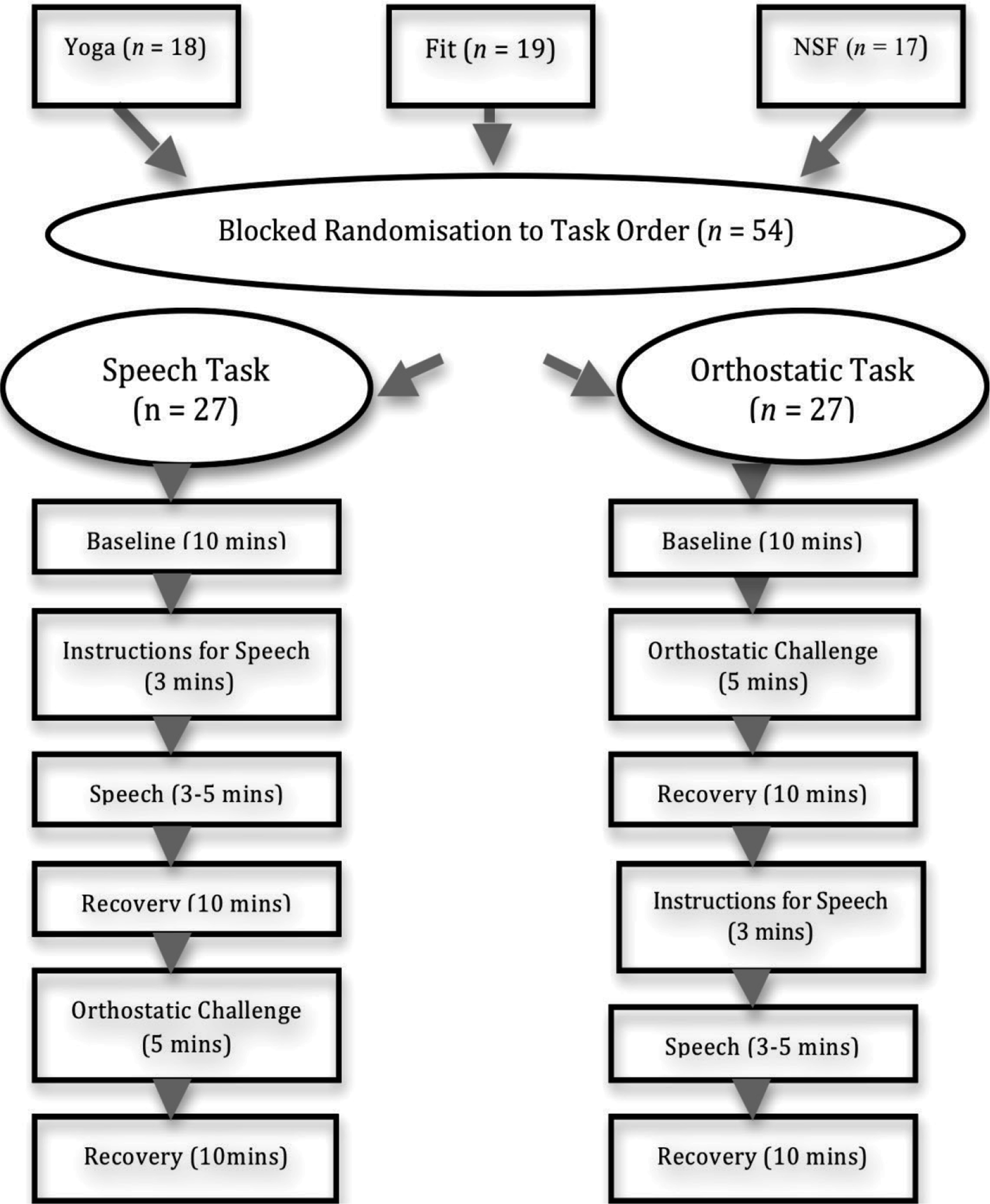
A diagrammatic representation of the block randomized study design.
For ease of explanation, this study reports mean interbeat interval (refer Figure 1) and pNN50 (the proportion of interbeat intervals with a difference in milliseconds of more than 50%), reflecting heart rate variability. The decision to report pNN50 was based on variables in both time and frequency domains being positively correlated across measures. PNN50 scores, therefore, represented an overall trend that emerged across all measures of heart rate variability. Respiration rates were calculated by transforming the peak of the high frequency taken from KUBIOS (high-frequency [hertz] autoregressive spectrum) according to processes outlined by Thayer et al. 13 The protocol lasted approximately 50 minutes. Mood data were collected at baseline and over tasks; however, these results will be addressed in subsequent papers.
Results
Baseline Characteristics
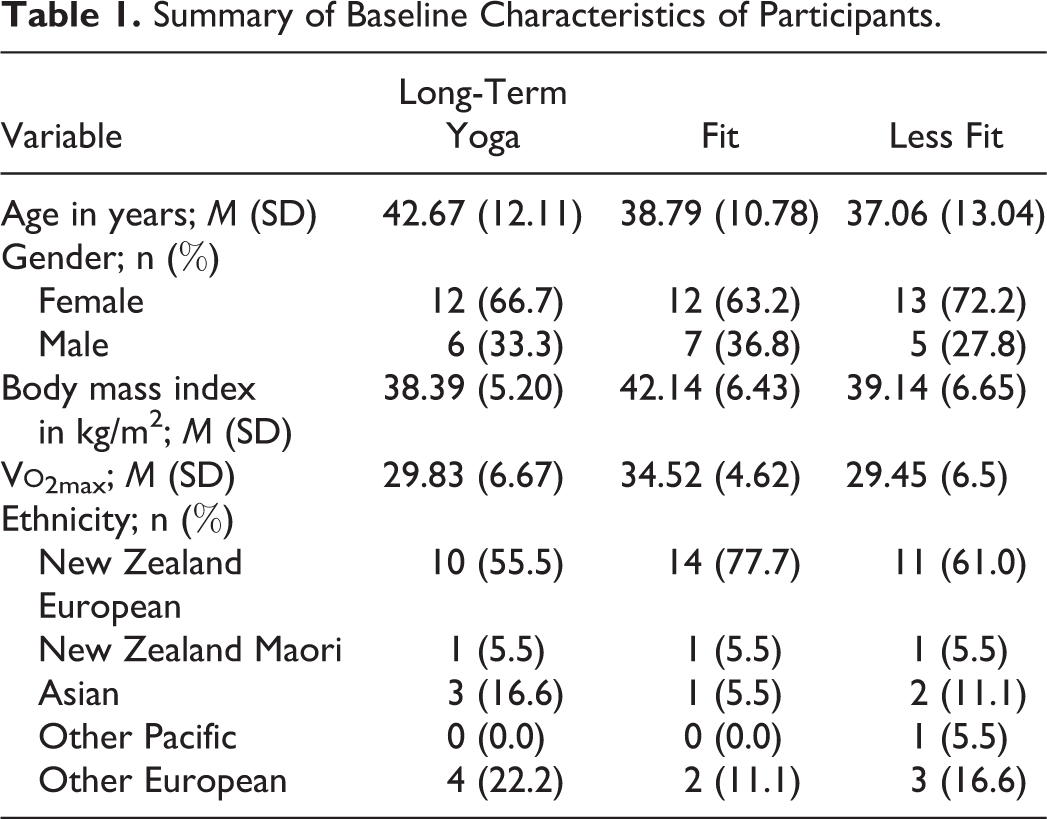
Although the sample was predominantly female (68.5%), there were no differences between groups in gender, ethnicity, age, or body mass index (see Table 1).
Summary of Baseline Characteristics of Participants
There was a difference in mean interbeat interval at baseline between groups, F(2, 52) = 6.99, P < .05. As was expected, the fit group (M = 928.435, SE = 89.23) had higher mean interbeat interval (ie, lower heart rate) at baseline than both the yoga group (M = 840.50, SE = 132.46) and the not-so-fit group (M = 803.40, SE = 86.95). There were no differences in mean interbeat interval at baseline between not-so-fit and yoga groups. There were no between-group differences in measures of heart rate variability at baseline. There were no differences between yoga males and yoga females in age, body mass index, ethnicity, or yoga style. There were no differences in number of years of practice, number of weekly practices, or average length of practice (see Table 2).
Characteristics of Yoga Group

There was a difference in estimated V
Mean Interbeat Interval
Results showed a main effect of task on mean interbeat interval, F(2.82, 132.73) = 65.38, P < .001,
Summary of Statistics for Autonomic Variables Across Tasks

Note: a, different to base; b, different to prespeech; c, different to speech; d, different to speech recovery; e, different to stand; f, different to stand recovery. *P < .05, **P < .001.
Summary of Statistics for Mean Interbeat Interval for Main Effect of Group and Gender
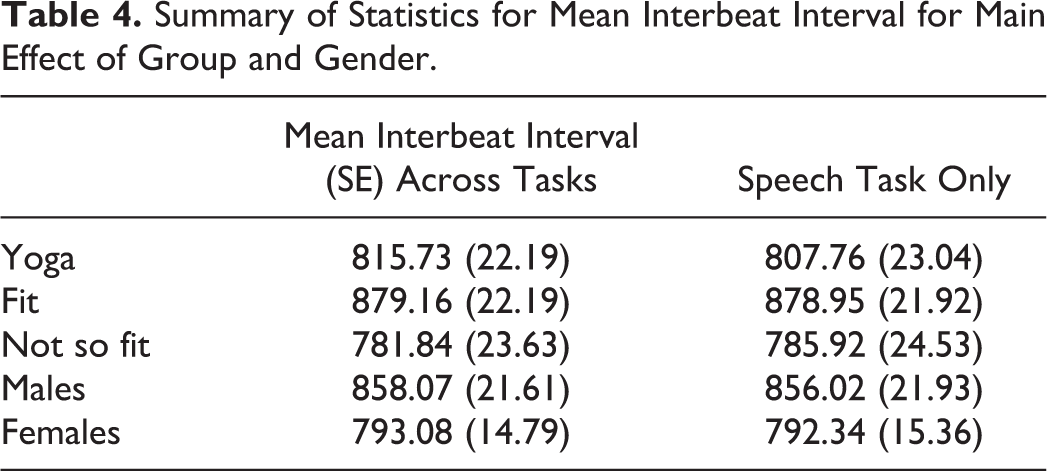
For the speech task alone, there was a main effect of task on mean interbeat interval, F(2.28, 109.66) = 70.17, P < .001,
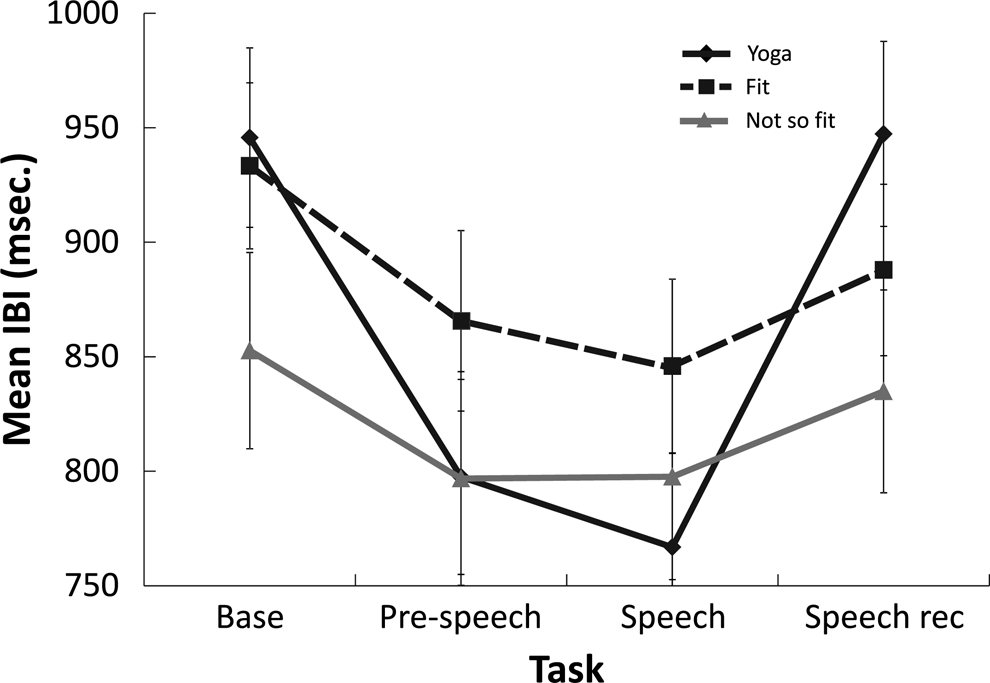
The 3-way gender × group × task interaction (speech only) for males showing means and standard errors (IBI = interbeat interval).
On the other hand, females in all 3 groups responded in a similar pattern to the speech task (see Figure 4).

The 3-way gender × group × task interaction (speech only) for females showing means and standard errors (IBI = interbeat interval).
Specific polynomial contrasts confirmed yoga males were different to both fit and not-so-fit males overall, evidenced in a significant quadratic pattern of response and recovery to the speech task, F(1, 15) = 14.08, P < .001. Further polynomial contrasts showed a between-group difference from baseline to instructions for speech, with yoga males showing a larger decrease in mean interbeat interval compared with both fit and not-so-fit males, F(1, 15) = 5.12, P < .05. Yoga males also showed a greater recovery in heart rate during speech recovery, compared with both other groups of males, F(1, 15) = 20.53, p < .001.
Heart Rate Variability
The different pattern of responding exhibited by yoga males was also reflected in analysis of heart rate variability. There was a main effect of task on heart rate variability, F(3.36, 157.99) = 13.34, P < .001,
Analysis of heart rate variability for the speech task alone showed a 3-way interaction of speech × group × gender. Whereas females in all 3 groups show a similar pattern of response to the task, yoga males were different from males in both fit and not-so-fit groups (see Figure 5).

The 3-way gender × group × task interaction (speech only) for males showing means and standard errors (Heart Rate Variability).
Discussion
The primary goal of this research was to examine the influence of yoga on autonomic nervous system regulation, with the suggestion being that this may be a result of improved integration of top-down and bottom-up processes. One hypothesis was that yoga’s emphasis on mindful attention would result in increased autonomic reactivity to psychological stress compared with other groups as a result of yogis’ practice of concentrated engagement in the present moment. This would then be followed by faster recovery as a result of a greater ability to disengage once the stressor had concluded. Alternatively, yoga’s effects may mean reduced autonomic reactivity as a result of downregulation of hypothalamic–pituitary–adrenal axis and sympathetic nervous system responses. Early suggestions of this influence can be seen in studies associating yoga with improved mood, improved concentration and reduced perceived stress. 2 All 3 groups were expected to respond to the physical standing task in the standard way, with the predicted pattern being an immediate vagal withdrawal and increase in heart rate on standing, followed by vagal recovery and decreased heart rate to baseline during recovery.
The key finding of this research was that yoga males demonstrated a different pattern of autonomic responding compared with the other groups, including yoga females. This effect was most evident in the speech task. Yoga males demonstrated increased reactivity and corresponding recovery compared with all other participants, quantified in situationally appropriate heart rate and heart rate variability changes. 17 These findings could be interpreted as providing support for the benefits of yoga in improving the integration of top-down and bottom-up processes, at least in males. While it is acknowledged that the number of yoga men was relatively small (n = 6), males were equally represented as a proportion of each group.
Why did yoga males, but not females, show a more definitive pattern of autonomic responding to the speech task? First, it is possible that the yoga males in this study are somehow different from more “typical” males in terms of having both the personality and the discipline to commit to a demanding yoga-training regime over a number of years. It is speculated that there may be personality variables mediating the effects seen in yoga males, although these were not investigated as part of this study. Second, it is speculated that yoga practice may have different neurochemical effects in males. Emerging evidence suggests that moderately stressful tasks, such as the speech stressor used in this protocol, may result in amygdala-mediated differences between males and females (or dimorphisms), as a consequence of gender differences in levels of neurochemicals. 18 Neurochemicals such as vasopression in males (involved in anxiety, stress and aggression, including “fight-or-flight” behaviors) and oxytocin in females (involved in bonding and “tend-and-befriend” behaviors) modulate projections to the amygdala, which, in turn, influences autonomic function. It is speculated that these differences in levels of neurochemicals may differentially affect neurochemically mediated autonomic nervous system function. Early evidence of neurochemical changes following yoga has previously been noted, for example, in levels of cortisol 19 and 8-hydroxy-deoxyguanosine, a biomarker of generalized, cellular oxidative stress. 20 Although these previous studies involved single (female) gender participants and cannot therefore be generalized to males, they are suggestive of an interesting effect in terms of neurochemical changes. It is suggested that the effects of regular, noncompetitive, meditative practice on neurochemically mediated autonomic responses to stress may be more profound in males, who are perhaps less flexible overall, naturally tending to exhibit more aggressive behaviors as part of an adaptive, self-preservatory mechanism. 21 The suggestion of reduced autonomic regulatory flexibility in men is already well supported in the literature 3 and has been proposed as one reason why the onset of cardiovascular mortality and morbidity is typically 10 to 20 years earlier in males than females. 22
Conclusion
Contrary to models that associate autonomic hyperreactivity and lability with pathology, a “neurovisceral integration model” highlights the importance and desirability of physiologic variability in maintaining health and stability of the organism. 5 Rather than pathologizing systemic lability, therefore, optimal functioning may be achieved by variability in autonomic processes, thus allowing flexible regulation and maximal efficiency of energy expenditure. It is speculated that the more extreme responding of yoga males seen in this study points to more flexibility in top-down integration compared with the other 2 groups, with yoga males more able to “let go” of the stressful experience after initially allowing themselves full engagement with the emotion of the task.
This study invites further research into yoga’s differing effects on the male regulatory system compared with females. This gender effect has previously been seen in the study by Sloan et al, 23 with these researchers showing an effect of aerobic exercise in males but not in females. It is further suggested that practices that cultivate mindful attention, thus enabling appropriate engagement and autonomic responses, may be health protective, assisting males to respond more efficiently to the daily stressors of life.
It remains possible that it is the physical exercise benefits of yoga that explain the feelings of improved well-being, better mood and reduced anxiety reported by practitioners, with physical exercise in itself being linked to neurophysiological changes, including heightened endorphin release and increases in mood-enhancing neurotransmitters, such as dopamine and serotonin. 1
Overall, however, research in the field of yoga remains challenging largely because of the lack of standardization of both the method of yoga practiced and the teaching style for those who practice yoga in a class, meaning replicability and reliability of studies is challenging. The very nature of yoga as a practice (with its key components of meditation, breathing, asana) makes it a private, subjective, and dynamic experience.
Ultimately, through improving top-down, bottom-up integration, it may be that yoga cultivates an ability to be mindfully engaged in the world, responding appropriately to environmental cues, with an enhanced ability to then “switch off” the stress response. One consequence could be to protect health through reducing wear and tear on physiological systems.
Future Directions
The decision to assess fitness based on an estimate of V
Footnotes
Author Contributions
This study was undertaken by AF as part of a master’s thesis, in partial fulfillment of the requirements of an MSc (Health Psychology) degree, under the supervision of JJS. This article was prepared for publication by AF, with grateful thanks to JJS for his support and guidance.
Declaration of Conflicting Interests
The authors declared no potential conflicts of interest with respect to the research, authorship, and/or publication of this article.
Funding
The authors received no financial support for the research, authorship, and/or publication of this article.
Ethical Approval
This study collected data under standardized conditions at the University of Auckland’s psychophysiology laboratory in the Department of Psychological Medicine. Ethics approval was granted by the University of Auckland Human Participants’ Ethics Committee on February 25, 2011, for a period of 3 years (reference number 2011/039).