




Abstract
According to the principles of Siddha system of medicine, the following polyherbal preparation consisting of 5 plant parts in equal ratio namely, Asparagus racemosus, Emblica officinalis, Salacia oblonga, Syzygium aromaticum, and Tinospora cordifolia was formulated to treat experimental type 2 diabetic rats. So, using plants having aphrodisiac property in the formulation is a rational approach and first of its kind, as there have been no reports so far. Phenolics and other bioactive compounds present in polyherbal preparation may be responsible for lipid-lowering effects and strong antioxidant activity. Polyherbal preparation treatment reverted the activities of glycolytic and gluconeogenic enzymes that are disturbed in diabetic rats. It is concluded that polyherbal preparation treatment improves deranged lipid profile, antioxidant status, glycogen content, and decreases lipid peroxidation, which provides stability to membrane integrity and thus favors insulin receptor to achieve better glucose tolerance through a holistic approach.
Introduction
The Siddha system of medicine was framed from the results of the devoted pursuit of Siddhars, who are saints, doctors, alchemists, and mysticists all at once. Literature works of Siddhars reveal that Siddha medicine was laid on strong fundamentals. Siddha science strongly believes that what exists in the microcosm is in the macrocosm; in which man is the microcosm and Universe, the macrocosm. Cosmogenesis symbolizes that there are 5 principal elements in nature, namely, earth, water, fire, wind, and ether. They are the origin of all corporeal things, which then die out, resolving themselves again into these elements. It is clearly laid down by Siddhars that there is a very close and intimate relationship between the external world and internal man. Six tastes (sweet, sour, pungent, bitter, salty, and astringent) are formed with the selective unification of these 5 elements. Siddha science defines clearly that 3 cardinal humors-Wind, Bile, and Phlegm (called Vali, Azahal, Aiyyam in Siddha medicine) are responsible for a person’s mental and physical qualities and dispositions. Treatment is aimed at the restoration of equilibrium among 3 humors with the help of 6 tastes. The essence of this is simply stated as “Food is medicine; medicine is food.” This phrase infers that what we eat is medicine for our body; the same food is responsible for our illness too.
Our food is composed of 6 tastes, which are also made up of 5 elements namely, sweet (earth and water), sour (water and fire), pungent (air and fire), bitter (air and sky), salt (earth and fire), and astringent (earth and air). 1 Siddhars have framed certain basic guidelines regarding which food to consume and which food to avoid while consuming Siddha medicine. So, food and environment (season) play a major role in maintaining the equilibrium of our body.
Over thousands of years, Siddha system of medicine has developed various practical theories to create polyherbal formulations in which multiple agents contained in one formula act synergistically. 2 Food stuffs possess 2 major functions. The primary function is nutritional feature (life support) and the secondary function is gustational feature (taste, flavor, and texture). A recent report suggested that antioxidant potency is the tertiary function of food. 3
In Siddha system of medicine, diabetes (Neerizhivu) is portrayed as Aiyyam (symbolizes earth and water) humor derangement disease that can be neutralized by Vali (represents air and space) humor predominant drugs. To nullify the detrimental effects of diabetes, the proposed drug should possess either bitter or pungent or astringent taste, which will retract the deranged Aiyyam humor, because of its predominant Vali humor. So, the proposed polyherbal preparation was selected from the list of known potent plants with antioxidant, immunomodulator, and aphrodisiac activity that have predominant Vali humor to treat diabetes as a novel strategic option. The polyherbal preparation containing Emblica officinalis ribes, Salacia oblonga—stem and root (both having astringent taste), Syzygium aromaticum buds (pungent), Tinospora cordifolia—stem and root (bitter), Asparagus racemosus spears/tubers (aphrodisiac property) was formulated to treat type 2 diabetic rats more tactically. All these ingredients do not have any toxicity because these are all added in regular cuisines being consumed globally. Asparagus edible spears are present in local diets of Eastern countries. 4 Salacia roots have been extensively consumed in Japan, the United States, and other countries as a food supplement for the prevention of obesity and diabetes. 5 Emblica and clove are integral part of cuisine for many centuries. 6 Tinospora is an important ingredient in every immune modulator preparations in Siddha and Ayurveda since ancient times. A racemosus Willd. (Asparagaceae) is an important medicinal plant indigenous to South Asian countries and its medicinal uses have been reported in the Indian and British Pharmacopoeias and also in Indian traditional systems of medicine such as Siddha, Ayurveda, and Unani. 7 Pharmacological studies with animals have manifested the potency of A racemosus extract as an antioxidant, 8 adaptogen, 9 and with the strongest focus being on its ability in modulating the immune system. 10,11 Emblica fruit has many pharmacological activities for the treatment of a number of diseases and is a constituent of many hepatoprotective formulations 12 ; it possesses antidiabetic activity 13 and shows presence of tannins, lignans, flavonoids, and alkaloids. 14 S oblonga, which has been traditionally used in Siddha medicine is effective for the prevention and treatment of diabetes 15 and possesses α-glucosidase inhibitors such as salacinol 16,17 and kotakanol. 18 Cloves are the dried flower buds of S aromaticum (L.) Merr. & Perry—a tree of the myrtle family (Myrtaceae). Phytochemical studies indicate that the clove contains free eugenol, eugenol acetate, caryophyllene, sesquetrepene ester, phenyl propanoid, 19 and β-caryophyllene. 20 Oil from clove reportedly modulated physiological responses in streptozotocin-induced diabetic rats. 21 Food seasoning spice mixtures containing clove have shown to improve glucose metabolism and lipid profile in fructose fed hyper-insulinemic male Wistar rats. 22 T cordifolia Miers (Menispermaceae) has been known to promote longevity and increase the body’s resistance against various diseases. 23 It has also been extensively reported as a general tonic, hepatoprotective, and antidiabetic agent. 24 Oral administration of either alcoholic or aqueous extract of Tinospora is reported to have hypoglycemic activity in different animal models. 25 As low testosterone level is commonly associated with diabetes, 26 a herb with aphrodisiac property was chosen in the formulation. This is a rational approach and first of its kind.
It is hypothesized that polyherbal preparation may improve glucose tolerance by modulating hormonal levels, lipid profile, liver function, free radical generation and antioxidant, glycolytic, and gluconeogenic enzymes activities in skeletal muscle and liver of type 2 diabetic male rats.
Materials and Methods
Preparation of Polyherbal Preparation
All the 5 plant parts were purchased from the local market, cleaned, dried in shade for a week. They were then powdered by pulverizer separately, sieved, and mixed in equal quantities. These plant parts were identified by Dr D. Aravindan, an Asst Prof, Department of Medicinal Botany, National Institute of Siddha, Chennai, India and specimen samples were deposited at the department.
Chemicals
All fine chemicals, including streptozotocin, were purchased from Sigma Aldrich (St. Louis, MO, USA) and SRL (Mumbai, India). All other chemicals used were of good quality and analytical grade and obtained from SRL (Mumbai, India). Biochemical kits used in the present study were purchased from Spinreact (Girona, Spain).
Induction of Type 2 Diabetes
Rats were made diabetic (type 2) by a single intraperitoneal injection of streptozotocin (35 mg/kg body weight) after 30 days of high-fat diet containing cholesterol 2 g, cholic acid 1 g, coconut oil 30 mL, standard rat feed 100 g, and 25% fructose feeding through drinking water 27 and were continued till the end of the study (30 days). The low dose of streptozotocin was given to generate a slight trauma to beta cells of pancreas to mimic the condition of chronic hypoinsulinemic insulin resistance condition.
Experimental Design
Rats were divided into the following groups: Group 1: Control. Group 2: Rats were made diabetic (type 2) by a single intraperitoneal injection of streptozotocin (35 mg/kg body weight) after 30 days of high-fat diet and high fructose feeding through drinking water (25%). Group 3: Diabetic (type 2) rats were treated with polyherbal preparation (500 mg/kg body weight) twice a day (8.00 Group 4: Diabetic (type 2) rats were treated with metformin (50 mg/kg bodyweight per day) for 30 days after 5 days of streptozotocin treatment Group 5: Control rats were treated with polyherbal preparation (500 mg/kg body weight) twice a day (8.00
At the end of the 30-day treatment, animals were anesthetized with sodium thiopentone (40 mg/kg body weight), blood was collected through cardiac puncture, sera were separated and stored at −80°C until the assay of hormones, and 20 mL of isotonic sodium chloride solution was perfused through the left ventricle to clear blood from the organs. Liver and gastrocnemius muscle were excised and used for the assay of various parameters. Tissues were minced and homogenized (10% w/v) with 0.1 M Tris–HCl buffer (pH 7.4) in ice-cold condition. The homogenates were centrifuged at 1000 × g for 10 minutes and then the supernatants were separated and used for the assay of various parameters.
Oral Glucose Tolerance Test and Plasma Glucose
Rats of all groups were subjected to oral glucose tolerance test 2 days prior to killing. All animals were fasted overnight and the following morning, they were subjected to oral glucose tolerance test by giving an oral dose of glucose (1 mL/100 g body weight, 50% w/v glucose solution) after collecting blood by puncturing the orbital sinus with the help of heparinized microhematocrit capillary tubes for estimating fasting blood glucose and insulin. Blood samples were collected subsequently at 60, 120, and 180 minutes and centrifuged for 10 minutes at 800 × g at 4°C within 30 minutes to prevent autoglycolysis by leukocytes. Plasma glucose was estimated by glucose oxidase–peroxidase method (CPC Diagnostics, Spain). Results are expressed as mg/dL.
Radioimmunoassay of Insulin and Testosterone
Serum insulin was assayed using 125I-labeled radioimmunoassay kit obtained from DiaSorin (Saluggia, Italy). The limit of detection is 3.0 μIU/mL. The percentage cross-reactivity of insulin antibody to rat insulin was 100% and to C-peptide was <0.01%. Intra-assay coefficient of variation was <10.6% and inter-assay coefficient of variation was <10.8%. Results are expressed as μIU/mL.
Serum testosterone was assayed using liquid-phase radioimmunoassay kit obtained from DiaSorin. The limit of detection is 0.02 ng/mL. Cross-reactivity of testosterone antiserum to other steroids such as 5-α-dihydrotestosterone and androstenedione is 6.9% and 1.1%, respectively. Intra-assay coefficient of variation was <8% and inter-assay coefficient of variation was <7.6%. Results are expressed as ng/mL.
Liver Function Test and Lipid Profile
The activities of serum aspartate aminotransferase, alanine aminotransferase, alkaline phosphatase, bilirubin (total and direct), total cholesterol, triglycerides, low-density lipoprotein cholesterol, high-density lipoprotein cholesterol, urea, and creatinine were estimated using commercially available kits according to manufacturer’s instructions.
Determination of Lipid Peroxidation and Reactive Oxygen Species Generation
Lipid peroxidation was measured by the previously published method. 28 The malondialdehyde content of the sample is expressed as nanomoles of malondialdehyde formed/min/mg protein. Hydrogen peroxide generation was assessed by the spectrophotometric method. 29 The hydrogen peroxide content of the sample is expressed as μmol/min/mg protein. Hydroxyl radical (OH*) production was quantified 30 and expressed as μmol/min/mg protein.
Determination of Antioxidant Enzymes
The activities of superoxide dismutase, 31 catalase, 32 glutathione peroxidise, 33 glutathione-S-transferase, 34 glutathione reductase, 35 and reduced glutathione 36 were assayed by previously published method. Protein was estimated by the method of Lowry et al. 37
Estimation of Glycolytic, Gluconeogenic Enzyme, and Glucose-6-Phosphate Dehydrogenase
Hexokinase was assayed 38 by determining the rate of disappearance of glucose at 37°C in a reaction mixture. Hexokinase activity is expressed as nanomoles of glucose-6-phosphate liberated/min/mg protein. Aldolase was estimated 39 and its activity is expressed as nanomoles of glyceraldehyde liberated/min/mg protein. Glucose-6-phosphatase was assayed 40 and its activity is expressed as nanomoles of inorganic phosphorus liberated/min/mg protein. Glucose-6-phosphate dehydrogenase was assayed 41 and its activity is expressed as units/mg protein.
Estimation of Markers of Kidney Function, Calcium, Lactate Dehydrogenase, and γ-Glutamyl Transpeptidase
Urea, creatinine, calcium, lactate dehydrogenase, and γ-glutamyl transpeptidase were estimated according to the manufacturer’s instructions using biochemical kits from Spinreact, Spain.
Estimation of Glycogen Content
Glycogen was estimated by the method of Hassid and Abraham. 42 The amount of glycogen is expressed as mg/g wet tissue.
Statistical Analysis
Data were subjected to statistical analysis using one-way analysis of variance and Duncan’s multiple range test to assess the significance of individual variations between the control and treatment groups using a computer based software (SPSS 7.5 for Windows student version) and expressed as mean ± standard error of the mean. In Duncan’s test, the significance was considered at the level of P < .05.
Results
Fasting Blood Glucose and Oral Glucose Tolerance Test
The fasting blood glucose level was elevated substantially (Figure 1A) in diabetic group and it was significantly decreased when treated with polyherbal preparation. In metformin-treated group also blood glucose level was partially ablated. From the results of oral glucose tolerance test (Figure 1B), it is evident that treatment with polyherbal preparation significantly reduced hyperglycemic excursions than metformin and showed improved tolerance to glucose at all time points.

(A) Effect of polyherbal preparation (PHP) on fasting blood glucose of type 2 diabetic adult male rats. Each bar represents mean ± standard error of the mean (SEM) of 6 animals. Significance at P < .05; (1) compared with control; (a) compared with control; (b) compared with diabetes control; (c) compared with diabetes + polyherbal preparation; (d) compared with diabetes + metformin. (B) Effect of polyherbal preparation on oral glucose tolerance of type 2 diabetic adult male rats. After overnight fasting, blood glucose was checked prior to subjecting the animals to an oral dose of glucose (5 g/kg body weight). Blood samples were collected subsequently at 60, 120, and 180 minutes and centrifuged to obtain plasma. Plasma glucose was estimated by glucose oxidase–peroxidase method. Each value represents mean ± SEM of 6 animals. Significance at P < .05
Effects of Polyherbal Preparation on Serum Insulin and Testosterone
In the diabetic rats, insulin and testosterone levels were decreased. Administration of polyherbal preparation significantly augmented the serum insulin and testosterone levels when compared with type 2 diabetic rats (Figure 2A and B).

(A) Effect of polyherbal preparation on serum insulin level of type 2 diabetic adult male rats. Each bar represents mean ± standard error of the mean (SEM) of 6 animals. Significance at P < .05; (a) compared with control; (b) compared with diabetes control; (c) compared with diabetes + polyherbal preparation (PHP); (d) compared with diabetes + metformin. (B) Effect of polyherbal preparation on serum testosterone level of type 2 diabetic adult male rats. Each bar represents mean ± SEM of 6 animals. Significance at P < .05: (a) compared with control; (b) compared with diabetes control; (c) compared with diabetes + polyherbal preparation; (d) compared with diabetes + metformin
Effect of Polyherbal Preparation on Liver Function Markers and Lipid Profile
Diabetic rats showed a significant increase in the levels of serum aspartate aminotransferase, alanine aminotransferase, alkaline phosphatase, bilirubin, cholesterol, triglycerides, and low-density lipoprotein cholesterol and showed a significant decrease in high-density lipoprotein cholesterol level, whereas polyherbal preparation treatment reversed the same effectively (Tables 1 and 2).
Effect of Polyherbal Preparation on Liver Function Test of Type 2 Diabetic Male Rats *

*Each group represents mean ± standard error of the mean of 6 animals. Significance at P < .05: acompared with control, bcompared with diabetes control, ccompared with diabetes + polyherbal preparation, dcompared with diabetes + metformin.
Effect of Polyherbal Preparation on Lipid Profile of Type 2 Diabetic Male Rats *

*Each group represents mean ± standard error of the mean of 6 animals. Significance at P < .05: acompared with control, bcompared with diabetes control, ccompared with diabetes + polyherbal preparation, dcompared with diabetes + metformin.
Effects of Polyherbal Preparation on Lipid Peroxidation and Reactive Oxygen Species in the Liver and Gastrocnemius Muscle of Type 2 Diabetic Rat
Free radicals and lipid peroxidation in the liver and gastrocnemius muscle were found to be significantly elevated in diabetic rats when compared with control rats. Treatment with polyherbal preparation and metformin proved to be beneficial in reducing the free radical production and lipid peroxidation in the tissues studied (Table 3).
Effect of Polyherbal Preparation on Lipid Peroxidation and Free Radical Generation in Type 2 Diabetic Male Rats *

*Each group represents mean ± standard error of the mean of 6 animals. Significance at P < .05: acompared with control, bcompared with diabetes control, ccompared with diabetes + polyherbal preparation, dcompared with diabetes + metformin.
Effects of Polyherbal Preparation on Antioxidant, Glycolytic, and Gluconeogenic Enzyme Activities
Decreased levels of antioxidants were observed in liver and gastrocnemius muscle of type 2 diabetic rats. These derangements were restored significantly towards near normal level in polyherbal preparation– and metformin-treated diabetic rats (Tables 4 and 5). Activities of glycolytic enzymes were reduced in diabetic rats. Treatment with polyherbal preparation and metformin considerably reversed the same in both liver and gastrocnemius muscle (Table 6). Table 7 depicts the activities of glucose-6-phosphatase and glucose-6-phosphate dehydrogenase in normal control and experimental rats. These enzymes were significantly decreased in diabetic rats. Oral administration of polyherbal preparation to diabetic rats restored near normal activities of these enzymes.
Effect of Polyherbal Preparation on the Activities of Superoxide Dismutase, Catalase, and Glutathione Peroxidase in Type 2 Diabetic Male Rats *
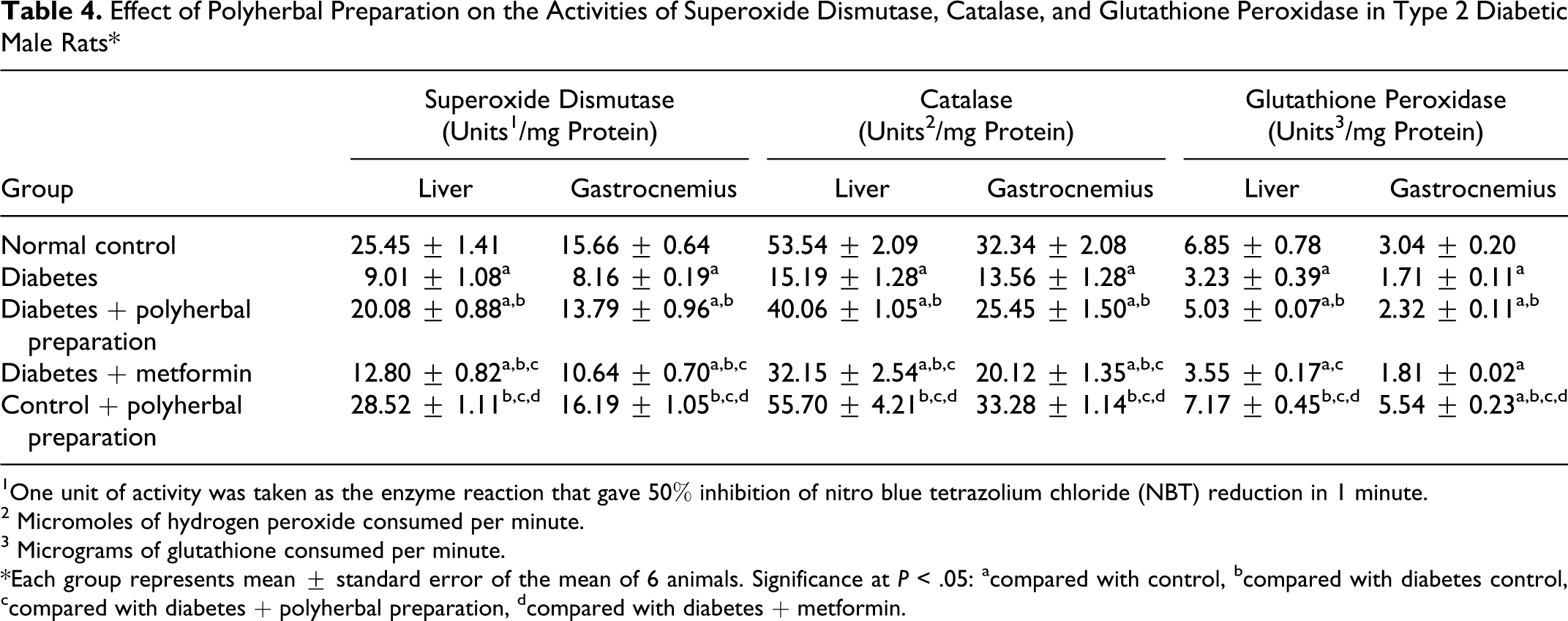
1One unit of activity was taken as the enzyme reaction that gave 50% inhibition of nitro blue tetrazolium chloride (NBT) reduction in 1 minute.
2 Micromoles of hydrogen peroxide consumed per minute.
3 Micrograms of glutathione consumed per minute.
*Each group represents mean ± standard error of the mean of 6 animals. Significance at P < .05: acompared with control, bcompared with diabetes control, ccompared with diabetes + polyherbal preparation, dcompared with diabetes + metformin.
Effect of Polyherbal Preparation on the Activities of Glutathione-S-Transferase, Glutathione Reductase, and Reduced Glutathione in Type 2 Diabetic Male Rats *

1Micromoles of 1-chloro-2,4-dinitrobenzene (CDNB)–glutathione conjugate formed per minute.
2 Nanomoles of glutathione disulfide (GSSG) reduced per minute at 37°C.
*Each group represents mean ± standard error of the mean of 6 animals. Significance at P < .05: acompared with control, bcompared with diabetes control, ccompared with diabetes + polyherbal preparation, dcompared with diabetes + metformin.
Effect of Polyherbal Preparation on Activity of Glycolytic Enzymes of Type 2 Diabetic Male Rats *
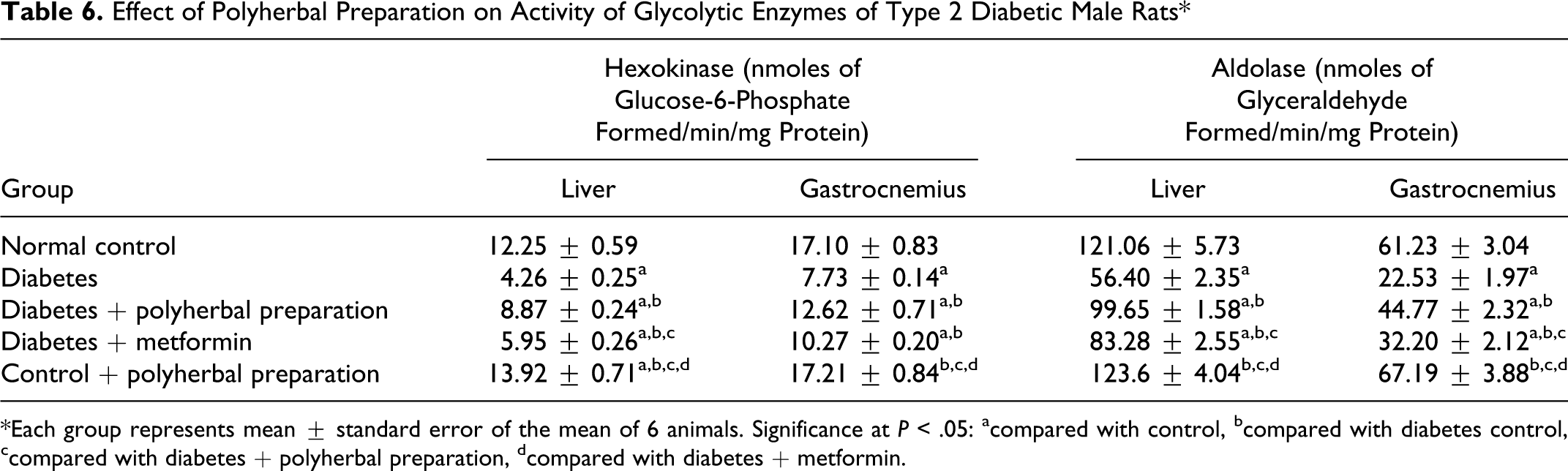
*Each group represents mean ± standard error of the mean of 6 animals. Significance at P < .05: acompared with control, bcompared with diabetes control, ccompared with diabetes + polyherbal preparation, dcompared with diabetes + metformin.
Effect of Polyherbal Preparation on Glucose-6-Phosphatase, Glucose-6-Phosphate Dehydrogenase Activities, and Glycogen Content of Type 2 Diabetic Male Rats *

*Each group represents mean ± standard error of the mean of 6 animals. Significance at P < .05: acompared with control, bcompared with diabetes control, ccompared with diabetes + polyherbal preparation, dcompared with diabetes + metformin.
Effects of Polyherbal Preparation on Glycogen Content in the Liver and Gastrocnemius Muscle of Type 2 Diabetic Rat
Type 2 diabetes lowered the glycogen concentration in liver and gastrocnemius, but treatment with polyherbal preparation was able to restore the same better than treatment with metformin.
Effects of Polyherbal Preparation on Kidney Markers, Calcium, Lactate Dehydrogenase, and Gamma Glutamyl Transpeptidase
In comparison with control rats, the urea and creatinine levels were increased significantly in diabetic rats. After treatment with polyherbal preparation and metformin, the same were significantly reduced compared with those in untreated diabetic rats (Table 8). The rise in calcium level was accompanied with significant increase in lactate dehydrogenase and γ-glutamyl transpeptidase levels in diabetic rats than those in control rats. Treatment with polyherbal preparation and metformin decreased the same compared with those in diabetic rats. Administration of polyherbal preparation to normal rats produced no significant change in these parameters (Table 8).
Effect of Polyherbal Preparation on Urea, Creatinine, Calcium, Lactate Dehydrogenase, and γ-Glutamyl Transpeptidase on Type 2 Diabetic Male Rats *

*Each group represents mean ± standard error of the mean of 6 animals. Significance at P < .05: acompared with control, bcompared with diabetes control, ccompared with diabetes + polyherbal preparation, dcompared with diabetes + metformin.
Discussion
Natural products drug industry has contributed nearly half of all small molecules approved in this decade. It has been suggested that the current drug discovery approach of finding “new entity drugs,” if shifted to “combining existing agents” may be helpful. 43 It is generally accepted that high-fat diets can be used to generate a valid rodent model for the metabolic syndrome with insulin resistance and compromised beta-cell function. 44 In the present study, improved fasting blood glucose level and better tolerance for glucose achieved in polyherbal preparation–treated group may be because of increased insulin sensitivity in type 2 diabetic rats. Enhanced testosterone level observed in polyherbal preparation–treated rats may partly be responsible for increased sensitivity to insulin. 45 In accordance with the present study, polyphenols, phenolic acids, and tannins from strawberry and apple have showed substantial inhibition on both glucose uptake and transport in Caco-2 intestinal cell monolayers. 46 Polyphenols from green tea interact with sodium glucose transporter-1 as antagonist-like molecules, controlling the dietary glucose uptake in the intestinal tract, 47 which hampers the rapid increase of plasma glucose after glucose load, and this may be responsible for the improved glucose tolerance as seen in the current study.
Optimal level of insulin and sex steroids is essential for the regulation of glucose homeostasis. Low testosterone level was reported in obesity with insulin resistance suggesting increased risk for type 2 diabetes and associated complications. 48 Increased testosterone observed in the polyherbal preparation–treated group can be attributed to aphrodisiac property of Asparagus, an age-old claim in Siddha system of medicine. Enhanced penile erection index and reduced hesitation time are the observed effects of Asparagus extracts 49 and dose-dependent proliferation of LNCaP cells with T cordifolia suggested that androgenic compounds present in the plant appear to act via androgen receptor. 50 Clove extract was shown to increase 3-β-hydroxysteroid dehydrogenase and 17-β-hydroxysteroid dehydrogenase activities and serum testosterone level. 51 All these reports reinforce the folklore aphrodisiac claim of Asparagus, clove, and Tinospora and provide a scientific basis for their traditional usage.
Increased levels of aspartate transaminase and alanine transaminase enzymes indicate increased permeability and damage and/or necrosis of hepatocytes 52 and spillage of these enzymes into blood results in elevation of these enzymes in diabetic condition. Polyherbal preparation treatment was effective in regulating the liver marker enzymes. Tannoid principles of Emblica when given to iron overload–induced oxidative stress rats resulted in the reduction of lipid peroxidation and restoration of the deranged activities of liver marker enzymes toward normalcy. 53 The increased bilirubin level in diabetic rats may be attributed to fatty liver induced by high fat and fructose diet. Polyherbal preparation treatment restored the above parameters to control levels by decreasing the triglycerides and cholesterol levels and improving liver function.
Free radical generation and oxidative stress can be responsible for accumulation of lipids and deranged antioxidant status. S oblonga, which contains compounds such as peroxisome proliferator-activated receptors-α agonists (enhances uptake and beta-oxidation of fatty acids in liver 54 ) was shown to normalize fatty liver and triglycerides. 55,56 Another polyphenol-containing plant, E officinalis was shown to regulate lipid profile in rat model of metabolic syndrome. 57 Fructose feeding leads to hypertriglyceridemia by increasing the formation of glycerol-3-phosphate, a precursor of lipid synthesis. 58 Increased triglycerides demonstrate that diabetic rats had more severe insulin resistance. Polyherbal preparation may inhibit the pathway of cholesterol synthesis and increase high-density lipoprotein/low-density lipoprotein ratio and this may be because of the activation of low-density lipoprotein receptors in hepatocytes, which are responsible for utilizing low-density lipoprotein and reduce its level in the serum. Flavonoids, anthocyanins, triterpenes, tannins, and saponins present in polyherbal preparation can be helpful in preventing diet-induced body fat accumulation. 59 High concentrations of lipid peroxides and hydrogen and hydroxyl peroxides in tissues of diabetic rats were shown to increase the generation of free radicals. Aroma chemicals such as eugenol, thymol, and benzyl alcohol in the S aromaticum extracts, which are shown to have inhibitory effect on malonaldehyde formation by 48%, 60 may be responsible for the decreased lipid peroxidation in polyherbal preparation–treated diabetic rats. The protective role of flavanoids, tannoids, saponins, phenolics, and terpenoids 61 present in polyherbal preparation is likely attributed to reduction of oxidative stress and associated complications.
Reduced activities of superoxide dismutase and catalase in diabetes may be because of increased reactive oxygen radicals. 62 The reduction of these enzymes can result in various deleterious effects. Increased activity of these enzymes due to polyherbal preparation treatment may quench diabetes-induced free radical generation. Chronic hyperglycemia in diabetic condition increases the polyol pathway as well as advanced glycation end products formation and free radical generation rates, leading to increased oxidation of reduced glutathione. Reduced glutathione is known to protect cellular system against the toxic effects of lipid peroxidation. 63 Reduced glutathione, a free radical scavenger acts as a co-substrate for glutathione peroxidase activity and a cofactor for many enzymes and form conjugates in endo- and xenobiotic reactions. 64 Glutathione peroxidase metabolizes hydrogen peroxide to water by using reduced glutathione as a hydrogen donor. 65 The significant recovery of reduced glutathione content and reduced glutathione–dependent enzyme glutathione peroxidase that was observed in polyherbal preparation–treated diabetic rats is likely due to the presence of ellagic acid, gallic acid, tannoids, 66 flavanoids, and proanthocyanidins 67 in the polyherbal preparation.
Increased glutathione reductase will in turn boost reduced glutathione levels, which would help in reducing oxidative stress. 68 Elevated glutathione (reduced) level can be induced by Tinospora and protect cellular proteins against oxidation. 69 High phenolic content in Asparagus, 70 Emblica, 14 and clove 60 species may explain greater radical scavenging capacity of polyherbal preparation. Glycolysis is a main metabolic pathway that provides energy by using glucose. Hexokinase and aldolase are the most sensitive enzymes of glycolytic pathway in diabetic condition. 71 The enhanced activity of glycolytic enzymes is suggestive of improved insulin sensitivity and glucose tolerance and the associated increased glucose utilization. The decrease in glucose-6-phosphate dehydrogenase activity in diabetic condition indicates the diminished functioning of hexose monophosphate shunt pathway and thereby impaired production of reducing equivalents. Insulin is reported to increase this enzyme activity in a dose-dependent manner. 72 Administration of polyherbal preparation and metformin increased the activity of glucose-6-phosphate dehydrogenase. This is likely due to improved insulin sensitivity and decreased insulin resistance.
It has been reported that clove represses phosphoenolpyruvate carboxykinase and glucose-6-phosphatase gene expression by affecting the expression of a transcription factor peroxisome proliferator-activated receptor-γ coactivator-1. It is an important coactivator for gluconeogenic genes. 73,74 A significant reduction in glucose-6-phosphatase enzyme activity observed in the present study may be correlated.
Increased levels of urea, creatinine, γ-glutamyl transpeptidase are suggestive of the renal tissue damage in type 2 diabetic rats. Reversal of the same in polyherbal preparation–treated group may be attributed to the strong curative action of T cordifolia. 25 γ-Glutamyl transpeptidase, a membrane-bound enzyme, is present in proximal renal tubule, liver, pancreas (ductules and acinar cells), and intestine. Decrease in serum γ-glutamyl transpeptidase activity with concomitant amelioration of reduced glutathione content observed in the present study suggests antioxidant action of quercetin, an active principle of E officinalis that neutralized the generated reactive oxygen species and thereby maintained cell membrane integrity and viability. 75
Serum calcium regulation is altered in diabetes mellitus, 76 and high serum calcium levels are associated with high levels of glucose, blood pressure and total cholesterol. 77 –80 Further studies are needed to identify the mechanism behind decreased calcium level observed in polyherbal preparation–treated rats.
In diabetes, there is a decrease in liver weight because of enhanced catabolic processes such as glycogenolysis, lipolysis, and proteolysis. 81 Glycogen level in muscle and liver were decreased in the absence of insulin and recovered on insulin treatment. 82 Administration of polyherbal preparation and metformin significantly increased hepatic glycogen content compared with diabetic group, which could be because of improvement in insulin sensitivity and inhibition of glucose-6-phosphatase in the liver, thereby preventing gluconeogenesis.
Conclusion
The novel Siddha polyherbal preparation supplemented in the present study exhibited reversal of deteriorated liver marker enzymes and lipid profile of type 2 diabetic rats and showed strong antioxidant activities. Improved glucose tolerance and hepatic gluconeogenic enzymes were also achieved suggesting its potential therapeutic effect for the management of type 2 diabetes through a holistic approach. Clinical trials employing such novel herbal preparations would be of great interest and beneficial to disease management and human welfare at large.
Footnotes
Acknowledgments
We thank Ms L. Sheerin Banu for correcting the article for proper English usage.
Author Contributions
BV conceptualized the study, collected the data, developed the tables, analyzed the data, and wrote the first draft of the manuscript. AWA, SS, MC, and AN developed the tables and helped in statistical analysis. BK conceptualized the study, critically analyzed and discussed the data, and corrected and reviewed the article.
Declaration of Conflicting Interests
The authors declared no potential conflicts of interest with respect to the research, authorship, and/or publication of this article.
Funding
The authors disclosed receipt of the following financial support for the research, authorship, and/or publication of this article: This study received financial assistance from DST-PURSE (grant letter no. RPO/PURSE/2009/4063 dated December 2, 2009, Department of Science & Technology, Government of India) and UGC-SAP-DRS (sanction letter no. F-3/58/2009/(SAPIII) dated September 17, 2010, University Grants Commission, New Delhi, India) programmes.
Ethical Approval
Ethical clearance was obtained from the Institutional Animal Ethical Committee (IAEC No. 03/019/2009 dated April 1, 2009).