




Abstract
The objective of the research was to map the discourse about herbal medicine in Australia’s primary medical journal, the Medical Journal of Australia, over 4 decades. Manifest content analysis of 148 articles about herbal or complementary and alternative medicine (CAM) in journal articles from 1966 to 2008 was undertaken. Issues of risk dominated the discourse about herbal medicine in the journal (70%), with a focus on adverse events (42%) as the most significant risk of herbal and other complementary medicines. Toxicity (23%) and drug interactions (18%) were the most frequently mentioned specific risk items. Items that acknowledged efficacy (32%) outweighed those suggesting ineffectiveness (11%). Case reports, reviews, research articles, and letters all had risk frequencies of more than 70%. Review articles and research articles had a high rate of reference to both risk and benefit. Review articles were found to have greater reference to benefit than risk. Possible reasons for these findings are discussed.
The use of herbal medicine and complementary and alternative medicine products in industrialized Western countries is at an all-time high and is steadily increasing. Studies have suggested that between 52% and 69% of Australians use self-prescribed complementary and alternative medicine products and between 16% and 33% use herbal medicine products.1–4 It is estimated that $1.86 billion is spent on complementary and alternative medicine products over a 12-month period in Australia. 1 Therefore, the investigation of media representations of these products, and the implications of such media representations, is timely and pertinent.
Evidence suggests that in Australia, people who use herbal medicine or other complementary and alternative therapies do not typically avoid orthodox medicine.5–8 Research by Xue and colleagues 1 has illustrated that the estimated number of visits to complementary and alternative medicine practitioners over a 12-month period (69.2 million) was almost identical to that of visits to medical practitioners (69.3 million). In another Australian survey of general practitioners, more than half stated that their patients were increasingly demanding complementary and alternative medicine. 9
Risk management is an important issue in consumerist societies in general and in mainstream medical practice more specifically. Although “risk avoidance” has become something of a moral responsibility for the individual in an increasingly neoliberal society, in which one is held accountable for “self-control, self-knowledge, and self-improvement,” it is a particularly prominent concept in the working life of biomedical practitioners. 10 As Lupton notes, those who do not engage in risk avoidance “may thus often find themselves stigmatised and subject to moral judgements.” 10 In the case of medical litigation, these judgments can have severe financial and professional repercussions for the individual practitioner. The sociocultural impact of risk avoidance is therefore important to consider in the relationship between biomedical practitioners and the way in which herbal medicine and other complementary and alternative medicines are represented to them.
A government-funded report in Australia in 2005 by Lin et al suggested that as a therapy, herbal medicine is of a higher risk than other Western naturopathic modalities because of the possibility of toxicity related to overdose, interactions with pharmaceutical drugs, allergic and anaphylactic reactions, and idiosyncratic reactions. 9 Their research showed that doctors' perceptions of adverse events from herbal medicines had an exceptionally higher rating than those of naturopathic and herbal practitioners. 9 In the study, Western herbal medicine was regarded by general practitioners as one of the most “dangerous” of the complementary therapies, after chiropractic and Chinese herbal medicine. Also, the authors noted that “potential harmfulness was seen to mirror potential effectiveness” in the case of the therapies that were deemed “moderately harmful.” 9 The findings from a 2006 study of 127 hospital-based surgeons, anesthetists, medical physicians, and pharmacists by Braun also conveyed this correlation between perceived effectiveness or “usefulness” and harm. 11 However, in the studies by both Lin et al and Braun, the practitioners' perceptions of harmfulness outweighed their perceptions of usefulness or effectiveness.9,11
This notion of harmfulness starkly contradicts attitudes held by many laypeople who self-treat or who are prescribed herbs by naturopaths or herbalists.4,12 However, as noted by Lupton, it is rarely laypeople (whose usage of complementary and alternative medicine has brought it into the biomedical domain) who play a major role in the construction—and indeed publicizing—of risk “objects.” 13 This work is undertaken by the experts who “define agendas” on risk discourses. 14
The impact of the growing popularity in complementary and alternative medicine usage can be seen in the increased reference to its various modalities in peer-reviewed biomedical publications, which provide a major forum for discussing expert knowledge. Whether it is being reported in a positive or negative way, complementary and alternative medicine as a phenomenon has inarguably become firmly located within biomedical and scientific discourse. As they are talked about, notions of risk, efficacy, or benefits become constructed into a biomedical framework of meaning (M. Lewis, 2011, “Australian Media Representations of Herbal Medicine and the Construction of Risk,” unpublished PhD thesis, submitted February 2011, School of Arts and Social Sciences, Southern Cross University, Australia). This research sought to systematically measure the discourse in the Medical Journal of Australia and to gauge the level of risk reporting in relation to herbal medicine.
A longitudinal content analysis of articles from the Medical Journal of Australia, the journal of the Australian Medical Association and Australia’s primary medical journal, was undertaken to map the nature of the discourse about herbal medicine and complementary and alternative medicine in the journal. Manifest content analysis was chosen as an appropriate method to quantify the main themes that arose in articles, letters, and editorials about herbal medicine and complementary and alternative medicine over a 42-year period. The Medical Journal of Australia was selected to gain insight into the way the primary readership has been encouraged or influenced to think about herbal medicine and complementary and alternative medicine issues over a period of 4 decades. In Australia, the Medical Journal of Australia is the country’s primary peer-reviewed medical journal reporting on issues associated with practice, research, education, and policy. Research indicates that medical journals are an important source of information about complementary and alternative medicines for general practitioners in Australia as well as hospital-based practitioners such as surgeons, anesthetists, and medical physicians.9,11,15
Medical journals also influence a broader group of people than their specific targeted readership.16,17 Significantly, research also indicates that health and medical journalists prefer to draw from these peer-reviewed publications for their news stories in the mainstream media.17,18 Indeed, the Medical Journal of Australia promotes its role as a “newsmaker” in its online media kit for advertisers. 19
The significance of the doctor–patient interface is also critical in the mediation of messages from medical journals, as the contemporary “health consumer” often has equal access to biomedical information when compared with his or her general practitioner. 16 Additionally, biomedical journal editorial and advertising staff are cognizant of the need for media, particularly newspapers (both print and online), to promote what they publish, as Stryker’s research into the effects of these journals' press releases has shown. 20 Policymakers and funding agencies are also important audiences who are influenced (and targeted) by medical journal articles. 20
The research questions that guided this study were the following: What are the most-mentioned aspects of herbal medicine and complementary and alternative medicine in this longitudinal study? Do the number of articles that refer to topics of risk in relation to herbal medicine and complementary and alternative medicine outweigh articles about efficacy or benefits? The Medical Journal of Australia was selected to gain insight into the way the primary readership has been encouraged or influenced to think about herbal medicine and complementary and alternative medicine issues over a period of 4 decades.
Research Design and Methods
Manifest Content Analysis
Content analysis is an efficient and unobtrusive method for tracking the frequency of ideas, opinions, and political leanings in texts. 21 It enables the researcher to measure and compare the categories created for the purposes of interpreting message characteristics.22,23 Manifest content analysis involves systematically counting the literal or denotative meanings of a message rather than searching for meanings that can be inferred or hidden, which is the domain of latent analysis. 24
Literature Search in the Medical Journal of Australia (2009)
Articles were sourced that appeared between 1966 and 2008 on the subject of herbal medicine specifically, as well as broader articles about complementary and alternative medicine. A literature search was conducted on MEDLINE, limiting to articles from the Medical Journal of Australia. Keywords for the search were the following: “herb*” OR “complementary medicine” OR “alternative medicine” OR “complementary therapies” OR “herbal medicine” OR “Chinese herbal medicine.” Additionally, a search on the journal’s own Web site (www.mja.com.au) was undertaken using the terms “complementary medicine” and “herbal medicine.”
Inclusion and Exclusion Criteria
All articles that mentioned herbal medicine as a product, therapy, or practice were included. Articles that were broadly about complementary and alternative medicine, but which mentioned herbal medicine or naturopathic practice, were also included. Articles with a specific subject focus on different complementary and alternative medicine modalities such as acupuncture, tactile therapies, or meditation were excluded, unless herbal medicine or naturopathy (a practice that uses herbal medicine as one of a number of its modalities) was mentioned in the text. Printed copies of all 148 identified articles were obtained.
Development of Coding Categories
The author held 2 focus group sessions with (a) a group of complementary and alternative medicine practitioners and educators from Southern Cross University and (b) a group of scientists from the same university. These sessions were held to map the distinctions that each group perceived between herbal and pharmaceutical medicines, and a range of themes emerged that contributed to the development of coding categories for the content analysis.
Literature Search
In 2003, a preliminary literature search of the Medical Journal of Australia was undertaken, in which themes about risk or danger in relation to herbal medicine or complementary and alternative medicine were counted from 1968 to 2002. This preliminary search contributed information in the form of articles sourced as well as emerging themes that were considered for coding categories in the most recent search in 2009.
These previous research activities provided a critical a priori base for devising the coding categories for the current study. 22
Drawing from the themes that arose from the 2003 literature search, a codesheet was prepared detailing the a priori coding categories. This codesheet consisted of 6 primary categories with multiple items of relevance within each section. These categories were tested on 5 sample articles from the articles collated. From this test sample, new categories also emerged and were added to the database, notably those in the sociocultural category. During the coding process, there were several further emergent categories that were added to the spreadsheet.
The 6 primary categories outlined for coding were safety, efficacy, quality, regulation, sociocultural, and historical, with 84 subcategories. These subcategories included topics that are widely discussed in relation to herbal medicine or complementary and alternative medicine in contemporary biomedical and sociological contexts.
An Excel spreadsheet was prepared for coding data to be entered by date, principal author, type of article (ie, editorial, letter, or research article), and the subcategories that were developed under the primary category headings. During the analysis, the coding was recorded on the printed copy of each article beside the relevant text and then entered onto the spreadsheet. The finalized codings were entered into a database using SPSS software for descriptive data analysis. Articles with 1 or more reference to an item were given a “1” (to avoid repetition within 1 article), and articles with no reference to an item were given a “0.”
Frequency tables were prepared in SPSS to measure the frequency of any articles about herbal medicine or complementary and alternative medicine during each year as well as each decade. Subcategories were clustered to investigate the more general categories of “risks” and “benefits.”
Results
The MEDLINE search resulted in 125 hits for the period 1966 to 2008. The search on the Medical Journal of Australia Web site resulted in 286 hits for “complementary medicine” and 106 hits for “herbal medicine.” This resulted in a total of 517 articles. After applying the exclusion and inclusion criteria, there were a total of 148 articles to code in the final data set.
Longitudinal Frequency of Articles
Every year, beginning 1966, the Medical Journal of Australia has published something about herbal medicine or complementary and alternative medicine (Figure 1). More than half of all items appeared after the year 2000.

Frequency of articles about herbal medicine/complementary and alternative medicine in the Medical Journal of Australia from 1966 to 2008
Issues Most Mentioned
Issues most frequently mentioned from 1966 to 2008 were, “adverse events,” “efficacy,” and “general risk of herbal/complementary medicine therapy or practitioner.” When items were clustered under the primary categories, the most frequently mentioned were those associated with risk, followed by efficacy, an then quality. Table 1 lists the clusters and the frequency of the 23 cluster subcategories.
Subcategories and Their Rate of Reference to Risks and Benefits of Herbal Medicine or Complementary and Alternative Medicine in the Medical Journal of Australi a From 1966 to 2008 (in 2 Clusters)

Abbreviations: HM, herbal medicine; CAM, complementary and alternative medicine.
References to Risk
Seventy percent of all articles across all decades referred to risk. Table 1 shows that “adverse reactions or events” (42%) was the subcategory most referred to in relation to risk, followed by the subcategories of “general risk of herbal/complementary and alternative medicine therapy or practitioner” (30%), “toxicity” (23%), and “drug interactions” (18%). “Dosage and preparation of herbal/complementary and alternative medicines” had a frequency of 14%, followed by “discouraging use of biomedical therapies” (11%). Two quality issues, “adulteration” and “contamination,” had frequencies of 11% and 10% respectively.
The subcategory of “risk of herbal/complementary and alternative medicine therapy or practitioner” had a frequency of 30%. This category included references to a more general riskiness of herbal medicine or complementary and alternative medicine as well as comments that suggested there were risks associated with herbal/complementary and alternative medicine (or “nonmedical”) therapists. The risk items were cross-tabulated with decades (see Figure 1). This demonstrated that the number was stable during the 1980s and 1990s and escalated during the 2000s.
The cross-tabulation of references to risk and/or benefit and article types revealed differences that can be observed in Figure 2 . Case reports (n = 13; 81%), reviews (n = 10; 77%), research articles (n = 12; 75%), and letters (n = 36; 70.5%) all had a high rate of reference to risk. Risk was referred to least of all in historical/sociological articles (n = 8; 57%).
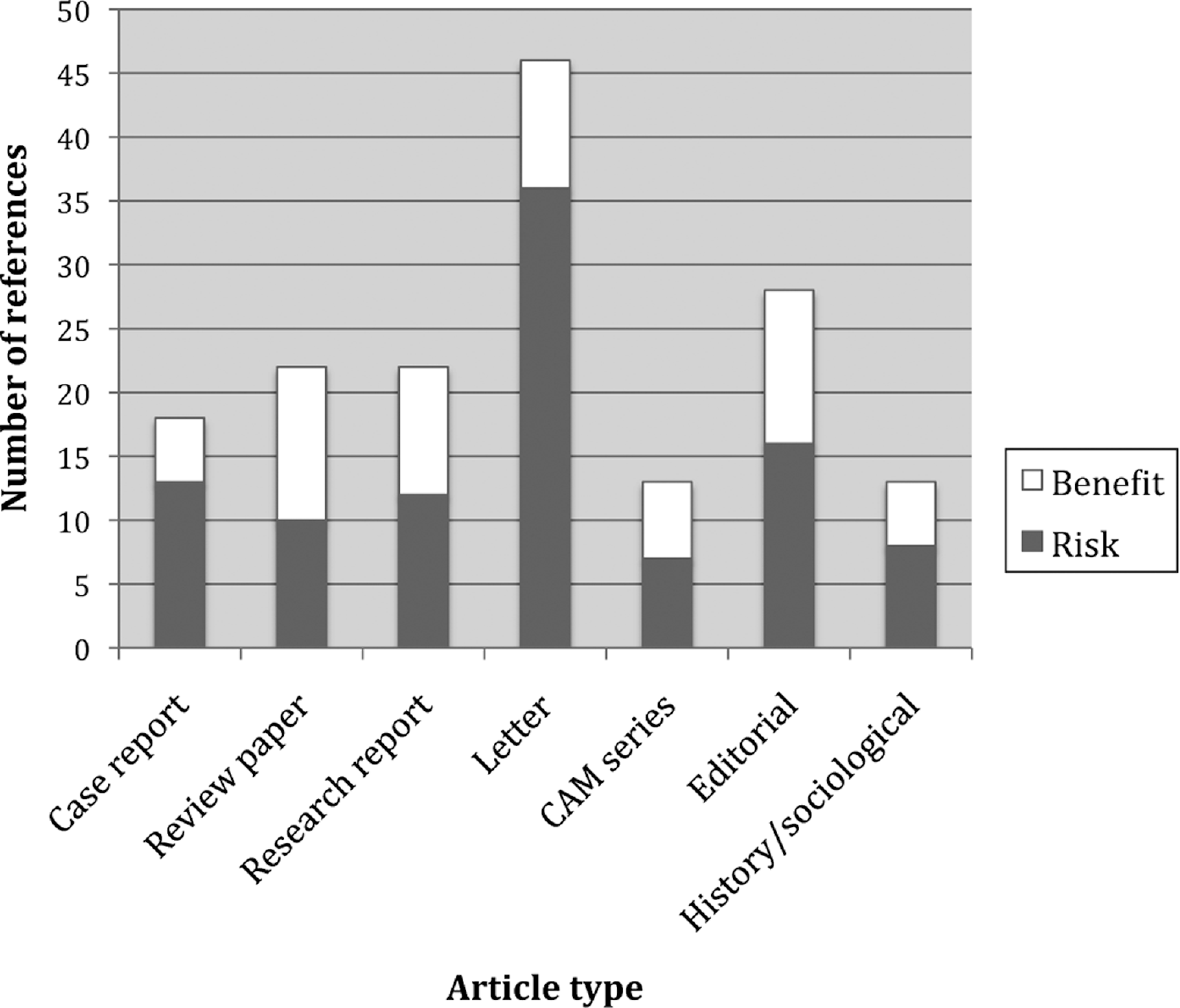
References to risk and benefit by article type in articles about herbal medicine/complementary and alternative medicine in the Medical Journal of Australia from 1966 to 2008
Reference to Benefits
Thirty-two percent of all articles during the 42-year period of 1966 to 2008 acknowledged that herbal medicine or complementary and alternative medicine was effective or potentially effective (Table 1). This can be contrasted with the 11% of articles in which “not effective” was mentioned about herbal medicine or complementary and alternative medicine. The overall discourse on effectiveness—indicated by articles that mentioned both effectiveness and ineffectiveness, as well as other issues such as lack of evidence—occurred in 46% of all articles. “Action needed in relation to efficacy” was mentioned in 36% of all articles.
When items relating to benefits were clustered, the result was a total of 41% of all articles. Items acknowledging the benefits of herbal medicine or complementary and alternative medicines were minimal during the late 1960s and 1970s (8%) and 1980s (8%) and jumped to 20% during the 1990s and then surged again to 63% during the 2000s (Figure 1).
Review articles had the highest reference to benefit (n = 12; 92%; see Figure 2). Research articles had a frequency of 62.5% (n = 10) followed by the complementary and alternative medicine series (n = 6; 54.5%). Letters were least likely to refer to benefit (n = 10; 20%).
Discussion
The new millennium has witnessed the greatest proportion of articles about herbal medicine or complementary and alternative medicines in the Medical Journal of Australia during the period being studied. This study indicates that in the journal, herbal medicine and complementary and alternative medicine are consistently framed in association with risk more often than any other topic. Results also indicate an increasing association of herbal medicine and complementary and alternative medicine with efficacy.
There can be a number of reasons for a predominance of risk references. Medical practitioners (in both general practice and hospital settings) are likely to be the first port of call in the event of significant adverse reactions from herbal medicine or complementary and alternative medicine. Therefore, there is a professional requirement to understanding the risks of these medicines, which are being more commonly used.
Another inference that can be made from the findings is the possible correlation of risk with a therapy that continues to be largely unfamiliar (rather than statistically harmful) for those working in the biomedical professions. 25 This contradicts the findings by Slovic, who found that laypeople’s fear of risk was related to uncertainty or unfamiliarity while experts considered risk in the context of annual mortality. 26 This can perhaps be explained by the fact that in the herbal medicine and complementary and alternative medicine domain, biomedical practitioners cease to be experts. Lack of knowledge about herbal medicine and complementary and alternative medicine among Australian biomedical practitioners is supported by the findings of Lin and colleagues 9 and Newell and Sanson-Fisher. 25 Interestingly, however, this issue is not represented in the Medical Journal of Australia as a risk factor in herbal medicine usage (M. Lewis, 2011, “Australian Media Representations of Herbal Medicine and the Construction of Risk,” unpublished PhD thesis, submitted February 2011, School of Arts and Social Sciences, Southern Cross University, Australia).
Consideration must also be given to the way in which risk discourse can serve the dominance of biomedicine in the Australian health care system. The construction of risk concepts is a process that sets up “boundaries and connections to define spaces of safety and danger.” 27 As Carter argues, risk discourses are not neutral or democratic; rather, they engage in a process of “othering,” whereby the “other” is cast as potentially dangerous. 27
Another possibility is that of editorial culture, whereby articles that address risk in relation to herbal medicine or complementary and alternative medicine are given preference by the Medical Journal of Australia. Publishing bias against articles about complementary and alternative medicine has been discussed by Resch et al, 28 Bubela et al, 29 and Koper et al. 30 At the same time, it should be acknowledged that research and review articles are designed to measure both risk and benefit in a biomedical framework of meaning.
The research by Lin and colleagues revealed that a surprisingly high proportion of general practitioners believed herbal medicines to be effective (almost 40%), while more than 60% believed they were potentially harmful. 9 This leads the discussion to efficacy, which was the most highly referred to item of benefit in the study. Many more articles acknowledged the existing or potential efficacy of herbal medicine or complementary and alternative medicine than those that referred to ineffectiveness. Whereas efficacy is an understandably hot topic in the journal discourse, it is pertinent to consider why this can be the case in the herbal/complementary and alternative medicine context.
In a sociopolitical sense, a discursive strategy of risk in the Medical Journal of Australia in relation to herbal medicine or complementary and alternative medicine supports the medical doctor’s role as a “protector” of the public, which has been an important aspect of the establishment and maintenance of biomedical dominance in Australia.31–33 This is based on the notion that because doctors have privileged access to elite knowledge, they are “guardians of scientific rationality.” 34 Simultaneously, the construction of a discourse about efficacy can serve to enhance doctors' roles as the masters of potentially dangerous substances, which only they are “equipped to handle.” 35
This notion supports theories about co-option of herbal medicine and complementary and alternative medicine, which convey the concerns by the “alternative others”—herbal medicine and complementary and alternative medicine practitioners—regarding the “mainstreaming” of their therapies or remedies.32–35 Sociological discussion has criticized this process as a way for biomedical practitioners to not only defend their professional territory but also to capture the new complementary and alternative medicine market.36–38
Drawing from another perspective, it has been argued that the act of proving efficacy has become a politically charged goal for practitioners and researchers operating in the domain of marginalized forms of medicine. 39 Consequently, innovative research that might strive to address the problems of incommensurability between the conflicting complementary and alternative medicine and biomedical epistemologies simply has no space in which to occur.36,37,40 Additionally, an entire efficacy industry has emerged with the “scientization” of herbal medicine and complementary and alternative medicine, commercially benefiting research institutions and researchers who compete for research grants and funding, as well as attracting students to their research programs.
Limitations
Longitudinal content analysis is a methodological approach that can provide, in a systematic way, a broad picture of the messages being conveyed over a period of time. However, as a method on its own it does not provide a sense of audience effect, nor can it predict it. 24 A study of how biomedical practitioners and researchers respond to such content would give further insight into the relationship between the content of the Medical Journal of Australia and the journal’s readers. Audience reception studies are particularly needed in relation to herbal medicine and complementary and alternative medicine research. 41
The research interest here was primarily to map the discourse about herbal medicine and complementary and alternative medicine over 4 decades and to scrutinize the frequency of references to specific issues rather than to detail the way in which the Medical Journal of Australia items were framed (ie, positive or negative). This is to be considered for another study.
This study was a preliminary mapping exercise that used 2 coders for the more subjective process of creating coding categories. 42 One coder undertook the actual coding process of denotative categories. There is arguably less risk of bias in the coding of denotative meanings that are explicitly stated and require little interpretation for coding purposes; however, this is a limitation of the study.
Conclusions
Of all the coding categories, risk is the predominant issue that appears in the Medical Journal of Australia in relation to herbal medicine and complementary and alternative medicine. This study highlights a significant increase in the discourse about risk in the Medical Journal of Australia over the period of analysis, which corresponds with the increase in articles about herbal medicine and complementary and alternative medicine generally.
Adverse events, the general risk of herbal medicine practitioner or therapy, toxicity, and drug interactions are risks most commonly referred to over the period of analysis. Case reports, reviews, research articles, and letters all had risk frequencies of more than 70%. Review articles and research articles, the least tolerant platforms for conveying bias, had a high rate of reference to risk and benefit. Review articles had a greater reference to benefit than risk. Based on these findings, it is likely that the increase in review and research articles about herbal medicine and complementary and alternative medicine will result in more broad-reaching and sophisticated representations in the Medical Journal of Australia, drawing from rigorous research approaches (M. Lewis, 2011, “Australian Media Representations of Herbal Medicine and the Construction of Risk,” unpublished PhD thesis, submitted February 2011, School of Arts and Social Sciences, Southern Cross University, Australia).
Without awareness and knowledge of the complementary and alternative medicine phenomenon, Australian biomedical practitioners are at a distinct professional disadvantage.36,43 They frequently rely on articles in their peer-reviewed journal as a source of information about herbal medicine or complementary and alternative medicine.9,11,15 The content of medical journals is not of relevance only to biomedical practitioners and researchers, as medical journals have a much broader social and political influence. 16
Possible reasons for these findings have been discussed and include professional requirements of risk awareness for biomedical practitioners, doctors' unfamiliarity with herbal medicine and complementary and alternative medicine, the legitimization of biomedical dominance, the issue of publication bias, and the legitimization of herbal/complementary and alternative medicine industries, research institutions, and professions.
It is hoped that this preliminary analysis of biomedical discourse about herbal medicine and complementary and alternative medicine in the Medical Journal of Australia paves the way for further discussion and investigation into how they are being discussed in biomedical literature, and importantly, how these representations can be shaping perceptions and philosophies of their readers and the broader publics that they influence.
Footnotes
Acknowledgments
I would like to acknowledge Professor Stephen Myers from Southern Cross University for his assistance with developing the coding categories and subcategories for this study, Dr Lyndon Brooks from Southern Cross University for his assistance with statistical analysis, and Dr Sue Evans for reading and commenting on the article. In particular, I would like to thank Paul Orrock from Southern Cross University for his help with the editing of this article.
The author declared no potential conflicts of interest with respect to the research, authorship, and/or publication of this article.
The author received no financial support for the research, authorship, and/or publication of this article.