




Abstract
Previous research has linked protests against police violence with reductions in police-involved killings. However, the conditions under which these protests are most effective remain largely unknown. This study draws on insights from protest scholarship and theories of institutional anomie, social capital, and collective efficacy to explore whether social institutions shape the geographic distribution of police killings and moderate protest efficacy. Findings from county-level negative binomial regression models reveal that Black Lives Matter (BLM) protests in 2020 were associated with a decline in deadly police-citizen encounters. Local commitments to the economy and military had direct and positive correlational effects on police-caused deaths, while commitment to education and family significantly reduced fatalities. The local polity and education moderated protest efficacy, whereby the protective role of BLM protest was strengthened at high levels of electoral participation and in counties with low educational commitment. Marginal effects for measures of family vitality and military veteran concentration approached conventional levels of statistical significance, suggesting potential moderating effects warranting further investigation. Together, these results suggest that local institutional contexts shape police killings of American civilians and help explain why protests appear more effective in some areas than others.
Keywords
Each year, approximately 1,000 people are killed by law enforcement officers in the United States, comprising more than 5% of all American homicides (Durán & Loza, 2025; Hirschfield, 2023). This level of state-linked violence significantly surpasses that of other Western industrial nations (Hirschfield, 2023) and has become a prominent political issue within the American electorate (Morris & Shoub, 2024; Reid, 2024a). The 2020 murder of George Floyd Jr by a police officer in Minneapolis, Minnesota, sparked what may have been the most significant protest movement since the Civil Rights era (Lum et al., 2021; Phelps, 2024). With Black Lives Matter (BLM) at the epicenter, citizens and activists mobilized across all 50 states in more than 140 cities (Putnam et al., 2020), demanding police reforms to enhance the quality of crime control nationwide and to curtail police misconduct and violence (Cobbina-Dungy et al., 2022; Craig & Reid, 2022; Jones-Brown & Williams, 2021; Phelps, 2024; Reid, Brown, and Ramos, 2025; Vaughn et al., 2022).
Research suggests that protests against police violence reduce future incidents of police-involved killings (Campbell, 2024; Olzak, 2021; Skoy, 2021). However, questions remain regarding how local social institutions strengthen or weaken this relationship. Informed by social movement literature and theories of institutional anomie, social capital, and collective efficacy, this study explores whether antipolice brutality protests linked to the 2020 BLM movement are associated with reductions in officer-involved fatalities and examines the direct and moderating roles of locally embedded social institutions—including the economy, polity, family, education, religion, and the military.
In doing so, this research extends the literature in several ways. First, it builds on previous assessments that probe the link between protests and police-caused deaths (e.g., Cunningham & Gillezeau, 2021; Olzak, 2021) by investigating the George Floyd and COVID-19 era, a period marked by co-occurring crises, mistrust in government, and other salient protest movements (Reid et al., 2024; Rohlinger & Meyer, 2024). Second, the article contributes to understanding the potentially deadly effects of structural strain and, more broadly, how local social institutions may protect communities against state-linked violence. Lastly, understanding the conditions under which antipolice brutality protests are most effective may bear important implications for democratic accountability and the functioning of US democracy.
Background and Theory
Protests and Police Killings
Despite a long-standing precedent of protests in response to police killings of minoritized Americans, only a handful of studies have examined whether these events have had any impact on subsequent police-caused deaths (Campbell, 2024; Cunningham & Gillezeau, 2021; Olzak, 2021; Skoy, 2021). In one of the first studies in this area, Cunningham and Gillezeau (2021) employed an event history analysis of over 700 racial uprisings in US counties in the 1960s and early 1970s. The researchers found that police-involved killings of both non-white and white civilians increased in the years directly following the uprisings. Although police killings of whites returned to their pre-existing levels after a few years, non-white civilian deaths remained at a heightened level after almost a decade. Building on Cunningham and Gillezeau's (2021) work, researchers have begun to probe the relationship between protest and police killings using contemporary data.
This thread of research has mostly focused on the BLM movement, with findings diverging from Cunningham and Gillezeau (2021) and instead consistently showing an inverse relationship between protests and subsequent police killings. For example, Skoy (2021) used a monthly panel of 50 states and Washington DC, from 2010 through 2017, and revealed that an additional BLM protest in the previous month resulted in a .225 reduction in police-involved killings of Black civilians per 10 million Black population. Likewise, Campbell (2024) demonstrated that census places with early BLM protests saw a 10% to 15% reduction in police killings from 2014 through 2019. Campbell (2024) suggests that the observed decline in police killings after BLM protests may be linked to mechanisms such as a potential “Ferguson effect” by which officers attempt to mitigate additional public scrutiny through de-policing and pulling back from proactive policing strategies (see also Roman et al., 2025).
Although de-policing may be an entirely plausible explanation, Olzak (2021) offers a strong alternative theory. Olzak argues that mobilization, in the form of protest, can help shield communities from state violence via three interrelated mechanisms: (1) signaling to elites and authorities that a social problem exists and requires remediation, (2) empowering community residents and heightening a sense of community cohesion, and (3) challenging the status quo in ways that threaten to undermine the authority of those in power. These threats encourage authorities to compromise with protestors’ demands, improving the odds of policy changes being implemented and incentivizing behavioral shifts involving the lethal use of force by police personnel. In the end, using data from 2001 through 2018 across the largest cities in the United States, Olzak (2021) demonstrated that local antipolice brutality protests mattered, especially for reducing police killings of Black and Latino civilians.
Although BLM emerged circa 2013 as a political-movement building project, the current study focuses on the 2020 movement due to its heightened historical relevance. The 2020 murder of George Floyd saw the rise in power and legitimation of BLM, with the movement garnering significantly more public, political, and corporate attention than in previous years (Lum et al., 2021; Rohlinger & Meyer, 2024). Favorable attitudes toward the movement peaked in 2020, with 67% of Americans reporting strong or moderate support (Horowitz et al., 2023). Beyond favorable public opinion, an estimated 15 to 26 million people took to the streets across more than 140 cities to rally against police violence (Buchanan et al., 2020; Putnam et al., 2020). Olzak (2021, p. 1070) notes that “[p]eak periods of protests surrounding an issue…increase its salience, which raises public concern and debate” and “[s]uch awareness increases the likelihood the issue will be framed as a social problem deserving of attention.” The context encircling the 2020 BLM movement raises questions about whether protests associated with the movement were effective in curbing the incidence of local police-involved killings.
Informed by Olzak (2021), we contend that local BLM protests are likely most effective when they send “a powerful signal to elites and authorities that a community demands a change in the status quo” (p. 1070). The potency of BLM's political signal in 2020 is likely to have varied across local areas due to the vast and polarized protest ecology of the period (Rohlinger & Meyer, 2024). In certain areas, for example, BLM protests were increasingly met with or preceded by counterprotests from pro-police demonstrators (Kishi & Jones, 2020). Likewise, the COVID-19 pandemic and the attendant government response sparked widespread protests against local lockdown restrictions (Reid & Craig, 2021; Rohlinger & Meyer, 2024). Ultimately, areas with extensive non-BLM protest activity likely represent contexts in which BLM claims-making must compete for political attention. Therefore, increases in BLM's political signal that make its claims appear dominant and representative of local public concern should make its demands more difficult for local authorities to ignore. This backdrop, alongside Olzak's (2021) theoretical account as well as Campbell's (2024) and Skoy's (2021) empirical findings, informs this study's first hypothesis: Hypothesis 1: An increase in the relative concentration of local BLM protests in 2020 will be associated with reductions in subsequent police-involved killings.
Indeed, within democratic politics, protest can be a powerful resource for marginalized communities to increase their bargaining power and achieve desired outcomes (Lipsky, 1968). However, protest and the community cohesion and political signaling it may inspire do not operate in a vacuum. The efficacy of protest movements may hinge on local institutional contexts. While we agree with Olzak's (2021) theoretical description, we argue that the effectiveness of BLM protests will likely depend on the vitality of key social institutions in the local area. Institutional theorists such as Messner and Rosenfeld (2012) describe social institutions such as the economy, family, education, and polity as the “building blocks” of society that reinforce values and norms (culture) and patterned relationships among persons and groups (social structure). Central to this study is our contention that the institutional vitality of an area will have a direct and moderating role in the relationship between BLM protest concentration and subsequent police killings of American civilians.
Social Institutions and Police Killings
In Crime and the American Dream, Messner and Rosenfeld (2012) advance arguments to explain comparatively high rates of serious crime within the United States, including “violations of criminal law involving significant bodily injury” such as violent and homicide offending (p. 49). Their theoretical assertions coalesce into a macrosociological perspective, known as institutional anomie theory (IAT). Central to IAT is the interplay between two fundamental elements of the social system: (1) cultural goals and values expressed in American society (e.g., the American Dream) and (2) social structure represented by the vitality of social institutions (Messner & Rosenfeld, 2012). Although social institutions assume different roles and responsibilities at both cultural and structural levels, Messner and Rosenfeld (2012) assert that a distinguishing feature of the institutional landscape is the dominance of the economy over non-economic institutions. For the theorists, this dominance occurs through the devaluation of non-economic institutional roles, the accommodation of other institutions to economic requirements, and the penetration of economic norms into other institutional domains (see Messner & Rosenfeld, 2012, pp. 80–87). Ultimately, IAT argues that crime rates will be higher in areas characterized by an institutional imbalance where the pressures of the economy are insufficiently regulated by non-economic institutions such as the family, the educational system, religion, and the polity (Maume & Lee, 2003; Messner & Rosenfeld, 2012).
Since its first articulation in 1994, IAT has been used to explain homicide and violent offending across various levels of aggregation within the United States (Chamlin & Cochran, 1995; Maume & Lee, 2003; Reid & Stults, 2026; Stucky, 2003; Stults & Baumer, 2008). However, it has yet to be applied to a subnational understanding of state-perpetrated violence. Although we do not intend to test IAT in its full scope, we draw on the perspective to inform hypotheses concerning the direct relationship between social institutions and police-involved killings of American civilians.
Messner and Rosenfeld (2012) contend that the cultural ethos of the “American Dream” overly emphasizes achievement through the lens of material success, relative to the means used to achieve it. The American Dream's capitalist nature cultivates an unlimited receptivity to innovation, fostering an environment in which goals are achieved “by any means necessary.” This blend of goals and means gives rise to a situation in which action tends to be governed by pure “technical efficiency,” and absent a cultural emphasis on the use of legitimate means to achieve success, criminal behavior is incentivized (Messner & Rosenfeld, 2012). In their novel application of IAT, Weiss et al. (2020, p. 456) suggest that “this focus on ends over means can also influence criminal justice policies that favor expanded use of incarceration” and, by extension, formal social control mechanisms that inherently lead to the over-policing of American civilians.
Messner and Rosenfeld (2001, p. 5) make clear: “[L]ike crime itself, crime control in the United States is driven by a strong, at times desperate, emphasis on ends over means.” The proliferation of police use of military-style weaponry, equipment, and tactics, as well as military cultural and organizational approaches in American civilian law enforcement (Steidley & Ramey, 2019), is a clear example of this ends-over-means framework. Unsurprisingly, policies that militarize local law enforcement agencies have proven deadly for American civilians. In a four-state county-level analysis, Delehanty et al. (2017) show that from 2006 to 2014, the total value of military surplus goods transferred to law enforcement agencies in the previous year was positive and significantly related to police killings of civilians. The relationship was robust even when accounting for relevant covariates such as lagged civilian deaths, violent crime rate, civilian drug use, and racial and population structure. In another study, Lawson (2019) evaluates the relationship between police militarization and police-involved killings of suspects across all 50 states quarterly from 2014 through 2016. He finds that militarization significantly increases the number of suspects killed.
The American criminal legal system—which is itself, according to Alexander (2010), penetrated by economic logics—is heavily oriented toward policing and punishment to address all manner of social problems (e.g., homelessness, drug addiction, mental health crises, and poverty). To the extent that policing structures operate in areas where the economy fosters an anomic environment in which criminal legal goals are achieved by any means necessary, one should expect those areas to have higher incidents of deadly police–civilian interactions. Previous work on IAT (e.g., Maume & Lee, 2003; Reid & Stults, 2026) suggests that inequality is a central indicator of the strength and dominance of the economy and plays a key role in generating anomic conditions within a local area. As such, this study's second hypothesis is as follows:
In contrast to the economy, Messner and Rosenfeld (2012) posit that non-economic institutions share a common ground in promoting moral legitimacy in the means of social action. This implies that in the context of crime, non-economic institutions are more likely to communicate values and norms that discourage criminal behavior (Messner & Rosenfeld, 2012). Informed by this logic, in the context of civilian law enforcement, non-economic institutions should be more likely to express values and norms that favor public safety strategies (i.e., means) rooted in productive police-community relations, in which state violence or misconduct is held in check and transparency, accountability, and mutual trust are upheld. Further still, Messner and Rosenfeld (2012) suggest that non-economic institutions serve as vital sources of informal social control associated with social structure. IAT therefore predicts that commitment to non-economic social institutions should be inversely related to local crime rates. The same institutional mechanisms that lead to lower crime rates should therefore reduce the formal social control meted out in an area (Messner & Rosenfeld, 2007). This backdrop leads to our third hypothesis:
Institutional Vitality, Protests, and Police Killings
Olzak's (2021) theoretical description highlights two potential mechanisms behind the effectiveness of BLM protests: the political signaling they provide and the community solidarity and empowerment they inspire. Building on Olzak's (2021) framework, we argue that protest and the community efficacy it promotes do not emerge in isolation but are embedded in broader institutional environments that facilitate cohesion, increase capacity for coordinated action, and, in turn, moderate protest efficacy by amplifying its political signal. Complementing our institutional framework, we draw on insights from social capital and collective efficacy perspectives to explain how social institutions may condition the relationship between BLM protests and police killings.
Beyond supporting values and norms, Messner and Rosenfeld (2012) note that social institutions also serve to pattern relationships among persons and groups. When individuals assume institutional roles and responsibilities, they gain access to resources embedded in the social relationships formed. Participation in and commitment to key social institutions can create and sustain social capital, which refers to “features of social organization such as trust, norms, and networks that can improve the efficiency of society by facilitating coordinated actions” (Putnam et al., 1993, p. 167). Putnam (2000) distinguishes between bonding social capital (i.e., connections within homogeneous groups) and bridging social capital (i.e., connections across diverse groups)—a distinction particularly relevant here, as successful social movements require both internal solidarity and broader coalition-building. For example, when analyzing factors affecting the short-term persistence of local chapters of Mothers Against Drunk Driving, Edwards and McCarthy (2004) found that groups with initial access to resources through social networks and those with a greater stock of weak ties in the local area were more likely to survive. While social capital provides the foundational networks and trust necessary for collective action (Putnam et al., 1993, 2000), the theory of collective efficacy explains how these social resources are activated to achieve specific goals.
Sampson et al. (1997, p. 918) define collective efficacy as “social cohesion among neighbors combined with their willingness to intervene on behalf of the common good” and represent “the capacity of a group to regulate its members according to desired principles—to realize collective, as opposed to forced, goals.” Collective efficacy transforms social capital from potential community resources into actual collective action capacity. This process operates through two key components: social cohesion, which captures “the structural foundation of working trust and mutual support,” and shared expectations, which represent “the norms and values with regards to the well-being of [the] neighborhood” (Ansari, 2013, p. 128). Although the collective efficacy perspective was initially formulated to explain neighborhood differences in criminal offending (Sampson, 2006), its core logic about the link between social cohesion, informal control, and collective action can be extended to other community concerns, such as demonstrations against police violence (Chisadza et al., 2025; Jones, 2016; Olzak, 2021).
In short, participation in and commitment to key social institutions such as the family, polity, education, and organized religion can engender social capital (Bubolz, 2001; Hale, 2024; Huang et al., 2009; Jackman & Miller, 1998; Paxton, 2002) by structuring stable networks characterized by trust and reciprocity and that serve to facilitate the realization of collective goals within and across neighborhoods. The vitality of these social institutions can also improve collective efficacy by increasing a community's capacity for coordinated action and problem-solving. Consequently, areas with more robust social institutional commitments are likely to be better equipped to mobilize residents, enforce shared norms rooted in productive police–community relations, and respond collectively to local issues of police violence or misconduct.
By the same token, social capital and collective efficacy built by strong institutions will likely extend local networks of support beyond homogeneous groups and bridge connections across diverse collectives (Putnam, 2000). Such a situation necessarily strengthens the political signal of collective mobilization. Take BLM, for example. Despite its frame as a Black-centered organization and movement, large contingents of allied white protestors participated in 2020 BLM demonstrations (Fisher, 2020). This network of support signals that BLM's grievances are not limited to only Black Americans but instead define a broader collective. In this way, solidarity can increase the perceived size of the coalition supporting BLM protests and boost media attention, intensifying the political signal (Clark, 2019; Jones, 2016). Moreover, racial threat arguments suggest that increased white participation may reduce sensationalized media coverage of protest events, thereby helping to legitimize and strengthen the movement's claims (Reid & Craig, 2021). Indeed, diverse networks of support and community cohesion are likely to cause electorally motivated officials to perceive greater costs to disregarding BLM demands for change.
We propose that this integrated framework described above explains why protests are successful in some contexts but not others. Communities with strong institutional foundations possess multiple advantages, including dense social networks that facilitate information sharing and resource mobilization (social capital), established norms of cooperation and mutual support (social capital), and a demonstrated capacity for collective problem-solving (collective efficacy). These factors combine to create institutional vitality—a barometer of the health and effectiveness of local social institutions. When local areas with high institutional vitality engage in protests, they can sustain mobilization efforts, effectively communicate their demands, and maintain pressure on decision-makers (i.e., amplify the political signal) in ways that communities lacking these resources cannot. This leads to our fourth hypothesis: Hypothesis 4: The strength of social institutions will moderate the relationship between BLM protest concentration and police-involved killings. Hypothesis 4a: Stronger non-economic institutions will strengthen the protective relationship between BLM protest concentration and police-involved killings. Hypothesis 4b: An increase in the dominance of the economy, reflected in higher inequality, will weaken the protective relationship between BLM protest concentration and police-involved killings.
The social institutions that often create and sustain social capital, such as the polity, families, schools, and religious organizations (Bubolz, 2001; Hale, 2024; Huang et al., 2009; Jackman & Miller, 1998; Paxton, 2002), operate across neighborhoods but are usually organized at higher levels of aggregation, such as at the US county level. US counties each have a local government responsible for policies and public services that can affect institutional engagement and the distribution of institutional resources that neighborhoods tap into, which, in turn, can impact neighborhoods’ capacity to build collective efficacy. The framework we advance here conceptualizes county-level institutional commitments as a structural precondition that promotes or hinders the development and maintenance of social capital and neighborhood collective efficacy. This county-level institutional approach is not intended to replace Sampson’s (2006) neighborhood perceptual collective efficacy measures of trust and informal control. Instead, our approach suggests that upstream county-level institutional commitments shape the broader institutional environment in which neighborhood processes take place.
Military as an Institution
The current study empirically examines its four stated hypotheses by incorporating indicators of the social institutions highlighted in the IAT literature: the economy, politics, education, family, and religion (Maume & Lee, 2003; Messner & Rosenfeld, 2012). However, given this study's focus on state-perpetrated violence, it may be pertinent and instructive to consider the role of the military as well. Unlike the social institutions highlighted in the IAT literature, military service can be considered a total institution (Barnao, 2019; Brown, 2011), in which service members are severed from society and indoctrinated into military culture. While more than 18 million living service members have transitioned to civilian life (Schaeffer, 2023), these veterans may not have been “de-programmed” from this indoctrination (Brown, 2011). Whether deemed positive or negative, veterans carry attributes of military service into civilian life, with potential implications for local policing (Gau et al., 2021).
Estimates suggest that veterans make up 25% of the nation's police force (AFBA, 2019). This number is due in part to state and federal laws that require law enforcement agencies to give hiring preference to candidates with military backgrounds (Gau et al., 2021). Some have raised questions about these hiring practices in terms of veterans’ propensity toward the use of violence (Gonzalez et al., 2019) and bringing into the policing occupation a “warrior” mindset (McLean et al., 2020) as well as antisocial and extremist values (Kondrat et al., 2025) that can potentially diffuse to their peers and threaten police-community relations (Gau et al., 2021). Some studies also point to the negative impacts of law enforcement work for veterans struggling with post-traumatic stress disorder (PTSD), as well as the differing patterns of public attitudes that veterans display compared to non-veterans in law enforcement (Ebscobedo & Orak, 2025). These trends, taken in tandem with the militarization of the police (Steidley & Ramey, 2019), suggest a need for continued research analyzing the relationship between local veteran presence and police violence.
Military veterans have played a notable role in protest movements throughout American history, participating in actions such as the Civil Rights movement and antiwar protests alike (Flores, 2017; Parker, 2009). Activism such as this has been shown to play a key role in veteran demilitarization, through solidarity with other like-minded veterans and by framing activism as a continued form of service to one's nation (Schrader, 2019). In addition to overt forms of activism, military veterans also tend to have higher levels of voter turnout (Teigen, 2006). These trends suggest that veterans are uniquely engaged in the American political landscape, both historically and today.
All things considered, the institutional backdrop of military service raises unanswered questions regarding the nature of the relationship between veteran concentration, police killings, and the efficacy of BLM protests. Areas with higher levels of veteran populations may be more likely to have higher levels of police killings, due both to veterans being likely to have more conservative attitudes (Chatagnier & Klingler, 2023), as well as veterans in civilian law enforcement showing tendencies toward more excessive force and gun incidents (Gonzalez et al., 2019; Terrill & Ingram, 2016). However, it is also plausible that the local presence of veterans could play a protective role, functioning as an asset to protest movements.
Against this backdrop, the current study contributes to an understanding of how commitments to social institutions of the economy, polity, family, education, religion, and the military shape local variations in lethal police violence and potentially strengthen or weaken the effectiveness of antipolice brutality protest movements.
Data and Methods
This study examines relationships among social institutions, BLM protests, and police-involved killings using US counties as the unit of analysis. Counties serve as fundamental administrative jurisdictions with local governments that provide a wide range of public services, chief among them being law enforcement (Maksuta et al., 2024). Given their role as the legal jurisdiction of governments and the criminal legal system, Eitle et al. (2002) recommend counties as the unit of analysis for studying differences in law enforcement practices. The current study limits its sample to counties with populations greater than 100,000 in 2020 (n = 597). This restriction enhances the reliability of measuring BLM protest activity, as protest enumeration often relies on media coverage. Smaller, less populous counties with smaller, more limited media infrastructures, for example, may present greater difficulty in reliably counting these events. Moreover, restricting the sample in this way follows the general convention in homicide-related research and is consistent with prior research on county-level variation in police killings (e.g., Gaston et al., 2021; Maksuta et al., 2024; Zhao et al., 2025). Like civilian homicide offending, police-involved killings are relatively rare events. Therefore, including this population criterion helps avoid analytical problems related to small cell sizes, frequent zeros, and missing data. All but one of these counties had complete data, resulting in a final analytical sample of 596 counties.
Key Variables
Police-Involved Killings
The dependent variable in this study is the total count of police-involved killings from 2021 through 2023. 1 This measure was constructed using data from Mapping Police Violence (MPV), a validated nonprofit crowd-sourced dataset (Comer & Ingram, 2023) heavily relied on by researchers across academic disciplines to estimate police-caused deaths (e.g., Campbell, 2024; DeAngelis, 2024; Gaston et al., 2021; Maksuta et al., 2024; Morris & Shoub, 2024; Olzak, 2021; Reid, 2024a; Zare et al., 2025; Zhao, He, & Reszka, 2025). MPV aggregates data from media outlets and other nonprofits such as The Washington Post, Killed by Police, and Fatal Encounters, delivering the most comprehensive national coverage on all known police killings of civilians, including cases where a person dies as a result of being shot, beaten, restrained, intentionally hit by a police vehicle, pepper sprayed, tasered, or otherwise harmed by police officers.
BLM Protest Concentration
Olzak (2021) argues that protest as a political tool will be most effective when it sends a strong political signal to authorities. The protest ecology of 2020, characterized by wide-ranging non-BLM protest activity (Reid & Craig, 2021; Rohlinger & Meyer, 2024), suggests that the political signaling of BLM protests may be enhanced depending on the extent of competing claims in the local area. With that in mind, our key independent variable of interest is the relative volume of local BLM protest activity, measured as the proportion of 2020 protest events in each county associated with the BLM movement. 2 This measure was constructed using data from the Armed Conflict Location & Event Data Project (ACLED).
ACLED is a nonprofit established in 2014 and provides the “highest quality and most widely used real-time data and analysis source on political violence and demonstrations around the world” (Jones, 2021). According to the documentation, ACLED and the Bridging Divides Initiative (BDI) at Princeton University launched the US Crisis Monitor in 2020, providing ACLED with a more comprehensive coverage of demonstrations in the United States. ACLED sources data from traditional media, organizational reports, and local partners, as well as having supplemental sources from (targeted and verified) “new media” (e.g., WhatsApp). ACLED's protest data is a daily list of protest events, along with information on the specific movement actor associated with each event.
ACLED researchers code “BLM: Black Lives Matter” as an associated actor when: (1) “the demonstration has a local or national BLM group involved,” (2) “the main issue of the demonstration concerns the police killing of a specific Black person (e.g., George Floyd, Breonna Taylor),” (3) “the main issue of the demonstration concerns police brutality against Black people in general,” or (4) “the demonstration is in solidarity with the movement in the US against police brutality.” ACLED geocodes the latitude and longitude coordinates of each protest so that they can be readily linked to a county Federal Information Processing Standards code. 3
Local Social Institutions
Although various social institutions exist within local areas and help to structure American society, this study focuses on the direct and potentially moderating roles of six institutions: Economy, Polity, Education, Family, Religion, and Military. Informed by previous work on IAT (particularly Maume & Lee, 2003; Messner & Rosenfeld, 1997; Reid & Stults, 2026), we measure the influence and structure of the economy in a local area using a composite measure that includes the overall Gini coefficient of income inequality and the Gini coefficients for income inequality among Black and white populations. All three Gini coefficients loaded highly on the scale (eigenvalue = 1.24), with factor loadings ranging from 0.56 to 0.68. The Cronbach’s alpha score was 0.68. We retrieved the race-neutral Gini coefficient from the 2020 American Community Survey (ACS) 5-year estimates and the race-specific Gini coefficients from the 2018 ACS 5-year estimates.
We draw on prior research and IAT literature to derive several measures that tap the presence and commitment to non-economic institutions across US counties. To measure participation in the political sphere, we use the average voter turnout for the 2016 and 2020 presidential elections. This data was sourced from the Massachusetts Institute of Technology Election Data + Science Lab (MITED + SL). Commitment to education as a non-economic institution is measured as the percentage of county residents enrolled in college or university, and the vitality of the family is reflected in the percentage of families that are two-parent married-couples in an area (the married couple may or may not have children living with them). We measure commitment to religion as the percentage of the county population that adheres to a major religious faith, and we measure the institutional vitality of the military as the percentage of residents 18 years and older who are veterans of the US Armed Forces. We sourced these last four measures from the 2020 ACS 5-year estimates. Higher scores for all measures indicate a greater commitment to those social institutions.
Controls
Informed by theory and empirical research linking structural characteristics to protests and police-involved killings, the study incorporates ten control variables to isolate the direct and moderating relationships of interest. Research by Williamson et al. (2018) suggests that officer-involved fatalities predict BLM protest activity. We therefore include a lagged measure of the dependent variable to account for temporal dependence and help model persistence in lethal police violence over time. This variable captured the extent of police-involved killings within a county from 2017 to 2019. Prior research also indicates that the political ideological context of an area often animates policing issues along partisan lines (Reid, 2024a) and can also shape local law enforcement practices and public sentiment toward aggressive enforcement strategies (Navarro & Hansen, 2023; Reid, Brown, and Blount-Hill, 2025). The political context may also influence the likelihood and prevalence of BLM protests occurring within the local area (Williamson et al., 2018). As such, we account for this by including a variable that captures the conservative political climate of a county, measured as the ratio of the Republican vote share to the Democratic vote share in the 2020 presidential election using data from MITED + SL. 4
Race relations scholarship emphasizes the significance of minority group presence within an area for activating formal social control mechanisms (Craig et al., 2022; Reid, Ramos, & Brown, 2024; Stults & Swagar, 2018). A growing body of research has examined conflict-based arguments and connected various dimensions of racial and minority group threat to incidents of police-involved killings (e.g., Gray & Parker, 2020; Maksuta et al., 2024). With this in mind, we account for the percentage non-white composition of an area. Persistent racial segregation can shape levels of concentrated disadvantage within an area and is empirically related to higher levels of crime and indicators of social disorganization, such as residential instability (Peterson & Krivo, 2010). Areas experiencing higher crime rates, and especially more serious crimes of a violent nature, will likely have an increased exposure to aggressive policing practices, which in turn may elevate the risk of deadly police-citizen encounters (Maksuta et al., 2024; Olzak, 2021). Residential instability can also undermine collective efficacy (Sampson et al., 1997) and potentially threaten the effectiveness of protests within an area (Olzak, 2021). To control for these potentially confounding factors, we include indicators that measure Black residential segregation, residential instability, and serious crime.
Black residential segregation is measured using the 2020 isolation index sourced from the Segregation Tracking Project at Stanford University. This index represents the probability that a non-Hispanic Black resident shares a census district area with another non-Hispanic Black person. Although Zhao et al. (2025) find that different segregation dimensions differentially correlate with race and ethnic specific police-involved killings, “scholars argue that the isolation index is preferable to other alternatives because it explicitly measures a group's relatively low level of exposure to other racial groups” (Olzak, 2021, p. 1076).
Residential instability was measured as the percentage of the population living in renter-occupied housing units, as reported in the 2020 ACS 5-year estimates. We account for serious crime in a county using the homicide offending rate per 10,000 of the population (logged). This variable was constructed from pooled 2019–2020 FBI Supplementary Homicide Reports data and population data from the 2022 ACS 5-year estimates. Because our analysis centers on 2020, a period characterized by the COVID-19 pandemic—a once-in-a-century health crisis—it is essential to account for local pandemic conditions that may have, in one way or another, affected both protest and police activities. Therefore, using Centers for Disease Control and Prevention (CDC) COVID-19 response data, we construct a variable representing the impact of COVID-19, measured as the ratio of total COVID-19 deaths to total COVID-19 cases in each county in 2020. We also control for the percentage of the population aged 35 years and over, given that older adults are less likely than younger adults to engage in progressive-themed political protests (Trachtman et al., 2023). Moreover, since historical dynamics of the South have been linked to (sub)cultures of violence in the region, as well as systems of formal social control rooted in violence (Echols, 2024; Reid, 2025), the study also accounts for whether a county is in the South. Finally, the last control variable measures the number of police officers per capita in 2018 (logged). This measure was constructed from Uniform Crime Reporting (UCR) Law Enforcement Officers Killed & Assaulted data (LEOKA).
Analytic Strategy
Police-involved killings are a relatively rare event. Therefore, we estimate negative binomial regression models, an appropriate method for a non-normally distributed count-based dependent variable with over-dispersion (Osgood, 2000). 5 We use the total population size as an exposure variable, standardizing fatality counts by population size, like modeling crime rates. We begin our analysis by examining how BLM protest concentration and social institutions directly relate to total officer-involved fatalities. Next, we examine the moderating role that social institutions may have in the relationship between protests and police killings. All analytic models are estimated in STATA 18. Variance inflation factors for all variables included in the analyses were below 5, indicating that multicollinearity was not a significant issue.
Results
Summary Statistics
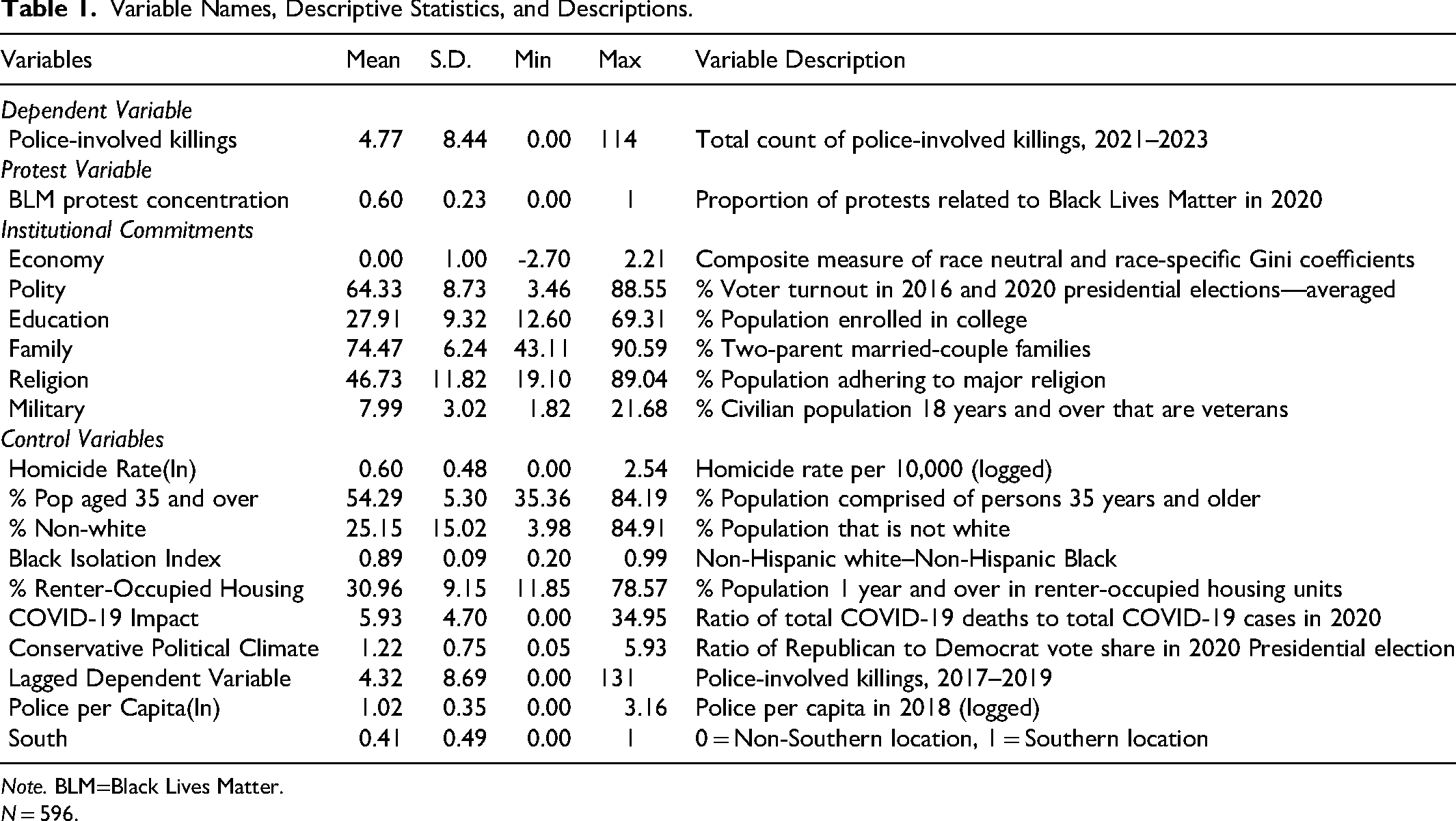
Table 1 presents the descriptive statistics and summary descriptions for all variables used in this study. On average, roughly five civilians were killed by police in each county, with almost 90 counties experiencing no deaths, while one county had a total of 114 deaths. About 60% of a county's protest activity in 2020 was related to the BLM movement, and 41% of sampled units were in the South. Non-whites comprised approximately a quarter of a county's population. The mean Black isolation index score of 0.89 indicates that a non-Hispanic Black person in an average county lived in a neighborhood where 89% of the population is non-Hispanic Black. The mean score of 1.22 for the political climate measure indicates that the average county is more conservative or right-leaning. In contrast, a score below 1 would suggest a more liberal or left-leaning context. Turning to the social institutions of interest, the composite economic measure ranges from −2.70 to 2.21, with higher scores indicating greater economic institutional dominance. The average voter turnout for the 2016 and 2020 presidential elections was roughly 64%, and about 27% of a county's population is enrolled in college or university. Seventy-four percent of families are married-couple families, and almost half (46.73%) of a county's population adheres to a major organized religion. Finally, military veterans comprise roughly 8% of an area's population.
Variable Names, Descriptive Statistics, and Descriptions.
Note. BLM=Black Lives Matter.
N = 596.
Direct Role of BLM Protest and Social Institutions
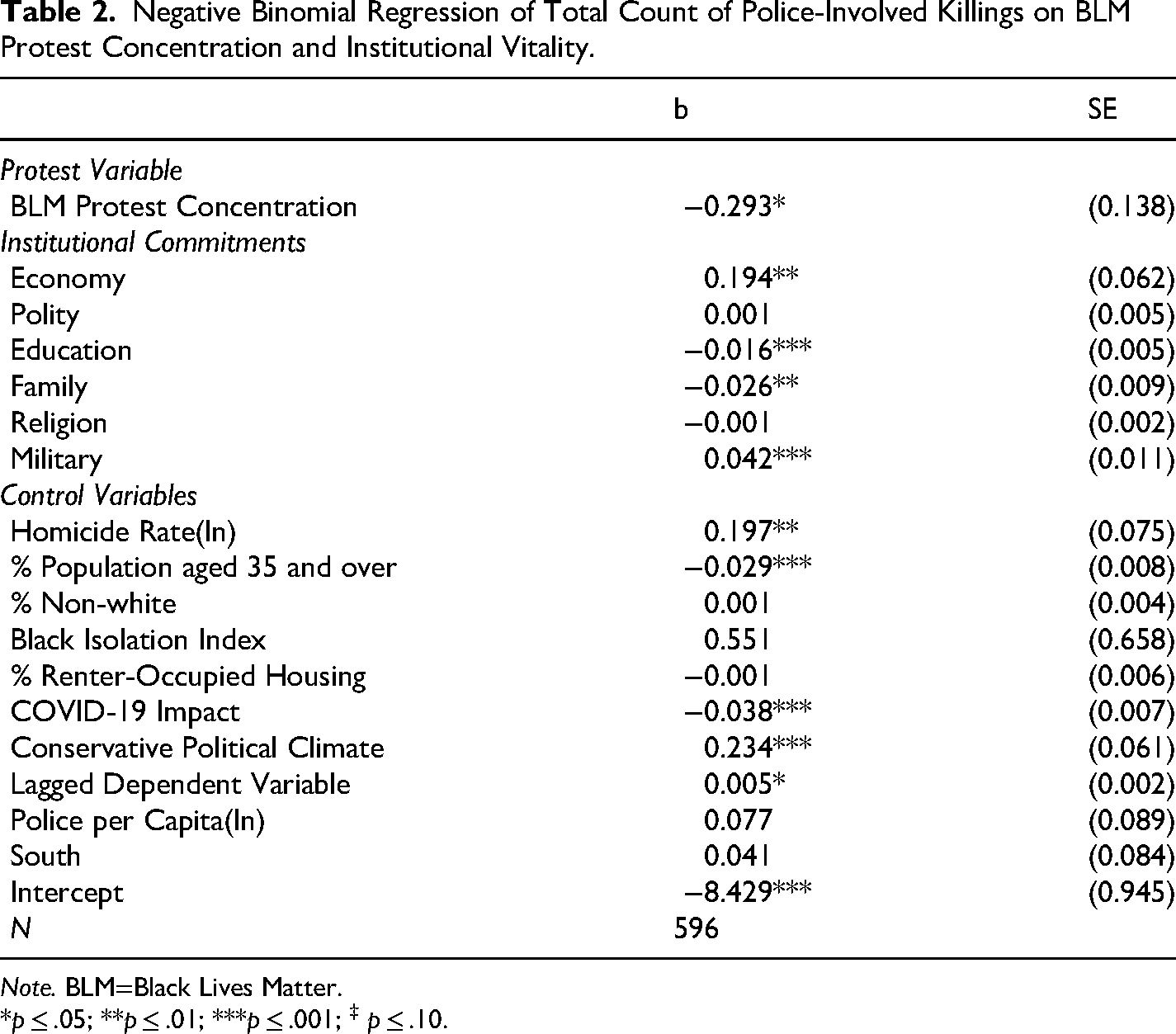
Table 2 presents findings from our negative binomial model predicting police-involved killings. Consistent with hypothesis 1, BLM protest concentration has an inverse and statistically significant association with police killings, net of other factors. This finding indicates that large American counties characterized by a higher intensity of BLM protest activity were more likely to have lower levels of police-involved killings in the years following the 2020 movement. Conversely, in counties where BLM protest activity was lower, incidents of officer-involved fatalities were more likely to occur in the ensuing period of 2021 through 2023. The coefficient of −0.293 suggests that a one standard deviation increase in the proportion of BLM protests (0.23 or 23%) is associated with a roughly 14% decrease in the relative incidence of police-involved killings post-2020. In other words, transitioning from a county where there was virtually no BLM protest activity to one where 50% of protests were affiliated with the movement would lead to a 35% reduction in the relative incidence of officer-involved fatalities. 6
Negative Binomial Regression of Total Count of Police-Involved Killings on BLM Protest Concentration and Institutional Vitality.
Note. BLM=Black Lives Matter.
*p ≤ .05; **p ≤ .01; ***p ≤ .001; ‡ p ≤ .10.
Next, we turn to the direct relationship between local institutional commitments and police-involved killings. Results in Table 2 reveal that higher levels of police-caused deaths are more likely to be found in counties where the economic institution dominates (b = 0.194, p ≤ .01), supporting hypothesis 2. The results also show that local non-economic institutions of education (b = −0.016, p ≤ .001) and the family (b = −0.026, p ≤ .01) both have a statistically significant and inverse relationship with police killings. These results are consistent with hypothesis 3 and suggest that incidents of fatal police encounters are less likely to occur in local areas where residents have a greater commitment to educational attainment and the traditional nuclear family structure. In contrast, measures representing non-economic institutions of the local polity and religion do not appear to be directly associated with police killings, with results indicating nonsignificant coefficients for voter turnout and religious adherence. As we explore the institutional role of the military, results indicate that in counties where there is a larger share of residents who are military veterans, there will also be significantly higher levels of officer-involved fatalities (b = 0.042, p ≤ .001).
The remaining regressors in Table 2 comprise our control variables. Measures representing a lag of the dependent variable, local homicide rates, and conservative political climate had a positive and significant connection to police-involved killings. Therefore, areas experiencing higher levels of these factors would be at increased risk of fatal police-citizen encounters. In contrast, results indicate that the likelihood of police-involved killings is significantly lower in areas with an older adult population and a greater impact of COVID-19 deaths. The controls representing non-white population composition, Black isolation, the extent of renter occupied housing, sworn police per capita, and Southern regional location demonstrated no detectable association with levels of lethal police violence.
Moderating Role of Social Institutions
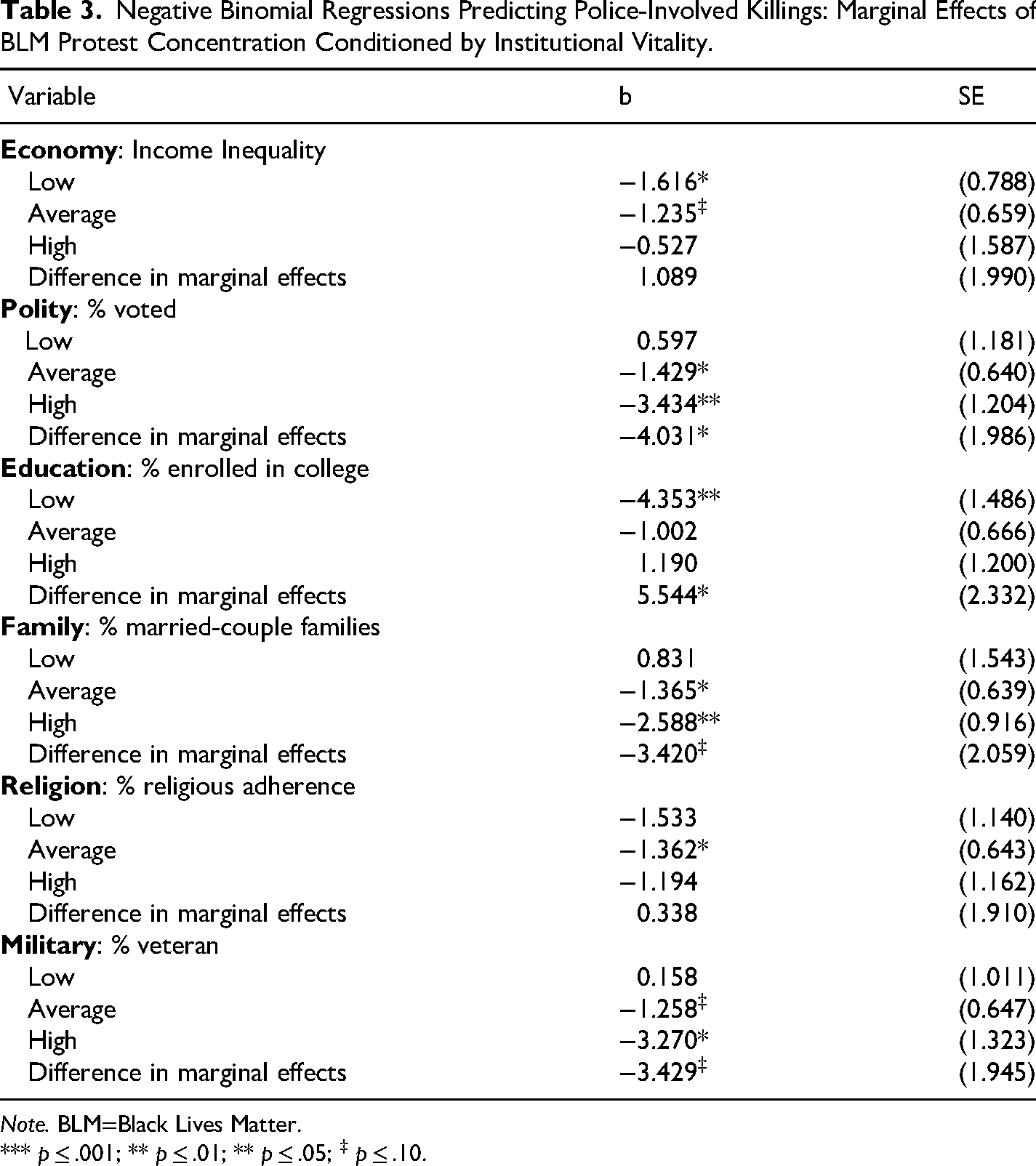
Table 3 shows the marginal effect of BLM protests on officer-involved fatalities as conditioned by each of the institutional measures for the economy, polity, family, education, religion, and military. These results are from models identical to those shown in Table 2, except that they include an interaction between BLM protest concentration and commitments to the different social institutions. Given the nonlinear nature of negative binomial regression, moderation cannot be assessed using the statistical significance of the interaction term, as is typically done in linear models (see Mize, 2019). Because the coefficients for the interaction have less direct meaning in these models, Table 3 presents the simple slopes for BLM's effect at low, average, and high levels of institutional presence and commitments. High and low scores are set at 1.5 standard deviations above and below the average score of each institution. Following the analytic method described above, we also present the difference between the coefficients at high and low levels of the moderator. A significant difference in these coefficients indicates that a given institution significantly moderates the relationship between BLM protests and police-involved killings.
Negative Binomial Regressions Predicting Police-Involved Killings: Marginal Effects of BLM Protest Concentration Conditioned by Institutional Vitality.
Note. BLM=Black Lives Matter.
*** p ≤ .001; ** p ≤ .01; ** p ≤ .05; ‡ p ≤ .10.
Focusing first on the moderating effect of polity, we see that higher levels of protest activity are related to significantly lower levels of police-involved killings in areas with average voter turnout (b = −1.429). The magnitude of this relationship is considerably larger and still significant for counties with high levels of voter participation (b = −3.434). Notably, the effect becomes nonsignificant in areas of low voter turnout. The significant difference in the marginal effects at high and low levels indicates that political commitment, as reflected in voting, significantly moderates the effect of BLM protests (b = −4.031, p < 0.05), consistent with hypothesis 4a. These results are also illustrated in Figure 1, where we see a steep, negative slope for the effect of BLM protest concentration when voter turnout is high, but a flat slope when voter turnout is low. We also find a conditioning effect of educational commitment, as illustrated in Figure 2. 7 Higher levels of protest activity are associated with lower levels of police-involved killings in counties where commitment to education is low. Still, the effect declines to essentially zero in counties with average or high levels of educational commitment. Again, the difference in these marginal effects, as seen in Table 3, is statistically significant. However, the direction of the relationship does not conform to expectations outlined in hypothesis 4a.

A simple slopes plot of the conditional effect between protest and voter turnout.
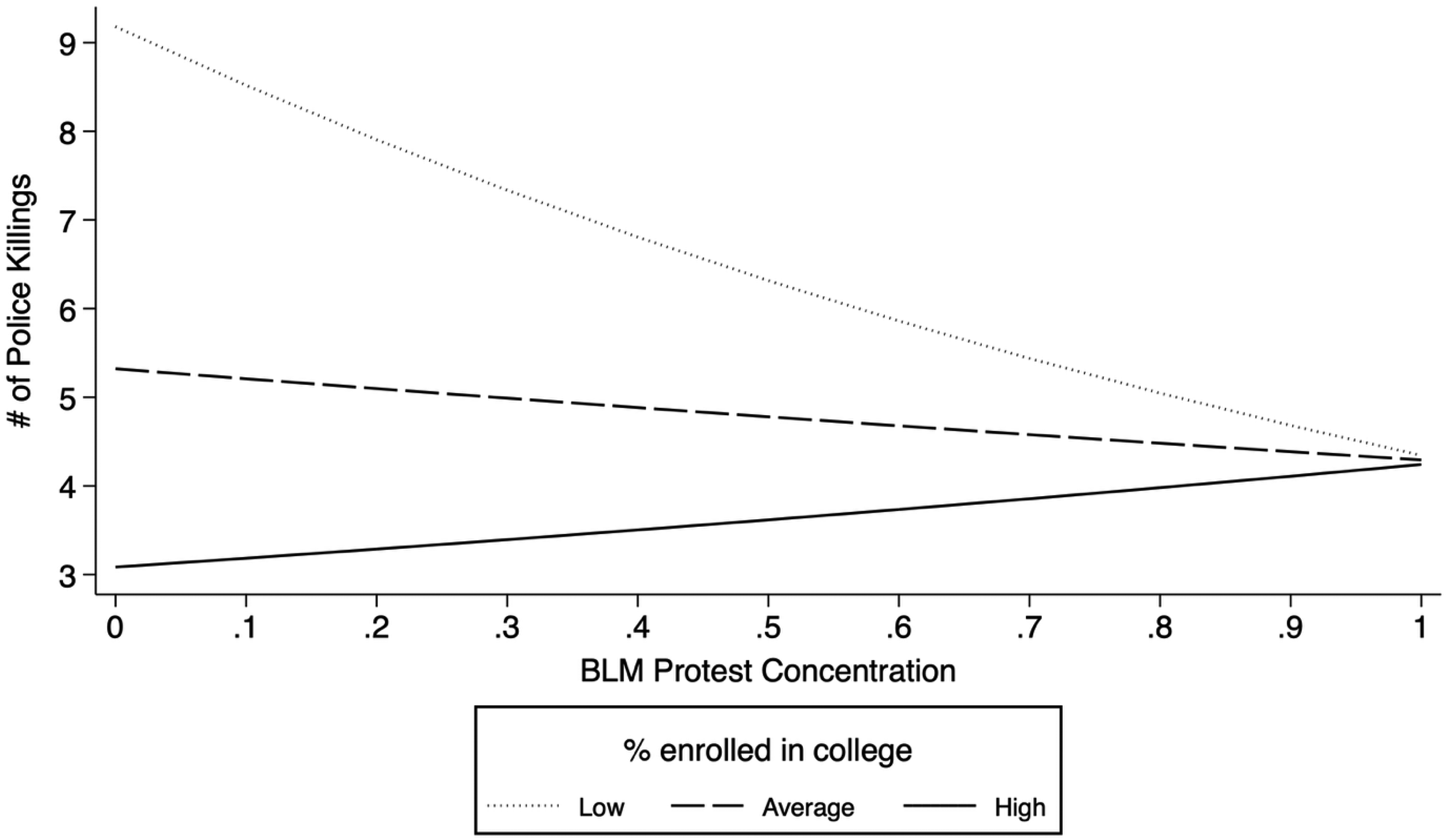
A simple slopes plot of the conditional effect between protest and education.
While not statistically significant at the conventional p ≤ .05 threshold, the results for measures of the family and military vitality offer suggestive evidence of moderating effects. The difference in marginal effects for both the family (p = .09) and military (p = .07) was marginally significant, indicating a potentially meaningful trend consistent with the study's theoretical expectations outlined in hypothesis 4a. As shown in Table 3, high levels of protest activity are associated with significantly lower levels of police-involved killings in counties where commitment to the family or military are high, with the size of effects slightly falling but remaining significant for counties with average levels of military veteran concentration or two-parent married-couple families—the effects decline to nonsignificance in counties where commitment to these institutions are low. Finally, the coefficient for differences in marginal effects for the remaining institutions of the economy and religion is nonsignificant, suggesting that neither institution moderates the relationship between BLM protests and subsequent police-involved killings.
Discussion
This study examined how BLM protest concentration and local institutional commitments shape variation in police killings of civilians, with particular attention to whether social institutions condition the relationship between protests and officer-involved fatalities. By integrating protest literature and theories of institutional anomie, social capital, and collective efficacy, the analysis provides nuanced insight into the macro-level factors associated with levels of deadly police-civilian interactions.
Several noteworthy findings emerged from our analysis. For example, results indicate that local social institutional commitments are directly associated with the geographic distribution of police killings. We find that counties with greater income inequalities are at an increased likelihood of experiencing police killings of civilians. This finding aligns with IAT arguments, which suggest that economic dominance in an area, as reflected in greater economic disparities, is likely to be accompanied by a formal social control regime characterized by “technical efficiency” and a “by any means necessary” policing model that expands the capacity of state actors to cause death to civilians. In addition, the study finds that local commitment to non-economic institutions, including education and family, significantly lowered the risk of police-involved killings. These findings also align with IAT's logic. Core non-economic social institutions of the family and education are likely to espouse values and norms rooted in constructive police-community relations. These non-economic institutions also provide informal social control by administering rewards and punishments through the social structure (Messner & Rosenfeld, 2012), which will likely reduce crime and the real or perceived need for formal social control via policing. Together, these findings build on the work of Messner and Rosenfeld (2001, 2012) and Weiss et al. (2020) by showing IAT's potential relevance in explaining formal social control meted out by state actors. While Weiss et al. (2020) analyzed institutional anomie and cross-national differences in incarceration rates, this study's findings demonstrate IAT's potential for understanding deadly police behavior at the subnational level.
Likewise, our analysis adds to the IAT literature and to research on police violence more broadly by evaluating how local commitments to the military shape police killings of civilians. The study's findings show that military institutional commitment has a direct and positive association with police killings, meaning that counties with a higher concentration of military veterans experience higher levels of deadly police–civilian interactions. While speculative, this seemingly lethal effect of the presence of military veterans could be due to several factors. For instance, veterans are more likely to have conservative attitudes (Chatagnier & Klingler, 2023). In the aggregate, these attitudes may also reflect or contribute to the conservative political climate of an area, which, as evidenced in this study, is itself positive and significantly associated with police-caused deaths. Another potential explanation for the direct role of military service is that, in areas of greater veteran concentration, local law enforcement agencies are more likely to recruit veterans and have them among their ranks (Gau et al., 2021). If the concerns raised in prior research are accurate (e.g., Gonzalez et al., 2019; Kondrat et al., 2025; McLean et al., 2020)—such as veterans’ propensity toward the use of violence, and veterans transmitting a warrior mindset, as well as antisocial and extremist values to law enforcement peers—one could reasonably expect veteran concentration and police violence to be connected. Future research would benefit from a more in-depth theoretical description and rigorous empirical analysis of the precise nature of the mechanisms that link veteran concentration with police killings of civilians.
Beyond our application of IAT and the direct associations of social institutions, this study underscores the importance of antipolice brutality movements in shaping lethal police violence. We find that counties with greater BLM protest concentration in 2020 were significantly less likely to experience deadly police-civilian encounters in the ensuing years, 2021 through 2023. This finding lends support to a growing body of research demonstrating that protests against police violence matter (Campbell, 2024; Olzak, 2021; Skoy, 2021). Protest movements, such as BLM in 2020, are critical conduits for civic engagement, which Rosenfeld et al. (2001) propose is a key indicator of social capital in a community. Trust and civic engagement likely go hand in hand. According to Brehm and Rahn (1997, p. 1002): “The more that citizens participate in their communities, the more they learn to trust others; the greater the trust that citizens hold for one another, the more likely they are to participate.” Therefore, initial levels of social capital may have led to protest actions in some local areas, while protest activities in other areas may have contributed to increased trust and cooperation. Either way, as Olzak (2021) would suggest, civic engagement expressed through BLM protests in 2020 may have empowered communities and fostered a sense of community solidarity. Moreover, the local concentration of BLM activity may have also offered meaningful political signaling to relevant authorities that a social problem exists (i.e., lethal police violence) and requires remedy—potentially increasing the likelihood of local policy adoptions and incentivizing behavioral changes involving lethal force.
Lipsky (1968) points out that protest movements are “usually comprised of individuals whose intense political activity cannot be sustained except in rare circumstances” (p. 1157). Therefore, a community's ability to achieve desired outcomes, such as reducing police violence, is likely to extend beyond the movement itself. Integrating our institutional perspective with theories of social capital and collective efficacy, we examined the conditional impact of BLM protests across varying institutional contexts. The results from our analyses of marginal effects demonstrated that an area's level of commitment to social institutions of education and polity moderated the association between BLM protest concentration and officer-involved fatalities. Marginal effects for institutions of the family and military approached conventional levels of statistical significance, suggesting potential moderating effects that warrant further investigation. Overall, these results suggest that protests are more likely to succeed in some contexts than others, primarily because of local differences in the vitality of specific social institutions.
Most notably, we find that higher levels of BLM protest activity are significantly associated with lower levels of officer-involved killings in counties where electoral participation rates are high. This finding highlights the importance of politics and voting in enhancing the effectiveness of protest activities. It also complements prior research by Reid (2024a) and Morris and Shoub (2024) concerning the electoral consequences of police violence. Morris and Shoub (2024) demonstrate that the mobilizing effects of deadly police-citizen encounters also include increased levels of voter turnout in affected communities. Informed by the issue ownership theory of voting, Reid (2024a) suggests that “insofar as fatal police violence is perceived to threaten community well-being these events should influence the probability of voting for the Democratic and Republican parties among residents who think that one party is more likely than the other to protect their communities from such violence in the future” (p. 2). In line with Democrats being generally regarded as the issue owners of civil rights and police reform, Reid (2024a) finds that voters living in areas characterized by lethal police violence were significantly more likely to vote for the Democratic Party in the 2020 presidential, State Senate, and House of Representatives electoral races. The moderating role of voting observed in the present study, considered alongside the findings of Reid (2024a) and Morris and Shoub (2024), signals the potential mark of community efficacy, reflected in established norms of trust and cooperation, as well as a shared capacity for coordinated political action to address local problems such as curbing lethal police violence.
In addition to voting, our finding that educational commitment moderates the relationship between protest and police killings is noteworthy. Contrary to expectations, a stronger educational context did not strengthen the efficacy of protests. Instead, demonstrations against police violence seemed more adept at reducing police killings in areas with low educational vitality. This result coincides with recent work by Zare et al. (2025), highlighting the role of social vulnerability as a key predictor of fatal police shootings. Although the Social Vulnerability Index (SVI) used by the authors encompassed 16 variables across four dimensions, the institutional vitality of education (or lack of education in an area) represents a core indicator of vulnerability. Our findings suggest that protests may function as an invaluable mechanism for safeguarding socially vulnerable communities from lethal police violence. While it falls beyond the scope of this study, future research would benefit from investigating how the full measure of the SVI moderates demonstrations against police violence and other types of social protests.
Like all research, this study has its limitations. First, although the study incorporates a wide range of potential confounders, we cannot rule out the possibility of omitted-variable bias. Unobserved factors, such as de-policing, may be related to police killings (Campbell, 2024). Likewise, broader socioeconomic conditions that may influence police violence may also be linked to factors such as voter turnout, college enrollment, and protest activity. We sought to mitigate this concern by including in our models controls theoretically relevant to socioeconomic conditions, such as measures of segregation, racial composition, and residential instability (see Peterson & Krivo, 2010). However, while these controls may reduce the risk of confounding, they cannot fully eliminate it. Second, the measures used to capture institutional commitments, though consistent with prior research (e.g., Maume & Lee, 2003; Reid & Stults, 2026), likely oversimplify complex cultural and structural processes. Given the long-standing difficulties in obtaining direct cultural and anomic measures (Rosenfeld & Messner, 1997), future studies would do well to employ alternative institutional measures and to incorporate more robust data on structures such as religion.
Finally, while our findings suggest that the 2020 BLM protest movement was consequential in reducing subsequent incidents of police-involved killings, we cannot claim to have demonstrated the full range of implied causal mechanisms outlined by Olzak (2021). Nevertheless, our objectives are more modest; we have drawn upon institutional insights and theories of social capital and collective efficacy to develop a reasonable explanation for why protests seem more effective in some areas and less effective in others. Future research is encouraged to extend this analysis by evaluating the precise nature of the mechanisms linking the 2020 BLM movement to reductions in lethal police violence. Moreover, scholars are also encouraged to examine the long-term consequences of the movement, not only as it relates to police policy and practice but also concerning its association with community and structural violence, as well as anti-Black hate crimes and backlash (Krupenkin et al., 2025) violence associated with racial threat and interracial political conflict (Reid, 2024b).
Despite its limitations, this study's results suggest that an area's social institutional landscape is indeed highly relevant to our understanding of police violence and the efficacy of protest. On the one hand, protest can help shield socially vulnerable communities from state violence. On the other hand, communities with greater institutional vitality—reflected in their family dynamics, residents’ military service, and especially citizens’ electoral participation—appear to benefit from an increased capacity for collective problem-solving.
Supplemental Material
sj-docx-1-raj-10.1177_21533687261455683 - Supplemental material for When Do Protests Matter? The Direct and Moderating Role of Social Institutions in Curbing Police-Involved Killings
Supplemental material, sj-docx-1-raj-10.1177_21533687261455683 for When Do Protests Matter? The Direct and Moderating Role of Social Institutions in Curbing Police-Involved Killings by Jonathan C. Reid, Dulce Angelica Espinoza and Anna Estelle Kelley in Race and Justice
Footnotes

Funding
The authors received no financial support for the research, authorship, and/or publication of this article.
Declaration of Conflicting Interests
The authors declared no potential conflicts of interest with respect to the research, authorship, and/or publication of this article.
Supplemental Material
Supplemental material for this article is available online.
Notes
Author Biographies
References
Supplementary Material
Please find the following supplemental material available below.
For Open Access articles published under a Creative Commons License, all supplemental material carries the same license as the article it is associated with.
For non-Open Access articles published, all supplemental material carries a non-exclusive license, and permission requests for re-use of supplemental material or any part of supplemental material shall be sent directly to the copyright owner as specified in the copyright notice associated with the article.
