



Abstract
Institutional anomie theory (IAT) argues that crime rates will be higher in areas characterized by a value complex that elevates the economy over non-economic institutions. Drawing on the Du Boisian tradition and race-relations scholarship, we argue that the racialized nature of American society influences racial differences in aggregate-level institutional commitments. These racial differences may, in turn, confound the “institutional balance of power” in race-neutral US–based IAT research. We present and test a racially informed IAT approach that directly addresses the racial structure of American society, therefore fostering a more rigorous evaluation of the validity and relevance of IAT. We use race-neutral and race-specific data from multiple sources to examine the relationship between race, social institutions, and homicide offending. Results from our county-level analysis demonstrate distinct institutional effects across race-specific African American and White IAT models, suggesting preliminary support for a race-sensitive approach. Our race-neutral results were generally consistent with IAT's expectations; however, this may not always be the case, depending on the racial balance of the sample. At a general level, the results of our study highlight the relevance of a racially informed IAT approach for enhancing evaluations of the theory in subnational research and explaining race-specific patterns of offending.
“[I]t is beginning to be widely recognized that in crime, the criminal is not the only one guilty; you and I share in the guilt if we have not given him as a child an education, furnished him with a place to play, and seen that his body was nourished; we are guilty if as a man he was not allowed to do honest work, did not receive a living wage, and did not have the proper social environment.”—W. E. B. Du Bois (1920, p. 173)
This study extends the IAT tradition by directly integrating the construct of race into its basic analytic framework. Informed by Black Criminology and Du Boisian insights, we present and empirically test a race-sensitive IAT approach. In the following sections, we emphasize how a racialized society produces transgenerational material and immaterial inequalities that emanate from and establish a system of racial stratification. We argue that the internal logic of this system creates and recreates distinct levels of race-based institutional imbalances that, in turn, engender unique racial patterns of criminal offending. At the US county level, our analysis explores the relationship between racial stratification, social institutions, and lethal criminal violence using data from FBI Supplementary Homicide Reports (SHR), the American Community Survey (ACS), and other data sources. We conclude with a discussion of the implications of this analysis for theory and research.
Crime and the American Dream
In Crime and the American Dream, serious criminal conduct in the United States is believed to be a function of the interdependent relationship between American culture and social structure. For Messner and Rosenfeld (2012), culture and social structure are rooted in social institutions—the “building blocks” of society that reinforce values and norms (the culture) and patterned relationships among persons and groups (the social structure). Messner and Rosenfeld ultimately contend that social institutions regulate human behavior by fostering internal controls through culture and external controls through the social structure. The authors identify the economy, family, education, and polity as critical institutions influencing individual conduct and criminality.
The theorists orient arguments regarding the internal and external control of criminal conduct around the “institutional balance of power” (Messner & Rosenfeld, 2012), a concept intended to capture the sometimes conflicting nature of institutions. Social institutions generally set out to accomplish unique objectives and responsibilities at the cultural and structural levels. Nevertheless, these same institutions exist in a symbiotic environment where the functioning of a given institution has consequences for the functioning of other institutions. Messner and Rosenfeld (2012) posit that economic dominance over all other institutions characterizes the interdependent relationship between the economy and non-economic institutions. They believe this economic dominance occurs through the devaluation of non-economic institutional functions and roles, the accommodation to economic requirements by other institutions, and the penetration of economic norms into other institutional domains (see Messner & Rosenfeld, 2012, pp. 80–87 for a more extensive discussion). The enfeebled non-economic institutions are subservient to economic functions and demands, leading to an institutional balance of power tilted toward the economy at the cultural and social structural levels.
Messner and Rosenfeld (2012) propose that economic dominance precipitates crime via two overlapping processes. First, as it relates to culture, the dominance of the economy relative to other institutions fosters an anomic environment that impinges on the socialization functions of non-economic institutions. Despite prescribing distinct orientations and different responsibilities, non-economic institutions find common ground in promoting moral legitimacy in the means of social action. In the context of crime, non-economic institutions express values and norms that proscribe illegal conduct. In contrast, the economic institution calls forth cultural orientations encapsulated in the American Dream that foster values and norms encouraging unlawful actions. Messner and Rosenfeld (2012) claim that the ethos of the American Dream creates the primary metric for measuring achievement, as it hyperinflates the goal of monetary success to the extent that it overpowers non-economic goals. In addition, the capitalist nature of the American Dream engenders an unlimited receptivity to innovation, promoting an atmosphere for achieving goals “by any means necessary.” Such a combination of goals and means leads to anomie—a situation in which action tends to be governed by pure technical expediency (Messner & Rosenfeld, 2012). Put simply, the anomic pressures of the American Dream inhibit the development of strong internal constraints against crime.
Messner and Rosenfeld (2012) next highlight the function of non-economic institutions in providing external forms of social control associated with social structure. Specifically, external control is achieved through individuals’ active involvement in institutional roles and by institutions’ administration of rewards and punishments. The very concept of institutional “roles” suggests restraint. Roles consist of behavioral expectations harnessed to social statuses. The performance of social roles suggests that a person's behavior is governed, at least to some degree, by constraints external to the individual. However, to the extent that non-economic institutions are devalued relative to the economy, the attractiveness of non-economic roles will be diminished. This reality leads to a widespread decline in non-economic institutional involvement and, thus, weak institutional controls. A lack of control provided by institutional relationships thus parallels and complements the lack of control at the cultural level of social norms (Messner & Rosenfeld, 2012). As a whole, Messner and Rosenfeld argue that the economy's cultural and structural dominance will likely diminish internal and external controls, resulting in high rates of serious crime.
Despite being developed to explain the relatively high overall crime rates in the United States, Messner and Rosenfeld (2012) assert that the institutional anomie perspective outlined in Crime and the American Dream also provides a valuable framework for understanding African Americans’ overrepresentation in violent criminal offending. They develop this argument in Crime and the American Dream by describing the weakened African American family structure in impoverished inner-city areas, where “the roles of men as husbands, fathers, and helpmates have been attenuated” (Messner & Rosenfeld, 2012, p. 93). They highlight survey research suggesting that underprivileged African Americans often overemphasize cultural prescriptions from the American Dream, “creating a commodity worship that even the strongest institutions would have difficulty keeping under control” (Messner & Rosenfeld, 2012, p. 94). For these reasons, Messner and Rosenfeld claim that African Americans are intensely exposed to the American Dream's economic pressures, further undermining the socialization and social control functions of non-economic institutions. Higher levels of African American violent criminal offending, therefore, result from the same kinds of institutional forces implicated in the overall crime rate.
Toward a Racially Informed IAT
The current formulation of IAT treats the construct of “race” purely as a sociodemographic characteristic of individuals that “can condition the interpretation of the American Dream and influence the level of participation in different institutional role[s]” (Applin & Messner, 2015, p. 37). This conceptualization of race is valuable, and the interpretation of African American offending in Crime and the American Dream is entirely plausible. However, a critical issue emerges that has not yet been adequately addressed. We contend that the overarching framework of IAT remains “sociologically incomplete” in a crucial respect: IAT overlooks a key insight central to the Du Boisian tradition—namely, that race is built into the very organization of American society (Du Bois, 1898, 1899; Gabbidon, 2007; Unnever et al., 2019; Unnever & Gabbidon, 2011; Werth, 2024; see also Cullen et al., 2025).
From this vantage point, race is embedded in the very structure of institutions. As the founder of Black Criminology (Unnever et al., 2019), W. E. B. Du Bois, beginning in the late 1800s, advanced arguments connecting racist sociopolitical and economic processes to racially disparate social problems (Du Bois, 1898). Du Bois argued that social conflict emanating from historical forces such as slavery and failed reconstruction had engendered a social environment of racial injustice and exclusion for African Americans that promoted structural strain and rebellion manifested through crime—and, in particular, violent crime (Du Bois, 1898, 1899; see also Werth, 2024 for a comprehensive discussion on Du Bois's theories of social disharmony and racial injustice). Du Bois's arguments did not show crime through the lens of racial invariance, which assumes racial differences in offending result from African Americans being exposed to the same criminogenic risk factors as Whites, but just more intensely (Unnever et al., 2019). Instead, he highlighted the distinct race-specific conditions that African Americans experienced as the linchpin undergirding Black crime rates.
Although Messner and Rosenfeld (2012) emphasize the institutional forces that impact crime rates, they do not explicitly account for the race-based discrimination system (Du Bois, 1898, 1899; Feagin, 2013; Feagin & Ducey, 2018; Reskin, 2012) that racially structures these institutions. This oversight is consequential to the IAT framework because it does not fully recognize the “objective conditions” or “socially structured realities” through which choices to participate in or refrain from crime are made (Bernburg, 2002, p. 739; see also Unnever & Gabbidon, 2011). Recognizing that racial actors populate society within a racially structured institutional landscape reframes theoretical interpretations and reorients empirical assessments of IAT. Therefore, the following discussion, building on W. E. B. Du Bois's foundational insights, is organized to move us toward a racially informed IAT by demonstrating how racial stratification in the United States has endured since Du Bois's time and its potential impact on IAT research.
American Racial Structure and Institutional Anomie
Historians, social scientists, and legal scholars have considered race to be one of the most salient forms of social stratification since the founding of the United States (Alexander, 2010; Bonilla-Silva, 1997; Durant & Knottnerusi, 1999; Feagin & Ducey, 2018; Golash-Boza, 2016; Massey, 2007; Omi & Winant, 2014; Reid, 2025, 2024a; Sampson et al., 2018; Smedley & Smedley, 2012). Roughly 70 years after Du Bois published The Philadelphia Negro, the National Advisory Commission on Civil Disorders (1968) warned that the United States was moving toward two societies, one Black and one White, separate and unequal. Pronouncements of this nature signal a societal context where the economic, social, and political landscape is structured along racial lines. Bonilla-Silva (2015), like Du Bois before him, argued that this racial structure is hierarchical, with Whites being ascribed a dominant status garnering societal rewards and African Americans assigned a subordinate status characterized by disadvantage.
Racial inequalities are endemic in such a social system and are cyclically reproduced through more or less overt institutional practices. For example, chattel slavery, Jim Crow laws, the urban ghetto, and mass incarceration form a constellation of “peculiar institutions” that have established and perpetuated Black disadvantage over many generations (Alexander, 2010; Omi & Winant, 2014; Tonry, 2011;Wacquant, 2017). Other less overt mechanisms, such as deindustrialization and the out-migration of middle-class African American families from inner-city areas, have also played a vital role in upholding the racial hierarchy (Wilson, 1987, 1996, 2009). Further still, persistent racial residential segregation has exacerbated racial inequalities and reified a social environment of Black concentrated disadvantage (Peterson & Krivo, 2010). Wilson (1987) contends that “concentration effects” or concentrated disadvantage—the effects of living in an overwhelmingly impoverished area—fosters a host of social dislocations (such as family disruption, joblessness, and crime) that have significant implications on the life chances of African Americans. In a national study of over 20 million children, Chetty et al. (2018) found that African American youth often reside in residential settings that provide meager support for economic advancement across generations. They reveal that “Fewer than 5 percent of black children currently grow up in areas with a poverty rate below 10 percent and more than half of black fathers present. In contrast, 63 percent of white children grow up in areas with analogous conditions” (p.5).
Although many factors have contributed to Black disadvantage, racial patterning in the spatial distribution of resources is perhaps the most consequential in contemporary America. Massey and Denton (1993) demonstrate how systematic actions, such as discriminatory practices in real estate and mortgage lending, ushered African Americans into circumscribed geographic settings, where they are spatially and socially isolated from mainstream society. Rothstein (2017), in The Color of Law, builds on the important works of Massey and Denton and other scholars (e.g., Hirsch, 1983; Kushner, 1980) to highlight what he considers the myth of de facto segregation and shows with compelling evidence the role of US federal, state, and local governments in aiding and sponsoring de jure segregation. Using data from 1970 to 2010, Rugh and Massey (2014) reconciled claims expressing the post-civil rights era end to race-based residential separation (see Glaeser & Vigdor, 2012), revealing that despite a decline in average levels, segregation remains notably high and especially persistent for African Americans (see also Logan et al., 2004; Logan & Stults, 2011; Wilkes & Iceland, 2004).
The processes that underlie this racial–spatial divide have resulted in African American and White neighborhoods that are not only separate but vastly unequal. Persistent segregation has concentrated advantages in White areas and concomitantly centralized disadvantages in minority communities. The racial differences in economic and non-economic structures are so substantial that the average context in which Whites live is considerably better than the most privileged context of African American communities (Logan & Stults, 1999; Peterson & Krivo, 2005, 2010; Sampson, 2009; Sampson et al., 2018; Sampson & Neil, 2024; Sampson & Wilson, 1995). The racial hierarchy manifested in the spatial configuration of communities disproportionately places African Americans in areas characterized by inferior government services, weaker institutions, and economic deprivation (Peterson & Krivo, 2010). Using census tract data from a nationally representative sample of US cities, Peterson and Krivo (2010) illustrate this residential disadvantage. They found that 7% of White neighborhoods were “highly” or “extremely poor,” whereas a staggering 78% of African American areas reached those thresholds. In addition to poverty, the researchers also found significant racial inequalities in joblessness, family disruption, and educational attainment.
Taken together, the social dislocations that overwhelm African American communities are not indicative of an all-encompassing race–neutral social system. Instead, these enduring conditions point to a racially structured reality that permeates virtually every aspect of society (Reskin, 2012), including the social institutions outlined in Crime and the American Dream.
Structural and cultural forces—both historical and contemporary—have combined to establish a racial stratification system in which communities provide racial groups differential access to what Messner and Rosenfeld term “non-economic resources for conformity” (2006, p. 139). As described in Crime and the American Dream, non-economic institutions such as the family, education, and polity are instrumental in curbing criminogenic economic forces. We posit, however, that within aggregate units (e.g., a city or county), African Americans and Whites may have different levels of commitment to these institutions. This situation will likely occur because of the racial residential disadvantages discussed above. A segment of research in the communities and crime literature has notably emphasized the relevance of structural conditions in providing the context within which cultural responses to chronic economic and racial subordination are developed (e.g., Burt, 2018; Massey & Denton, 1993; Sampson et al., 2018; Sampson & Bean, 2006; Sampson & Wilson, 1995; Small & Newman, 2001; Wilson, 2009, 2010). Informed by this literature, it is reasonable to expect structural features such as residential segregation and Black concentrated disadvantage to foster community contexts that give way to cultural values and attitudes that delegitimize or at least provide a basis for disinterest in prosocial institutional commitments. Despite their relative infrequency, ethnographic studies generally support this expectation.
For example, Anderson's (1989) account of cultural adaptations in depressed Philadelphia inner-city areas, composed mainly of African Americans, shows how macrostructural constraints hinder the formation of strong family bonds, in part through creating an “oppositional culture” that orients persons away from marriage and family life. Anderson (1989) reports that: The lack of gainful employment opportunities not only keeps the entire community in a pit of poverty, but it also deprives young men of the traditional American way of proving their manhood, namely, supporting a family. They must thus prove their manhood in other ways. Casual sex with as many women as possible, impregnating one or more, and getting them to “have your baby” brings a boy the ultimate in esteem from his peers and makes him a “man.” Casual sex is therefore not so causal but fraught with social significance for the boy who has little or no hope of achieving financial stability and so can have no sense of himself as caring for a family. (p. 77)
Given the logic that community contexts shape norms and values that influence institutional commitment, African American areas, which disproportionately face structural constraints, will likely have comparatively reduced institutional commitments to not only the family but also to other prosocial non-economic institutions. This general understanding would suggest an important reason to incorporate race into IAT research. Moreover, Messner and Rosenfeld (2012) draw heavily from Roberts Merton's (1938) strain theory, wherein he acknowledged that his perspective was not entirely race-neutral. As Merton (1938) notes in an often-overlooked footnote of his classic work: Certain elements of the Negro population have assimilated the dominant caste's value of pecuniary success and advancement, but they also recognize that social ascent is at present restricted to their own case almost exclusively. The pressures upon the Negro which would otherwise derive from the structural inconsistencies we have noticed are hence not identical to those upon lower class whites. (p.680)
Racialized Institutions and American Homicide
Messner and Rosenfeld (2012) contend that a crucial scope condition of IAT is its explanation of “violations of criminal law involving significant bodily injury,” with homicide being the most severe outcome on that continuum (Messner & Rosenfeld, 2012, p. 49). The individual and social consequences of homicide cannot be overstated and are outlined in detail in Crime and the American Dream. Moreover, Messner and Rosenfeld's (2012) emphasis on lethal violence has led numerous scholars to test IAT using different homicide outcomes (e.g., Batton & Jensen, 2002; Hughes et al., 2015; Kim & Pridemore, 2005; Maume & Lee, 2003; Stults & Baumer, 2008).
When Messner and Rosenfeld published the first edition of Crime and the American Dream in 1994, violent crime rates in the United States had reached historic levels. What was true then is true today—African Americans, particularly in impoverished urban settings, are disproportionately represented as offenders of lethal criminal violence (Rosenfeld & Fox, 2019). From 1999 through 2008, the rate of homicide offending was 6.7 to 8.1 times higher for African Americans than for Whites (Cooper & Smith, 2011). Furthermore, despite African Americans comprising only 13% of the general population, African American offenders were responsible for approximately 38% of all homicide offenses for the decade-long period of 2010 to 2020 (FBI, 2021). These trends suggest that the racial differentials in levels of criminal violence highlighted by Messner and Rosenfeld in 1994 constitute an ongoing social reality.
The enduring racial inequalities observed in both homicide offending and macrostructural conditions raise a critical question for the IAT perspective: How do race-based differentials across key social institutions connect with racial patterns of lethal violence? In our view, the answer to this question is rooted in the same “institutional balance of power” theorized by Messner and Rosenfeld (2012). Again, IAT expects offending rates to be higher in areas characterized by an institutional imbalance where non-economic institutions insufficiently regulate criminogenic economic pressures. Economic pressures are a universal constant that impacts all Americans, regardless of their social origins or social location (Messner & Rosenfeld, 2012). We expect a system of racial stratification to create social conditions that tend to weaken African American non-economic institutions relative to that of Whites. Considering that enfeebled non-economic institutions allow for economic dominance in the institutional balance of power, we can, in turn, expect African Americans to be more vulnerable than Whites to the criminogenic forces of the economy. On this account, race-specific rates of criminal homicide offending can be reasonably interpreted as a function of the interplay between the racial stratification system and the institutional balance of power. Note that “race” in this framework should not be construed as a direct cause of homicide or any other social outcome. Instead, “race is a marker for the accumulation of social and material adversities that both follow from and constitute racial status in America” (Sampson et al., 2018, p. 16).
Our primary contention in this paper is that a rigorous evaluation of the validity and relevance of IAT must directly address the racial inequalities endemic to the US social structure. By measuring the institutional balance of power in a race-neutral fashion, prior research (e.g., Chamlin & Cochran, 1995; Maume & Lee, 2003; Piquero & Piquero, 1998; Stults & Baumer, 2008) has overlooked the likelihood that the strength of a given institution—economy, education, family, or polity—will vary by race. Likewise, the strength of commitment to the economy relative to other institutions, and therefore the potential for those non-economic institutions to regulate the anomic pressures of the economy, may vary in a given area for African Americans and Whites. Thus, we argue that it is crucial to measure the race-specific strength of social institutions and assess their relevance in explaining race-specific rates of homicide for African Americans and Whites. To that end, the current study examines a fundamental claim: We posit that race-specific economic and non-economic social institutions and their institutional imbalances significantly predict race-specific homicide offending. In the subsequent sections, we provide the first empirical assessment of this claim.
Data and Methods
We draw on three sources of county-level data to test our hypotheses. Our homicide measures come from FBI SHR. Total and race-specific voting information comes from TargetSmart, a private supplier of voter data. Our remaining variables come from single-year ACS estimates. Homicide rates are measured for 2017, and all independent variables are measured for 2016. We limit our sample to counties with at least 65,000 residents because disclosure avoidance rules from the Census Bureau prevent the release of single-year ACS estimates for smaller populations. Additional confidentiality requirements prevent the release of group-specific information—such as for Blacks and Whites, separately—when the group population is small. Therefore, our analytic sample consists of 328 counties from across the United States.
Dependent Variables
Our dependent variables are total, Black, and White homicide counts for 2017. SHR data suffer from a high rate of missing information, primarily due to unknown characteristics of offenders. The SHR files we use, provided by Fox and Fridel (2019), account for missing data using a multistage approach (Fox & Swatt, 2009). They first use multiple imputation to account for missing items such as age, race, sex, and relationship with the offender. Next, a weighting procedure matches the age, sex, and race distribution of victims in the SHR data to distributions in the homicide mortality data from the National Center for Health Statistics. Finally, SHR cases are weighted to match the published state-level homicide estimates from the FBI. These weighted homicide incidents are then aggregated at the county level.
Independent Variables
Economic and Non-economic Institutions
We measure the dominance of the economy and the anomic pressure associated with that dominance using the Gini index of household income inequality. This is a standard indicator in past IAT research used to operationalize the strength and dominance of the economy (Maume & Lee, 2003; Messner & Rosenfeld, 1997; Savolainen, 2000). High-income differentials in an area indicate that market dynamics are largely unchecked by other institutions and thus serve as a proxy for the dominance of the economy (Hirtenlehner et al., 2013). We measure this separately for total, African American, and White households. Though prior research has exclusively used a race-neutral measure of income inequality, we argue that, especially given the high levels of segregation in the United States, within-race inequality may be a better indicator of the localized economic dominance faced by individuals.
According to IAT, non-economic social institutions can regulate the dominance of the economy, thus reducing the relationship between economic dominance and criminal offending. Following prior research and furthering our goal of directly incorporating racial differences into the theory, we measure the race-specific strength of three social institutions—family, education, and polity. Messner and Rosenfeld (2012) argue that families can provide emotional support, particularly in response to economic pressures, and family roles can provide an alternative measure of self-worth and identity. We measure the institution of the family using the percentage of the population 15 years and older that is married. As Piquero and Piquero (1998) explain, education exposes residents to an institution that values the pursuit of knowledge as a goal that can be separated, at least in part, from the desire to secure a high-paying job. This value orientation can serve as a buffer against the anomic and crime-producing pressures of the economy. Following prior research, we measure the institution of education using the percentage of the population enrolled full-time in college (Kim & Pridemore, 2005; Piquero & Piquero, 1998). Finally,Messner and Rosenfeld (2012) conceptualize polity as a means of mobilizing and distributing power to provide safety and attain the goals of the broader collectivity. We follow prior research by operationalizing this concept as the percentage of people 18 and older who voted in the 2016 presidential election (Kim & Pridemore, 2005; Maume & Lee, 2003; Schoepfer & Piquero, 2006).
It is important to reiterate that we measure the strength of these social institutions separately for African Americans and Whites. We argue that the relevance of overall levels of commitment to economic and non-economic institutions and the imbalance between them may be confounded by racial differences in those commitments. Any inconsistency and lack of support in prior IAT research may be partly due to the exclusively race-neutral approach to measuring institutional commitments. A low divorce rate in an area, for example, may be equally representative of White and Black commitment to family as an institution, but underlying racial variance in the divorce rate is also a possibility. If divorce rates vary between racial groups, an analysis of overall rates of divorce and offending may produce null findings, even when race-specific divorce rates are strongly predictive of race-specific offending.
Control Variables
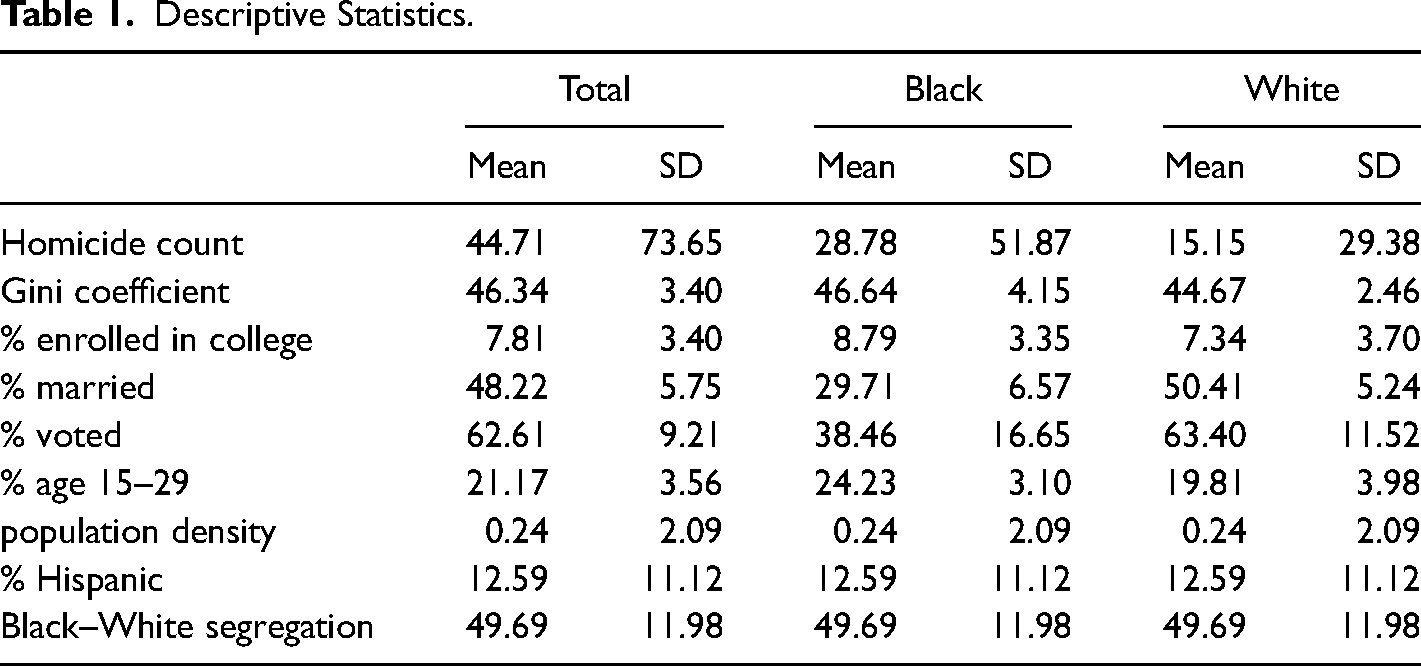
We control for a set of variables identified in prior research as associated with homicide offending. These include the percentage of the population that is 15–29 years old, population density measured as total population per square mile, percent Hispanic, and the residential segregation between Black and White residents measured with the index of dissimilarity. Descriptive statistics for all variables—total and race-specific—are provided in Table 1.
Descriptive Statistics.
Analytic Strategy
Homicide is a relatively rare event, even at the county level. Therefore, we estimate negative binomial regressions, an appropriate method for a non-normally distributed count-based–dependent variable with overdispersion. Depending on the model, we use the population size—total, Black, or White—as an offset term that standardizes homicide counts by the population size, similar to modeling a crime rate. Our analysis begins by replicating typical IAT race-neutral models and examining the effect of the four social institutions—economy, family, education, and polity—on total homicide offenses. We follow this with similar models but disaggregated by race. By comparing these two sets of results, we can assess the importance of considering racial differences in the strength of social institutions. However, a thorough evaluation of IAT also requires an examination of the conditioning influence that non-economic institutions may have on the crime-generating dominance of the economy. Again, we first evaluate this without considering racial differences, as is typical in IAT research, followed by a race-specific analysis.
The typical approach to modeling conditional effects requires the researcher first to construct a multiplicative term representing the product of the two interacting variables and then include that term in the regression model. The size and significance of the coefficient for the multiplicative term determines the presence, direction, and extent of the conditional effect. In the language of marginal effects, this approach estimates the first derivative of the effect of the interaction term, which can be understood as the predicted change in the effect of x1 on the dependent variable given a one-unit increase in x2 (Buis, 2010). In our models, it would indicate whether the hypothesized positive effect of economic dominance on homicide is weaker in areas where non-economic institutions are stronger. Though this approach is appropriate for linear regression models, it is not valid for negative binomial models because the first derivative of an effect in a nonlinear model is not constant across its entire range (Ai & Norton, 2003; Buis, 2010; Karaca-Mandic et al., 2012; Mize, 2019; Mustillo et al., 2018). Ai and Norton (2003, p. 129) explain that the interaction effect “cannot be evaluated simply by looking at the sign, magnitude, or statistical significance of the coefficient on the interaction term when the model is nonlinear.”
Instead, we test for conditional effects in our negative binomial models by evaluating the difference in the marginal effects using the following process. First, we estimate the marginal effects of the Gini coefficient on the homicide rate at high and low levels of the non-economic institution (measured as 1.5 standard deviations above and below the mean) while setting all other variables to their mean. Second, we calculate the difference between these two marginal effects. Third, we estimate a bootstrapped standard error for this difference in marginal effects using 1,000 replications. Fourth, we evaluate the statistical significance of the interaction by examining bias-corrected confidence intervals around the difference in the marginal effects. Bias-corrected bootstrapped confidence intervals are preferable because conventional standard errors tend to overestimate the likelihood of a genuine interaction effect (Assmann et al., 1996).
Results
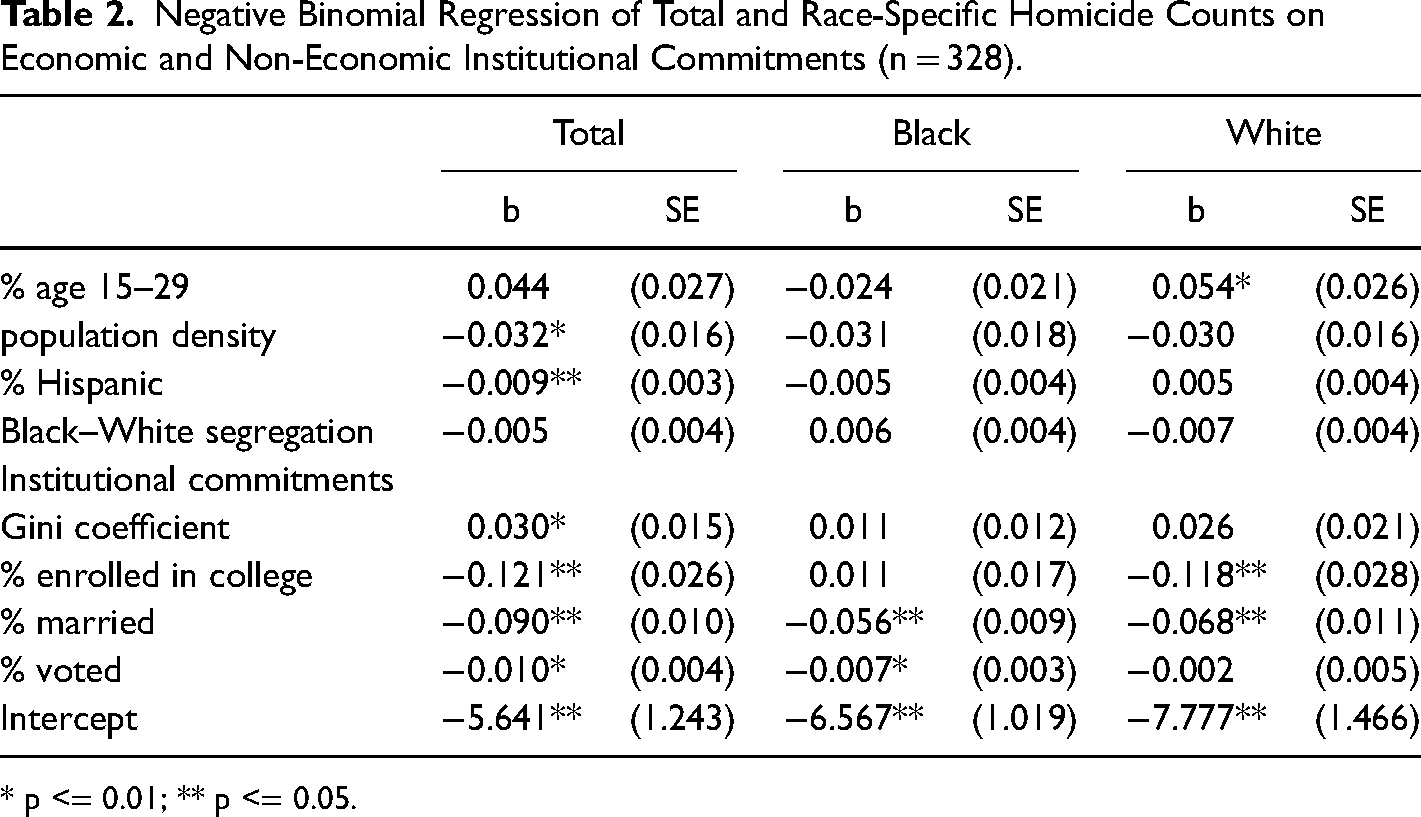
The first model in Table 2 shows results when a race-neutral approach is considered. The model reveals that counties with higher population densities and a higher percentage of Hispanic residents tend to have lower homicide rates. The main relationships of interest to this study—the effects of institutional commitments on homicide offending—are all statistically significant and in the expected directions for the total population, suggesting preliminary support for IAT's central proposition when a race-neutral approach is taken. Specifically, counties with higher levels of commitment to the economy have higher rates of homicide, while counties with higher levels of commitment to the non-economic institution of education, family, and polity have lower rates of homicide.
Negative Binomial Regression of Total and Race-Specific Homicide Counts on Economic and Non-Economic Institutional Commitments (n = 328).
* p <= 0.01; ** p <= 0.05.
The next two models in Table 2 assess IAT's central propositions separately for Blacks and Whites. The results from these race-specific models show that support for IAT's predictions does indeed change when analyzed separately by race. For example, in the Black-specific model, the effects of population density and percent Hispanic remain inversely related to county homicide rates, but both now fail to achieve statistical significance. The effects of the institutional commitment measures on homicide offending also differ somewhat between the Black model and the race-neutral model. For example, the effect of commitment to the economy on homicide offending remains in the predicted positive direction but is no longer statistically significant. Similarly, the effect of commitment to education, which was statistically significant in the predicted negative direction in the race-neutral model, is not statistically significant in the Black model. The effects of both commitment to family and political action on homicide offending remain statistically significant and negative in the Black model, but both effects are reduced in magnitude relative to the race-neutral model.
The findings from the White-specific model in Table 2 also show a number of differences compared to the race-neutral model. For example, the effect of percentage of residents aged 15 to 29 on homicide offending remains in the predicted positive direction but now reaches statistical significance. Conversely, the effect of population density on homicide offending remains in a negative direction but now fails to reach statistical significance. Additionally, the effects of percent Hispanic and Black–White segregation on homicide offending remain statistically unrelated to homicide offending. The effects of the institutional commitment measures also differ in the White-specific model as compared to the race-neutral model. For example, the effect of economic commitment remains in the predicted positive direction but fails to achieve statistical significance in the White model. Similarly, the effect of political commitment remains in the predicted negative direction but fails to achieve statistical significance in the White model. The effects of commitment to education and family remain statistically significant and negative in the White model, but both effects are slightly reduced in magnitude compared to the race-neutral model.
In short, although the race-neutral model presented in Table 2 is notable for providing preliminary support for IAT, the main focus of the current paper is the contention that the effects of institutional commitments on homicide may vary by race. Although, as expected, the race-specific models in Table 2 show differences compared to the race-neutral model, the race-specific models appear to provide less support for IAT than the results that do not take race into account. However, it is important to note that IAT asserts that it is the balance of institutional commitments—rather than discrete direct effects—that should impact criminal offending. In other words, non-economic institutional commitments should moderate the effect of the economy on criminal offending. This more nuanced argument is addressed in Table 3.
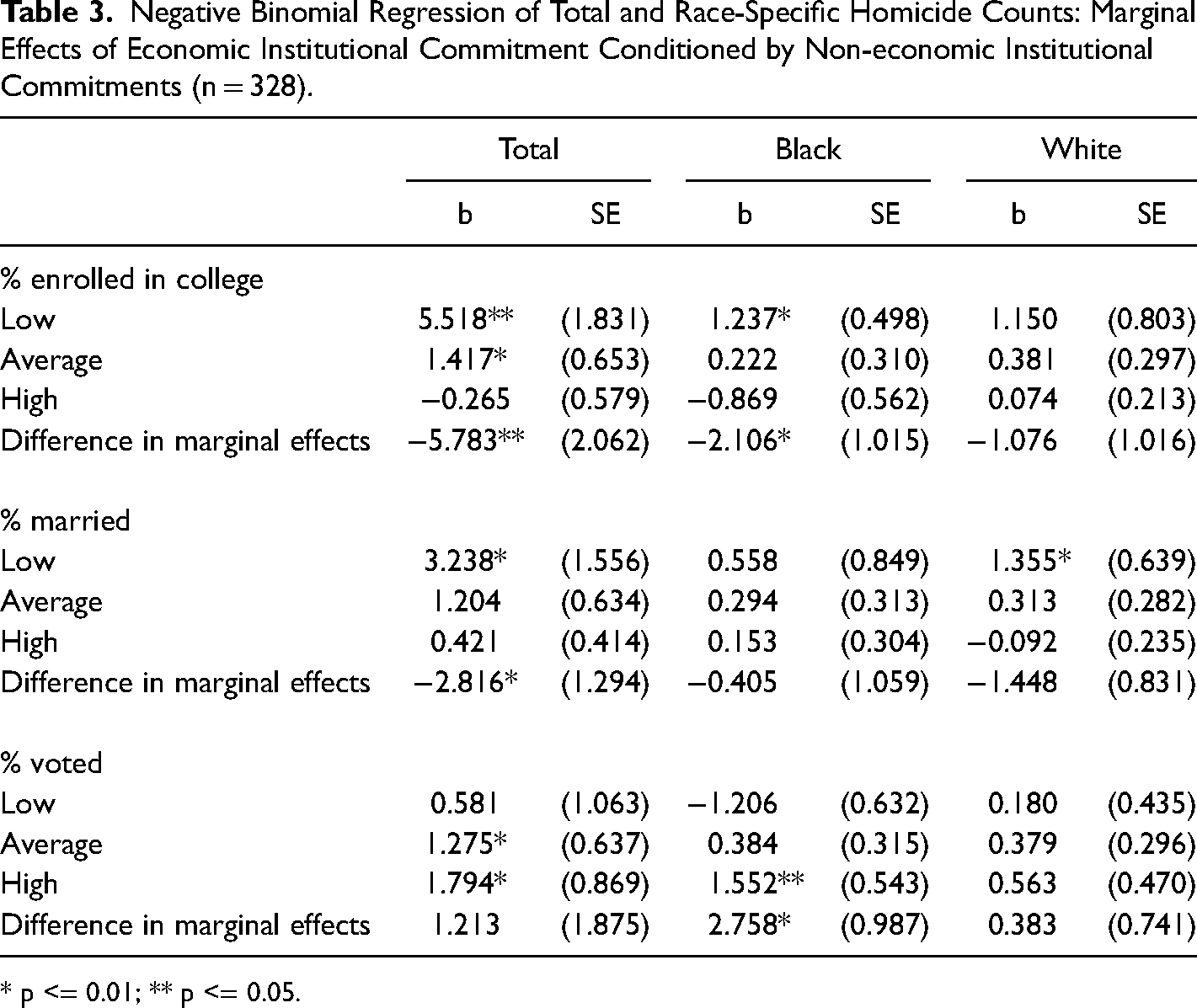
Negative Binomial Regression of Total and Race-Specific Homicide Counts: Marginal Effects of Economic Institutional Commitment Conditioned by Non-economic Institutional Commitments (n = 328).
* p <= 0.01; ** p <= 0.05.
Table 3 shows the marginal effect of economic commitment on homicide offending as conditioned by each of the non-economic institutions—education, family, and polity. These results are from models identical to those shown in Table 2, except that these new models include an interaction between economic commitment and the relevant non-economic institution. As noted earlier, since negative binomial models are nonlinear models, moderation cannot be assessed using the statistical significance of the interaction term as is common with linear models. Since the coefficients for the interaction have less direct meaning in these models, in Table 3 we present the simple slopes for the effect of economic commitment at low, average, and high levels of the non-economic institution. Following the analytic method described above, we also present the difference between the coefficients at high and low levels of the moderator. A significant difference in these coefficients indicates that commitment to the non-economic institution significantly conditions the effect of commitment to the economy.
Focusing first on the moderating effect of education in the race-neutral model in Table 3, we see a significant positive effect of economic commitment on homicide offending when commitment to education is low (b = 5.518). However, this effect is considerably smaller, though still significant, for counties with average levels of educational commitment, and the effect declines to nonsignificance in counties with high commitment to education. The significant difference in the marginal effects at high and low levels indicates that educational commitment significantly moderates the effect of economic commitment, as expected by IAT. These results are illustrated in Figure 1 where we see a steep, positive slope for the effect of the Gini coefficient when college enrollment is low but a flat slope when college enrollment is high. We find a similar conditioning effect of commitment to family, illustrated in Figure 2. High levels of economic commitment are associated with high levels of homicide in counties where the marriage rate is low, but the effect declines to essentially zero in counties where commitment to family is high. Again, the difference in these marginal effects is statistically significant. In contrast, the results for the percentage who voted indicate that the effect of economic commitment on homicide offending is not conditioned by political commitment.
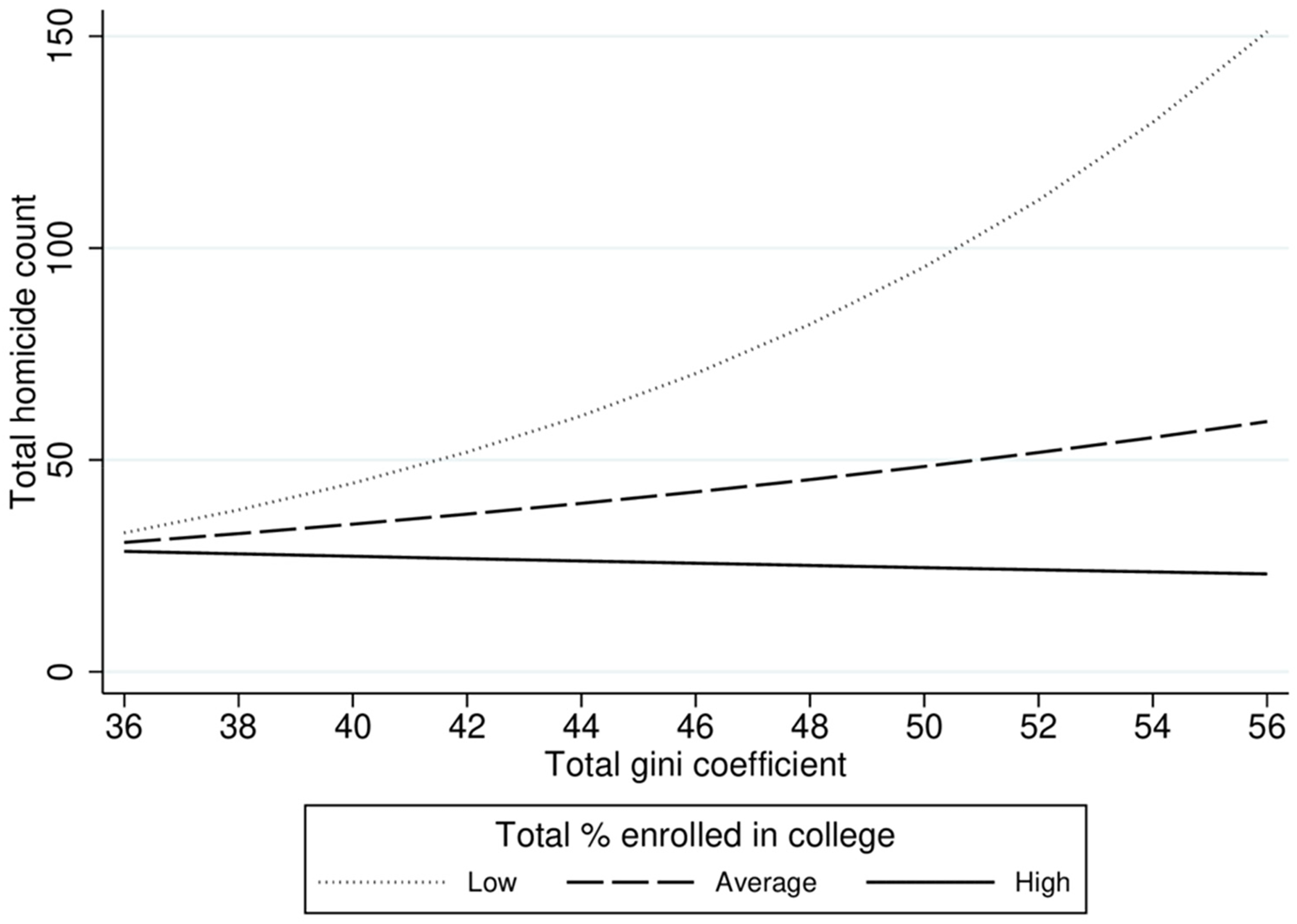
A Simple Slopes Plot of the Conditional Effect between Economy and Education for the Race-Neutral Sample.
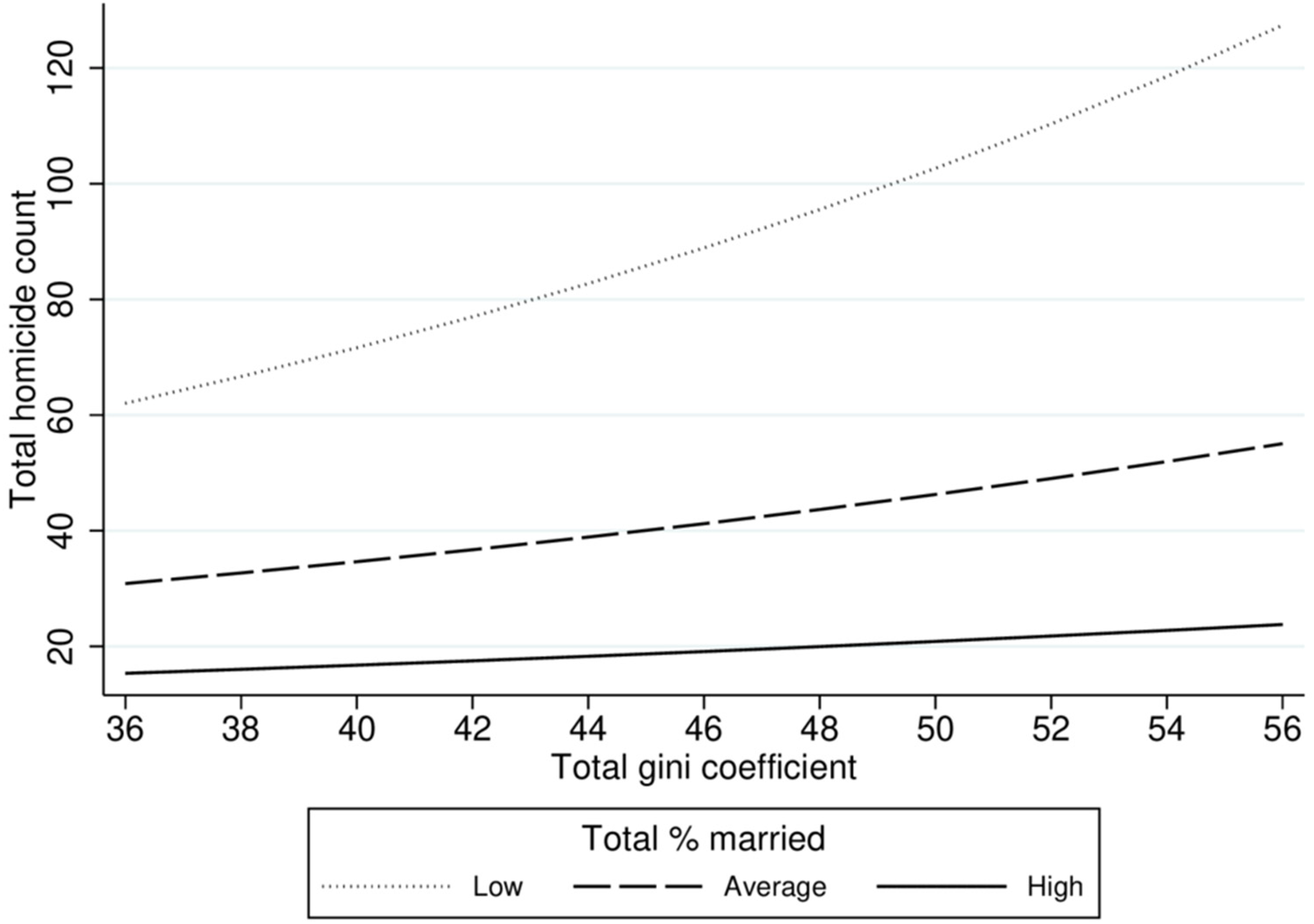
A Simple Slopes Plot of the Conditional Effect between Economy and Family for the Race-Neutral Sample.
Results for our main arguments are found in the race-specific models in Table 3. The Black model is similar to the race-neutral model for the interaction between commitment to the economy and commitment to education; the difference in marginal effects is statistically significant and is illustrated in Figure 3. Again, the effect of economic commitment is positive and significant in counties where the marriage rate is low, but the effect declines to nonsignificance at average and high levels of marriage. The Black model also finds a significant difference in marginal effects for the interaction between commitment to the economy and political commitment and is illustrated in Figure 4. This is a notable finding because the race-neutral model did not find a statistically significant difference in marginal effects for this relationship. Though the significant interaction between economic and political commitment is expected by IAT, the direction of the marginal effects is unexpected. The significant positive coefficient at high levels of voting (b = 1.552), paired with the negative coefficient at low levels (b = −1.206), indicates that high economic commitment is associated with higher homicide levels, but only in counties where political commitment is also high. IAT expects an opposite set of findings. Finally, although the race-neutral model found a significant difference in marginal effects for the interaction between economic commitment and family commitment, the difference in marginal effects for this relationship does not achieve statistical significance for the Black-specific model.
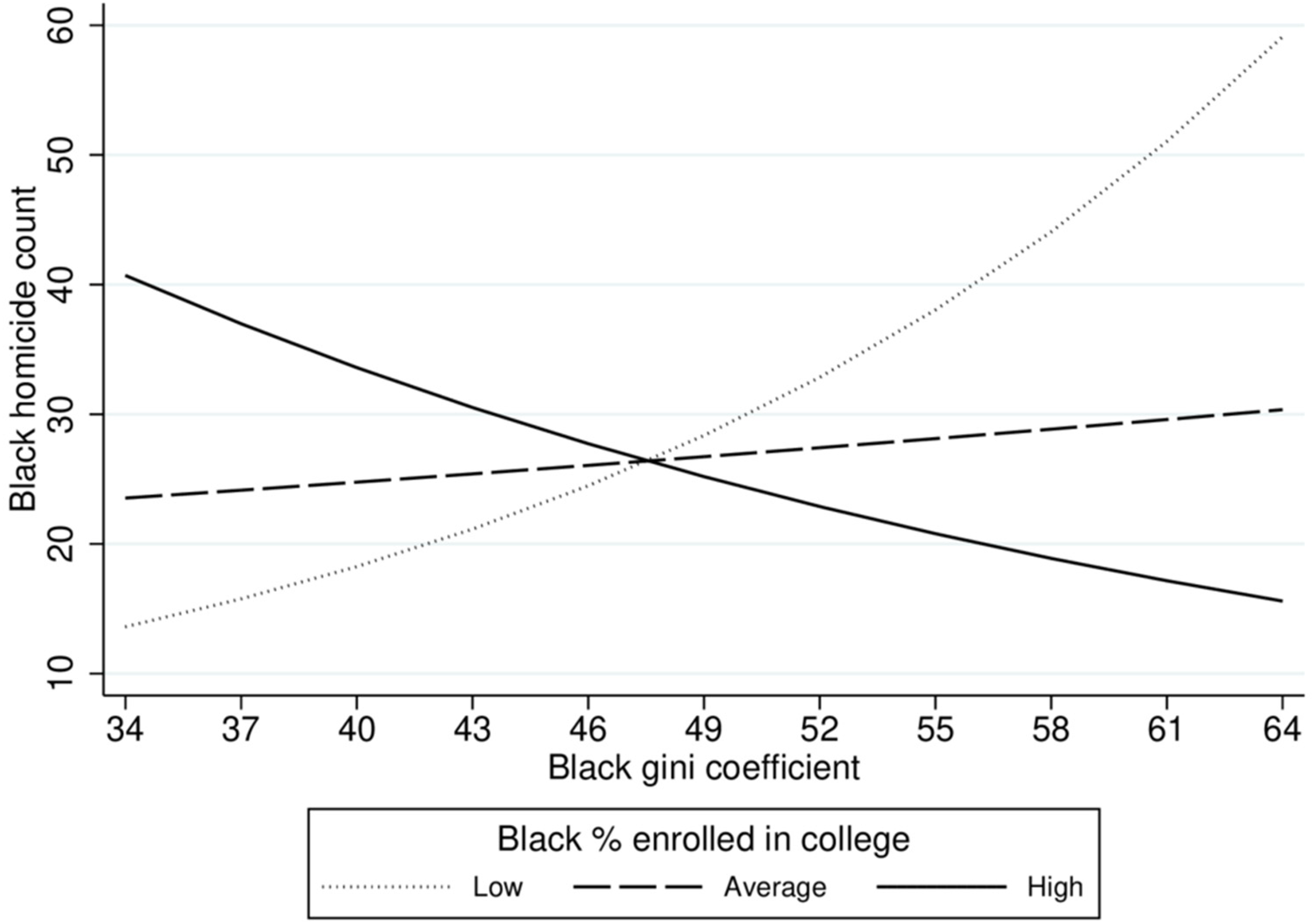
A Simple Slopes Plot of the Conditional Effect between Economy and Education for the Black Sample.
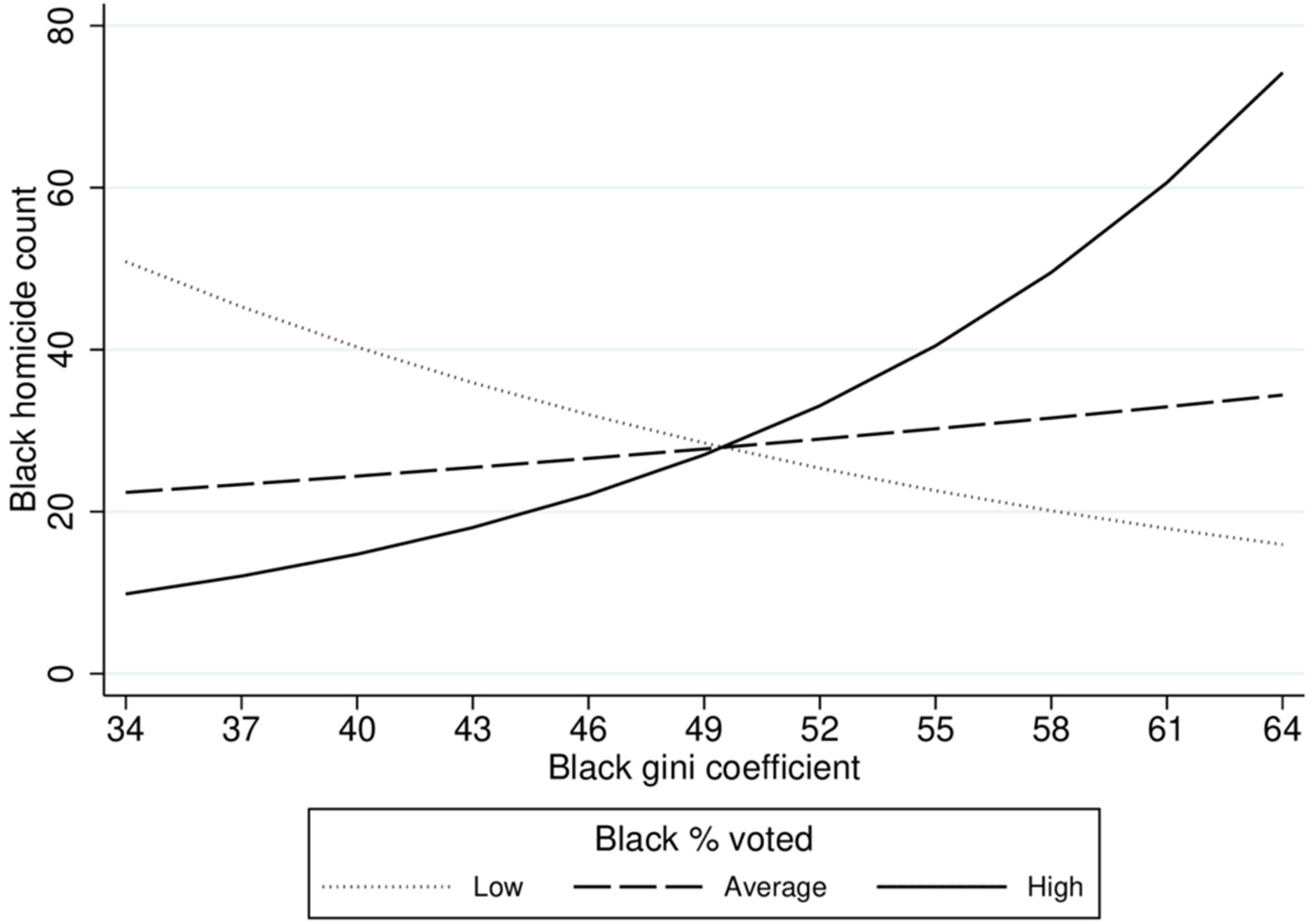
A Simple Slopes Plot of the Conditional Effect between Economy and Polity for the Black Sample.
The White-specific model in Table 3 continues to show that there are important differences in support for IAT when models are separated by race. Specifically, although the race-neutral model finds significant differences in marginal effects for the economic/education and economic/family interactions and the Black model finds significant differences in marginal effects for the economic/education and economic/political interactions, the White model finds that none of the differences in marginal effects reach statistical significance. In short, the conditional models presented in Table 3 provide some support for IAT's typical race-neutral approach; however, when the conditional models are separated by race, only the Black model continues to provide support for IAT's contention that non-economic institutions can temper the effect of economic commitment on criminal offending.
Discussion
The current study contributes to the IAT tradition by being the first to integrate race into its basic analytic framework. The theory, as formulated by Messner and Rosenfeld (2012) in Crime and the American Dream, treats race as a sociodemographic attribute of individuals that can affect how actors perceive cultural prescriptions and perform institutional roles. Though informative, conceptualizing race in this manner overlooks the role of systemic racism and its relationship to crime. W. E. B. Du Bois, the founder of Black Criminology, has long established race as a mechanism in the organization of American society (Du Bois, 1898, 1899; Gabbidon, 2007; Unnever et al., 2019; Werth, 2024). Du Bois, in his writings, analyzed how a history of slavery and failed reconstruction had established a social environment of exclusion and economic, social, and political subordination of Black communities (Du Bois, 1898, 1899). The racial oppression that Du Bois experienced and studied would suggest that the basic elements of social organization outlined in Crime and the American Dream—namely, culture and social structure—are themselves racialized in meaningful ways. Through a Du Boisian lens and evidenced by the continuing legacies of Black–White racial inequality, we do not live in a race-neutral environment. As such, IAT and related empirical tests at the subnational level should not presume otherwise. Informed by empirical and historical realities of the United States, the current study extends IAT scholarship by testing a Du Boisian racially informed approach to evaluate the theory's predictive power for explaining county-level homicide offending.
Summary of Empirical Support
We began our empirical assessment by replicating the classic race-neutral IAT model, examining the effects of the economy and three non-economic institutions (family, education, and polity) on total homicide offending. We followed this with a similar set of models disaggregated by race. Based on IAT, we expected homicide offending rates to be higher in counties with a greater commitment to the economy and lower in counties with a greater commitment to non-economic institutions. Table 4 provides a summary of the empirical support for our IAT models. The table shows that results varied across models, yielding mixed support for IAT, especially in racially disaggregated analyses.
Summary of Empirical Support for IAT Models.
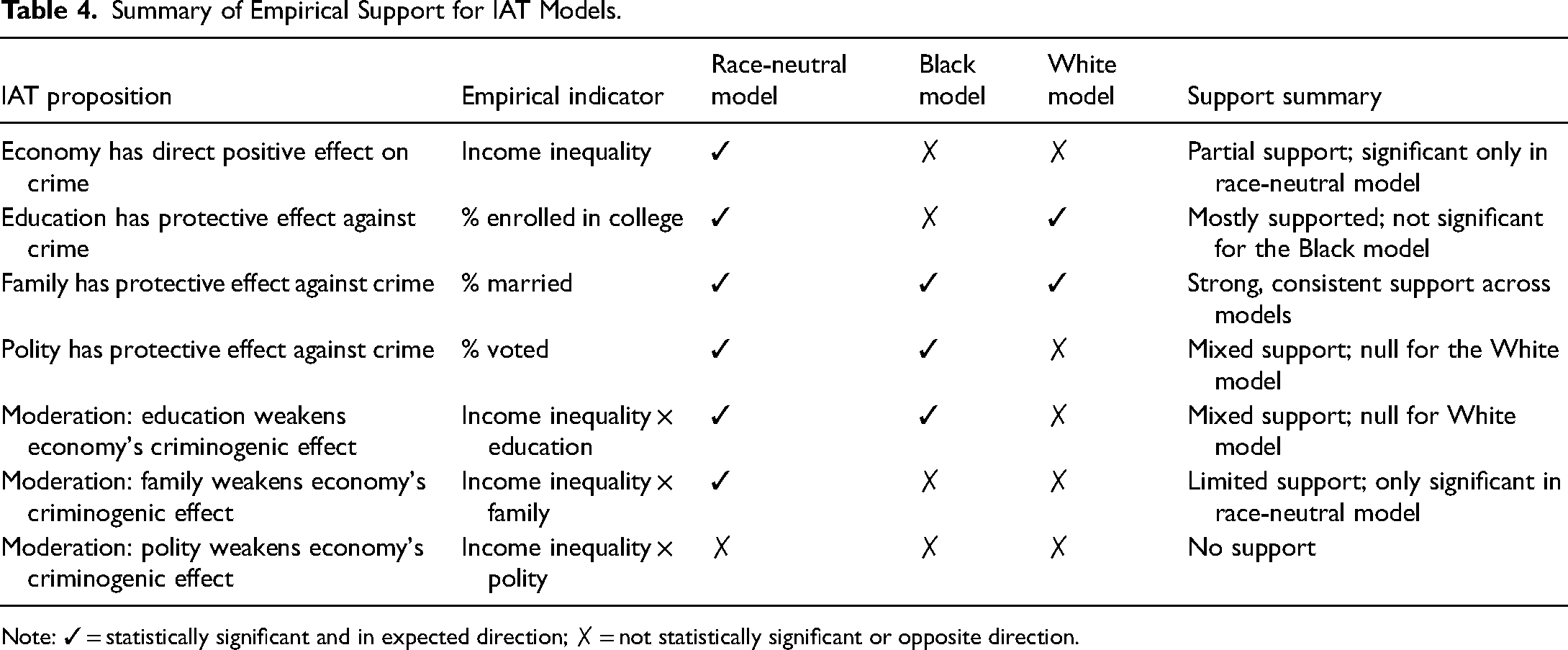
Note: ✓ = statistically significant and in expected direction; ✗ = not statistically significant or opposite direction.
The race-neutral model demonstrated the most support for the theory. However, our findings of distinct institutional effects across racially disaggregated models corroborate our claim that race, as a structural marker, can manifest divergent institutional dynamics between groups. Our race-specific findings show that the effect of institutional commitments on homicide offending and the effect of institutional imbalance vary between African Americans and Whites. This variability is noteworthy because it may explain mixed results in previous IAT research that exclusively used all-encompassing race–neutral samples (e.g., Chamlin & Cochran, 1995; Maume & Lee, 2003; Piquero & Piquero, 1998; Stults & Baumer, 2008). Although our race-neutral results were generally consistent with IAT's expectations, we caution that this may not always be the case, depending on the racial balance of the sample. Accounting for racial differences in the strength of commitments to social institutions can foster more reliable assessments of IAT. Accordingly, our findings call for a renewed appreciation of the racial stratification system in empirical tests of IAT at the subnational level. Moreover, it would be advisable to include IAT in macro-level tests that focus on collective efficacy, social disorganization, and concentrated disadvantage, for example. Though our findings are strong enough to support further investigation into a racialized IAT, it may be instructive to judge them in the context of other theories.
Interpretations and Implications
Our race-specific findings support research that has emphasized the need to incorporate features of social stratification into the IAT framework. Despite drawing heavily from Robert Merton's (1938) anomie perspective, Messner and Rosenfeld (2012) place limited emphasis on key Mertonian insights that link the motivations and opportunities for crime to the social stratification system (Bernburg, 2002; Messner & Rosenfeld, 2006). The current analysis identifies race as a critical aspect of social stratification, yet other notable features may also socially structure levels of criminal offending. One such feature is gender. Applin and Messner (2015) recently proposed a “gender-sensitized” IAT framework that focuses on men's overwhelming engagement in the economic sphere versus women's disproportionate involvement in familial roles. For Applin and Messner, the gender differentials in economic and familial engagement, alongside cultural understandings of gender, amplify pressures toward economic dominance in the institutional balance of power for men and mitigate these pressures for women, thus producing gender disparities in crime rates. To date, no study has incorporated gender in empirical evaluations of IAT. However, like our application of race, the role of gender stratification can be assessed through a series of multiple group models, and we encourage its application in future research.
In acknowledging the racialized nature of institutions, the current study offers a valuable framework for understanding the race-specific patterns of violent criminal offending. Specifically, the relative disadvantage of African American institutional structures is likely to be at the core of African Americans’ overrepresentation in homicide offending. Against the backdrop of IAT, greater commitment to non-economic institutional structures should help offset the economy's criminogenic effect on Black crime rates. This interplay was especially apparent for the non-economic institution of education. Our operationalization of education as the percentage of the Black population enrolled full-time in college suggests that increased engagement in higher education conveys respect for formal learning and the pursuit of knowledge. Note that such values may be transmitted to other African American community members. However, a more definitive evaluation of this explanation requires survey research with African American college enrollees and is a worthwhile goal for future research. Our findings nonetheless suggest that education can curb the criminogenic influence of economic dominance in African American offending rates and thus help to reduce the racial gap in rates of lethal violence.
The crime-producing moderation effect between the polity and the economy starkly contrasts with the results for education. The unexpected finding that political commitment enhances the effect of economic commitment on homicide does not necessarily negate the polity's relevance for counterbalancing the criminogenic forces of the economy. Such a finding could instead be attributed to our operationalization of the polity. The measures we used for the non-economic institutions of education and the family inherently denote a substantial and meaningful commitment to these structures. Enrolling in college requires years of dedication to schooling, and one can argue that marriage generally embodies support for family values. However, our polity measure—the Black voting rate in the 2016 Presidential election—might be a less effective indicator of meaningful institutional commitment. We recognize that voting in a political contest can take considerable time and effort. However, unlike our family and education measures, the singular act of casting a ballot does not necessarily indicate an earnest commitment to the polity. Instead, a measure embodying more long-term and consistent engagement with civic duties, such as the degree of volunteer activity, may be more appropriate in capturing the polity's vitality. Data limitations precluded such a measure of volunteerism for our analysis.
It is also possible that Black voting is tied to broader racial dilemmas that impact crime rates. African American civic and political participation has been systematically repressed for much of American history (Alexander, 2010). However, the victories of the civil rights era have given African Americans a greater capacity to participate and address grievances within the sociopolitical sphere. Despite being a few decades removed from the civil rights era, the most prominent examples of contemporary Black political mobilization, including the Black Lives Matter (BLM) movement, continue to echo themes of racial injustice, institutional racism, and inequality (Reid & Craig, 2021). Mass protest events spurred by BLM differ from other forms of political action, such as voting. However, depending on the sociopolitical climate of an area, the impetus for both activities may, to some degree, align (Reid, 2024b). Given the racially divisive context of the 2016 Presidential election cycle (Bobo, 2017) coupled with sweeping racial inequalities across the urban landscape, it is reasonable to suggest that high voting rates among African Americans could indicate anger and frustration with issues such as racial inequality and systemic racism. That anger, especially when paired with economic commitment, may yield higher levels of violence. African Americans’ unique history in the sociopolitical domain calls for further theoretical and empirical inquiry into the relative importance of various aspects of the polity in protecting against economic pressures that contribute to African American offending.
Limitations
Although the preceding analysis contributes meaningfully to the IAT literature, it has limitations. For instance, our analysis only explores the non-economic institutions outlined in Crime and the American Dream, specifically the family, education, and polity. However, race-specific commitments to other non-economic institutions, such as religion, health care, and law, may have important implications for mitigating the economy's criminogenic effects along racial lines. Future studies can expand this racially informed IAT appraisal to include these and other potentially relevant institutions. Moreover, central to IAT are the notions of culture and anomie—concepts our data cannot directly capture. Acquiring direct cultural and anomic measures is perhaps the most challenging issue facing IAT scholarship (Piquero & Piquero, 1998; Rosenfeld & Messner, 1997). Additionally, our empirical assessment only offers a conservative test of IAT due to the indirect measurement and operationalization of IAT constructs. Notably, however, we were able to account for racial differences in institutional commitments while replicating the basic analytical model of IAT. According to Piquero and Piquero (1998), “such preliminary assessments are important when testing new theoretical advancements” (p. 80).
Conclusion
In closing, the current study argues that despite being evaluated as an all-encompassing race–neutral perspective, IAT and its related research can be significantly enhanced by incorporating race into its institutional models. As a prominent feature of social stratification in America, race is entrenched in the very structure of institutions that are built and maintained on racial ideology and populated by racial actors who have differential degrees of institutional commitment. Considering that race often structures the motivations and opportunities for crime, a racially informed IAT can elucidate patterns of race-specific offending. These arguments may be critical when attempting to derive policy implications from IAT, especially regarding disproportionate African American violent crime. The distinct institutional effects between African Americans and Whites found in the current study suggest that IAT scholarship and criminological theory, more generally, must recognize and directly address what W. E. B. Du Bois (2015) highlights as endemic in American society—the “problem of the color line.”
Footnotes
Acknowledgments
Richard Rosenfeld passed away in January 2024. We honor his memory and his tremendous contributions to criminology. The authors thank the Special Issue editors, Shaun Gabbidon and Francis Cullen, for this opportunity. Thanks to the reviewers for valuable feedback, and special thanks to María Vélez, Eric Baumer, and Nic Swagar for their comments on earlier drafts. This study was presented at the annual meeting of the American Society of Criminology in 2019 and the Racial Democracy Crime and Justice Network (RDCJN) Summer Research Institute in 2023.
Declaration of Conflicting Interests
The authors declared no potential conflicts of interest with respect to the research, authorship, and/or publication of this article.
Funding
The author(s) received no financial support for the research, authorship, and/or publication of this article.
