



Abstract
The social resistance framework offers an explanation for high-risk and criminal behaviors among non-dominant minority groups. The study explores the generalizability of the framework to minority groups which are marginalized for different reasons, such as immigration, and deep historical national conflicts, and across several criminal behaviors, by surveying a representative sample of more than 1,000 participants from Israel's majority population and four minority groups—Muslims, Jews of Ethiopian origin, immigrants from the former Soviet Union, and ultra-Orthodox Jews. Negative binomial regressions show that social resistance is positively associated with criminal behaviors, controlling for exposure, demographic characteristics, and previous explanations. Additionally, both levels of social resistance and its association with criminal behaviors vary between the different non-dominant minority groups. The study supports the premises of the framework, showing that social resistance plays a role in criminal behaviors among minority groups which are marginalized for different historical reasons.
Introduction
Members of certain non-dominant minority groups, such as ethnic and racial minorities, immigrants, and individuals of low socioeconomic status, are often over-involved in various high-risk and criminal behaviors compared to the majority group (see, e.g., Bui, 2009; Friese & Grube, 2008; Gofen et al., 2021; Marshall, 1997; Osypuk et al., 2006; Veen et al., 2011). This pattern appears to be widespread, though there are exceptions in some societies (Factor et al., 2011; Ujcic-Voortman et al., 2010).
The social resistance framework (Factor et al., 2011; Factor, Mahalel, et al., 2013) aims to explain high-risk and criminal behaviors among non-dominant minority groups. According to this innovative perspective, the experiences that shape the lives and attitudes of non-dominant minorities may encourage members of these groups to actively engage, consciously or unconsciously, in a variety of everyday resistance behaviors against the majority group. Importantly, the social resistance framework posits that these everyday acts of resistance may include high-risk and criminal behaviors.
Previous studies (see, e.g., Factor, Mahalel, et al., 2013; Factor, Williams, et al., 2013; Gofen et al., 2021; Langley et al., 2021; Letki & Kukolowicz, 2020) have supported the main premises of the model. However, it remained to be determined whether the theoretical framework is generalizable to a broad range of non-dominant minority groups which are marginalized for different reasons, such as immigration, extreme religious beliefs, or deep historical national conflicts (Mentovich et al., 2020; Sargeant et al., 2021; Unnever et al., 2016). The present study fills this gap, examining whether the social resistance framework applies to members of minority groups which are distinct from the majority society—and from each other—for diverse reasons. In addition, the study tests the framework across a wider range of criminal behaviors than previously examined, and does so while controlling for socio-demographic characteristics and previously suggested theoretical explanations, namely low perceptions of procedural justice, low obligation to obey, and high self-help (see, e.g., Black, 1983; Jackson et al., 2012; Lind & Tyler, 1988; Tankebe, 2009; Weisburd, 1988).
The present research is based on a survey conducted among a representative sample of 1,091 participants from five Israeli subpopulations, including Israel's majority population and four minority groups—Muslims, immigrants from the former Soviet Union (FSU), Jews of Ethiopian origin, and ultra-Orthodox Jews. The data are used to explore the association between perceptions of social resistance and five wide-ranging criminal behaviors—not using a seat belt; littering; making noise at night; buying stolen goods; and physical violence (beating someone up)—while controlling for a variety of confounders.
Minority Groups and Criminal Behaviors
In many societies, non-dominant minorities tend to be over-involved in different high-risk and criminal behaviors. For example, non-dominant minorities have been found to engage at higher rates in smoking, alcohol consumption, drug use, and risky sexual behaviors. They tend to engage more in unsafe driving-related behaviors, and they are overrepresented in the criminal justice system (see, e.g., Bui, 2009; Burt & Simons, 2015; Factor, 2018a; Factor et al., 2021; Friese & Grube, 2008; Gofen et al., 2021; Marshall, 1997; Osypuk et al., 2006; Peterson, 2012; Sitney et al., 2016; Veen et al., 2011).
This appears to be a widespread pattern (although there are exceptions in some societies; Factor et al., 2011; Ujcic-Voortman et al., 2010). For instance, Sitney et al. (2016), in a 14-year longitudinal study among young males in the United States, calculated that African Americans were 1.6 times more likely than Caucasians to be charged for a violent offense. Wormith et al. (2015) explored a cohort of Aboriginal and non-Aboriginal offenders in the province of Ontario, Canada, and found a higher rate of recidivism in the former. In the Netherlands, Blom and Jennissen (2014) found that members of four large non-Western immigrant groups—Antilleans, Moroccans, Surinamese, and Turks—are involved in or suspected of crimes at higher rates than native Dutch people. Similarly, Factor et al. (2021) showed that Israeli Arabs, a minority group in Israel, are overrepresented in speeding violations relative to their share of the driver population in Israel, although in general there is no indication of bias against Israeli Arabs in police enforcement of speed limits.
The explanations offered in the literature for this interesting pattern can generally be separated into two types—macro-structural and micro-agentic. Macro-structural explanations emphasize the power of structural conditions to influence the individual's attitudes and behaviors (Cockerham, 2005). Explanations of this sort highlight a litany of problems: residential and occupational segregation; poor living conditions; unemployment and economic deprivation; institutional discrimination and racism; disparities in political and economic power; disparities in social capital, social ties, and social cohesion; cultural and religious differences; and acculturation problems (Bui, 2009; Cockerham, 2005; Phillips & Bowling, 2003; Sampson, 1987). Micro-agentic explanations, for their part, focus on the individual's freely-made choices, which are independent of structural constraints (Cockerham, 2005). Some of these explanations emphasize psychological and personality factors, such as poor self-esteem, self-regulation, or self-efficacy; poor coping strategies for stress, anger or hostility; micro-interactional processes or interpersonal racial discrimination; or legal cynicism. Others point to more philosophical notions such as personal responsibility (Agnew, 2016; Ajzen, 1991; Kirk & Matsuda, 2011; Sorensen et al., 2004).
The Social Resistance Framework
The social resistance framework (Factor et al., 2011; Factor, Mahalel, et al., 2013) integrates the macro-structural and micro-agentic approaches. It proposes that the experiences that shape the lives and attitudes of non-dominant minorities—including discrimination, low status in society, lack of attachment to the country, and alienation from the larger society (Hasisi, 2008; Rattner & Yagil, 2004)—may encourage members of these groups to actively engage, consciously or unconsciously, in a variety of everyday resistance behaviors (de Certeau, 1984; Scott, 1985, 1990) against the majority group.
The social resistance framework builds upon established theories, including strain theory (Agnew, 1992; Merton, 1938), social control theory (Black, 1983), defiance theory (Sherman, 1993), procedural justice theory (Tyler, 1990), and the concepts of “everyday resistance” (Scott, 1990) and “weapons of the weak” (de Certeau, 1984). It accepts many of the foundational ideas of these theories, but takes them a step further. For example, in contrast to social control and defiance theory, which deal with conflict and deviance following the initial emergence of criminal behavior, the social resistance framework aims to elucidate the roots of criminal behavior itself. More important, the framework integrates macro and micro components while introducing an active perspective. For example, unlike general strain theory, which views criminal behavior as a coping mechanism for negative emotions through the attainment of material success, the social resistance framework interprets criminal behavior as a means of coping with discrimination and alienation. Here, while criminal behavior is still a coping mechanism, it is not merely a passive response to strain, but an active expression of resistance, undertaken in order to signal the individual's discontent with and protest against the prevailing social order and their group's marginalized social standing. In this respect, it should be noted that the social resistance perspective was developed specifically to explain the participation of non-dominant minorities in risky and criminal behaviors (contrary to previous theories, which in general do not focus on minorities per se).
Within the social resistance framework, high-risk and criminal behaviors serve three purposes. They (a) function as safety valves that lessen stress (see, e.g., Gluckman, 1963; Jackson et al., 2010), while allowing members of minority groups to (b) express their resistance to the larger society, with its rules, strictures, and exhortations, and (c) signal to the dominant group that their power is not without limits. In some respects, these risky and criminal behaviors can be likened to behaviors that enable prisoners to assert their autonomy, such as deliberate self-injury or self-mutilation (Klonsky, 2007).
The social resistance framework, and research tools for testing the framework, have been explored in several countries (the United States, Israel, Australia, and several European nations) using diverse research methods, including surveys, field experiments, focus groups, and in-depth interviews. Findings from these studies support the main premises of the model (see, e.g., Ayodeji, 2018; Gofen et al., 2021; Itskovich & Factor, 2023; Langley et al., 2021; Letki & Kukolowicz, 2020; Savaya et al., 2023; Waterworth et al., 2016). For example, Factor, Williams, et al. (2013) found that African Americans who reported higher levels of everyday racial discrimination and alienation also exhibited significantly higher levels of social resistance. Additionally, among African Americans—but not among comparable white respondents—social resistance was positively and significantly associated with several risky behaviors (use of alcohol, non-use of seat belts, and smoking). Letki and Kukolowicz (2020) found, based on an extensive survey of more than 14,000 respondents from 11 Central or Eastern European countries, that members of minority groups which carry a collective sense of discrimination and are spatially clustered tend to have lower levels of tax compliance (used as a proxy for higher tax evasion). Langley et al. (2021), working in an unnamed European democracy, used a cluster randomized controlled field trial to explore the use of a procedural justice checklist by counterterrorism officers during interrogations of individuals profiled as potential terror suspects. They found that adherence to the procedural justice checklist significantly improved suspects’ attitudes toward the police and the law and reduced social resistance compared to control conditions. Finally, a study in Australia based on focus group discussions found that Indigenous West Australians may deliberately refuse to embrace healthy behaviors which they see as promoting the perspective and identity of the dominant culture (Waterworth et al., 2016).
However, while the empirical evidence accumulated so far goes a long way toward validating the social resistance framework, the framework has not yet been examined in a sufficient number of marginalized groups to prove its generalizability. Many societies include minority groups which experience various levels of discrimination as a consequence of different historical conditions, such as immigration, religious beliefs, or deep historical national conflicts (Sargeant et al., 2021; Unnever et al., 2016). Thus, the specific relationship between the majority population and non-dominant groups may differ between and within societies (Factor et al., 2011). The present study addresses this gap, testing whether the theoretical framework is generalizable to various non-dominant minority groups which are marginalized for different reasons, and across various criminal behaviors, while controlling for alternative theoretical explanations.
The Current Study
The current study explores the association between social resistance and criminal behaviors in four Israeli minority groups—Muslims, Jews of Ethiopian origin, ultra-Orthodox Jews, and immigrants from the FSU—and the (largely secular, mainly non-immigrant) Jewish majority group. The four minority groups differ in the character and degree of their marginalization within Israeli society, and the historical contexts that underlie their relationships with the majority group. They also differ in their perceptions about the legitimacy of the Israeli legal system, and their obedience to the law (Al-Haj, 2002; Hasisi, 2008; Hasisi & Weitzer, 2007; Rattner & Yagil, 2004).
Israeli Muslims are part of the Israeli Arab community, which also includes Christians, Druze, Bedouins, and Circassians. As a whole, Israeli Arabs are a non-assimilating minority, who experience higher levels of poverty and discrimination than the Jewish majority, although they are citizens with full rights under the law (Ben-Porat & Yuval, 2012; Factor, 2018b; Hasisi & Weitzer, 2007; Mizrachi & Herzog, 2012). Muslims are the largest group among Israeli Arabs, comprising about 85% of the Israeli Arab population and about 18% of the total Israeli population at the time of the study (Central Bureau of Statistics, 2016). Relative to the other Arab groups in Israel, Muslims appear to have more negative attitudes toward the police, greater engagement in risky behaviors, and higher representation in the criminal justice system (Central Bureau of Statistics, 2013; Hasisi, 2008).
Israeli Jews of Ethiopian origin comprised less than 2% of the Israeli population at the time of the study (Central Bureau of Statistics, 2016). This group immigrated to Israel in a series of waves following their recognition as Jews by Israel's rabbinical authorities in the mid-1970s. Their absorption in the larger Israeli society was challenging, as most immigrated from poor and undeveloped rural communities with distinct cultural mores; and they are phenotypically distinctive with respect to their dark skin color. Moreover, many first-generation Ethiopian immigrants were housed upon arrival in peripheral localities and poor neighborhoods, segregated from the larger society. As a result, Jews of Ethiopian origin today remain a disadvantaged and marginalized group with high rates of unemployment, poverty, and juvenile delinquency, and with strong feelings of alienation, discrimination, and mistreatment by the police (Abu et al., 2017; Mizrachi & Herzog, 2012; Offer, 2007; Walsh & Tuval-Mashiach, 2012).
Ultra-Orthodox Jews are estimated to make up about 11% of the Israeli population (Central Bureau of Statistics, 2016; Malach & Cahaner, 2020). They have a higher poverty rate and lower employment rate than the mainstream (non-ultra-Orthodox) Jewish majority. Ultra-Orthodox Jews are an isolationist community whose members live in self-segregated neighborhoods and maintain a religious lifestyle which is distinct from that of secular and even religiously observant mainstream Jews. Large parts of the ultra-Orthodox community do not accept the legitimacy of the political systems and its law, but believe in the supremacy of traditional Jewish law. They express higher levels of alienation and non-commitment to the law compared to the Jewish majority; evaluate the police and courts more negatively; and are more ready to take the law into their own hands (Kook & Harel-Shalev, 2021; Malach & Cahaner, 2020; Pedahzur et al., 2000; Rattner et al., 2001; Rattner & Yagil, 2004).
Immigrants from the FSU came to Israel in a large wave in the early to mid-1990s, following the collapse of the Soviet Union, and have continued to immigrate in smaller numbers since then. At the time of the study, individuals born in the FSU comprised about 9% of the Israeli population (Central Bureau of Statistics, 2016). In general, the FSU immigrants came with high levels of education, and have high rates of employment. Studies examining the integration of FSU immigrants in Israeli society have yielded mixed results. Some findings suggest that FSU immigrants have aimed to soften their integration by remaining a distinct group with its own cultural heritage, while others point to a desire to become an integral part of the broader society. Regardless, FSU immigrants have been shown to have high rates of substance abuse and alcohol use; and studies examining adolescents within this population have found high rates of juvenile delinquency and risky behaviors, including cigarette smoking, marijuana use, binge drinking, and drunkenness (Al-Haj, 2002; Cohen-Louck, 2022; Leshem & Ne’eman-Haviv, 2013; Liat, 2019; Shechory & Ben-David, 2010; Walsh et al., 2015; Weiss, 2012).
The current study examines the generalizability of the theoretical framework across these subgroups while examining five different risky or criminal behaviors (not using a seat belt; littering; making noise at night; buying stolen goods; and physical violence), and controlling for factors previously suggested to explain criminal behaviors—(low) procedural justice, (low) obligation to obey, and self-help (vigilantism). The first two of these factors were chosen in light of previous findings linking low perceptions of procedural justice and low obligation to obey to engagement in risky or criminal behaviors (see, e.g., Factor et al., 2014; Jackson et al., 2012; Lind & Tyler, 1988; Savaya et al., 2023). Self-help, or vigilantism, is understood as a reaction to deviant behavior and means of conflict resolution when enforcement institutions within a society are weak, or when people who feel victimized believe they will not get redress from the authorities. By this reasoning, victims of discrimination or crime engage in criminal or illegal behavior to express their dissatisfaction while seeking compensation for their own grievances (see, e.g., Black, 1983; Nivette, 2016; Tankebe, 2009; Weisburd, 1988).
Method
Data
A national random-digit telephone survey was conducted among a representative sample of 1,091 Israelis—257 Muslims, 244 immigrants from the FSU, 88 Jews of Ethiopian origin, and 241 ultra-Orthodox Jews, along with 261 members of the (non-ultra-Orthodox, non-Ethiopian, non-FSU-immigrant) Jewish majority. Each minority subgroup was oversampled, beyond their actual proportion in the Israeli population, in order to ensure an adequate sample size for each subgroup (to increase the statistical power of our analyses and reduce standard errors) (Weisburd & Britt, 2014). Trained interviewers from the University of Haifa's survey institute conducted the interviews in September 2015, in Hebrew, Arabic, or Russian, according to the preference of the participant. In order to ensure adequate representation of the subsamples and a high response rate, up to ten contacts were attempted for each sampled household on different days and at different hours. In cases where the initial contact met with a refusal, the household was contacted again by an experienced interviewer. The total response rate was 46%, and ranged from 66% for the Jewish majority subsample to 26% among the respondents of Ethiopian origin. 1 The total cooperation rate was 62%, ranging from 82% for the Jewish majority subsample to 50% among respondents of Ethiopian origin (for a description of the rate calculations, see American Association for Public Opinion Research, 2009). It should be noted that these rates are comparable to those found in other large telephone surveys (see, e.g., Hasisi & Weitzer, 2007; Lee et al., 2009; Schneider et al., 2012). The five subsamples were weighted separately by gender and age to make each subsample equal to the distribution of the subpopulations according to national data (Central Bureau of Statistics, 2017). The descriptive statistics for each group can be found in the Appendix.
Research Tool
The questionnaire was based on the UNREST and DRQ questionnaires, which include the main factors of the social resistance framework and were previously validated (Factor, Kawachi, et al., 2013; Factor, Mahalel, et al., 2013). In addition, the questionnaire included scales for estimating respondents’ perceptions of procedural justice, obligation to obey (Jackson et al., 2011), and self-help (vigilantism; Tankebe, 2009). The questionnaire was translated and back-translated to Arabic and Russian, and was tested in a small pilot sample of 15 respondents before being administered.
Variables
Dependent Variable
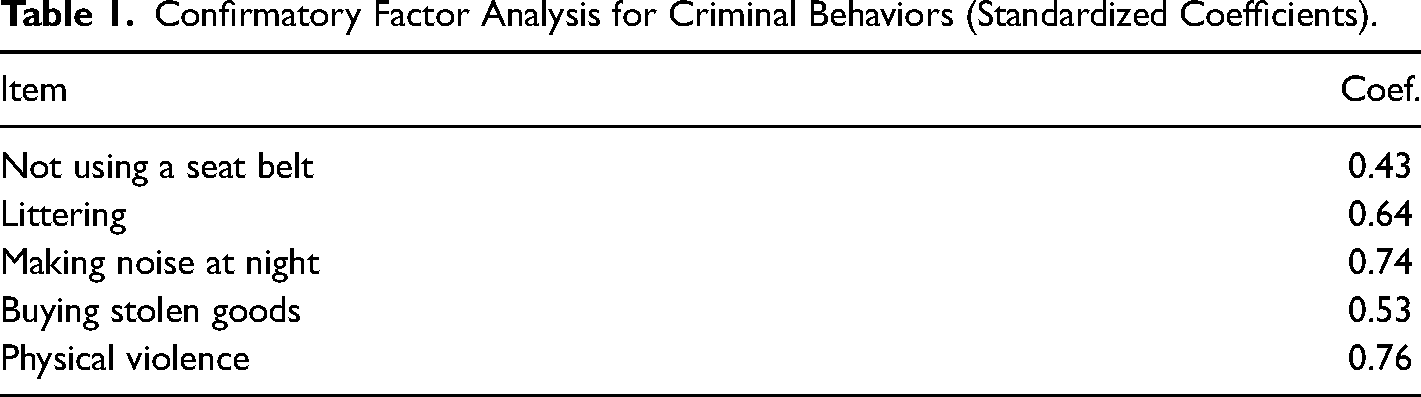
The dependent variable, criminal behaviors, was a summation of five criminal behaviors: not using a seat belt; littering; making noise at night; buying stolen goods; and physical violence (beating someone up). For every item, participants were asked to indicate how often they had engaged in this act during the last 12 months, from 0 (never) to 5 (almost all of the time). Confirmatory factor analysis was used to validate the scale (see Table 1) (Byrne, 2009; Schumacker & Lomax, 1996). The five items were found to load significantly (p < .001) on the factor, and the fit indices (CFI = 0.97; SRMR = 0.03) indicate a good fit to the model (Cheung & Rensvold, 2002; Hu & Bentler, 1999; Schumacker & Lomax, 1996). In addition, Cronbach's alpha for the scale was 0.75, suggesting the scale is reliable (DeVellis, 2003).
Confirmatory Factor Analysis for Criminal Behaviors (Standardized Coefficients).
Independent Variables
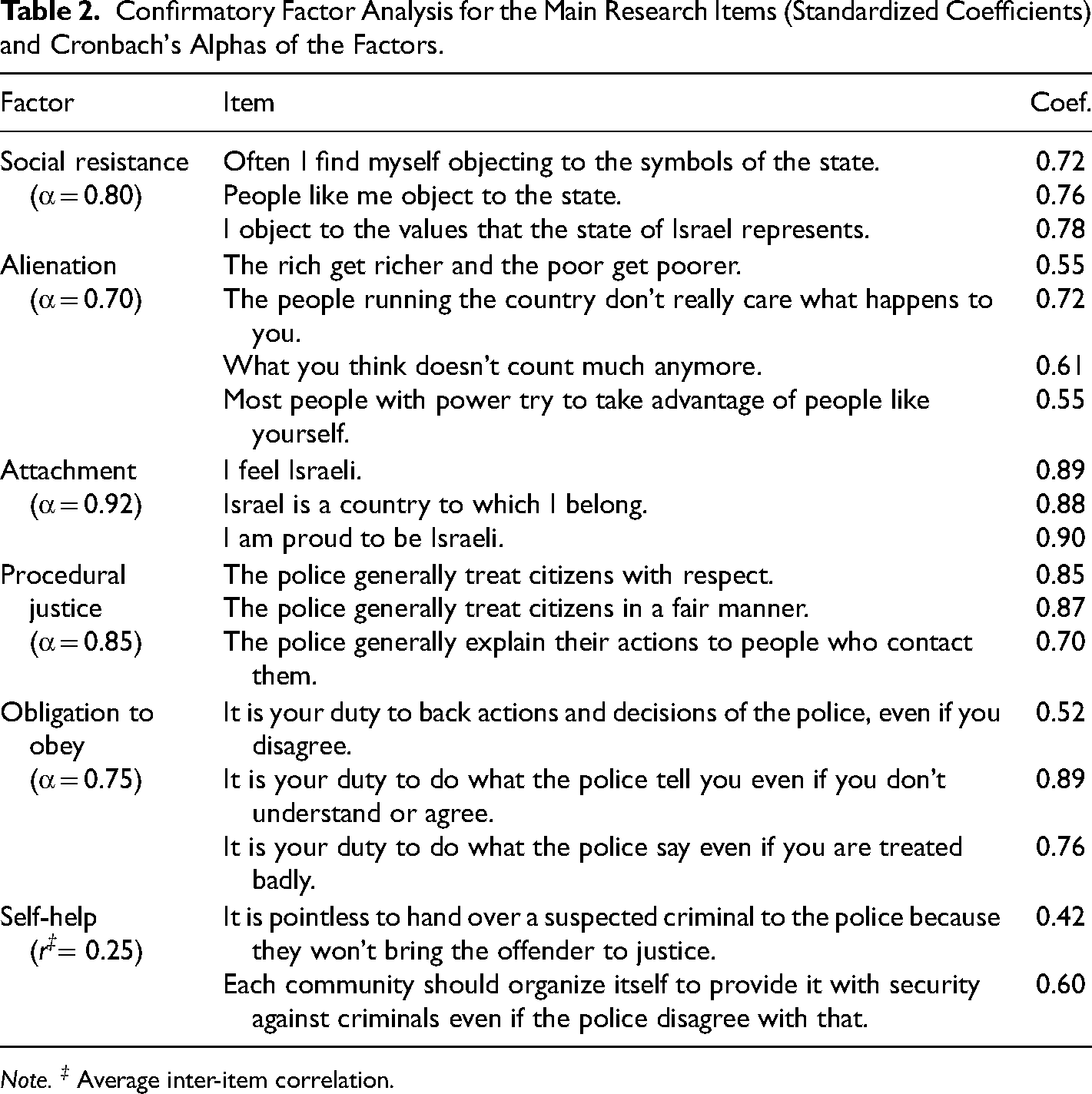
The main independent variable, social resistance, was measured with three items (see Table 2 for the wording of the items). Two additional variables reflecting two factors at the heart of the social resistance framework—attachment to the country and alienation—were measured with four and three items, respectively (Factor, Kawachi, et al., 2013; Factor, Mahalel, et al., 2013). The three variables previously suggested as helping explain criminal behaviors, namely procedural justice, obligation to obey, and self-help or vigilantism, were measured based on scales that were used and validated in previous studies (Factor et al., 2023; Jackson et al., 2011; Tankebe, 2009; Van Damme et al., 2015). The first two were measured with three items each, and the third with two items.
Confirmatory Factor Analysis for the Main Research Items (Standardized Coefficients) and Cronbach's Alphas of the Factors.
Note. ‡ Average inter-item correlation.
Table 2 presents the confirmatory factor analysis for all items mentioned so far, and the corresponding Cronbach's alphas. Each item was measured on a 6-point Likert scale ranging from 1 (strongly disagree) to 6 (strongly agree). All the items are significant (p < .001), and the fit indices (CFI = 0.98; SRMR = 0.03) indicate a good fit of the model (Cheung & Rensvold, 2002; Hu & Bentler, 1999; Schumacker & Lomax, 1996). For most of the scales, Cronbach's alphas are at the traditional cut-off of 0.7 or higher (DeVellis, 2003), which suggests that the scales are reliable. The single exception is the self-help scale, which has just two items. Cronbach's alpha values can be small for scales with a small number of items. In these cases, it is recommended to calculate the mean inter-item correlation for all items in the scale. The mean inter-item correlation for self-help was 0.25, which is within the recommended range of 0.2–0.4 (Pallant, 2007).
In addition, everyday discrimination was measured through the well-known everyday discrimination scale (Factor, Kawachi, et al., 2013; Hunte & Williams, 2009). The scale has two steps. First, participants were asked to indicate how often the following things happened to them (1 = never, 6 = almost every day): being treated with less courtesy or respect than other people; receiving poorer service than other people at restaurants or stores; being threatened or harassed; feeling that other people act as if they think you are not smart; and feeling that other people act as if they are afraid of you. Second, respondents were asked what they perceived to be the main reason these experiences happened. For those respondents who indicated that the main reason was their ethnicity, race, religion, or religiosity, the answers to their questions in the first stage were summed up to compute the everyday discrimination variable. For those who did not cite any of these reasons, this variable was coded as 0.
Eight control variables were collected. Three of these related to exposure to different settings and circumstances (Wikström et al., 2013): How often in the last 30 days did you spend time in the city center or outdoors in streets and parks without doing anything in particular (1 = never, 5 = six or seven days a week); and did you have any contact with the police in the last year (yes/no). Five variables captured demographic characteristics: gender (male = 1); age; age squared (age2) to allow for non-linear associations; years of education; subjective social status (1 = lowest; 10 = highest); and monthly net income (no income to more than 14,000 NIS).
Data Analysis
Like many social science databases (Freedman & Wolf, 1995), the current dataset includes variables with missing values (ranging from 1% to 16%, with an average of 5.6%). Little's test for the missing completely at random assumption (i.e., an assumption that missing cases are independent of the observed and unobserved data) is insignificant (p = .949), indicating that there are no differences between the means of different missing value patterns and that the variables are missing completely at random (Li, 2013). However, to avoid enlarged standard errors, multiple imputation was conducted prior to analyzing the data to create ten imputed “full” files (Enders, 2010; Schafer, 1999). The research analyses were performed separately on each of the ten imputed files. They were then pooled together to provide estimations of the parameters and standard errors which account for the uncertainty implied by the missing data (Allison, 2001; Schafer, 1999).
The analyses included several steps. First, confirmatory factor analyses were performed on the questionnaire items (see above). Second, the means of the main research variables were compared across the five groups using analysis of variance (ANOVA). 2 Third, for each group (subpopulation) negative binomial regressions were conducted to test the effect of social resistance on criminal behaviors while controlling for various variables. Negative binomial regressions were used since our outcome variable, criminal behaviors, is highly positively skewed (Factor, 2018a; Fox, 2008). We analyzed each group separately for several reasons. (a) Our main interest here is to better understand the characteristics of the individual minority groups, and to identify any differences between them. (b) There are good reasons to believe that group membership interacts with other variables in the model. Thus, using one model would require adding many interaction terms, making the model less efficient. (c) Using one model based on a representative sample of the Israeli population would require weighting the groups according to their size in the population, thus making the sample size for some of the groups very small (e.g., only about 22 Ethiopian Jews). No multicollinearity was found between the independent variables in the models, with VIF values ranging from 1.08 to 1.70 and a mean value of 1.29, not including the age and age squared variables (Fox, 2008). In addition, to illustrate the main findings obtained in the regression analyses, the regression coefficients were used to calculate the marginal effect displays of the predicted criminal behaviors across social resistance levels, controlling for the other variables in the model by setting them to their means (Factor & Gur-Arye, 2020; Fox, 2008).
Results
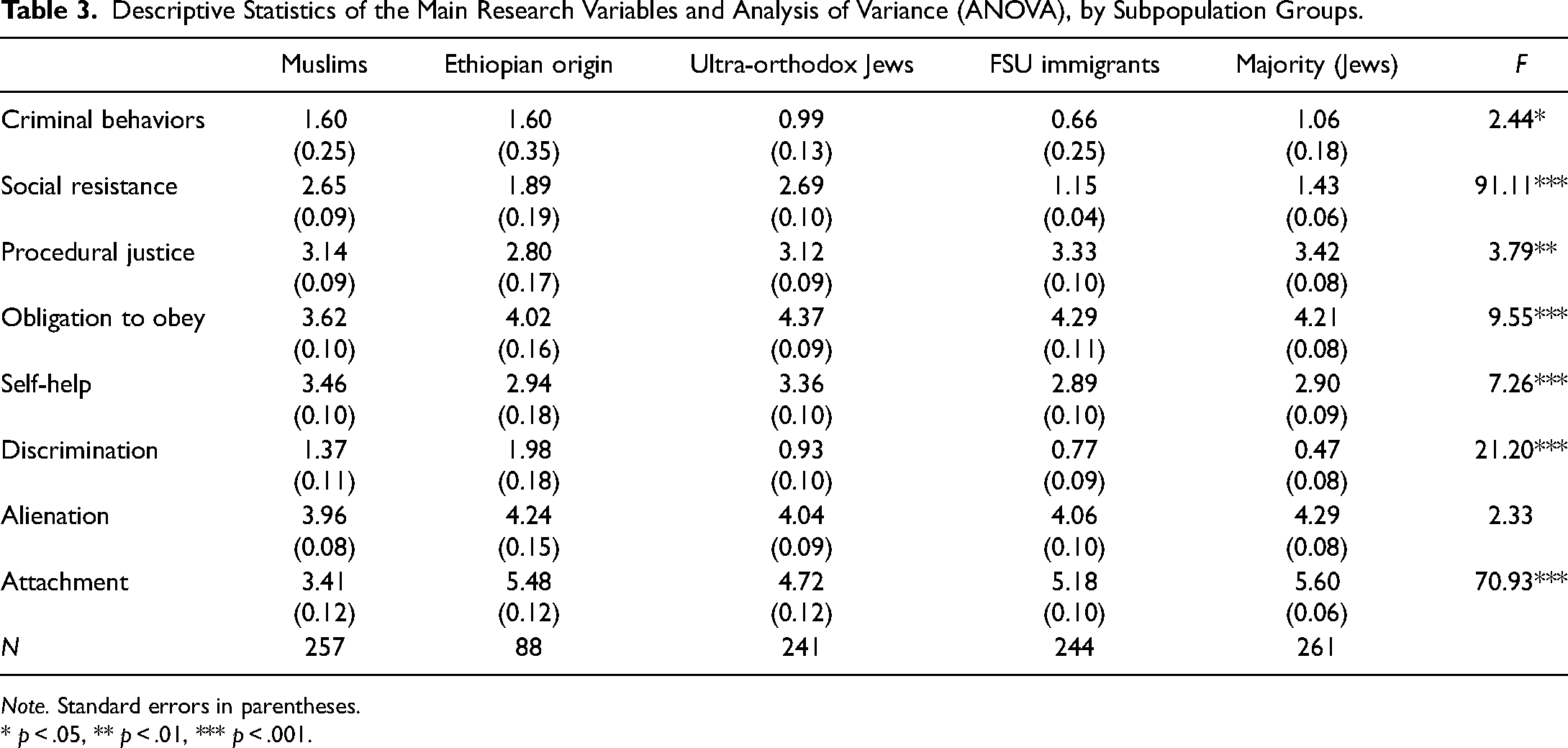
Table 3 presents descriptive statistics for the main research variables, along with the results of the ANOVA. As can be seen from the rightmost column, the ANOVA yielded significant differences between the subpopulations in the means of all the main research variables except alienation. Muslims and Jews of Ethiopian origin have the highest level of criminal behaviors (1.60). Ultra-Orthodox Jews (2.69) and Muslims (2.65) score highest in social resistance. Jews of Ethiopian origin have the lowest perceptions of procedural justice (2.80) and majority-population Jews the highest (3.42). Muslims and Jews of Ethiopian origin score lowest in obligation to obey (3.62 and 4.02, respectively). Support for self-help behavior is highest among Muslims (3.46) and ultra-Orthodox Jews (3.36). Participants originating in Ethiopia (1.98) and Muslims (1.37) experience the highest level of everyday discrimination. Finally, the Muslim non-dominant minority group (3.41) and ultra-Orthodox Jews (4.72) have the lowest level of attachment to the country.
Descriptive Statistics of the Main Research Variables and Analysis of Variance (ANOVA), by Subpopulation Groups.
Note. Standard errors in parentheses.
* p < .05, ** p < .01, *** p < .001.
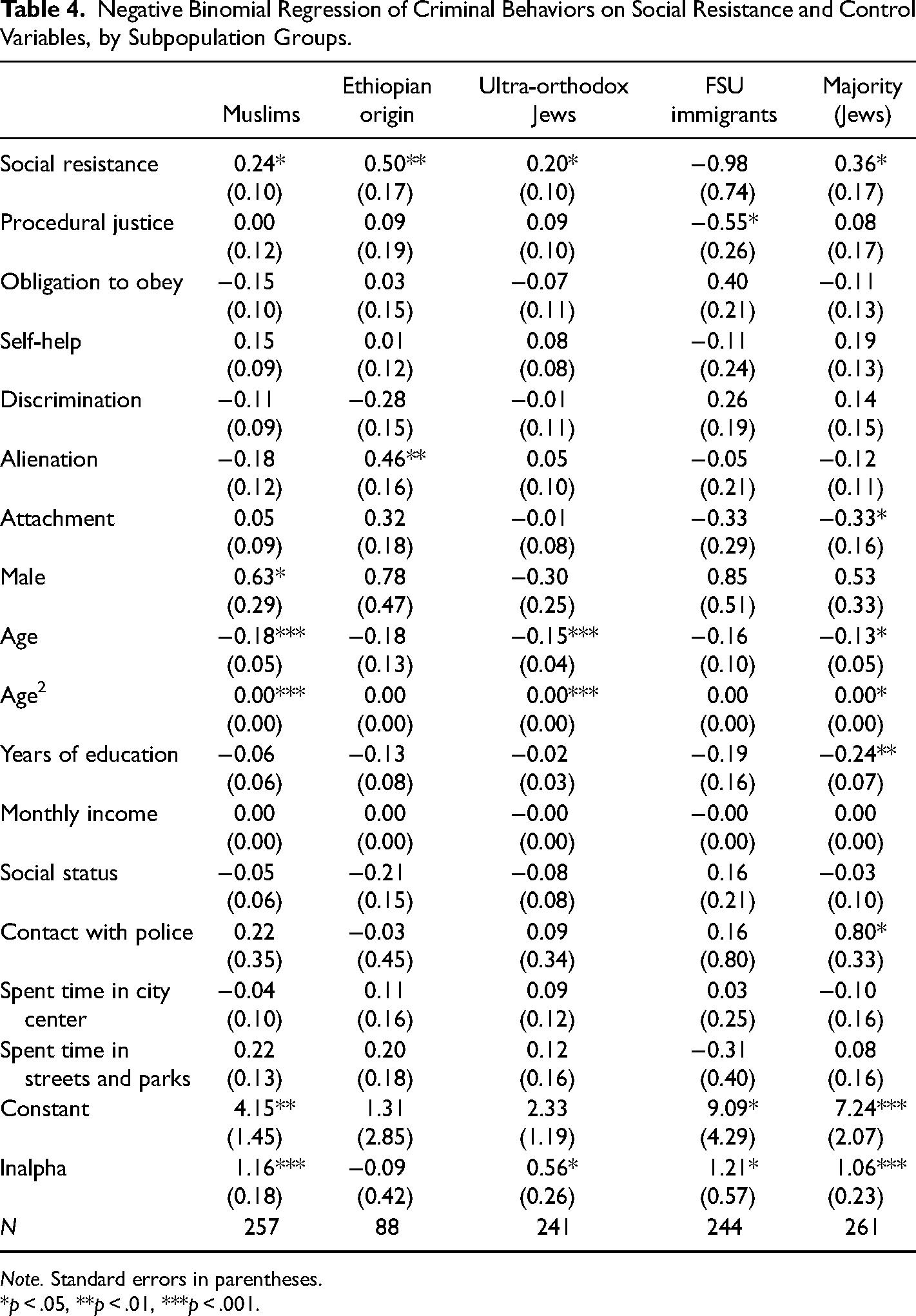
Table 4 displays the results of a negative binomial regression of criminal behaviors on the social resistance framework variables for each of the five research subpopulations, controlling for factors at heart of the social resistance model (attachment to the country, alienation, everyday discrimination), and factors that were previously offered to explain criminal behaviors (procedural justice, obligation to obey, and self-help), as well as exposure to different settings and circumstances and demographic characteristics. The table shows that controlling for the other variables in the model, social resistance is positively associated with criminal behaviors among all the groups except the FSU immigrant subpopulation. 3
Negative Binomial Regression of Criminal Behaviors on Social Resistance and Control Variables, by Subpopulation Groups.
Note. Standard errors in parentheses.
*p < .05, **p < .01, ***p < .001.
The association of social resistance with criminal behaviors can be easily understood by predicting the marginal effects from the regression models, while setting the other variables in the model to their means (Fox, 2008). Since there are differences in the levels and range of social resistance between the groups, in order to compare the effects of social resistance we first calculated each group's average level of social resistance, and one standard deviation above and below this mean. We then calculated the corresponding prediction of criminal behavior for each group, and then plotted these results. Figure 1 presents these effects for the five subpopulations. The figure clearly shows that social resistance is positively associated with criminal behaviors: as social resistance rises, so do criminal behaviors (except for the FSU immigrants, where the effect is not significant). According to the figure, the strongest effect appears to be among participants of Ethiopian descent, followed by Muslims, then ultra-Orthodox Jews, and finally majority-population Jews.
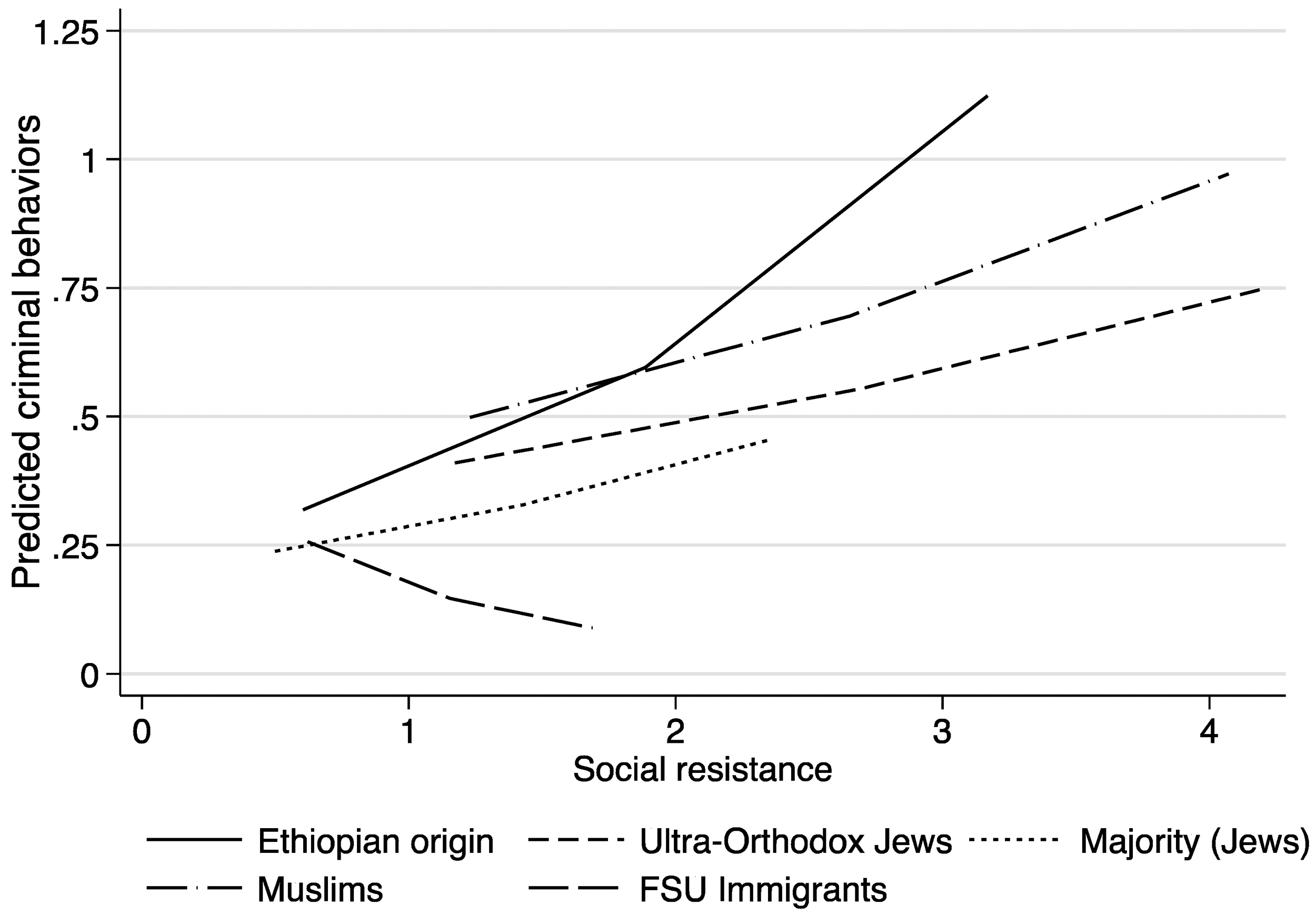
Predicted criminal behaviors by social resistance at the average and one standard deviation above and below the average, for the five subpopulations.
For instance, when the other variables in the model were fixed to their means, Ethiopian-origin Jews with social resistance levels one standard deviation below the mean scored, on average, 0.32 in criminal behaviors, while for those with social resistance levels one standard deviation above the mean this score rose to 1.12. These figures are 0.50 and 0.97 for the Muslim subpopulation, and 0.41 and 0.75 for ultra-Orthodox Jews. It is interesting to note that these effects can be observed among the majority group as well, where those one standard deviation below the mean in social resistance scored 0.24 in the criminal behaviors variable, and those one standard deviation above the mean in social resistance scored 0.46.
Discussion and Conclusions
Non-dominant minorities in various societies are often over-involved in high-risk and criminal behaviors compared to the majority (see, e.g., Bui, 2009; Burt & Simons, 2015; Factor, 2018a; Factor et al., 2021; Friese & Grube, 2008; Gofen et al., 2021; Marshall, 1997; Osypuk et al., 2006; Peterson, 2012; Veen et al., 2011). The innovative social resistance framework was developed to help explain this phenomenon (Factor et al., 2011; Factor, Mahalel, et al., 2013). The current study aimed at testing this theoretical framework among different non-dominant minority groups which are marginalized for different reasons, such as immigration, extreme religious beliefs, and deep historical national conflicts, over a set of five criminal behaviors. The study builds on a representative sample of 1,091 participants among five Israeli subpopulations, namely four non-dominant minorities (Muslims, Jews of Ethiopian origin, immigrants from the FSU, and ultra-Orthodox Jews) and the Jewish majority.
The current findings generally support the main assumptions and premises of the social resistance framework. It was found that Muslims and respondents of Ethiopian origin, who suffer the most discrimination, have the highest level of criminal behaviors—not using seat belts; littering; making noise at night; buying stolen goods; and physical violence. Consistent with the main premises of the social resistance framework, social resistance was positively associated with criminal behaviors in all the research subpopulations, except immigrants from the FSU, even after controlling for previous explanations for criminal behaviors, exposure, and demographic characteristics.
However, there are significant differences in the means between the subpopulations in most of the main research variables, and the nature of the association between social resistance and criminal behaviors differs between the non-dominant minority groups explored. Thus, we can conclude that the way the social resistance framework manifests itself may vary between and within societies, depending, inter alia, on the specific relationship between the majority and non-dominant group concerned (Factor et al., 2011). Predictions from the negative binomial regressions suggest that in the current study, the strongest effect is seen among participants of Ethiopian descent, followed by Muslims and ultra-Orthodox Jews. The specific findings for each group may reflect the different circumstances underlying the marginalization of each one, and their distinct positions in society (although it is difficult at this point to precisely weight each contributing factor). In general, while cultural factors contributed to the challenging absorption faced by the first generation of Ethiopian Jews in Israel, the continuing marginalization of this group appears to be due in large part to their darker skin color. In this study, Jews of Ethiopian origin reported the highest rates of everyday discrimination and the lowest perceptions of procedural justice relative to the other groups examined. Muslims are the largest ethno-religious minority group among Israeli Arabs; and they are in a state of national conflict with the Jewish majority. Among the five groups examined, they rank lowest in attachment to the country and perceived obligation to obey the police, and highest in support for self-help. Finally, ultra-Orthodox Jews are an isolationist community who hold themselves apart from mainstream Jews, who they see as insufficiently devoted to religious practice, and are ranked highest in the present study in social resistance.
The present study found no association between social resistance and the criminal behaviors tested among immigrants from the FSU; and in general this group ranked lowest in social resistance among the minority groups explored in the current study. There are several possible reasons for these findings. First, this group's self-reported criminal behaviors are very low to begin with (and lowest among all the studied groups). Moreover, in four of the seven main independent variables explored in the current study, namely procedural justice, obligation to obey, self-help, and everyday discrimination, immigrants from the FSU report similar levels as the Jewish majority—findings which may indicate that this group is largely assimilated within mainstream culture, as suggested by the mixed results found in previous studies on this question (Al-Haj, 2002; Cohen-Louck, 2022). Second, relative to the other non-dominant groups in the current study, FSU immigrants are both the oldest group, with an average age of 55.62 years, and the most educated, with 15.55 years of education. Previous studies have found both age and education to be negatively associated with social resistance (Factor, Kawachi, et al., 2013; Factor, Mahalel, et al., 2013; Factor, Williams, et al., 2013). Third, to the degree that members of this group do remain only partially assimilated and seek to express social resistance, they may do so largely through non-criminal behaviors, such as by sustaining their separateness and cultural heritage through use of Russian over the Hebrew language (Amit, 2012; Leshem, 2012; Shechory & Ben-David, 2010).
It is interesting to note that we found that social resistance appears to be associated with criminal behaviors also among the Jewish majority group (although its general effect seems modest; see Figure 1). One possible explanation is that both social resistance and criminal behaviors within the majority group are characteristic of subgroups who also experience discrimination for different reasons, such as poverty or economic inequality. Future studies are needed to evaluate the reasons for social resistance within the majority group.
The social resistance framework offers a fresh theoretical perspective for understanding minority groups’ over-involvement in high-risk and criminal behaviors, yet may operate in concert with other existing social and behavioral theories. Theoretically, the framework presents an integrated model that applies both macro-structural and micro-agentic explanations, and that treats individuals as active players rather than passive victims of circumstance or of poor choices. The framework also provides some practical tools for reducing high-risk and criminal behaviors among non-dominant minorities. Indeed, to the extent that social resistance is one of the underlying mechanisms that produce risky and criminal behaviors among non-dominant minorities, it is important to develop interventions that take the resistance factor into account, since interventions that ignore this relationship may fail to work. In addition, future studies should explore the dynamics over time of the relationship between non-dominant minorities and the majority group as well as the state. It may be the case that positive or negative dynamics over time change non-dominant minorities’ perceptions and need for resistance against the majority and state institutions. To this end, longitudinal or panel data can be used to explore changes in social resistance perceptions over time, and their association with delinquent behavior and attitudes toward the law and the state.
The findings of the current study should be interpreted in light of its research limitations. First, the survey was conducted in 2015. While it is reasonable to assume that the general attitudes explored in the current study have not changed dramatically since then, future studies should be conducted to provide updated results. Second, the sample size of the Jews of Ethiopian origin subpopulation is rather small—though it is not overly small relative to a national sample, since this group makes up less than 2% of the Israeli population (Central Bureau of Statistics, 2016). Still, future studies should validate the current results with larger sample. Third, the study is based on self-reports, with the well-known limitations this entails. Future studies should aim to use a range of methodologies, including in-depth interviews and randomized controlled experiments, to further explore the social resistance framework among various minority groups in different societies. Fourth, and in the same vein, the current findings build on a cross-sectional survey, which makes it difficult to establish causality. In the future, studies should be designed to identify causal relationships between social resistance and criminal behaviors among different minority groups.
In sum, the current study provides support for the social resistance framework. Social resistance attitudes were found to be associated with criminal behaviors in three minority groups. In addition, social resistance varies between the groups in both degree and character, and in the magnitude of its association with criminal behavior—a finding that may reflect differences in the circumstances underlying the marginalization of each group. Future studies should validate the current results and continue to investigate the association between social resistance and criminal behaviors among different minority groups and in a range of societies. Finally, the association between social resistance and criminal behaviors was also found within the majority group, which calls for further exploration to identify subgroups with higher levels of social resistance and the underlying reasons for this pattern.
Footnotes
Declaration of Conflicting Interests
The author declared no potential conflicts of interest with respect to the research, authorship, and/or publication of this article.
Funding
The author disclosed receipt of the following financial support for the research, authorship, and/or publication of this article: This work was supported by the Israel Science Foundation (grant number 1329/14).

Notes
Author Biography
Appendix
Descriptive Statistics of the Research Subsamples.