



Abstract
Although the post-civil rights era has motivated many people to avoid appearing racist, they may still be unwilling to relinquish privileges derived from the U.S. racial hierarchy. Because the Confederacy fought to preserve slavery, which upheld this hierarchy, support for the Confederate flag may serve as a proxy measure for individuals’ commitment to maintaining privileges stemming from structural racism. Moreover, given that the modern legal system upholds this same racial hierarchy through anti-Black discrimination, individuals who prioritize protecting their privilege may soothe the guilt they feel for benefiting from structural racism by convincing themselves the legal system treats everyone equally. Similarly, because flag supporters identify with the symbol of a failed nation that considered northern states to have insufficiently policed Black people, they may view police as protectors of the racial hierarchy. Hypotheses were tested using randomly sampled CBS News national poll data. As anticipated, flag supporters were 66% less likely to perceive anti-Black criminal justice system bias, 60% less likely to perceive anti-Black police bias, 34% less likely to consider racial profiling widespread, and 55% more likely to view police as friends.
Trenticosta and Collins (2011, p. 163), in their article addressing the presence of the Confederate flag outside a Louisiana courthouse and its potential to bias jurors against Black defendants, observed “[t]he Confederate flag has important implications for how we think about race disparities in the criminal justice system.” The majority of research on the Confederate flag, however, has identified predictors of flag support rather than used it as a predictor itself. Similarly, no research to date has explored whether Confederate flag support is related to perceptions of anti-Black bias in the U.S. legal system. This topic is important to study because even though the post-civil rights era has motivated people to avoid appearing racist (Manning et al., 2015), they may still be unwilling to relinquish the privileges they receive from the current U.S. racial hierarchy. As a result, individuals’ level of support for the Confederate flag may serve as a proxy measure for their level of commitment to maintaining privileges stemming from structural racism. This makes intuitive sense, since the Confederate army fought to preserve slavery, which was the primary form of social control used to maintain the U.S. racial hierarchy during the 19th century. Moreover, given that the U.S. legal system perpetuates the current racial hierarchy through anti-Black discrimination in much the same manner as slavery, individuals who prioritize protecting their privilege may attempt to soothe the guilt they feel for benefitting from structural racism by convincing themselves the legal system treats everyone equally.
Support for the Confederate flag may also be linked to perceptions of the police. Law enforcement agencies in the south emerged from slave patrols, and that legacy lingers to this day (Hinton & Cook, 2020). The common thread connecting slave patrols to contemporary police forces is that both serve(d) to protect white power structures and interests while maintaining “[B]lack subordination” (Spruill, 2016, p. 62). If flag supporters’ identification with the Confederacy extends beyond the flag to the core values that characterized the Confederacy, they may view police as a resource to “uphold white supremacy by surveilling, capturing, assaulting and killing [B]lack people” (Myers, 2020, para. 4). Thus, the current study uses national data from a randomly-sampled telephone poll conducted by CBS News (2000) to examine whether Confederate flag supporters are: (1) less likely to perceive anti-Black bias in (a) the CJ system, (b) police, and (c) traffic stops; and (2) more likely to perceive police as friends.
Literature Review
During 1860 and 1861, 11 southern states seceded from the United States to preserve the institution of slavery. Although the Confederacy went through several different versions of its flag, the flag most people recognize as the Confederate flag today is “the Southern Cross” flown by the Army of the Northern Virginia (also known as the Confederate battle flag). Following the Confederates’ defeat, white southerners flew the battle flag to protest the U.S. government stationing troops in southern states to protect Black people’s rights (Webster & Leib, 2002). After federal troops left in 1877, Confederate flags were predominantly displayed at military burial sites, statues, and veteran reunions (Martinez, 2008). Between 1879 and 1913, seven southern states introduced Confederate symbols into their state flag designs.
Democratic President Truman’s efforts to address lynching, poll taxes, and military segregation in 1948 prompted southern democrats to split from the party. They rallied behind South Carolina Governor Strom Thurmond to form the States Rights Democratic Party, better known as the Dixiecrats (Talbert, 2017). The Dixiecrats embraced the Confederate battle flag to symbolize their support for segregation (Strother et al., 2017). In response to advancements in civil rights during this time, several states began flying the Confederate battle flag from their capitol buildings to express opposition to federal support for integrating Black people into previously white spaces.
Contemporary associations with the flag remain overwhelmingly negative. In 1999, the National Association for the Advancement of Colored People (NAACP) announced a boycott against South Carolina for displaying the Confederate battle flag on government property (Capps, 2015). Because South Carolina’s presidential election primary was scheduled on February 19, 2000—before most other states’—the issue gained national attention when John McCain was forced to take a stance on the issue in January while running against George W. Bush in the Republican primary (Holmes, 2000). Shortly thereafter, on March 21st, South Carolina’s Senate proposed bill 1266 to remove the flag from the capitol dome but fly a similar flag near a Confederate war memorial on capitol grounds (Associated Press, 2000). The bill passed, becoming Act No. 292, and took effect on July 1st (South Carolina Legislature, n.d.).
Perhaps most notably, a white supremacist fatally shot nine Black people at the Emanuel African Methodist Episcopal Church in South Carolina on June 17, 2015 (Inwood & Alderman, 2016). In the aftermath, photographs surfaced of the shooter posing with the Confederate battle flag, prompting a new reckoning with the flag’s racist history and connections to ideological extremism. While speaking at one of the victims’ funerals, President Obama urged South Carolina to remove the flag completely from capitol grounds, saying “As we all have to acknowledge, the flag has always represented more than just ancestral pride” (Nelson, 2015, para. 6). The next day, North Carolina activist Bree Newsome climbed the 30-foot flagpole and removed the flag, declaring as she was arrested “Every day that flag stays up there is an endorsement of hate” (Democracy Now, 2015, para. 4). By July 10, 2015, South Carolina’s governor had signed a bill permanently removing the flag (Ellis et al., 2015).
Former President Trump has addressed issues related to the Confederacy on at least two occasions. After white supremacists, neo-Nazis, and counter-protesters assaulted each other during an August 2017 Unite the Right rally protesting the proposed removal of a Robert E. Lee statue from the University of Virginia campus in Charlottesville, Trump declared there were “some very fine people on both sides” of the protest (Chiacu, 2020, para. 4). The second occasion took place after Minneapolis police murdered an unarmed Black man, George Floyd, on May 25, 2020. Following the incident, NASCAR banned the Confederate flag at events. Trump responded to the NASCAR ban by claiming, “When people proudly had their Confederate flags they’re not talking about racism. They love their flag, it represents the South” (Chiacu, 2020, para. 2). Experts interpreted Trump’s remarks as aimed at his supporters, who routinely brought Confederate battle flags to his campaign rallies (Davich, 2020).
On January 6, 2021, white supremacists forced their way inside the U.S. Capitol in an attempt to stop Congress from certifying the electoral college results, which favored Biden over Trump. During the failed insurrection, some Trump supporters displayed the Confederate flag while walking the Capitol halls. As one historian noted, this action held significance because the Confederate flag never saw the inside of the Capitol building during the Civil War era (Bendix, 2021). As it stands today, six states still fly flags associated with Confederate symbols, and neo-Confederate groups are recruiting new members daily by decrying the alleged “cultural genocide” caused by the accelerated national shift away from Confederate imagery (Schecter & Connor, 2015, para. 3).
Research on the Confederate Flag
Several studies have identified predictors of support for the Confederate flag. Orey (2004), for example, found white Mississippi college students who held more racist beliefs about Black people were more likely to approve of Mississippi’s state flag containing the Confederate battle flag. A second study reported people who wanted the federal government to play less of a role in addressing racism against Black people at work were less likely to support taking the Confederate flag down from South Carolina’s Capitol (C. A. Cooper & Knotts, 2006). White Georgia residents who did not perceive Black people to be economically or educationally disadvantaged compared to white people were more likely to support the flag (Strother et al., 2017). In a sample of Amazon Mturk participants recruited from Georgia, Mississippi, and South Carolina, holding more racist views about Black people corresponded with greater support for the flag (Wright & Esses, 2017). Most recently, Talbert and Patterson (2020) reported that participants who thought the United States had achieved equality among races/ethnicities were more likely to support the Confederate flag.
At least two studies have used exposure to the Confederate flag as an independent variable. The first study used data from 130 undergraduate psychology students collected during 2008 and found that white participants who were subliminally primed with a Confederate flag image were less likely to support Obama as a political candidate than white participants who were subliminally primed with a neutral image (Ehrlinger et al., 2011). In the second study, Goldman and colleagues (2019) discovered that Georgia psychology undergraduates with more conservative political views expressed greater resistance to group equality after viewing an image of the Confederate battle flag instead of the Olympic flag. The same study also noted that participants with more conservative political views had a reduced ability to empathize with individuals facing racism following exposure to the Confederate flag instead of the Olympic flag.
Research on Perceptions of Criminal Injustice
A sizable body of literature has examined public perceptions of bias in the legal system. Hagan and Albonetti (1982) conducted one of the first studies in this area and discovered Black participants perceived significantly more criminal injustice than white participants. Similarly, Henderson and colleagues (1997) reported Black Cincinnati residents were more likely than white people to perceive anti-Black bias in the CJ system. Since then, several other studies have demonstrated that both Black and Latinx people perceive greater bias in the legal system compared to white people (Buckler & Unnever, 2008; Buckler et al., 2008; Hagan et al., 2005; Weitzer & Tuch, 2004). In one study, Black Cincinnati residents thought police exhibited less procedural justice and made decisions more often based on civilians’ race/ethnicity relative to white residents (MacDonald et al., 2007). Wang and colleagues (2019) found that Los Angeles residents who perceived police in their community to be predominantly non-white considered law enforcement to treat civilians more equally. Research also shows that individuals who perceive poorer quality relations between Black, Latinx, and white people believe police treat Black civilians less fairly compared to white civilians.
A few studies have explored public perceptions of why Black people are disproportionately involved in the legal system. Unnever (2008), for example, noted Black participants considered anti-Black bias among police and courts to be the strongest explanation of why Black people are disproportionately incarcerated. White participants were less likely to endorse this explanation. In a second study, Black and Latinx participants were more likely than white participants to perceive discriminatory court procedures as explaining why Black men were overrepresented in prison (Buckler et al., 2011). Finally, Cooper and colleagues (2020) demonstrated that participants who perceived more negative relations between Black, Latinx, and white people considered racism a greater reason why Black people are overrepresented in prison. Collectively, this body of literature suggests that people’s race/ethnicity and their perceptions of racism influence whether they view the legal system as biased.
Confederate Flag Support and Perceptions of Criminal Injustice
Scholars have documented how the same system of social control against Black people that served as the driving engine behind slavery initially transformed into sharecropping, Black codes, and convict-leasing at the end of the Civil War, then morphed into Jim Crow laws, before assuming its current forms as a war on drugs and aggressive broken windows policing efforts that have produced mass incarceration disproportionately affecting Black people (Alexander, 2012; Goodwin, 2019; Kamalu & Onyeozili, 2018). According to this perspective, many people materially benefited from the strict racial hierarchy that slavery enforced. After slavery was abolished, those same people sought new ways to protect their political and materials interests, which depended upon the continued oppression of Black people. Consequently, people who fought for the Confederacy during the Civil War did so because they realized their material interests hinged on preserving the institution of slavery.
Today, people who support Confederacy symbols such as the flag may do so because they realize on some level that: (1) the privileges they enjoy are derived from the existing U.S. racial hierarchy; and (2) the U.S. legal system is a form of social control that reinforces and maintains the racial hierarchy. Racism in the post-civil rights era can be nuanced at times because many people are motivated to avoid appearing racist (Manning et al., 2015). People who identify with the Confederate flag, therefore, may be psychologically motivated to perceive the U.S. legal system as treating everyone equally because acknowledging the system as biased against Black people would require they support correcting the system to remove that bias. Removing bias from the legal system, however, would cause them to forfeit the privileges they enjoy as a result of the system oppressing Black people. Consequently, individuals who are unwilling to relinquish privileges tied to the oppression of Black people may convince themselves the legal system treats everyone equally in order to assuage the guilt they feel for recognizing they benefit from structural racism. In other words, they prioritize keeping their privilege, which in the post-civil rights era forces them to deny those benefits originate from anti-Black bias baked into the legal system.
Thus, individuals’ level of support for the Confederate flag may serve as a proxy measure for their level of commitment to maintaining privileges derived from the current U.S. racial hierarchy. This makes intuitive sense since the Confederate army fought to preserve slavery, which was the 19th century form of social control used to maintain the racial hierarchy. In turn, individuals who prioritize protecting privileges derived from a legal system biased against Black people may attempt to soothe the guilt they feel for benefitting from structural racism by convincing themselves the legal system treats everyone equally. In this manner, people who support the Confederate flag may perceive less anti-Black bias in the U.S. legal system.
Confederate Flag Support and Viewing Police as Friends
Several experts have documented southern law enforcement agencies’ emergence from slave patrols and how that legacy lingers to this day (Durr, 2015; Hinton & Cook, 2020; Nicole, 2020; Philimon, 2020; Reichel, 1988; Spruill, 2016; Turner et al., 2006). Specifically, while white people relied on slave patrollers to police Black people considered out of place during the slavery era, this function shifted to law enforcement after the Civil War via Black Codes and Jim Crow laws, and later the war on drugs and broken windows policing (Hasbrouck, 2020; Lepore, 2020). Baldwin (1966, para. 22) highlighted this aspect of police when he called them “simply the hired enemies of this [Black] population. They are present to keep the N**** in his place and to protect white business interests, and they have no other function.” May and Yancy (2020) revisited the purpose of law enforcement within the context of recent police killings of unarmed Black civilians such as Breonna Taylor, George Floyd, and Rayshard Brooks. In their view, the best way to understand what police consider their mandate is to examine what they successfully accomplish. Accordingly (para. 9):
They succeed in keeping middle-class and especially upper-class white people safe, so long as they don’t get out of line. They succeed in keeping people of color in their place so that they don’t challenge the social order that privileges middle- and upper-class white people.
The end result is that even though “[i]nstitutional slavery is dead,” law enforcement ensures “[s]lavery’s legacy is alive and lethal” today (Taylor, 2020, para. 19). Dr. Jeffrey Epstein (no relation to the person arrested for sex trafficking minors) demonstrated this understanding of police when he shouted “you are treating me like a fucking Black person” while airport security arrested him for causing a disturbance (Sacks, 2018).
Many white civilians (and those who exist in close proximity to whiteness) serve a similar function as law enforcement when they play in the sandbox of white supremacy by policing Black people perceived as out of place in white spaces and those who support equality for Black people (Onwuachi-Willig, 2017). George Zimmerman’s fatal shooting of Trayvon Martin; Gregory McMichael, Travis McMichael, and William Bryan’s murder of Ahmaud Arbery; and Kyle Rittenhouse’s fatal shooting of two people protesting police brutality against Jacob Blake serve as just three recent examples. When white people do not wish to directly “dirty their hands” with policing Black people, they often resort to calling the police, as Amy Cooper did when falsely portraying Christian Cooper as a dangerous threat while he was birdwatching in Central Park (Fleischer, 2020). Given that Confederate flag supporters identify with the symbol of a failed nation that started a war because it considered northern states to have insufficiently policed Black people, they may view modern-day police as a resource to “uphold white supremacy by surveilling, capturing, assaulting and killing [B]lack people” (Myers, 2020, para. 4). As a result, flag supporters may regard police as allies and friends united by a common purpose, even if this feeling is not reciprocated by law enforcement agencies themselves.
Current Study
The current study explores two primary hypotheses:
Method
Data
Data were collected February 6–9, 2000, as part of a CBS News (2000) monthly poll series focusing on the then-upcoming presidential election. Participants were randomly surveyed via landline phone. The original dataset contained 1,499 participants from all 50 U.S. states plus the District of Columbia (D.C.). After listwise deletion, the final sample consisted of 905 participants from the 50 states plus D.C. Listwise deletion was selected over other approaches to handling missing data because imputation can result in distorted significance reporting and effect sizes in analyses (Garson, 2015). Additionally, in their study evaluating accuracy of various missing data techniques, Switzer and colleagues (1998) found listwise and pairwise deletion to be more accurate than imputation methods (see Chen & Åstebro, 2003). Participants who reported a race other than Black, Latinx, or white were excluded from the sample due to their small number. On average, the sample contained 26 participants from each state (sd = 14), with the fewest participants from Nebraska and Hawai'i i (n = 1) and the most from California (n = 78). Table 1 shows the sample’s descriptive statistics
Descriptive Statistics of Sample.
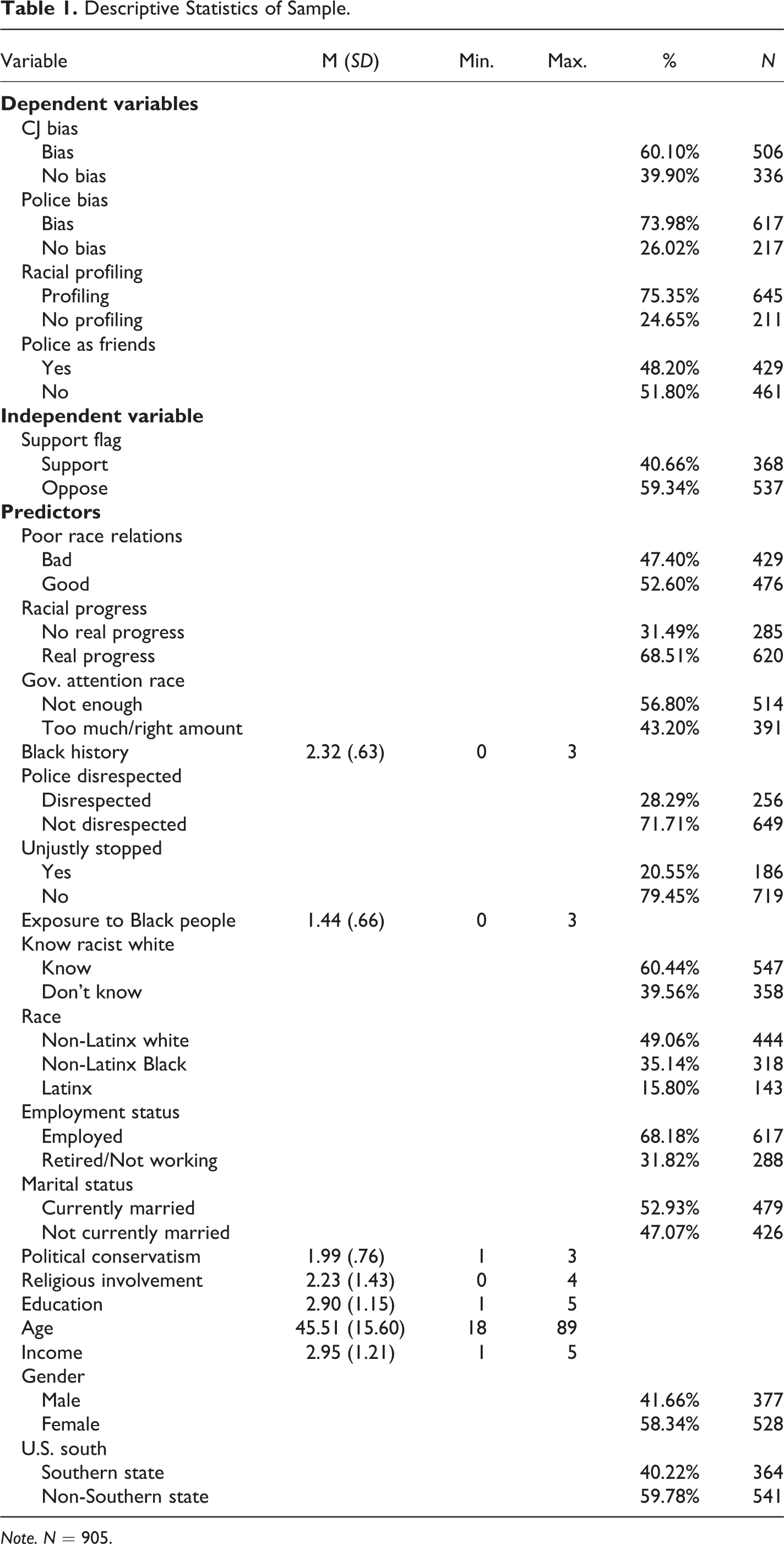
Note. N = 905.
Dependent Variables
Criminal justice (CJ) bias was measured by asking participants whether they thought the CJ system was biased in favor of Black people, against Black people, or generally gave Black people fair treatment (1 = biased against Black people, 0 = Black people favored or treated fairly). Police bias was measured by asking participants whether they thought police in most big cities were generally tougher on white people than Black people, tougher on Black people than white people, or treated both the same (1 = tougher on Black people, 0 = tougher on white people or treat same). Racial profiling was assessed using the item: “It has been reported that some police officers stop motorists of certain racial or ethnic groups because the officers believe that these groups are more likely than others to commit certain types of crimes. Do you believe that this practice, known as ‘racial profiling,’ is widespread, or not?” Responses were dichotomized (1 = yes, widespread, 0 = no, not widespread). Viewing police as friends was measured by asking participants whether they generally thought of police more as friends, enemies, or didn’t think of them in either of these ways (1 = friends, 0 = enemies or neither).
Independent Variable
Support for the Confederate battle flag was measured according to the following item: “As you may know, the State of South Carolina flies the Confederate flag over its State Capitol building. Some people say the flag should be removed because it is a symbol of slavery, while others say the flag should remain because it is a symbol of southern heritage. Which comes closer to your view—should the flag be removed or should it remain?” Participants who thought the flag should remain were coded as supporting the flag, while participants who thought the flag should be removed were coded as opposing the flag (1 = support flag, 0 = oppose flag). For context, data collection occurred after the NAACP had launched its boycott and McCain had addressed the issue to a national audience, but before South Carolina’s legislature had proposed legislation to relocate the flag.
Control Variables
Prior studies on public perceptions of criminal injustice commonly control for a variety of variables (e.g., Gabbidon & Higgins, 2009). Unnever and colleagues (2011), for example, found being male, married, older, earning more money, and residing in a southern state all predicted reduced perceptions of anti-Black bias in the CJ system among white participants, but not Black participants. When possible, variables were coded as they had been in prior studies. Participants’ perceptions of U.S. race relations were measured dichotomously (1 = generally bad, 0 = generally good). Racial progress measured how much progress participants perceived to have occurred since the 1960s in getting rid of racial discrimination against Black people (1 = not much real progress, 0 = real progress). Government attention measured perceptions of whether government in Washington was paying too much, not enough, or about the right amount of attention to the needs and problems of Black people and other minorities (1 = not enough, 0 = too much or the right amount). Participants were also asked how much they knew about U.S. Black history (0 = nothing, 1 = not much, 2 = some, 3 = a lot; x¯ = 2.32, sd = .63).
Two variables relevant to participants’ personal experiences with the CJ system were examined. The first item stated that “Some people say the police don’t show respect for people, or they use insulting language” and asked whether that had ever happened to participants (1 = disrespected, 0 = not disrespected). The second item asked participants if they felt they had ever been stopped by the police just because of their race or ethnic background (1 = unjustly stopped, 0 = never unjustly stopped).
Exposure to Black people was measured by asking participants how many of the customers at the places where they usually shopped, such as grocery stores or pharmacies, were Black (0 = none, 1 = a few, 2 = almost half, 3 = almost all; ā = 1.44, sd = .66). Participants were also asked whether they personally knew any white people who disliked Black people (1 = yes, know at least one racist white person, 0 = no, don’t know any racist white people). Race/ethnicity was measured using two dummy variables: Black (1 = non-Latinx Black, 0 = non-Black) and Latinx (1 = Latinx, 0 = non-Latinx). Non-Latinx white people served as the reference category. Employment status was measured dichotomously (1 = working at least part time, 0 = retired or not working), as was current marital status (1 = married, 0 = not married). Political ideology was measured categorically (1 = liberal, 2 = moderate, 3 = conservative; ā = 1.99, sd = .76) along with religious involvement (how often attend religious services; 0 = never, 1 = few times a year, 2 = once/twice a week, 3 = almost every week, 4 = every week; ā = 2.23, sd = 1.43) and level of education completed (1 = didn’t graduate high school, 2 = high school graduate, 3 = some college, 4 = college graduate, 5 = post-grad work or degree; ā = 2.90, sd = 1.15). Age (in years) was measured continuously (ā = 45.51, sd = 15.60). Annual income was measured categorically (1 = <$15,000, 2 = $15,000–$30,000, 3 = $30,000–$50,000, 4 = $50,000–$75,000, 5 = > $75,000; ā = 2.95, sd = 1.21). Gender was measured dichotomously (1 = male, 0 = female). Finally, living in a southern state was measured dichotomously based on the U.S. Census Bureau classification system (1 = southern state; 0 = non-southern state).
Analysis
Two sets of analyses were conducted. First, four χ2 analyses were conducted in Stata 14.0 to examine whether perceptions of CJ system bias, police bias, how widespread racial profiling is, and whether police are friends, respectively, varied based on support for the Confederate flag. Then, four logistic regression analyses were run using CJ system bias, police bias, racial profiling, and police as friends as separate dependent variables, Confederate flag support as the independent variable, and a host of other factors as control variables.
Results
Hypothesis 1a predicted Confederate flag supporters would be less likely than those who opposed the flag to consider the CJ system biased against Black people. At the bivariate level, χ2 results were consistent with this expectation (χ2(1) = 126.80, p < .001; see Table 2). Three-fourths (75.5%) of those who opposed the flag perceived the CJ system to be biased against Black people compared to only 36.7% of those who supported the flag. Similarly, logistic regression results showed that even after controlling for other variables—including race, political ideology, personal experiences with the CJ system, and living in the south—Confederate flag supporters were 66% less likely to perceive the CJ system as biased against Black people compared to those who opposed the flag (Exp(B) = .34; p < .001; see Table 3). People who perceived poorer race relations in the U.S. (Exp(B) = 1.72; p < .01), that the United States had made no progress against racism since the 1960s (Exp(B) = 1.58; p < .05), and who thought that the federal government was not paying enough attention to the needs and problems of communities of color (Exp(B) = 2.00; p < .001) were all more likely to view the CJ system as biased against Black people. People who felt they had been disrespected by police (Exp(B) = 1.56; p < .05) and Black people (Exp(B) = 2.92; p < .001) were also more likely to consider the CJ system biased against Black people. In contrast, people who were more politically conservative (Exp(B) = .72; p < .01) and men (Exp(B) = .69; p < .05) were both less likely to consider the CJ system biased against Black people.
Differences in Perceptions of CJ Bias, Police as Friends, Police Bias, and Racial Profiling by Confederate Flag Support.
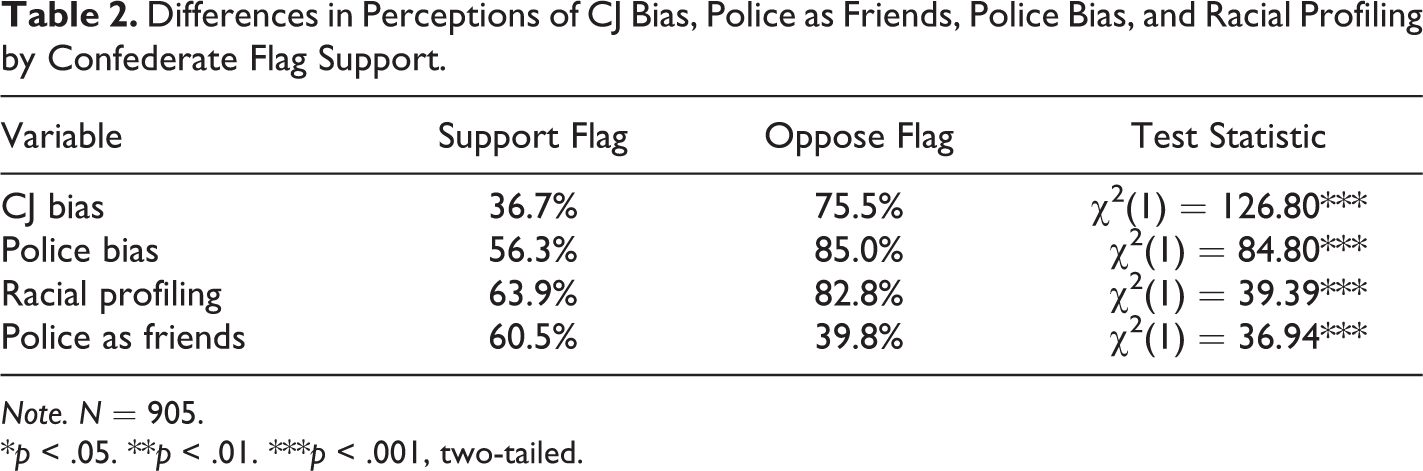
Note. N = 905.
*p < .05. **p < .01. ***p < .001, two-tailed.
Logistic Regression Coefficients for Perceptions of CJ Bias, Police Bias, Racial Profiling, and Police as Friends.
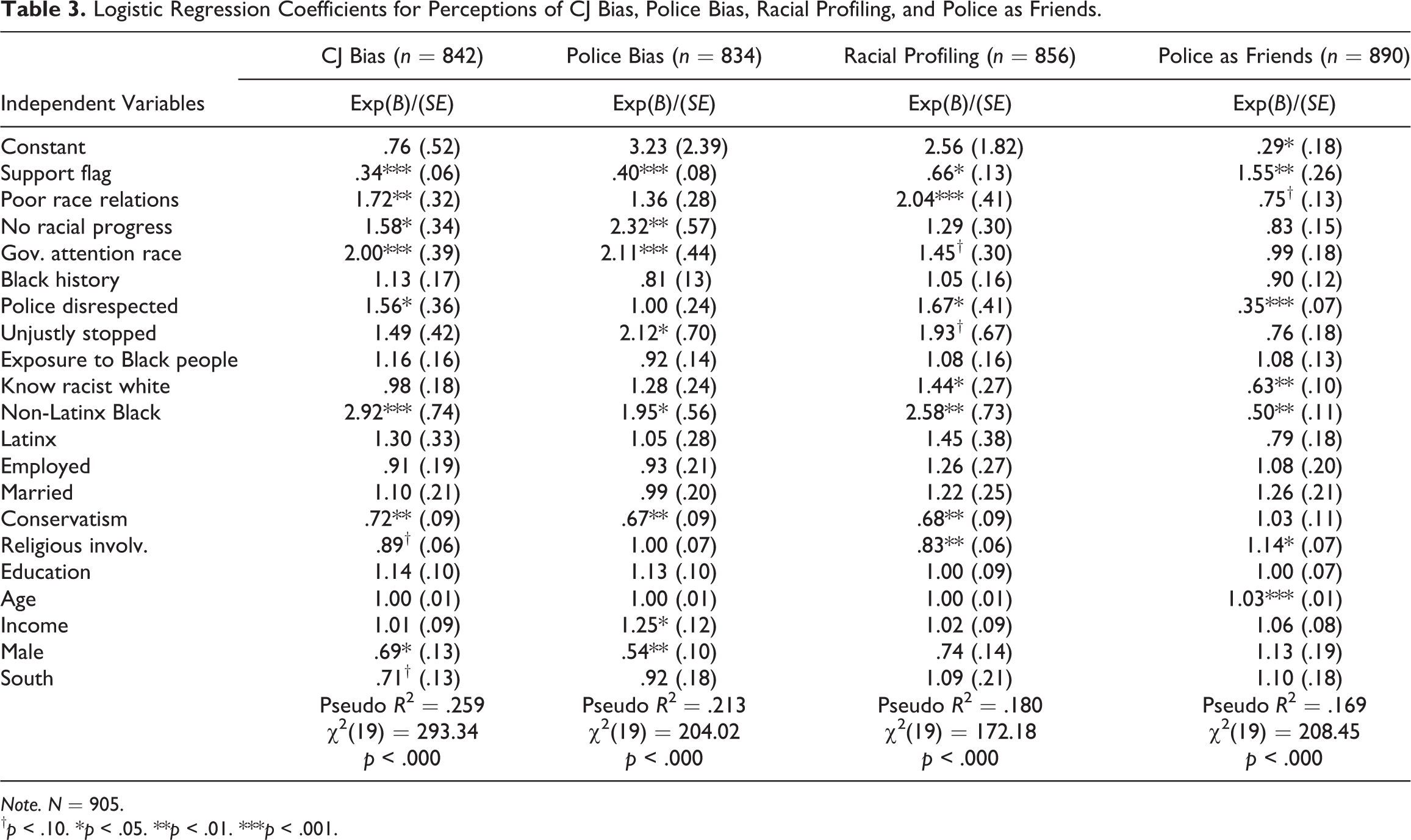
Note. N = 905.
† p < .10. *p < .05. **p < .01. ***p < .001.
Hypothesis 1b predicted Confederate flag supporters would be less likely than those who opposed the flag to consider police biased against Black people. χ2 results were consistent with this expectation (χ2(1) = 84.80, p < .001). A full 85% of those who opposed the flag perceived police to be biased against Black people compared to only 56.3% of those who supported the flag. At the multivariate level, Confederate flag supporters were 60% less likely to perceive the police as biased against Black people compared to those who opposed the flag (Exp(B) = .40; p < .001). People who thought the United States had made no racial progress (Exp(B) = 2.32; p < .01), the federal government was not paying enough attention to problems in communities of color (Exp(B) = 2.11; p < .001), perceived themselves to have been unjustly stopped by police (Exp(B) = 2.12; p < .05), were Black (Exp(B) = 1.95; p < .05), and who had higher incomes (Exp(B) = 1.25; p < .05) were all more likely to view police as biased against Black people. In contrast, political conservatism (Exp(B) = .67; p < .01) and being male (Exp(B) = .54; p < .01) were associated with a reduced likelihood of viewing police as biased against Black people.
Hypothesis 1c predicted Confederate flag supporters would be less likely than those who opposed the flag to perceive racial profiling to be widespread among police. χ2 results were consistent with this expectation (χ2(1) = 39.39, p < .001). A full 82.8% of those who opposed the flag perceived racial profiling to be widespread among police compared to 63.9% of those who supported the flag. At the multivariate level, Confederate flag supporters were 34% less likely to perceive racial profiling to be widespread among police compared to those who opposed the flag (Exp(B) = .66; p < .05). People who perceived poorer race relations in the U.S. (Exp(B) = 2.04; p < .001), felt they had been disrespected by police (Exp(B) = 1.67; p < .05), knew at least one racist white person (Exp(B) = 1.44; p < .05), and were Black (Exp(B) = 2.58; p < .01) were all more likely to consider racial profiling widespread among police. In contrast, people who were more politically conservative (Exp(B) = .68; p < .01) and religiously involved (Exp(B) = .83; p < .01) were both less likely to consider racial profiling widespread among police.
Finally, Hypothesis 2 predicted Confederate flag supporters would be more likely than those who opposed the flag to view police as their friends. χ2 results were consistent with this expectation (χ2(1) = 36.94, p < .001). A full 60.5% of flag supporters considered police to be their friends compared to only 39.8% of those who opposed the flag. At the multivariate level, Confederate flag supporters were 55% more likely to consider police to be their friends compared to those who opposed the flag (Exp(B) = 1.55; p < .01). People who were more religiously involved (Exp(B) = 1.14; p < .05) and older (Exp(B) = 1.03; p < .01) were both also more likely to view police as friends. In contrast, people who felt they had been disrespected by the police (Exp(B) = .35; p < .001), knew at least one racist white person (Exp(B) = .63; p < .01), and were Black (Exp(B) = .50; p < .01) were all less likely to view police as friends.
Discussion
This paper sought to investigate the relationship between attitudinal support for the Confederate flag and perceptions of anti-Black bias in law enforcement and the legal system more broadly. Bivariate and regression analyses revealed Confederate flag supporters were less likely than those who oppose the flag to perceive anti-Black bias in the CJ system, law enforcement, and traffic stops. Thus, while the public disagrees over whether the flag represents “hate” or “heritage”—a framing that is itself problematic because it reduces structural racism to interpersonal animosity—findings from the current study suggest that support for the Confederate flag corresponds with downplaying the well-documented racial disparities that exist in parts of the legal system due to structurally privileging whiteness. As such, support for the Confederate flag in the 21st century remains associated with an ideology that denies the societal harms government institutions inflict upon Black communities. In terms of policy implications, findings from this study suggest that support for the Confederate flag is linked with views that could conceivably reduce the likelihood of supporting policies intended to address ongoing racial disparities in the legal system. If future research bears this out, this would constitute compelling evidence that the Confederacy holds a lingering influence over a segment of the U.S. population today. The current study also found flag supporters were more likely to view police as their friends. This is not entirely unexpected. Far right extremism, including white nationalist movements, have been associated with securitization training, such as military service (Simi et al., 2013).
Within the field of criminology, scholars are increasingly calling for the decolonization of the discipline and criminal justice practitioners (see León, 2021). This call is supported by an expansive body of literature that focuses on the racialization of justice in the U.S. (e.g., Brewer & Heitzeg, 2008; Knepper, 2008; Saperstein et al., 2014; Vue et al., 2016). Findings from this work portray racism as a structural issue, deeply embedded within the fabric of the nation’s legal system. Hinton and Cook (2020), for example, argue that the legacy of law enforcement’s “slave patrol” past continues on within the U.S. south today. The long list of killings perpetrated by police against unarmed Black people illustrates just how close this past remains throughout the nation. The names that make national headlines, such as George Floyd, Breonna Taylor, Botham Jean, Tamir Rice, and Walter Wallace Jr., represent only a small number of the total victims attributable to racism in the contemporary United States. During summer 2020, the nation saw widespread outcries demanding justice and equality in response to police murdering George Floyd. While U.S. institutions—some related to the legal system and others unrelated—acted swiftly to implement or expand on diversity, equity, and inclusion programs, the existence of these programs is insufficient. Conversations and actions must progress beyond mere lip service to foster genuine social progress that breaks free from colonial-rooted structural racism.
Racism remains pervasive outside of the legal system in the United States, too, with the Confederate flag serving as a symbol of the vast racial disparities that still exist in many facets of U.S. society. Researchers, for example, reported that voters exposed to the Confederate flag evaluated Black political candidates more negatively, though this exposure had no effect on perceptions of white candidates (Ehrlinger et al., 2011). Thus, the flag remains a symbol of both interpersonal and structural racism, manifesting in rhetoric and props for a wide array of far-right domestic terrorist organizations in the United States (see Perliger, 2020). The white supremacist who sought to start a “race war” by killing nine Black people at an Emmanuel African Methodist Episcopal Church is a recent example of someone inspired by the Confederate flag and radicalized by George Zimmerman’s racist vigilante murder of Trayvon Martin (McLaughlin, 2015). Extremist groups revering the flag abound, ranging from the KKK to the Confederate Hammerskins and beyond. To these groups, the flag embodies hatred and a desire for further racial marginalization, if not complete annihilation, of Black people.
Extremist groups also view the Confederate flag as a symbol of defiance. On January 6th, 2021, when insurrectionists besieged the U.S. Capitol building, pictures of their Confederate flags swept international headlines. The imagery of white nationalists waving the flag while striving to illegally overturn an election in favor of the then-sitting president who appealed to a far right political base strongly echoes Southern states raising the Confederate flag to protest court-ordered racial integration (Strother et al., 2017). In both instances, white supremacists deployed the flag as a symbol of defiance and resistance. As a result of these media portrayals, global audiences associate the flag with extremist action, thereby further cementing the flag’s heritage as one steeped in opposition to racial equality.
In the aftermath of the insurrection, video footage showed Capitol police officers posing for pictures with Trump supporters and appearing to help them navigate through fencing (Wade, 2021). Authorities have also identified 26 police officers from 11 different law enforcement agencies who participated in the insurrection (Ben-Menachem, 2021). This discovery aligns with a recent report released by German (2020), a former FBI employee who warned that many police officers hold extensive ties to white supremacist and far right groups. Findings from the present study—in conjunction with recent events showing how differently police treated white supremacists involved in the January 6, 2021 insurrection compared to Black Lives Matter supporters (Fadel, 2021)—highlight just how important it is for criminologists to critically grapple with the elephant in the room: whiteness. Future research should explore how whiteness influences: (1) public support for certain CJ policies and opposition to other policies; (2) the ways in which various CJ actors perform their jobs; and (3) who becomes involved in the legal system and how they are processed throughout that system.
Several limitations bear mentioning. First, data from the CBS News telephone poll appear to have relied solely on landline numbers. Although cell phones were less common in 2000 when the data was collected, and people who owned a cell phone were also more likely to have owned a landline then, omitting people who only possessed cell phones from the sample may still have biased results in favor of individuals who are able to afford a permanent residence. Second, because data was collected during 2000, it is over 20 years old. Meanings of the Confederate flag are likely to have remained relatively stable during this period of time, although the association of the flag with the murder of nine Black congregants in a South Carolina church and the January 6, 2021 insurrection led by white supremacists on the U.S. Capitol has undoubtedly increased public awareness of the flag’s controversial nature in recent years. Perceptions of anti-Black legal system bias, however, may have changed more noticeably since 2000 given that the Black Lives Matter movement has raised public awareness of existing racial disparities. Future research, therefore, should investigate whether support for the Confederate flag predicts perceptions of anti-Black legal system bias in today’s heightened political climate.
Conclusion
Support for the Confederate flag remains a contentious issue in the United States. While the debate over the legitimacy of the flag as a relic of U.S. history has been articulated elsewhere, this study demonstrated an inverse relationship between support for the flag and perceptions of anti-Black bias in the U.S. legal system. In doing so, this paper bridges ongoing discussions of racial injustice in CJ and the persisting symbology of the Confederate flag for many right-wing extremists. Because the connection between white nationalists among other far right movements and the military have already been documented (Ralston et al., 2020), further research and scrutiny is needed to systematically investigate potential connections between these movements and the law enforcement community—particularly personnel who do not hold marginalized identities. This call to action is especially salient given growing reports that members of law enforcement aided in the seditious acts that temporarily plunged the U.S. Capitol into chaos on January 6, 2021 (Ben-Menachem, 2021). The Center for Systemic Peace (2020) clearly states: “Democracy cannot be defended by force; it is enforced through accountability.” Thus, in order to move forward and build a more inclusive legal system—and, by extension, U.S. society—it is imperative to permanently relegate the Confederate flag and other relics of colonialism, slavery, and repression to their place in history, out of contemporary symbology. In conclusion, findings from this study echo prior literature suggesting that, at least for certain segments of the population, the U.S. legal system is perceived more as a criminal injustice system rather than a system that treats everyone fairly.
Footnotes
Declaration of Conflicting Interests
The author(s) declared no potential conflicts of interest with respect to the research, authorship, and/or publication of this article.
Funding
The author(s) received no financial support for the research, authorship, and/or publication of this article.
