




Abstract
Fenugreek (Trigonella foenum-graecum) is a food product that belongs to the Leguminosae family along with other legumes. It has been used in India, Greece, and Egypt for culinary and medical purposes since ancient times, and today, fenugreek is used for flavoring foods, dyes, and drugs throughout the world. Many members of the Leguminosae family have been associated with allergies including soybean, green pea, and peanut. Fenugreek is also included in this family and may result in allergic reactions. Two cases of anaphylaxis have been described in children after ingestion of curry and pastes that contain fenugreek, although the true nature of the causative agent was unclear. We report the first case of fenugreek anaphylaxis in a pediatric patient defined by skin testing, immunoglobulin E ImmunoCAP assays, and clear ingestion.
Keywords
Background
Food allergies are increasing in prevalence, affecting 5% of young children and 3%–4% of adults. 1 Fenugreek (Trigonella foenum-graecum) is a food product that belongs to the Leguminosae family along with other legumes. It has been used in India, Greece, and Egypt for culinary and medical purposes since ancient times, and along with lupine, it can be found in processed foods. 2 Today, fenugreek is used for flavoring foods, dyes, and drugs throughout the world. The seeds can be used to make a powder that then can be used in tea, curry, and chutney. 3 Medicinal properties of fenugreek have demonstrated immunostimulatory, antidiabetic, antihypertensive, and cholesterol-lowering activities. 4 Two cases of anaphylaxis have been described in children after ingestion of curry and pastes that contain fenugreek although the true nature of the causative agent was unclear.5,6 We report the first case of fenugreek anaphylaxis in a pediatric patient defined by skin testing, immunoglobulin E (IgE) ImmunoCAP assays, and clear ingestion.
Case Presentation
The subject is a 14-year-old male with no significant medical history who presented for evaluation of food allergy. The patient had a spread consisting of fenugreek, lemon, garlic, and cilantro. Approximately 10–15 min thereafter, he developed hives, chest tightness, abdominal pain, and emesis. The symptoms resolved after the administration of diphenhydramine. He was given 12.5 mg of diphenhydramine, and symptoms resolved approximately an hour thereafter. He has since avoided fenugreek; however, he has ingested and tolerated lemon, garlic, and cilantro. Current literature has shown cross-reactivity between members of the Leguminosae family. Both fava beans and lentils are part of this family in addition to fenugreek. 7 Indeed, the patient in this case, in addition to a fenugreek allergy, has a clinical history of fava bean and lentil allergy. At the age of 8, the patient had fava beans in the form of a homemade dip and had lentil in a soup. Within an hour of ingestion, the patient developed chest tightness and abdominal pain.
Ground fenugreek was weighed on an analytical balance. To 200 mg of fenugreek was added 2 mL of sterile diluent and mixed for 10 min prior to use. The resultant was 1/10 (w/v) heterogeneous solution of fenugreek. Skin prick testing of the solution, sterile diluent, and histamine were performed on four healthy individuals without known fenugreek allergies to determine and verify nonirritant concentrations. All participants were only positive to the histamine +4 (4–6 mm wheals) after 15 min. No irritation was reported by the participants or seen on examination around the sample sites. The subject’s skin prick test, however, was found to be significantly positive with the affected area having pseudopods and measuring at 15 mm (Figure 1). An IgE level was performed via ImmunoCAP testing, which is a Food and Drug Administration-approved test that is commercially available for clinical use. This test is run on Phadia ImmunoCAP allergen-specific IgE system at a World Health Organization-approved laboratory. The test was found to be positive with an IgE level of 38.10 kU/L (reference range < 0.35). An ImmunoCAP test was also done for lentil and found to be positive with an elevated IgE level of 7.89 kU/L. The patient was prescribed an epinephrine auto injector for as needed use.
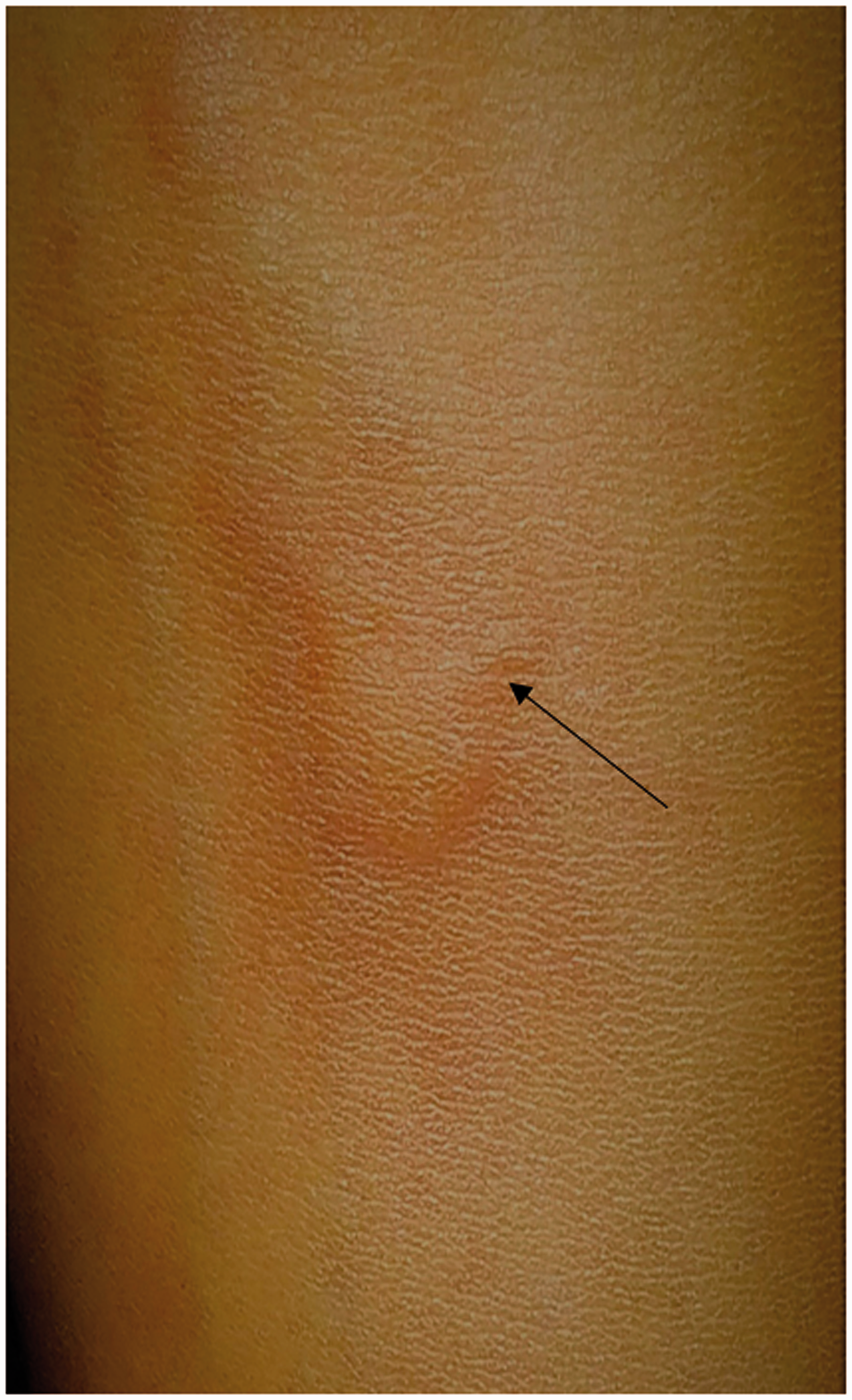
Fenugreek reaction with associated pseudopod formation (arrow).
Discussion
Many members of the Leguminosae family have been associated with allergies including soybean, green pea, and peanut. 5 There is a significant amount of cross-reactivity among legumes. 8 Fenugreek is also included in this family and may result in allergic reactions. This familial relationship between fenugreek and legumes is supported by Faeste et al. who, using in vitro studies, found considerable cross-reactivity between fenugreek and peanut proteins. 7 Patil et al. described two cases of fenugreek anaphylaxis in adults who had consumed fenugreek powder and paste, respectively. 6 Skin prick testing for fenugreek was done for both of these cases and was found to be appropriately positive.
Che et al. described two possible pediatric fenugreek reactions. 5 In one of these patients, there was a known peanut allergy, and a fenugreek-containing curry was ingested with subsequent anaphylaxis. Therefore, the reaction was postulated to be due to peanut cross-reactivity. The patient had ingested a curry at a restaurant reportedly for the first time and developed urticaria and wheezing. The food item that the patient reacted to is unknown since the curry contained 11 components. This patient was evaluated via skin testing to fenugreek, and results were positive, although no photograph was shown. It was unknown whether all the contents of the curry were tested. In addition, there was no ImmunoCAP or direct challenge performed.
Conclusion
Fenugreek is a common protein utilized in a variety of ways including a spice. As the spice is increasingly used, it will create a history of reaction. If a patient history raises concern for fenugreek allergy, skin prick testing would be useful to help discern the specific source of the allergic reaction. If the skin prick test is negative, it would be recommended that serum testing is performed. We describe the first pediatric case of fenugreek anaphylaxis with identifiable ingestion, documented by skin testing and ImmunoCAP.
Footnotes
Ethical Approval
This study is a single case report and thus ethical approval is not applicable.
Statement of Human and Animal Rights
This article does not contain any studies with human or animal subjects.
Statement of Informed Consent
There are no human subjects in this article and informed consent is not applicable.
Authors’ Contributions
NJ, ES, and RWH contributed to conception of study, data generation, analysis and interpretation of data, and preparation and revision of the manuscript. BPP contributed to data generation, analysis and interpretation of data, and preparation and revision of the manuscript.
Declaration of Conflicting Interests
The author(s) declared no potential conflicts of interest with respect to the research, authorship, and/or publication of this article.
Funding
The author(s) received no financial support for the research, authorship, and/or publication of this article.