



Abstract
Background
Thoracic injuries are a very common entity throughout all age groups. With rising numbers of geriatric patients, characteristics of this patient group need to be better defined. The aim of this study was to investigate the impact of age on the outcome of thoracic trauma. In this project we provide a stratification of differentiated age groups regarding outcome parameter on rib fractures.
Methods
The study employed a retrospective design using data from patients who sustained thoracic trauma and received treatment at a level I trauma center over a 5-year period. Patients with the same pattern of injury and gender but different age (above and below 70 years) were matched.
Results
The mean age of the study population was 57 ± 19 years, 69% were male, 54% of patients had preexisting comorbidities. Hemothorax was present in 109 (16%), pneumothorax in 204 (31%) and lung contusions in 136 patients (21%). The overall complication rate was 36%, with a mortality rate of 10%. The matched pair analysis of 70 pairs revealed a higher prevalence of comorbidities in the older age group. They had significantly fewer pulmonary contusions and pneumothoraces than the younger patients and a shorter length of stay. However, the older age group had a significantly higher mortality rate.
Conclusions
Geriatric patients with rib fractures exhibit different patterns of intrathoracic injuries compared to their younger counterparts. Although numeric age may not be the most accurate predictor of adverse outcome, we found that higher age was associated with a clear trend towards an increased mortality rate. Our findings build a basis for further research to evaluate the outcome of age for instance with the tool of a rib fracture scoring system within stratified age groups in order to identify patients at major risk.
Introduction
Rib fractures are a common injury and can have significant impact on patient outcomes.1-3 Furthermore, age and comorbidities influence the outcome and likelihood of adverse events in chest trauma. 4 Rib fractures can cause a variety of problems for trauma patients, including pain, difficulty breathing, impaired lung function, pneumonia and ARDS.5,6 In some cases they are accompanied by hemo- or pneumothorax, pulmonary contusion or injury to other intrathoracic organs. 3 Management ranges from simple pain to surgical treatment like intrapleural drains and rib fixation in extensive injuries.7-9 Proper management and early identification of risk factors is important to ensure the best possible outcome for the patient.
The global population of older people is rapidly increasing. According to the United Nations, the number of people in the age group 65 years or older is expected to reach almost 1.5 billion by 2030. By 2050, this number is expected to nearly double. 10 They also conduct a different lifestyle and stay active up to a high age, increasing the probability for accidents and injuries. 11
Elderly patients who sustain rib fractures from blunt chest trauma have a higher risk of mortality and pulmonary morbidity compared to younger patients with similar injuries, and the risk increases with the number of fractured ribs.12,13 Approximately 10% of elderly patients with rib fractures suffer from severe pneumonia and about 10% die.13,14
Therefore, it is important to further characterize this patient group. In this study, we aimed to examine differences in younger vs older patients with rib fractures with special attention to adverse events and mortality.
Material and Methods
The study employed a retrospective design using data from patients who sustained thoracic trauma and received treatment at a level I trauma center over a 5-year period (from 2012 to 2016). The inclusion criteria were age over 17 years and at least 1 radiologically confirmed rib fracture or pulmonary contusion. A total of 663 patients were evaluated for this study. Data on their hospitalization, including sex, age, comorbidities, insurance (statutory or private), detailed description of the chest trauma, further concomitant injuries, length of stay, hours of ventilation, chest tube insertion, performed thoracotomy, and complications were obtained from electronic patient files, the Swiss classification of operations (CHOP), and the International Classification of Diseases (ICD) codes.15,16
We excluded all patients under the age of 17 to focus our analysis on an adult population. Additionally, any cases with missing relevant information were excluded to maintain the integrity and accuracy of our dataset. Specifically, we excluded all patients who did not have complete information regarding their thoracic trauma.
We defined as outcome criteria the duration of ventilation and of hospital stay, complications (categorized into pulmonary and general complications), and mortality rates.
The extent of injury was assessed by analyzing imaging as computerized tomography scans and x-rays and operative reports. Complications were defined as certain clinical events that occurred during hospitalization, such as pneumonia, respiratory insufficiency, myocardial infarction, urinary tract infection, anemia, and complications after surgical interventions. The abbreviated injury scale (AIS) and injury severity score (ISS) were assessed by experienced trauma surgeons and were included in the analysis.17,18 The study was conducted in compliance with ethical standards, having received approval from the institutional review board (IRB) with the number (PB_2016-01888).
Statistical Analysis
Characteristics of Matched Groups.

SD: Standard Deviation; IQR: Interquartile Range; AIS: Abbreviated Injury Scale.
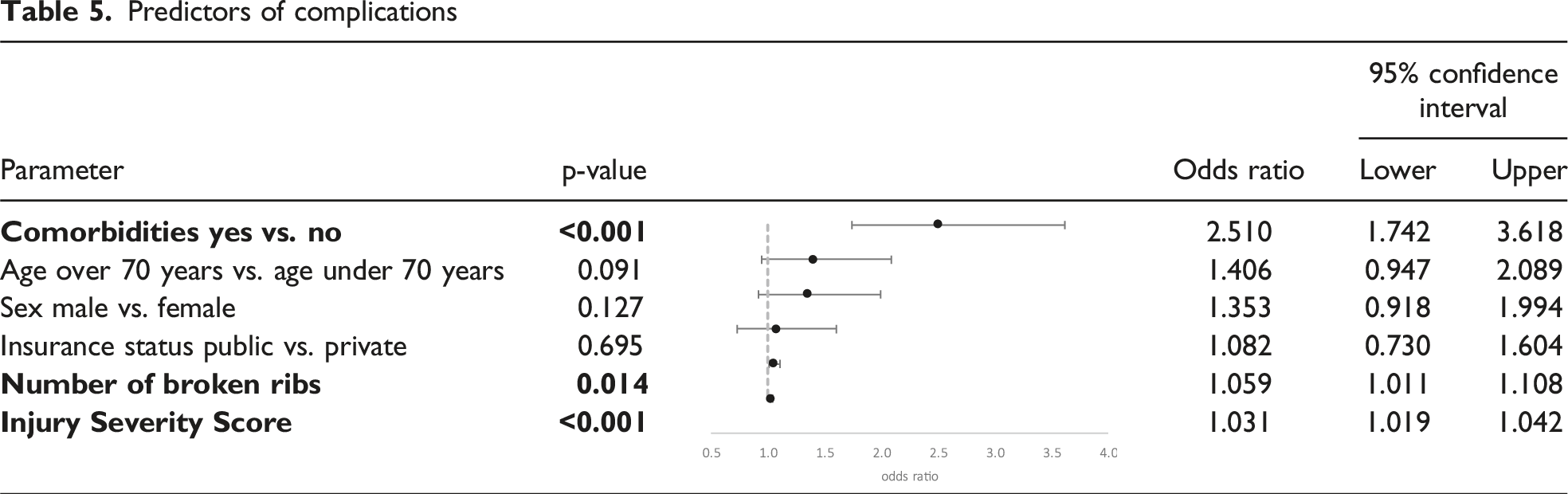
The second aspect of the study involved a regression analysis to identify predictors of complications. The normality of the data was assessed with the Kolmogorov-Smirnov test. Bivariate analysis was performed using the Chi-square, Mann-Whitney U and Fisher tests, where appropriate. Risk factors for complications were evaluated in a stepwise backward likelihood logistic regression analysis. Significant (P < 0.05) or nearly significant factors (P < 0.1) in bivariate analysis were selected as potential confounders. For our regression analysis for complications the Hosmer and Lemeshow test (Chi-square = 15, P = 0.068) suggested an acceptable fit of the model. Omnibus tests of model coefficients indicated the overall significance of the model in this fitted model (P < 0.001). Our model had an R-square of 0.178.
Statistical analysis was conducted using IBM SPSS version 26 (IBM, Armonk, New York, USA).
Last, we stratified the patients from under 40 years to patients with an age of over 80 years into 6 subgroups of age and analyzed them regarding the outcome criteria number of broken ribs, length of stay (days), comorbidity, general complications, hemothorax, pneumothorax, lung contusion on both sides and rib series fracture or unstable thorax.
Results
The Study Population
The study population consisted of 663 patients with a mean age of 57 ± 19 years. Of the patients, 69% were male. A total of 54% of patients had at least 1 comorbidity. The mean number of broken ribs among patients was 5.1 ± 3.9. Lung contusion was present in 21% of patients, with 136 cases, of which 65 were bilateral. Pneumothorax was present in 31% of patients, with a total of 204 cases. Hemothorax was present in 16% of patients, with a total of 109 cases. A total of 24% of patients (n = 156) underwent chest tube insertion, with 7.4% receiving bilateral chest tubes. Seven patients (1.1%) required thoracotomy.
Characteristics of Patient Cohort.
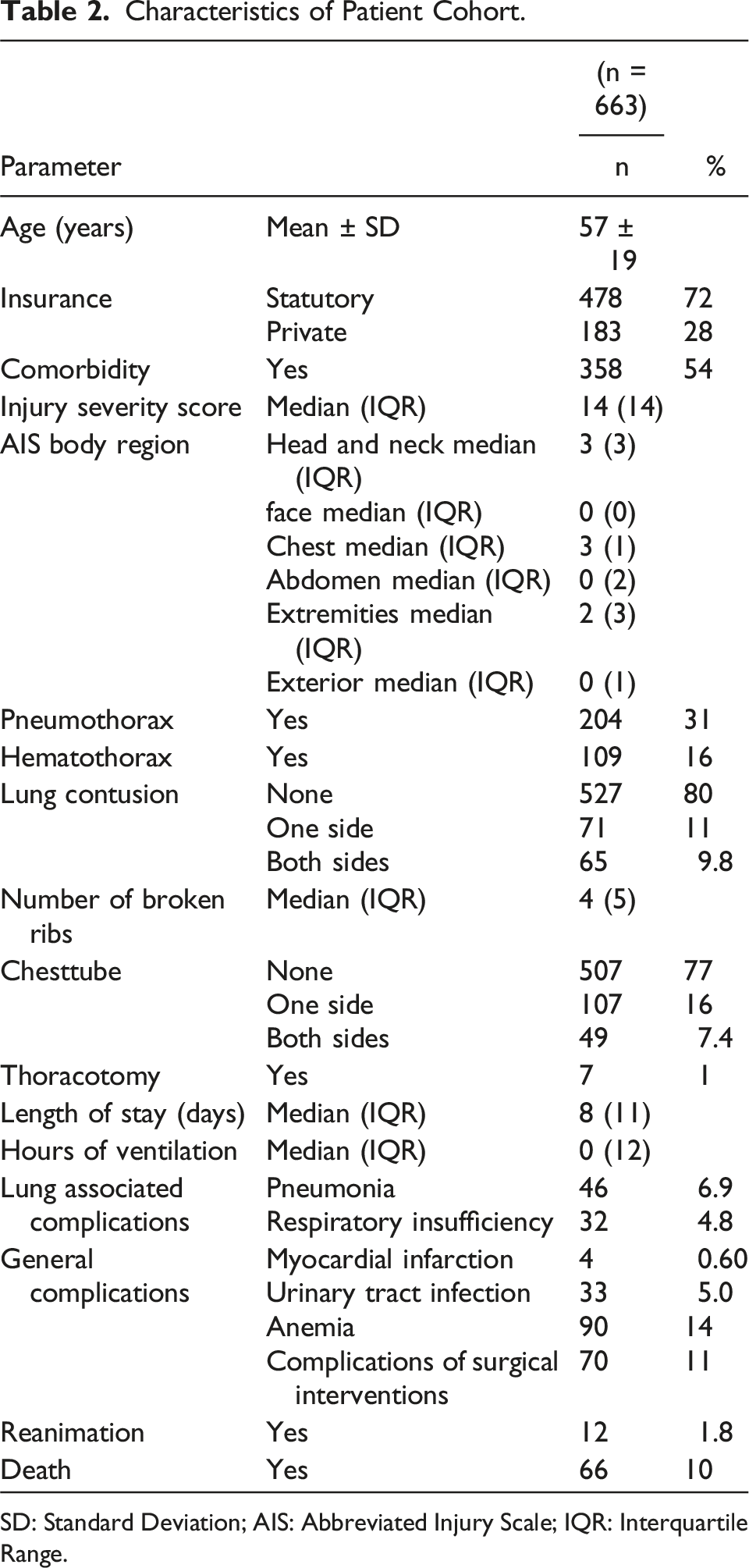
SD: Standard Deviation; AIS: Abbreviated Injury Scale; IQR: Interquartile Range.
Matched Pair Analysis
The study found 70 matched pairs for analysis. Results indicated no significant differences between the 2 groups in terms of Injury Severity Score (ISS), insurance type, hours of ventilation, the number of chest tubes, the occurrence of hemothorax, and lung-associated and general complications. However, the younger cohort had a higher incidence of pneumothoraces and a significantly higher rate of lung contusions. In contrast, the older cohort had a significantly higher prevalence of comorbidities. The length of stay was found to be significantly longer in the younger cohort, while the elderly group had a significantly higher mortality rate (Table 1).
Deceased Patients
Characteristics Deceased Patients.

SD: Standard Deviation.
Number of Broken Ribs, Hospital Stay, Comorbidities and Complications
We found significant differences for comorbidities (P < 0.001), number of broken ribs (P = 0.014), and Injury Severity Score (P < 0.001). There were no significant differences for age over 70 vs under 70 years (P = 0.091), sex (P = 0.127), and insurance status (P = 0.695) (Table 5).
Influence of Age on Outcome.

SD: Standard Deviation.
Comorbidities and Complications
The prevalence of comorbidities amplified with age, with the <80 years cohort indicating the highest at 83%. General complications showed a slight increase with age, peaking at 49% in the <80 years category (Table 4).
Specific Thoracic Injuries
Hemothorax presented most frequently in 70-80 age cohort (22%), whereas pneumothorax was most prevalent in the <40 age group (41%). The incidence of bilateral lung contusions decreased consistently with age, being most prominent in the <40 years group (18%) and least in the <80 years group (3.4%). Rib series fractures or unstable thorax were frequently observed across all age groups, with the 70-80 years cohort showcasing the highest incidence at 77%.
Regression Analysis
Predictors of complications
Predictors of Mortality.

For our regression analysis for mortality the Hosmer and Lemeshow test showed a Chi-square of 5.4 and a P = 0.718. Omnibus tests of model coefficients indicated the overall significance of the model in this fitted model (P < 0.001). Our model had an R-square of 0.625.
Discussion
The aim of this study was to evaluate the impact of age on outcome in patients with chest trauma. Our results indicated that the elderly patient was overall sicker with a higher prevalence of preexisting conditions. Elderly patients had different injury patterns than their younger counterparts with fewer pneumothoraces and lung contusions. The mean ISS and complication rate did not show significant differences between the groups. Nevertheless, the geriatric group had a trend towards a higher mortality rate. We found comorbidities, ISS and number of broken ribs to be predictive for adverse outcome.
There are some limitations to this study that must be considered when interpreting its findings. We used retrospective data for this analysis, so data not included in the first place could not be obtained. Secondly, the study is limited to a single level I trauma center, which may limit the generalizability of the results. The findings may not be applicable to other populations or medical systems with different patient demographics, treatment practices, or resource availability. The retrospectively collected data may be partially incomplete, leading to potential missing information that could affect the results. Furthermore, the study may not have considered all relevant confounding variables, such as patient-specific factors, medical history, and social determinants of health that could have impacted the results.
In Addition we had no sufficient information on the mechanism of injury to perform further analysis.
We observed different injury patterns in the 2 cohorts. Younger patients displayed a higher incidence for pneumothoraces and lung contusions, but there was no significant difference in the ISS. Our findings are consistent with previous research indicating a higher prevalence of lung contusions in younger patients, 19 while rib fractures of elderly patients result more often from low energy trauma and result in a lower incidence of lung contusions20,21).
It is notable that the overall length of hospital stay was significantly longer for the younger patient population. A factor playing into that might be the 7 elderly patients that died within 24 hours of admission (Table 3). This unexpected result might also be influenced by different inclusion criteria in the other studies, for example only thoracic mono trauma. 22
Our data showed a higher mortality rate among elderly patients. However, 7 out of the 13 deceased patients in the elderly group and both deceased younger patients died due to severe head trauma. According to Marini et al, data indicates that among patients between the ages of 16 and 75 with rib fractures, severe traumatic brain injury is the primary cause of death. Conversely, for individuals over 80 years of age with rib fractures, respiratory complications are the most frequent cause of mortality.6,12,23-25
Our data did not show a significant difference in overall complications in the different age cohorts. This concurs with the results of another matched-pair analysis that focused on pneumonia as a complication of blunt thoracic trauma. 26
In a subanalysis we found a delirium rate in our older cohort of 10%. Among patients over 70 with rib fractures, those experiencing delirium had an average hospital stay of 20 days, compared to 7.5 days for those without delirium. Delirium patients also had higher rates of: haematothorax (33% vs 18%) and lung contusion (22% vs 7.6%). The frequency of pneumothorax was similar in both groups.
We found ISS, number of fractured ribs and comorbidities to be predictors for adverse outcome. The literature on prognostic factors for adverse outcomes is sparse.13,27
Previous studies have established that the number of fractured ribs is a reliable predictor of mortality and complications.28-30 This finding is reflected in various scoring systems designed to predict outcome after thoracic injury, which consider the presence and pattern of rib fractures.31-35
The finding of comorbidities being a predictor for complications rather than numeric age agrees with the term of frailty being increasingly discussed as a good indicator for outcome in geriatric patients.36-38 However, our study did not systematically assess frailty, so we cannot make a definitive statement on this issue.
The higher mortality among elderly patients and the predictive power of comorbidities suggests the importance of tailored treatment approaches, which have been shown to be beneficial.39,40 Nevertheless, accurately identifying frailty can be challenging. The available scoring systems to this point use numeric age rather than frailty for predicting outcome.41-43 Chen et al. described the Chest Trauma Score (CTS), which includes among other factors the numeric patient´s age. 31 A score ≥5 can predict a poorer outcome and is associated with increased mortality. 44 The CTS is also recommended especially for geriatric patients as it predicts pneumonia well 45 and may assist to evaluate early intensified focused care.
In this study we provided a stratification of small age groups with parameters describing the outcome of rib fractures, which shows interesting varieties in terms of complications or number of broken ribs within older age groups (Table 4). For example, did the amount of rib fractures increased the older the patients got up to 80 years, but decreased then at over 80 years, while general complications increased with increasing age.
This enhances the need for a further observation within stratified age groups, especially if the trend towards higher mortality rate in older age would alter after application of a score like CTS and its consequences like early intensified care.
As demographic trends shift, this may be a promising area for future research.
Conclusion
The management of thoracic trauma in elderly patients with multiple comorbidities poses unique challenges.
Our results show that numeric age may not be the most accurate predictor of adverse outcome in terms of length of stay, hours of ventilation and complications. But we found that higher age was associated with a clear trend towards an increased mortality rate.
Our findings build a basis for further research to evaluate the influence of age on outcome for instance with the tool of a rib fracture scoring system within stratified age groups.
The application of a score may help to evaluate patients with rib fractures objectively and provide a sensibilization for closer follow-ups and expedite therapeutical interventions in specified older age groups in clinical practice.
Footnotes
Author’s Note
Statement of location where the work was performed: Division of Trauma Surgery, University Hospital Zurich (USZ), University of Zurich (UZH), Raemistrasse 100, 8091 Zuerich, Switzerland.
Author Contributions
Franziska Ziegenhain, Dr med.: data acquisition, writing and analysis
Anne Sophie Mittlmeier: writing and analysis
Hans-Christoph Pape, Prof. Dr med.: concept and writing
Valentin Neuhaus, Prof. Dr med.: concept and writing
Claudio Canal, Dr med: writing, analysis and concept
Declaration of Conflicting Interests
The author(s) declared no potential conflicts of interest with respect to the research, authorship, and/or publication of this article.
Funding
The author(s) received no financial support for the research, authorship, and/or publication of this article.
