



Abstract
Introduction
In China, the proportion of the elderly population is gradually increasing, followed by the increasing medical demands of elderly patients. Hip fracture is a common fracture in the elderly. The elderly are prone to serious postoperative complications, resulting in failure to restore normal hip function, which seriously affects patients’ quality of life and further increases their mortality rate. Thus, hip fracture represents a remarkable public health issue within the realm of geriatric medical care.
Significance
This study systematically evaluated the impact of comprehensive rehabilitation training, with a focus on balance function, on elderly individuals with hip fractures’ postoperative recovery and functional outcomes.
Result
Results showed a significant difference in BBS scores favoring comprehensive rehabilitation training based on balance function over conventional intervention. Similarly, AM-PAC scores favored the balance-focused training. TUTG meta-analysis indicated its adoption in comprehensive rehabilitation training. FIM scores showed improvement with balance-focused training. Harris score meta-analysis also favored this approach. A funnel plot analysis revealed potential publication bias, likely due to study heterogeneity and limited publications.
Conclusions
In conclusion, comprehensive rehabilitation training centered around balance function displayed clinical efficacy in enhancing postoperative hip joint function in elderly hip fracture patients. This approach improved balance, coordination, and posture control, facilitating lower limb function recovery and overall prognosis. It holds promise as a valuable treatment approach.
Keywords
Introduction
In China, the proportion of the elderly population is gradually increasing, followed by the increasing medical demands of elderly patients. Hip fracture is a common fracture in the elderly, with a reported lifetime prevalence rate of 10%-20%. 1 According to reports, the mortality rate within the first year for patients with hip fractures ranges from 12% to 17%, with a long-term risk of death close to 30%. 2 Elderly individuals are prone to serious postoperative complications, resulting in failure to restore normal hip function, which seriously affects patients’ quality of life and further increases their mortality rate. 3 Thus, hip fracture represents a remarkable public health issue within the realm of geriatric medical care.
Balance training typically encompasses exercises aimed at controlling the body’s center of gravity while engaging in unstable movements or standing on unstable or limited support surfaces. 4 The primary objective is to evaluate the impact of both short-term and long-term balance training interventions on enhancing physical performance and reducing the risk of falls. 5 The functional level, motor coordination, sensory organization, psychological cues, attention ability and environment of the musculoskeletal system contribute to gait balance and postural stability. Alterations in the major systems or environmental factors have the potential to affect gait balance, postural stability, and subsequently increase the susceptibility to falls. 6
Implementing tailored rehabilitation to address motor impairments, improve gait balance, and prevent falls is essential for elderly hip fracture surgery patients. Balance-focused rehabilitation plays a pivotal role in enhancing motor function. Numerous studies have examined comprehensive balance-based rehabilitation for elderly hip fracture patients, but their findings vary, with similar study designs. Additional research is needed. This study systematically and quantitatively analyzed independent studies to assess the feasibility of comprehensive balance-based rehabilitation for elderly hip fracture patients. We hypothesize that comprehensive balance rehabilitation training will have a positive impact on the rehabilitation of elderly patients with hip fractures, including improving functional mobility, reducing the risk of falls, and ultimately enhancing the quality of life. Through a systematic and quantitative analysis, we aim to validate this hypothesis and provide a more effective rehabilitation program for elderly patients with hip fractures.
Methods
Literature research was conducted in accordance with the guidelines of Preferred Reporting Items for Systematic Reviews and Meta-Analysis (PRISMA) 7 for systematic review and meta-analysis.
The Sources and Retrieval Methods of Documents
A comprehensive search was performed independently by Hai Chang, Chunliang Luan across multiple databases, including PubMed, EMBASE, ScienceDirect, Cochrane Library, China National Knowledge Infrastructure (CNKI), China VIP Database, Wanfang Database, and China Biomedical Literature Database (CBM). The search encompassed both Chinese and foreign language journals, conference papers, degree papers, news articles, and manual search contents. Additionally, a literature review was conducted to supplement the search. The search strategy involved the use of free words and subject words, with keywords including “balance function”, “comprehensive rehabilitation training”, “elderly hip fracture”, “postoperative recovery”, and “hip joint function”. Quotes were used to search for exact terms. The search period spanned from January 2000 to July 2023. The detailed search strategy was provided in supplemental file.
Literature Inclusion Criteria
(1) Types of study: all clinical randomized controlled trials, both domestic and international, investigating the effect of comprehensive rehabilitation training based on balance function in elderly patients with hip fracture. (2) Subjects: all patients were definitively diagnosed as elderly patients with hip fracture, using diagnostic criteria referenced from relevant literature.
8
(3) Grouping: study group was defined comprehensive rehabilitation training based on balance function; and control group was that received routine rehabilitation training. (4) The following outcome indicators: Berg scale (BBS) score, activity scale after intervention (AM-PAC), stand-up-walk timing test (TUTG), functional independence scale (FIM) score, Harris score and so on.
Literature Exclusion Standard
(1) The data report was incomplete, rendering the data unusable. (2) Identify duplicate research content and include the most recent study. (3) Literature review. (4) Clinical cases. (5) Grey literature (i.e., conference articles, editorials).
Quality Evaluation and Data Extraction
Ruolan Liu, and Chen Li independently assessed the methodological quality of each included study. (1) The study included bias risk assessment using the recommended tool from the Cochrane Systematic Review Manual 5.4. (2) Literature screening and data extraction: 2 researchers (Hai Chang, and Chunliang Luan) conducted an independent screening of the literature, extracting relevant data and assessing the quality of the included studies. Discussions or judgments from a third researcher were used to resolve discrepancies. A document management software program called NoteExpress (version 3.20) and an office software program called Excel (version 14.4.0) were used to extract and manage data. In cases where data was incomplete within the literature, efforts were made to contact the respective authors for supplementation.
The extracted data encompassed the following information: (1) basic details such as author, publication date, and sample size; (2) research methods employed; and (3) outcome indicators, including BBS score, AM-PAC, TUTG, FIM score, Harris score, and other relevant measures.
Statistical Processing
This meta-analysis was conducted by the ReMan5.4 software (Cochrane Collaboration, London, United Kingdom). Mean Difference (MD) is utilized for continuous outcomes with the same scale. Otherwise, Standardized Mean Difference (SMD) was used. The mean and standard deviation of BBS score, AM-PAC score, TUTG score, FIM score and Harris score are input into RevMan5.4 for analysis. An effect index is calculated based on the weighted mean difference (WMD) along with 95% confidence intervals (CI). Firstly, the χ2 test is used to assess the presence of heterogeneity among studies. If P > .05 and I2 < 50%, it indicates that the included studies are homogeneous, and the modified effect model can be used for meta-analysis. If P < .05 and I2 ≥ 50%, the combination effect is needed to judge the homogeneity included in the study, then the random effect model is selected. If P < .05 and the source of heterogeneity cannot be determined, meta-analysis will not be conducted and descriptive analysis will be performed instead. The inverted funnel plot is generated to assess publication bias in the included literature. Egger’s test is conducted to evaluate the asymmetry of the funnel plot. If the P-value of this test is less than .1, the Trim and Fill method can be applied to adjust the funnel plot and account for the potential publication bias.
Results
The Results of Literature Search and the Basic Characteristics of the Included Studies
Through computer database searches, 2012 articles were initially retrieved. After eliminating duplicate studies, 435 articles remained. Upon conducting a preliminary review of the titles and abstracts, 142 articles were identified as potentially relevant. Exclusion criteria were applied to remove irrelevant studies, reviews, case reports, and non-controlled literature, resulting in the inclusion of 75 articles. Subsequently, a thorough examination of the full texts led to the exclusion of 69 articles due to incomplete data or lack of primary outcome indicators. Finally, 6 clinical randomized controlled trials were included for analysis, comprising a total sample size of 617 participants. Figure 1 presents the flow chart depicting the process of literature screening. Table 1 provides an overview of the essential characteristics captured in the included literature. Flow chart of document screening. Basic Characteristics of Literature. Note: ① Berg (BBS) Score;② AM-PAC;③ TUTG;④ FIMScore;⑤ Harris Score; The balance training: Systematic rehabilitation functional training was used to maintain normal lower limb muscle strength and joint range of motion, stabilize hip joint mobility across various ranges, and consequently enhance hip function. The control group’s rehabilitation measures focused on traditional muscle strength and balance training.

Assessment of the Methodological Quality of the Included Studies
Of the 6 studies included in this meta-analysis, all 6 articles provided comprehensive baseline information regarding the enrolled patients.9-14 Each study described the observation indicators, research methods, and specific grouping techniques in detail. Furthermore, all the included studies provided explicit descriptions of the blinded method, including the number of participants involved and reasons for any missing follow-up or withdrawals. The literature quality was assessed using the Jadad scale, with a score of ≥3 indicating high quality and a score of ≤2 indicating low quality. The risk of bias analysis was presented in Figures 2 and 3. Risk of bias summary. Summary of the risk bias assessment of the studies.

BBS Score
The meta-analysis of BBS scores was analyzed by meta-analysis. According to the results of heterogeneity test, Chi2 = 82.55, df = 4, P = <.00001, I2 = 95%, so the fixed effect model was selected for analysis (Figure 4). In the analysis, the results could be concluded that a statistical difference was found in the WMD of BBS scores between patients with comprehensive rehabilitation training based on balance function and those with conventional intervention. The 95% confidence interval of the weighted mean difference (WMD) was located to the right of the null line, indicating a significantly greater effect of comprehensive rehabilitation training based on balance function on the improvement of patients’ BBS scores compared to conventional intervention. Meta-analysis of BBS scores between patients with comprehensive rehabilitation training based on balance function and those with conventional intervention. Significant statistical difference in BBS scores indicated by the 95% confidence interval of the WMD located to the right of the null line.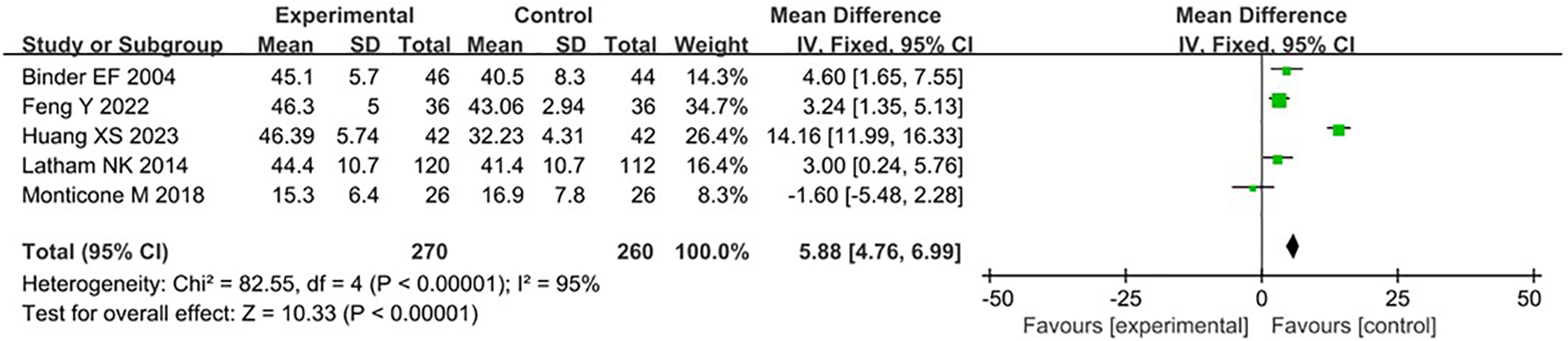
AM-PAC
The AM-PAC was analyzed by meta-analysis. The heterogeneity test results indicated no remarkable heterogeneity among the included research data, as evidenced by Chi2 = 3.92, df = 1, P = .05, I2 = 74%. The random effect model analysis was performed accordingly (Figure 5). The 95% CI was from .09 to .53 (Z = 2.74, P = .006). The data suggested that the comprehensive rehabilitation training with balance function was remarkably better than the routine intervention in improving the AM-PAC of patients. Meta-analysis of the AM-PAC using the random effects model. The results show that comprehensive rehabilitation training with balance function significantly improves the AM-PAC of patients compared to routine intervention. The 95% CI ranges from .09 to .53 (Z = 2.74, P = .006). The heterogeneity of the included data is not significant (Chi2 = 3.92, df = 1, P = .05) I2 = 74%).
TUTG
The meta-analysis of TUTG was analyzed by meta-analysis. Based on the heterogeneity test results (Chi2 = 133.27, df = 1, P < .00001, I2 = 99%), the fixed effect model was chosen for the analysis (Figure 6). The results of this analysis suggested that the TUTG of patients with comprehensive rehabilitation training based on balance function was remarkably lower compared to patients with routine intervention. Meta-analysis of TUTG using the fixed effects model. The analysis was based on the results of the heterogeneity test (Chi2 = 133.27, df = 1, P < .00001, I2 = 99%). The results indicate that patients undergoing comprehensive rehabilitation training with balance function have significantly lower TUTG compared to patients receiving routine intervention.
FIM Score
The meta-analysis of the FIM scores was analyzed by meta-analysis. The results of the heterogeneity test indicated Chi2 = 9.65, df = 1, P = .002, I2 = 90%. Therefore, the fixed effect model was used for the analysis (Figure 7). The finding revealed that the improvement effect of comprehensive rehabilitation training based on balance function on FIM score of patients with balance function was remarkably higher compared to routine intervention. Meta-analysis of FIM scores using the fixed effects model. The analysis was based on the results of the heterogeneity test, which showed significant heterogeneity among the included studies (Chi2 = 524.35, df = 1, P < .00001, I2 = 100%). The results indicate that comprehensive rehabilitation training based on balance function has a significantly higher effect on improving FIM scores in patients compared to routine intervention.
Harris Score
The Harris score was analyzed by meta-analysis. The results of heterogeneity test showed that Chi2 = 21.86, df = 2, P < .00001, I2 = 91%, so the fixed effect model was selected for analysis (Figure 8). According to the results of this analysis, it could be considered that the improvement effect of comprehensive rehabilitation training based on balance function on Harris score of patients with balance function was remarkably higher compared to routine intervention. Meta-analysis of Harris scores using the fixed effects model. The analysis was based on the results of the heterogeneity test, which indicated significant heterogeneity among the included studies (Chi2 = 21.86, df = 2, P < .00001, I2 = 91%).
Publication Bias Analysis
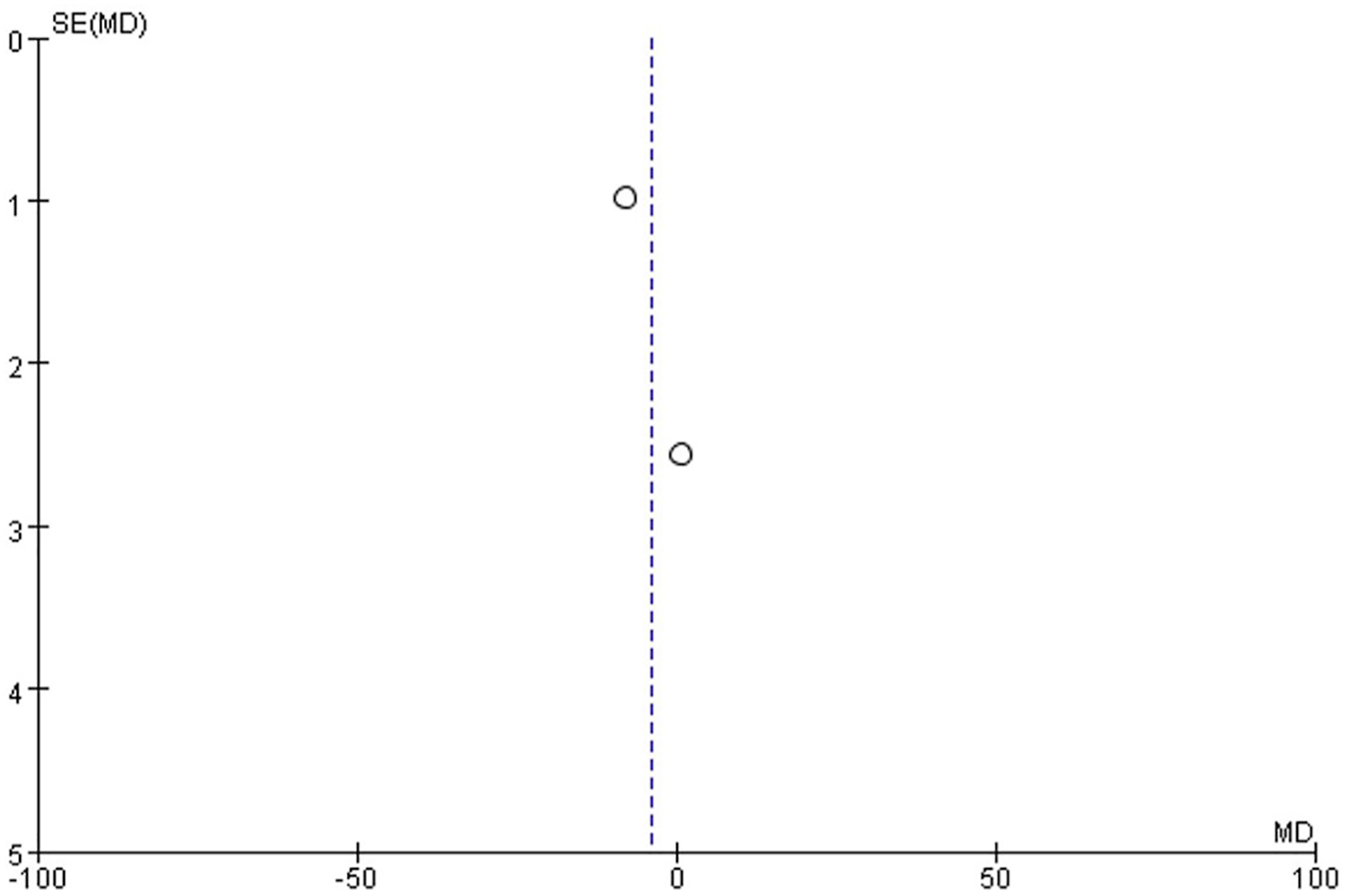
A funnel plot was constructed using the BBS score, AM-PAC, TUTG, FIM score, and Harris score as basis, followed by conducting a publication bias analysis (Figures 9–13). The majority of the funnel plots (Figures 10–12) exhibited symmetrical distribution, while a few (Figures 9 and 13) showed asymmetries. Egger’s test was used to evaluate the asymmetry of the funnel plot (Figures 9 and 13). The results of the Egger test in Figures 9 and 13 showed no publication bias (Egger P = .356; Egger P = .115). However, due to the limited number of included publications, Egger test could not be conducted in the asymmetry of the funnel plots in Figures 10–12. It is suggested that there may be publication bias in the included literature. This bias could potentially be attributed to study heterogeneity and the limited number of included publications. Funnel plots and publication bias analysis for BBS score. Funnel plots and publication bias analysis for AM-PAC. Funnel plots and publication bias analysis for TUTG. Funnel plots and publication bias analysis for FIM score. Funnel plots and publication bias analysis for Harris score.



Discussion
In the case of elderly hip fractures, surgical treatment is primarily employed to improve hip joint deformity and mobility, helping to alleviate pain and discomfort, and proving beneficial for the majority of patients. However, the surgical procedures for elderly hip fractures are relatively complex, involving significant difficulty and trauma, which can adversely affect postoperative recovery. Therefore, enhancing postoperative rehabilitation interventions is crucial for improving patient outcomes.
The control group was intervened using conventional methods, such as strengthening the lower limb muscles, ankle pump exercises, joint mobility training, and early weight-bearing exercises from postoperative days 1 to 7. From weeks 2 to 4 postoperatively, muscle strength, balance, and proprioception training were intensified. From weeks 5 to 8 postoperatively, unsupported and unassisted training, as well as walking exercises, were reinforced. 11 Rehabilitation training holds remarkable potential in addressing exercise-related aspects such as gait, balance, and strength, as well as non-motor symptoms and complications, including cardiovascular issues and osteoporosis, in patients following hip fracture surgeries. Balance training can reduce the incidence of falls in the elderly and improve the evidence-based support of balance function in the elderly. 15 Notably, balance function training plays a crucial role in effectively improving postural instability and abnormal gait patterns observed in post-hip fracture surgeries patients. The existing body of evidence supports the beneficial impact of rehabilitation training on various outcomes in patients after hip fracture surgeries, including enhanced postural stability, increased gait speed, and improved aerobic capacity.16-18 Balance training post-surgery should involve specialized equipment like rocker boards, instability planes, Biodex trainers, or pool therapy. It’s recommended to start these exercises under the guidance of a rehabilitation specialist 2 weeks after surgery. This form of training encompasses various methods beyond traditional balance boards and beams, including muscle strength, proprioceptive, aerobic exercises (e.g., yoga, Tai Chi, Pilates), cognitive function, and whole-body vibration balance training.9-14 The control group’s rehabilitation measures focused on traditional muscle strength and balance training. In contrast, the balance training group employed more specialized and diverse methods, including the use of professional equipment and comprehensive rehabilitation training, aiming to more effectively promote patients’ recovery.
This study conducted a meta-analysis of 6 clinical randomized controlled trials involving 617 samples, assessing BBS, AM-PAC, TUTG, FIM, and Harris scores. Patients undergoing comprehensive rehabilitation training with a focus on balance function achieved higher scores in BBS, AM-PAC, FIM, and Harris compared to those with routine interventions. Funnel plots were used to analyze publication bias, indicating some asymmetry likely due to research heterogeneity and limited studies. The analysis highlights how comprehensive rehabilitation targeting balance function effectively modulates the sensory, central nervous, and musculoskeletal systems. This approach promotes balance and coordination function recovery in patients with damaged nervous systems through sensory feedback and central system adjustments.19,20
In this study, the study group demonstrated significantly higher scores in the Berg Balance Scale (BBS) and AM-PAC. This can be attributed to a comprehensive rehabilitation program focusing on balance, which includes progressive dynamic and static balance training, as well as balance response training. This training regimen effectively enhances muscle strength, coordination, and overall balance. In contrast, conventional rehabilitation lacks specificity and systematic structure, leading to limited effectiveness in improving balance. The study group also showed notably higher FIM scores but lower TUTG scores. The balance-based rehabilitation significantly improves limb motor function and functional independence, as indicated by the Harris score, which confirms better hip joint function. This comprehensive approach stimulates the patient’s nervous system through various training methods, leading to substantial improvements in hip joint function.
Incomplete data reports in the literature have been excluded, and all included literatures were randomized trials in this study. However, there are some limitations to the study. First, only 6 studies were included. Secondly, grey literature was not included, and there may be publication bias. Finally, only 1 paper 13 has explicitly shown high risk bias of blinding of participants and personnel. However, because of the obvious differences between the 2 interventions, it was not possible to perform blind testing on participants or researchers. Therefore, the blinding of participants and people in other trials9-12,14 included in this meta-analysis was judged to be of unclear risk.
Conclusion
Comprehensive rehabilitation training that focuses on balance function demonstrates positive outcomes in improving postoperative hip joint function among elderly patients with hip fractures. It effectively enhances balance, coordination, and posture control abilities, thereby facilitating the recovery of lower limb function and improving overall prognosis. Overall, it exhibits a favorable clinical treatment effect. However, certain aspects warrant further improvement and enrichment within this study. These aspects include the small sample size, limited coverage, and incomplete assessment of risk factors. These limitations will be addressed and supplemented in subsequent follow-up observations and studies.
Supplemental Material
Supplemental Material - Effect of Comprehensive Rehabilitation Training Based on Balance Function on Postoperative Recovery and Function of Hip Fracture in the Elderly: A Systematic Review and Meta-Analysis
Supplemental Material for Effect of Comprehensive Rehabilitation Training Based on Balance Function on Postoperative Recovery and Function of Hip Fracture in the Elderly: A Systematic Review and Meta-Analysis by Hai Chang, Chunliang Luan, and Chen Li in Geriatric Orthopaedic Surgery & Rehabilitation
Footnotes
Author’s Contribution
Hai Chang, Chunliang Luan, and Chen Li contributed to conception and design of this study. Study selection and data extraction of the finally included studies were done by Hai Chang, Chunliang Luan. Chen Li independently assessed the methodological quality of each included study. Hai Chang, Chunliang Luan and Chen Li contributed to preparation of the manuscript. The final version of the article was approved by all the authors.
Declaration of Conflicting Interests
The author(s) declared no potential conflicts of interest with respect to the research, authorship, and/or publication of this article.
Funding
The author(s) disclosed receipt of the following financial support for the research, authorship, and/or publication of this article: This study was supported by the National Natural Science Foundation Youth Foundation (grant number 81603696).
Ethical Statement
Disclosure
None of the authors has or will receive benefits for personal or professional use from a commercial party related directly or indirectly to the subject of this article.

Supplemental Material
Supplemental material for this article is available online.
References
Supplementary Material
Please find the following supplemental material available below.
For Open Access articles published under a Creative Commons License, all supplemental material carries the same license as the article it is associated with.
For non-Open Access articles published, all supplemental material carries a non-exclusive license, and permission requests for re-use of supplemental material or any part of supplemental material shall be sent directly to the copyright owner as specified in the copyright notice associated with the article.
