



Abstract
Background:
Bucket-handle meniscal tears are rare in geriatric patients. Displaced bucket-handle meniscal tears are usually treated operatively. Due to the rarity of these tears in elderly patients and conflicting evidence regarding the use of arthroscopy versus conservative treatment, it is valuable to report the clinical presentation, treatment, and outcome of these injuries in elderly patients.
Case Description:
We describe a 71-year-old man who presented with an acute, displaced, magnetic resonance imaging (MRI)-confirmed right medial meniscal bucket-handle tear with mild effusion and no signs of degenerative joint disease. On physical examination, the patient was unable to fully extend the right leg due to locking of the knee. At 2-month follow-up, MRI showed mild degenerative changes and an anatomically reduced tear. At 6-month follow-up, the patient reported normal, pain-free knee function, and MRI showed the tear healing in anatomic position with minimal inferior surface changes and no effusion. He returned to his pain-free baseline level of physical activity.
Literature Review:
Upon review of the English literature, this 71-year-old patient is an exceptional case and one of the oldest patients reported to have sustained a displaced medial meniscal bucket-handle tear treated successfully with nonoperative means. Two reported cases of spontaneously reduced meniscal bucket-handle tears were found in the English literature, although both cases were seen in much younger males and involved the lateral meniscus.
Clinical Relevance:
This case suggests that in elderly patients with displaced medial meniscus bucket-handle tears that reduce spontaneously, the physician can safely and efficaciously use conservative, nonoperative management to achieve restoration of baseline knee function and anatomic meniscal healing while avoiding the risks of arthroscopic surgery. Surgical intervention for reduction without repair may be an available option, but no literature is present to direct care; however, complete documentation as in the current case would be instructive. Katz et al have reported that physical therapy was as efficacious as surgical intervention, although the specific displaced bucket-handle tear was not reported.
Keywords
Introduction
Meniscal tears are the most common orthopedic knee pathology with a mean annual incidence of 66 per 100 000 population. 1 Longitudinal tears with an attached fragment that rotates into the joint space are known as “bucket-handle” tears and display common findings on physical examination including anteromedial joint pain, mechanical obstruction to extension, and locking of the knee in flexion. 2,3 Of all meniscal tears, bucket-handle tears represent 9% to 34%, with a higher incidence among men (35%) than women (21%). 3 –7 Bucket-handle tears occur more commonly in the medial meniscus than in the lateral meniscus. 3,5,7,8
The vast majority of meniscal tears in older adults are associated with chronic degenerative changes in the knee, whereas meniscal tears in younger adults generally occur consequent to an acute traumatic event. 9 With a mean age of onset of 29 years, bucket-handle tears are typically seen in younger patients and are generally caused by sports trauma, although 20% of all patients sustain this injury pattern following simple crouching or through an unknown mechanism of injury. 3
Displaced bucket-handle tears are typically treated by arthroscopic reduction and suture repair in order to maintain absorption of tibiofemoral load, prevent accelerated degenerative changes, and remove mechanical obstruction. Although the benefits of arthroscopic surgery in the younger population have been well documented, there is debate as to the utility of arthroscopy in elderly patients. 10 –17
Due to the rarity of displaced bucket-handle tears in elderly patients and conflicting evidence regarding the use of arthroscopy versus conservative treatment, it is valuable to report the clinical presentation, treatment, and outcome of these injuries in elderly patients. In this report, we examine the case of an uncommon presentation of a bucket-handle medial meniscus tear in a 71-year-old patient. The need to consider factors such as age, functional limitations, and type of meniscal tear in treatment of these injuries in elderly patients is demonstrated by this case.
Case Report
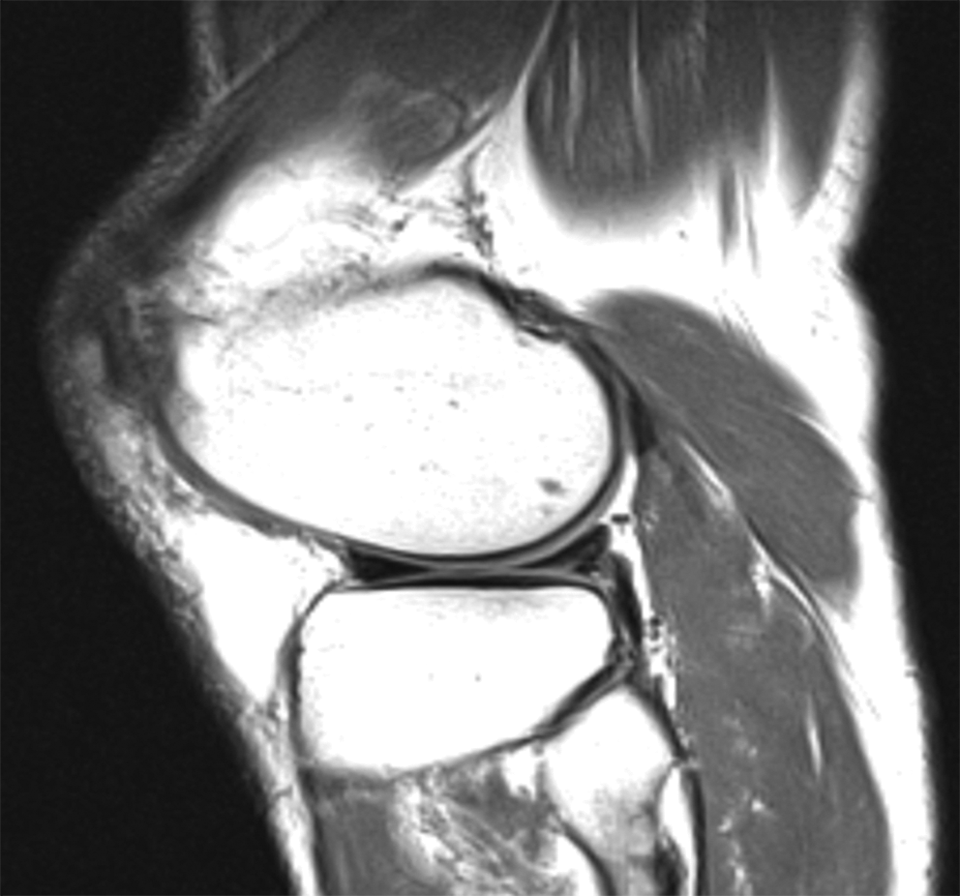
A 71-year-old male presented to a primary care clinic with 2 weeks of debilitating right knee pain. Prior to injury, the patient was able to ambulate without assistance and swim recreationally. The patient experienced a sharp “tearing” pain in his right knee upon crossing his right leg over his left. He characterized the initial knee pain as a 10/10 without radiation or paresthesias. 18 On physical examination, the patient was unable to fully extend his leg due to locking of the affected knee. Radiographs showed no signs of degenerative joint disease (Figure 1). Magnetic resonance imaging (MRI) revealed a displaced bucket-handle tear in the posterior horn of the medial meniscus (Figure 2). When patient was seen 2 weeks later, he reported spontaneous resolution of the locked knee and was able to achieve full extension. A follow-up MRI was ordered and obtained 2 months later.
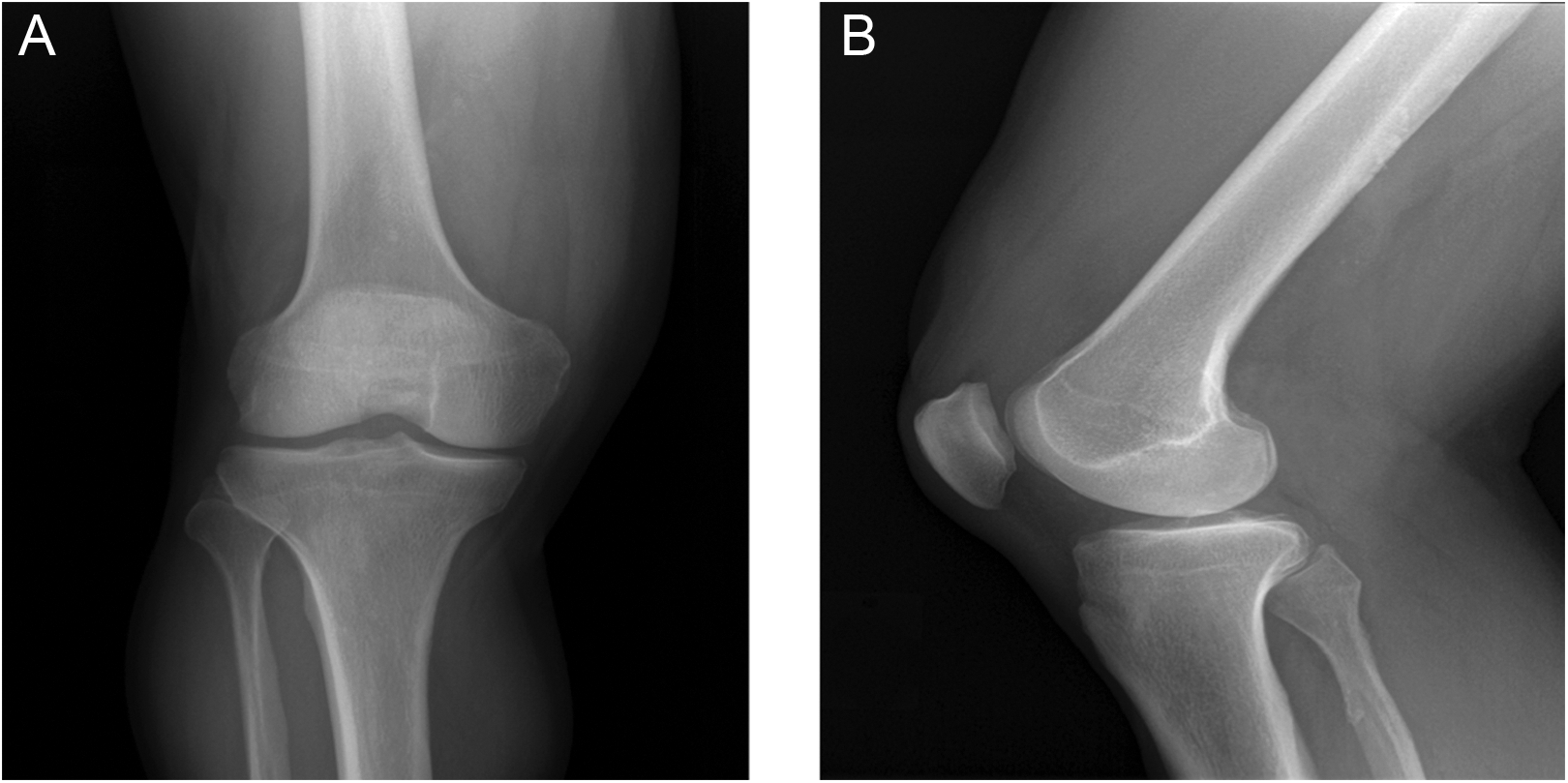
Anteroposterior AP (A) and lateral (B) radiographs of the right knee. There are no significant degenerative changes, although the mineralization in the popliteal fossa on the lateral image suggests the patient may be older in age.

Sagittal T1-weighted fast spin echo magnetic resonance imaging (MRI) of the right knee taken after initial presentation at the primary care clinic. The medial meniscal bucket-handle tear and knee effusion are shown.
The patient returned to the clinic 2 months later and reported moderate improvement in his knee pain as well as maintenance of the resolved mechanical symptoms seen at his prior visit. Knee examination demonstrated a 2+ effusion, negative joint line tenderness, negative McMurray test, and comparable active range of motion to the contralateral knee. The repeat MRI showed the posterior horn reduced in anatomic position with evidence of mild degenerative changes (Figure 3).
Sagittal T1-weighted fast spin echo magnetic resonance imaging (MRI) of the right knee taken 3 months post-injury. The medial meniscus is reduced and has developed a degenerative undersurface tear.
The patient was monitored with minimal activity restriction. The patient was advised not to recreate the motion that originally led to his injury, that is, crossing his legs in a seated position. However, aside from strenuous physical activity, the patient was allowed to maintain normal daily activities. He returned to the clinic 6 months post-injury with a third MRI revealing interval healing of the medial meniscus in anatomic position (Figure 4). As this was an unusual injury, in a previously asymptomatic male, sequential MRIs were ordered to confirm that the treatment strategy was working and to reinforce activity modification to the patient. His symptoms and the original effusion had resolved. He returned to his baseline physical activity level and was discharged from the clinic.

Sagittal T1-weighted fast spin echo magnetic resonance imaging (MRI) of the right knee taken 6.5 months post-injury. The medial meniscus remains in a reduced position with no change in the degenerative undersurface tear.
Discussion
This unique case of a displaced medial meniscal bucket-handle tear in an elderly patient is a valuable contribution to the scientific literature due to the patient’s age, the spontaneous resolution of the injury, and the favorable outcome through conservative treatment. Medial meniscal bucket-handle tears typically occur in younger patients and are associated with trauma, whereas older patients usually sustain meniscal tears related to meniscal degeneration. 9 In Hede et al’s retrospective analysis of 1215 meniscal lesions, the incidence of meniscal lesion in the male 70 to 79 age-group was 1 in 10 000 population. 1 Shakespeare and Rigby retrospectively examined 272 surgically diagnosed meniscal bucket-handle tears and reported a mean patient age of 29 years with a range of 16 to 62 years. 3 Although past studies did not always specify patient age, tear classification, or tear displacement status, this 71-year-old patient is an exceptional case and one of the oldest patients reported to have sustained a displaced medial meniscal bucket-handle tear.
The spontaneous reduction and favorable short-term outcome of this injury also contribute to the rarity of our case and warrant further discussion due to the possible extension of this finding to the management of bucket-handle tears in the elderly individuals. Because of differences in injury etiologies among different age-groups, physicians must be mindful of relevant factors that could help determine the optimal treatment modality for a given patient. Although meniscal tears continue to be the most common knee injuries treated with arthroscopy, the use of this surgical intervention in the knees of elderly patients has been a historically controversial subject. 10 –17 Although the procedure is minimally invasive and can be performed under local or regional anesthesia, their outcome is less predictable and is often considered a temporary measure in elderly patients. As the majority of past studies have justifiably focused on arthroscopic debridement of the degenerative knee due to its high prevalence in the elderly, there is little evidence surrounding indications for arthroscopy and short-term outcomes of bucket-handle tears in geriatric patients. No case of a displaced bucket-handle meniscal repair has been previously reported in this age group. Prior to our patient, 2 reported cases of spontaneously reduced meniscal bucket-handle tears were found in the English literature, although both cases were seen in much younger males (11 and 23 years of age) and involved the lateral meniscus. 19,20 At short-term follow-up, the 11-year-old boy was able to return to his previous level of functioning and the 23-year-old male was participating in pivoting sports without symptoms. Although the spontaneous reduction was by chance and not a direct result of treatment, our rare case demonstrates that conservative management of a displaced medial meniscal bucket-handle tear in an elderly patient can result in restoration of baseline knee function and anatomic meniscal healing while avoiding the risks of arthroscopic surgery.
Footnotes
Acknowledgments
The authors would like to thank the patient for providing informed consent for publication of this case report.
Authors’ Note
The Human Studies Subcommittee Chairperson (Leonardo Tamariz, MD) at the Bruce W. Carter Department of Veterans Affairs Medical Center in Miami, Florida, has determined this report do not constitute research, and therefore, no review from the local institutional review board is required.
Declaration of Conflicting Interests
The author(s) declared no potential conflicts of interest with respect to the research, authorship, and/or publication of this article.
Funding
The author(s) received no financial support for the research, authorship, and/or publication of this article.