




Abstract
Consuming 5 or more cups of fruits and vegetables (F & V) per day or 400 g/day for adults is advocated by most health authorities and has short-term and long-term health benefits. There have been numerous studies examining dietary behaviors among different US populations; however, the literature on F & V consumption behavior among Asian Americans (AAs) is sparse. AAs constitute a diverse group and as their population continues to grow in the US; there is a greater need to examine the health practices of AAs and their constituent subgroups. The study aimed to conduct a thematic analysis based on a scoping review of the peer-reviewed published literature over the past 15 years targeting F & V consumption among AAs. The thematic analysis was organized around the prevalence, consequences, determinants, and interventions (n = 33). AAs consuming recommended servings of F & V ranged from 0.5% to 20%. Correlations between the consumption of F & V and Body Mass Index (BMI) and other chronic diseases were reported as negative and significant associations were noted between F & V intake and self-reported health. There was only 1 intervention that was conducted with this behavior in only 1 small subgroup of this target population. There is an urgent need to study F & V consumption behavior among different AA subgroups as well as to design culturally appropriate theory-based efficacious F & V promotion interventions for them.
Introduction
There is no doubt that healthy lifestyle choices such as healthy eating behavior are beneficial for many reasons. There is a wide variety of diets people choose to practice. Diets that lead to healthy long-term effects share a few important similarities which include high consumption in fruits and vegetables (F & V). 1 According to the latest Dietary Guidelines for Americans, healthy eating patterns include a variety of F & V. 2 Specifically, it is recommended by the World Health Organization that all adults should consume 5 or more cups of F & V per day or 400 g/day. 3 Consumption of F & V is an important health behavior that prevents obesity, 4 diabetes, 5 cardiovascular diseases, 6 cancers, 7 stroke, 8 digestive problems 9 and has protective effects on hypertension. 10
Eating behaviors and food choices are highly associated with obesity and other chronic diseases.11 -13 In order to identify health intervention priorities among AAs, Maxwell et al 14 investigated health risk behaviors (i.e., Body Mass Index-BMI) among 5 AA subgroups (i.e., Chinese, Filipino, Japanese, Korean, and Vietnamese Americans). The findings of the study revealed that when using the BMI cutoff for AAs, 67% male participants and 41% female participants were categorized as increased (overweight) or high risk (obese). Approximately 80% of Filipino and Japanese American, and 70% of Korean American male participants were categorized as the increased or high risk, while 55% Filipino American female participants were categorized as the increased or high risk which had the highest percentage among all other AA female groups. Regarding the participants’ self-reported food consumption, results showed that the AAs reported a lower prevalence of 5 or more F & V consumption per day compared to the non-Hispanic Whites. Another study conducted by August and Sorkin 15 examined differences in dietary behaviors among middle-aged and older adults. Results of the study revealed a disparity in a healthy diet (i.e., consuming 5 or more servings of F & V daily) for middle-aged English-proficient AAs compared to non-Hispanic Whites.
Serafica 16 conducted a review study aiming to understand the construct of dietary acculturation among the AA population. Keywords used for literature search including: Asian Americans, dietary practices, dietary acculturation, and eating habits. Only 7 articles were identified and relevant. The findings of the review concluded that research investigating dietary patterns among AAs was limited and the discussion section focused on how acculturation influenced diet choices among AAs. The study concluded that AA immigrants who had lived long in the US were more likely to adopt the American eating patterns (e.g., exceeded added sugars, saturated fats, and sodium, and high in calories), while those who were born outside of the US, or immigrated at an older age were more likely to maintain traditional dietary patterns in which consumption of F & V is emphasized.
There have been numerous studies examining dietary behaviors among different US populations; however, the literature on F & V consumption among AA is sparse. Therefore, it is in this context that, this study aimed to conduct a thematic analysis based on a scoping review of the literature in the past 15 years regarding the prevalence, consequences, determinants, and intervention for F & V consumption among AA. The study also provides recommendations for interventions and policy priorities to promote F & V consumption among AA populations.
Methods
Literature Search and Inclusion Criteria
A primary literature search was conducted in MEDLINE and CINAHL databases using key terms: fruit and vegetable and Asian Americans. Inclusion criteria were studies: (1) with participants who were AA adults aged 18 years or older, (2) investigating F & V consumption, (3) that were published in peer-reviewed journals from 2005 onwards, (4) in the English language with full text available, and (5) were empirical research articles. Additionally, the researchers used the same keywords for a secondary search on the Google Scholar to identify potential articles.
Data Extraction
The search was executed on October 27, 2020 by using customized searching strategies in select databases. Specifically, the researchers searched in MEDLINE using the searching strategy: TOPIC: (fruit and vegetable) and TOPIC: (Asian Americans) during the timespan between 2005 and 2020 in which 102 text results were returned. In CINAHL, combination of fruit and vegetable and Asian Americans were used for search, and limited to linked full text, published date between 2005 and 2020, English language, and peer-reviewed research articles. This search resulted in 14 articles.
The Preferred Reporting Items for Systematic reviews and Meta-Analyses extension for Scoping Reviews (PRISMA-ScR) guidelines 17 were utilized to complete the data extraction process (please see Figure 1). Eligibility screening was independently applied by 2 researchers. First, titles of those retrieved articles were screened to identify key terms: Asian American (or a subgroup of AA) and F & V consumption or intake. If only 1 key term, fruit and vegetable consumption or intake OR Asian American (or subgroup of AA), was identified in the title, then abstracts were reviewed. During the abstracts screening stage, if F & V and AA were mentioned, then full text screening was performed. Concurrently, if terms such as dietary behavior, dietary practice, dietary choice, health behavior, healthy eating, nutrition, obesity, lifestyle behavior, race, ethnic, racial, and minority were used in the titles, then abstracts and full articles screening was conducted for detailed assessment. Microsoft Excel was used to document and screen the identified articles for inclusion/exclusion.

PRISMA flowchart: data extraction process Inclusion.
Exclusion Criteria
Those non-peer reviewed articles and grey literature such as technical reports, newsletters, government documents, and white papers were excluded during the literature retrieval stage. Next, studies that were excluded during screening stage were those targeting non-AA adults (n = 20; including Asians residing outside of the US), children or adolescents (n = 19), without reporting AAs F & V consumption outcomes separately (n = 20), without measuring/reporting F & V consumption outcomes (n = 15), duplicates (n = 5), full text unavailable (n = 3; including conference presentation proposals), and review/opinion articles (n = 2) (Figure 1).
Results
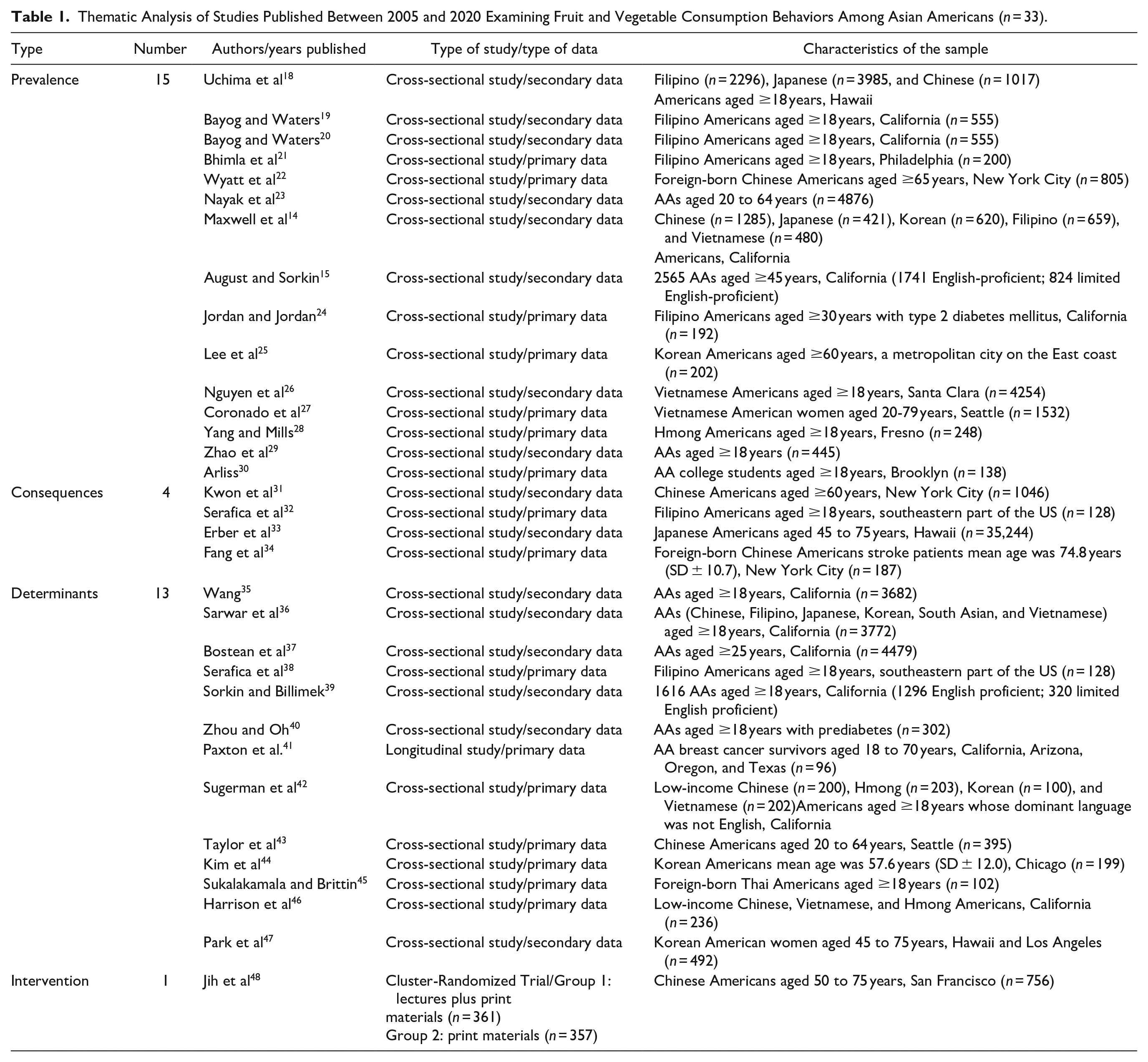
The search yielded a total of 33 empirical articles that met the inclusion criteria (please see Table 1). Thematic analysis of relevant studies published between 2005 and 2020 examining F & V consumption behavior among AA were organized based on the primary aims of reviewed studies including: prevalence (n = 15), consequences (n = 4), determinants (n = 13), and intervention (n = 1). Highlighted findings of each theme were detailed in the following section.
Thematic Analysis of Studies Published Between 2005 and 2020 Examining Fruit and Vegetable Consumption Behaviors Among Asian Americans (n = 33).
Prevalence (n = 15)
Wyatt et al 22 examined health behaviors among Chinese Americans aged 65 or older and were foreign-born. The study reported that only 19% of participants consumed 5 or more cups of F & V daily. Nguyen et al 26 also reported that fewer Vietnamese Americans ate recommended F & V per day compared with non-Hispanic Whites (16.3% vs 27.8%, P < .05). In this study, it is worth noting that based on language Vietnamese Americans who completed responses in Vietnamese were less likely to meet F & V recommendations than those who completed responses in English (14.9% vs 19.9%, P < .05). This is the opposite of the assumption that increased acculturation to the US has been viewed as a risk factor as it has been linked to decreased consumption of F & V.
Bhimla et al 21 conducted a health needs assessment among Filipino Americans who were older and highly acculturated. The findings of the study showed that only 0.5% of the participants consumed 5 or more portions of F & V daily. Likewise, Bayog and Waters 20 examined the health behaviors from a group of Filipino Americans with whom majority (95.5%) self-defined as English speaking only or English proficient. The study indicated that less than 10% of participants reported meeting the recommended F & V daily consumption, and the median servings of F & V per week was only 21 (M = 16.0, SD = 11.4) in which the recommended per week serving is 35. Bayog and Waters 19 conducted another study testing how nativity (years living in the US) impacted eating behaviors among adult Filipino Americans. The study found that no matter the status of nativity, the majority of participants (i.e., US born 93%, long-term immigrant 87.5%, and recent immigrant 93.3%) reported not meeting the recommended F & V intake (<35 servings per week). Jordan and Jordan 24 examined self-care behaviors of Filipino Americans with type 2 diabetes mellitus. Only 1/5th of Filipino American participants self-reported eating 5 or more F & V every day during the past week, whereas females were more likely to consume 5 or more servings of F & V daily compared to males.
Nayak et al 23 examined health behaviors among cancer survivors in different racial and ethnic groups. The findings of the study estimated that almost 70% of AA cancer survivors did not meet the F & V intake recommendations. Likewise, Lee et al 25 assessed dietary patterns among Korean American older adults. The study reported that the majority of participants (99%) consumed dietary fiber below 75% of the recommended dietary allowance which meant inadequate dietary consumption as defined in the study. Next, in Yang and Mills’ study, 28 results indicated that very few Hmong Americans (<10%) reported eating fresh F & V daily and percentage of daily consumption of leafy vegetables was even lower (<5%); however, if F & V were in-season, more than a half of the participants stated that they would consume them. Another study 27 examining heart disease prevention lifestyles among Vietnamese American female immigrants found that the average daily consumption of F & V was 3.5 servings. Zhao et al 29 examined hypertension-related lifestyles among the US women with self-reported hypertension, and found that less than 5% of AA women consumed 8 or more servings of F & V per day (based on recommended dietary guidelines of American Heart Association).
August and Sorkin 15 investigated the dietary patterns among racially/ethnically diverse adults and found a disparity in the daily consumption of 5 servings of F & V for middle-aged English proficient AAs compared to non-Hispanic Whites. While 8.3% of English proficient AAs consumed a recommended amount of daily F & V, only 6.1% of limited English proficient AAs met the recommended amount of F & V. In another study, Maxwell et al 14 assessed health behaviors among 5 AA subgroups, findings showed that AA participants reported a lower prevalence of 5 or more F & V consumption per day than non-Hispanic white participants (P < .001). Arliss 30 examined AA community college students’ diet revealed that only 11.9% met F & V recommended servings. Uchima et al 18 found that the prevalence of consuming more than 3 servings of fruit daily among Filipino, Chinese, and Japanese Americans were 14.4%, 7.5%, and 10.2 respectively; while the percentage of consuming more than 3 servings of vegetable daily were 18.9%, 16.4%, and 17.1%.
Findings of these included studies suggested that the majority of AAs participating in studies reviewed did not meet the diet recommendation—consuming 5 or more cups of F & V per day or 400 g/day. Recommended F & V consumption behavior in AAs ranged from 0.5% to 20%.
Consequences (n = 4)
Serafica et al 32 examined the associations between dietary patterns and body measurements among Filipino Americans. The study found that consuming F & V and BMI was negatively correlated among the participants. In another study, Kwon et al 31 found that the majority of Chinese American participants (who were aged 60 years or older and the majority of them were born outside the US) did not meet the recommended F & V intake. Significant associations between F & V intake and self-reported health for Chinese American participants were found. Specifically, Chinese Americans consuming F & V fewer than 3 times per day reported poorer general health than those consuming F & V 5 or more times per day. Chinese Americans consuming F & V fewer than 3 times per day also reported the highest proportion of unhealthy days physically, mentally, and days of limited activities. In another study, Erber et al 33 examined the influence of diet on diabetes risk and found the significant associations between higher vegetable consumption with lower diabetes risk in Japanese American men. Lastly, the results of Fang et al 34 study indicated that stroke patients were less likely to consume F & V compared to those without experienced stroke.
Results of F & V consumption and related consequences among AAs participating in these included studies indicated that those who consumed fewer servings of F & V reported a higher prevalence of unhealthy lifestyle (e.g., physical inactivity), poorer mental health, greater BMI, and higher likelihood of developing chronic diseases.
Determinants (n = 13)
Regarding what determines AAs F & V consumption, Zhou and Oh 40 found that for AA women, being older, married or living with a partner, being overweight or obese, perception of poor health, and no cardiovascular diseases are positively associated with consuming 5 or more servings of F & V (P < .001). The study also observed that less than 25% of AA participants reported an adequate intake of F & V. In another study, Sarwar et al 36 found that being a female (Chinese, Filipina, Korean, and Vietnamese), single (Chinese), not being a college graduate (Chinese), living in poverty (South Asian), and responding in English language only (Chinese and Japanese) were more likely to consume less than daily F & V servings recommendation. Sorkin and Billimek 39 examined eating behaviors of racially/ethnically diverse participants and found that AAs consumed significantly lower portions of fruit compared to non-Hispanic Whites. AAs with limited English proficiency consumed more vegetables each day than non-Hispanic Whites while AAs who were English proficient consumed vegetables fewer times each day compared to non-Hispanic Whites. Similar results were shown in another study which Taylor et al 43 found that recent Chinese American immigrants consumed more F & V per day than those who had stayed in the US for 10 years or more. The study also observed that only 15% of the participants consumed 5 or more servings of F & V per day. Kim et al 44 also found that native Koreans consumed a higher amount of F & V compared to Korean Americans. In another study, Harrison et al 46 explored health behaviors among AA participants (i.e., Chinese, Hmong, and Vietnamese) who were low-income and first-generation immigrants. Results showed that participants indicated their struggle between adopting mainstream American diets and maintaining traditional eating behaviors in which higher amounts of F & V consumption were incorporated. AAs noted their barriers to maintain traditional dietary practices including children’s choices for less healthy foods, the convenience, availability and affordability of fast food, and long work hours of both parents. The study also suggested that the majority of participants emphasized the importance of fresh (not frozen) F & V consumption, yet a general lack of knowledge about F & V consumption recommendation was found. Participants also stated that the consumption of vegetables is more important than fruit intake.
Bostean et al 37 examined the relationship among race, education and health behaviors in adults. The findings of the study showed that AAs with a college degree did not consume greater recommended F & V servings compared to AAs without a college degree. Sugerman et al 42 conducted a study to explore healthy lifestyle practices among low-income limited English proficiency AAs (Chinese, Hmong, Korean, and Vietnamese). Findings of this study showed that 83% Hmong Americans thought the cost of F & V was too high, and 49% of Vietnamese Americans expressed the difficulty in finding good quality and affordable fresh F & V. Nevertheless, Wang 35 investigated the relationship between availability of F & V and consumption of F & V across racial groups. The findings of the study indicated that the increased availability of F & V was not significantly associated with consumption of F & V among AAs. Results of the study suggested that perceived availability of fresh F & V did not explain F & V consumption, so researchers should consider examining other social and cultural factors’ influence in F & V consumption among AAs.
Park et al 47 found that Korean American women who were born in Korean consumed more F & V than those who were born in the US. Contrastingly, Yang et al 49 study revealed the length of residence in the US (P < .05) and education level (P < .05) were positively associated with intake of F & V among Korean Americans women. Sukalakamala and Brittin 45 investigated dietary patterns among Thai Americans who were born in Thailand and had lived in the US for at least 3 months. Results suggested that participants maintained adequate daily intake of F & V with a mean daily serving of 2.2 fruits and 3.8 vegetables. Serafica et al 38 study showed that Filipino Americans who consumed higher amounts of F & V are more likely to choose higher numbers of traditional Filipino foods. In this study, the majority of participants only ate 1 serving of F & V per day. Lastly, Paxton et al 41 analyzed data from a healthy eating intervention and found significant improvement in servings of F & V intake from the baseline to the post-assessment among AA cancer survivors compared to the control groups.
There were a variety of factors that correlated to lower F & V consumption among AAs including low income, acculturation, adoption of American dietary choice, lack of knowledge regarding recommended servings of F & V consumption, high cost, and limited access to fresh F & V. Yet, participation in a healthy eating intervention increased the F & V consumption.
Intervention (n = 1)
Only 1 healthy eating intervention was found. Jih et al 48 evaluated the impact of a nutrition intervention on knowledge and practices of dietary guidelines among older Chinese Americans with limited English proficiency. Participants were randomized into groups of printed materials plus lectures or printed materials only. The findings of this cluster-randomized controlled trial revealed that printed materials plus lectures group (n = 361) showed significantly greater increases in knowledge of vegetable intake (adjusted odds ratio = 12.61; 95% CI = 6.50, 24.45) and knowledge of fruit intake (adjusted odds ratio = 16.16; 95% CI: 5.61, 46.51), and actual consumption of recommended vegetable intake (adjusted odds ratio = 5.53; 95% CI: 1.96, 15.58) compared to printed materials only group (n = 357). The knowledge of the recommended vegetable intake and knowledge of fruit intake increased almost eight-fold (P ≤ .001) in the printed materials plus lectures group while there was only a marginal increase in the printed materials only group for vegetables knowledge and fruits knowledge was not even significant. Regarding self-reported dietary behavior, baseline assessment showed that the median number of servings of F & V consumed by participants during the previous day was only 2 per person. At post-assessment, consumption of recommended servings of vegetables per day increased 7-fold in the printed materials plus lectures group while there was no significant change in the printed materials only group. Both groups significantly increased in consuming recommended cups of fruits per day but it was more for the printed materials plus lectures group. Results of the study were concluded that for older Chinese Americans print materials plus lectures were helpful in increasing nutrition knowledge and dietary practices.
Discussion
The purpose of this study was to examine the multifarious dimensions of F & V consumption behavior among AAs as it has been studied sparingly in the literature. Along with being one of the fastest growing racial and ethnic groups in the US, AAs also face a widening gap in income inequality within their racial/ethnic group. Studies have indicated that the low socioeconomic status among this group may limit the affordability, availability, and accessibility to healthy foods. The current review found 33 empirical peer-reviewed journal articles focusing on various aspects of F & V consumption among AA populations including studies investigating its: prevalence (n = 15), consequences (n = 4), determinants (n = 13), and interventions (n = 1). Future studies and interventions promoting healthy eating for AAs are needed.
Prevalence
Findings of these included studies (n = 15) suggested that the majority of AAs participating in studies reviewed were unable to consume recommended 5 or more servings of F & V per day as per the dietary guidelines. Similar to the prevalence of non-Hispanic Whites in which only one-fifth met the recommendation for F & V consumption. 50 Obesity is the leading threat to population health in the US. While prevalence of overweight and obesity among AAs was lower than other racial groups, the rate of overweight and obesity among AAs is fast growing. 51 Also, in some subgroups of AAs, such as South Asian men, the rates of obesity are quite high. Hruby et al 52 review study suggested that healthy eating habits, including fresh F & V intake, can contribute to maintaining healthy weight and reducing the risk of developing several chronic diseases. Hence, the inadequate F & V consumption among AAs underlined the need for implementing interventions targeting healthy dietary patterns among AAs.
Consequences
Results of F & V consumption and related consequences among AAs participating in these included studies (n = 5) indicated that those who consumed less servings of F & A reported increased prevalence of unhealthy lifestyle (e.g., physical inactivity), poorer mental health, and higher risk indicator to health (e.g., BMI). Results are consistent with a previous study, in which Azagba and Sharaf 53 examined the associations between F & V consumption and the BMI, and found that they were significantly negatively correlated among both females and males. Findings of the relationship between lower servings of F & V consumption and poor physical and mental health are consistent with previous longitudinal studies. Zhang et al 54 examined the associations between F & V consumption and potential health effects among AAs, and found that higher amount of F &V intake was related to a lower risk of total mortality, and a dose-response pattern was observed. Comparably, Ocean et al 55 found the positive relationship between F & V consumption and mental well-being, and the dose-response in terms of increases in both quantity and frequency of F & V consumed. These findings indicated the need to promote healthy eating behaviors to benefit AAs’ physical and mental health.
Determinants
By reviewing these included studies (n = 13), we observed that there were a variety of factors that contributed to lower F & V consumption among AAs including low-income status, adoption of American dietary choice, lack of knowledge regarding recommended levels of F & V consumption, and high cost and limited access to fresh F & V. Given that less healthy food choices are often cheaper than healthy options such as fresh F & V, and are more likely to be accessible in lower-income neighborhoods (i.e., food deserts) and chosen by people with lower levels of education, 56 it is not surprising that AAs with lower incomes and education levels are less likely to meet the recommended servings of daily F & V intake. Typically, AAs who were born in the US were more likely to be overweight and obese than those born in foreign countries. 57 This might be due to the changes in dietary practices that are influenced by acculturation. The longer AAs live in the US, their dietary practices tend to be merged into those within the American dietary culture. 58 Comparing the vegetarian eating patterns in different countries, Jaacks et al 59 reported that 33% of adults in South Asia were vegetarian compared with only 2.4% in the US sample. Considering the impact of acculturation on eating behavior, AAs should incorporate Asian traditional diets which usually include high amounts of F & V. 16 Further studies are warranted to examine cultural variables influencing food choices within specific AA subpopulations, and implement interventions to enhance nutrition knowledge and promote lifelong healthy eating behaviors as well as develop effective policies to address AAs’ health needs.
Intervention
Thus far, only 1 intervention was identified to impact F & V consumption among AAs. Results of the intervention highlighted that both strategies (printed materials vs. printed materials plus lectures) significantly increased participants’ nutrition knowledge and self-reported behavior of F & V consumption at the end of the intervention. The findings of the study suggested that interventions and healthcare policies should prioritize the promotion of healthy dietary patterns to support AAs meeting the recommended daily F & V intake. Interventions need to be based on sound behavioral theories. These days’ 4th-generation behavioral theories are being used to design precision interventions. 60 One such theory is the multi-theory model (MTM) of health behavior change that can be applied to design efficacious and effective interventions. 61 In this theory, the behavior change is divided into initiation and sustenance. For initiation of the behavior change, constructs of participatory dialogue in which advantages of behavior change supersede the disadvantages, behavioral confidence, and changes in the physical environment play a role. While for sustenance of the behavior change, the constructs of emotional transformation, practice for change and changes in the social environment play a role. 61 AAs constitute people of different nationalities with different cultures and dietary practices. There is a need to keep these differences in mind while designing culturally appropriate interventions for these subgroups of AAs.
Limitations of this review
Very few studies on this topic are available in the literature so the findings of this review need to be interpreted with caution. The review only focused on 3 databases and may have missed some articles reported in other databases or gray literature. Furthermore, the review only included published studies and that is amenable to publication bias 62 which may have influenced the results.
Conclusion
AAs constitute a diverse group and their population continues to grow in the US. This group includes people with origins from different nationalities who are in different socio-economic strata in the US. Their cultures and languages are different from each other and so are their dietary practices. To characterize AAs as a monolithic entity is an oversimplification of the rich cultures that make up Asia in addition to having deleterious effects on the success of future studies. There is very little research available on dietary practices particularly F & V consumption behavior in this group and its constituent subgroups. From the limited literature it is evident that this group is not meeting the recommended levels of consumption of F & V. There is an urgent need to study F & V consumption behavior among different AA subgroups as well as to design theory-based efficacious F & V promotion interventions that consider the diverse cultures and dietary habits/restrictions of these subgroups.
Footnotes
Authors’ Contributions
CD contributed to the concept and design of the work, data acquisition, analysis and interpretation, and drafted the manuscript; MS contributed to the concept and design of the work, acquisition, analysis and interpretation of data, and revised the manuscript critically; TH contributed to data acquisition, analysis and interpretation, and critically edited the manuscript; HS contributed to data acquisition, analysis and interpretation, critically edited the manuscript. All authors have approved the version to be published,
Declaration of Conflicting Interests
The author(s) declared no potential conflicts of interest with respect to the research, authorship, and/or publication of this article.
Funding
The author(s) disclosed receipt of the following financial support for the research, authorship, and/or publication of this article: The publication fees for this article was supported by the UNLV University Libraries Open Article Fund.
