




Abstract
Keywords
Introduction
In Indonesia, one of the low-to-middle-income countries (LMIC), diabetes mellitus affects 8.9% of the population aged 15 years or older. 1 Due to the high complication rate and high utilization at the outpatient clinics, diabetes has become among the 5 highest hospital claims in 2016. 2 This situation prompted the need to reduce the cost burden due to diabetes mellitus, by introducing a program, Prolanis, that allow patients to receive routine diabetes mellitus treatment at primary-level health care clinic (PHC) instead of in hospital. 3
Prolanis was initiated in 2010 under the Askes, social insurance covering government employees and military, nearly 20% of the country’s population. 4 As one of the strategies following the introduction of Indonesian National Health Insurance or Jaminan Kesehatan Nasional (JKN), Prolanis was scaled up to cover more than 75% of the country’s population. 5 Prolanis, which was previously only carried out by private practitioners, is being mandated for government-owned PHC or Puskesmas. 3
Under the JKN, PHC receives monthly capitation, based on the number of registered JKN members and the achievement of performance indicators on service delivery (ie, performance-based capitation). One of the 3 performance indicators is the Prolanis member participation. To assess facility performance, the Social Security Agency for Health (or Badan Penyelenggara Jaminan Sosial Kesehatan–BPJSK), the fund manager under JKN, used the data reported by the facility online. Failure to record patient visit data may cause underestimation of program output; hence lead to reduced capitation payment. Thus, facilities not only must run the program well but also ensure that they enter the data correctly to the system.
Shifting diabetes management from secondary to primary-level care has been widely implemented in many nations and shown positive results.6,7 In Indonesia, where diabetes mellitus costs 6.5% of total hospitals’ outpatient care claims, shifting treatment to the primary levels has the potential to reduce the cost. Yet, it could cause a significant increase in the number of patients visiting PHCs, adding to the workload for PHC providers. 3 Meanwhile, the availability of diabetes mellitus care in primary care is limited. Only 2 out of 34 provinces in Indonesia have more than 75% of its PHC capable of performing blood glucose tests. 8 With increasing patient burden but limited resources, these health facilities could face severe problems in implementing Prolanis.9,10 Whether the program is acceptable is an important matter in ensuring long-term sustainability.
The concept of health program acceptability involves a set of dimensions that illustrate the extent to which an intervention is deemed appropriate, fit, or suitable by the implementers or recipients.11,12 Acceptability of a health program for the patients and care providers may contribute to compliance and program success.13,14 This study is aiming at understanding the acceptability of Prolanis program among health care providers. Furthermore, this study also seeks to understand how this acceptability vary between urban and rural health care providers.
Methodology
Study Population
This was a qualitative study using semistructured interviews for data collection. We selected health care professionals working in 4 districts in Yogyakarta and Central Java province. From each district, we requested the health manager to nominate 2 Puskesmas with the highest and lowest Prolanis indicator in the past 3 months. We purposively select participants who were the key persons for Prolanis program in each Puskesmas: 1 doctor, responsible for providing individual care and group counseling, and 1 program person-in-charge (PIC), responsible for the above tasks, arranging the “Prolanis day,” reporting patient visits into the BPJSK information systems and administrative works for claiming and reimbursement.
The Program
To be eligible as program recipient, JKN members with type 2 diabetes mellitus (T2DM) must enroll to become a “Prolanis member,” with the following benefits:
Allowed to obtain a 1-month supply of medicines for T2DM; while nonmembers only allowed to obtain the medicines for maximum 7 to 14 days
Receive monthly group education sessions and group exercise, and free monthly blood glucose check. These are usually delivered 1 day in each month, named “Prolanis day.”
Receive free HbA1c testing after 6 months with routine visits in 6 consecutive months.15,16
The cost of Prolanis day, including blood glucose check, group exercise, and counseling is reimbursable by the BPJSK. If the Prolanis indicator—that was (at the time of data collection) the proportion of registered Prolanis members visiting the facility monthly—is less than 50%, the capitation is reduced by 2% to 5%. 17
Data Collection
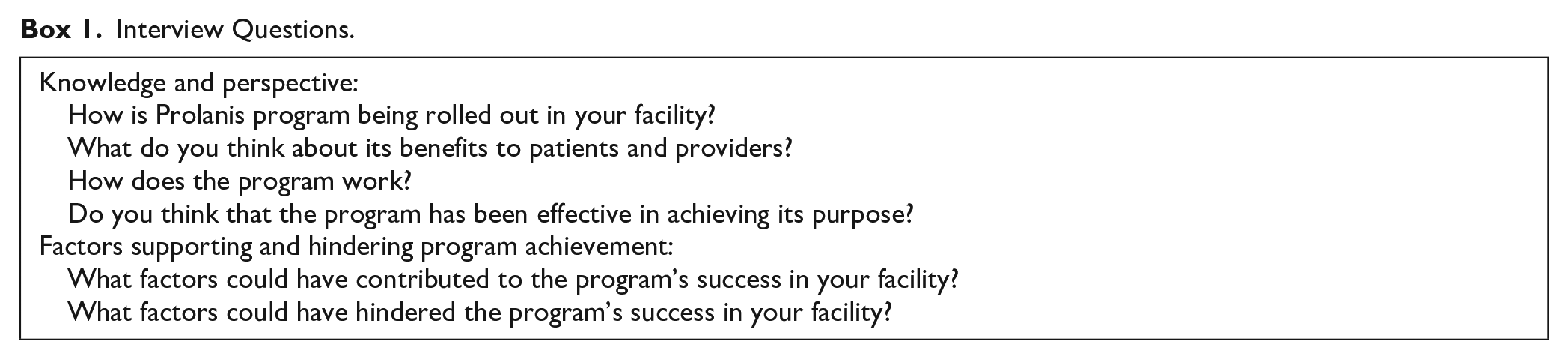
The face-to-face interviews to 14 respondents were conducted from October to November 2017 by the first author (LP) in participants’ offices. The interviews were semistructured based on topic guide (Box 1) consisting of open-ended questions covering knowledge, perspective, and recommendations on the Prolanis program, and factors supporting and hindering program implementation.
Interview Questions.
Data Analysis
The content analysis was conducted using the theoretical framework of acceptability (TFA) of health care intervention using inductive approach to understand the acceptability of the Prolanis program among health care providers. The TFA includes 7 constructs: affective attitude, burden, ethicality, intervention coherence, opportunity cost, perceived effectiveness, and self-efficacy. 11 The interviews were audio-recorded and transcribed verbatim. No transcripts were returned to participants. LP—has a master degree in public health—coded the manifest data from the transcriptions based on the TFA. 11 Facilities were grouped into urban and rural according to Indonesian bureau of statistics’ classification based on scoring on population density, type of household, and living amenities. 18 A facility is classified as rural if it is located in a subdistrict with at least 50% rural villages. For describing quotes, we also classified facilities as well-performing if they had always met the Prolanis target in the last 1 year or poor-performing if otherwise.
Ethical Approval
Written informed consent was obtained from each participant. Ethical clearance was granted by Medical and Health Research Ethic Committee (MHREC) Faculty of Medicine Gadjah Mada University number KE/FK/0836/EC/2017.
Results
Study Participants
We interviewed a total of 14 participants from the 7 facilities selected. Two doctors in rural Puskesmas, who were not available for interview, were replaced by heads of Puskesmas, who are also doctors. The characteristics of the respondents are presented in Table 1.
Characteristics of Respondents.

Key Themes
We identified 4 out of 7 constructs of acceptability that are most important for participants: perceived effectiveness, affective attitude, and burden are constructs that are similar among urban and rural providers, while self-efficacy differs.
Perceived Effectiveness
All respondents agreed that Prolanis members visit the facility (to take the medicine) more routinely compared with nonmembers. None of the facilities had formally evaluated T2DM outcomes before-and-after enrolling in the program or between Prolanis members and nonmembers; thus, respondents were unsure whether the program has been effective. Some respondents stated that some patients had fluctuating blood sugar test results or controlled blood glucose level but poor HbA1c, implying poor consistency in practicing healthy habit (see Table 2).
Key Constructs of Acceptability Identified From the Interviews.

Burden
All doctors interviewed mentioned no significant additional patient load due to the new program, except for one respondent who acts as the only doctor in the facility. On the contrary, most Prolanis PICs felt that they are facing a considerable increase of workload due to preparing the group sessions on the Prolanis day and the administrative work (claim and reimbursement for Prolanis day). The burden was even higher when the Puskesmas without a dedicated staff for entering data into the JKN information systems.
Affective Attitude
All participants agreed that the Prolanis program had benefited T2DM patients by encouraging them to have more routine visits. However, only 2 out of 14 participants recognized the program benefit for themselves as care providers, which is helping them provide standardized T2DM care, including blood glucose test, counseling, and pharmacological therapy. The respondents were concerned about the Prolanis indicator that determines the amount of capitation money that will be received by PHCs. Such an indicator could encourage providers to recruit as few T2DM patients as possible to become Prolanis members. This could neglect the high number of undetected T2DM cases in the community. Also, they also concerned that such indicator contradicts ministry of health’s indicator of preventive health care for diabetes mellitus that requires as many T2DM patients as possible to receive care in the Puskesmas, regardless of the enrollment status in Prolanis.
Self-Efficacy
Overall, 3 (out of 4) urban facilities and 1 (out of 3) rural facilities were confident that they had good self-efficacy, that is can perform the behavior required to succeed in the Prolanis program. This is attributable to adequate facility equipment, being located in urban areas with dense population, collaboration with community health workers, and human resource factors.
Availability of spectrophotometer enabled Puskesmas to run the program properly because—although the official regulation did not mention type of blood glucose test that is reimbursable by BPJSK—the BPJSK will only repay the cost for blood glucose level when tested using spectrophotometer. Facilities without own spectrophotometer are allowed to hire third parties for blood glucose tests. There were 4 facilities: 2 in urban and 2 in rural areas, without a spectrophotometer. We found that both urban facilities managed to collaborate with local laboratories while rural ones failed to collaborate with third parties because of the distance and the number of T2DM patients not meeting the minimum required by the laboratories.
Providers in the urban Puskesmas, surrounded by densely populated areas, felt there were no significant obstacle to reach out the Prolanis members for giving reminders of monthly visit or follow up purposes. Also, the Puskesmas is located within short distance to patients’ homes and with plenty public transportation, thus it is accessible by the patients.
Some providers in rural Puskesmas perceived that people living in rural areas tend to have poorer care-seeking behavior compared with their urban counterparts. This, compounded by lack of public transportation, have resulted in low interest to become Prolanis member and low facility utilization. However, one respondent in rural facility disagreed with the above statement because the respondent believed that it depends on how the providers encourage the community and engage community health workers to succeed the program.
Discussion
Our study revealed the lack acceptability of Prolanis among the doctors, nurses and public health officers responsible to run the program. Despite positive attitude that Prolanis improve patients’ adherences to T2DM treatment, there are some concerns that it does not guarantee patients’ improved outcomes as it has weak influence to support patients’ self-management. There are also negative perceptions that Prolanis was a mere compulsory program utilized by BPJSK as a facility performance indicator to determine the amount of capitation, which somewhat contradicts MoH direction to widen efforts to detect undiagnosed T2DM cases in the population. The Prolanis is less acceptable for rural facilities due to limited geographic accessibility and health equipment as well as poorer people’s health-seeking behavior compared with the urban ones.
This study cannot conclude that Prolanis is effective in improving T2DM patient outcomes—as widely documented from past studies19-22—since we assessed the perceived instead of actual effectiveness. However, there are patients demonstrated favorable monthly blood glucose results but poor HbA1C, which made some providers perceived that Prolanis was not sufficient to encourage patients practicing healthy habit consistently. Strategies to improve T2DM patient self-management emphasize the importance of a tailor-made treatment that acknowledges the needs of patients with varied social, cultural, and educational background, which was achieved by establishing care managers or having one-on-one coaching.7,14,23 Care manager is a trained health providers that responsible in ensuring that T2DM patients receive an appropriate management according to each patients situations, including medicinal and nonmedicinal such as diet and exercise. 7 Other studies suggest that better self-management can be achieved by establishing reminders systems such as short message service (SMS), mobile apps, or other e-health-based tools, telephone support, and peer support group.24,25 These additions could improve the Prolanis in the future.
Although not specifically emphasized in the articles, previous studies demonstrating program success has involved facilities that earlier expressed interest to develop chronic care disease management, hence contributed to better attitude, knowledge, and commitment.21,23 In our study context, the Prolanis implementation is obligatory and the facility will be “punished” should they fail in meeting certain indicator and this could be a risk for reduced facility income. This may send the message of “obligation” rather than “the important of improving chronic disease management.” It is critical for the stakeholders to devote time and resource to improve commitment among the health care providers prior to and along the program implementation.
In this study, rural facilities faced a bigger challenge to run the program due to wider catchment areas, limited equipment availability, and limited public transportation. This study shows that lack of equipment might have resulted in poor facility capacity to monitor patients properly. This is similar to what happened in other developing nations where patients experience substandard diabetes management at primary care due to the limited availability of equipment and medicines.26,27 In terms of geographical location, previous studies suggest that diabetes care in rural location is more inadequate compared with its urban counterpart due to the limited number of staff, challenging accessibility, and poorer care-seeking behavior.28,29
Limitations
The study includes participants that works in 4 districts located in Central Java and Yogyakarta, which have more developed infrastructures compared with other regions in Indonesia; thus, the findings should be interpreted carefully when applied in different contexts. In addition, the study has relatively small number of participants, 14 health care professionals, due to short duration of the study. However, the 14 participants selected were from health facilities with various characteristics (ie, rural and urban settings, well-performing and poor-performing facilities, and 4 different districts, thus cover various local government-related factors). This has allowed the authors to capture maximum diversity of Prolanis implementation in different settings. Also, drawing on the information from respondents and considering the variety of the Puskesmas in the study districts, the researchers decided that data saturation had been achieved. No further data collection was made to confirm providers’ information on patients’ visit record, blood glucose, and HbA1c; hence, all the results presented are solely based on providers’ statement.
Conclusion
This study suggests that the lack acceptability of Prolanis is attributable to (a) the absence of formal evaluation of intervention’s success in improving patients’ outcomes leading to poor perceived effectiveness, (b) increased workload due to clerical works, (c) the enactment of Prolanis’ output as one of pay-for-performance indicator that limits program’s ability in capturing cases of undetected T2DM, and (d) inadequate equipment in the PHC. Facilities in rural locations were having more significant challenges due to poorer geographic accessibility and people’s health-seeking behavior. Improving accessibility needs a considerable contribution by the government in ensuring that PHCs have adequate equipment and establish a system that incentivizes health providers to get them more motivated and committed to the program.
Further studies should include more participants from more variety of PHC facilities such as private clinics, health facilities located in the less developed regions compared with Java, and facilities located in islands and remote areas. More study is also needed to investigate whether this intervention effective in reducing blood glucose and HbA1c levels in T2DM patients.
Footnotes
Declaration of Conflicting Interests
The author(s) declared no potential conflicts of interest with respect to the research, authorship, and/or publication of this article.
Funding
The author(s) disclosed receipt of the following financial support for the research, authorship, and/or publication of this article: The research received funding from the Faculty of Medicine, Public Health and Nursing Universitas Gadjah Mada research grant for young lecturer.
