




Abstract
Introduction:
Job satisfaction has been shown to have important effects at the organizational level. In various corners of the world, physicians are obliged to perform a period of social service, generally at the first level of care in rural or remote areas.
Objective:
To describe the level of job satisfaction and perceptions of Ecuadorian rural physicians regarding compulsory social service.
Methodology:
A descriptive, cross-sectional study was conducted based on a self-administered online questionnaire from February to March 2022, in Ecuadorian rural physicians who were performing their compulsory social service. Participants were invited through official outreach groups. A total of 247 surveys were included in this study. We assessed job satisfaction by means of the S20/23 job satisfaction questionnaire and compared these results with sociodemographic variables and job characteristics of the participants. We performed the reliability test (Cronbach’s alpha) to find the validity of the S20/23 questionnaire in physicians performing compulsory social service.
Results:
The majority of participants were women (61.0%), and overall job satisfaction was 4.1/7.0 pts. “indifferent.” The only satisfaction factor in which a predominance of dissatisfaction was found related to benefits/remuneration (43.3%). Participants’ perceptions of wrong academic guidance during training, insufficient induction, and negative experiences during work were related to higher levels of dissatisfaction (P < .05).
Conclusion:
The level of job satisfaction of Ecuadorian rural physicians during their compulsory social service was low and graduates indicated a neutral attitude toward job satisfaction in general. Negative perceptions with respect to training and expectation formation prior to and during the mandatory social service generated greater dissatisfaction. The Ministry of Health of Ecuador, as an organizational entity, should implement improvements to increase the job satisfaction of recently graduated physicians, given the implications that this experience may have for their professional future.
Introduction
Currently, the study of the work environment takes an “organizational climate” approach which is characterized by a holistic vision that relates how the individual (worker) perceives the working environment in which they are engaged and the phenomena that occur within this context. 1 It is believed that the organizational climate is generated as the result of the interaction between individuals (workers) and the environment. This interaction is reiterative, and has the capacity to exert temporary or permanent influence on the individuals who are part of the organization.2,3 When this interaction produces improvements in skills and knowledge, it augments the “human capital” that the worker also acquires throughout his personal, academic, and previous work training. This, when used in the organizational environment, can also give value to and promote economic development of the organization. To the extent that positive workplace interactions produce stronger workplace connections, goodwill, and as a result, higher worker investment in skill and knowledge accumulation on the job, worker wellbeing becomes an important determinant of organizational productivity.4-6
Working wellbeing is most often measured through surveys of employees’ job satisfaction. Job satisfaction is defined as the positive perception of the employee with respect to factors such as management expectations, the level of stress required by the job, the quality of coworker relationships, as well as career progression opportunities. 7 Basically, job satisfaction levels measure how close the worker’s environment is to the worker’s expectations or desires with respect to these satisfaction factors. 8 From the worker’s point of view, job satisfaction is also closely related to their emotional state precipitated by their perception of his work environment. Where remuneration levels are perceived be below the level that concords with the expectations of the employment position, employee satisfaction can also be negatively impacted. 9 Studies have shown that there is an important correlation between the quality of work life and the employee efficiency, and in turn, organization productivity.10-13
While employee satisfaction in any sector is important, health sector employee satisfaction can impact the performance of a critical public service and therefore has implications for public policy management. Moreover, the sector is well known for being a high stress sector, especially in under-resourced contexts.14,15 Recently graduated medical professions are found to be disproportionately impacted on by the stresses presented by the sector in general as they have had less time to develop their coping mechanisms in such an environment. 16
Within the professional training process for medical careers, in several countries of the world and within several within Latin America, such as Colombia, Mexico, and Ecuador, there is a period of compulsory social service. 17 In Ecuador, this period is called “rural medicine” and lasts 1 year. 18 The rural medicine year necessitates that rural physicians provide health promotion and prevention care to inhabitants of communities located in rural areas that are often remote or difficult to access. 19 Ecuador’s health system is structured under the Comprehensive Community and Intercultural Family Health Care Model (MAIS-FCI). The MAIS-FCI divides health care into 4 levels of complexity to respond to the health needs of the entire population. The health units (health centers) where medical professionals carry out their compulsory social service belong to the first level of care and represent the entry point for patients to the health system. 20
Given the remote or isolated nature of the experience and the challenges that this poses for health service management in a country with limited resources, professionals often face a variety of obstacles during the year of compulsory social service. Examples of these challenges are deficiency of working resources and poor relationships of health units with national level authority. 19 These obstacles can lead to feelings of disempowerment and frustration, consequently resulting in stress. Such perceptions are inclined to reduce the level of job satisfaction of Ecuadorian rural physicians. While the impact of reduced job satisfaction of rural graduates in Ecuador on their intention to remain in the profession is not known, several studies have shown that employee satisfaction in health sector workers correlates importantly with reduced professional retention in the sector.21,22 As the costs of training new doctors are substantial, implications of reduced job satisfaction are important for the overall effectiveness of the sector.
The objective of this study is thus to describe the level of job satisfaction and perceptions of Ecuadorian rural physicians regarding compulsory social service.
Methods
Study Design
A descriptive, cross-sectional, nationwide study was performed using an online questionnaire.
Setting and Participants
Ecuador is a country located on the equator and situated on the eastern coast of the South American continent. With a territory of approximately 283 560 km2, the Ecuadorian territory is divided into 4 geo-climatic regions: Coast, Andes (highlands), Amazonia, and Galapagos Islands. Politically it is divided into 24 provinces.
Ecuador’s health system is divided into 3 sectors: social security, which is responsible for providing care to members; the private sector, which consists of self-financed, for-profit health institutions; and the public sector, which consists of government-funded health institutions. The public sector, in turn, is divided into 4 levels of health care which are available to provide health care to the entire population of Ecuador. 23 In 2019, Ecuador had a total of 40 230 physicians, the majority of which work in the public sector (73.6%). 24 Within the first level of care are included several professionals such as family medicine specialists, dentists, nursing graduates, primary health care technicians, and recently graduated professionals. These recent graduates are employed for a 1-year mandatory residency in rural and remote areas. The number of these rural physicians vary from generation to generation depending on the total number of professionals graduating each year. Additionally, in Ecuador for each year, 2 periods of mandatory social services are available for rural physicians, the first period from January to December and the second period from September to August. 25
The sample group employed for the present study consisted of rural physicians enrolled in the national registry of obligatory social service (rural medicine) in the period corresponding from September 2021 to August 2022. Study participants were eligible to participate if they had graduated in medicine and were legally performing their year of obligatory social service in Ecuador. Consent was obtained from participants at the beginning of the questionnaire with an explanation of the purpose of the study. Participants could continue with the entire questionnaire only after obtaining an anonymous consent (by electronically marking) a “Terms and Conditions” and “Participation Agreement” assent form.
Data Measurement and Questionnaire
A structured questionnaire was designed to assess the perceptions and level of job satisfaction of rural physicians in Ecuador with respect to compulsory social service. Initially, a pilot survey was undertaken with 20 rural physicians to identify understanding difficulties or errors in the structure of the questions. After editing errors detected by the pilot study, a 37-question questionnaire was consolidated in Spanish, revised, and validated by a Public Health expert. Additionally, an English translation of the questionnaire was created to be presented in this manuscript (Supplemental file 1).
The final version of the online questionnaire consisted of 3 sections:
Section 1: Comprises 3 questions about participant demographics, including gender, age, and marital status.
Section 2: Is composed of 11 questions that evaluated characteristics and perceptions regarding compulsory social service (rural medicine), including: type of health unit of work, geographical region of work, work schedule, difficulty in accessing the workplace, the existence of delays in remuneration, and the use of one’s own salary or other personal income to finance the materials or supplies needed during the compulsory social service work. Perceptions about the election system used to access compulsory social service positions in terms of fairness and functionality, the adequacy of academic orientation during university training, the professional usefulness of compulsory social service work, the sufficiency of the induction for compulsory social service, and the perceived experience (positive, indifference, and negative) during compulsory social service for their professional future.
Section 3: Includes 23 questions belonging to the job satisfaction questionnaire S20/23, which evaluate the level of job satisfaction of rural physicians with respect to their work during their mandatory social service. In this evaluation the “organization” role was played by the Ministry of Public Health of Ecuador. 26
The questionnaire was distributed through a unique link belonging to the Google Forms platform through official dissemination groups of rural doctors throughout Ecuador via WhatsApp and Facebook social networks, between March and April 2022. In all cases, a brief explanation of the purpose of the study and the guarantee of data confidentiality was ensured in the initial section of the questionnaire. All questionnaires were anonymous, and no identifiable data were requested.
Bias
To avoid duplicate response bias, using the properties of the “Google Forms” tool, the number of responses for the questionnaires was limited to 1 response for each IP device.
Likewise, this research could be exposed to a selection bias since part of the potential participants could be busy or performing working activities in areas of Ecuador without internet access, however, we tried to reduce the effects of this bias by conducting the collection process for 30 days, in which the professionals who are performing the mandatory social service had access to their monthly rest days.
Study Size
According to official data, the total number of medical professionals in Ecuador who are completing their mandatory social service year during the period September 2021 to August 2022 is 2012 professionals. 27 From this population, the necessary sample size was calculated using the following equation. 28

Where, the total population (N = 2012), the expected proportion of unknown response was (P = .5), confidence level (Z = 95%, or Z = 1.96) and a precision or margin of error allowed of (d = 6%). A required sample of 236 participants (rural physicians) was obtained.
Data Management
Work characteristics in the compulsory social service can be categorized by the complexity of services of the health units employing the graduates. These include the Type of Health Care Unit which can be classified according to the level of as follows: Health post (the least complex, with limited resources for health promotion and prevention), Type A Health Center (promotional, preventive, and rehabilitative care for communities of up to 10 000 inhabitants), Type B Health Center (promotional and preventive care for communities between 10 001 to 50 000 inhabitants), Type C Health Center (promotional, preventive and rehabilitation care, performs as a short stay maternity and emergency clinic for communities between 25 000 to 50 000 inhabitants), and Basic Hospital (a health care unit of secondary level that has outpatient service, emergency, clinics and basic surgery specialties). 29 The remoteness of ease of access to compulsory social workplace was classified as: easy access to the Health Care Units (the doctors have roads accessible by land throughout year), difficult access to the Health Care Unit (the doctors only have passable roads during the summer or through walking trails), and very difficult access to the Health Care Units (requiring River or air transport for health center access). 30
In the evaluation of residents’ perceptions, the variable “election system” captures the perceived fairness of process of choosing (choice by means of an online platform) the health care unit in which recently graduate physicians would perform the compulsory social service. The variable “adequate academic orientation” assesses whether the physicians consider that their formation in university was adequate for their rural medical experience. The variable “usefulness for professional practice” evaluates the graduate’s perception regarding whether social compulsory service will be useful for their future professional life. The variable “sufficient induction” assesses if the period of de preparation (7 days) before starting their social service was enough to develop their work activities optimally. Finally, the variable “marked experience” evaluates the physician’s perception of the possible effect of the professional practice during the mandatory social service on his or her future professional life, whether positive (the experience increased the professional’s mood toward future medical practice), indifferent, and negative (the experience decreased the professional’s mood toward future medical practice).
The evaluation of job satisfaction was performed using the job satisfaction S20/23 questionnaire originally formulated in Spain by Meliá y Peiró in 1989. The adequacy of the questionnaire was validated on external workers in the health area, with a Cronbach’s alpha coefficient (α = .897), conformed by 23 questions with 7 answer options, using a Likert-type scale (1 = completely dissatisfied, 2 = quite dissatisfied, 3 = somewhat dissatisfied, 4 = indifferent, 5 = somewhat satisfied, 6 = quite satisfied, 7 = completely satisfied) permitting a minimum score of 7 and maximum score of 163 points. Job satisfaction was evaluated across 5 factors: satisfaction with participation (q19-q21), intrinsic satisfaction (q1, q2, q3, q5), satisfaction with benefits and remuneration (q4, q11, q12, q22, 23), satisfaction with the physical work environment (q6-q10), and with the quality of supervision (q13-q18).26,31 The level of satisfaction was calculated by computing the mean of the total scores and the overall level determined by grouping the mean responses by 3 possible general satisfaction levels. The groups were denoted: dissatisfied for the scores between 1.0 to <3.5 points, indifferent between 3.5 to <4.5 and satisfied between 4.5 to 7.0 points.
Statistical Methods
The descriptive analysis of the qualitative variables was carried out using frequencies and percentages. For satisfaction level value, quantitative measures of mean and standard deviation (SD) were used. The Chi-Square test was used to search for an association between qualitative variables. Values P < .05 were accepted as statistically significant. In addition, Cronbach’s alpha reliability analysis was performed to assess the validity of the S20/23 questionnaire in medical professionals. All the analysis of results was carried out in the IBM SPSS version 24.0 software.
Results
General Characteristics
A total of 247 newly graduated physicians participated, the majority were female (60.7%), aged 26 years or younger (63.6%) and single (87.9%). Table 1. Likewise, the majority of participants reported working in type A health centers, in the Sierra region (46.2%) and on a “regular” schedule of 5 days on and 2 days off (62.0%) (Table 1).
Characteristics of Ecuadorian Recent Graduates’ Physicians During the Compulsory Service.

Abbreviation: CSS, compulsory social service.
Job Perceptions
Most of the rural physicians were in favor of the compulsory social service, considering that the work performed was useful for the future of their working life and that the experience had been positive. However, it was evidenced that the processes in charge of the organizing entity (Ministry of Public Health) have not performed satisfactorily; 66.0% believe that the job selection system was not optimal, and 88.3% considered that they had an insufficient induction period (Table 1).
Job Satisfaction
The individual evaluation of the questions of the S20/23 questionnaire showed a higher degree of dissatisfaction (mean < 3.5 pts.) in relation to opportunities for promotion during work (mean 3.3 ± 1.7 pts.), equality and fairness of treatment at work (mean 3.4 ± 1.8 pts.), and training opportunities offered by the job (mean 3.4 ± 1.7 pts.). On the other hand, the responses with the highest satisfaction (mean ≥ 4.5 pts.) related to questions regarding satisfaction that the job produces for its own sake (mean 4.7 ± 1.6 pts.), participation in organizational decisions and participation in departmental decisions (mean 4.5 ± 1.6 pts.) for both (Table 2).
Mean and SD of the Questions of the S20/23 Job Satisfaction Questionnaire.

Abbreviations: SD, standard deviation; Q, question.
Regarding job satisfaction factors, it was found that many participants were satisfied with supervision, work environment, participation, and intrinsic satisfaction, while the only factor with the highest percentage of dissatisfaction was related to benefits (43.3%) (Figure 1).

Level of satisfaction according to job satisfaction factors of Ecuadorian physicians during compulsory social service.
The level of job satisfaction did not show significant differences between demographic characteristics. However, according to the characteristics of the job, the participants who had breaches in remuneration had a higher percentage (39.4%) of job dissatisfaction (P < .001). On the other hand, those with perceptions of having had an unhelpful workplace election system, an insufficient job induction period, and little job utility showed higher frequencies of dissatisfaction 35.0% (P = .003), 30.3% (P = .002), and 65.5% (P < .001), respectively. Finally, the job satisfaction of those who considered having had an adequate academic preparation for compulsory social service was lower (20.7%) than those who considered not having had it (P = .046) (Table 3).
Relationship Between Job Satisfaction Level and Participants’ Characteristics and Perceptions.
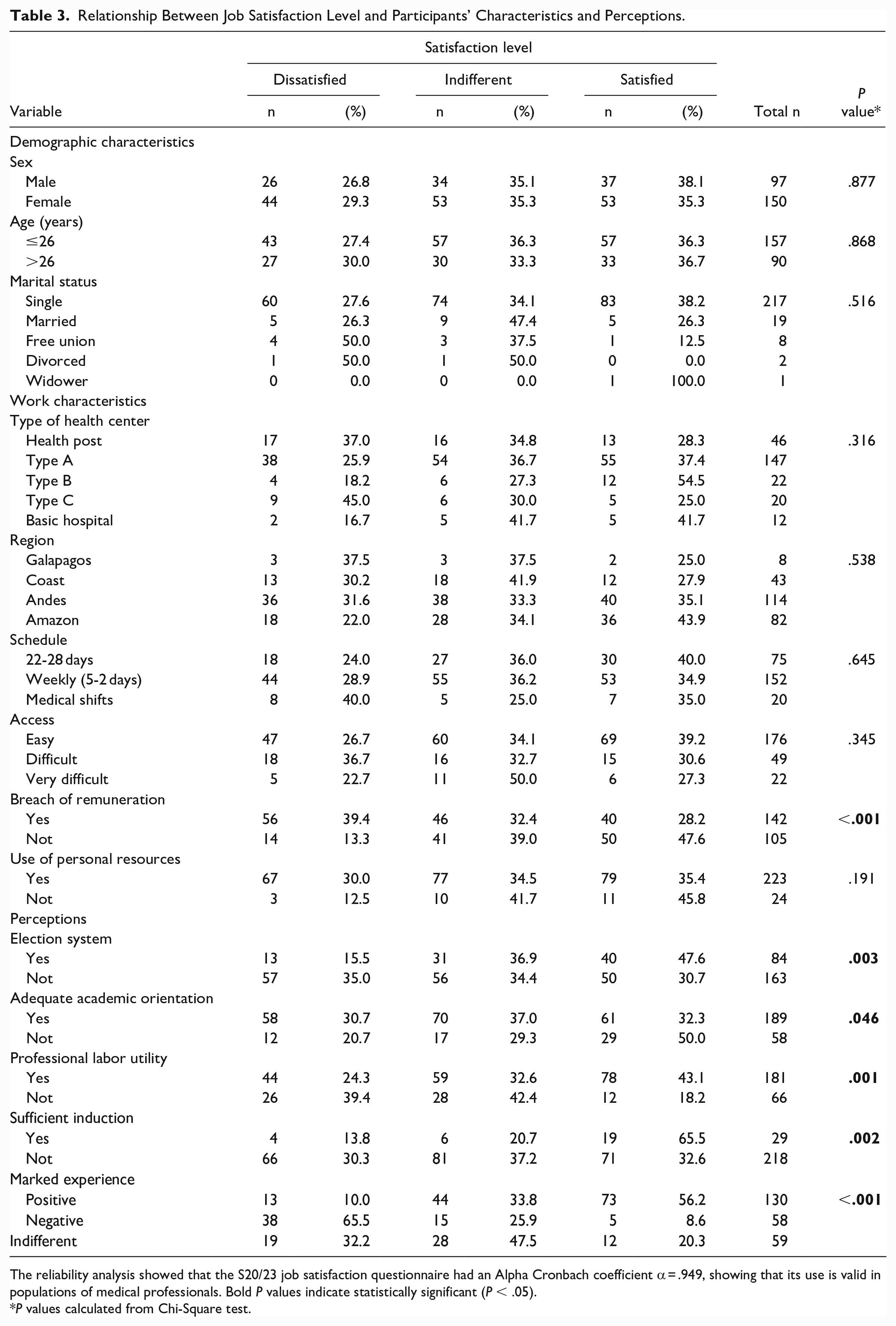
The reliability analysis showed that the S20/23 job satisfaction questionnaire had an Alpha Cronbach coefficient α = .949, showing that its use is valid in populations of medical professionals. Bold P values indicate statistically significant (P < .05).
P values calculated from Chi-Square test.
Discussion
To the best of our knowledge, this is the first study in the world to examine the job satisfaction of rural physicians during their mandatory social service. The analysis of our sample showed that rural physicians performing compulsory social service for the Ministry of Health of Ecuador were mostly female, under 26 years of age, and single.
The overall job satisfaction analysis showed that the items with the highest levels of satisfaction relate to the satisfaction produced by the work itself, workplace illumination, and the level of participation that the participants consider they have in their work group and area. These findings are different from those presented in several studies; in the case of first level health professionals in Spain it was professional competence, 32 while in that of nursing professionals in Mexico it was the satisfaction produced by the work itself. 31 On the other hand, the aspects that generated the greatest dissatisfaction in our participants were the temperature of the workplace, the training and promotion opportunities offered by the job, and the perception of equality and fairness they receive. These results agree with those found in various first level health professionals studies in Madrid. 32 However, in a study of nurse job satisfaction, support for personal goals and objectives, and satisfaction with salary levels were identified as the most negative aspects. 31
The global satisfaction of the participants had a mean score of 4.1 pts, categorizing as “indifferent.” The level of satisfaction revealed by this research is lower than that found in physicians at the secondary level of care (4.7 pts) in Mexico, 33 but higher than that found in nurses (clinical and administrative) at the primary level of care in Sao Paulo, Brazil, which was 3.7 pts., 34 and in Brazilian health workers in general, which was 2.55 pts. 35 Despite certain differences between the level of satisfaction, these results seem to indicate that the level of care in which physicians work would correlate very little with the level of job satisfaction.
While job satisfaction studies of health care workers have been undertaken in many countries and several measurement instruments have been used around the world, 36 until now, this problem has not been studied in physicians performing compulsory social service. We use the S20/23 job satisfaction questionnaire founded on the theoretical basis proposed by Herzberg, who stated that workers’ satisfaction and motivation are positively related to factors intrinsic to the job, while dissatisfaction is related to extrinsic factors.37,38 This questionnaire evaluates job satisfaction from 5 factors: intrinsic satisfaction, and 4 factors relating to extrinsic satisfaction (supervision, physical environment, benefits/rewards, participation), and we deem these factors apt to optimally describe the job satisfaction in our population. 26
The results of our survey of 236 fully responding participants showed positive levels of satisfaction in almost all factors (supervision, physical environment, participation, and intrinsic satisfaction). The only factor that showed a predominance of dissatisfaction was that related to benefits/remuneration. This result corroborates research in other groups of health care workers that shows that the factors with the lowest level of satisfaction were promotion and remuneration.39,40 We consider that the findings obtained from the use of the S20/23 job satisfaction questionnaire in physicians performing mandatory social service are valid, since the reliability coefficient (alpha) calculated shows an acceptable value (>0.7), and a higher than corresponding values in comparable reported studies conducted in other populations. 41
Regarding the characteristics of the participants, gender disaggregation shows that male respondents apparently had higher levels of job satisfaction. This is a trend also observed in Nigerian health workers. 42 Single participants share this tendency. However, none of these differences were statistically significant. Differentiating reported satisfaction by age groups showed no distinctions in levels of satisfaction.
Results pertaining to work characteristics reveal that participants working in type B health centers (medium complexity) had greater satisfaction compared to the rest of the groups. We believe this relationship may be associated with the schedule managed by physicians in these health units (5 working days and 2 days off), since the highest frequency of dissatisfaction was observed in participants who reported having a night shift schedule (P > .05); or with the workload that rural physicians working in type B health centers face since they have personnel in charge of administrative and statistical procedures, a characteristic that health posts and type A health centers lack. However, our results contrast with that of research conducted in a group of Spanish nurses showed that workers with longer working hours (night shifts) registered higher levels of satisfaction. 43 In addition, participants who reported having delays in pay showed much lower levels of satisfaction (P < .001).
Finally, the perceptions that the participants have about the characteristics of compulsory social service program were found to have a great influence on the job satisfaction of the rural physicians (P < .05). Specifically, we found that the participants who considered that the election system used to select the job position was unfair, those who considered that the professional tasks performed during the compulsory social service were not useful for the professional future, those who felt that they had not received a sufficient induction period to feel ready for the professional activities they had to develop, and those who perceived the compulsory social service as an experience that negatively marked their professional life showed significantly higher levels of dissatisfaction compared to their counterparts. These findings are consistent with theoretical precepts described by Lazzati S., who postulated that workers’ feelings of dissatisfaction are mainly attributed to extrinsic job factors such as politics, administration, supervision, and working conditions, 44 and can be observed in aspects such as the perception of the training they have received, which is a characteristic of universities, as well as the induction period (preparation), and the experiences they may have during the job, which may be related to the interaction between colleagues and other causes.
From the results gathered in this research, we observe that even though the general score qualifies the satisfaction of physicians who perform the mandatory social service as “indifferent,” there are several aspects that are identified as contributing negatively to perceived satisfaction. However, it is important to mention that in Ecuador, as well as in other several countries in the world, the mandatory social service is a process of short duration in organizational terms since it lasts the calendar year, 45 nevertheless, we consider that despite the short permanence of rural physicians, the impact of changes in the management and administration of the obligatory social service could have an impact on future generations, even if this would take time, it should result in changes that have persistence. A study conducted on health workers in Turkey showed that the implementation of reforms within the health system managed to obtain positive satisfaction effects toward aspects related to physical characteristics of the workplace. However, changes targeting more complex factors such as professional training, government support and excessive workload were not successful in significantly increasing satisfaction after the reforms. 46 This suggests that possibly the most difficult aspects to change in favor of job satisfaction are those related to organizational culture and work environment.
Limitations
This study had several limitations. Firstly, according to what has been observed after the bibliographic search carried out in this research, so far there have been no studies that have sought to evaluate job satisfaction in health personnel performing mandatory rural service (rural physicians). This prevents finding homogeneous data that would allow us to find explanations for the differences found in the results of this study. Likewise, the research was exposed to an important collection bias, possibly because a certain percentage of medical professionals who were performing compulsory social service (rural medicine), work in remote geographic areas (predominantly located in the Amazon region) where access to Internet service is limited or non-existent. This may result to the exclusion of an important group of workers from the study as they did not have the possibility of responding to the survey during the data collection period. In addition, because the period of mandatory rural community social service in Ecuador is limited to 365 days (1 calendar year), and the selected population only included participants who had worked as rural doctors for 6 months, it was impossible to measure any kind of effect that the time spent studying in the compulsory social rural community service could have. However, due to the short duration, I think that finding differences between just a couple of months of work would have been very difficult.
Finally, it is important to mention that we do not rule out the possibility that this research may have been exposed to a confounding bias or mixture of effects, established by the fear of possible reprisals from the organization (Ministry of Public Health of Ecuador) as a confounding variable. However, in order to mitigate the influence of this bias, an explanatory paragraph was included in the initial section of the instrument, where it was clarified that the data collected in the questionnaires are completely anonymous and no information that could be identifiable will be used in the case of professionals who have feelings of rejection or dissatisfaction with aspects of the work or the organization. 47
Conclusions
The level of job satisfaction of rural physicians during their compulsory social service was rated as indifferent (4.1/7.0 pts.). This result holds independently of demographic characteristics and job characteristics. On the other hand, the perception of extrinsic factors to the experience such as university training adequacy, insufficient induction periods, and negative work experiences showed more frequent low satisfaction responses.
Supplemental Material
sj-docx-1-jpc-10.1177_21501319231179936 – Supplemental material for Job Satisfaction and Self-Perceptions Among Ecuadorian Medical Doctors During Their Compulsory Rural Community Social Service: A Countrywide Cross-Sectional Analysis
Supplemental material, sj-docx-1-jpc-10.1177_21501319231179936 for Job Satisfaction and Self-Perceptions Among Ecuadorian Medical Doctors During Their Compulsory Rural Community Social Service: A Countrywide Cross-Sectional Analysis by Juan S. Izquierdo-Condoy, Estefanía Morales-Lapo, Marlon Hidalgo, Andrea Tello-De-la-Torre, Carlos Ruiz-Sosa, Galo S. Guerrero-Castillo, David Sánchez Ordoñez, Alexander Puglla, Jorge Vasconez-Gonzáles, Sarah J. Carrington and Esteban Ortiz-Prado in Journal of Primary Care & Community Health
Footnotes
Acknowledgements
We would like to thank all the participants who voluntarily agreed to participate in this study.
List of Abbreviations
MAIS-FCI: Comprehensive Community and Intercultural Family Health Care Model
SD: standard deviation
Author Contributions
JSIC was fully responsible for the conceptualization and for the content presented in this study. All authors were responsible for recruiting the questionnaire information. JSIC, EML, and MH were responsible for the statistical analysis and data representation. JSIC, EML, MH, ATDT, CRS, GSGC, DSO, and AP contributed with the drafting of the first version of the manuscript. JSIC, EOP, SJC, and JVG contributed within the discussion section and critically reviewed the entire manuscript. JSIC, EML, and MH wrote the final version of the present study. All authors reviewed and accepted the final version of the manuscript.
Declaration of Conflicting Interests
The author(s) declared no potential conflicts of interest with respect to the research, authorship, and/or publication of this article.
Funding
The author(s) disclosed receipt of the following financial support for the research, authorship, and/or publication of this article: This fee publication of this study was funded by Universidad de las Américas.
Ethics Statement
Our study used only anonymous, non-identifiable data that were provided voluntarily by the recruited participants. The development of this study was approved by an exempt from the Ethics Committee of the Universidad de las Américas. All participants voluntarily agreed to participate in this study by means of an online informed consent, through the mandatory selection of a checkbox, agreeing to the purpose of the study and that there was no violation of their rights or coercion for their participation.

Data Availability
The dataset can be obtained from the authors upon reasonable request. The questionnaire summary and its results are included in this article.
Supplemental Material
Supplemental material for this article is available online.
References
Supplementary Material
Please find the following supplemental material available below.
For Open Access articles published under a Creative Commons License, all supplemental material carries the same license as the article it is associated with.
For non-Open Access articles published, all supplemental material carries a non-exclusive license, and permission requests for re-use of supplemental material or any part of supplemental material shall be sent directly to the copyright owner as specified in the copyright notice associated with the article.
