




Abstract
Background
Undeniably, many pharmaceuticals save lives and relieve suffering. However, if these products get damaged, expired, and indecorously disposed, they may have a reverse action leading to adverse impacts on the environment as well as dangerous consequences like poisoning and death to humans.1,2
All living things are exposed to pharmaceuticals through the consumption of tainted food and water.3,4 Pharmaceuticals may enter the environment through different means, such as excretion after ingestion and the elimination of topical medications during showering. 5 However, inappropriate disposal of unused and expired pharmaceuticals accounts for the largest share. 6
Developing countries, with unknown quantities of (and capacity for) medicinal wastes, have recently significantly increased in pharmaceutical product consumption.7,8 This leads to global apprehensions associated with the production of pharmaceuticals waste, which in turn necessitate the advancement of knowledge and awareness on safe disposal of the wastes for the general public.9,10 These global concerns include inappropriate self-medication, accidental consumption by children, accumulation of active pharmaceutical ingredients in streams as environmental pollutants, a risk of antimicrobial resistance, and accidental poisoning of wildlife. 10 For example, diclofenac, a nonsteroidal anti-inflammatory drug, has been shown to induce renal failure in vultures following the uptake of the flesh of oxen treated with this drug. 11 Expired tetracycline is also confirmed to cause renal tubular damage. 12
Thus, any damaged or expired medicinal product ought to be processed directly into specialized waste bins following their removal from pharmacy stock or return from patients. If pharmaceuticals waste cannot undergo immediate processing, they should be separated from the other pharmaceutical products, and tags should be attached by specifying “medicines for destruction” and stored under the control of authorized personnel in a specified quarantine, pending timely processing for disposal. There should be no accumulation of such medicinal waste at the pharmacy. 13
A previous study showed that around 3% of pharmaceuticals and chemicals released along with other healthcare waste through health care activities. This can be sufficient to cause hazardous impact if disposed of improperly. 14 Of the total waste generated by health care activities, 10% to 25% are considered unsafe and threats to environmental and health. 15
Health care system failures and factors associated with repeat prescribing and dispensing processes become the principal reasons for pharmaceuticals waste in service delivery points. 16 Besides, many health workers, especially in developing countries, have failed to manage damaged and expired medicines appropriately, primarily due to resource constraints, lack of knowledge, and awareness of safe disposal practices.13,17
The strength of policies regarding waste disposal systems, as well as the availability of national disposal guidelines, may influence how people dispose of waste medicinal products. 6 Moreover, in health care systems with weak regulatory and managerial support, most practitioners remain unaware of the best disposal practices of unused or expired medicines. 18 Previous related studies conducted in South Africa KwaZulu-Natal district hospital and Indian tertiary hospital showed that only 42.7% and 39% of participants, respectively, knew proper disposal of health care waste.19,20 In the latter study, the health workers disposed of unused and damaged medicines through flushing in sewer and river, throwing in household trash, and burning at home. 20
To date, in Ethiopia, no formal system has been established to recall back the damaged, expired, unused, and leftover medicines from the downstream supply chain system. Nonetheless, just a few months ago (before the current study), the Ethiopian government has officially declared to introduce reverse logistics. Hence, it is essential to investigate the level of awareness, practice, and knowledge of consumers and practitioners toward the safe disposal practices of pharmaceutical waste products, thereby designing strategies to inform the stakeholders on how to write off the harmful waste medicinal products.
In Ethiopia, studies in this field are limited in some parts of the country where most were conducted from a patient and public health practitioner perspective. Besides, the roles of private practitioners remain overlooked. Therefore, the study was aimed to assess knowledge, attitudes, and disposal practices of pharmaceuticals waste among practitioners in private retail outlets in Jimma city. It was intended to answer the following questions: (a) What level of knowledge do private practitioners have about disposal practices of damaged and expired pharmaceuticals? (b) What is the practitioners’ attitude toward pharmaceuticals waste disposal practice? (c) How does the current pharmaceuticals waste disposal practice look like at private retail outlets?
Methods
Study Area
The study was conducted among practitioners in private drug retail outlets of Jimma city. Jimma is the largest city in southwestern Ethiopia. It is a special zone of the Oromia regional state and surrounded by Jimma Zone. It has a latitude and longitude of 7°40′N 36°50′E. The city has a total population of 207 573, comprising different ethnic groups, including Oromo (accounts for the largest portion), Yem, Amhara, Kafficho, and others (Central Statistical Agency 2012). Currently, Jimma city has 1 medical center, 1 general public hospital, 21 private pharmacies, and 35 drug shops (Jimma City Health Bureau 2019).
Study Design and Period
A facility-based descriptive cross-sectional study was conducted among practitioners engaged in dispensing and managing medicines in private drug retail outlets in Jimma city. The study was conducted from November 20 to December 19, 2018.
Source Population
We considered all drug retail outlets and practitioners in those retail outlets of the city as source populations.
Study Population and Sampling Procedures
All private drug retail outlets, that is, pharmacies and drug shops and practitioners involved in dispensing and managing medicines in those pharmacies, and drug shops were selected as a study population.
Inclusion and Exclusion Criteria
All open retailers on the day of the data collection and the practitioners agreed to take part in the study were included. The total number of data collection tools was determined based on the estimation of practitioners in each retailer. We estimated based on previous experience. As a result, an average of 2 practitioners per retailer expected, which could make 112. However, 111 practitioners met during the actual practice, of whom 5 took part in the pretest.
Data Collection Procedures
We used self-administrated questionnaires to collect all the necessary data. It had 4 parts. The first part dealt with sociodemographic characteristics of the study participants; the second part consisted of questions addressing medicine disposal practice; the third part contained questions to assess the participant’s knowledge about disposal practice of damaged or expired medicines. The final part contained questions about the practitioners’ attitudes toward pharmaceuticals waste disposal practices.
Data Processing and Analysis
We used the Statistical Package for Social Sciences (SSPS) software version 20 to encode and analyze data. Descriptive statistical analysis, including frequency and percentages, were used, and the findings summarized using tables and figures.
Data Quality Assurance
The principal investigator (PI) provided a half-hour training for the data collectors on how to gather relevant data by describing the objectives and significance of the study. All investigators oversaw the data collectors and reviewed the completeness of the questionnaires at the end of each data collection day. We discarded the incomplete questionnaires and redirected the data collectors to support respondents in need of clarification. Before leaving for the actual data collection, a pretest was conducted on 5% of the estimated sample size (112) to check the clarity of the tools and the length of time to complete the questionnaires. The participants for the pretest were selected from three retail outlets and excluded from the actual study.
Operational Definitions
Pharmaceuticals
The term pharmaceuticals is interchangeably used with drugs or medicines. These may include chemical products, supplies, reagents, or packages.
Private Drug Retail Outlets
These include private pharmacies and drug shops providing service to communities. According to the Ethiopian regulatory body, only licensed pharmacy practitioners are allowed to open a pharmacy or drug shop. Nevertheless, other health care professionals may also provide pharmacy services under compelling circumstances. 21 Pharmacies are retail outlets where prescription drugs dispensed to patients. Drug shops are also retail outlets but less than pharmacies in the scope of services and types of drugs it manages.
Private Practitioners
Private practitioners include any health professionals involved in the sale and administration of medicines in private pharmacies or drug shops.
Pharmaceuticals Waste
Pharmaceuticals waste refers to damaged, expired, or leftover pharmaceutical products.
Antibiotics
As per the Food and Drug Authority of Ethiopia, antibiotics are medicines used to treat infections caused by bacteria and other microorganisms.
Results
Sociodemographic Characteristics
All drug shops, 35 (62.5%) and pharmacies, 21 (37.5%) in Jimma city were visited, 3 of which were used for pretesting. A total of 106 questionnaires were distributed to practitioners in 53 retail outlets, of which 87 returned the completed questionnaires, making a response rate of 82.1%. The majority of the practitioners, 44 (50.6%) were within the age range of 25 to 31 years. More than half, 56 (64.4%) of them were males. Regarding their profession, the majority of them were pharmacy professionals, 73 (83.9%). Nearly half of the practitioners, 44 (50.6%), were degree holders. Of the total respondents, only 16 (18.4%) received training on pharmaceuticals waste management (Table 1).
Sociodemographic Characteristics of Private Practitioners in Retail Outlets of Jimma City, Jimma, Ethiopia: November 20 to December 19, 2018 (N = 87).

Abbreviation: PWM, pharmaceutical waste management.
Health officer, midwife, medical laboratory.
The Drug Retail Outlet–Related Characteristics
Sixty-six (51.5%) of the participants reported that the sources of medicines for private retail outlets were wholesales. Sixty-eight (78.2%) of them specified that they had received an inspection from regulatory bodies. The majority of them, 46 (52.9%), replied that their retail outlets received inspection once per year, but 19 (21.8%) of the retailers did not receive yet (Table 2).
Frequency of Inspection and Sources of Medicines for Retail Outlets in Jimma City: November 20 to December 19, 2018 (N = 87).
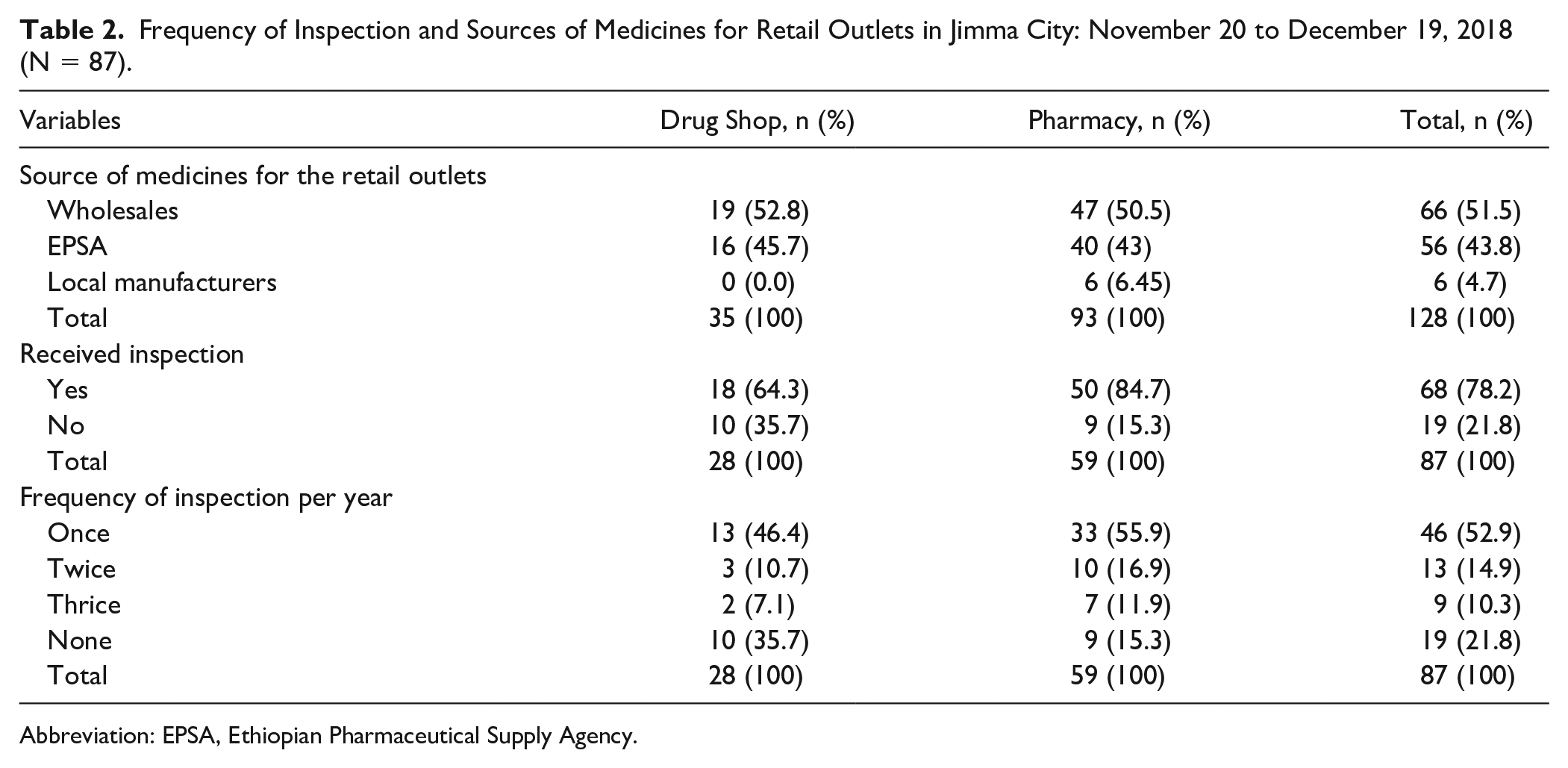
Abbreviation: EPSA, Ethiopian Pharmaceutical Supply Agency.
Practitioners’ Knowledge About Pharmaceuticals Waste Disposal Practices
The majority of participants, 53 (60.9%), had awareness regarding appropriate disposal practices and safe disposal sites. Specifically, pharmacy professionals had better awareness, 44 (50.6%) (Figure 1).

Awareness of safe disposal practices and disposal sites for pharmaceuticals waste among practitioners in retail outlets in Jimma city, Jimma, Ethiopia: November 20 to December 19, 2018, (N = 87).
As shown in Table 3, the main reasons for the damage or expiration of medicines in retail outlets were receiving products with a near expiration date, 42 (38.2%), and “inappropriate storage practice, 32 (29.1%). Seventy (41.7%) of the participants knew that the safe disposal of damaged or expired pharmaceuticals would prevent environmental pollution. Sixty-one (46.9%) and 50 (38.5%) of the participants respectively held the Ethiopian Pharmaceutical Supply Agency and Ethiopian Food and Drug Authority accountable to take the largest share in creating awareness for the drug retail outlets (Table 3).
Knowledge of the Participants on the Causes of Medicines Damage or Expiry, Reasons for Safe Disposal, and Awareness Creation for Practitioners in Retail Outlets in Jimma City, Jimma, Ethiopia: November 20 to December 19, 2018 (N = 87).

Abbreviations: EPSA, Ethiopian Pharmaceutical Supply Agency; EFDA, Ethiopian Food and Drug Authority; FMOH, Federal Ministry of Health.
Change in prescribing pattern.
To prevent antimicrobial resistance.
Universities.
Practitioners’ Disposal Practices of Pharmaceuticals Waste
The majority of participants, 67 (77 %), had an experience of checking the expiration date of medicines during the reception from suppliers. Fifty-nine (67.8%) of the participants reported that at least one type of damaged or expired medicines was available in their store because of the reasons mentioned in Table 3. Antibiotics, 31 (35.6%), and antihypertensive, 21 (24.1%), constituted the highest proportion of the waste. Regarding the actions taken to remove the waste, 47 (38.2%) of the respondents reported burning separately, and 24 (19.5%) of them reported burying underground (Table 4).
Private Practitioners’ Disposal Practices of Pharmaceuticals Wastes in Retail Outlets in Jimma City, Jimma, Ethiopia: November 20 to December 19, 2018 (N = 87).

Practitioners’ Attitudes Toward Pharmaceuticals Waste Management
More than half of the participants, 65 (74.7%) strongly agreed that improper disposal of damaged and expired medicines would negatively affect health and ecological systems. Fifty-two (59.8%) of the respondents strongly agreed that environmental protection is their responsibility. Concerning means of creating awareness on safe disposal of pharmaceuticals waste, the majority of the participants strongly agreed that training, 53 (60.9%), and provision of information by health professionals, 49 (56.3%) would improve the practitioners’ awareness (Table 5).
Private Practitioners’ Attitudes Toward Pharmaceuticals Waste Management in Retail Outlets in Jimma City, Jimma, Ethiopia: November 20 to December 19, 2018 (N = 87).

Discussion
Improper disposal of medicinal waste would be hazardous if it contaminates the water supplies or local sources used by communities or wildlife. Moreover, pharmaceuticals waste may be diverted to the market for illegal resale and also used by scavengers or children if a landfill is insecure. 2 In the present study, 47 (38.2%) of the participants burned the damaged, expired, or unused medicines separately, 24 (19.5%) buried underground, and 17 (13.8%) flushed in the toilet or river. It is a suggestion of improper disposal practices, which are likely to lead to undesirable effects. The possible reason could be the infrequent inspection of retail outlets by the regulatory body, where most of them received once a year. These findings are in line with other studies conducted among health care professionals in Kuwait, 22 Kabul, Afghanistan, 23 and in Kwazulu-Natal, South Africa, 19 yet deviate from the Ethiopian medicinal waste management and disposal directive. The directive requires that unfit drugs, except for recyclable materials, cartons, and leaflets, be returned to the respective suppliers for disposal. 24
In the current study, the participants reported that they knew safe disposal of pharmaceuticals waste would prevent environmental pollution, 70 (41.7%), and illegal use by the communities, 55 (32.7%). It is an indication of a good understanding of the safe disposal of pharmaceuticals waste, and it is also consistent with the findings of previous studies in Harar City and South India.25,26
Regarding attitude toward medicinal waste disposal practices, 65 (74.7%) participants strongly agreed that improper disposal of damaged and expired medicines could affect the environment and health. Nevertheless, the finding is not consistent with the study in Kabul, where around 98% stated that inappropriate disposal practices could harm the environment and human beings. 23 The reason might be the difference in the readiness of the practitioners to learn and cultural differences. Moreover, the commitment and actions the governments take in creating awareness might also matter. On the other hand, 52 (59.8%) participants strongly agreed that environmental protection is their responsibility, which is also in agreement with a study conducted in New Delhi, India. 27 Fifty-three (60.9%) and 49 (56.3%) of the participants respectively strongly agreed that training on pharmaceuticals waste management and a provision of information by health professionals could be the best means of raising practitioners’ awareness about safe disposal of pharmaceuticals waste. These findings are in line with the study conducted in Gujarat, India. 20 However, in Ethiopia, apart from the curricular programs, it is not common for the government to provide short-term training for private practitioners.
As limitations, because of budget constraints, the study was conducted in retail outlets of one city. Thus, we recommend that other researchers extend the study to include broader geographic areas. Summative findings may, therefore, allow the Ethiopian Federal Ministry of Health and the regulatory body to enforce the reverse logistics already underway effectively. The current study was conducted among private practitioners. Thus, prospective researchers may consider both private and public professionals for their comparative study.
Conclusions
To conclude, the majority of the participants knew that the appropriate disposal of pharmaceuticals waste could protect human beings and ecological systems. Most of the respondents also had a positive attitude toward environmental protection. However, on the contrary, a large share of them had disposed of unused or expired medicines inappropriately. It could be due to negligence and nonpharmacy professionals engaged in the management of medicinal products in the outlet. The authors, therefore, recommend that the Ethiopian Food and Drug Authority should increase the frequency of inspections and also raise practitioners’ awareness of safe disposal practices of expired or damaged medicines. Additionally, Ethiopian Pharmaceutical Supply Agency and partners should consider private practitioners during the provision of training on health care waste management for public health professionals.
Footnotes
Acknowledgements
The authors would like to thank Jimma University for creating an opportunity to conduct this study. We express our deep gratitude to the owners of retail outlets and participants for their cooperation in providing us with all the necessary data. Last, but not least, our acknowledgment goes to Dereje Kebebe (PhD), the staff of Jimma University School of pharmacy, for reviewing the final manuscript.
Author Contributions
TG reviewed the article, was involved in the data collection process, analyzed data, interpreted data, participated in the sequence alignment, drafted the manuscript, and communicated for publication. DA reviewed the article, participated in the design of the study, and was involved in data analysis, interpretation, and drafting of the manuscript. Both authors read and approved the final manuscript.
Declaration of Conflicting Interests
The author(s) declared no potential conflicts of interest with respect to the research, authorship, and/or publication of this article.
Funding
The author(s) received no financial support for the research, authorship, and/or publication of this article.
Ethical Approval
Ethical approval was granted by the institutional review board of Jimma University. The owners of the retail outlets were communicated using a support letter written from Jimma University School of Pharmacy.
Informed Consent
The participants were asked to sign a consent form before the start of data collection.
