




Abstract
Introduction
One in 5 married women of childbearing age has an unmet need for modern contraception in Africa. 1 Only 2% of married women of reproductive age women use a copper bearing intrauterine device (IUD) in sub-Saharan African countries with 30% contraceptive prevalence rate (C-PR) and 24% unmet need for family planning.2,3
Ethiopia is the second most populous country in Africa with an estimated total population of 104.3 million with annual growth rate of 2.7% in 2017. 4 According to Ethiopian Demographic and Health Survey (EDHS 2016), 22% of currently married women have unmet need for family planning and 4.6% total fertility rate, with an estimated 32% of all maternal deaths related to unsafe abortions. 5 The highest total fertility rate and unmet need will require quite concrete activities to increase country’s C-PR and also shift the method mix to a greater emphasis on long-acting, safe, and highly effective method. In Ethiopia, the rates are only 35% C-PR and only 2% copper-bearing IUD utilization among current user of modern contraceptives.5,6 There were also differentials in use of copper-bearing IUD in different parts of Ethiopia, the least in Jimma town, southwestern Ethiopia, which is 3.8% as compared with 5.7% in Gonder town, and 13% in Tigray region, northern Ethiopia.7-9
The Ethiopian Federal Ministry of Health (FMoH) so far conducted different interventions aimed to increase the accessibility of long acting contraceptives. However, recent study revealed that only injectable (23%) and implants (8%) were the most utilized methods of contraception despite their hormonal side effects. 6 More than 80% of the people in the country reside in the rural areas for which they are unable to get adequate informed decisions due to different behavioral and individual barriers.
The national and local rate of copper IUD use was low despite its advantage as compared with the other modern reversible contraceptive methods. 10 Studies in rural community that identify factors affecting IUD utilization were lacking for contextualized design and influence of policies and strategies aiming at increasing modern contraceptive prevalence through improving contraceptive method mix. In addition, it is helpful for achieving women’s reproductive health rights of choosing the method they like whenever they need it. Thus, the aim of this study is to identify factors affecting copper-bearing IUD utilization among married women of reproductive age in Mettu rural community of southwestern Ethiopia
Methods
Study Area and Period
The study was done in Mettu rural district, from April to May 2018. The district was located 600 km to the southwest of Addis Ababa, the capital city of Ethiopia, and located on the main road passing from Jimma to Gambella town. The total area of the district is 67 km2. There are 29 functional health facilities (5 health centers and 24 health posts) in the district.
Study Design and Population
A community-based cross-sectional study design was done among married women of reproductive age group.
Sample Size Determination
A single population proportion formula, n = (Z α/2)2 ×p × (1 − p) / d2.With the assumption of 95% confidence level, margin of error (d) = 3%, 7.7% proportion (p) of women using an IUD in Addis Ababa, Ethiopia, 11 and design effect of 1.5 were used. Adding 10% nonresponse rate the final sample size was estimated at n = 501.
Sampling Techniques
Multistage sampling techniques was used to select the study participant. In the first stage nine kebele 1 out of 29 were selected randomly by using lottery method and then sample sizes were proportionally allocated to each kebeles. In the second stage, sampling frame was prepared from the family folders of community health information system (CHIS) to select married women of reproductive age, then whole numbers were given for eligible women, and finally, study participants were selected by using systematic random sampling techniques. The interviewer revisited the household at least 3 times to declare the nonresponse.
Data Collection Procedure
Data were collected using structured interviewer-administered questionnaire that was translated to local language Afaan Oromo and then translated back to English language to check consistency. The study participant was interviewed in private room about the IUD utilization status, sociodemographic variables, and factors affecting IUD utilization.
Measurement
Knowledge
Knowledge of an IUD was measured by asking 8 questions with a minimum score of 0 and maximum of 8. Knowledge of an IUD was categorized as having “adequate knowledge,” for those who scored above the mean and inadequate knowledge otherwise, 17 see Table 4 in the Supplementary Material available online.
Attitude
Married women’s attitude toward IUD use were measured by using 3-point Likert-type scale with positively stated statements. women who scored above the mean were considered as having favorable attitude, otherwise unfavorable attitude toward an IUD,17,18 see Table 5 in the Supplementary Material.
Myth and Misconceptions
Myth and misconceptions were measured by using median score of the correct responses, and it is classified as having “no myth and misconception,” for those who scored above the median and “had myth and misconception” toward an IUD use otherwise, 12 see Table 6 in the Supplementary Material.
Data Management and Quality
Properly designed data collection instrument was adapted after thoroughly revising related literatures that were used in other similar studies by considering local conditions.17,18,29,42 The English version of the questionnaire was translated to local language (Afan Oromo) by language experts and translated back to English to check consistency by medical professionals from Mettu Karl referral hospital who are familiar with both languages. The questionnaire was pretested before actual data collection on 25 (5%) of women in Ale district (similar population out of the study area) and necessary modifications were made specifically on the understandability of specific item. Reliability test was done and Cronbach’s α >.7 taken for actual data collection. Five female data collectors were recruited based on having diploma in clinical nursing and those currently not engaged in another duties. Two supervisors who were senior nurses from the health center checked for completeness of the data and reported problems encountered immediately to the principal investigator. Two days of training was given to data collectors and supervisors on data collection tools and overall techniques in a community-based survey method. Every day, completeness and consistency of the collected data was reviewed and checked by supervisors and principal investigator. Discussions were made with the interviewers at the end of the day and in the morning; corrective actions were taken timely to minimize errors committed during interview. To minimize the nonresponse rate adjusting appropriate time for repeat visit with when respondents were unavailable or when the study households were closed. The principal investigator and supervisors selected a few households for re-interview to check validity of the data. Ethical clearance was obtained from the institutional review board of Mettu University Institute of Public Health, School of Postgraduate Study.
Statistical Analysis
Data were cleaned, coded, and entered using EpiData manager version 4.1 and analyzed by using Statistical Packages for Social Sciences (SPSS) version 20. Summary statistics of mean and percentages were used to describe the study population. Bivariate logistic regression was run for all independent variables to assess the association between the study outcomes and independent variable. Then, multivariable logistic models were fitted to identify the important predictors of an IUD utilization. For the multivariable regression modeling, the covariates to be included in a model were selected based on their bivariate association with the outcome variables with P value <.25. Adequacy of the models to predict the outcome variables was checked using the Hosmer and Lemeshow test. Also, presence of multicollinearity among covariates in the models was assessed and accepted with level of tolerance at 0.2. The strength of association between outcome variable and independent variable was reported using adjusted odd ratios and the presence of statistically significant association was considered at P < .05.
The wealth index is a composite measure of the cumulative living standard of a household. The wealth index is calculated using household’s ownership of selected assets, such as ownership of agricultural land, cattle, television, radio and bicycles, materials used for housing construction, bank account and amount of deposit on the account, and types of water access and sanitation facilities. Wealth index places individual households on a continuous scale of relative wealth using principal components analysis (PCA).
The collected information on each household asset for which assigned a weight or factor score generated through PCA. After computing these components together, an index was developed and used to create the break points that define wealth tertiles as: lowest wealth tertile, middle wealth tertile, and highest wealth tertile.
IUD utilization indicates those clients who were using intra uterine contraceptive device at the time of interview.
IUD refers to a copper-bearing IUD.
Women development army (WDA) is an all-women network for discussion of socioeconomic and health issues with 1 to 5 households in rural kebeles (the lowest administrative structure).
Results
Sociodemographic Characteristics of the Respondents
A total of 492 women completed the questionnaire yielding a response rate of 98.2%. About half (51.6%) of the study participant were in the age group of 25 to 34 years with mean age of 27.51 years (SD ±5.65 years). A total of 445 (90.6%) were from the Oromo ethnicity group; 172 (35%) respondent were Protestant in religion; 235 (45.70%) study participants had not attained formal education, while 12.3% had attained formal education (see Table 1).
Sociodemographic Characteristic of Married Reproductive Age Women in Mettu Rural District, Southwest Ethiopia, 2018.

Gurage and kefa.
Catholic and Wakeffata.
Reproductive Characteristics of the Respondents
Of the 492 study participants, 417 (84.8%) had history of pregnancy and 125 (30%) had more than 2 alive children. A total of 376 (76.4%) were planning to control their fertility (see Table 2).
Reproductive Characteristics of Married Reproductive Age Women in Mettu Rural District, Southwest Ethiopia, 2018.

I don’t know and mother.
Rate of IUD Use
The rate of IUD utilization was found to be 4.1% (95% CI 2.4-5.9) in Mettu rural community (see Figure 1).
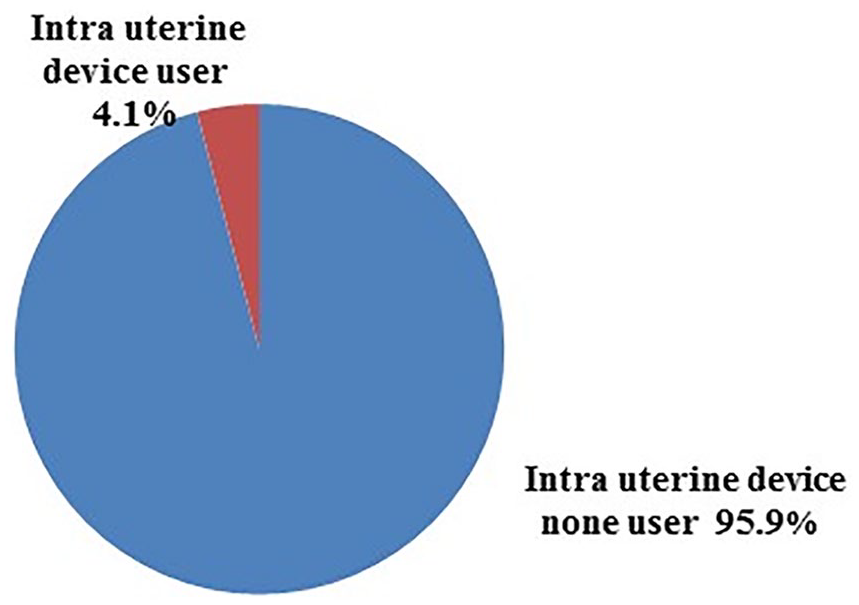
The rate of intrauterine device use among married women of reproductive age in Mettu rural district, southwest Ethiopia, 2018.
Reasons for Not Using an IUD
Out of 492 respondents, 242 (49.2%) were not using an IUD because of they were using other family planning method. Of 250 (50.8%) women who responded to the reasons for not using an IUD, the most common cited reasons were fear of side effect (45.8%), partner disapproval (23.9%), and lack of information (15%) (see Figure 2).

Reason not using intrauterine contraceptive device among married women of reproductive age in Mettu rural district, southwest Ethiopia, 2018.
Independent Predictors of IUD Utilization
Bivariate logistic regression analysis reveals that age, educational status of respondent and partner, number of children alive, plan for future fertility, discussion about IUD with women health developmental army, intention to use IUD, myth and misconception, knowledge of IUD, and attitude of women toward IUD were found to be candidate variables for multivariable analysis.
Educational status of women was found to have a statistically significant association with IUD utilization. As educational status of women increases the utilization of IUD also increases. Women with primary education were 4 times (adjusted odds ratio [AOR] 4.40; 95% C.I 1.32-14.64) more likely to utilize IUD than those who had no formal education and also women with secondary education and above were 5 times (AOR 5.05; 95% C.I 1.11-22.01) more likely to utilize IUD than those who had no formal education.
Mothers who had favorable attitudes toward an IUD were found to be 3 times (AOR 3.24; 95% CI 1.06-9.89) more likely to use IUD compared with those who had unfavorable attitudes. Women who had no myth and misconception toward IUD were found to be 3 times more likely to use an IUD as compared with those who had myth and misconception (AOR 3.24; 95% CI 1.06-9.89). Mothers who had more than 2 alive children were found to be 3 times (AOR 3.48; 95% CI 1.31-9.27) more likely to use an IUD as compared with those who had less than or equal to 2 alive children.
Women who discuss about IUD use with women health development army were found to be 3 times more likely to use IUD as compared with those who did not discuss about IUD with women health development army (AOR 3.11; 95% CI 1.02-9.49) (see Table 3).
Multiple Variable Analysis of Factors Affecting IUD Use Among Married Reproductive Age Women in Mettu Rural Community, Southwest Ethiopia, 2018.

Abbreviations: IUD, intrauterine device; COR, crude odds ratio; AOR, adjusted odds ratio; 1.0, indicates reference category.
Statistically significant at P < .05.
Discussion
IUD is the second most commonly used method in the world and the most cost-effective, safe, long-lasting, rapidly reversible method of contraception that does not need continuous resupply. According to demographic and health surveys in 2016, more than 60% of women in Ethiopia were not using any modern contraceptives. 6 There was a difference in the rate of utilization and associated factors in different parts of Ethiopia. Thus, this study assessed the rate of an IUD use and its predictors in Mettu rural community, southwestern Ethiopia.
In this study, the rate of IUD utilization was 4.1% (95% CI 2.4-5.9). This finding was comparable to cross-sectional study done in Jimma town (3.8%) in 2012, in Kenya city slums (4%) in 2011, and in Adigrat town (3.8 %) in 2012.7,13,14 The finding of this study was lower than cross-sectional study done in Mekele town (1.5%) in 2011, EDHS 2016 (2.1%), and study done in Rwanda (2.1%) in 2010.9,15,16 The reason for the observed difference could be due to information provision by health extension worker, presence of different media in the area, and sociocultural factors. This finding was higher than a cross-sectional study done in Egypt in 2013 (27%), survey conducted in selected public health facility of Ethiopia (6%) in 2014, study conducted in Addis Ababa (7.7%) in 2013, and a study in Isfahan, Iran (8%) in 2010.11,17-19 The variation could be attributed to differences in study setting, residence, sociodemographic and cultural variability; that is, this study was a community-based study and focused on rural married reproductive age women whereas all other mentioned studies were facility based and deal with urban married reproductive age women and also other variability may be due to sociodemographic and cultural differences.
This implies that the rate of an IUD utilization in the rural community still needs great attention from different stakeholders in this area.
This study identified different factors affecting IUD utilization among married reproductive age women. In this study, educational status of women was found to be statistically significantly associated with IUD use, that is, women with primary education were 4 times, whereas those with secondary and above education were 5 times, more likely to use IUD as compared with those who had no formal education. This finding is comparable to the studies done in Rwanda in 2010, in Addis Ababa in 2013, and in Nepal in 2013.11,15,20 This could be beause educated people tend to adopt modern values, have the opportunity and better access to gain adequate information about contraceptives, and have greater autonomy to make decision. This indicates that the sociodemographic factors affect the use of an IUD, for which equity in service accessibility should be considered.
In this study, married reproductive age women who had favorable attitude toward IUD were 3 times more likely to use IUD as compared with those who had unfavorable attitude. This finding was consistent with studies done in Arbaminich in 2014 and Adigrat town in 2012.13,21 This could be because women who had favorable attitude had self-confidence or self-motivation and no method-related confusion or fear to use IUD.
In this study, a significant number of women (339, 68.9%) had myth and misconception to have intention to use IUD, which is statistically significant (AOR 3.40; 95% CI 1.23-9.39). This finding is comparable to the study done in Wolita Zone in 2013, and in Uganda in 2012.12,22 This could be due to widespread of misinformation or rumor like IUD can move beyond the uterus, cause infertility, can cause cancer of the uterus, can damage the womb, and reduce sexual pleasure. This shows that behavioral and sociocultural factors can be modified through informal ways, for example, women development army, were helpful in reducing myths and misconceptions regarding am IUD.
This study reveals that number of alive children women had statistically significant association with IUD utilization. In this study, participants who had greater than 2 alive children were 3 times more likely to use IUD as compared with those who had less than or equal to 2 alive children. This finding is comparable to the study done in Newest town in 2014, 23 in Nepal in 2013, 20 and in Uganda in 2012. 24 This may be because once women have the desire number of children they want, they prefer to use long-term method due to not visiting health facility frequently. Also, method-related fear like using IUD for long period of time can cause infertility decreases.
This study reveals that discussion about IUD with women health developmental army was statistically significantly associated with IUD utilization. In this study, women who discussed about IUD with women health developmental army were found to be 3 times more likely to use IUD as compared with those who did not discuss about IUD with women health developmental army. This implies that an informal way of learning from peers can influence the utilization of an IUD in addition to the formal ways through health workers.
The study being in a rural community and involving women who were not self-referred for the service were the strengths of study. While relying only on women’s response by excluding male partner’s response may not represent the overall factors affecting an IUD use and being a cross-sectional study, we are unable to establish cause-effect relationships. Another limitation was the inability to show trends over a longer period of time in a population as the study used survey-based data.
Conclusion
Only 1 in 25 women was using an IUD in Mettu rural community. Primary and higher level of education, positive attitude toward IUD use, not having myth and misconception toward IUD use, having more than 2 alive children, and discussion about IUD with women health developmental army were positive influencing factors for IUD use. Public health interventions should focus on scaling up and strengthening awareness creation program that address women at large to bring behavioral change, especially among women’s attitude and misconception or rumor toward IUD use focusing on women who have no formal education and have less than 2 alive children. Further qualitative study that involves male partner and service provider regarding IUD utilization is also recommended.
Supplemental Material
Table_supplementary – Supplemental material for The Rate of Intrauterine Contraceptive Device Use and Associated Factors Among Married Women of Reproductive Age in Mettu Rural Community, Southwest Ethiopia
Supplemental material, Table_supplementary for The Rate of Intrauterine Contraceptive Device Use and Associated Factors Among Married Women of Reproductive Age in Mettu Rural Community, Southwest Ethiopia by Shimelis Teshome, Ebissa Negera, Tesfaye Sileshi and Afework Tadele in Journal of Primary Care & Community Health
Footnotes
Authors’ Note
The data sets used and/or analyzed during the current study are available from the corresponding author on reasonable request.
Author Contributions
ST made substantial contributions to conception and design, acquisition of data, and analysis and interpretation of data. EN and TS were involved in analysis and interpretation of data. AT was involved in drafting the manuscript and revising it critically for important intellectual content. All authors read and approved the final manuscript.
Declaration of Conflicting Interests
The author(s) declared no potential conflicts of interest with respect to the research, authorship, and/or publication of this article.
Funding
The author(s) received no financial support for the research, authorship, and/or publication of this article.

Supplemental Material
Supplemental material for this article is available online.
References
Supplementary Material
Please find the following supplemental material available below.
For Open Access articles published under a Creative Commons License, all supplemental material carries the same license as the article it is associated with.
For non-Open Access articles published, all supplemental material carries a non-exclusive license, and permission requests for re-use of supplemental material or any part of supplemental material shall be sent directly to the copyright owner as specified in the copyright notice associated with the article.
