



Abstract
Introduction
HIV preexposure prophylaxis (PrEP) was first approved by the Food and Drug Administration (FDA) in 2012 and is effective in preventing HIV in individuals who are vulnerable to HIV transmission. Despite the fact that multiple clinical trials have demonstrated PrEP efficacy in preventing HIV transmission when taken daily as prescribed, with relatively few side effects, PrEP is an underutilized method of HIV prevention in the United States. 1 The Centers for Disease Control and Prevention (CDC) estimates that 1.2 million individuals are eligible for PrEP based on sexual and/or drug use behaviors, yet the total number of people using PrEP in the United States is approximately 225 000. 2 A multicity survey (Philadelphia, Houston, Detroit, Atlanta, and Washington, DC) conducted in 2014 found that Philadelphia had one of the lowest PrEP usage rates (0.5%) among persons facing the greatest risk: black men and transgender women who have sex with men. 3 PrEP has shown significant effectiveness in reducing HIV transmission and holds great promise for increasing community-level protection, particularly in cities like Philadelphia where the prevalence of HIV is high at 1.2%. 4
Success of the scale up and adoption of PrEP requires that health care providers are aware of PrEP, knowledgeable to discuss it with their patients, and comfortable prescribing it. Previous studies examining PrEP prescriber comfort have found that common perceived barriers are the assumed time-consuming process of prescribing PrEP, 5 insufficient clinical capacity, 6 and insurance concerns and potential cost to patients. 7 Providers have reported concerns prescribing PrEP to patients who report low medication adherence and the potential for drug resistance.8,9 Additionally, provider discomfort with taking a comprehensive sexual history or difficulty determining PrEP patient eligibility are limitations that prevent adoption of PrEP.10,11 Provider discomfort prescribing PrEP presents a major barrier to PrEP access.
Primary care providers (PCPs) are uniquely positioned to identify patients who are eligible for PrEP as they may serve HIV uninfected patients who are vulnerable to HIV acquisition. 12 Because of a lack of awareness of PrEP and a low prevalence of PrEP prescriptions written by these medical providers, there are missed opportunities for engaging persons vulnerable to HIV along the PrEP continuum.13,14 Our study sought to examine Philadelphia health care providers’ knowledge and attitudes, prescribing practices, and self-reported comfort level with PrEP in order to identify potential areas of training and capacity building.
Methods
Respondents and Procedures
The survey was administered by the Philadelphia Department of Public Health (PDPH) AIDS Activities Coordinating Office (AACO) and was conducted through an online platform from September to December 2017. One email reminder was sent 2 months after initial survey; no compensation was provided. Survey participants were recruited through the Philadelphia County Medical Society distribution list and a PDPH HIV provider listserv. Both lists included HIV/ID specialists, family medicine, internal medicine, women’s health, and pediatric/adolescent providers, who were mainly physicians, and also included nurse practitioners and physician assistants. Recruitment emails included a brief description of the survey and were sent to 1000 providers. Study questions characterized the sample through identifying health care setting type, number of patients with HIV cared for, and knowledge of PrEP eligibility criteria. Questions asked respondents to rate their comfort level discussing HIV risk factors and prescribing PrEP (Figure 1).

Questions assessing preexposure prophylaxis (PrEP) prescribing comfort and experience.
Statistical Analysis
Respondents were anonymous and results were analyzed based on aggregate data. The analysis focused on the respondents answer to the question “Do you feel comfortable prescribing PrEP to your patients?” on a Likert-type scale of “Strongly Disagree” to “Strongly Agree.” For the purpose of this assessment, respondents who had answered “Strongly Disagree,” “Disagree,” or “No Opinion or Uncertain” were considered to feel “Not Comfortable” and respondents who had answered “Agree” or “Strongly Agree” were considered to feel “Comfortable” prescribing PrEP.
The analysis was done using χ2 tests to describe differences in sample demographics between providers who were and were not comfortable prescribing PrEP. Similarly, χ2 tests were used to identify differences along the PrEP continuum between HIV care providers and non-HIV care providers. All statistical tests were completed using SAS 9.4.
Ethics Statement
The study received institutional review board approval from the Philadelphia Department of Public Health.
Results and Discussion
Characteristics of the Study Population
Of 1000 potential respondents, there was a 9% response rate. Of the 87 respondents, 6 were excluded based on incomplete or missing survey responses leaving a total of 81 eligible participants. The majority of participants were family/internal medicine physicians (48%) and HIV/infectious disease specialist (31%). Respondents included 8 nurse practitioners and physician assistants. The sample was evenly distributed in terms of age, gender, and years practicing; 53% (n = 43) were female, 63% (n = 51) were younger than 50 years, and 60% (n = 49) had been practicing medicine for over 10 years. Demographics, including professional and clinical practice type, are shown in Table 1.
Participant Demographics.

Provider Comfort of Prescribing PrEP
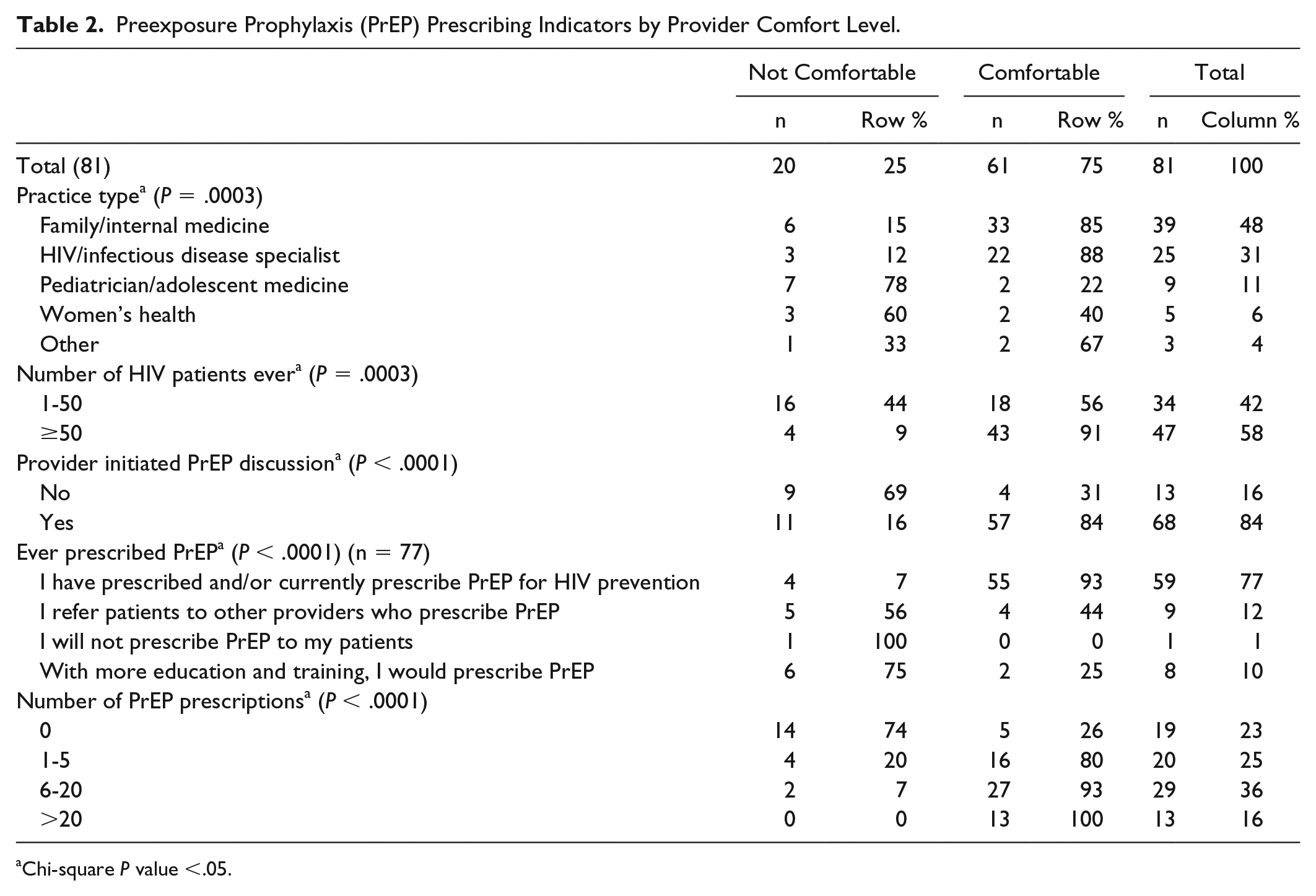
The majority of providers (76%) felt comfortable prescribing PrEP to their patients. There were no significant differences in the providers who were comfortable and those who were not comfortable prescribing PrEP in terms of gender, age, and years practicing medicine (Table 2). More than half of the providers (58%, n = 47) had cared for more than 50 HIV patients ever, and those providers who had cared for more than 50 HIV patients were significantly more likely to feel comfortable in prescribing PrEP (P = .0003).
Preexposure Prophylaxis (PrEP) Prescribing Indicators by Provider Comfort Level.
Chi-square P value <.05.
Providers from family/internal medicine and HIV/infectious disease specialist were more likely to feel comfortable prescribing PrEP than providers who were in pediatrics/adolescent medicine or women’s health (P = .0003). Those providers who were comfortable providing PrEP were more likely to have their patients ask them about PrEP (P < .0001), more likely to have initiated a PrEP discussion with their patients (P < .0001), and were more likely to have prescribed PrEP (P < .0001). Of those uncomfortable prescribing PrEP, 30% (n = 6) were family/internal medicine, 35% (n = 7) were pediatric/adolescent medicine, and 15% (n = 3) were women’s health providers.
PrEP Prescribing Continuum
Providers were asked about their familiarity and comfort with PrEP prescribing indicators and clinical protocols. The questions were asked using a Likert-type scale of “Strongly Disagree” to “Strongly Agree.”
Provider responses based on comfort were used to create the PrEP prescribing continuum (Figure 2). For the purpose of the PrEP prescribing continuum, the categories of pediatric/adolescent medicine, women’s health, and family/internal medicine were collapsed into the category of “Non-HIV Provider” There was a significant difference between HIV/infectious disease specialist and Non-HIV Providers in the categories of being knowledgeable about required labs (P = .03) and of a history of prescribing PrEP to more than 10 patients (P = .006).

Preexposure (PrEP) prophylaxis prescribing continuum, by provider type.
Consistent with previous studies, we found that HIV providers who cared for more than 50 persons living with HIV were more likely than non-HIV providers to be comfortable in prescribing PrEP to their patients.1,15 The PrEP prescribing continuum illustrates that a significantly higher proportion of HIV specialists had prescribed PrEP to their patients and were knowledgeable about required labs compared with non-HIV providers. These providers may be more aware of and able to identify HIV risk factors in HIV-negative patients.
When the provider types were disaggregated, results of PrEP comfort varied by practice type. Over three-fourths (77%) of pediatric/adolescent medicine providers felt uncomfortable prescribing PrEP to their patients, which was consistent with previous surveys in which providers felt less comfortable prescribing PrEP to adolescents due to concerns about confidentiality, legality of prescriptions without parental consent, and high costs of PrEP medication.16,17 Similarly, 60% of surveyed women’s health providers felt uncomfortable prescribing PrEP. Family planning and women’s health providers have an opportunity to discuss HIV/sexually transmitted infection prevention and screening with their patients, yet only 4% of family planning/women’s health providers surveyed in other studies had ever prescribed PrEP to their patients. 18 With an estimated 624,000 heterosexual persons having risks of acquiring HIV consistent with indicators for PrEP, 19 it would be beneficial to include family planning and women’s health providers in future PrEP educational programs.
There are limitations to this study. Recruitment for the survey was a convenience sample and inherently biased, as providers who see HIV patients and have preexisting knowledge about PrEP may be more willing to respond to a survey on PrEP. The survey attained a low response rate and we were unable to compare characteristics of surveyed providers with nonresponders to assess response bias. Although we received a lower response rate from adolescent medicine and women’s health providers than HIV care providers and primary care providers, we were able to characterize potential PrEP prescribers, which will help inform future opportunities for training and education that build on PrEP prescribing comfort.
Reducing the rate of new HIV transmissions will require a broad and diverse dissemination of PrEP. Addressing provider concerns and perceived barriers through educational efforts is a critical component to increasing PrEP prescribing comfort amongst a diverse set of providers.
Conclusions
In summary, this study found there is variation in comfort and experience in prescribing PrEP across provider types. Of those surveyed, HIV care providers were significantly more likely to report experience and knowledge in prescribing PrEP compared with providers in primary care, women’s health, and/or adolescent/pediatric medicine. It would be beneficial to include family planning and women’s health providers in future PrEP educational programs, as this is a population whose risks for HIV may be unrecognized. 19 In order to grow broad and diverse dissemination of PrEP, non-HIV providers must be aware of the efficacy of PrEP and be prepared to integrate conversations about sexual health, HIV prevention, and PrEP into routine preventive health care to raise awareness among patients about PrEP availability.
Footnotes
Acknowledgements
We thank the Philadelphia Department of Public Health for their assistance. We thank the Philadelphia County Medical Society for their contribution of a county medical provider listserv. We thank the Arizona Department of Health Services for their permission to adapt their questions from PrEP provider attitude survey.
Author Contributions
EA designed the study. MC and EA were involved in data collection. TN and KAB conducted the analysis. All authors contributed to the writing of the manuscript. All authors have read and approved the manuscript.
Declaration of Conflicting Interests
The author(s) declared no potential conflicts of interest with respect to the research, authorship, and/or publication of this article.
Funding
The author(s) received no financial support for the research, authorship, and/or publication of this article.
