



Abstract
Objective:
This current study aims to explore the associations and the longitudinal effects of childhood intimate violent exposure (IPV) on bullying and cyberbullying perpetrations and the trajectory of bullying and cyberbullying perpetrations during adolescence.
Methods:
This study used data from the Bullying, Sexual, and Dating Violence Trajectories from Early to Late Adolescence in the Midwestern United States, 2007 to 2013. One thousand one hundred sixty-two participants were recruited from 4 Midwestern middle schools (mean age = 11.81; SD = 1.09) and followed into high schools. A 2-part mixed-effects model, the logit submodel and the continuous submodel, was used for statistical analyses.
Results:
Bullying perpetration declined as adolescents aged (β = −.03, P < 0.01), while cyberbullying perpetration increased (β = .05, P < .01). Adolescents who have childhood IPV exposure were more likely to engage in bully perpetration (β = .27, P < .01) and cyberbullying perpetration (β = .17, P < .05).
Conclusions:
Cyberbullying perpetration has increased as ages, while bullying perpetration decreased. Childhood IPV exposure significantly increased the levels of bullying and cyberbullying perpetrations. Parents need to avoid violent behaviors in front of children; in addition, parents and teachers should pay attention to children’s online experiences and educate children about emotion control and proper tools for dealing with negative experiences.
Introduction
Bullying is defined as unwanted, aggressive behavior characterized by a real or perceived power imbalance. 1 It occurs both in-person and electronically as cyberbullying. 2 In the United States, about 20% of adolescents aged 12 to 18 years experience bullying each year in person or online. 3 Bullying exposure has profound developmental consequences, including altered brain development,4,5 substance use, emotional distress, and suicidality.6-10 Preventing bullying is therefore essential to promoting adolescent health. 7
Intimate partner violence (IPV) is aggression that occurs within romantic relationships. 11 Such an exposure affected 26% of U.S. children,12,13 making it a major component of adverse childhood experiences (ACE) with long-term effects on health and behavior.14,15 In particular, childhood IPV exposure increases adolescents’ involvement in bullying and cyberbullying perpetration16-18 and predicts violent behavior into adulthood. 19 However, meta-analytic evidence suggested that associations vary depending on the type and severity of IPV. 20 Some studies report links only for psychological IPV 21 or severe physical IPV. 22 In addition, research on the longitudinal trajectory of bullying and cyberbullying from early to late adolescence remains limited.
Amidst the mixed findings, this study aims to examine the developmental trajectories of bullying and cyberbullying perpetration across adolescence and the longitudinal associations between childhood physical IPV exposure and bullying and cyberbullying. In addition, bullying measures often contain many zeros due to large proportions of adolescents reporting no perpetration. Traditional transformations or dichotomization can distort parameter estimates.23,24 A 2-part mixed-effects model—estimating the likelihood of any perpetration and the frequency of perpetration among perpetrators—offers a more accurate analytic approach. 25 This study explores the longitudinal effects of IPV exposure on these behaviors using a 2-part mixed-effects model.
Method
Participants
This study used data from the Bullying, Sexual, and Dating Violence Trajectories from Early to Late Adolescence in the Midwestern United States, 2007 to 2013. 26 Participants were recruited from 4 Midwestern schools comprising 1162 students (mean age = 11.81; SD = 1.09), including fifth, sixth, and seventh graders, who were followed into high schools longitudinally. The sample is demographically diverse in terms of race/ethnicity, with 30.2% White, 55.6% African American, 3.8% Hispanic, 2.4% Asian, and 12.1% Other. Around 60% of the sample was eligible for free/reduced lunch. Survey response rates were 78.7%, 76%, 81.5%, and 77.2% from wave 2 to wave 6, respectively. Five waves of self-reported surveys were administered and collected data pertaining to familial violence exposures, physical abuse experience, and bullying behaviors. The detailed distribution of gender and waves are shown in Table 1.
Descriptives of Main Variables at Each Timepoint.

Measures
Physical Intimate Partner Violence Exposure During Childhood
Following the measurement in a previous study, 18 this study used the 1-item “Before you were 10 years old, did you see or hear one of your parents or guardians being hit, slapped, punched, shoved, kicked, or otherwise physically hurt by their spouse or partner?” from the Student Health and Safety Survey. 27 Students were asked to respond on a binary scale with 0 indicating no experience at all, and 1 indicating the existence of exposure to IPV during childhood.
Bullying Perpetration
Participants were asked to self-report their bullying perpetration using 7 items from Illinois Bully Scale 28 on a 5-point scale including “Never,” “1 or 2 times,” “3 or 4 times,” “5 or 6 times,” and “7 or more times.” Students are asked how often in the past 30 days they did the following to other students at school: teased other students, upset other students for the fun of it, excluded others from their group of friends, helped harass other students, and threatened to hit or hurt another student. Higher scores indicated more self-reported bullying perpetration. Cronbach’s alpha coefficients ranged from .81 to .82 for all waves of data used in the present study, indicating good internal consistency. 26
Cyberbullying Perpetration
Following the previous study, 29 this study measured cyberbullying perpetration using 4 items, including (1) “Made rude or mean comments to anyone online.”; (2) “Spread rumors about someone online, whether they were true or not.”; (3) “Made aggressive or threatening comments to anyone online”; and (4) “Sent a text message that said rude or mean things.” Response options include “Never,” “1 or 2 times,” “3 or 4 times,” “5 or 6 times,” and “7 or more times.” Higher scores indicated more self-reported cyberbullying perpetration online. Cronbach’s alpha coefficients ranged from .70 to .80 across all waves of data used.
Gender
Gender (0 “Male” and 1 “Female”) was added as a covariate in this study.
Statistical Analysis
Missing data was evaluated the using Little’s test. 30 Consistent with a previous study, 26 we assumed the data were Missing at Random (MAR) and employed multiple imputation to handle missing values. A 2-part mixed-effects model (the logit submodel and the continuous submodel) designed for longitudinal data was used. The logit submodel specifies a random effects logistic regression for the binary part of the data. The continuous submodel is a linear mixed-effects model for the logarithmic transformation of the non-zero responses. The analysis was done using the GLMMadaptive package in R. 31
Result
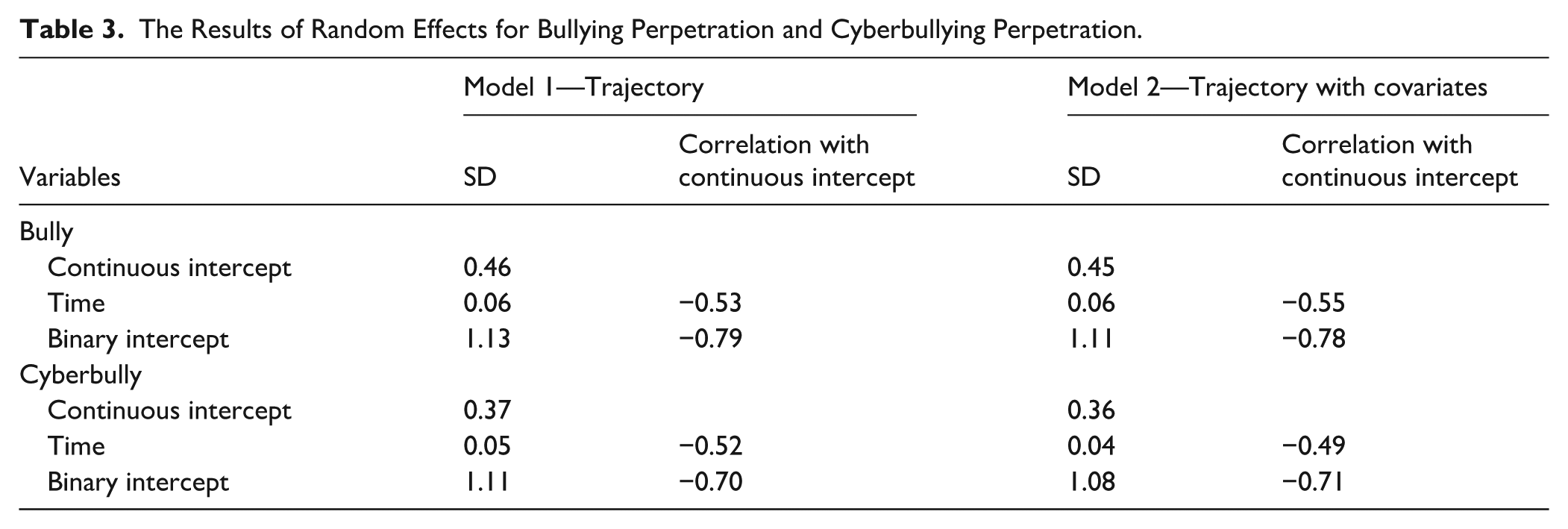
The results of the 2-part mixed-effects model are presented in Tables 2 and 3. The continuous submodel revealed that bullying perpetration demonstrated a decreasing trend over time (Estimate = −0.03, SE = 0.01, P < .01). Conversely, cyberbullying perpetration exhibited an increasing trend over time (Estimate = 0.05, SE = 0.01, P < .01). In the zero-inflated part of the models, represented by the logit submodel, significant intercepts were observed for both bullying (Estimate = −0.61, SE = 0.04, P < .01) and cyberbullying perpetration (Estimate = 0.60, SE = 0.04, P < .01), indicating that there is a large proportion of participants reporting non-committing bullying and cyberbullying behavior over time.
The Results of the Fixed Effects for Bullying Perpetration and Cyberbullying Perpetration.

The Results of Random Effects for Bullying Perpetration and Cyberbullying Perpetration.
IPV exposure was significantly associated with higher levels of bullying (Estimate = 0.27, SE = 0.07, P < .01). The interaction between IPV exposure and time was not significant (Estimate = −0.01, SE = 0.02, P = .39), suggesting that the effect of childhood IPV exposure on bullying did not change significantly over the observed period. Gender did not have a significant effect on bullying perpetration in the continuous submodel (Estimate = −0.02, SE = 0.04, P = .61). In the case of cyberbullying perpetration and being similar to bullying, IPV was significantly associated with higher levels of cyberbullying perpetration (Estimate = 0.17, SE = 0.08, P = .03). Gender was not significant (Estimate = 0.08, SE = 0.04, P = .07); and the interaction between IPV exposure and time was not significant for cyberbullying perpetration (Estimate = −0.02, SE = 0.02, P = .52).
In the zero-inflated part of the models, IPV exposure during childhood IPV exposure was significantly associated with the probability of engaging in both bullying (Estimate = −0.47, SE = 0.14, P < .01) and cyberbullying perpetrations (Estimate = −0.43, SE = 0.12, P < .01). Specifically, adolescents with IPV exposure were less likely to be in the non-engaging group, indicating a higher likelihood of participating in these behaviors. For cyberbullying, gender was also significant in the logit submodel (Estimate = −0.32, SE = 0.10, P < .01), which suggests that male adolescents were more likely to engage in cyberbullying perpetration.
Discussion
Amidst the inconsistent findings in the literature, this study provided findings on the associations between childhood physical IPV exposure and bullying and cyberbullying. This study extends existing literature by distinguishing the initiation and intensity of bullying and cyberbullying perpetration through a longitudinal 2-part mixed-effects model. Unlike prior research that relied on dichotomized or single-process outcomes, we examined how childhood IPV exposure influences both the likelihood of engagement and the frequency of perpetration across adolescence. The results showed that IPV exposure increases both the probability of engaging in bullying and cyberbullying and the frequency of these behaviors among perpetrators, while not significantly altering their developmental trajectories. This suggests that IPV exposure exerts an early and sustained effect rather than a progressively amplifying one.
The Trajectory of Bullying Perpetration During Adolescence
There were significant time effects on the trajectories of both bullying and cyberbullying perpetration, and the effects were different. As adolescents age, bullying perpetration declines, whereas cyberbullying perpetration increases over time. Possible explanations might be the differences in nature between traditional bullying perpetration and cyberbullying perpetration. First, compared to traditional bullying perpetration, the cyber environment provides an anonymous space, which is ideal for misbehaviors 32 that might end up with cyberbullying with no physical interaction. The anonymity and the absence of physicality made perpetrators less remorseful when conducting cyberbullying behaviors. 33 Furthermore, the emergence of social connectivity and easy access to electronic devices without geographic barriers increase the occurrence of cyberbullying. 34
Furthermore, 50% of teens browsed social media sites daily in 2008, whereas the number increased to 82% by 2016. 35 Screen time, especially on the internet, is positively associated with cyberbullying experiences.9,36 With the fear of losing internet access, children are reluctant to report cyberbullying experiences to their parents or teachers, leaving cyberbullying perpetrators with no punishment, which indirectly promotes cyberbullying perpetration. 37 In addition, with more time spent in the cyber environment, the decreased time in physical environments could also contribute to the decreasing trend in traditional bullying perpetration.
The Association Between IPV Childhood Exposure and Bullying Perpetration
Our findings align with previous studies,16,18,20,38 suggesting a positive association among childhood IPV exposure and bullying and cyberbullying perpetrations. Furthermore, by using a zero-inflated statistical model, this study provided nuanced associations. According to the logit sub-model, compared to adolescents without childhood IPV exposure, adolescents with childhood IPV exposure were more likely to be in the group of ever-conducted bullying and cyberbullying perpetrations. In addition, the continuous sub-model indicated that childhood IPV exposure was associated with higher numbers of such perpetrations. In other words, childhood IPV exposure not only helps initiate bullying and cyberbullying perpetration but also intensifies the frequency of such behaviors.
Longitudinal Effects Between Childhood IPV Exposure and Bullying Perpetration
This study found differences in the effects of childhood IPV exposure with bullying perpetration and cyberbullying perpetration. There were no significant longitudinal effects between childhood IPV exposure and bullying perpetration or cyberbullying perpetration. However, longitudinal effects have also been found in previous studies. For example, using data that followed children from birth to adulthood, revealed that exposure to parental IPV in early childhood (0-64 months) predicted dating violence in early adulthood. 19 However, such an effect was not found in this study.
The potential explanations for the insignificant interaction effect between time and childhood IPV exposure on bullying and cyberbullying perpetration might be the already high levels of perpetration, which are associated with childhood IPV exposure. As found in this study, childhood IPV exposure is associated with higher levels of bullying and cyberbullying perpetration, compared to those without childhood IPV exposure. In addition, this study also found significant correlations between the random intercepts and slopes, indicating that adolescents with higher initial levels of perpetration tended to show a decreased rate of change over time compared to those with lower initial levels. Therefore, despite the associations between childhood IPV exposure and higher initial levels of bullying and cyberbullying perpetration, the longitudinal effect of childhood IPV exposure was not significant.
Based on these findings, interventions should be implemented early—especially for children at high risk of IPV exposure—ideally before adolescence to prevent the onset of bullying and cyberbullying behaviors. Such interventions should target both parents and children, focusing on emotion regulation and aggression management to mitigate risk before aggressive behaviors become entrenched. Prevention efforts should also differentiate between initiation and escalation, addressing both the likelihood of engaging in bullying and the intensity of perpetration among those already exhibiting aggressive behaviors. Finally, given the increasing prevalence of cyberbullying, online monitoring and guidance tailored to IPV-exposed youth can help reduce opportunities for harmful online interactions while promoting healthy digital behavior.
Strengths and Limitations
By using the longitudinal data, this study could identify potential causal relationships by observing participants over time. In addition, the 2-part mixed-effects model can generate robust estimation and solid statistical inference toward traditional methods in several simulation studies for longitudinal data. 25 There are also several limitations in this study. This study only focused on physical IPV using a single-item measure. Missing other forms of IPV might affect the results of this study, especially since previous studies have confirmed the association between psychological IPV and bullying-related behaviors.15,21 The early collection of the dataset may appear as a limitation. Although the dataset extends only through 2013, it remains one of the few longitudinal cohorts spanning early to late adolescence with repeated measures of both bullying and cyberbullying perpetration. The developmental mechanisms examined—IPV exposure, aggression modeling, and peer-related aggression—are theoretically stable over time, even as online platforms evolve. In addition, while social media platforms have changed since 2013, recent studies continue to report similar prevalence patterns and psychosocial risk factors for cyberbullying perpetration, suggesting that the observed developmental processes remain relevant. In addition, this study only tested the effect of IPV on bullying perpetration; the underlying mechanisms were not explored. Future studies shall focus on the underlying mechanisms.
Conclusion
This study revealed that cyberbullying perpetration has increased with age, while bullying perpetration has decreased. Childhood IPV exposure significantly increased the levels of bullying and cyberbullying perpetration. Future research should focus on longitudinal analyses of various types of parental IPV on the differences in bullying behaviors, as well as the mechanisms linking IPV exposure with bullying perpetration.
Footnotes
Acknowledgements
There is no additional acknowledgment.

Ethical Considerations
Secondary data from ICPSR was used in this study. Approval from our university Institutional Review Board (IRB) was received to proceed with the study.
Funding
The authors received no financial support for the research, authorship, and/or publication of this article.
Declaration of Conflicting Interests
The authors declared no potential conflicts of interest with respect to the research, authorship, and/or publication of this article.
Data Availability Statement
Data is readily available upon request.