




Abstract
This study conducted a validation of the piloted Positive Psychology Intervention (PPI) program, which was empirically designed based on the character strengths and virtues (CSV) of the Person Who Use Drugs (PWUDs) and aims to improve their life satisfaction, mental wellbeing, and overall psychological functioning. Forty male residents of the Mega Drug Abuse Treatment and Rehabilitation Center were randomly assigned in treatment or control group using a between-subject experimental pretest-posttest design. Results showed significant improvement in PWUDs’ mental wellbeing (M = −0.63, SD = 0.25; t(20) = −2.5, P < .02921), overall psychological functioning (M = −1.25, SD = 0.22; t(20) = −5.71, P < .00013) but not in their life satisfaction (M = −1.55, SD = 0.4; t(20) = −1.55, P > .15033); this could be attributed to their habituated lifestyle brought by their prolonged stay in the center due to the series of nationwide restrictions. However, the vibrant documented accounts of the PWUDs about the perceived impact of the PPI program showed a very high rating coupled with substantial data supporting impactful effects on their overall personhood that are essential to their drug abuse treatment and rehabilitation efforts. Putting the data altogether, it is validated that the PPI program was practical, effective, and functionally responsive to the drug abuse treatment and rehabilitation of the PWUDs. Pertinent conclusions were drawn, and recommendations were provided accordingly.
Keywords
Introduction
In the past 2 decades, the application of positive themes in the context of illicit substance use and drug recovery seems to be relatively scant. The dearth of both global and local literature is still observed and the applications of positive psychological concepts in an intervention such as drug abuse treatment and rehabilitation are still emerging. Hence, this study endeavors to shed more empirical understanding on how positive psychology applies to drug addiction in general and drug abuse treatment and rehabilitation in specific.
In the past studies the author has conducted, a Positive Psychology Intervention (PPI) program was empirically designed consisting of a 14-session program 1 that focuses on 12-positive-psychology based capacities. These activities are based on the character strengths and virtues (CSV) of the persons who use drugs (PWUDs) as extracted from 3 superordinate themes, namely intrapersonal, interpersonal, and milieu-related dynamics that collectively explained drug addiction from psychological need perspectives. 2 Based on the PWUDs’ identified needs, the said program aims to improve the life satisfaction, mental wellbeing, and overall psychological functioning of the PWUDs. With this goal, the author 3 adapted the Warwick-Edinburg Mental Wellbeing Scale 4 and Life Satisfaction Scale, 5 and the developed Psychological Functioning Scale. All these scales yielded psychometrically and statistically significant scores.
Furthermore, the PPI program has also been piloted among PWUDs with promising results 6 ; a significant improvement in their life satisfaction, mental wellbeing, and psychological functioning was observed using a within-subject pre-test post-test design. Incorporated improvements centered around proper time allotment, number of participants in the program sessions, and appropriate activities per session, including specific ice breaker games, activity materials needed, and the proper sequencing of each session. In view of these undertakings, this study’s central focus and foremost goal are to validate the PPI program to help PWUDs gain a better chance of recovery in their drug abuse treatment and rehabilitation, thus making them contributing members of the society despite drug addiction.
The reviewed literature emphasizes the transformative role of Positive Psychology (PP) in addiction treatment and rehabilitation. Unlike traditional pathology-based approaches, PP promotes well-being through Positive Activity Interventions (PAIs)—brief, self-administered activities aimed at fostering positive emotions, thoughts, and behaviors.7,8
The historical development of addiction recovery as a social movement intersected with positive psychology in the early 2000s. Key predictors of recovery include spirituality, altruism, and quality of life.9-11 The construct of recovery capital—encompassing social support, life meaning, and 12-Step affiliation—has been linked to sustained remission. 12 Core PP constructs such as hope, life purpose, gratitude, resilience, and grit are noted to significantly influence recovery outcomes.13-15 Studies show that exercises like “Three Good Things” significantly reduce negative affect and enhance calmness among individuals with substance use disorders. Positive Psychotherapy (PPT) fosters recovery through building personal strengths, focusing on positive emotions, engagement (flow), and life meaning. 16 Despite limited research in this domain, scholars argue for the expansion of PP in addiction treatment.17,18
Masanda1,6 piloted a 14-session Positive Psychology Intervention (PPI) program for Persons Who Use Drugs (PWUDs), incorporating 12 character strengths and virtues (Peterson & Seligman, 2004). The study showed improvements in mental well-being, life satisfaction, and psychological functioning. Additional constructs emphasized in the literature include motivation and curiosity as drivers for recovery,19,20 courage in facing fear and adversity 21 , empathy, often impaired by addiction, as essential to relational healing, 22 mindfulness, shown to regulate attention and reduce cravings, 23 humility and forgiveness, vital for self-awareness and spiritual healing,24,25 and Gratitude, a key driver of emotional well-being. 26
The literature concludes that although still underdeveloped, PP offers a promising strength-based framework for addiction treatment, urging more empirical studies to build upon the initial positive results.
Methods
Research Design
This study utilized a mixed-method sequential explanatory design, combining quantitative and qualitative approaches. The quantitative component employed a between-subject experimental pretest-posttest design, while the qualitative part followed a descriptive inquiry.
Participants
Forty (40) male persons who use drugs (PWUDs) from a major national Drug Abuse Treatment and Rehabilitation Center, were randomly assigned to either a treatment or control group (20 participants each). As a background, given certain limitations from the existing rules and regulations of the center and the practical and logistical considerations in the implementation of the study, and after accounting to the mortality in the number of the originally selected participants, only a handful completed the conduct of the study. The treatment group underwent a Positive Psychology Intervention (PPI) program, while both groups completed standardized questionnaires before and after the program.
Inclusion criteria
(a) be undergoing treatment under a plea-bargaining agreement (R.A. 9165),
(b) have completed detoxification, and
(c) have used methamphetamine and/or marijuana.
Instrumentation
Instrumentation included both standardized and researcher-developed tools 3 :
Warwick-Edinburgh Mental Wellbeing Scale (α = .92) and
Life Satisfaction Scale (α = .87), both translated into Filipino with high reliability.
A Psychological Functioning Questionnaire (35 items; α = .66-.89) and an Activity Evaluation Questionnaire were also used.
Data Gathering Procedures
Data gathering followed 4 key stages:
Gaining institutional approval and selecting participants.
Conducting the intervention and collecting data.
Closing procedures and providing participant tokens.
Data consolidation for final analysis and program refinement.
Data Analysis
Data analysis involved descriptive statistics and independent samples t-tests to identify significant differences between pre- and post-test scores of both groups. Thematic analysis was applied to the qualitative data.
Ethical Considerations
Upon approval from the Ethics Research Board, the researcher gathered and oriented the randomly selected participants of the objectives, purposes, and methods of study as well as their rights, benefits, and other pertinent matters. After satisfying all inquiries and concerns, the solicitation of consent was secured. With the considerable positive and promising results of the study, the PPI program was equally implemented and facilitated to the control group after the first run of the study.
Results
Table 1 indicates that in the onset, the PWUDs in both experimental and control groups during the pre-testing seem to experience a good sense of wellbeing (experimental group’s mean = 5.39, SD = 0.44; control group’s mean = 5.50, SD = 0.44). However, their attitude toward their life and future might need improvements as their sense of life satisfaction (experimental group’s mean = 3.09, SD = 0.91; control group’s mean = 3.17, SD = 0.55) fell within just the average range. Lastly, their overall psychological functioning (experimental group’s mean = 4.34, SD = 0.59; control group’s mean = 3.96, SD = 0.51) seems to perform well as they can work productively, which requires affective, behavioral, and cognitive coordination.
Pre-and Post-test Scores Between Treatment and Control Groups.

1.00-1.85-Very Low
2.86-2.70-Low
2.87-3.55-Low Average
3.56-4.40-Average
4.41-5.25-High Average
5.26-6.10-High
6.11-7.00-Very High.
After the program run, the experimental group showed significant improvement in their overall functioning compared to before they were subjected to the program sessions (from “high” to “very high” in their mental wellbeing, from “low average” to “high average” in their life satisfaction, and from “average” to “high” in terms of their overall psychological functioning). On the other hand, the control group did not show any significant improvement in their mental wellbeing (from “high” to “high”), life satisfaction (from “low average” to “average”), and psychological functioning (from “average” to “high average”).
To evaluate the significance of the changes in the mental wellbeing, life satisfaction, and psychological functioning of the PWUDs after they underwent the developed PPI, the table below assesses the post-test scores of the control and experimental groups using t-test statistics.
Table 2 shows that there was a significant difference in the mental wellbeing scores (M = −0.63, SD = 0.25) of the PWUDs after they underwent the program, t(20) = −2.5, P <.02921, compare to those who did not undergo the program. Similarly, a significant change in their scores in psychological functioning (M = −1.25, SD = 0.22) were observed, t(20) = −5.71, P < .00013; but not in their life satisfaction (M = −1.55, SD = 0.4) after the program run t(20) = −1.55, P > .15033 notwithstanding.
Test of Difference in the Post-test Scores Between the Treatment and Control Groups.

Independent Sample t-Test.
Significant at P < .05.
The results indicate that the PWUDs in the experimental group seem to use their abilities appropriately and meet the demands of everyday life in the center and contribute accordingly to their rehab community. More specifically, they feel more comfortable and happier despite their past experiences despite drug addiction and feel a higher sense of purpose and fulfillment as they gain more control of how they choose to feel, think, and behave in their everyday lives and lives in general. Further, they seem to have become more attuned to their emotions, regulate their thoughts, actions, and feelings, and become more aware of the proper behaviors they should possess in most of their situations. In addition, however, the life satisfaction of both groups developed a more positive evaluation of their present situation as they have grown accustomed to its culture due to their unusually prolonged stay in the center. In addition, this was due to the extended effects of the nationwide restrictions due to the pandemic.
The PWUDs also shared their subjective experiences and evaluation of the PPI program, which further validated the usefulness and effectiveness of the piloted PPI program for PWUDs, as documented in Table 3.
The PWUDs’ Ratings of Their Experiences in the PPI Program Sessions.
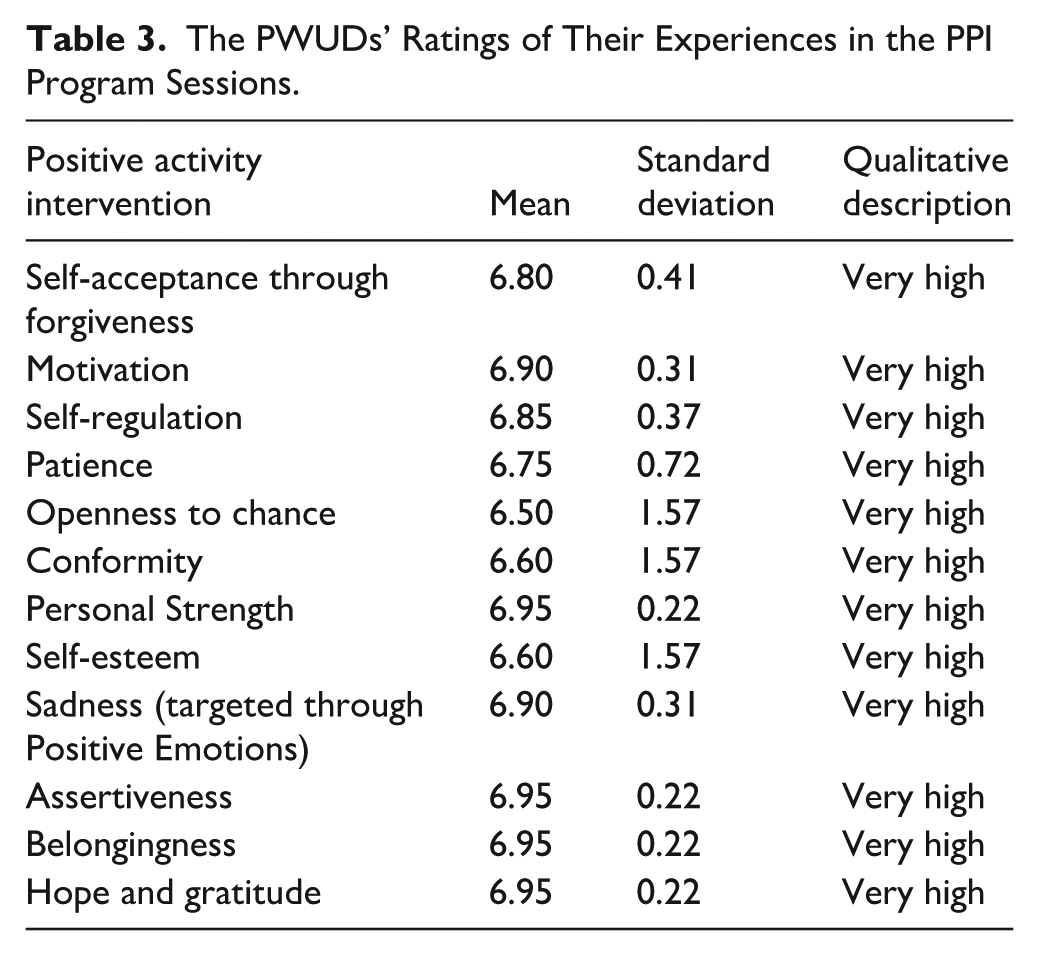
The PPI program implemented in Mega DATRC showed very high effectiveness in supporting PWUDs across a range of psychological capacities. Based on the participants’ ratings, all 13 measured constructs—including self-acceptance, motivation, self-regulation, patience, assertiveness, and hope—received “Very High” qualitative descriptions, confirming the intervention’s overall positive impact.
Qualitative data from participant reflections revealed deep personal insights, emotional healing, and behavioral changes. Participants acknowledged significant psychological transformations, including improved emotional regulation, increased motivation for sobriety, and greater self-awareness.
Key Themes From the Sessions
Self-acceptance through Forgiveness: Participants learned to forgive themselves and others, which led to emotional peace, personal growth, and deeper understanding of their life experiences.
Motivation: They explored intrinsic motivation—autonomy, mastery, and purpose—and connected these with meaningful goals such as staying drug-free and restoring trust with loved ones.
Self-regulation: PWUDs identified strategies for managing cravings and triggers, developed emotional control, and learned practical behavioral techniques for self-discipline and healthy coping.
Patience: They embraced patience as essential in recovery and reintegration, learning to slow down, persevere, and respond thoughtfully to life’s challenges.
Openness to Change: Participants gained clarity that real change must be demonstrated, not just spoken. They committed to personal transformation despite external doubts or pressures.
Conformity: The program helped them reject negative peer influences and choose healthier social relationships. They aimed to become role models rather than conforming to harmful behaviors.
Personal Strength: Participants identified and strengthened their inner resources—such as love for family, self-control, and courage—to face challenges and resist temptation.
Self-esteem: Many rebuilt their sense of worth, learning self-love and how to care for themselves physically and emotionally, recognizing that they deserve happiness and respect.
Sadness and Positive Emotions: Through creativity and cognitive strategies, they learned how to replace sadness with joy, focus on positivity, and find happiness even in solitude or hardship.
Assertiveness: They practiced refusal skills and assertive communication to resist peer pressure and avoid harmful behavior after treatment.
Belongingness: Participants reflected on their past need for belonging, developed healthier ways of connecting with others, and understood the value of community rooted in respect and support.
Hope and Gratitude: By reawakening their capacity to hope and express gratitude, they began dreaming of a better life and recognized the blessings, however small, around them.
Overall Experience and Observed Impact
Participants expressed deep appreciation for being part of the program, not just for its personal benefits but for the potential it holds to help others like them in the future. They reported improvements in decision-making, emotional resilience, interpersonal relationships, and self-perception. Many now aspire to use their learnings to guide others and prevent relapse.
Statistical data showed significant psychological development among the experimental group compared to the control group, whose scores remained largely unchanged. This suggests the PPI program’s effectiveness in improving the psychological functioning of PWUDs.
Moreover, center staff observed remarkable behavioral improvements among the experimental group participants. These residents, previously known for disciplinary issues, became rule-abiding, active, and even took on leadership roles. Their transformation, both in behavior and mindset, served as strong validation of the PPI program’s real-life impact. In general, the PPI program appears to be a highly effective tool in enhancing the psychological resilience and personal growth of PWUDs, playing a crucial role in their treatment and rehabilitation.
Discussion
Impact of PPI on PWUDs
The Positive Psychology Intervention (PPI) significantly improved the mental wellbeing, life satisfaction, and psychological functioning of Persons Who Use Drugs (PWUDs). Participants in the experimental group showed marked gains compared to the control group, particularly in mental wellbeing and psychological functioning. These improvements align with existing literature emphasizing the role of positive emotions, gratitude, and hope in recovery.15,27
Effectiveness in Drug Abuse Treatment
The PPI program addressed key psychological needs of PWUDs, including self-acceptance, motivation, and self-regulation. Forgiveness and self-worth were crucial in reducing guilt and promoting resilience.16,25 Motivation was enhanced through autonomy and purpose, consistent with motivational therapy principles.19,28
Participants also developed patience, openness to change, and assertiveness—traits essential for long-term recovery. These outcomes reflect the effectiveness of strengths-based and cognitive-behavioral approaches.29,30 Improvements in self-esteem and social relationships further supported recovery, aligning with research on social support and community reinforcement. 31 The program’s emphasis on positive emotions, creativity, and gratitude helped counteract sadness and fostered a hopeful outlook. These findings confirm that integrating positive psychology into addiction treatment can enhance psychological resilience and reduce relapse risk.
Limitation
This validation study on the Positive Psychological Intervention (PPI) for Persons Who Use Drugs (PWUDs) has several notable limitations. Firstly, the study was conducted in a single rehabilitation center, which may not reflect the diversity of experiences and conditions in other settings. The reliance on self-reported measures for assessing mental wellbeing, life satisfaction, and psychological functioning could introduce bias, as participants might respond in socially desirable ways. Furthermore, the study's design did not account for long-term follow-up, making it difficult to determine the sustainability of the observed improvements over time. There could also be potential selection bias during the randomization process due to value judgments of the center’s facilitators about the selected participants (ie, still under medical detoxification, therefore he may not be lucid enough to participate in group sessions). Given these, the generalizability or external validity of the results may be limited to treatment and rehabilitation settings only (versus other avenues likes therapeutic communities and community-based centers).
Conclusion
Considering the implications of the data gathered in this study, the developed and validated PPI program for PWUDs is practical, effective, and functionally responsive. It is therefore a viable supplemental program for drug abuse treatment and rehabilitation. The PPI fosters positive psychological competencies for the PWUDs and ushered them to further self-development and empowerment. It has also equipped them with psychologically relevant capacities to transcend healthily in their treatment and rehabilitation. Most suggestively, it has promoted PWUDs with various opportunities for personal flourishment. This would mean that including a PPI using strength-congruent and competency-based activities in drug abuse treatment and rehabilitation is an emergent and burgeoning trend in contemporary psychotherapeutic practices.
Recommendations
Based on the data gathered by this study and its significant suggestions, it is hereby recommended to implement the developed and validated PPI program as a supplemental course in the overall program of Mega Drug Abuse Treatment and Rehabilitation Center (DATRC) and other TRCs in the country for utilization and application. For this to be practical and relevant, the developed and validated PPI Program needs to be contextually supplemented, continuously monitored, and objectively evaluated when implemented. Any related program designed as supplemental to the findings of this study requires to be empirically analyzed, designed, piloted, and validated following the same level of sophistication and rigor used herein or an enhancement thereof. The various Mental Health Practitioners (psychologists, psychiatrists, psychometricians, social workers, and even nurses) working in TRC settings are suggested to be trained to facilitate the PPI program for their clients with related cases to substance use. This study can aid their practice, especially in delivering further psychological services to their clients/patients. Specifically, the developed and validated PPI program can guide them in facilitating such services and inculcating values and virtues among PWUDs essential in their overall treatment and rehabilitation.
Footnotes
Acknowledgements
The researcher extends sincere gratitude to National University, Philippines for the generous funding and institutional support that made this study possible. The researcher is also deeply thankful to the Mega Drug Abuse Treatment and Rehabilitation Center (Mega DATRC) located at Fort Magsaysay, Nueva Ecija, Philippines, for their invaluable cooperation, assistance, and openness in allowing the conduct of the intervention program within their facility. The collaboration and support of the Mega DATRC administration, staff, and resident participants were crucial in the successful implementation and completion of this research. Their commitment to rehabilitation and psychological recovery has greatly contributed to the meaningful outcomes of this study.

Ethical Considerations
This study strictly adhered to ethical standards in research involving human participants. Prior to implementation, formal approval was secured from the appropriate institutional review board. Participation in the study was entirely voluntary, and all participants provided informed consent after being fully briefed on the purpose, procedures, risks, and benefits of the research. Confidentiality and anonymity of the participants were maintained throughout the study, and data were handled with strict adherence to privacy and data protection policies. Participants were assured of their right to withdraw from the study at any point without any negative consequences. The psychological well-being of the participants was prioritized, and the intervention was delivered in a respectful and non-coercive manner. No form of deception was used, and all procedures complied with the ethical guidelines set forth by the Philippine Psychological Association, Inc. (PAP) and relevant international standards for research involving vulnerable populations such as persons undergoing drug rehabilitation.
Author Contributions
Argel B. Masanda solely conceptualized the research design, developed the Positive Psychology Intervention (PPI) program, conducted the data collection and analysis, and interpreted the findings. He also prepared the manuscript, reviewed relevant literature, and ensured the ethical conduct of the study. All aspects of the research—from proposal to implementation and final documentation—were independently carried out by the author.
Funding
The author disclosed receipt of the following financial support for the research, authorship, and/or publication of this article: This research is funded by the National University Philippines’ NU Research Faculty Program under the project entitled “Drug Abuse Treatment and Rehabilitation in the Philippines: A Positive-Forensic Psychological Approach” with the funding detail: 2021F-3T-01-NUB-CAS.
Declaration of Conflicting Interests
The author declared no potential conflicts of interest with respect to the research, authorship, and/or publication of this article.