




Abstract
Building on the premises of Positive Psychology, this undertaking conducted a pilot study of the designed 14-session Positive Psychology Intervention (PPI) program established based on the character strengths and virtues (CSV) of persons who use drugs (PWUDs) to assess its usefulness, delivery details, and impacts. Conducted in one of the biggest Drug Abuse Treatment and Rehabilitation Center in the Philippines, 24 PWUDs were randomly selected by the program staff to participate in its pilot run while securing all necessary ethical guidelines and requirements. Via within-subjects pretest-posttest experimental design, the especially adapted and developed tools were used to assess the PWUDs’ progress as they were facilitated by the said program. Results yielded significant improvements in the PWUDs’ mental wellbeing (M = 1.29, SD = 0.35; t(21) = 9.30, P < .00001), life satisfaction (M = 1.82, SD = 0.24; t(21) = 9.89, P < .00001), and psychological functioning (M = 1.65, SD = 0.19; t(21) = 8.58, P < .00001). Moreover, the PWUDs regarded the designed PPI program very highly and experienced it with positive outcomes, especially for their CSVs. Further improvement of the said program centers around proper time allotment, number of participants in the program sessions, appropriate activities per session, including specific ice breaker games, activity materials needed, and the proper sequencing of each session. These data are used to improve the PPI program structures and components. Pertinent conclusions about the gathered data were drawn, and relevant recommendations were also thereby provided.
Keywords
Introduction
The current understanding of drug abuse treatment and rehabilitation focuses on the classic pathologic model, where substance use is best understood as a “disease” that disables individuals from optimal functioning. Similarly, existing programs and frameworks for dealing with persons who use drugs (PWUDs) tend to center more on clinical and community-based approaches. Although these approaches are effective, this study, however, aimed to add more to the literature by venturing forward to positive psychological approaches and thus veering away from the classical “disease” model in handling disorders and related symptoms of drug addiction. Furthermore, using a positive psychological framework entails looking at the PWUDs’ inner characters with a more positive view that can be harnessed through guided training, thus inviting them toward a psychological good life and a flourishing sense of wellbeing.
Positive Psychology received significant advances in the past decades, and its applications are ever widening. Seligman 1 explained that “it strives to improve the quality of life and prevent mental and physical illness that can arise when life appears depleting and overwhelming (p. 17).” Positive psychology centers on individuals having qualities and characteristics that enable them to flourish in times of stress and happiness. He further argued that contemporary psychology “fulfills only half of its original vision: to cure mental illness, to make our lives more productive, and to fulfill, identify, and nurture high talent (p. 66). 1 ” Positive psychology endeavors to expand our resources to allow people to thrive despite the challenges they face in their lives. This practice area uses empirical research to ascertain factors and activities that lead to “individual wellbeing, positive outlook, and thriving communities.”
In terms of its applications to addiction treatment, scholarships are relatively practically scant, and only a handful had been published for the last 10 years specifically on drug addiction.2,3 Positive psychologists point out that “very little empirical research has explored the role of positive emotions and strengths in drug abuse prevention and treatment.” 4 It is not only true in prevention and intervention studies in general, but it is especially true in addiction studies in the early 21st century.5 -8 It posited that evidence-based positive interventions have a promising potential for further investigation among individuals with substance use disorders. Even in the recent research strides, the application of “positive psychology to the field of addiction prevention, assessment, and treatment is a relatively new endeavor.” 9 Given this scarcity of related studies in positive psychology and drug addiction, this present study aims to fill the gap in the literature.
In this context, treatment approaches using positive psychology are steadily developing globally, and it is continuously expanding the conceptual and theoretical frameworks in which addiction is treated. Positive psychology distinguishes that recovery may be best understood as a function of moving toward a “positive adaptation in life.” 1 Research in the treatment and rehabilitation of addiction using positive psychology broadens our attention from “reducing dysfunctional behaviors to creating meaningful and positive experiences that lead to a positive life” (p. 18). 1 Since the late 20’s, positive psychological science pursues to comprehend and appreciate people’s life satisfaction and happiness from all populations. Positive intervention is defined as “an intervention, therapy, or activity primarily aimed at increasing positive feelings, positive behaviors, or positive cognitions, as opposed to ameliorating pathology or fixing negative thoughts or maladaptive behavior patterns.” 8 Referred to as “positive activity interventions,” or PAIs, these are defined as “relatively brief, self-administered, and non-stigmatizing exercises that promote positive feelings, positive thoughts, and positive behaviors, rather than directly aiming to fix negative or pathological feelings, thoughts, and behaviors.” 10
Research using the framework of positive psychology aims to identify specific characteristics that may be substantial and essential among substance users that may also have a positive impact on recovery, and frequent moments of gratitude might be beneficial for lasting recovery. 11 Therapeutic modalities in positive psychology (called positive psychotherapy, or PPT) are “concerned with building personal strengths. In addiction treatment, PPT is a process of building a positive, satisfying, and reinforcing life in recovery.” 12 In the classic works of Seligman and Csikszentmihalyi, 13 they explained that “positive interventions, by definition, build pleasure, engagement, and meaning. Hence, building positive emotion, engagement, and meaning may counter the disorder itself.”
Anchored on this literature and the theory of Positive Psychology, this undertaking piloted the designed Positive Psychology Intervention (PPI) program for PWUDs, which is the output of the previous studies conducted 14 to assess its impact and effectiveness initially. This designed program is established based on the character strengths and virtues (CSV) of the PWUDs. 15 Similarly, the assessment of the designed PPI program’s effectiveness and usefulness is evaluated using a set of tools exclusively adapted and developed 16 for this study. This paper also aims to assess the protocols, activity strategies, techniques, and appropriate procedures of the designed PPI program in preparation for its larger-scale facilitation and validation to maximize its benefits to the PWUDs. Finally, it endeavors to identify potential problem areas in the designed PPI program and offer preemptive solutions accordingly.
Method
Research Design
This study utilized a Within-Subject Experimental and Pretest-Posttest Design. All participants were subjected to a series of activity sessions and were given a set of questionnaires at the beginning and end of the said treatment condition to assess the progress of the PWUDs in relation to the utility and effectiveness of the designed PPI program. 15
Participants and Locale
Twenty-four male PWUDs (out of the 40 qualified participants) from the Mega Drug Abuse Treatment and Rehabilitation Center (Mega DATRC) at Fort Magsaysay, Palayan City, Nueva Ecija, Philippines were duly selected by the program staff through researcher-coding and random selection to participate in the pilot run. They belonged to the pre-discharge phase in their treatment and rehabilitation. Of note, it was prohibited by the center’s policy and standards to mix male and female residents and have interactions with the opposite sex during their treatment and rehabilitation; thus, a pure male-only pilot participant. At the end of the pilot run, only 24 were left; mortality was primarily due to retraction of consent and the implementation of the extended COVID-19 safety protocols as some participants displayed health-related concerns.
Inclusion criteria were as follow:
a. Must have an ongoing case (violation of R.A. 9165) in plea-bargaining agreement with their respective trial courts. These are the apprehended drug users who agreed to undergo treatment and rehabilitation in exchange for being incarcerated.
b. Must have already completed the detoxification of the center.
c. Previous drug use must be either methamphetamine hydrochloride (colloquially known as “shabu” or “poor man’s cocaine), cannabis or marijuana, and the combination of the 2. These are the most commonly abused drugs in the country based on the literature review.
Instrumentation
Standardized Questionnaires
a. Warwick-Edinburg Mental Wellbeing Questionnaire. A 14-item scale with positively worded items was “developed to enable the measuring of mental wellbeing in the general population and the evaluation of projects, programs and policies which aim to improve mental wellbeing” 17 . This scale has an internal consistency of .92. 16
b. Life Satisfaction Scale. It is a short 5-item instrument “designed to measure global cognitive judgments of satisfaction with one’s life.” 18 It has an internal consistency of .87. 16
Note: Both of these questionnaires were translated in Filipino (W-EMWS, r(92) = .95, P < .01; LSS, r(92) = .82, P < .01) 16 in order to conform to the language requirement of the PWUDs.
Researcher-made Questionnaires
a. Psychological Functioning Questionnaire. It is a 35-item 7-point Likert scale categorized into 3 domains (affective: α = .87; behavioral: α = .66; cognitive: α = .89, respectively 16 ) which was specifically designed to measure the PWUDs’ overall psychological functioning.
b. Activity Evaluation Questionnaire. It is used after each activity session to assess the perceived impact of the designed program on the PWUDs. Used during the pilot study and validation stage, it consists of a simplified version of the Wong-Baker Faces Scale and open-ended questions about their learnings and suggestions for improvement of the program.
Data Gathering Procedures
The following steps were observed and followed:
a. Seeking permission and defining objectives and selection of participants. This involved pursuing a formal request letter to the Mega DATRC, thereby defining perspectives on how the study will be conducted. It also established common expectations as to the roles of the researcher in the process. This step includes selecting the participants by the Mega DATRC staff based on the set criteria previously specified and the solicitation of consent from all participants.
b. Program proper and gathering of the evidence. This involved implementing the designed PPI Program 15 program to the participants for pilot testing. It sets the stage upon which the said program can be appropriately delivered and implemented to the PWUDs. The survey methods were administered face-to-face with the researcher being present to guide the PWUDs step-by-step in accomplishing the study questionnaires.
c. Closure. The termination of the data gathering procedures to the study participants by providing necessary tokens as a gesture of appreciation.
d. Consolidation. This involved incorporating the pilot testing results in the overall design of the PPI program for improvement and validation.
Each PWUDs signed a consent form and a letter of participation as a standard ethical procedure. Similarly, the recording of the program sessions and activities was subjected to the participant’s approval.
Data Analysis
Descriptive statistics through means and standard deviations were used to describe, show, and summarize various data in a meaningful way. Further, a repeated measures t-test was used to compare significant differences in the mean scores of the PWUDs before and after the facilitation of the designed PPI program 15 .
Results and Discussion
Table 1 presents the pretest and posttest scores of the PWUDs in the 3 variables investigated, namely mental wellbeing, life satisfaction, and overall psychological functioning. As can be observed, there were notable changes in the scores of the PWUDs after they underwent the designed PPI program. Specifically, “high average” to “high” scores were observed in their mental wellbeing, while a giant leap of scores (from “average” to “very high”) in their life satisfaction was recorded, much similar to their psychological functioning—from “average” to “high.”
Summary of the Pre-and Posttest Scores of the PWUDs.
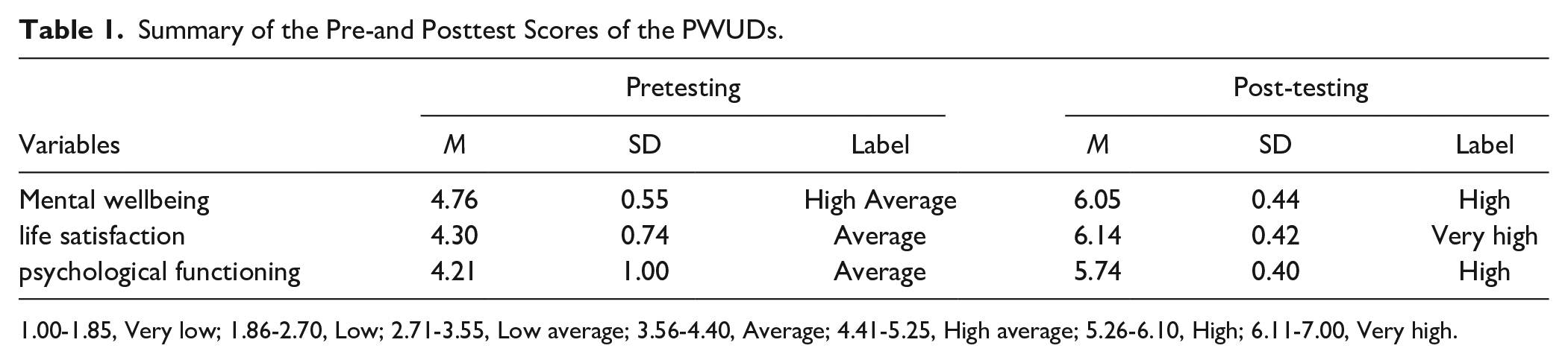
1.00-1.85, Very low; 1.86-2.70, Low; 2.71-3.55, Low average; 3.56-4.40, Average; 4.41-5.25, High average; 5.26-6.10, High; 6.11-7.00, Very high.
In view of these data and to assess if the notable changes in the mental wellbeing, life satisfaction, and psychological functioning of the PWUDs after they underwent the designed PPI program are significant, a repeated measure t-test was utilized as presented in Table 2 below.
Test of Difference Between the Pre-and Post-Tests Scores of the PWUDs.

Repeated measure T-test.
Significant at P < .05.
The figures in the Table 2 above indicated that the mental wellbeing of the PWUDs (M = 1.29, SD = 0.35) were significantly higher than their pre-test scores, t(21) = 9.30, P < .00001. Likewise, their level of life satisfaction significantly increases (M = 1.82, SD = 0.24) after the post-test t(21) = 9.89, P < .00001. Lastly, all of the psychological functioning measures in terms of the affective, behavioral, and cognitive subscale did also significantly increased (M = 1.65, SD = 0.19) after the program run t(21) = 8.58, P < .00001.
Based on these results, after the PWUDs fully experience the designed PPI program, their mental wellbeing improved significantly. For example, they seemed to become confident in themselves and developed more positive relationships. In addition, their sense of purpose and ability to live and work productively improved. Much is the same regarding their coping capacity to everyday stresses of day-to-day life and their overall ability to manage constant changes in their everyday lives. Further, it seemed evident from these scores that their overall evaluation of their feelings and attitudes about their lives had significantly improved.
Further, after the program run, it seemed that the PWUDs experienced their everyday life with considerable ease in terms of their thoughts, feelings, and overall coping with the ups and downs of their lives. Their sense of how satisfied they believe they are with their lives thus increased. This might also indicate that they do not experience severe life dissatisfaction and mental health problems.
Significant changes have also been observed regarding their overall psychological functioning. Specifically, they seemed to have developed effective strategies to manage their tensions, cravings, restlessness, sadness, fear or anxiety, anger, and worrying and became more focused on their everyday tasks. As a result, their overall mood, sense of hope and direction, and sense of importance despite their experiences of illicit drug use were all enhanced. Specific improvements in their behavioral functioning were also observed, and their capacity to perform their everyday tasks and overall ability to deal with others seemed to have gotten better. Their scores also indicated that they were better able to regulate their emotional responses and became more adept at creating better plans for themselves, thereby making them more decisive. In addition, they seemed to have become cognizant of themselves and their goals in their lives. Lastly, based on their improved scores from the pretesting, their focus, awareness, and attention to what is essential to their lives have become more evident.
Furthermore, Table 3 summarizes the results regarding the PWUDs’ perceived value and importance of each program session during the pilot run of the designed PPI program as extracted from the Activity Evaluation Questionnaire, which was given after each session. Note that sessions 1 and 14 are the pre-and post-testing of the said program.
Summary of the PWUDs’ Ratings of Their Experiences in the Program Sessions.
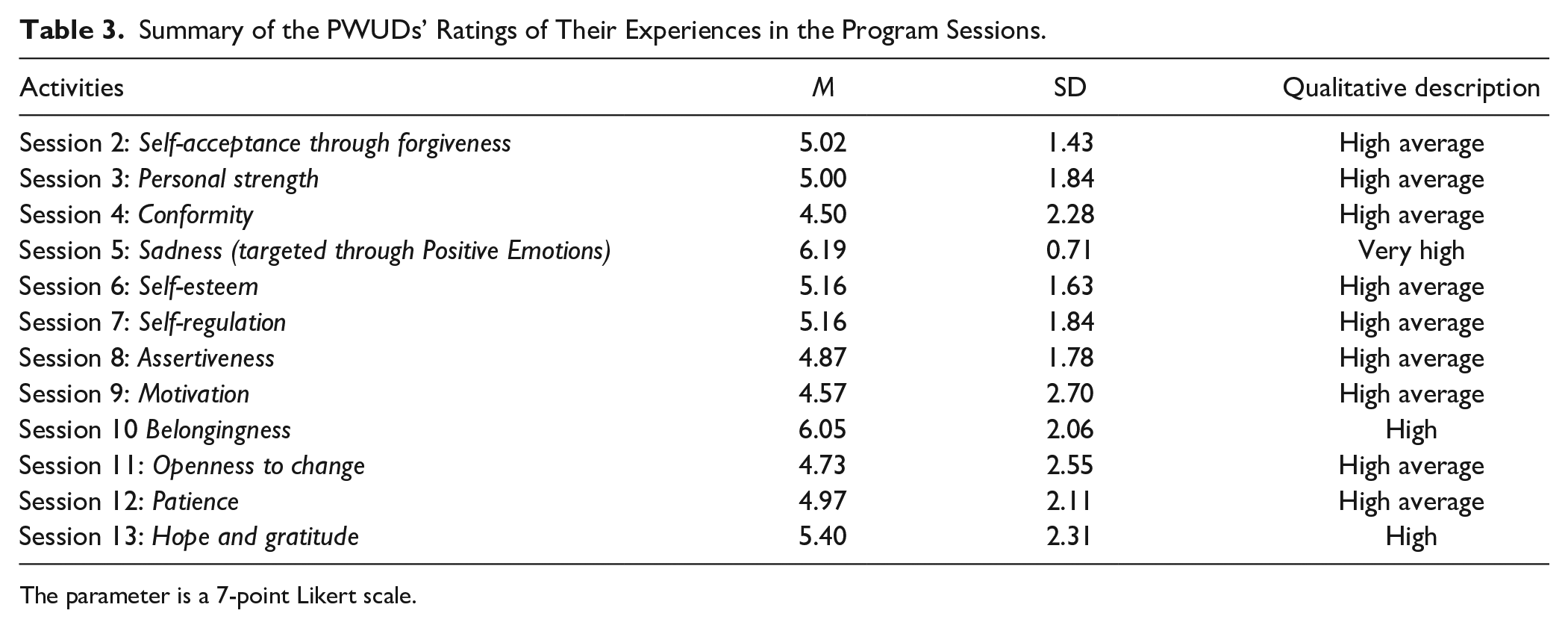
The parameter is a 7-point Likert scale.
Based on these data, the PWUDs regarded the program sessions as valuable to their drug abuse treatment and rehabilitation efforts, with scores ranging from “high average” to “very high.” These quantitative data and their implications are supported by their personal accounts based on their experiences in facilitating the designed PPI program.
In addition to these first-hand accounts of the PWUDs about their learnings from each program session, their recommendation, together with the recorded observations of the researcher-facilitator while delivering the designed PPI program, were documented in the appendix 1. These mixed topics were translated into group sessions based on the initial study phase conducted by the researcher and his colleagues 15 about the needs of PWUDs using a positive psychological framework.
Taken all together after the pilot run, the study was further informed of how it should be facilitated and delivered among its intended recipients considering their backgrounds, the center’s policies, regulations, and physical plant and facilities. Both the researcher-facilitator and the PWUDs assessed each activity session and offered observations and suggestions for its betterment and improvement. Significant findings revolved around proper time allotment (each session must be facilitated at least 1 h and 30 min up to 2 h and 30 min), the number of participants in the program sessions (only 40 male participants are suggested to comply with the center’s regulations and the size of the session rooms to be used), appropriate activities per session including specific ice breaker games, activity materials needed, and the proper sequencing of each session for a seamless facilitation flow.
The overall implications of these rich data indicated that the designed PPI program significantly impacted the PWUDs’ mental wellbeing, life satisfaction, and overall psychological functioning. It meant a significant difference between their self-confidence 19 and ability to build meaningful relationships 20 with their co-residents in the center before and after they underwent the entire program. The same is true with their sense of purpose 21 and ability to work productively, 1 ability to handle changes and stresses, and the way they look and value their lives before and after the said intervention. Furthermore, these scores also indicated that their self and emotion regulation 22 and related skills had improved significantly, especially those drug-related cravings that are the most troubling for them as one of the debilitating effects23,24 of their illicit drug use.
Finally, throughout the pilot run, the PWUDs highly regarded each session of the designed program conducted for them. It might further mean that they have considered the program helpful to their overall treatment and rehabilitation experiences. Therefore, based on these results, the designed PPI program for PWUDs can be considered responsive to their needs to fight against the effects of illicit drug use as they experienced during its various sessions activities.
Conclusion
In the context of the data gathered and its significant implications, the following are hereby concluded:
Based on the pilot run conducted, the designed Positive Psychology Intervention (PPI) program is a proactive and effective approach to drug abuse treatment and rehabilitation of persons who use drugs (PWUDs).
In devising and delivering a PPI program for PWUDs, premium considerations on its utility should be focused on the aptness of the materials to be used, its accuracy based on the proper sequencing of each session and activity, its feasibility on time allotment, and a fair number of participants per program run; and finally, its propriety based on the appropriateness of the activities in each session of the entire program.
Positive Psychology, both theoretically and conceptually, is a viable framework and a highly practical orientation in the drug abuse treatment and rehabilitation of PWUDs.
Using a strength-based framework instead of the traditional disease laden model, helps PWUDs live functional and well-adjusted lives instead of stopping them from completely using illicit substances abruptly. As drawn from the data, even a subtle bolstering of our basic humanities (eg, self-forgiveness, self-regulation, motivation, and hope) can lead to a more purposeful striving and the need to use illicit drugs to cope with life can be reduced.
Recommendations
In light of the implications of the results of the study, the following recommendations are hereby made:
To further assess the feasibility, accuracy, and propriety of the designed PPI program, conduct and facilitate it to other PWUDs from other settings like community-based centers and private shelters.
Since it was conducted exclusively with male participants due to policy-based restrictions, facilitating it with exclusively or mixed female participants is highly recommended to balance any possible sex- and gender-related bias. It is also to assess further the roles that sex and gender factors play in program development and evaluation in the context of drug addiction.
Validate the designed PPI program using a between-subject experimental research design among PWUDs in a drug abuse treatment and rehabilitation center setting to formally established its usability and effectiveness.
Supplemental Material
sj-docx-1-jpc-10.1177_21501319241271909 – Supplemental material for Positive Psychology Intervention (PPI) Program for Persons Who Use Drugs (PWUDS): A Pilot Study
Supplemental material, sj-docx-1-jpc-10.1177_21501319241271909 for Positive Psychology Intervention (PPI) Program for Persons Who Use Drugs (PWUDS): A Pilot Study by Argel B. Masanda in Journal of Primary Care & Community Health
Footnotes
Declaration of Conflicting Interests
The author declared no potential conflicts of interest with respect to the research, authorship, and/or publication of this article.
Funding
The author disclosed receipt of the following financial support for the research, authorship, and/or publication of this article: This research is funded by the National University, Philippines’ NU Research Faculty Program under the project entitled “Drug Abuse Treatment and Rehabilitation in the Philippines: A Positive-Forensic Psychological Approach.”

Supplemental Material
Supplemental material for this article is available online.
References
Supplementary Material
Please find the following supplemental material available below.
For Open Access articles published under a Creative Commons License, all supplemental material carries the same license as the article it is associated with.
For non-Open Access articles published, all supplemental material carries a non-exclusive license, and permission requests for re-use of supplemental material or any part of supplemental material shall be sent directly to the copyright owner as specified in the copyright notice associated with the article.
