




Abstract
As recognition grows around the need for equitable, person-centered engagement for people living with neurocognitive disorders or dementia, accessible community programs that challenge stigma and foster inclusion remain limited. This program presents a 12-week ukulele learning program co-led by a person living with dementia that advances health equity by promoting inclusion, empowerment, and social connection through music. Developed through a university-community partnership, the program was intentionally designed to welcome participants from diverse cultural backgrounds and cognitive abilities into an accessible and supportive environment. Unlike conventional music-based interventions, the initiative emphasized active skill development, co-leadership, and intergenerational collaboration. Qualitative reflections from the program leads and team members identified 4 key themes: (1) confronting stigma and reimagining capacity; (2) fostering social inclusion and connectedness; (3) creating shared joy and respite for care partners; and (4) encouraging mutual learning and support. Participants emphasized the program as transformative in advancing health equity by challenging dominant deficit-based narratives, affirming the strengths of individuals often marginalized in traditional care settings. This initiative offers a scalable model for an inclusive, community-driven approach to enhance quality of life, strengthen relationships among people living with dementia and their care partners, and promote equitable health outcomes for people living with dementia.
Keywords
Introduction and Background
Over 700 000 people are currently impacted by neurocognitive disorder or dementia in Canada. 1 About 61% of them are living in the community. 2 Neurocognitive disorder or dementia is an umbrella term for “an individual’s memory, thinking, or reasoning changes.” The decline in mental ability impacts the person’s daily life. 3 The diagnosis of dementia is associated with stigmatizing narratives such as “loss” 4 of identity and personhood, “being lost,” 5 and “broken self” 6 that reinforce fear, exclusion, and discrimination. These experiences are shaped by cognitive changes and broader societal and structural barriers, such as ageism and a lack of inclusive programming. 7 One focus of the National Dementia Strategy of Canada is to eliminate the stigma toward dementia, build a dementia-inclusive community and optimize the well-being of people living with dementia. 8 One suggestion is engaging people living with dementia in “meaningful activities.” Yet, what is meaningful to people living with dementia in the community? Some of them shared that “meaningful” activities are “not static”; they evolve and include trying new things, embracing challenges, and feeling valued. 9 Engaging in an activity can also inspire and encourage individuals with dementia to engage in another.
These activities’ level of challenges and difficulties should be regularly monitored and adjusted based on each individual’s strengths, needs, progress, and tolerance. 10 Being adaptive increases these activities’ potential to engage people with diverse stages of dementia, including individuals with later stage of dementia and who cannot verbally express themselves.
Music can be a powerful tool for engaging people at various stages of dementia, as it does not rely on their ability to communicate verbally. One study highlights music’s role in “giving people with dementia a voice and feel equal to all others,” noting its potential for “learning and communication with others through music.” 5 Learning through music is seen as a “mutual and reciprocal process” that involves the person with dementia, the care partner, and the music instructor. Each participant contributes to and benefits from the process, helping create a respectful environment where all can grow and develop at their own pace.
While a variety of music-based programs exist for people living with dementia, such as The Music Project by the Alzheimer Society of Canada 11 and the Dementia Action Alliance’s initiatives (Music Memory Care, Giving Voice, Music & Memory, Music Mends Minds, and Music Therapy at Home), 12 these programs predominantly focus on interactive enjoyment, therapeutic listening, and social engagement. They emphasize activities such as group sing-alongs, movement exercises, and personalized music playlists designed to alleviate symptoms like anxiety and depression. While these approaches have demonstrated significant benefits in enhancing mood and fostering connection, they generally do not incorporate an active learning component where participants acquire new instrumental skills.
Emerging research suggests that engaging in active learning, such as learning to play a musical instrument, offers additional cognitive benefits for persons living with dementia.13 -15 Instrumental learning stimulates neural plasticity, enhances fine motor coordination, and promotes sustained cognitive engagement through creative problem-solving.16,17 By integrating structured musical instruction into dementia care, there is potential to enrich traditional music interventions with opportunities for skill development, thereby addressing a critical gap in current approaches.
The Unique Model of Our Ukulele Program
This commentary presents a ukulele learning program—a co-created, community-university initiative that reimagines engagement in dementia care by centering active learning and co-leadership. The Ukulele Program was born from a vision of transforming how people living with dementia and their care partners engage with music, shifting from passive enjoyment to active learning, recognizing that people living with dementia are capable of learning, contributing, and thriving when provided with opportunities for active engagement. The ukulele was chosen as an accessible and versatile instrument. People living with dementia and their care partners engaged in musical exploration together, where learning became a shared journey rather than a 1-sided activity.
Uniquely, the program embraced a co-leadership model (Figure 1) between an undergraduate student and a person living with early-stage dementia with mild cognitive decline. Rather than positioning people living with dementia solely as recipients of care, the co-lead living with dementia was instrumental in guiding the program’s development and delivery. He took an active role to guide and mentor rather than being a passive participant. He informed the program from planning through to implementation with his lived experiences. To support this collaboration, weekly debrief meetings were held throughout all phases of the program, from early planning to post-program reflection, to facilitate shared decision-making and ensure sustained engagement. A preferred communication format (email) was mutually established, enabling clarity and comfort in idea exchange. These regular check-ins created a space for reciprocal mentorship, transparency, and flexibility, allowing the co-lead to shape the direction of the program at his own pace. This role reversal redefines traditional roles in community-based programs and challenges conventional hierarchies, empowering these individuals to lead and influence program outcomes. The leadership structure was intentionally designed to monitor and mitigate any potential burden by ensuring that the co-lead’s involvement remained empowering rather than overwhelming, with adjustments made based on his comfort and availability. This model advances health equity by challenging normative care structures, affirming capacity, and promoting inclusive, strength-based programming. This collaborative approach ensured that the program reflected the perspectives and needs of people living with dementia and empowered them to shape a learning experience.

Co-leadership model of the program.
This initiative embodies an interdisciplinary community-university partnership that unites a nursing professor, an engineering undergraduate student and graduate students from nursing and social work with community members, including the people with lived experiences of dementia, a ukulele instructor, and a local community center’s leadership staff. The diverse perspectives and expertise enrich every aspect of the program. Through this model, students and community partners work side-by-side, fostering an environment where academic inquiry meets real-world application.
Program Design and Implementation
The program was a 12-week in-person ukulele class tailored for people living with dementia, older adults, and their care partners. Hosted at a local community center in Vancouver, Canada, the class convenes for 1 h each week over the 12-week period, bringing together a diverse group of 18 participants: predominantly older adults with varying stages of dementia alongside a few care partners. The curriculum is designed with an emphasis on enjoyment rather than technical mastery. Participants are gently introduced to the ukulele, where the focus is on experiencing the joy of music, fostering creative expression, and engaging in cognitive stimulation through rhythmic and melodic exercises. This relaxed yet structured approach encourages skill development at a comfortable pace and leverages music’s therapeutic potential, alleviating stress and enhancing overall well-being by creating a low-barrier environment where learning and play coexist. 18 The program did not require participants to have prior musical experience or assess their attention span, motor coordination, or motivational readiness. Instead, inclusivity was prioritized, welcoming individuals at various stages of dementia. Those with more advanced dementia attended with their care partners, who offered personalized support during sessions. The intention was to create an accessible space where anyone could participate, regardless of previous ability or experience. Notably, all invited participants chose to attend, and no one withdrew or declined participation over the course of the program.
To enhance cultural relevance and promote engagement, a brief survey was administered at intake to gather information about participants’ cultural backgrounds, age groups, and musical preferences. This allowed the instructor to tailor the curriculum and song selection to reflect the group’s diverse interests. Language was not a major barrier, and volunteer interpreters were available to assist where needed. The program was offered free of charge, and the local community center venue was selected for its accessibility, minimizing cost, and transportation challenges for participants.
The program employs an inclusive engagement model that creates ample opportunities for collective learning and meaningful social connection. By involving family members and care partners in the sessions, the initiative offers a shared space for interaction, support, respite, and reinforces community bonds, enabling participants to exchange experiences, and provide mutual encouragement. Such a model not only enriches the learning experience but also transforms the class into a space with social and emotional support, contributing to the overall health and vitality of the group.
Reflection and Insights
The undergraduate student lead, the co-lead, and the graduate student communicated regularly with the staff in the community center and the ukulele instructor to address students’ needs and potential class adjustments throughout the 12 weeks. The team also had conversations with students at the last class and received some valuable feedback from students regarding the ukulele program. The core team, including the undergraduate student lead, the co-lead living with dementia, a graduate student, and a nursing researcher reflected on the potential of this ukulele learning program for people living with dementia in the community based on the team’s experiences in coordination, observations, and feedback collected throughout and at the end of the 12 weeks. The team identified the following themes.
Confronting Stigma and Reimagining Capacity
The Ukulele Program challenged common misconceptions surrounding dementia by demonstrating that people living with dementia can actively engage in meaningful learning experiences. Traditional programs for people living with dementia often emphasize passive activities, such as listening to music or participating in sing-alongs, which can reinforce stereotypes of dependence. In contrast, this program promoted active learning through a structured ukulele curriculum, where participants not only listened but also learned to play an instrument. The program emphasized skill acquisition, creative expression, and cognitive stimulation, challenging the misconception that people living with dementia cannot learn or take on new challenges. 7
Moreover, the program adopted a unique co-leadership model, with a patient partner with dementia playing a central role in designing and guiding the program. This participatory approach empowered people living with dementia to contribute their insights and experience, transforming them from passive recipients to active leaders. It underscored that people living with dementia are not only capable of learning but also teaching, inspiring, and mentoring others. By redefining their role from learners to co-leaders, the program challenged traditional, deficit-based models, and affirmed the value of reciprocal learning and co-production. This shift supports a broader vision of health equity–one that affirms the agency, strengths, and social inclusion of people often marginalized in conventional care settings.
Fostering Social Inclusion and Connectedness
Our program created a space where individuals from diverse cultural backgrounds and varying stages of dementia could come together, connect, and learn in an inclusive environment. Unlike many traditional dementia programs, which often group participants based on cognitive abilities, this initiative intentionally embraced diversity, allowing individuals with different experiences and skills to learn side by side. Participants were not only encouraged to play the ukulele but also to sing along, share stories, and interact with each other, creating a sense of community (Figure 2).
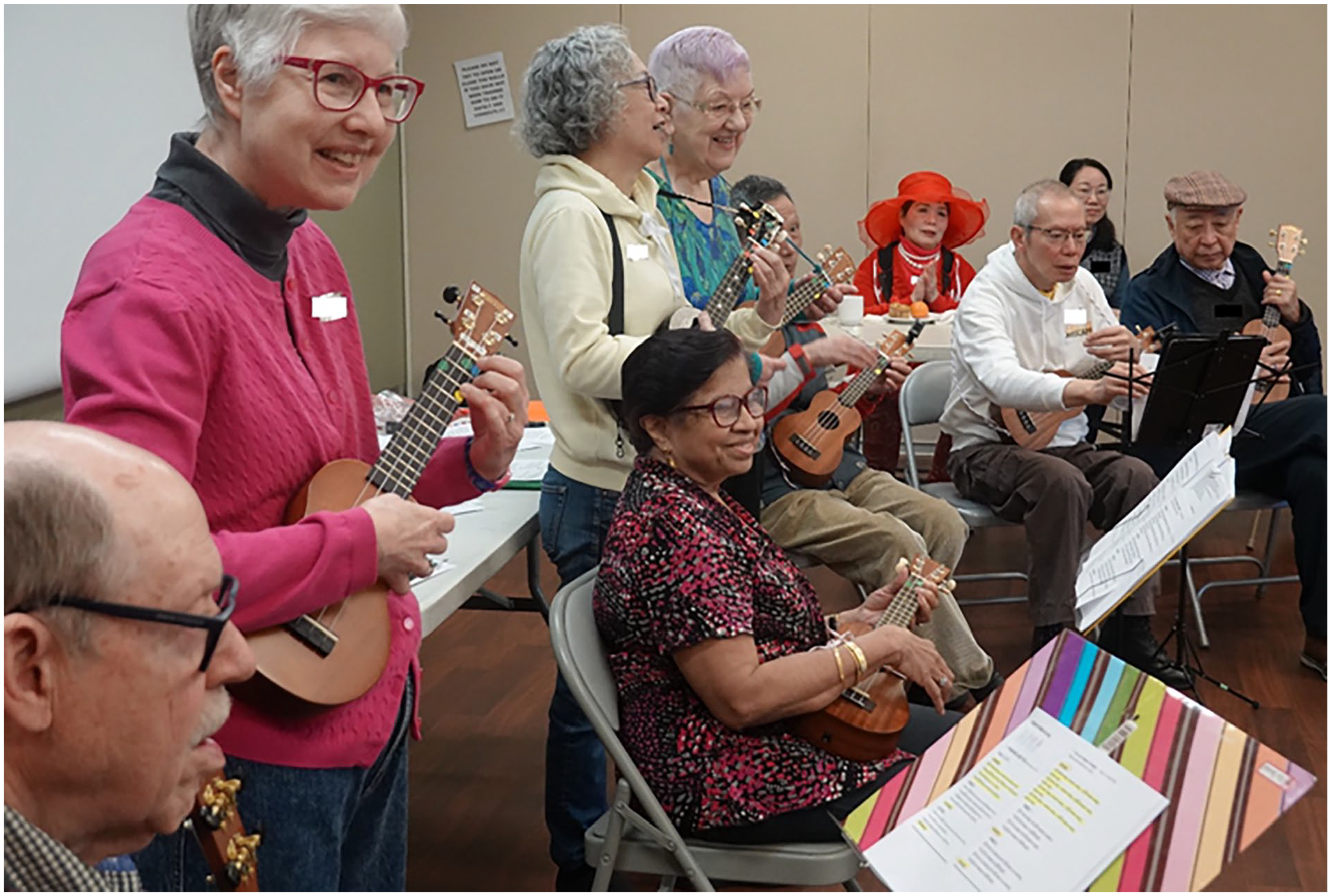
Students’ Ukulele learning session.
Participants’ feedback highlighted the program’s ability to bring people together. A team member recalled 1 senior describing the program as an “exceptional experience” adding that it provided an opportunity to “mingle with others and practice skills at the same time.” Another participant shared that even those who struggled with chords could still contribute by singing along, creating an environment where “everyone had a way to participate” and contribute in their own way. For many, it was their first experience with the ukulele, but they quickly found joy in learning together, regardless of skill level. The team observed that the class became a space of laughter, shared memories, and new friendships, where participants felt seen, valued, and connected. These experiences counteract the isolation and stigma often associated with dementia, advancing a more inclusive and equitable model of engagement for people living with dementia.
Creating Shared Joy and Respite for Care Partners
The Ukulele Program was not only a source of joy and connection for individuals living with dementia but also a valuable opportunity for care partners to experience relief, engagement, and mutual support. In many cases, care partners initially joined the program to support their loved ones, yet they soon found themselves actively participating and enjoying the experience as well. The program offered them a chance to step away from their caregiving roles and reconnect with their partners in a positive, relaxed setting (Figure 3).

Care partners and people living with dementia participating and enjoying the class.
One care partner shared to the graduate student that they originally participated “for my partner so she can get out and socialize,” but soon found that they enjoyed the sessions just as much. The undergraduate program lead mentioned the day for the ukulele class was described as a care partner’s “happy Tuesday,” a time for him to learn a new instrument, socialize, and share in his partner’s joy. The sessions allowed care partners to interact with others facing similar challenges, creating a network of mutual understanding and support. This shared experience alleviated stress and strengthened the emotional bond between partners, transforming the ukulele class into a sanctuary of connection and care.
Encouraging Mutual Learning and Support
The Ukulele Program created a welcoming space where participants, care partners, students, and the leadership team supported and learned from each other. Co-led by a person living with dementia, the program was shaped by the voices of those it was meant to serve. For the undergraduate student leading the program, it was a valuable learning experience, from building community partnerships to working with the ukulele instructor to design the sessions. Each challenge brought new insights and skills.
During the classes, the team observed people of all ages and cognitive abilities practicing together, offering tips, and cheering one another on. Care partners supported their loved ones and contributed to the friendly, team-like atmosphere. The instructor played a vital role in adapting the learning environment. She shared with the core team that instead of “pushing the students to learn new things every week,” she preferred to “go with the flow of where they are at.” This flexible and patient teaching approach allowed everyone to feel supported, regardless of experience or ability.
Implications
The reflection of our Ukulele Program contributes to the current limited evidence on the possibilities of co-led music learning programs for people living with dementia. It offers important insights into how participatory, strengths-based approaches can advance health equity, challenge stigma, and foster well-being through inclusive engagement.
The program demonstrates how a co-developed ukulele learning program for people living with dementia can support health equity for both individuals with dementia and their care partners to “attain their full potential in health and well-being” through social participation, 19 music enjoyment, and skill building. The program embraces students’ different capacities, challenging the stigma and stereotypes about people living with dementia, and pushing boundaries of what meaningful and inclusive learning activities can be for them. It creates an inclusive space for these individuals to engage with each other through a common language—music.
The classes also inspire a new approach to respite programs with people living with dementia and the care partners in the same physical space. By concentrating on learning and the joy of playing music, the care partners can experience a mental break while sharing the joy, gaining support from other people on a similar caregiving journey, and expanding their social networks.
With the positive impact of the music-learning program, our team advocates more of these innovative and diverse opportunities that community organizations can consider for people living with dementia and their care partners. Leadership teams in community organizations need to reflect on their assumptions, biases, and positionality and be open to program development.
Sharing lessons learnt and experiences from these innovative programs can create a ripple effect in the community locally, nationally, and internationally for program adaptation in diverse settings. For example, the involvement of a person with lived experiences as a co-lead in developing the community program can be adapted in similar programs to help ensure the relevance and meaningfulness of the program activities and the ethical practices of class delivery. Moreover, the inclusiveness of how these skill-based classes can engage people with different types and stages of dementia can also be a reference. Various program teams can share their experience on other non-traditional skill-based activities beyond music learning programs, expanding the knowledge and evidence to further support a dementia-inclusive community, and improve the overall health of the population living with dementia.
Storytelling about the positive impact can show the value of initiatives to leadership teams and policymakers in the community and encourage the consideration of whether these initiatives can be sustained or scaled up with funding allocations. Our ukulele program started with a small university-community partnership fund and was sustained by volunteer effort and support from community organizations. People can adapt a similar model by applying for community grants and partnering with community organizations for spaces to kickstart these small programs. Another possibility is to incorporate these grassroots community programs as part of university or high school students’ experiential learning, which can benefit students, participants, and the community organizations.
Our program is limited to a local urban community in Vancouver, Canada. Further adjustments will be needed when adapting the co-leadership model and these skill-based programs to other communities with contextual differences. For example, transportation to attend classes in community centers can be challenging for older adults in rural communities. As our program did not involve a structured evaluation, researchers may conduct an empirical study to evaluate participants’ satisfaction and engagement scores. Researchers can also investigate the short-term and long-term impact of these skill-based programs on people living with dementia and their care partners, such as mood, quality of life, loneliness levels, and pre- and post-caregiver burden levels. Additionally, researchers can explore the impact of these initiatives on care partners’ respite, moving beyond traditional models and promoting shared experiences, empowerment, and community building. Further investigation into the facilitators and barriers to the design and implementation of these skill-based programs can enhance adoption, sustainability, and equitable access.
Conclusion
The Ukulele Program demonstrates how co-led, community-based programs can challenge stigma, foster inclusion, and promote health equity for people living with dementia and their care partners. As communities seek innovative models of dementia care, our Ukulele Program offers a scalable example of how music can create joy, empower individuals, and strengthen community ties.
Footnotes
Acknowledgements
We want to acknowledge the valuable contribution of the participants from the Dementia Friends Café, the Burnaby Neighborhood House, and their instructor Jane.

Consent to Participate
Informed consent on images for publication were provided by the program participants.
Funding
The author(s) disclosed receipt of the following financial support for the research, authorship, and/or publication of this article: The operation of the program is supported by the UBC Equity and Inclusion Office. The authors received no financial support for the authorship and publication of this article.
Declaration of Conflicting Interests
The author(s) declared no potential conflicts of interest with respect to the research, authorship, and/or publication of this article.
Data Availability Statement
Not applicable.