



Abstract
Introduction:
While childrearing can enhance mothers’ psychological well-being, parenting can also increase mental stress for mothers with young children, which is considered a risk factor for child maltreatment. A lack of social capital reportedly influences mothers’ parenting, but few studies have investigated the effects of social capital on the perception of mental stress and well-being associated with childrearing among mothers with young children. Therefore, we investigated the effects of lower perceived neighborhood trust and support on higher mental stress and/or lower well-being associated with childrearing among Japanese mothers with children aged 2 to 3 years.
Methods:
A total of 570 mothers with children (aged 2-3 years) in nursery school were invited to join the survey. The childrearing perspective scale for mothers (CPS-M97) was used to evaluate mothers’ perceptions of mental stress and well-being associated with childrearing. Odds ratios (ORs) reflecting lower satisfaction/fulfillment scores (ie, well-being) and/or higher burdened/anxious scores (ie, mental stress) associated with perceived social capital levels were analyzed, after adjusting for confounding factors.
Results:
The OR for lower satisfaction/fulfillment scores was significantly higher (OR = 1.77) for mothers with lower neighborhood trust. Significantly increased ORs for higher burdened/anxious scores were found in mothers with lower neighborhood trust (OR = 1.50) and support (OR = 1.49). The ORs for poor mental status, with lower satisfaction/fulfillment scores and higher burdened/anxious scores, were significantly increased in mothers with lower neighborhood trust (OR = 1.96) and lower neighborhood support (OR = 2.10).
Conclusions:
Higher social capital was associated with higher psychological well-being and/or lower mental stress in Japanese childrearing mothers. These results suggest that enhancing social capital is necessary to facilitate successful parenting that contributes to the prevention of child maltreatment.
Introduction
Parenting is a considerable challenge associated with childrearing and is known to increase the mental stress of parents, particularly mothers. 1 High levels of parenting stress have been reported as a risk factor associated with child maltreatment.1 -3 Personal factors that increase parenting stress reportedly include child caretaking difficulties, larger numbers of children in a family, low family income, and physical stress.4 -7 Social support is one of the most effective protective factors for improving mothers’ mental health, which, indirectly, can help prevent child maltreatment.8,9
Neighborhood social cohesion, indicated by social trust and bonds among neighbors, is believed to play a positive role in helping parents cope with parenting stress and providing a source of social support. 9 In Japan, Cabinet Office, Government of Japan 10 reported increased area-specific differences in levels of social capital including social trust and bonds in neighborhood and other environment such as relatives and friends, with lower social capital in large-scale prefectures such as the Metropolis of Tokyo and higher social capital in smaller prefectures such as Shimane prefecture.
Fujiwara et al 11 reported a significantly lower odds ratio (OR) for infant physical abuse associated with perceived neighborhood trust among mothers of 4-month-old infants living in a city near Tokyo. Their findings suggest that higher social trust may help prevent infant maltreatment. In a national-wide birth cohort study to clarify the effects of environmental factors on infant and child development (the Japan Environment and Children’s Study, or JECS), Matsumura et al 12 showed that a lack of social support and trust among the participating mothers significantly influenced maternal mental health; the largest adverse effects were observed when their children reached 2.5 years old. This study further indicates the importance of supporting mothers with young children aged 2 to 3 years.
Importantly, parenting can also enhance psychological well-being for parents who perceive meaning, significance, and purpose in being a parent. 13 Social support is generally perceived as well-intentioned actions that produce a positive response, which has been reported as having more significance for mothers. 14 Furthermore, social support can reduce the pressures of child-rearing and is positively associated with happiness of mothers, 13 which suggests that lower social support may increase parenting stress.
Therefore, we aimed to investigate the effects of perceived neighborhood trust and support on positive and negative aspects of parenting stress, lower well-being, and higher mental stress among Japanese mothers with young children living in prefectures with varying levels of social capital.
Materials and Methods
Study Area and Participants
Based on the national survey results on social capital by prefecture in Japan, 10 the following residential areas were chosen for the study sites: 1 city in Shimane prefecture with the highest level of social capital, 1 town in Ishikawa prefecture with middle level, and 4 neighboring wards in the center of Tokyo (23 wards) with the lowest level. Because, we intended to enroll mothers with wide range of perceived social capital. Then, we recruited mothers from 11 to 13 nursing schools or kindergartens in each study site to participate in our survey to investigate associations between their levels of parenting stress and perceptions of trust and support in their neighborhood.
Mothers with children aged 2 to 3 years were invited, via their children’s school teachers, to join the survey. A total of 570 mothers agreed to participate in the survey, whose characteristics were shown in Table 1.
Characteristics and Social Capital of Mothers (N = 570).

Abbreviation: N: number of subjects.
Mean and Standard Deviation were shown in the table.
This study was approved by ethics committee of Ishikawa Prefectural Nursing University in Japan (ID1069). Verbal informed consent was obtained from all participants. At that time, completion of the questionnaire was accepted by the committee as evidence of consent to participate.
Measurements
This study used a cross-sectional design to investigate associations between mental stress and well-being associated with childrearing (outcome) and social capital index (relevant factors) among mothers with young children. All information was collected from self-administered questionnaires, which were distributed to mothers at their children’s school and returned to the researchers by participants via post after filling in all the questions.
The following participant characteristics were collected using a self-administered structured questionnaire: age (years), job (1: paid job, 2: housewife), education (1: high school or lower, 2: university or higher), self-reported health status (1: good or no problems, 2: poor or not well), economic condition (1: good or no problems, 2: difficult or hard), and the number of children and their age. Furthermore, they were asked whether they joined activities planned for their and other children as a supporter, or planned those activities for themselves and other mothers, or planned community-based activities for all residents.
Perceived social capital was evaluated using 2 aspects: neighborhood trust and neighborhood support. These variables were assessed using a 5-point Likert scale for responses to the following 2 questions, respectively; “Do you think that your neighbors trust one another?” and “Do you think that your neighbors help one another?” The answers, “Neither,” “Somewhat disagree,” and “No,” including negative elements were categorized as lower trust and support because of lower rates of answers “Somewhat disagree” and “No.” (9.3%-14.4% for neighborhood trust).
To measure parenting stress and well-being levels associated with childrearing (outcome), we used the Childrearing Perspective Scale for mothers with children aged 3 years or younger (CPS-M97), developed by Naitoh et al 15 and Naitoh 16 It evaluates mothers’ positive and negative perceptions of childrearing. The positive physiological scale comprised 6 questions to measure the levels of satisfaction with and fulfillment in childrearing (well-being) using a 5-point scale. Another 6 questions measured the levels of perceived burden and anxiety associated with childrearing, also using the same 5-point scale. Finally, total scores for the satisfaction/fulfillment and burdened/anxiety subscales were calculated by summing the scores for each set of their associated 6 questions.
Statistical Analysis
Binary logistic analysis was performed to analyze the ORs for lower satisfaction/fulfillment scores and/or higher burdened/anxious scores associated with lower neighborhood trust and support, after adjusting for confounding factors included all in a model. Confounding factors were age, job, education levels, health status, economic condition, having another child under the age of 2 years, and social capital levels of their living prefectures (1: Tokyo, 2: Ishikawa, 3: Shimane) in the national survey in 2003 10 Because, younger age and poor health status were significantly associated with both of lower satisfaction/fulfillment and higher burdened/anxiety scores. Significant associations were also found between difficult economic condition and lower satisfaction/fulfillment scores and between job status (housewife) and higher education (university degree) and higher burdened/anxiety scores. No significant associations were found, however, between “another child under age 2” and prefectural social capital levels and any parenting stress scale scores.
All analysis was conducted using SPSS software (Ver. 24).
Results
Characteristics of the participants are shown in Table 1. Of the 570 mothers, 68.8% were in their 30s; 14.4% were housewives; 37.7% had a university degree or higher; 8.2% and 21.8%, respectively, reported that they were in poor health and that their economic condition was difficult or hard. The mean number of children was 2.1, and 203 mothers (35.6%) also had children under 2 years old. The distribution of participants living in Tokyo, Ishikawa, and Shimane were similar. The activity most frequently engaged in by participants was social activities for their and other children.
We divided participants into lower and higher score groups, with 25 points as the cut-off value (the 25th percentile value of total satisfaction/fulfillment score); the OR, with 95% confidence interval (CI), for lower satisfaction/fulfillment was 1.77 (1.15 2.71), which was significantly positively correlated with lower neighborhood trust (P = .009; see Table 2). Only a nonsignificant association, however, was found between satisfaction/fulfillment and neighborhood support (P = .063).
Odds Ratios for Lower Satisfaction/Fulfillment Scale Scores Associated With Lower Neighborhood Trust and Support.

Abbreviations: CI: confident interval; N: number of subjects; OR: odds ratio.
For each satisfaction/fulfillment subscale, associations between lower scores (ie, ≤3 points) and lower neighborhood trust and support were analyzed (see Table 2). Significant positive associations were observed between lower neighborhood trust and lower scores on subscale 3 (P = .026) and subscale 5 (P = .003); their respective ORs were 1.54 (1.05, 2.27) and 1.77 (1.22, 2.58). For subscale 5, the OR for the lower score was 1.54 (1.06, 2.25), which was significantly associated with lower support (P = .024).
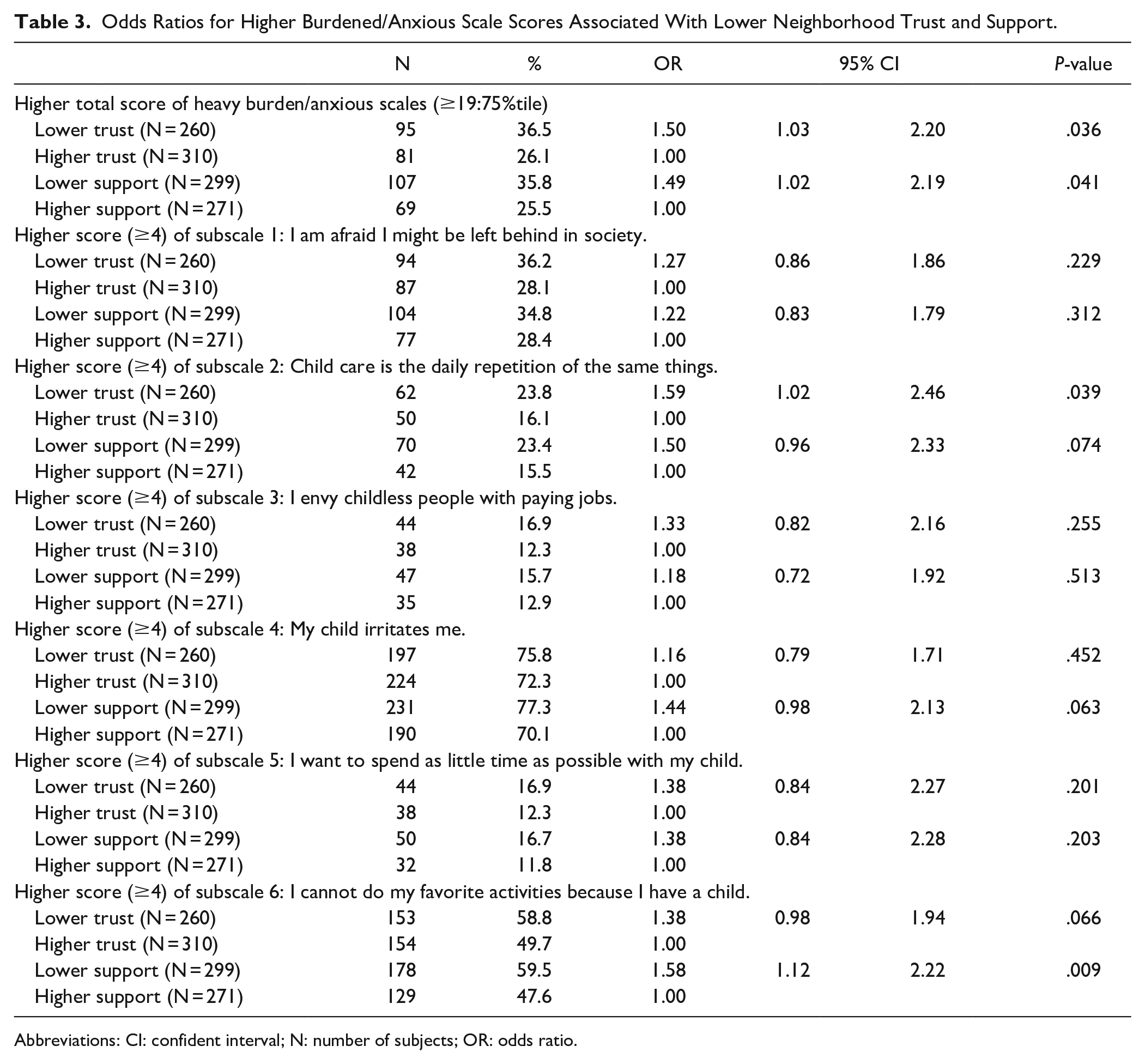
Similarly, we divided participants into higher and lower total burdened/anxious score groups, with 19 points as the cut-off value (75th percentile), and investigated associations between total burdened/anxious scores and neighborhood trust and support. Results showed that higher total burdened/anxious scores were significantly positively correlated with lower neighborhood trust (P = .036) and support (P = .041, with ORs of 1.50 (1.03, 2.20) and 1.49 (1.02, 2.19), respectively (see Table 3).
Odds Ratios for Higher Burdened/Anxious Scale Scores Associated With Lower Neighborhood Trust and Support.
Abbreviations: CI: confident interval; N: number of subjects; OR: odds ratio.
For each burdened/anxious subscale, we analyzed the ORs for higher scores (≥4 points) associated with neighborhood trust and support; the results are shown in Table 3.
Higher scores for subscale 2 were significantly associated with neighborhood trust (P = .039; the OR was 1.59 (1.02, 2.46). Similarly, higher scores for subscale 6 were significantly associated with lower neighborhood support (P = .009); the OR was 1.58 (1.12, 2.22).
Table 4 shows the ORs for poor parenting type for mothers with lower total satisfaction/fulfillment scores (<25 points) and higher total burdened/anxious scores in lower trust and support groups, when the cut-off for higher burdened/anxious scores was 19 points (75th percentile of the present samples) or 17 points, as suggested by Naitoh, 16 who developed the CPS scale. Poor parenting type with a burdened/anxious score ≥ 19 was significantly associated with lower neighborhood trust (P = .020); the OR was 1.94 (1.11, 3.37). However, only a nonsignificant association was found between poor mental status and neighborhood support. The ORs for poor parenting type with a high burdened/anxious score (≥17, as suggested by Naito et al) were significantly associated with lower neighborhood trust and support (P = .004 and .001, respectively), with ORs of 1.90 (1.22, 2.96) and 2.10 (1.33, 3.31), respectively. These results suggest that poor social capital, characterized by both lower neighborhood trust and lower neighborhood support, may increase the likelihood of poor parenting among mothers with perceived low well-being and high stress.
Odds Ratios for Poor Parenting Type (Lower Satisfaction/Fulfillment Scores and Higher Burdened/Anxious Scores) Associated With Lower Neighborhood Trust and Support.

Abbreviations: CI: confident interval; N: number of subjects, OR: odds ratio.
Cut-off value for heavy burden/anxious scale by Naitoh et al.16
Discussion
Effects of Neighborhood Trust and Support on Mothers’ Well-Being
The OR for lower total satisfaction/fulfillment scores was significantly increased with lower neighborhood trust. For some satisfaction/fulfillment subscales, such as “Raising my child is my reason for living or a pleasure,” lower scores were frequently observed in mothers with lower neighborhood trust. These results suggest that childrearing was not perceived as very meaningful or joyful by mothers with lower neighborhood trust, which was reflected in their reported negative attitudes toward childrearing. This may be because, in East Asia, people typically find it difficult to be happy without close and harmonic relationships in their social environment (ie, plenty of social trust), including neighbors and the wider neighborhood. 17
In our previous study, 18 we found area differences in associations between neighborhood trust and total satisfaction/fulfillment scores: the ORs for higher satisfaction/fulfillment scores were significantly higher in mothers with higher neighborhood trust in Shimane and Ishikawa Prefectures, but not in Tokyo. Moreover, the OR for higher satisfaction/fulfillment scores was significantly increased in mothers who joined activities organized in their community only in Shimane Prefecture, where the levels of neighborhood trust and support were highest in the national survey in Japan. 10 These results suggest that other interventions for mothers, other than creating opportunities to participate in community activities, are necessary to increase happiness associated with parenting for mothers in areas with medium or lower levels of social capital.
Effects of Neighborhood Trust and Support on Mothers’ Mental Stress
The OR for higher total burden/anxious scores was significantly increased in mothers with lower neighborhood trust, suggesting that lower social trust may increase mental stress associated with childrearing. Additionally, increased ORs for higher scores on the subscale, “Childcare is daily repetition,” was significantly associated with only neighborhood trust. These findings suggest that lower neighborhood trust may increase mothers’ anxiety and a sense of despair and thereby reduce their initiative for childrearing. However, the OR for higher scores on the subscale, “I cannot do my favorite activities because I have a child,” were associated with neighborhood support, suggesting that neighborhood support may directly help mothers’ ability to join their favorite activities.
In the present study, we analyzed the ORs for higher total burdened/anxious scores, with 17 points as the lower cut-off value, as suggested by Naitoh, 16 and found that for moderately higher scores, the OR was strongly associated with lower neighborhood support, but not with lower trust (see Table 4).
Similarly, increased ORs for poor parenting type defined as lower satisfaction/fulfillment scores and higher burden/anxious scores were significantly associated with only neighborhood trust when the cut-off value for burdened/anxious scores was 19 points. However, they were strongly associated with either neighborhood trust or support when mothers with moderately higher mental stress were included in poor parenting type with a cut-off value of 17 points for burdened/anxious scores and 25 points for satisfaction/fulfillment scale scores (negative type), as suggested by Naitoh. 16
Naitoh 16 measured the CPS-M97 scale scores for 303 Japanese full-time housewives and divided them into 4 different types of parenting, including negative types. They reported that self-esteem levels were significantly lower among mothers with a negative parenting type, compared with other types. They also suggested that increasing mutual support from relatives and local community members helped change mothers’ attitudes toward childrearing from negative to positive, particularly among mothers who were full-time housewives. In the current study, 31.7% of mothers who were full-time housewives reported a negative parenting type, whereas 17.8% of mothers with a paid job reported a negative parenting type; the housewife mothers represented only 14.4% of all participants. Therefore, we adjusted for the effect of a mothers’ job (housewife or not) on associations between CPS scores and neighborhood trust and support, as well as other confounding factors such as maternal age. Even after adjusting for the effect of being a housewife, however, increased parenting stress was associated with lower social capital, suggesting that some community-based interventions for childrearing mothers should be introduced to prevent potential child maltreatment in future.
Previous Studies of Associations Between Neighborhood Trust and Support and Parenting Stress in Japanese Mothers
Researchers involved in the Toyama Regional Center for the JECS reported that both social support indicated by individual social capital and social trust indicated by neighborhood social capital may improve the mental health status scores of pregnant women. 19 Matsumura et al 12 followed up with the mothers in the JECS study 2.5 years after their infants’ birth and reported the significant adverse effects associated with lower social support and trust on the mothers’ mental health. This suggests that lower social support and trust during pregnancy may remain as risk factors for a mother’s poor mental health for at least 2.5 years postpartum.
Consistent with the JECS results, another study showed that increased neighborhood trust was significantly associated with decreasing infant physical abuse among mothers who were rearing infants aged 4 months in a city near Tokyo. 11 The findings also indicated that strengthening social bonds in the community was essential for isolated mothers, as was a strong social network. Morikawa et al 20 investigated associations between social support, measured by the Social Support Questionnaire (SSQ), during pregnancy and postpartum depression, measured by the Edinburgh Postnatal Depression Scale (EPDS), and reported a significant inverse correlation between EPDS scores and SSQ scores, which was stronger in pregnant women compared with non-pregnant women. These findings suggest that greater social support is necessary for mothers during pregnancy (ie, before birth) to prevent postpartum depression, which is a major risk factor for child maltreatment.
Previous Studies of Associations Between Neighborhood Trust and Support and Parenting Stress in Mothers in Western Countries
A national sample survey conducted in the United States reported that social support, particularly instrumental and partner support, decreased the risk of depression in low-income urban mothers with young children. 8 In a study of 1045 American women with a child aged 5 years or younger who joined a program for lower-income families, Magure-Jack and Wang 9 reported that mothers in socially cohesive neighborhoods had higher levels of social support and showed lower parenting stress. These reports found that neighborhood trust was an important factor for decreasing parenting stress, but their samples were limited for mothers with lower incomes. Swanson and Hannula 21 conducted an online survey and recruited new mothers from the general population in Finland and the UK to compare the parenting stress between more (Finland) and less (UK) supportive cultures. No significant differences in parenting stress levels were found between Finland and the UK. In both countries, social support reduced parenting stress, but mothers preferred informal and private support such as support from their partners, family members, and Social Networking Service (SNS) groups. These results suggested that even in the more supportive country, mothers did not use formal support (social support) as often. Therefore, information about formal social support should be more widely conveyed (eg, via the internet) to enable more mothers in Japan to get social support in future.
Limitations of the Study
The study design has limitation of selection of the study sites. At first, we selected 3 prefectures (Tokyo, Ishikawa, and Shimane) with different levels of social capital (lowest, middle, and highest) reported in the national survey in 2003. 10 However, aging rate and levels of education and economic status in Tokyo is different from other prefectures, that may influence not only characteristics of mothers but also those of neighbors. Also, in the current study, the highest rates of home ownership and multigenerational family and the longest residency in the present address were observed in participants in Shimane prefecture, suggesting analysis with factors related with residency in future.
Conclusion
Neighborhood trust was positively associated with psychological well-being and inversely associated with mental stress relating to childrearing in Japanese mothers. While, neighborhood support was inversely associated with mental stress, particularly. In addition, both neighborhood trust and support were strongly and inversely associated with poor parenting type (lower well-being and moderately higher mental stress).
These findings suggest that enhancing social capital is necessary to increase psychological well-being of mothers leading to successful parenting that contributes to the prevention of child maltreatment. Because of local differences in associations between neighborhood trust and well-being, however, intervention methods should be produced that are most suitable to improving social capital in a given living area.
Footnotes
Acknowledgements

Declaration of Conflicting Interests
The author(s) declared no potential conflicts of interest with respect to the research, authorship, and/or publication of this article.
Funding
The author(s) disclosed receipt of the following financial support for the research, authorship, and/or publication of this article: This work was supported partly by the Ministry of Education, Sports, Science and Culture, Japan, Grant in Aid for Young Scientists (B) (26870484). These funders played no role in the study design, data collection and analysis, decision to publish, or preparation of the manuscript.