



Abstract
Background:
Screen time (ST), mainly social media (SM), has increased during the coronavirus 2019 (COVID-19) pandemic, impacting mental and physical health. This study aims to analyze SM use in young adults ages 18 to 28 years and lifestyle changes during COVID-19 to provide a baseline on pandemic habits in the younger population.
Methods:
An international cross-sectional observational study was conducted from September 2020 to January 2021. Participants responded about their SM behavior, and activities they noticed they did less and more during COVID-19. A total of 183 responses were analyzed.
Results:
The top reason respondents increased SM was for entertainment. Many respondents increased ST, physical activity (PA), and sleeping habits during COVID-19, while many decreased socialization, PA, and going outdoors. PA had mixed results among participants, indicating some increased PA and some decreased. Evidence suggests that timing of quarantining during the pandemic significantly influenced variables, like ST (P = .004) and socialization (P = .037).
Discussion and Conclusion:
Respondents generally noticed increased SM use for various reasons, including socialization, potentially explaining why respondents feel they socialize less. ST use increased; some people reported increased PA while others reported a decrease. Altogether, this provides vital context on young adults’ SM and lifestyle habits, highlighting potential areas for further research.
Keywords
Introduction
Since March 11, 2020, the novel coronavirus 2019 (COVID-19) disease has caused a global pandemic and altered the world in many facets. Despite other pandemics during the internet age, like H1N1 (the “swine flu”), the global reach and the role of social media is unique for COVID-19. It became a hub for the pandemic in many ways, from information dissemination to staying socially connected. This worldwide health emergency precipitated the implementation of restrictive measures on activities to reduce the spread of the disease, such as mandatory home lockdowns and social distancing. 1 Such restrictive measures can affect an individual’s daily behavior and routine, potentially leading to a sedentary lifestyle and ultimately affecting socialization, physical activity (PA), sleeping habits, screen time (ST), and social media (SM) use.
Aside from physical symptoms caused by COVID-19, the changes in daily activity and behavior due to increased ST use and SM may become one of the most significant impacts on individuals from a public health perspective. 2 Increased ST is associated with sedentary behaviors, and during the pandemic, young adults admitted increased recreational ST due to boredom and socialization. 3 SM played a significant role in spreading COVID-19 information both supportive and contrary to official government narratives thus affecting public acceptance of official policy. 4 Despite these negative associations, there are advantages to SM use, like disseminating COVID-19-related information rapidly. Global SM use exponentially increased during the pandemic due to individuals seeking health information related to COVID-19 for themselves and their loved ones.5,6 Furthermore, communication with family and friends was maintained primarily through SM. This was to support overall well-being and reduce boredom to help reduce anxiety and distress. 7 This emphasizes the complex role SM had during the pandemic, as it was a social double-edged sword.
It is known that the pandemic significantly changed lives, as many struggled to resume pre-pandemic routines and activities. 8 The stay-at-home measures and social distancing negatively impacted a person’s quality of life, specifically altering healthy lifestyles, like exercising, smoking, and nutrition choices.9,10 With previous studies highlighting the importance of healthy lifestyles to improve and maintain quality of life, recent research has linked the pandemic to unhealthy sedentary behaviors, especially in individuals working/studying from home or in self-isolation because of quarantine measures. 11 However, there is minimal research regarding activities individuals increased and decreased because of the pandemic. Emerging research focuses on specific lifestyle areas, like focusing solely on exercise, unhealthy eating patterns, sleep quality, increased alcohol consumption and cigarette smoking, and increased ST.12 -15 Thus, it is difficult to understand these changes objectively, as they do not provide an overview of the lifestyle changes from the pandemic.
Previous work of this research focused heavily on a quantitative assessment of ST use in the young adult population while investigating associations with mental health and other wellness measurements. 15 Since young adults were deeply affected by the pandemic with increased mental health issues, this study focused on the same age group to provide additional insight regarding their wellness and ST for implementation strategies for the future. 16 Thus, this study aimed to bridge the gap and assess the changes in online presence and lifestyle behaviors in individuals through a more qualitative approach during the COVID-19 pandemic to understand associations with COVID-19 and quarantine measures.
Methods
Study Design and Setting
The research protocol was approved by each member of the Institutional Research Committee (IRC) at Saint James School of Medicine (research project #119). An international cross-sectional observational study was conducted from September 2020 to January 2021 through the SurveyMonkey® survey platform. Respondents were recruited by word of mouth, campus emails, SM posts (ie, LinkedIn and Twitter), and online survey exchange platforms (ie, SurveySwap and SurveyCircle). All participants consented before participating and could stop the study at any time.
Sample and Sampling Size
The inclusion criteria for the study included respondents aged 18 to 28 years who completed all validated survey questions. The responses of respondents who did not meet the targeted age range and/or failed validation questions were excluded. Of 294 participants, 35 were excluded for not meeting age criteria, and 76 were excluded for improperly answering validated questions. Overall, 183 participants were eligible for data analysis.
Research Instruments and Assessment
Social Demographics
We collected information on the following demographics: gender, ethnicity, age at the time of the survey (in 2020), employment, country of residence within the past 6 months, academic status, socioeconomic status, and household size. Ethnicity was divided into 3 groups: people who identified as Hispanic or Latina/o/x, not Hispanic or Latina/o/x, and another ethnicity (i.e., Romani) with a write-in option. Students were categorized as “unemployed” unless they had a job (ie, part-time and work-study). Due to low sample numbers, the countries of residence were sorted into respective continents.
COVID-19 Related Questions
Respondents were instructed to provide up-to-date information about their COVID-19 status regarding whether they were tested for the virus and had been diagnosed with COVID-19. Past and current quarantine statuses and the duration (days) they are/were in quarantine were collected.
Reasons for SM Usage During COVID-19
If participants noticed an increase in SM usage during the COVID-19 pandemic, they selected reasons why. Activities included “staying up-to-date with COVID-related news,” “staying in touch with family/friends,” “searching for funny/entertaining content,” and “filling up spare time.”
Changed Activities During the COVID-19 Pandemic
Respondents were asked to list 3 activities they noticed they had done less since the start of COVID-19. Similar instructions were repeated for 3 activities they had done more of since the pandemic began. This section served as qualitative content analysis. Once data was collected, responses were sorted into categories for analysis. Two researchers individually coded categories after reviewing the raw data, collaborated to agree upon overarching categories for final analysis, and sorted the raw data into its prospective and best fitting categories. This was to minimize bias in analysis. Other team members were consulted if the 2 parties did not agree.
Data Analysis
Data was analyzed using IBM SPSS version 25.0 (IBM, Armonk, NY, USA). All statistics were conducted at the 95% level of significance. The analyses performed in this study included Levene’s Test for Equality of Variances, independent t-tests, chi-square tests, and Bonferroni tests. Any missing data due to unanswered questions or responses such as “don’t know” and “refuse to answer” were coded as “missing” and separated during data analysis.
Results
Out of 183 respondents, the average age was 23.43 (SD = 2.54, n = 183). 71.1% were female (n = 128). Most were not Hispanic/Latina/o/x (73.8%, n = 124), 8.3% (n = 14) were Hispanic/Latina/o/x, and 17.9% (n = 30) identified as other ethnicity. 79.8% (n = 142) were Caucasian/white, 14.0% (n = 25) were Asian, and 6.2% (n = 11) were other races. 67.8% (n = 124) were from Europe, 23.0% (n = 42) were from North America, and 9.3% (n = 17) were from other continents. Most participants were students (89.0%, n = 162). 58.2% (n = 106) were unemployed, 25.8% (n = 47) were employed part-time, and 13.2% (n = 24) were employed full-time. Most participants made less than $50,000 (72.1%, n = 98). The average size in the participants’ households was 3.17 (SD = 1.49, n = 179).
Overall, less than half tested for COVID-19 (40.4%, n = 74), only 6.7% of all participants (n = 12) were diagnosed with a COVID-19 infection, and little under half quarantined (43.2%, n = 79) with 9.3% (n = 17) currently quarantining. The average time spent past quarantining was 20.07 days (SD = 23.87, n = 61), and the average time spent currently quarantining was 15.18 days (SD = 23.50, n = 17).
89.1% of participants (n = 163) noticed their SM usage increased, primarily to stay up to date with news (55.8%, n = 91), to stay in touch with family/friends (65.6%, n = 107), to fill up their spare time (66.9%, n = 109), and for entertainment (77.3%, n = 126; Figure 1). Table 1 illustrates associations between social media usage during the COVID-19 pandemic and demographics and COVID-19 variables.
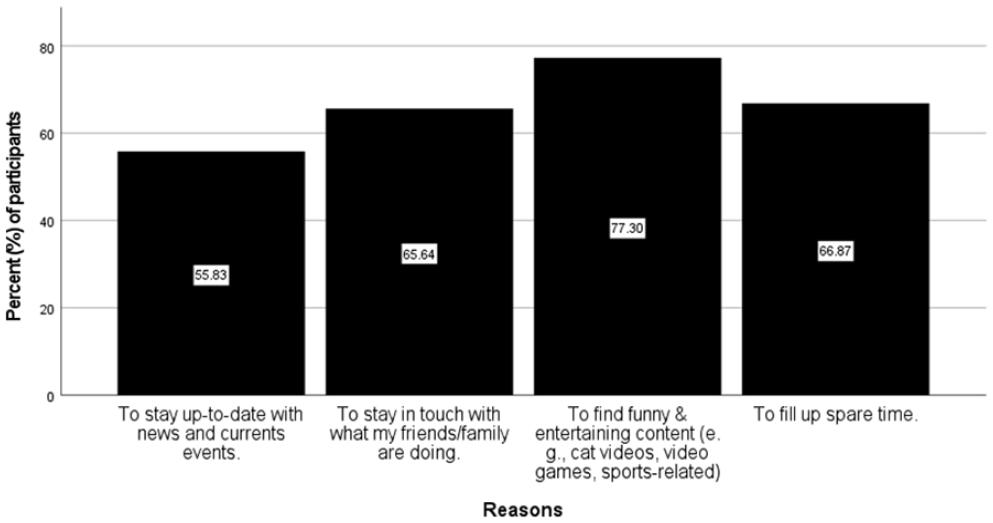
Reasons why young adults increased social media (SM) use during the COVID-19 pandemic (n = 163).
Associations Between Social Media Usage During the COVID-19 Pandemic and Demographics and COVID-19 Variables.

The top 3 activities respondents noticed they did more (n = 174) during the COVID-19 pandemic were ST use (n = 124; 71.3%), PA (n = 49; 28.2%), and sleep (n = 34; n = 19.5%). The top 10 categories participants reported doing more since the pandemic’s start is visualized in Figure 2. Associations between demographics and COVID-19 variables for the top 3 categories of increased activities since the beginning of the pandemic are provided in Table 2.

Top 10 categories participants reported doing more since the start of the COVID-19 pandemic, from least to greatest (n = 174).
Associations Between Demographics and COVID-19 Variables Comparing the Top 3 Categories Participants Responded They Increased Since the Start of the COVID-19 Pandemic.

The top 3 activities that respondents noticed they did less (n = 171) during COVID-19 were socialization (n = 126; 73.7%), PA (n = 101; 59.1%), and going outdoors (n = 56; 32.7%). The top 10 categories of participants reported doing less since the start of the pandemic are visualized in Figure 3. Associations between demographics and COVID-19 variables for the top 3 categories of decreased activities since the beginning of the pandemic are provided in Table 3.

Top 10 categories participants reported doing less since the start of the COVID-19 pandemic, from least to greatest (n = 171).
Associations Between Demographics and COVID-19 Variables Comparing the Top 3 Categories Participants Responded They Decreased Since the Start of the COVID-19 Pandemic.

Discussion
Nearly 90% of our sample found that their SM use increased during the pandemic, primarily to stay up-to-date with current events, stay in touch with family or friends, fill up spare time, or for entertainment. Wagner et al 3 also demonstrated that SM is a component of increased ST usage during the pandemic, mainly due to boredom, obtaining news, socialization, and other factors. Because there is a significant association between news and the mental health of young adults during the COVID-19 pandemic, this study emphasizes the nature and importance of SM to young adults and reiterates the effects of the COVID-19 pandemic on the role and usage of SM. 17 It is challenging to compare lifestyle changes with previous pandemics, like the Spanish Flu, as SM is a recent societal invention absent in earlier pandemics, and COVID-19 is one of the first international pandemics heavily researched since the inception of SM. Since SM is a vital component of everyday life, it is important to research its effects and create interventions for future events that affect the world to help combat misinformation, mainly since the younger generation utilizes SM for various reasons during worldwide crises.
Regarding demographics and SM use, we found differences between genders on whether or not they subjectively said their SM increased during COVID-19. These gender differences were limited to staying in touch with family/friends (P = .027) and filling up their spare time (P = .021), where females were more likely to indicate they increased SM for those reasons. Research shows that there are gender associations with SM use, especially regarding psychological distress during the COVID-19 pandemic, which could contribute to these findings. 18 Additionally, we found that those diagnosed with a COVID-19 infection were more likely to stay up-to-date with news and events than those who did not (P = .003). This finding adds to the limited literature regarding infection rates and SM use, as most of the current literature focuses on how SM helps disseminate information about the COVID-19 pandemic, specifically for infection and diagnosis. 19 Additional studies need to analyze why the use of SM to cope with the pandemic was different for the infected and non-infected.
ST use, PA, and sleep were the top 3 things our respondents wrote they did more during the COVID-19 pandemic. 71% of participants reported more ST use during the pandemic, followed by PA (28%) and sleeping (19.5%). This finding corroborates with current consensus, with research indicating a sharp increase in ST due to social isolation and moving education and work online. 20 Although counterintuitive, we found that participants increased their sleep. Although this is a common finding, other studies suggest that sleep was variable among some individuals, with some people reporting their sleep increased and others saying their sleep decreased. 21 Our study also found that household size may affect changes in sleep patterns during pandemics. Those reporting an increase in sleep were in significantly larger households than those who did not report an increase in sleep. This emphasizes how relationships in homes could link to a young adult’s sleep behavior during the pandemic.
Our study also found that those who reported an increase in ST spent statistically significantly less time in quarantine than those who did not report an increase in ST (P = .004). This could indicate that the different times and types of quarantine have varying effects on individuals, which would then ultimately affect other factors associated with ST, such as PA and mental health. 22 This result stresses the importance of timing within the pandemic, as the dynamic changes, like fluctuating mandatory quarantining, can ultimately affect health and well-being during COVID-19.
As for what respondents did less, the top 3 results were socialization, PA, and going outside, similar to trends seen in current literature for adults. 23 Those who reported a decrease in socialization were more likely to be employed full-time than those who worked part-time or were unemployed (including students; P = .005). However, it is essential to note that student status was insignificant for those who indicated less socialization than those who did not, and subsequent research should look at the socialization differences between employment status, especially since this could play a role in other areas of concern, like the psychological impact of COVID-19. Age was also associated with those who answered less socialization (P = .040). Participants who wrote that they socialized less during COVID-19 were slightly younger (x = 23.04 years, SD = 2.42, n = 112) than those who did not (x = 23.86 years, SD = 2.61, n = 59). This finding provides further context behind the complexity regarding socialization in emerging adults during the pandemic, potentially indicating that generational differences may be a factor for these findings. 24
There were significant differences between demographic variables for those who wrote they spent less time outside, specifically with continent of residence (P = .027) and gender (P = .005). Further analysis showed that respondents from the continent of Africa were statistically significant from North America in answering that they spent less time outside. Recent studies suggest varying policies and governmental responses can affect outdoor time and other factors, indicating that cultural and political factors highly influence this finding.25,26 Future directions should better compare these continents and outdoor activity to assess the impact on an individual’s mental and physical health. We also found that females were more likely than males to write that they spent less time outside during the pandemic. This could be linked to other factors, like their environment and schedule, as there is already a link between males being more physically active in their environment compared to females during the pandemic in a study set in the UK. 27 Understanding this association is vital as spending less time outdoors could worsen mental health, ultimately impacting the quality of life. 28
The effect of quarantine on socialization during the pandemic has been mixed, but our study showed that those who were more likely to say they socialized less spent less time in quarantine (days) than those who did not mention their socialization decreased (P = .037). The number of significant findings for past quarantine and no significant findings with current quarantine suggests that timing and intensity of quarantine may play a role in isolation. Fancourt et al 29 proposed that people in the early phases of the pandemic felt isolation more intensely than those in later phases due to adaptability. Thus, intervention strategies for future pandemics should focus on quarantine measures and their effect on socialization, proposing suggestions for combatting feelings of isolation and loneliness.
One of the biggest takeaways of this study was the mixed findings of PA, suggesting the complexity of PA during the pandemic. Since the pandemic consisted of stay-at-home policies and lockdowns, the initial speculation was that, overall, individuals reported their physical activity levels decreased, as they may not have access to shared answered less socialization sports facilities or be deeply affected by the pandemic to a degree where they took a break on PA. However, based on these results, our initial hypothesis was proved wrong. Current literature also shows mixed findings regarding PA of young adults during the pandemic, focusing on the impact it has on mental health and comparisons to ST use.30,31 Considering the growing evidence suggesting some individuals may increase PA and some may decrease, there is a call to compare the 2 groups and follow them longitudinally to understand more about the differences and outcomes, especially since mental health and PA associations are also complex. 32
This study has multiple limitations. The sample size was small, and the demographics were not representative of the population, as most were females and students, with little minority representation. Furthermore, there is bias in their subjective assessment of SM usage and potential bias from self-reported measurements. There is also a degree of interpretation bias while analyzing and categorizing open-ended responses.
Conclusion
There is no doubt that SM use in young adults has increased drastically during the pandemic. In general, there was a large consensus over top behaviors that increased, like more ST, sleep, and PA, as well as top behaviors that decreased, like PA, socialization, and going outdoors. Shedding light onto these lifestyle behaviors helps bridge existing gaps in the literature regarding SM use and changes in habits early in the COVID-19 pandemic. Robust research studies need to focus on specific time points of the pandemic and the intensity of policies to better understand the direct effects on young adults, primarily since significant associations were found with participants who quarantined in the past (early in the COVID-19 pandemic). In addition, the inconclusive findings on PA behaviors are becoming an increasing trend, and since activity levels play a prominent role in mental and physical health, future research should focus on understanding how the pandemic has shaped PA levels in young adults and its direct impact. We need more public health initiatives to decrease ST, optimize sleep quality, and find ways to go outdoors during restrictive measures to help people increase their PA. All these activities are linked to both physical and emotional health. Thus, focusing on these lifestyle changes in this population could benefit young individuals’ overall health for future worldwide pandemics and also continue to promote healthy behaviors.
Footnotes
Acknowledgements
The authors would like to acknowledge the valuable contributions of AS, SSB, all young adult participants who participated in the international survey, and support of the faculty of Saint James School of Medicine in the conduct of the study.
Author Contributions
All authors helped conceive the study, participated in the methodology, and were involved in protocol development. MW and OS researched literature. DS gained ethical approval and was a liaison with the institutional research committee board. MW and OS participated in patient recruitment and data cleaning. MW was involved with data analysis. MW and OS wrote the first draft of the manuscript. All authors reviewed and edited the manuscript and approved the final version of the manuscript.
Declaration of Conflicting Interests
The author(s) declared no potential conflicts of interest with respect to the research, authorship, and/or publication of this article.
Funding
The author(s) received no financial support for the research, authorship, and/or publication of this article.
Ethical approval
All procedures performed in studies involving human participants were in accordance with the ethical standards of the institutional and/or national research committee and with the 1964 Helsinki Declaration and its later amendments or comparable ethical standards. The research protocol was approved by each member of the Institutional Research Committee (IRC) at Saint James School of Medicine (research project #119). Informed consent was obtained from all individual participants included in the study. Additional informed consent was obtained from all individual participants for whom identifying information is included in this article.
Guarantor
MW and DS.
