



Abstract
Introduction:
Strategies are needed to promote the uptake of preventive health services among Black, Hispanic, and rural men because these men underutilize health services. Previous research indicates that men prefer community-based health promotion programming, such as health fairs; however, specific guidance on how to tailor health fairs for Black, Hispanic, and rural men are lacking. The present seeks to study provides that guidance.
Methods:
A multisectoral team developed, implemented, and evaluated a men’s health fair in a county of South Carolina with a sizeable Black, Hispanic, and rural-dwelling population. Although the health fair was open to all men in the county, specific outreach campaigns were implemented to attract Black and Hispanic men. The health fair occurred on Father’s Day weekend in 2023 and consisted of health screenings, health information, and other resources (eg, condoms, research studies). Participants who attended the health fair were asked to complete a check-in survey (N = 103) that assessed demographic information and how they heard about the health fair, followed by a survey (N = 58) that assessed facilitators/barriers to participation in a men’s health fair.
Results:
Results were stratified by the gender of respondent. The results highlight the facilitators/barriers experienced by men to attending health fairs and also highlight important differences in facilitators/barriers for men to attend a health fair as perceived by men and women.
Conclusions:
These findings have implications for the design and implementation of future men’s health fairs to promote preventive health service use among Black, Hispanic, and rural men.
Keywords
Introduction
Eliminating health inequities and disparities is a priority for many health-related organizations, campaigns, and funding initiatives,1 -4 yet there has been relatively little attention given to men’s health disparities in the United States. 5 Men in the United States experience multiple health disparities compared to women including worse cardiovascular health, 2 a slightly higher incidence of invasive cancers, 6 and a 6-year lower life expectancy. 7 As such, Healthy People 2030 has called for increasing awareness of men’s health through preventive screenings and regular health care. 8 However, men continue to utilize preventive health services less than women, 9 and Black and Hispanic men are less likely to use these services than White men.10,11 These disparities in use of preventive health services among Black and Hispanic men persist despite insurance status and availability of services12 -14 and are financially costly. For example, it has been estimated that Black men incur $25 billion in excess medical costs due to health disparities. 15 Efforts to improve men’s uptake and use of preventive health services are therefore needed, particularly for Black and Hispanic men who experience complex system and individual-level healthcare barriers.14,16 -18
The US Preventive Service Task Force and the Institute of Medicine have highlighted the importance of tailoring preventive health promotion efforts to the needs of particular populations,19,20 and scholars have argued that more effective public health campaigns are needed to specifically target men. 21 Results from research conducted among men indicate that men prefer community-based health promotion programming,22 -25 such as health fairs—a strategy recognized for increasing health awareness for medically underserved and health disparate populations.26,27 However, specific recommendations to tailor health fairs to the needs of men are lacking despite evidence that gender-sensitized health promotion programs have shown to be preferred by men.28,29 Gender-tailored efforts to reach and engage men are needed24,30 given that men are less likely than women to participate in various health-related initiatives 31 and that men and women differ in their motivation to participate in health-related activities.32,33
This manuscript describes (1) the process of designing a men’s health fair that targeted men in a South Carolina county with a substantial representation of Black, Hispanic, and rural-dwelling men and (2) the results from a survey-based assessment of perceived barriers and facilitators to attending a men’s health fair by men and women. The perspectives of both men and women who attended the fair were included to gather comprehensive insight regarding this attempt at health promotion, which is consistent with other research in which both men and women have offered important insights on men’s health. 34 Additionally, an understanding of barriers and faciliators experienced by men that are reported by both men and women is important because of gender roles (eg, men may underreport barriers in order to conform to hegemonic masculine norms 35 ), family dynamics (eg, many men report that women and family play an important role in their health promotion 36 ), and data triangulation/results confirmation (eg, assessing both men and women allows for triangulation and credibility of results). The insights and outcomes from this endeavor are summarized as lessons learned in order to inform future community-based efforts to engage men from these backgrounds.
Methods
A local health prevention outreach team and a local Black-owned barbershop identified a need for men’s health promotion in their community and formed a cross-sector organizing committee to coproduce the county’s first annual Men’s Health Expo. The organizing committee included these 2 organizations, in addition to members of a regional fatherhood coalition, the United Way, a state flagship university, a local federally qualified health center, and community health workers based in the area.
Men’s Health Expo Advertisement
The Expo was open to all community members; though, specific outreach efforts focused on Black and Hispanic men. Efforts to promote the event among Black men were conducted at barbershops, radio stations, and through announcements at churches with predominately Black congregations. Efforts to promote the event among Hispanic men were conducted through the use of Spanish-speaking community health workers, advertisements on Spanish language radio stations, announcements at churches with predominately Hispanic congregations, and flyers in Spanish.
The Men’s Health Expo
The Men’s Health Expo was hosted from 10 am to 2 pm in the county’s convention center during Father’s Day Weekend (Saturday, June 17, 2023). This county is a rural-adjacent community with a population just under 40 000. According to 2020 US Census Data, this county has a median age of 31.8 years and a 21.4% poverty rate. The poverty rate among Black or African American residents of this county is 71.6%. Additionally, 49.3% of the population of this county is Black or African American and 5.5% of the population is Hispanic. 37 The Men’s Health Expo consisted of vendors, organizations, and volunteers across the state that provided attendees free health screenings (eg, blood pressure tests), health information (eg, recommended nutrition guidelines), and resources (eg, condoms). Of note, this iteration of the Men’s Health Expo did not provide any cancer-related services despite the prevalence of cancer among men. Additionally, the organizing committee intentionally included other activities/vendors to attract men to the event (eg, local food trucks, raffles).
Data Collection Procedures
The present study was approved by the partnering state flagship university’s Institutional Review Board. Surveys were created by the research team and the contextual validity of each survey was confirmed with the organizing committee—individuals familiar with the health needs of men in this county of South Carolina. The surveys were then made available in both Spanish and English. Upon entering the facility, all attendees were asked to complete a check-in survey. This brief check-in survey assessed demographic information, in addition to how the attendee heard about the Men’s Health Expo. After completing this brief check-in survey, participants were invited to complete a slightly longer survey that assessed perceptions’ of men’s barriers/facilitators to participation in a health fair. Upon completion of this survey, participants were entered into a random drawing for 1 of 4 $50 Visa gift cards. All randomly drawn gift card recipients were selected, and gift cards were mailed, within 1 week of the event.
Results
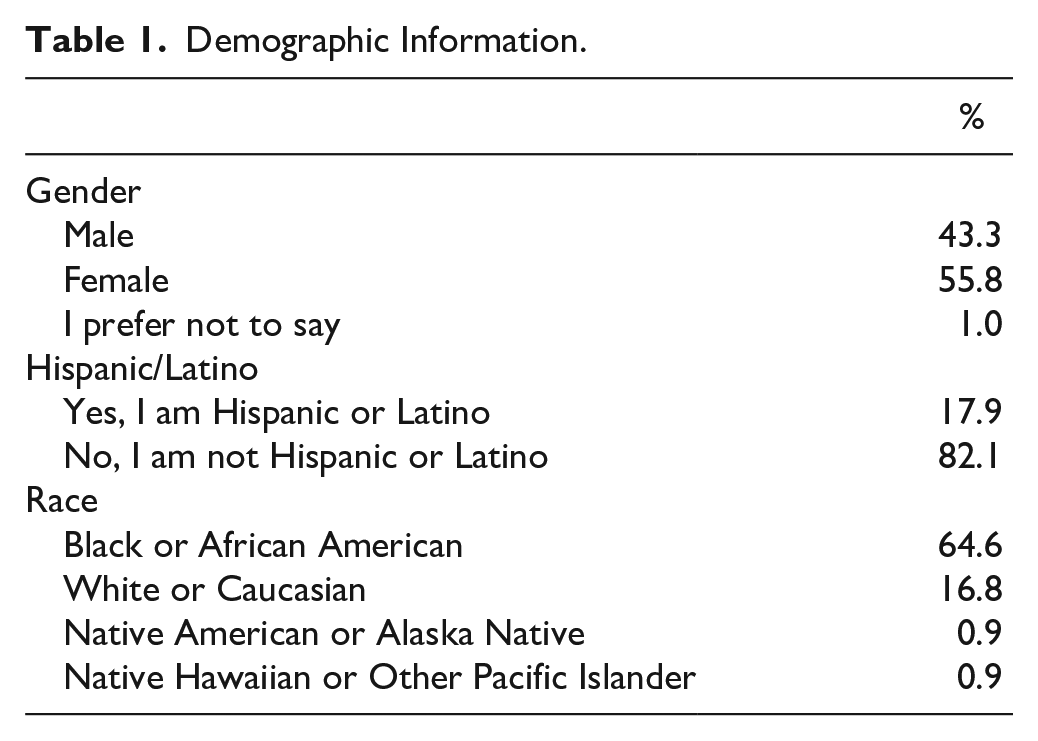
One hundred and three individuals completed the check-in survey. This number is a close approximate of the number of individuals who attended the Men’s Health Expo. It is estimated that 5 to 10 attendees declined to complete the check-in survey. The mean age was 47.65 (SD = 15.82). See Table 1 for demographic information of attendees and Table 2 for how attendees heard about the health fair. It should be noted that given the specific outreach efforts targeting Black and Hispanic men, there was an overrepresentation of Black and Hispanic individuals who attended the Men’s Health Expo and an underrepresentation of White individuals based on county-level demographic information.
Demographic Information.
How Did You Hear About the Men’s Health Fair?
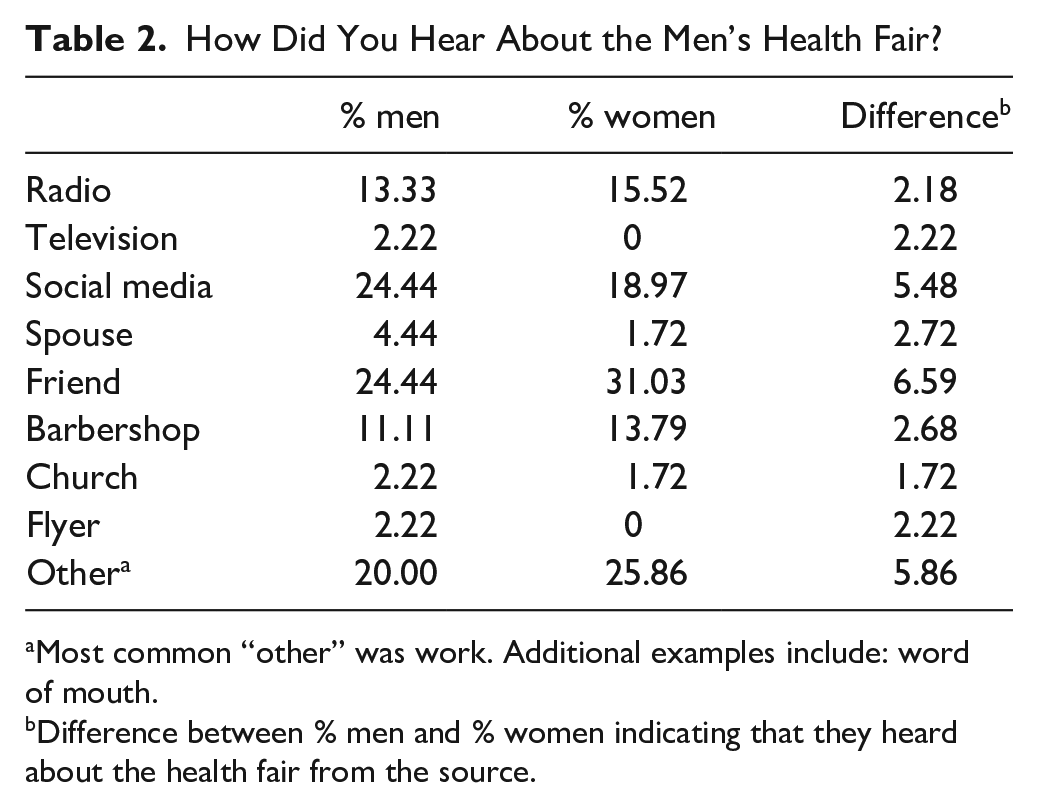
Most common “other” was work. Additional examples include: word of mouth.
Difference between % men and % women indicating that they heard about the health fair from the source.
A subsequent survey that assessed barriers and facilitators to participation in a men’s health fair was completed by 58 individuals. The mean age of these individuals was 49.03 (SD = 13.97) and 56% were women. See Table 3 for a list of barriers to participation in a men’s health fair, with percentage agreement of each barrier stratified by gender. See Table 4 for a list of facilitators to participation in a men’s health fair, with percentage agreement of each facilitator stratified by gender. Important findings are discussed in the Conclusions section.
Barriers to Participation in a Men’s Health Fair.
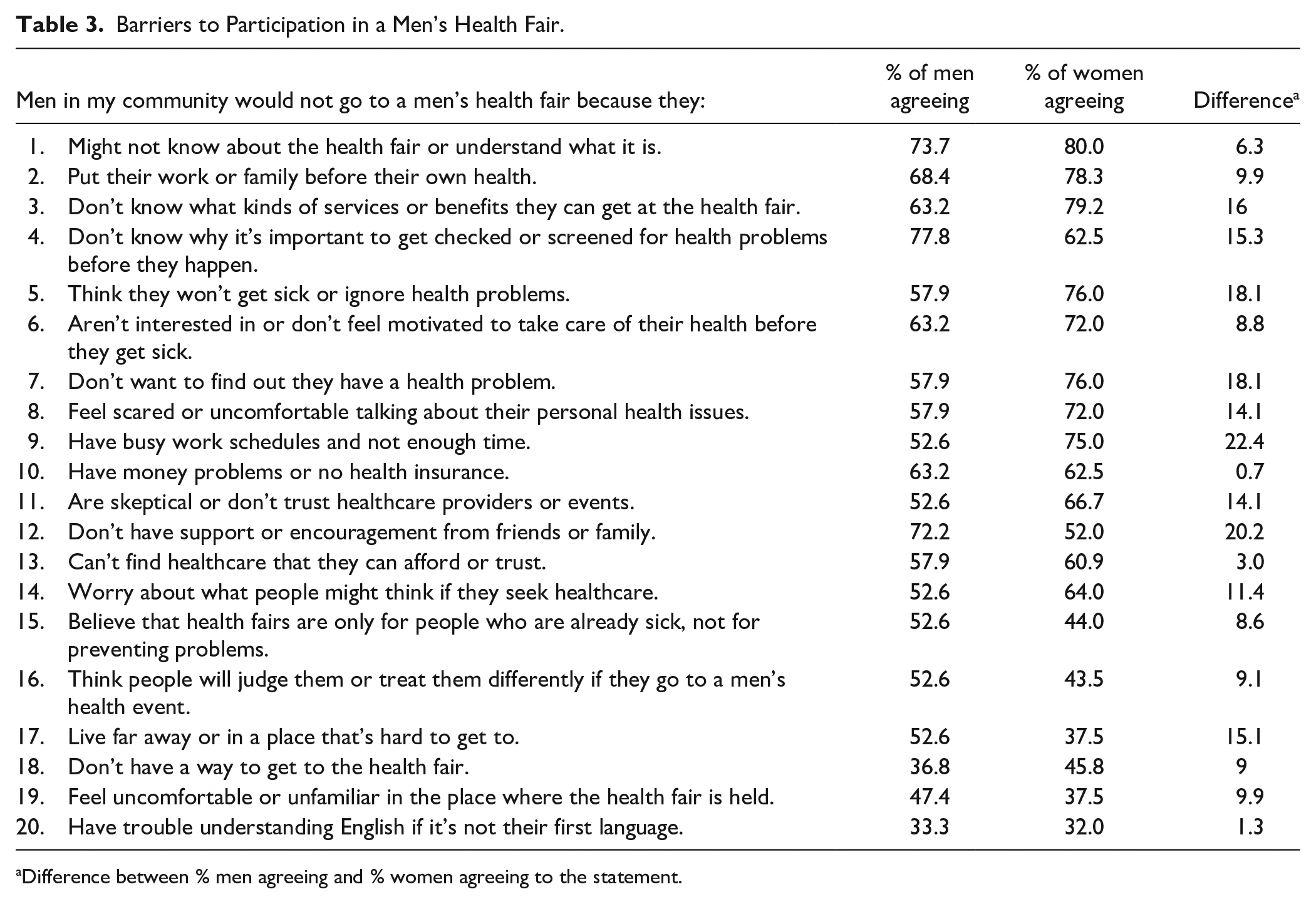
Difference between % men agreeing and % women agreeing to the statement.
Facilitators to Participation in a Men’s Health Fair.

Difference between % men agreeing and % women agreeing to the statement.
Conclusions
It is important to develop gender-tailored efforts to reach and engage men in community-based health promotion events (eg, health fairs).24,30 The following community-informed and data-driven lessons learned from the Men’s Health Expo can inform the development and implementation of similar health promotion events for men. These lessons learned are grouped into 5 informative categories— (1) strong barriers to participation endorsed at a high rate by both men and women, (2) strong faciliators to participation endorsed at a high rate by both men and women, (3) strong barriers to participation primarily endorsed by men, (4) strong barriers to participation primarily endorsed by women, and (5) strong faciliators to participation primarily endorsed by men. The first 2 categories represent barriers and facilitators endorsed by both men and women at a commensurate rate and are likely to play key roles in the successful development and implementation of men’s health fairs. The last 3 categories represent barriers and faciliators with noteworthy discrepancies in endorsement between men and women and likely represent unique opportunities to tailor men’s health fairs. In addition to these lessons learned about barriers and faciliators to participation, the present study also found that social media and peer networks were important sources for disseminating information about the event. There is growing interest in the importance of peer-to-peer health promotion efforts among men, including among Black men 30 and Hispanic men. 38
Specifically, both men and women reported that many men would not attend a men’s health fair because they might not know about the health fair or understand what it is (Barrier 1). This finding corresponds with other findings from the present study that knowledge and understanding are key facilitators for men’s participation and highlight the importance of informational campaigns about the fair preceding its implementation (Facilitators 4, 5, and 9). Furthermore, both men and women endorsed that men would attend a men’s health because they are interested in early detection and services (Facilitator 1). Their attendance can be facilitated by environmental characteristics (eg, supportive environments, opportunity to win prizes; Facilitators 2 and 3) and interpersonal characteristics (eg, encouragement from friends, family, and doctors; Facilitator 6). These findings support similar findings that men prefer health promotion efforts that are marked by comfort and are conducted among peers, 36 thus it is recommended that future men’s health fairs intentionally foster a supportive and affirming environment.
The lessons learned also indicate that men perceive that lack of support from friends and family prevents them from attending men’s health fairs (Barrier 12). This lesson learned aligns with the present research (Facilitator 10) and research suggesting that men perceive social support from friends and family as important sources of health-related motivation. 39 Thus, future efforts may benefit from initiating community outreach and awareness campaigns that encourage friends and family to support and accompany men to health fairs. Additionally, the results from the present study found that men perceive distance to be a barrier to attending men’s health fairs (Barrier 17). It is recommended that future efforts seek to implement men’s health fairs in locations easily accessible to men. This is particularly important in rural and rural-adjacent areas in which greater travel distances have been shown to negatively affect attendance for health-related endeavors. 40
These lessons learned should be viewed in conjunction with the barriers to men’s participation that were primarily endorsed by women. First, women believe that men’s work schedules prevent men from attending health fairs (Barriers 2 and 9). This finding may reflect a gendered perception of work-life balance and the prioritization of work over health among men. It is suggested that future men’s health fairs occur during flexible hours or weekends to accommodate men’s work schedules. 41 Second, women believe that men might avoid attending a men’s health fair due to ignoring symptoms and/or fear of discovering health problems (Barriers 5, 7, and 8). Future efforts should consider educational campaigns on the importance of early detection and treatment prior to the fair, particularly given evidence that younger men have reported prioritizing immediate health issues and neglecting long-term health risks. 42 Third, women believe that men’s lack of knowledge about the services and benefits of men’s health fairs serve as barriers (Barriers 1 and 3). Previous literature suggests that the health perceptions of men contribute to the delay in utilization of health services.14,17 Future men’s health efforts should clearly indicate the services and benefits being offered to men. The importance of this final finding is underscored by the faciliators to participation primarily endorsed by men. In addition to receiving services at little to not cost (Facilitator 7), men viewed knowledge and understanding as key facilitators to men’s participation (Facilitators 4, 5, 8, and 9).
The results from the present study should be view in light of its limitations and strengths. The primary limitation of the present study was the fair’s implementation in a rural-adjacent county in South Carolina. The experiences of men who are Black and Hispanic and are residents of this county may not reflect those of similar men in other parts of the United States. However, there is an urgent need to understand strategies to promote health among these men in more rural areas of the Deep South—an area of the United States with amplified health disparities. 43 Additionally, the present study did not assess statistical differences in the responses to barriers/facilitators experienced by men between the men and women participants. This decision was made due to the likely non-independence of the data and sample size considerations. The strengths of this study include the participant sample (ie, Black and Hispanic adults – individuals often underrepresented in health research, though intentionally overrepresented in the present study), the direct potential of the results to inform health promotion efforts among individuals and communities in need, and muti-sectoral team that developed and implemented the Men’s Health Expo.
The lessons learned from the present study have practical and policy-level implications for community-based efforts to promote men’s health. These implications are informed by the finding that many of the lessons learned reveal underlying gender dynamics and social expectations to attending men’s health fairs. The lessons learned highlight the importance of considering both men and women’s perspectives in designing and implementing men’s health fairs and other community-based health promotion efforts. Tailoring communication strategies, providing family and friend social support, addressing logistical challenges, and acknowledging fears and attitudes toward health concerns may be key to encouraging more men to attend men’s health fairs—an evidence-based and community-informed strategy to promote health equity among men.
Footnotes
Declaration of Conflicting Interests
The author(s) declared no potential conflicts of interest with respect to the research, authorship, and/or publication of this article.
Funding
The author(s) disclosed receipt of the following financial support for the research, authorship, and/or publication of this article: GMW is funded by the National Institute on Minority Health and Health Disparities of the National Institutes of Health (K23MD016123). DAA is funded by the National Institute on Minority Health and Health Disparities of the National Institutes of Health (K23MD013899). The study sponsors had no role in study design; collection, analysis, and interpretation of data; writing the report; and the decision to submit the report for publication.
