




Abstract
Background:
Electronic massagers have gained popularity for their non-invasive and cost-effective approach to healthcare. However, existing electronic massagers require manual manipulation, leading to inconsistency.
Objective:
To investigate the feasibility and acceptability of the Electronic Massager—Expert Manipulative Massage Automation (EMMA) among the American population.
Methods:
A single-arm pilot study was conducted at Mayo Clinic Rochester campus. Participants received massage therapy with the EMMA treatment model and completed a demographics and Satisfaction Survey Questionnaire. Data were collected using REDCap, and statistical analysis was performed.
Results:
Twenty healthy volunteers (13 women, 7 men; median age, 47 years) participated and completed the intervention within 2 weeks. No adverse events were reported. Overall, the acceptability and satisfaction of massage utilizing EMMA were high, with all participants finding the study worthwhile, willing to participate again, and willing to recommend the study to others. Regarding the overall experience, 65.0% reported a better-than-expected experience. Responses to open-ended post-treatment questions showed that most participants enjoyed the warmth (35%), pressure (25%), and relaxation (20%) provided by EMMA, with the majority suggesting no changes or improvements were needed. However, some participants expressed a desire for an expanded massage area (20%).
Conclusions:
This study suggests that the EMMA massager has high acceptability and satisfaction among healthy volunteers, thus demonstrating its feasibility. However, further research is needed to optimize EMMA and assess its clinical effectiveness.
Background
With the experience of the COVID-19 pandemic, the focus of medical healthcare has shifted towards the adaptability and acceptability of remote visits, as well as the utilization of Artificial Intelligence (AI) in patient care. Smart devices are currently being used to track steps, detect falls, measure heart rate, monitor sleep, and even measure insulin levels for diabetes. While technology will not replace healthcare providers, it does offer non-invasive, accessible, and cost-effective assistance in delivering healthcare.
Various electronic massagers are available in the market, ranging from foot massagers, muscle massage guns, eye massagers, neck and shoulder relaxers, deep tissue massagers, to back massagers. However, these electronic massagers are either handheld or require continuous manipulation by the individual, which can lead to inconsistency due to human fatigue or error. As a new electronic massager under FDA’s 510(k) exemption, the massager utilized in this current protocol is programmed to deliver consistent precision and effective massage based on feedback from the muscles being massaged. Developed by AiTREAT, Pte Ltd. in Singapore, this electronic massager is known as Expert Manipulative Massage Automation (EMMA). 1
EMMA is classified as 510(k) Exempt under Device Class 1 890.5660, according to FDA regulations. 2 There are 4 models of EMMA, each with a different focus (EMMA@Wellness, EMMA@Sports, EMMA@Treatment, EMMA@Customized) 3 AiTreat, 2015. For this study, we utilized the model “EMMA@treatment” 3 at Mayo Clinic, Rochester.
Massages can be expensive and sometimes lack expertise. The autonomous electric massager addresses the scarcity of skilled massage therapists while providing high-quality healthcare treatment at affordable costs. Currently, there are over 11 EMMA electric massagers being used in traditional Chinese Medicine clinical settings in Singapore. 4 EMMA tracks and analyzes the patient’s progress, generating a performance report that allows physicians to measure a patient’s recovery using precise empirical data. Ultimately, the goal is for EMMA to offer precise, consistent, low-cost, and customized massage treatments as part of preventative medicine. 5
Although EMMA is currently in use in Singapore, it remains unknown how the American population will respond to its utilization. The purpose of this small pilot study is to gather feedback on the feasibility and acceptability of the “EMMA@treatment’ model.” 3
Materials and Methods
This single-arm pilot study was conducted at Mayo Clinic—Rochester between May 1, 2023, and May 11, 2023.
Subjects
Healthy volunteers of both sexes who expressed an interest in receiving EMMA massage were included in the trial if they were 18 years or older and able to provide informed consent. Female participants of childbearing potential who self-reported not being pregnant and agreed to use an effective method of birth control (such as surgical sterilization, oral contraceptives, barrier methods with spermicides, or intrauterine devices) during the study period were eligible. Additionally, participants needed to have the ability to complete all aspects of the trial. Volunteers who met any of the following exclusion criteria were not included in the study: pregnancy or breastfeeding, inability to stay in a prone position, bleeding disorders, current diagnosis of cancer or undergoing cancer treatment, allergies and/or local skin affectations, and unstable medical or mental health conditions as determined by the physician investigator.
Intervention
Study participation was approximately 2 h, which included the time for consent, completion of questionnaires, and undergoing massage therapy with EMMA (Figure 1). All subjects were invited to participate in the study and provided verbal consent. Before initiating the treatment, participants were requested to fill out a demographic survey questionnaire, including age, sex, race, and ethnicity.

Consort flow diagram of participants through the study.
The massage intervention was 20 to 30 min in duration delivered by the EMMA@TREATMENT. The participant assumed a prone position on the robot platform, and a trained EMMA therapist set the robot parameters. The EMMA electronic massager applied massage to specific focus Huatuojiaji and Back shu points on the participants’ lower back, guided by cameras and computer programs (Figure 2).

Representative photo of EMMA intervention.
At the end of the treatment, participants completed a Satisfaction Survey Questionnaire.
EMMA massage was available 5 days a week, from 8:00 AM to 5:00 PM, in a private room. A total of 20 massage appointments were made available. The EMMA therapist remained blinded to the questionnaires.
Device
The EMMA massager was equipped with sensors to measure muscle stiffness and utilizes 3D vision technology to identify pressure points and deliver massages to participants. Based on the information stored by EMMA’s Artificial Intelligence, the electronic massager determined the best course of action, and EMMA’s robotic arm performed the massage. Soft treatment using a soft silicone tip, warmed to a temperature between 38 and 40°C is used to mimic human touch during the massage.
Data Collection and Outcomes
Study data were collected and managed using REDCap (Research Electronic Data Capture), which is a secure, web-based application designed for research data capture. 6
Demographics Form: This form collects demographic information of the research subjects, including age, sex, race, and ethnicity. This data was collected before each study treatment.
The Satisfaction Survey Questionnaire was an 8-item, self-reported instrument adapted from Was it Worth it Questionnaire (WIWI). 7 It was administered to the participants to assess their satisfaction with the treatment experience of the EMMA electronic massager. These data can be used to evaluate the feasibility of the intervention by asking the patients if the entire research experience was worth it for them. This data was collected at the end of the massage therapy (end of study participation).
Safety
EMMA massage therapy is safe when performed by a trained practitioner. Careful observation for any adverse events was practiced during each of the massage sessions. No adverse events were observed or reported.
Statistical Analysis
This small pilot study aimed to establish the feasibility and acceptability of this AI approach to massage therapy. Descriptive data related to subject recruitment were summarized, including reasons for failing screening criteria and declining study participation. Satisfaction data were also summarized to evaluate acceptability, adaptability, and satisfaction with the treatments delivered by EMMA. Quantitative variables were reported as means with standard deviation calculations, while qualitative variables were reported as numbers and percentages. The percentage of subjects who discontinued study participation and the reasons for discontinuation were also summarized. Patient demographics were described using descriptive statistics.
Ethical Considerations
This study was approved by the Institutional Review Board of Mayo Clinic (NO. 22-013099) and complied with the ethical principles of the Declaration of Helsinki. Oral consent was obtained from all participants.
Results
Demographic Characteristics
During the study period, a total of 22 volunteers expressed interest, but 2 volunteers were unable to participate due to 1 residing in another state and the other being out of the country during the 2-week study period (Figure 1). Ultimately, 20 participants (13 women, 7 men) were enrolled in this study. All subjects provided verbal consent. The median age of the participants was 47 years (range, 26-76 years). Seventeen (85.0%) were white, and 3 (15.0%) were of Asian ethnicity (Table 1).
Demographic Characteristics of the Participants.

Feasibility
This study began receiving inquiries concerning participation prior to opening study enrollment. All participants enrolled and finished study participation within 2 weeks. Of the total 20 participants who entered the study, all 20 completed the intervention and 1 even inquired “how could I get one for home?.” No one reported any adverse events during study participation and no complaints were received. These experiences lead us to conclude that massage therapy utilizing EMMA is acceptable to patients.
Satisfaction
Overall satisfaction with the EMMA massage therapy was high. All 20 volunteers (100%) considered it worthwhile to participate in this research study, expressed willingness to participate again in similar research, and would recommend this study to others. Regarding the overall experience of participating in this research study, 7 participants (35.0%) reported an experience as expected, while 13 participants (65.0%) expressed a better experience than expected (Table 2).
Satisfaction Survey Results.
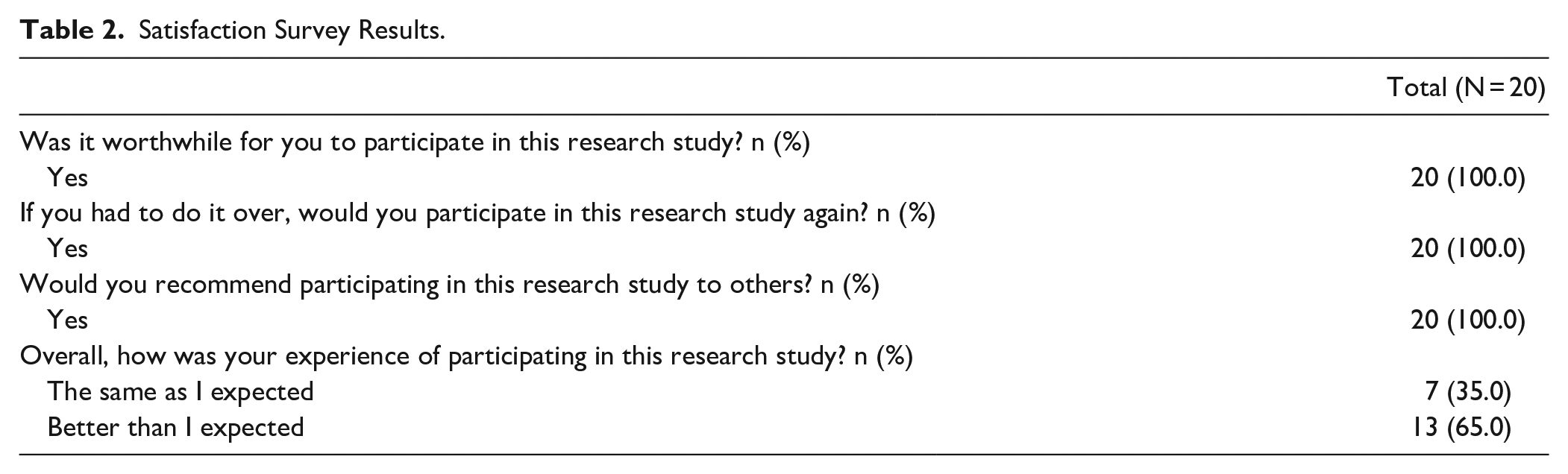
Figure 3 is a graphic presentation of the 3 open-ended questions asked of participants post treatment. Approximately 85.0 to 95.0% of the participants responded to the 3 open-ended questions. When asked if there anything you particularly liked about your massage experience with the EMMA electronic massager, the majority (35%) indicated the warmth, followed by the pressure (25%), and the relaxation (20%). When asked if there was anything they did NOT like about your massage experience using EMMA, the majority (30%) indicated no changes, followed by expanding the massage area (20%). When asked if there was one thing that could have been done to improve your experience in this research study, the majority (35%) indicated no improvement was needed and 15% suggested a larger area for massage targeting. When asked if they would like to talk to someone about any concerns 15% (N = 3) indicated they would. When the study team followed up with these participants, they indicated they had misinterpreted the question and had no issues or complaints, that they enjoyed the treatment.
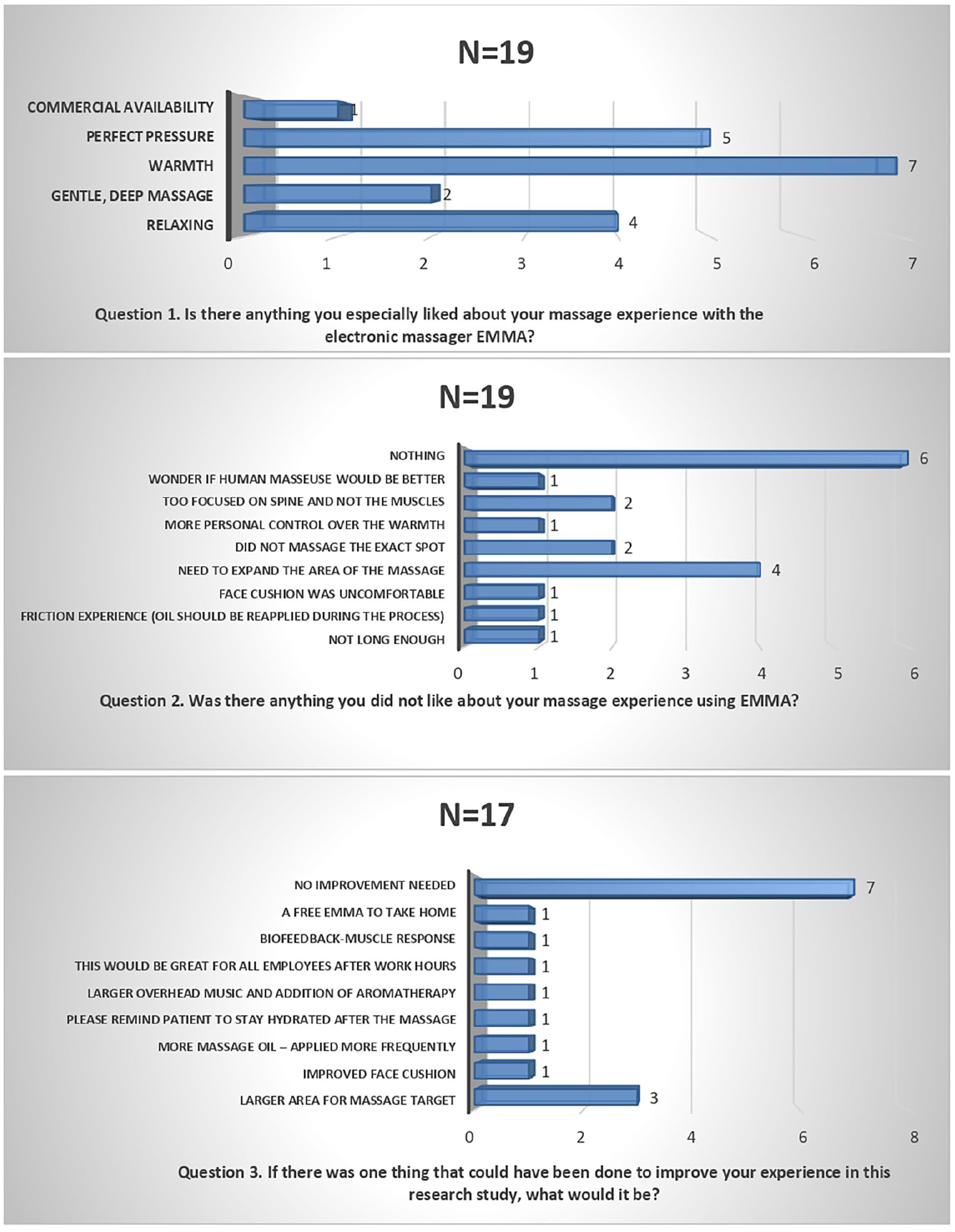
Feedbacks of open-ended questions.
Adverse Events
During the trial period, no adverse events related to EMMA massage were reported. No adverse events occurred during any massage, except in 1 case when the robot probe moved off target due to the presence of lumbar post-discectomy scar tissue. The patient did not experience any negative effects as a result, only a momentary disruption in the massage.
Discussion
This pilot study examined the feasibility and satisfaction associated with EMMA massage in 20 healthy volunteers and found that EMMA massage seemed feasible and worthy of recommendation. Previous studies have delved into the subjective experience of receiving a massage from a robot; our study, however, placed a focus on assessing the feasibility and satisfaction associated with the EMMA massage system, which has not been studied extensively before. Our findings are consistent with earlier research that suggested robots could deliver pleasurable and relaxing experiences akin to human touch. 8 Moreover, our study broadens the scope of prior work by including a U.S.A.-based population, facilitating a more comprehensive perspective on the feasibility and satisfaction derived from EMMA massage.
Traditional Chinese Medicine (TCM) is an ancient form of healthcare that dates back over 2500 years and includes various forms of herbal medicine, acupuncture, massage therapy (tui na), exercise (qigong), and dietary therapy. The TCM system focuses on the balance and flow of “Qi” (life force or energy), which circulates through channels called meridians. These meridians have branches connected to bodily organs and functions, making this energy flow essential for health and wellbeing. Acupuncture points located along these meridians can be stimulated to restore balance and flow of qi. The EMMA massage trajectory points include the Huatuojiaji and Beishu points, which are specific acupuncture points within the TCM system. Here’s a brief explanation of these points:
Huatuojiaji Points: These points are located 0.5 cun from the dorsal apophysis of each vertebra. A “cun” is a unit of measurement in Chinese Medicine that varies based on the patient’s body size. In this case, the Huatuojiaji points correspond to the motor points of deep paraspinal muscles such as the rotatores brevis, longus, and multifidus. Stimulating these points is believed to help with a variety of conditions, especially those related to the spine and the organs innervated by the corresponding spinal nerves.
Beishu Points: Also known as the Back-Shu points, these points are located on the first chain of the Urinary Bladder meridian at the joint of the transverse apophysis. The Urinary Bladder meridian is 1 of the most extensive meridians in the body with many branches. According to TCM, the Beishu points are associated with various organs (eg, lungs, heart, liver, spleen, kidneys), and stimulating these points is believed to regulate the corresponding organ’s function. Beishu points also play a significant role in the communication between the subcutaneous tissue and the organs.
In a TCM massage like EMMA, these points would be used in a specific sequence or combination based on the individual’s needs and overall health condition. The underlying principle is to improve the circulation of qi and blood in the body, thereby promoting healing and wellness.
As detailed in the previous article, the EMMA massage robot also employs a combination of advanced technologies to identify focus points and adjust the amount of pressure provided. Firstly, the robot employs sensor-based technology, including force and position sensors, which detect the stiffness and resistance of various points on the human body. This allows EMMA to identify muscle knots, tension points, or areas requiring therapeutic attention, known as “focus points.” Regarding pressure application, the system is designed to apply varying levels of force according to the detected body feedback and user preferences. For example, if the sensors detect a higher degree of stiffness, the system will interpret this as an area needing more intense pressure. It is important to note that EMMA is equipped with a safety mechanism that controls the maximum force applied to avoid causing discomfort or injury. In terms of “green Internet of Things” (IoT) applications, the paper suggests that EMMA utilizes IoT technology for remote control, programming, and updating. This allows healthcare professionals to customize the parameters of the robot according to the patient’s needs and preferences, such as the specific focus points and the desired pressure. This intricate network of sensors, AI algorithms, and IoT connectivity all contribute to EMMA’s effectiveness, ensuring it provides personalized and safe therapeutic interventions. 5
Of course, various factors could influence the massage experience with the EMMA robot massager for different participants. One of the key factors is individual sensitivity and tolerance to pressure. People have varying thresholds for what they find comfortable or painful, which can significantly influence their experience with the robot massager. Secondly, the physical condition of the individual can also play a significant role. Factors such as muscle stiffness, the presence of injuries or chronic conditions, and overall health can affect how the massage is perceived. For example, someone with a chronic pain condition might have a different experience compared to someone using the massage robot for relaxation or general muscle tension. Personal preferences also play a significant role. Some people may prefer softer, more soothing massages, while others may prefer deep tissue massages that apply a higher degree of pressure. Preferences can also extend to specific areas of focus; some individuals may prefer massages that concentrate on the neck and shoulders, while others might prefer focus on the lower back. Lastly, the settings and parameters set for the EMMA robot massager could significantly influence the experience. Depending on the parameters set by the healthcare professional or the user, the massage experience can be customized to be gentler or more intense, focused on specific areas, or adjusted in other ways to better fit the user’s needs. These settings could vary for each participant, creating unique massage experiences. Thus, as with any medical or therapeutic intervention, the effectiveness of the EMMA massage robot needs to be validated through well-designed clinical trials. These trials should ideally be randomized, controlled, and, if possible, double-blind. They should also be performed with a large and diverse group of participants to ensure the results are generalizable to a wider population. In these trials, various outcomes could be evaluated, such as pain reduction, improvement in range of motion, reduction in muscle stiffness or tension, improvement in relaxation and stress reduction, and overall user satisfaction. Furthermore, potential adverse effects should also be closely monitored to assess the safety of the device. Finally, since the EMMA massage robot utilizes IoT technology for remote control, programming, and updating, security and privacy concerns should be addressed. Ensuring the device’s security and protecting users’ personal health information is paramount. In conclusion, although the EMMA massage robot appears to have promising applications in healthcare and wellness according to our study, more extensive research and trials are needed to fully understand its future benefits and potential limitations.
The strengths of our study lie in its novelty, high response rate at enrollment (enrollment was completed in less than 10 days), high acceptability responses in the satisfaction survey, absence of adverse events, successful questionnaire completion, and low levels of missing data. However, there are some limitations to consider. Firstly, our study can be regarded as a preclinical investigation of robotic massage before FDA formal approval. Secondly, the intervention was only applied to healthy volunteers, and caution should be exercised when extrapolating these findings to clinical settings. Additionally, the lack of a control group and the relatively small sample size limit the assessment of clinical efficacy and generalizability of the findings. Furthermore, the open-ended feedback from participants provided valuable insights for further improvement of the EMMA massager, but additional research is needed to optimize its functionality and user experience.
Despite these limitations, our study confirms the feasibility of applying EMMA massage on healthy volunteers. However, further detailed clinical experiments are necessary to determine the actual acceptance of EMMA massage by patients. In the future, more comprehensive experiments should be conducted to validate the effectiveness. Future studies are also needed to help define the optimal role of EMMA in augmenting a massage therapy practice, focusing on the optimal timing and duration with hands-on massage.
Conclusions
In conclusion, we examined the feasibility and acceptability of EMMA@treatment in healthy volunteers and found positive results for both. We believe future studies will need to focus on a wider exploration of the various treatment modules available in EMMA and how these impact clinical syndromes.
Footnotes
Acknowledgements
We also thank Nanyang Technological University, Singapore, for supplying the EMMA device. Additionally, we extend our thanks to our colleagues Jennifer (Jenny) Lee and Heather Ehrich at the Rejuvenate spa at Mayo Clinic Rochester Campus, for their invaluable support and assistance throughout this project. This experimental research has obtained permission from the Ethical Review Board of Mayo Clinic to conduct studies involving humans.
Author Contributions
ITC, BAB, and TYC conceived the research. BAB and TYC performed the investigation. SCF and DEJ recruited patients and served as study coordinators. JY performed the intervention. TYC supervised the study. ITC and JY wrote the original draft. JJC, AD, MRM, BAB, and TYC revised and edited the manuscript.
Declaration of Conflicting Interests
The author(s) declared no potential conflicts of interest with respect to the research, authorship, and/or publication of this article.
Funding
The author(s) disclosed receipt of the following financial support for the research, authorship, and/or publication of this article: We would like to express our gratitude to The HEAD Foundation, Singapore, for their financial support of Dr. Bauer and Dr. Yang.
Informed Consent Statement
Informed consent was obtained from all subjects involved in the study.

Data Availability Statement
The data that support the findings of this study are available from the corresponding author upon reasonable request.