




Abstract
Stress in young children can interfere with academic achievement. To help address stress and aid in developing beneficial lifelong coping skills, educational systems are more widely incorporating programs that teach social and emotional regulation, such as mindfulness-based programs. The effects of these programs may be strengthened through parental support in the home environment. This study examined the feasibility and acceptability of a new Parent-Child Mindfulness-Based Training (PC-MBT) program, which delivered mindfulness-based training to parents and children simultaneously in the home environment. This study also implemented a working memory training after PC-MBT to assess the feasibility of completing two trainings sequentially. Healthy children, ages 8-10 (n = 14), and their parents participated in the PC-MBT program. They met with an instructor at home and online each week for 6 weeks and were provided resources including books, worksheets, audio recordings, and daily practices to reinforce mindfulness skills. A control group (n = 8) participated in the working memory training only. All PC-MBT and control children, except one, participated in the working memory training. All PC-MBT assigned families completed the PC-MBT program, and a majority utilized all types of the mindfulness training materials. A majority of participants also reported high levels of enjoyment and understanding of the PC-MBT program. This study establishes the feasibility and acceptability of the PC-MBT program and lays the foundation for future studies to assess program efficacy in healthy and clinical populations as well as the utility of PC-MBT to improve engagement and outcomes of other cognitive training programs.
Introduction
Stressful circumstances can interfere with memory, higher-order cognitive processes, and academic performance, and there is evidence that this occurs even in young children. 1 Multiple studies have demonstrated the success of mindfulness training for stress reduction in clinical and non-clinical adult populations. 2,3 The success of Mindfulness-Based Stress Reduction (MBSR) programs has led to the development and implementation of similar programs in K-12 curricula with promising results, particularly for reducing perceived stress and improving cognitive performance. 4 While research has demonstrated support for programs in schools, very few studies have examined mindfulness programs that train parents and children together in the home environment.
Traditionally, school-based training programs have been designed to improve foundational cognitive skills such as working memory and other domain-general functions that support academic achievement. 5,6 Now, however, there is widespread recognition that many students need instruction specific to the development of emotion-regulation skills and techniques that mediate the stress response. 7 Self-regulation and aspects of socioemotional competence are linked to academic achievement and numerous aspects of long-term well-being. 8,9 This body of work highlights the importance of supporting and improving the development of socioemotional competence in children, and for this reason, many schools now incorporate socioemotional learning and mindfulness training for teachers and students. 10
The prevalence of anxiety and stress-related disorders among youth has also led to a growing interest in mindfulness training programs for this age range. 7,11 Anxiety can impact attentional control, leading to deficits in concentration, thus hampering performance during high-stakes testing and novel learning scenarios. 12,13 Unfortunately, one consequence of perceived stress is that cognitive resources are usurped and cannot be allocated during challenging learning opportunities. 13 –15 This is highly problematic for children with anxiety who are more likely to score lower on tests and have lower overall academic achievement. 16
Developing regulatory strategies to manage stressors early in life could optimize learning conditions and allow children to perform at their best. 17,18 Additionally, research has demonstrated that children are capable of learning and using MBSR techniques to manage stressful circumstances and consciously direct their attention. For example, children as young as 9 years old can learn to apply stress management techniques in a period as short as 6 weeks, 19 and children in Grades 4-6 are able to incorporate mindfulness-based practices (e.g., progressive muscle relaxation) after only 5 sessions. 20 Positive effects of mindfulness programs in school settings include decreased negative affect, 21 increased optimism, 18 lower levels of stress, and a greater sense of well-being 22 in children ranging from 7 to 16 years of age. Although schools are implementing various mindfulness programs, there are few programs to date that deliver mindfulness-based training to parents and children simultaneously. 23 Therefore, this study examined the feasibility and acceptability of a new parent-child mindfulness-based training program (PC-MBT) delivered in the home setting with training focused on individual family units.
Late childhood, around ages 8-10 years, provides a prime window of opportunity for parents to support their children’s socioemotional development using mindfulness practices. In this age range, children’s developing metacognitive abilities, language skills, and executive control may allow for the awareness of internal thoughts and emotions, as well as the ability to regulate counterproductive emotional responses and behavior. 23 –25 At the same time, children at this stage of development are not quite prepared to cultivate mindfulness skills independently and would benefit greatly from additional parental support. 26 At this stage, just prior to adolescence, parents still play an influential role in guiding their children’s behavior. 26,27 Accordingly, late childhood emerges as the optimal developmental stage in which to study the benefits of mindfulness practices in a home setting.
Although the addition of parental training in mindfulness programs is rather unique, clinical practitioners point to a “shared understanding and practice” and “the ability of the joint intervention to target the home environment” as beneficial outcomes for a program aimed at parents and their children. 28 Additionally, established programs such as The Incredible Years and Strengthening Families 10-14 have had success in decreasing some of the negative consequences (such as substance abuse and behavior problems) surrounding childhood stress. 29 These data suggest that engaging parents in mindfulness programs with their children may strengthen outcomes for the entire family. The current study builds on this previous research by providing mindfulness-based training to parents and children simultaneously. 23,30
The first step in implementing a new intervention program includes assessing the feasibility and acceptability of the intervention within a healthy, normative population. 31,32 Therefore, the focus of this study was to assess the feasibility and acceptability of the Parent Child Mindfulness-Based Training (PC-MBT) program, delivered in the home, to a sample of parents and typically developing children between 8 and 10 years of age. In addition, the PC-MBT was followed by a working memory training program with the same children, which allowed the research team to assess the feasibility of completing two trainings sequentially. We hypothesized that there would be high levels of feasibility and acceptability of the PC-MBT program and that improvements in working memory would be achieved, thus indicating feasibility of completing these two trainings sequentially.
Methods
Participants
Healthy, typically developing children between the ages of 8 and 10 years (mean age = 9.63 years, SD = 0.98) and their parent(s) were recruited through community flyers and online postings. Exclusion criteria included prior psychiatric or neurodevelopmental diagnoses in children, previous formal training in mindfulness practices (children or parents), and expected major life transitions (e.g., relocation) during the time period surrounding the study. Of the 45 families in the initial recruitment pool, 22 were eligible (see Table 1 for participant demographics). Parents provided their written consent and permission for their children to participate; children provided written assent. Families were randomly assigned to the PC-MBT group (children: n = 14, males = 6) or wait-list control group (children: n = 8, males = 5). The waitlist control group had the option of receiving the PC-MBT program when the study was complete; a majority of control families did go on to participate in the PC-MBT program. Only one family decided not to continue with the working memory training after they completed the mindfulness training, stating time restraints as the limitation. All participants, with the exception of two children, completed all 30 sessions of the working memory training program within the 6-week training period. The two children completed 23 and 24 of 30 training sessions, respectively.
Sample Demographics for PC-MBT Participants.

Parent-Child Mindfulness Based Training (PC-MBT)
The PC-MBT course was designed using core principles from Jon Kabat-Zinn’s MBSR program. 3 Curriculum materials were further modeled after two established mindfulness programs for young children that have been used in both clinical settings and schools: Mindful Schools Elementary Curriculum 33 and A Still Quiet Place. 34 The PC-MBT program took place over 6 weeks, providing families with in-home training for 1 hour each week with the same instructor (M.R.) who had extensive experience working with children and was certified in both the Mindful Schools and A Still Quiet Place curriculums. All members of the family were invited and encouraged to participate in the weekly in-home sessions. Families also participated in 15 minutes of online, virtual training each week. Online sessions were designed to reinforce the content presented during the in-home sessions and offered families the opportunity to address questions and problem-solve around any obstacles to completing the independent daily practices.
Weekly themes of the PC-MBT program were reinforced with daily practices and activities that families were encouraged to complete independently. Each week, children were assigned daily practices and parents were asked to choose their own daily practice and to record this information, as well as the frequency of daily practices, on their record logs. Examples of daily practices included mindful eating and walking and noticing thoughts and feelings. Materials for the weekly activities included books, audio recordings, and worksheets. The same books were utilized by both parents and children. Some audio recordings differed for children and parents in order to provide age-appropriate instruction on certain mindfulness concepts. The children’s worksheets reinforced mindfulness concepts through activities, while the parents’ worksheets consisted of a log to keep track of the mindfulness practices they completed. Parents and children logged their engagement with these materials on a weekly basis. See Table 2 for additional details on program structure and content.
Parent-Child Mindfulness Based Training (PC-MBT) Program.

Assessment of PC-MBT Program Feasibility and Acceptability
Parents and children completed weekly questionnaires to provide measures of study compliance, participants’ understanding of the course content, participants’ levels of weekly/daily engagement with home practice materials, and overall satisfaction of the PC-MBT program.
The PC-MBT program feasibility was assessed by measuring how often parents and children participated in trainings, both in-home and online, and the degree to which parents and children engaged in weekly activities (i.e., books, worksheets, and audio recordings) and daily practices (e.g., mindful eating, noticing feelings, etc.). Engagement with home practice materials was calculated from parents’ and children’s weekly practice logs. Scores for each week were calculated using a 5-point Likert scale, and mean (and SD) scores for parents and children were calculated across all 6 weeks of the PC-MBT program.
Self-reports of enjoyment and understanding of mindfulness training materials were collected using a 5-point Likert scale ranging from 0 (“Strongly disagree”) to 4 (“Strongly agree”). This data provided measures of PC-MBT program acceptability. Questionnaires to assess acceptability were developed by the research team.
Mindfulness Measures
Determining the efficacy of the PC-MBT program was not the focus of this feasibility study; however, we chose to collect data on the following mindfulness measures as a reference for future studies: the Five Facet Mindfulness Questionnaire 35 and the Mindful Attention Awareness Scale, 36 which were completed by parents. Children completed the Child & Adolescent Mindfulness Measure (CAMM). 37 Both control and intervention groups completed these measures. These self-report questionnaires were collected prior to participation in the study to provide baseline data, 6 weeks later (control) or after the PC-MBT program (intervention group), and again 6 weeks after children completed the working memory training program (control and intervention groups). See Supplementary Materials for additional information.
Working Memory Training
After completing the PC-MBT program, or a 6-week wait period, all children completed a computerized adaptive working memory training program (CogmedRM) for a total of 30 training sessions over a 6-week period. Families were provided with desktop computers, login credentials to access the memory training program online, and an external camera to monitor fidelity of children’s training at home. Children also selected a prize that would serve to incentivize completion of training each week. Children trained at home for 45 minutes per day, 5 days per week on visuospatial and sequencing working memory exercises. Each training session consisted of 3 exercises that were randomly assigned from a battery of 8 working memory exercises. The number of presentations for each exercise was consistent across the training program for every participant. Training related improvements in working memory were calculated as change scores for each participant by subtracting the start index score from the max improvement score in the Cogmed program. Confirming expected improvements in working memory was important for determining overall feasibility of combining the PC-MBT and working memory training programs.
Data Analysis
Parent’s and children’s level of engagement with home training materials (i.e., worksheets, audio recordings, books, and daily practices) were calculated from weekly practice logs. For families with both parents participating in the mindfulness training (n = 2), we only analyzed data provided by the parent who was more involved. Scores were summarized on a 5-point Likert scale, means and SD are shown in Figure 1A and B.
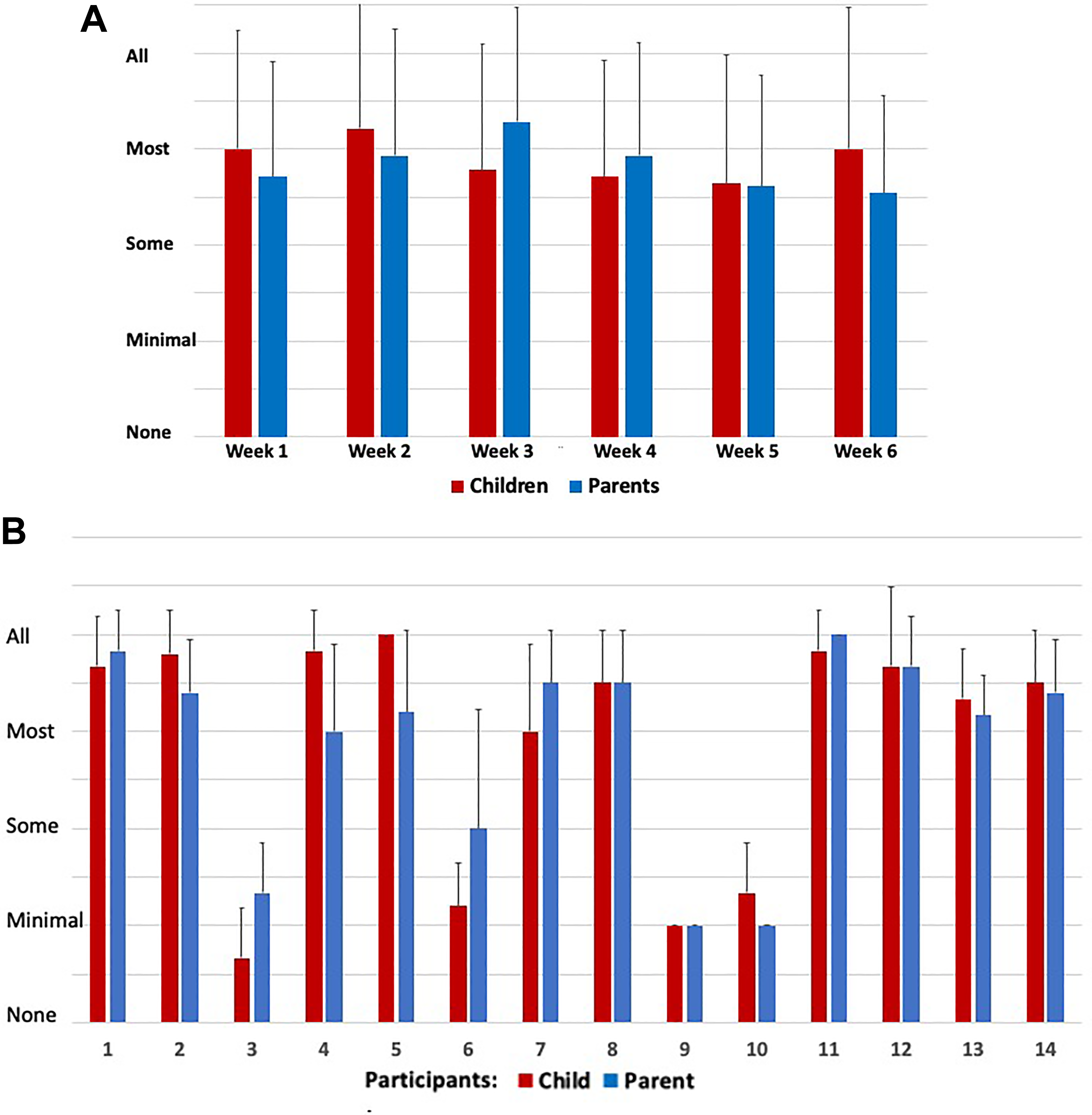
A, Children and parent’s engagement with training materials (M and SD). Training materials for each week included worksheets, audio recordings, books, and daily practices. All = engagement with all home training and completion of daily practices; Most = engagement with all home training materials and some daily practice; Some = engagement with some training materials and/or home practices; Minimal = engagement with one of the training materials and/or daily practice; None = no reported engagement or independent practice for that training week. B. Child’s engagement mirrors their parent’s engagement across training (M and SD for individual children and their parents). All = engagement with all home training and completion of daily practices; Most = engagement with all home training materials and some daily practice; Some = engagement with some training materials and/or home practices; Minimal = engagement with one of the training materials and/or daily practice; None = no reported engagement or independent practice for that training week.
The level of enjoyment and understanding that materials provided was captured each week from parents and children using a 5-point Likert scale from 0 (“Strongly disagree”) to 4 (“Strongly agree”). Means and SD are shown in Figure 2A and B. Details regarding the statistical analysis of scores on mindfulness measures across time can be found in the Supplementary Materials.

A, Children rate mindfulness books as most enjoyable. M (SD) for children’s ratings of the home training materials by week. B, Parent’s ratings (M and SD) of enjoyment and understanding of the home training materials.
In order to determine the feasibility of working memory training after mindfulness training, CogMed Performance Index (CPI) scores were analyzed. This score reflects children’s working memory improvement over the course of the training. Student’s t-tests were run to confirm that improvement, as measured by CPI, was significantly greater than zero for both the full sample and the mindfulness group independently.
Results
Feasibility of PC-MBT (Engagement)
In this study, all participants (parents and children) successfully completed the PC-MBT program, including attending all training sessions (in person and online) across the 6-week program. Parents’ and children’s weekly practice logs and completed worksheets were collected each week and used to determine which materials participants engaged with and how often (Figure 3). Four families utilized all home practice materials every week of the program. A majority of families (11 of 14) utilized all 3 types of home practice materials throughout the program. The remaining 3 families all reported utilizing the books, which parents and children read together. Of the 11 families that utilized all 3 resources, 9 families reported using the books all 6 weeks of the training compared to 8 families that used worksheets and 5 that reported using the audio recordings every week of the program (Figure 3).
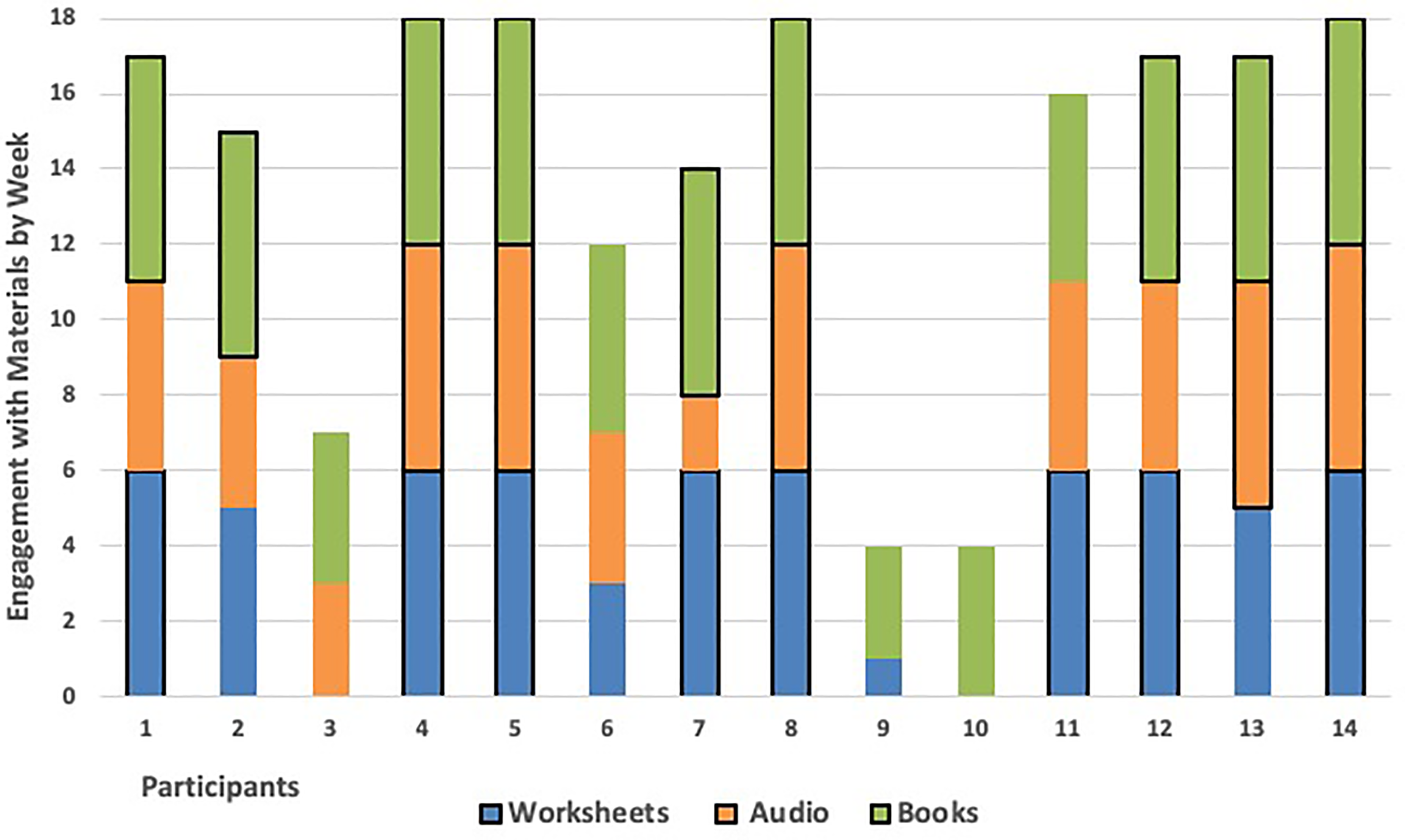
Children’s engagement with home training materials (worksheets, audio, and books). Data are presented individually for each child participant, with the colored bars showing the number of weeks that each of the materials were utilized. Bolded sections indicate when participants utilized a training material during all 6 weeks of the PC-MBT program.
Across participants, mean engagement scores show that both children and parents utilized most of the home practice materials each week of the PC-MBT program (Figure 1A). Overall, 79% of families regularly engaged with home practice materials to support the weekly training topics. While perhaps not a surprise, it is important to note that parents’ level of engagement is mirrored by their children (Figure 1B). For those families who were less engaged, time and schedule were reported as the greatest barriers to completing daily practice exercises and engaging with home practice materials.
A large majority of families also reported that they completed activities for daily practice (mindful eating, mindful showering, etc.). On average, across the 6-week program, participants engaged with prescribed and self-identified daily practices most of the time (approximately 4 days of the week).
Acceptability of PC-MBT (Enjoyment and Understanding)
The majority of participants reported high levels of enjoyment and understanding of the PC-MBT program content, specifically the in-person and online trainings, as well as the home practices and materials (daily practices, audio recordings, books, and worksheets). On average, across all 6 weeks of training, children and parents rated the in-person and online trainings as useful.
Among the home practice materials, the mindfulness books were rated as the most enjoyable training tool by both parents and children (Figure 2A and B). Specifically, families gave the highest rating to the following books: No Ordinary Apple by Sara Marlowe 38 and Zen Shorts by Jon Muth. 39 When asked if they enjoyed the books, children on average, across all 6 weeks, strongly agreed (M = 4.55, scale of 1-5) and reported that the books helped them to understand the program content. Children’s average ratings for worksheets (M = 3.67) and audio recordings (M = 3.57) were lower (between neutral and agree) on the rating scale. All families reported high levels of enjoyment during the training, and books were reported as the most highly used resource of the three home practice options.
Children and parents reported that the daily practice was useful (M = 3.93 and M = 3.89, respectively). Comments from parents included, “[The daily practices] are such a great way to focus and center our family,” and “We all did this as a family one day when everyone was a bit out of sorts—it was very helpful!” Children said they found the home practices “fun” and “relaxing.”
Mindfulness Measures
See Supplementary Materials for information about mindfulness measures, as training efficacy was not the focus of this feasibility and acceptability study.
Working Memory Training
Although not the main focus of this study, working memory in children was also measured before and after the working memory training to assess the fidelity of training and to address the feasibility aim of this study. As expected, analysis of the CogMed Performance Index (CPI) scores showed significant improvement across the full sample (t(20) = 15.02, p < .0001), as well as, the mindfulness training group specifically (t(12) = 10.66, p < .0001), demonstrating that working memory improved after Cogmed training, even when that training immediately followed mindfulness training. This finding provides support for the feasibility of combining the mindfulness and working memory training programs.
Discussion
This study examined the feasibility and acceptability of a new parent-child mindfulness-based training program (PC-MBT) delivered in the home setting. All participants successfully completed the PC-MBT program and a majority reported high levels of enjoyment and understanding of the 6-week program. By demonstrating feasibility of the PC-MBT program within a normative population of children and their parents, this study lays the foundation for further studies to explore the efficacy of PC-MBT and its potential impact on cognitive performance, attentional control, and stress in children. For example, PC-MBT may be particularly relevant for children who experience anxiety as traditional MBSR programs have demonstrated reduced anxiety in adults. 2,3 Anxiety disorders, with a median onset age of 11 years old, rank among the most prevalent class of mental disorders in adolescents and adults. 11 Teaching children and their families healthy coping strategies through PC-MBT or similar programs, prior to the onset of clinical symptoms, may provide families alternate treatment options and possibly serve as a means of mitigating the deleterious effects of anxiety disorders.
A unique aspect of the PC-MBT program is that training is completed in the home. There are several advantages to teaching the PC-MBT program in the home. These include children being more comfortable in the home setting and an instructor who is able to observe the home environment and respond to each family’s specific needs within their home setting. Practicing and developing mindfulness skills within the home context is also likely to foster further practice and implementation of these skills in the home, where the majority of time is spent with family members. As schools are implementing more social and emotional learning into their teaching competencies, 10 training parents with their children in the home may additionally strengthen outcomes by encouraging out-of-school practice. 23,28,29 The importance of parental inclusion is supported in our study as child engagement mirrored parent engagement in PC-MBT (Figure 2B).
Our study provides evidence of both the feasibility and acceptability of this parent-child mindfulness program. When feasibility and acceptability are reported, previous studies examining mindfulness programs in schools suggest high acceptability among students and teachers. 4 Our participants similarly reported high levels of acceptability. Although families engaged with all mindfulness materials, including books, audio recordings, and worksheets, books were the preferred method of support materials (Figure 3). Books provide a “joint object of reference” for parents and children to discuss “story characters’ feelings and thoughts.” 40 In particular, children’s storybooks may aid in the development of positive cognitive empathy through perspective-taking and out-group connection. 40 Shared reading between parents and children allows parents to discuss mental states of the characters and introduce emotional words that may promote empathy 40 and influence children’s theory of mind development. 41 In our study, books allowed parents and children to engage in discussions about compassion, which were then reinforced through mindfulness practices. Collectively, our study suggests that for parents who engaged with program materials on a limited basis, books were the most accessible, enjoyable, and most frequently used resource to teach mindfulness to both children and parents. Future studies implementing PC-MBT may want to consider utilizing books as the primary tool for connecting parents and their children with mindfulness and may even wish to examine more specifically which books best reinforce mindfulness practices.
Our results also support the feasibility of sequential trainings, as children completed two consecutive trainings: PC-MBT and working memory. Children in this study showed improvement in working memory after 6 weeks of Cogmed training, even when that training immediately followed 6 weeks of mindfulness training. This finding lays the foundation for future studies to examine whether mindfulness training prior to cognitive training improves the impact of the cognitive training (for example, leading to increased improvement in working memory).
Study Limitations and Future Research Directions
This pilot study helped establish the feasibility and acceptability of a new parent-child mindfulness program. Due to the nature of the pilot study, the scope of this study was limited in several respects. For example, the study sample was small in size and some data were not available as some participants did not complete all questionnaires. The study sample was comprised of a healthy, normative participant pool as this is often considered the first step for examining feasibility and acceptability of a new program. However, now that feasibility and acceptability have been established, future studies of the PC-MBT program will need to include a broader sample of children and their parents to include a more diverse sample, potentially including individuals with mobility issues, and children who suffer from anxiety or attentional deficits.
Although not the focus of this study, mindfulness measures were collected (see Supplemental Materials), and it is noteworthy that some baseline scores differed between groups. This is an important consideration for future studies examining efficacy of the PC-MBT program and will need to be addressed from the outset if control and treatment groups are randomly assigned. It is also important to note that few, if any, mindfulness measures are age-appropriate for the children (ages 8-10) included in this study. At the time of this program, the CAMM questionnaire was the best available measure for children although it is recommended for children ages 11 years and older (Supplementary Table 1). Development of age-appropriate mindfulness measures will be necessary to adequately assess efficacy of future PC-MBT programs.
Future research with the PC-MBT program will also need to consider additional challenges when expanding this work as parental engagement in the home environment may be limited due to socioeconomic status, employment, and mental health. It will be necessary to examine parental stressors that may also impact the program’s fidelity in more diverse populations. On the other hand, PC-MBT also provides the opportunity for families with low socioeconomic status, limited access to transportation, or parents with more than one child to complete training in the home, which may not have been possible if the training was offered in a group setting outside of the home, with scheduling that may not have fit the family’s needs. It is also possible that greater flexibility for families through training in the home may actually create a more inclusive environment for those families who may not otherwise have access to mindfulness training.
Conclusion
This study is one of the first to explore a mindfulness program (PC-MBT) that includes both parents and children training simultaneously in the home setting. With 100% of participants finishing the PC-MBT program and high levels of reported engagement and enjoyment, this work has established the PC-MBT program as both feasible and acceptable within a normative population. Following PC-MBT with additional cognitive training (i.e., working memory training), is also feasible as children completed the training and demonstrated expected improvements in working memory. This study lays the foundation for further research into PC-MBT efficacy and to begin feasibility and acceptability testing with clinical populations, particularly for children who experience anxiety. Additional studies should also examine the efficacy of PC-MBT for enhancing outcomes from subsequent cognitive training programs.
Supplemental Material
Supplemental Material, sj-docx-1-chp-10.1177_2515690X211002145 - Parent-Child Mindfulness-Based Training: A Feasibility and Acceptability Study
Supplemental Material, sj-docx-1-chp-10.1177_2515690X211002145 for Parent-Child Mindfulness-Based Training: A Feasibility and Acceptability Study by Courtney H. Guenther, Rebecca L. Stephens, Macy L. Ratliff and Sarah J. Short in Journal of Evidence-Based Integrative Medicine
Footnotes
Authors’ Note
Courtney Guenther—Writing original draft, review and editing. Rebecca Stephens—Data collection, analyses, review and editing of manuscript. Macy Ratliff—Mindfulness instructor, data collection, review and editing of manuscript. Sarah Short—Conceptualization, formal analysis, investigation, review and editing, supervision. This study was approved by the University of North Carolina at Chapel Hill Institutional Review Board (Protocol #: 15-2203).
Acknowledgments
The authors would like to thank all of the parents and children who participated in this study. They also wish to acknowledge the following individuals for their support and guidance during the development of this study: Barbara Goldman and Maggie Fox at Frank Porter Graham Child Development Institute, John H. Gilmore and Karen Bluth with the Psychiatry Department at UNC-Chapel Hill, and Sarah Jarvis at UNC-Chapel Hill. The authors are grateful to Elizabeth O’Callaghan at UW-Madison for her review and editorial comments on the manuscript.
Declaration of Conflicting Interests
The author(s) declared no potential conflicts of interest with respect to the research, authorship, and/or publication of this article.
Funding
The author disclosed receipt of the following financial support for the research, authorship, and/or publication of this article: This work was supported by the Mind & Life Institute Francisco J Varela Research Award [2013-Varela-Short, Sarah] and K01-MH099411.

Supplemental Material
Supplemental material for this article is available online.
References
Supplementary Material
Please find the following supplemental material available below.
For Open Access articles published under a Creative Commons License, all supplemental material carries the same license as the article it is associated with.
For non-Open Access articles published, all supplemental material carries a non-exclusive license, and permission requests for re-use of supplemental material or any part of supplemental material shall be sent directly to the copyright owner as specified in the copyright notice associated with the article.
