




Abstract
Both external structure (ie, participating in extracurricular activities) and family factors (ie, parental emotional support) have separately been linked with children’s physical health and well-being, however, their combined effects are less well known. The current study examined the longitudinal associations between participating in structured out-of-school activities and parent reports of warmth/emotional support with children’s weight status (ie, zBMI) over time. Utilizing longitudinal data from the United States-based Early Childhood Longitudinal Study, Kindergarten Class of 2010 to 2011 (ECLS-K:2011), we employed a confirmatory factor analysis (CFA) and a latent variable cross-lagged path analysis to examine if emotional supportiveness and participation in structured activities predicted lower zBMI over the course of 1 year. The final sample included 18 135 participants. Mean age of the participants was 8.12 years (±0.38 years), and 51% of children were male. Mean zBMI was 0.54 (±1.12). Structure at baseline predicted increased zBMI in year 2 (β = .03, P = .02) but did not predict parent emotional supportiveness at year 2 (β = −.05, P = .09). Parent emotional supportiveness at baseline predicted greater zBMI at year 2 (β = .02, P = <.01) but did not predict structure at year 2 (β = .02, P = .39). zBMI at baseline did not predict structure (β = .02, P = .25) or parent emotional supportiveness at year 2 (β = −.01, P = .55). Our findings were inconsistent with our hypothesis with regard to directionality. Continued refinement about the role of internal structure (ie, family, and parenting practices) may inform public health prevention strategies to support the well-being of children and families.
Introduction
Childhood obesity is linked to a variety of non-communicable diseases.1,2 Contributions to obesity risk result from a complex interaction of predictors, including parenting, family, psychosocial, and environmental factors.3-5 Research has established that Adverse Childhood Experiences (ACEs) (eg, physical abuse, emotional neglect, etc.) are associated with childhood obesity and mental health conditions in children.6-8 However, little research has explored positive experiences or protective factors that may buffer against negative adverse outcomes. More preliminary work has begun to explore the association between positive experiences and health outcomes.9-12 For example, “flourishing” is a concept comprised of positive life features, including positive emotion, engagement in meaningful activities, competence, and self-esteem.13-15 Both positive experiences with a parent/caregiver in the home and positive and engaging experiences at programs outside of the home may provide the necessary conditions to support a child’s ability to flourish.
Parent emotional supportiveness, such as problem-solving and positive responsiveness, have been found to have moderate associations with children’s weight outcomes.16,17 Still, the contextual nature of the psychosocial mechanisms remains unclear5,18 Avula et al 18 examined individual parenting practices and their associations with weight change in children and found that an increase in individual parenting practices was associated with lower odds of being overweight. 19 However, this study only examined selected individual parenting practices and their singular association with body composition, which may not capture the true underlying latent concept of ‘positive parenting’ due to measurement error. 20 Stated differently, by using only raw questionnaire items, authors are unable to separate signal (positive parenting) from noise (measurement error). Alternatively, a latent variable approach can extract the underlying construct that each specific behavior shares, thereby creating an “error-free” construct. Understanding the core constructs underlying the association between parenting and health can inform different forms of public health interventions to support children and families. Chen et al 17 also concluded that greater relationship satisfaction was associated with a lower risk of offspring mental illness, eating disorders, overweight/obesity, and marijuana use.
Children can also have positive and engaging experiences that lead to flourishing outside their homes. Structured programs outside of the home are likely to have positive experiences within these opportunities, leading to a child’s ability to flourish. The Structured Days hypothesis states that a structured day (ie, school day, after-school program, etc.) can play a protective role against obesogenic behaviors and, ultimately, prevent unhealthy weight gain in children. 21 Less is known regarding the type and context of structured programs that will, in part play a role in weight maintenance during less-structured periods.22-25
No studies have simultaneously examined the influence of parents’ emotional supportiveness and out-of-school activities on children’s weight outcomes over time. We hypothesize that parenting practices and engagement in structured activities complement each other and lead a child to flourish, which will predict a healthy weight status. The purpose of this study is to examine the longitudinal association between participating in structured out-of-school activities, and the presence of parental “emotional supportiveness” with weight status (ie, zBMI change) over time.
Methods
This research draws on publicly available data from the Early Childhood Longitudinal Study, Kindergarten Class of 2010-11 (ECLS-K:2011). ECLS-K:2010 follows a nationally representative sample of US children from kindergarten through elementary age. 26 The survey collects data on children’s early educational experiences through interviews with parents, questionnaires with teachers and school administrators, and one-on-one assessments with children. 26 This study utilized data from the Spring 2015 to Spring 2016 parent interview portion of the database and demographic and anthropometric information. Data collection included interviews with parents and visits to schools to select children for the study and collect signed consent documents, all led by trained data collectors. 26 Structural equation modeling (SEM) utilizing a confirmatory factor analysis (CFA) and a latent variable cross-lagged path analysis was conducted to answer the research questions listed below:
Will children who attend structured out-of-school activities show less BMI-z score gains over 1 year?
Will positive parental emotional supportiveness show less BMI-z score gains over 1 year?
Confirmatory Factor Analysis
CFA is a type of SEM technique that examines relationships between observed indicators (eg, questionnaire items) and unobserved latent variables.27-29 Once both unobserved and observed variables are identified, you can estimate factors relating to each observed indicator, CFA allows for the common variability or the influence of the same underlying construct of each observed indicator with a pre-determined latent variable.30,31 This approach theoretically removes random measurement error, thus increasing the convergent validity of theoretical constructs. 28 The current study used the observed indicator variables as indicators of latent constructs representing extra-curricular structured activities and positive parental emotional supportiveness. This approach was chosen as theoretical concepts of structure and positive parental practices association with health outcomes are established in the literature.18,21
Within a CFA, The objective of using latent variables is to investigate the relationship by statistically relating covariation between observed to latent variables. 32 This method is conducted using a factor model, in which factors are drawn to examine the relationships between observed variables and unobserved latent constructs. For this project, 2 latent variables were constructed: structure and positive parental emotional supportiveness.
We measured structure from 4 observed indicators that occur outside of school hours based on the frameworks of SDH and flourishing. These binary indicators were included in the parent interview portions of Spring data collection within ECLS-K:2010-11: 1) Outside of school hours in the past year, has [your child] participated in: Academic activities, like science, computers, math lab, and so on 2) Outside of school hours in the past year, has [your child] participated in Organized clubs or recreational programs, like scouts? 3) Outside of school hours in the past year, has [your child] participated in Music lessons? and 4) Outside of school hours in the past year, has [your child] participated in Drama classes?
We examined latent parent emotional supportiveness from 5 measured indicators based on the parent emotional supportiveness aspects of flourishing. Questionnaire items were answered on a Likert-scale (never true, sometimes true, often true, or very often true) and were selected from the Discipline, Warmth, and Parental Emotional Supportiveness section of the Spring parent interviews within ECLS-K:2010-11: 1) I encourage my child to express his/her opinions, 2) I encourage my child to talk about his/her troubles, 3) I encourage my child to tell me about his/her friends and activities, 4) I discourage my child from talking about his/her worries because it upsets him/her, and 5) Even if I am busy, I make time to listen to my child. All observed variables and their descriptions can be found in the supplementary materials section.
Measures
Anthropometrics
Trained ECLS-K:2010-11 staff collected height and weight measurements using study protocols. Children’s height and weight were measured using a Shorr board (tall wooden stand with a ruled edge for measuring height) and a digital scale to obtain weight measurements. 26 Children’s height (in inches to the nearest quarter inch) and weight (in pounds to the nearest half pound) were recorded twice to ensure reliable measurement. 26 Heights and weights were then converted to metric before being fused or BMI calculation. BMI was then calculated using the standard formula (ie, BMI = kg/m2). From there, World Health Organization age-sex standardized BMI z-scores (zBMI) were estimated. 33
Covariates
Income-to-poverty is calculated by dividing the total reported household income by the Department of Health and Human Services poverty level, where lower scores represent greater unmet need. For example, an income-to-poverty ratio of 0.5 indicates that a household is earning an equivalent of 50% of the amount of income as the federally established poverty level. Each participant was classified as low, medium, or high based on their household income-to-poverty ratio. Classifications aligned categories defined by the study database 34 and were created as follows. If a child’s household received an income-to-poverty ratio of 0.00 to 0.99, the child was classified as “low-income.” Children living in a household with an income-to-poverty ratio of 1.00 to 2.00 were classified as medium-income, and children living in households above 2.00 on the income-to-poverty ratio were classified as high-income.
Race/ethnicity of children was collected via parent proxy report. Race was included in the model as a dichotomous variable (white vs underrepresented racial groups [ie, Black, Asian, more than 1 race])) to account for the impact of identifying as part of a historically minoritized group in the context of a society that favors “whiteness.” 35 Discrimination and other psychosocial stressors occur more often in minoritized populations. Therefore we chose to dichotomize race as described above. 36
Analysis
All analyses were performed using Mplus version 8.1. 37 We used a cross-lagged panel design with latent variables. This approach allows for patterns of covariation among variables to be examined over time. 38 In this approach, information from 2 or more variables are measured on 2 or more occasions and allowed to predict each other over time. The analytical approach was performed in 2 steps. First, measurement models were constructed to examine the model fit of the latent constructs. Second, we investigated the statistical assumption of latent factor stability (ie, time invariance) of all observed indicators on structure and parental emotional supportiveness at both timepoints. Because of the longitudinal nature of the data, we allowed the observed variable residuals to correlate with themselves over time. We incorporated a stepwise approach to assess model fit by each latent variable across years and then as 1 final measurement model. Model building proceeded as follows model 1) we restricted the model to just the first year and assessed model fit for the latent variable “Structure.” Model 2), model fit for the latent variable positive parental “Emotional Supportiveness” at baseline was assessed. Model 3) we restricted the model to just the second year and assessed model fit for the latent variable “Structure.” Model 4), model fit for the latent variable positive parental “Emotional Supportiveness” was assessed in the second year alone. Model 5), we estimated the model fit for the final measurement model, including latent constructs and their observed indicators over 1 year. To assess model fit, we examined several fit indices: root mean square error or approximation (RMSEA) ≤ 0.08, 39 comparative fit index (CFI) > 0.90, 40 standardized root mean square residual (SRMR) < 0.08, 39 and chi-square test P > .05. 41
Next, a path analysis with autoregressive and cross-lagged paths was examined, including time to examine the relationships between the endogenous latent variables of structure and emotional supportiveness and the outcome of interest zBMI. 42 Covariates of race/ethnicity, sex, and age were included in the final model estimating autoregressive and cross-lagged effects. Standardized path coefficients were interpreted as effect sizes using the following guidance: .03 Small effect, .07 medium effect, and .12 Large effect. 43
Results
Demographics of the analyzed sample at baseline (Spring 2015) are presented in Table 1. The final sample included 18 135 participants (8.12 years, ±0.38 years, 51% male). The mean zBMI was 0.54 (±1.12). 47% of the parents classified their children as White, 13% as Black, 25% as Hispanic or non-White Hispanic, 9% as Asian, 2% as American Indian or Pacific Islander, and 5% as multi-racial. 20% of participants were low-income (0.0-0.9 PIR), 22% of participants were classified as medium-income (1.0-1.9 PIR), and 52% of participants were classified as high-income (>2.0 PIR).
Demographics of Analyzed Sample at Baseline.

Abbreviation: PIR, Poverty-to-Income Ratio (PIR of 1.0 equates to living at the poverty line).
All descriptive based off year 1 (baseline) characteristics.
At baseline and year two, the latent variable structure was constructed of 4 observed measures. The latent variable of Parental Emotional Supportiveness at baseline and year 2 were constructed of 5 observed measures. Model fit indices are presented in Table 2. The estimates produced indicated at least adequate model fit for all models. Thus, we concluded that observed indicator variables served as adequate measures of our latent factor.
Model Fit Estimation.

Standardized path loadings are presented in Table 3. Exogenous variables were allowed to correlate in the model at baseline. Table 3. Highlights direct path loadings for each observed indicator and the latent variable used in analysis presents as standardized beta-coefficients. This allows for the direct understanding of each observed measure and its association with each present latent variable. Further, structure and zBMI were correlated at baseline (β = .06, P = <.01)
Standardized Path Loadings for Each Indicator and Latent Variable Used in Analysis.
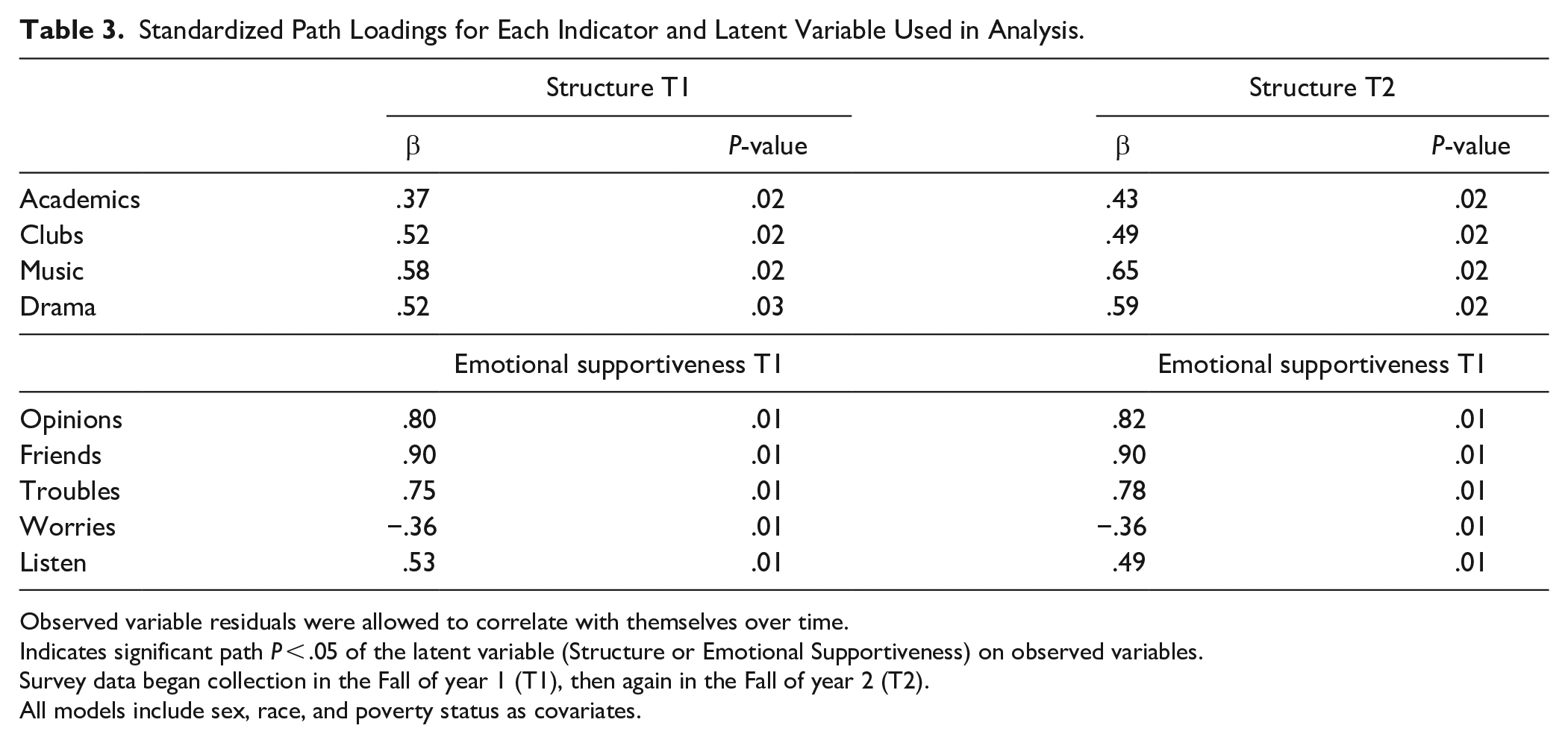
Observed variable residuals were allowed to correlate with themselves over time.
Indicates significant path P < .05 of the latent variable (Structure or Emotional Supportiveness) on observed variables.
Survey data began collection in the Fall of year 1 (T1), then again in the Fall of year 2 (T2).
All models include sex, race, and poverty status as covariates.
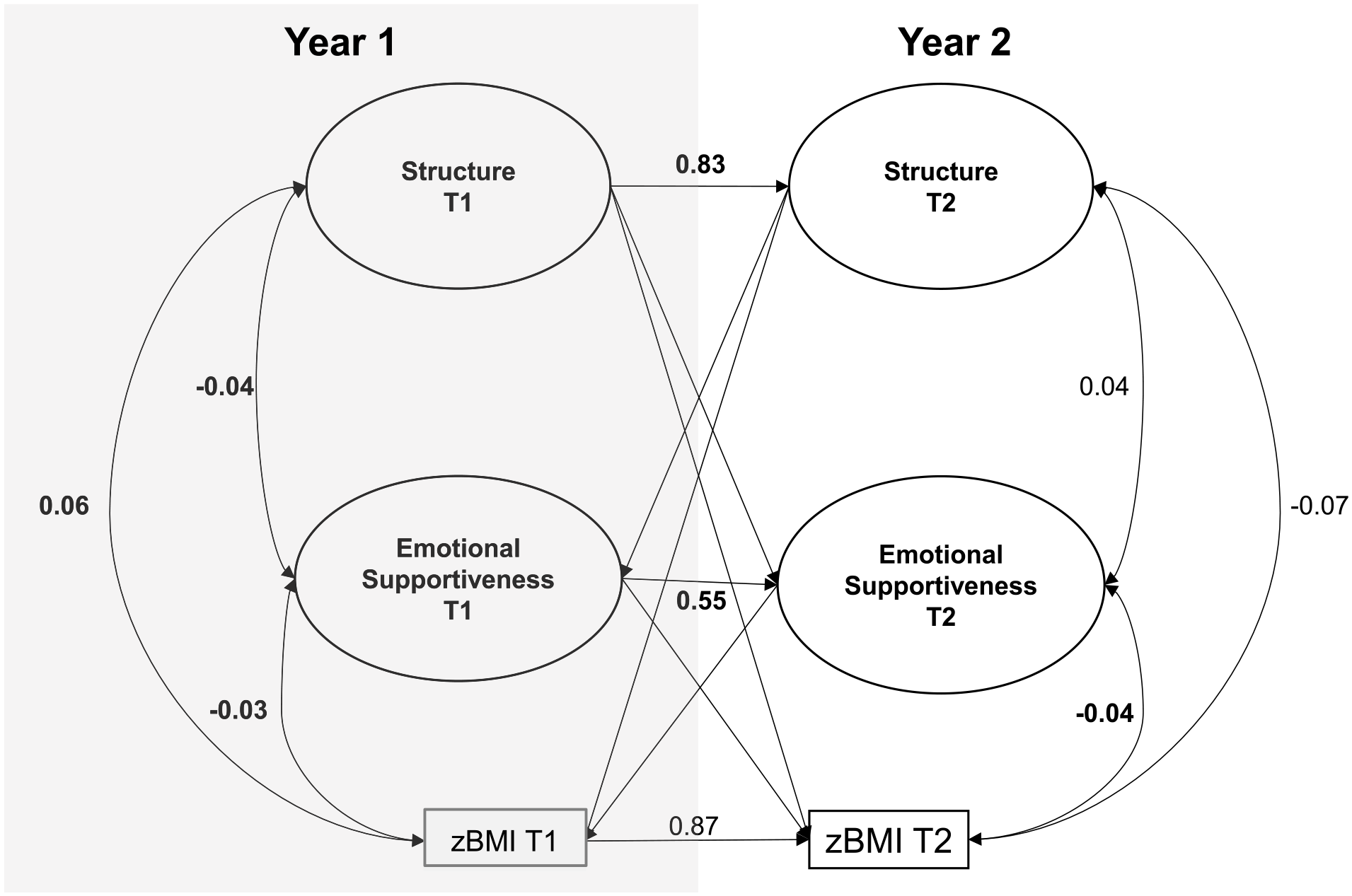
Standardized cross-lagged path loadings for each latent variable and outcome used in analysis.
Higher structure predicted itself at time 2 (β = .83, P = <.01), parent emotional supportiveness at baseline predicted parent emotional supportiveness at year 2 (β = .55, P = <.01), and zBMI at baseline predicted zBMI at year 2 (β = .87, P = <.01).
Associations between cross-lagged parameters can be found in Figure 1. Structure at baseline predicted greater zBMI at year 2 (β = .03, P = .02) but did not predict parent emotional supportiveness at year 2 (β = −.05, P = .09). Parent emotional supportiveness at baseline predicted greater zBMI at year 2 (β = .02, P = <.01) but did not predict structure at year 2 (β = .02, P = .39). zBMI at baseline did not predict structure (β = .02, P = .25) or parent emotional supportiveness at year 2 (β = −.01, P = .55). Higher amounts of structure and parent emotional supportiveness both were associated with zBMI at year 2. Further, results from the cross-lagged analysis indicate that in this cohort, zBMI may not be associated with structure or parent emotional supportiveness at year 2.
Figure 1 also presents associations of residual variability. Residual variability between year 2 parent emotional supportiveness and year 2 structure was significantly correlated (β = .04, P = .04). Residual variability between year 2 structure and year 2 zBMI was not significantly correlated. Year 2 parent emotional supportiveness and year 2 zBMI was significantly correlated (β = −.04, P = .04). The residual correlation between parent emotional supportiveness and zBMI indicated additional covariance between these parameters not explained by the model.
Discussion
This study examined relationships between structured out-of-school activities, parent emotional supportiveness and zBMI. In contrast to our hypothesis, we found that higher parent emotional supportiveness and structure were associated with increased zBMI a year later. We used a parent emotional supportiveness latent factor which loaded on 5 observed indicators of emotional support and warmth. Our results contrasted with Avula et al 18 which found that similar supportive parenting practices were associated with smaller increases in children’s zBMI. Thus, additional aspects of parental emotional supportiveness, such as compassion, warmth, and self-esteem building, that were not measured in the current study may contribute to maintaining body composition in children.
While established as predictive of health in adults, the concept of flourishing is less studied regarding childhood obesity. 13 In addition, flourishing is most commonly measured using specific indicator questions, 44 which are not directly captured here. The current study used the concept of flourishing as a guiding framework. As a proxy, we used a latent variable approach and used observed indicators hypothesized to load on 2 aspects central to the concept of flourishing. Thus, while the concept of flourishing guides the spirit of this study, a direct comparison between measures used in the current study may not represent the concept as described elsewhere.
Study results regarding structure are also surprising and warrant further investigation. Study hypotheses were based on the Structure Days Hypothesis, which states that the presence of structure in pre-planned and adult supervised activities can play a protective role against negative obesogenic behaviors and subsequent weight gain. 21 As the Structure Days Hypothesis is based upon the “filled-time” perspective 45 we included 4 observed indicators that occur outside of school hours based on the Structure Days Hypothesis. While these activities are pre-planned, and adult supervised they were not related to weight outcomes in the hypothesized direction. There are several reasons why this may be the case. First, parents only report if their child/children only attended these programs. Therefore, gathering contextual information on the experience of the programs is limited. Second, measures in the current study did not capture the dose of programming to which children were exposed. Thus, children may not have attended these programs frequently enough to have sufficient exposure to engaging and positive experiences that would lead to flourishing and therefore change in zBMI. Third, the structured programs that children attended in the current study likely occurred during the school year while children were also attending school. Thus, any positive and engaging experiences children received occur in the context of a school day. During the school year, children spend up to one-fifth of their waking hours in school. Therefore, positive or negative experiences during the school day may override any experiences in programming outside of the school day. Placing these programs and making them accessible to children in the summer may have a more significant impact on obesity, as children gain significantly more weight and engage in more negative obesogenic behaviors during summer vacation when they are not enrolled in school.46-48 Finally, the content of the programs that were included, while potentially providing positive experiences, may not be sufficient for impacting children’s health behaviors. Past research that has examined the impact of the Structure Days Hypothesis on children’s weight status has included attendance at schools and summer programs as the indicator of structure.48-50 While health is not the main focus of most school and summer programs, both of these settings provide opportunities for physical activity (PA) (ie, free play or recess) and healthy eating (ie, National School Lunch and Summer Feeding Programs).51,52 Providing PA and healthy eating opportunities may be essential for the Structure Days Hypothesis to influence children’s weight status positively. It is unclear if the structured programming in the current study offered PA or healthy eating opportunities.
This study adds to the literature on the etiology of childhood obesity by examining the dual influences of structure and emotional supportiveness using a positive protective factor lens. While these constructs have typically been examined in isolation, the current study investigated the combined effects using a large nationally representative sample. An additional strength of this study is the use of objective, longitudinal measured body composition, which increases the robustness of the study. However, using additional measures of body composition, such as percentage body fat derived from dual x-ray absorptiometry (DEXA), could strengthen our ability to understand and examine the longitudinal nature of body composition and its association with health outcomes. Lastly, by utilizing an SEM model, we could estimate the covariation of observed indicators to their latent variable, correcting for biases attributable to measurement error. 53 However, this study has limitations. In particular, this is a secondary analysis, and measures were not designed to answer the research question specifically. We utilized and identified survey questions that parents were asked in back-to-back springs of data collection. Therefore, other variables that may have contributed to the latent variables of external structure and parent emotional supportiveness were omitted because they were not measured in both measurement waves. Therefore, the validity of these latent constructs is questioned. 54 For example, indicators of cognitive stimulation, such as providing parental warmth, is omitted from this analysis, even though it is central to the concept of flourishing. This may limit our ability to fully extrapolate results to generalize to the larger population. The use of parent/guardian reporting sensitive information regarding emotional support of their child/children may lead to information bias as they would potentially avoid reporting negatively. This could skew parts of the observed indicators An additional point for future studies would be to have a specific focus on early life exposure and dietary intake, as recent literature suggests an association between the 2. 55 Findings from Bost and colleagues found that parenting styles and emotional regulation influence dietary intake. 56 Further, Webb et al 57 also concluded that the parent-child relationship was predictive of child dietary intake, highlighting the need for these exposures to be included in future studies. It should also be noted that future projects examining these questions should consider a separate analysis by sex, as differences by sex exist in obesity status among youth. 58 Because the dataset was not designed with this specific research question, all aspects of parent emotional supportiveness are not captured. Of the 5 functional domains of positive parenting (meeting physical needs, child safety, development stimulation, positive communication, and positive discipline), this study only captures emotional warmth and does not focus on discipline and development stimulation. 59 The observed measures of structure also have limitations. A single indicator regarding the past year and not capturing the dose of attending activities limits the strength of the available indicators’ ability to capture attendance over time to specific activities. Finally, standardized estimates showed small effects (all below .03). 43 Given the large sample size, we may be overpowered to find statistically significant but not clinically meaningful effects. 60
Conclusion
The findings contribute to the literature linking parenting, structured out-of-school activities, and children’s weight status. Our findings were inconsistent with our hypothesis regarding effect and directionality of effect. We believe this may be due to the coarseness of measures included in the analysis. To appropriately capture this important research question, future studies explicitly designed to answer this research question may need to incorporate both positive and negative aspects of parenting to understand best how not only how positive experiences (ie, parental warmth) may impact health but how the absence of negative experiences may impact health outcomes. The observed measures of structure, largely comprised of sedentary activities, may not be sufficient to capture the underlying aspects of the Structure Days Hypothesis. While the hypothesis does not specifically specify that structure includes health-promoting activities directly (ie, sports), it is possible that these activities underpin much of the initial evidence supporting the Structure Days Hypothesis. Additional explorations of convergent validity for the latent factor used in the study and refinement of the nature of structure as it relates to the Structure Days Hypothesis may be warranted.
Footnotes
Data Availability
Data can be made available upon request
Declaration of Conflicting Interests
The author(s) declared no potential conflicts of interest with respect to the research, authorship, and/or publication of this article.
Funding
The author(s) disclosed receipt of the following financial support for the research, authorship, and/or publication of this article: The first author reported in this publication was supported by award/project number R21HD090647-01A1S1 of the Eunice Kennedy Shriver National Institute of Child Health & Human Development of the National Institutes of Health under parent Award Number R21HD090647. The content is solely the responsibility of the authors and does not necessarily represent the official views of the National Institutes of Health. Work on this article by Armstrong and Weaver was supported in part by the National Institute of General Medical Sciences of the National Institutes of Health for the UofSC Research Center for Child Well-Being under Award Number P20GM130420. The content is solely the responsibility of the authors and does not necessarily represent the official views of the National Institutes of Health.
Ethics Approval
All Authors have completed the Collaborative IRB Training Initiative and subsequent refreshers.
Patient Consent
The Early Childhood Longitudinal Study obtained appropriate consent and IRB approval.
