




Abstract
Background:
The Job Demands and Resources (JD-R) model is used to examine predictors of well-being, work engagement, and individual or organizational outcomes. According to the model, work engagement and communication skills play a mediating role between work-family conflict and resilience to job satisfaction in nurses.
Methods:
A cross-sectional study was conducted considering 431 Peruvian nurses of mean age (M = 40.31 years; SD = 10.94) ranging from 22 to 68 years working in public hospitals in the Lima region. Data were collected using a self-reported form of the Job Satisfaction Scale, communication skills, work engagement, work-family conflict, and resilience. The theoretical model was evaluated using structural equation modeling (SEM).
Results:
A theoretical model with adequate fit was obtained [χ2(2) = 6.0, P < .001, CFI = 0.995, RMSEA = 0.068, SRMR = 0.015]. Results indicated an inverse relationship between work-family conflict with communication skills (β = −.24, P < .001) and work engagement (β = −.10, P = .003). Likewise, resilience had an influence on communication skills (β = .55, P < .001) and work engagement (β = .33, P < .001). In addition, the model explains 71% of job satisfaction. Also, the results indicate the influence of work-family conflict and resilience through the mediating role of work engagement and work-family conflict on job satisfaction.
Conclusions:
The model confirmed that work engagement and communication skills are valid moderators to mitigate work-family conflict and strengthen resilience that favors job satisfaction in nurses.
Introduction
Globally, there is a shortage of nurses, and this becomes a major concern for organizations to maintain quality care for patients, therefore, there is a need for retention of nursing staff. 1 The psychological and physical conditions in which nurses perform contribute to higher attrition. The demands on nurses’ jobs require greater effort. 2 This effort is associated with a physical or psychological cost, since it requires the patient’s attention and mobilization showing positive emotions, even if the feelings are contrary. 2
The Job Demands and Resources (JD-R) theory is an extension of the Job Demands and Resources model. 3 JD-R examines predictors of well-being, engagement, and both individual and organizational outcomes of workers. 4 The model is based on 2 processes that play a role in the development of tension and motivation. First, job demands that comprise health impairment, that is, a large number of emotional demands and work-family conflict that deplete the employee’s capacity, lead to further burnout, quitting, or job dissatisfaction. The second process is motivational, and involves work resources that may be intrinsic, such as resilience and communication skills, which foster growth and development. Labor resources refer to the physical, psychological, and social aspects of work and can reduce the demands and costs associated with the physiological and psychological aspects. They can also help achieve work objectives or stimulate personal development and learning. 5 Therefore, the professional experiences have greater satisfaction and has a better performance; likewise, they lead to the achievement of objectives, such as work engagement, making it possible to cope with work demands.6,7
Previous studies have examined the impact of various job demands and resources. Employee well-being (work engagement) has been shown to impact job satisfaction.8,9 Job satisfaction has a major impact on most healthcare organizations as well as on patients. 10 Job satisfaction can be defined as an individual’s general attitude toward his or her job 11 ; this involves not only activities or tasks, but also aspects such as the work environment, which is often highly stressful and manifests itself emotionally in attitudes and work commitment. 12 The work environment influences several factors such as quality of care and patient safety, absenteeism, and increased intention to quit. 13 Furthermore, job dissatisfaction among nurses is a major problem, due to the negative effects of nurse turnover and the fact that there is a decrease in the number of nurses worldwide. 14 There is evidence that nurse retention is a persistent problem associated with job satisfaction. 15 Research indicates that job satisfaction in developing countries has declined and it is therefore important to better understand the factors related to job satisfaction.10,16
Low job satisfaction among nurses is due to a variety of factors, including interaction with co-workers. Few studies have examined how communication skills explain job satisfaction. 17 According to the JD-theory, the skills in the process that represent interpersonal resources require cognitive, psychomotor, and affective efforts; in addition, they can facilitate communication. 18 Effective nurse-patient communication is essential to improving outcomes in clinical settings, 19 becoming a key factor in making the workplace safe and healthy. 20 Communication allows for building therapeutic relationships and is a tool for diagnosing and providing interventions. Health care workers should be trained in communication skills. 21 Therefore, it contributes to greater professionalism, greater tolerance, respect for rights, and not violating other people’s limits. 22 Nurses, unlike other health care professionals, are the ones who provide the most patient care.23,24 They often worked during their breaks, experiencing high levels of stress. 25 Communication barriers may arise, such as inappropriate ways of communicating, introversion or avoidance of communication, decreased listening skills, and the creation of conflict. 26 Clearly, communication skills and work engagement are critical to providing holistic patient care. However, for nurses to be successful in their work, it is necessary for them to learn about various aspects and applications of communication during their nursing education, as communication is not a natural skill but something that is developed through specialized training, continuing education, and practical activities.27-29 Therefore, improving nurses’ communication skills with patients requires training programs at the national level. 22
On the other hand, the JD-R model has been modified in recent years to include aspects such as work-family conflict. 30 Nurses play different roles, usually emphasizing 2 roles, both of which must be balanced: work and family life. Since it provides them with the ability to be equally committed and satisfied with family and work roles. 31 However, the negative and significant relationship between work-family conflict and the level of job satisfaction is becoming increasingly evident. 32 Interference between work and personal/family life has been listed as one of the top 10 workplace stressors. 33 There are several factors that allow the development of work-family conflicts such as shift work, long hours, responsibility for patients, among others. 34 In addition, persistent work-family pressure has undesirable effects in the work domain, as it has been suggested that work-family conflict is negatively associated with work engagement, organizational commitment, and job satisfaction. 9 Work-family imbalance behaves as a negative predictor of work engagement,35,36 and a relationship has been found between work-family conflict and job satisfaction through work engagement. 37
It is in the best interest of organizations to keep labor demands on nurse’s low or decrease them, increasing resources to perform efficient work with little emotional cost. 38 Job demands affect work engagement, 39 which in turn affects the positive outcome of the organizations. Work engagement is a positive and rewarding state of mind in relation to work, characterized by the vigor and dedication with which the work is performed. 40 Professionals with high levels of work engagement show positive attitudes toward organizations. 41 For higher work engagement, nurses must have a higher work resource. Labor resources can lead to high work engagement and excellent performance. 42 Furthermore, work engagement is stimulated by institutional challenges, the global nursing shortage, quality of care, and overburdened work systems. 43 In addition, interpersonal relationships foster greater work engagement, moreover, they promote work behaviors with better job performance. 44
The JD-R model added personal resources as an antecedent to work engagement. Personal resources refer to individual aspects associated with resilience and represent a person’s ability to control and affect his or her environment. 2 Resilience, defined as the ability to overcome challenging obstacles and successfully cope with stressful events 45 is a contributing factor to job satisfaction 46 and that ameliorates the effects of family stress. 47 Several studies indicate that personal resources buffer job demands, specifically resilience predicts greater psychological well-being in healthcare workers. 48 Resilience has a positive effect on work engagement and communication skills.49-51 People become stronger, safer, and more productive when they overcome, through resilience, adverse events. 52 Furthermore, the indirect effect of resilience on satisfaction through resilience has been demonstrated. 53 Resilience can help health professionals adapt positively to stressful situations, better manage emotions, develop coping strategies, improve well-being, and aid professional growth. 54 Thus, resilience can improve the ability to alleviate stressors by improving the job satisfaction and commitment of healthcare personnel, while reducing burnout, as there is a close relationship between job satisfaction, resilience and job commitment. 55
To date, no studies have been reported in Peru that promote work engagement to improve job satisfaction through the use of JD-R in nurses. The JD-R model has shown that work engagement functions as a mediator between work demands (work-family conflict) and life satisfaction. Likewise, work engagement mediates personal resources (resilience)2,9,53; and in turn, it is expected to mediate the relationship between work-family conflict and job satisfaction. 37 In addition, the relationship between family-work conflict, resilience, and satisfaction through communication skills is expected. In this sense, job satisfaction is a topic of great importance for organizations linked to nursing professionals.
Taking into account the arguments adduced, the following hypotheses are put forward (Figure 1):
H1: There is a negative relationship between family conflict and work engagement and communication skills.
H2: There is a positive relationship between resilience and work engagement and communication skills.
H3: There is a positive relationship between communication skills and work engagement.
H4a: Work engagement mediates the relationship between work-family conflict and job satisfaction.
H4b: Work engagement will mediate the relationship between resilience and job satisfaction.
H5a: Communication skills will mediate the relationship between work-family conflict and job satisfaction.
Hypothesis 5: Communication skills will mediate the relationship between resilience and job satisfaction.

Theoretical model.
Materials and Methods
Study Design and Population
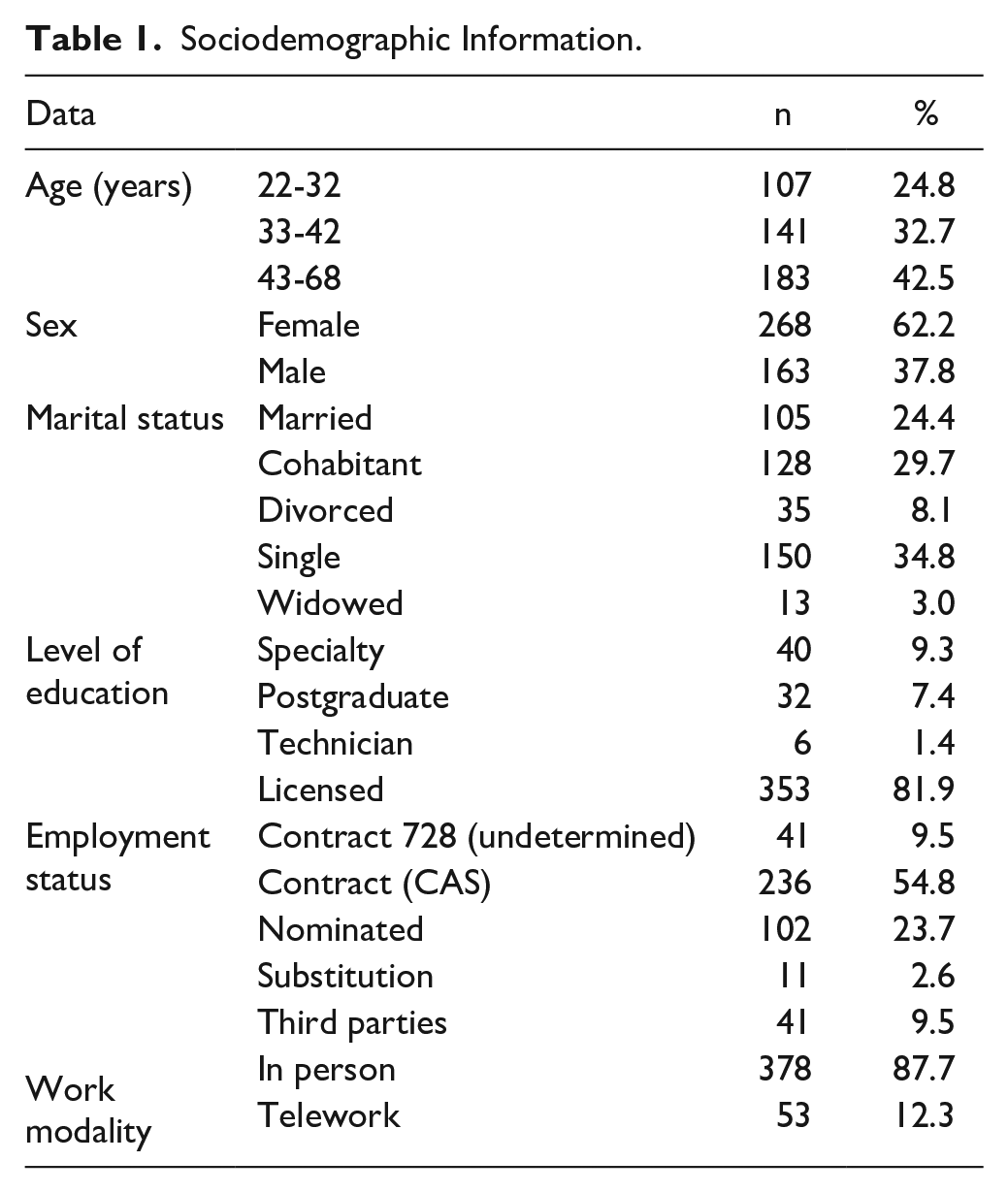
A cross-sectional and explanatory study was designed considering latent variables represented by a system of structural equations. 56 The review conducted by Schumacker and Lomax was considered to determine the minimum sample size, in which they indicate that articles that use SEM models tend to consist of between 250 and 500 subjects. 57 This is also supported by Iacobucci’s simulation studies 58 where they observe a good performance of the fit indices for SEM models for samples larger than 200. The sample was selected by non-probabilistic sampling. The participants consisted of 431 Peruvian nurses from the Lima region. The mean age was M = 40.31 years (SD = 10.94), ranging from 22 to 68 years. Table 1 shows that most of the participants were women (62.2%), single (34.8%), with a bachelor’s degree (81.9%), with an administrative service contract (ASC) (54.8%) and working in the face-to-face modality (87.7%).
Sociodemographic Information.
Instruments
Communication skills: The 18-item Communication Skills Scale (EHC) is a self-administered instrument to assess nurses’ communication skills. 59 It is scored on a 6-point Likert-type scale (1 = almost never to 6 = very often), with 4 dimensions: informative communication, empathy, respect, and social skills. 60 Internal consistency was adequate (α = .88) for the total scale and moderate for each dimension (empathy, α = .77; informative communication, α = .76; respect, α = .73; social skill, α = .70).
Job satisfaction: The Spanish-adapted G_Clinic satisfaction questionnaire was used to assess job satisfaction in nursing professionals. 61 The G_Clinic is a self-report made up of 10 items in 4 dimensions (work environment, labor relations, motivation and recognition). The response system is a 5-point Likert scale, where 1 is the minimum satisfaction and 5 is the maximum satisfaction. Internal consistency was adequate with a Cronbach’s alpha of .76.
Work engagement: For the assessment of work engagement, the brief engagement scale (UWES-9) was used by health professionals. 62 It is composed of 9 items, evaluated with a 6-point Likert-type scale ranging from 0 as never to 5 as always, with 3 dimensions: vigor, dedication, and absorption. The internal consistency by means of Cronbach’s α had a range of .84 to .92 for the dimensions.
Family-work conflict: The family-work relationship scale was used 63 and it is a self-report measure of 11 items that evaluates the conflict in the personal and professional life of health personnel, evaluated with a Likert-type scale with 7 points (1 = Total disagreement to 7 = Total agreement) in 2 dimensions: family support and family conflict. The dimensions have shown adequate internal consistency (family support = 0.87 and family conflict = 0.72).
Resilience: The Brief Resilient Coping Scale (BRCS) unidimensional version adapted to Spanish was used, 64 which assesses the ability to cope adaptively with stressors, which is composed of 4 items, evaluated with a Likert-type scale ranging from 1 (does not describe me at all) to 5 (describes me very well). Internal consistency was assessed using the component reliability index (0.70).
Procedure
The study was conducted during the months of January and February 2022. Personal contact was made with the health facilities. Approval was received from the ethics committee of a Peruvian university (Number: 2021-CE-EPG-000034), which followed the guidelines of the Declaration of Helsinki. Likewise, access to the participants was obtained through the directors of 2 hospitals in the city of Lima. An online survey was distributed, and participants were informed of the objective of the study, voluntary participation, benefits, and risks, and it was also indicated that privacy and confidentiality of the data collected would be guaranteed.
Statistical Analysis
A SEM was then performed, which is a methodology that allows the evaluation of explanatory models with greater complexity, through the software used was “R” version 4.1.2 and the library “lavaan” version 06-10.65,66
The theoretical model under study was analyzed using structural equation modeling with the MLR estimator, which is appropriate for numerical variables and robust to inferential normality deviations. 67 The evaluation of the fit was performed with the comparative fit index (CFI), the root mean square error of approximation (RMSEA) and the standardized root mean square residual (SRMR). CFI values >.90, 68 RMSEA < .080, 69 and SRMR < .080 70 were use. In the present study, the betas obtained are greater than .10, which is generally considered significant in studies with similar variables involved.71-73 Regarding reliability analysis, the internal consistency method was used with the stratified alpha coefficient (αS) for those multidimensional constructs 74 and the coefficient alpha (α) for the unidimensional construct.
Results
Preliminary Analysis
The scores of the study variables were scaled between values between 0 and 30 to facilitate their reading. Table 2 shows the correlation matrix and the descriptive results, where the correlations are between −.31 and .80 in absolute value for the study variables. In addition, this table also shows that the stratified alpha internal consistencies were found to be between .91 and .98.
Descriptive Statistics, Internal Consistency, and Correlations for the Study Variables.

All correlations are statistically significant (P < .001).
Coefficient alpha and not the stratified alpha as the instrument is unidimensional.
Analysis of the Theoretical Model
In the theoretical model analysis, an adequate fit was obtained, χ2(2) = 6.0, P < .001, CFI = 0.995, RMSEA = 0.068, SRMR = 0.015. With this result the H1 on the inverse relationship of work-family conflict with communication skills, β=−.24, P < .001 and work engagement, β = −.10, P = .003 is confirmed. Furthermore, the positive relationship of resilience with communication skills, β = .55, P < .001 and work engagement, β = .33, P < .001 (H2). Likewise, H3 on the positive influence of communication skills and work engagement, β = .55, P < .001. In addition, the explained variability in job satisfaction was 71%. These results can be observed in Figure 2.
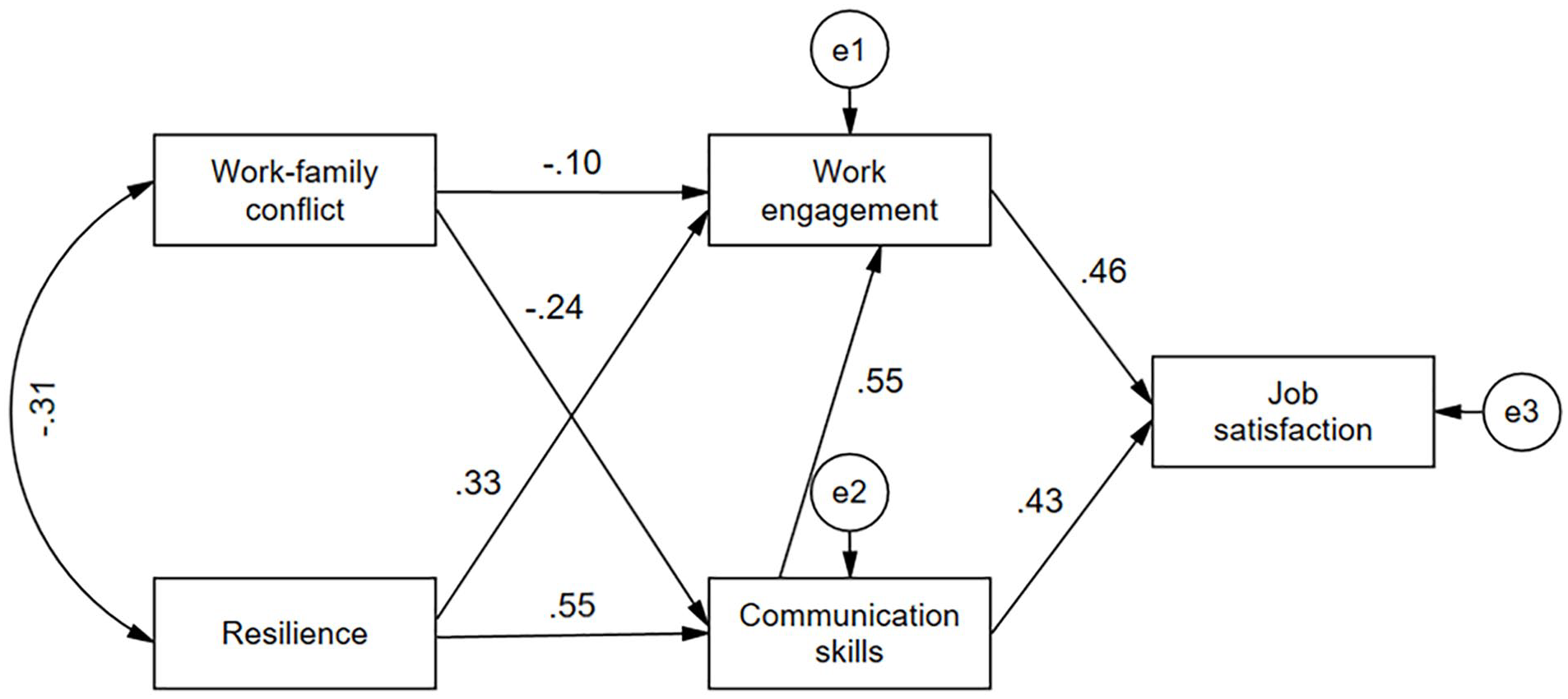
Results of the structural explanatory model of job satisfaction.
Mediation Model
For the mediation analysis, bootstrapping of 5000 iterations was used and these results are shown in Table 3. The mediating role of work engagement is confirmed in the relationship between work-family conflict and job satisfaction, β = −.05, P = .005 (H4a); and between resilience and job satisfaction, β = .15, P < .001 (H4b). Similarly, the mediating role of communication skills was confirmed between work-family conflict and job satisfaction, β = −.10, P < .001 (H5a); and between resilience and job satisfaction, β = .24, P < .001 (H5b).
Research Hypotheses on Indirect Effects and Their Estimation.

Discussion
This research sought to design a JD-R model that assumes 2 job characteristics: job demands and job resources. This would allow us to understand the relationship between work-family conflict and resilience in job satisfaction mediated by work engagement and communication skills. The results show a good statistical fit for the proposed model. Additionally, the parallel mediation analysis further explains the appropriateness of the model in indicating nurses’ satisfaction in care settings. The model allows inferring that the best ways to increase a nurses’ satisfaction. Strategies should be proposed to improve resources such as resilience, communication skills, and work engagement, as well as interventions based on mitigating work demands such as work-family imbalance.
The model confirmed that work engagement and communication skills are valid mediators to mitigate work demands such as work-family conflict that affect a nurse’s professional and personal life. It would be a management error to ignore the effect of work-family conflict, which is attributed to the potential incompatibility of roles and demands in both spheres on job satisfaction. Likewise, decreased work engagement and communication skills affect the likelihood of satisfactory work engagement. Therefore, it is important for organizations to have a comprehensive understanding of work-family conflict that can lead to contradictions in performance, communication skills, and job satisfaction.
Family-work conflict had a negative influence on work engagement. Similar studies indicate that the negative impact of the family-work relationship results in decreased work engagement.35,36 This conflict between family-work relationship and work commitment may be due to low income, which drives nurses to work overtime, consequently negatively affecting family responsibilities and producing a conflict between family life and work life.32,75 However, other studies found no conflict between family-work, this may be because organizations support the nurse and tend to generate positive emotions toward work and they perceive greater positive emotions in the family. 76 Meanwhile, nurses who are dedicated to work can achieve greater professionalism; conversely, those who experience more time and dedication to family can interfere with work engagement, 77 in addition to increasing a greater intention to drop out of the labor market, causing organizational failure and achievement. 78 Therefore, family balance can give value to the profession, greater security to patients by projecting a positive image for the environment in which it is located, thus, the family can help nurses to their valuation through tokens of appreciation and foster a stronger bond toward the profession and work engagement among nurses.79,80
As our results from previous studies indicate, family-work conflict (job demand) negatively influenced communication skills, 9 as expected, family conflicts affect nurse communication, discord and frustration cause work conflicts. 81 However, in environments where nurses share concerns, find solutions, and increase more meaningful connections, they reduce frustration and feel less fearful in crises, which increases respectful communication. 82 In view of this, training in communication skills training has been shown to improve patient relations and teamwork.83,84 Likewise, Family-work conflict indirectly influenced job satisfaction; previous studies indicate similar results.9,30,85,86 This is because it is difficult for the nurse to balance family roles and work conflicts, leading to lower performance and decreased job satisfaction. 85 While a work-family balance increases job satisfaction and teamwork, 87 reducing anxiety and verbal abuse. 88 Interference between family-work, insufficient support from organizations interferes with family-work conflicts and leads to poor work performance and motivation, which contributes to the poor quality of care provided to patients.89,90 Therefore, nurses who are dissatisfied are at greater risk for psychological distress, so fostering a good work environment can help nurses perform better. 91
Resilience positively influences communication skills, previous studies show that this ability is the most effective way to cope in the face of an external threat.49,92,93 Therefore, it is necessary for organizations to adopt strategies to increase the capacity to develop resilience in staff to cultivate communication skills. 49 Given that, resilience acts as a buffer against job stress. 94 Nurses with greater resilience have strong communication skills, as they are able to express themselves in the face of various stressful events and seek support from colleagues, friends, or family members, helping to maintain greater mental health. 93 This is because exposure to morbidity and mortality, challenging situations, and patient suffering exacerbates morale and leads to increased burnout in the team. This negatively affects the patient’s quality of life, threatens the nurse’s well-being, and affects organizational outcomes. 95 On the other hand, resilience positively influenced work engagement. Previous studies indicate similar results.50,51 Highly resilient professionals improve performance in challenging and constantly changing work environments 96 ; that is, employees with a high level of confidence in their abilities to perform work tasks recover quickly, improving their commitment to their work. 51 Thus, resilience plays an important role in overcoming and adapting to difficulties, reducing work stress, job burnout, and allowing for effective stress management. 97 In addition, the results indicate an indirect relationship between resilience and job satisfaction. Thus, the promotion of resources such as resilience may help to improve work engagement and job satisfaction among nurses. 98
The mediating role of work engagement between job demands (work-family conflict) and satisfaction has been documented in previous research, 9 This is because commitment has a buffering effect capable of mediating the negative consequences of family-work conflict, giving greater stability in the workplace.9,99 Since work demands (family-work conflict) cannot be met by domestic responsibilities, employees experience less work engagement, as they are not emotionally, cognitively, and physically motivated at work, thus reducing job satisfaction as they do not have the resources to adequately perform their work.2,9 However, it is possible that nurses with high engagement may experience positive emotions in the family and work setting, abandoning the belief that it is organizations that are responsible for the family-work imbalance. 100 In addition, increasing satisfaction can be accomplished by promoting a balance between demands such as work-family conflict, job promotion, job feedback, autonomy, work identity, childcare facilities, and maternity leave.99,101 Likewise, the mediating role of work engagement in the relationship between resilience and job satisfaction was confirmed. 53 This is because resilience is one of the personal resources that support positive personal functioning.102,103
On the other hand, the mediating role of communication skills between work-family conflict and satisfaction has not been documented to date. Furthermore, previous research in nurses indicates that having a higher work-family conflict affects organizational commitment and its impact leads to a higher intention to leave the job. 78 Thus, dissatisfied nurses have poorer communication skills and greater work-family conflict. Additionally, strengthening communication skills allows the healthcare professional to develop greater empathy toward patients and contributes to job satisfaction.17,18,29 Improving administrative tasks requires excellent and contributes to greater job satisfaction. Appropriate communication skills such as communicating openly, listening, conveying relevant information, enable nurses to make good decisions and resolve conflicts. 17 Hospital administration should evaluate interventions in which healthcare workers develop various skills such as communication, collaboration, resource management, and leadership.
Relevant practical implications are evident from the study, such as the need to focus on the nursing professional to provide a better quality of care. It is therefore recommended that managers be aware of the needs and resources that allow them to closely monitor the nurse-patient relationship by meeting their needs and expectations in order to ensure continuity in the satisfaction of their service.
Organizations that seek to reduce family-work conflict, providing guidance to employees to reduce conflict in family life, on how to improve relationships between partners and with children. Likewise, flexible schedules or interventions from more understanding managers can reduce anxiety and improve experiences that interfere between family and work. Also, organizations can provide nurses with opportunities to experience professional adaptability so that they do not experience the disruptions between family and work and how they can feel the value of family. On the other hand, organizations can promote professional development and education in values, guiding nurses to have full confidence in their profession. Thus, psychological counseling to improve resilience would increase resources and reduce labor demands. Consequently, nurses would have better care and would provide patients with a better service, since the mental health of nurses is useful for high-quality care. For this, interventions that improve the communication skills of the nurse with the patient are also necessary, allowing empathic listening and communication with the other person, absence of presumptions and openness to the patient. Organizations must establish norms and policies that allow better recognition of nurses, as this will help their better training as professionals and a greater work commitment, this in turn improves the success of nurses and a greater effort at work. Thus, organizations must develop interventions to improve or enhance human resources such as nurses who face various challenges in their profession, which promote greater job satisfaction and mitigate family conflicts, increasing their resilience for better patient care. Therefore, organizations should develop interventions to improve or enhance human resources such as nurses who face various challenges in their profession, through interventions or training that promote greater job satisfaction, and mitigate family conflicts, increasing their resilience for better patient care. Moreover, psychological interventions are becoming promising tools for improving employee well-being and performance. Managers should not overlook job demands, as increased work-family conflict is likely to cause lower performance and lower job satisfaction. In such cases, measures such as shift flexibility, reasonable schedules, increased staffing of facilities, reward systems and teamwork will allow for better management and prevention of work-family conflict. Therefore, the manager must be concerned about the socio-labor demands in order to have greater communication, cooperation, and a greater contribution to the organization.
Limitations
This is a cross-sectional data set, which limits the scope of causal relationships. However, based on the literature review and grounded theories, they were substantially supported. Therefore, it is recommended that longitudinal studies be conducted in the future. In addition, the Neyman bias (incidence-prevalence) present in the study due to the time of exposure and the selection of participants must be considered. Participants who presented a large proportion of the variables evaluated are absent due to desertion or lack of acceptance, which can greatly reduce their evaluation and the results show a distorted frequency of exposure. Thus, the results tend to show a distorted exposure frequency.104,105 The research had greater participation of women, which makes it difficult to generalize the results to both groups. On the other hand, the research provides data from a specific region of Peru, and other regions or samples were not considered; therefore, generalizations to other countries should be made with caution.
Conclusion
This study adds to the JDR model literature by adding job resources that have not been examined in a sample of nurses working in primary health care services. The study provides further insight into the indirect relationship of job demands (work-family conflict) and resources (resilience) with job satisfaction; in which, work engagement and interpersonal resources (communication skills) can buffer the negative effect of work-family conflict, as well as strengthen resources on job satisfaction. Complex relationship analyses have made it possible to evaluate the effects of these variables and to establish strategies to improve the work of nurses.
Footnotes
Availability of Data and Materials
The data sets generated to support the findings of this study are not publicly available, but can be requested from the corresponding author.
Declaration of Conflicting Interests
The author(s) declared no potential conflicts of interest with respect to the research, authorship, and/or publication of this article.
Funding
The author(s) received no financial support for the research, authorship, and/or publication of this article.
Ethical Statements
The study was conducted during the months of January and February 2022. Personal contact was made with the health facilities. Approval was received from the ethics committee of the Universidad Peruana Unión (Number: 2021- CE-EPG-000034), which followed the guidelines of the Declaration of Helsinki.
