




Abstract
Background:
Life satisfaction is a determining factor for the improvement of mental and physical health. Health care workers are a vulnerable population to suffer alterations in the factors that affect life satisfaction. Determining the influence of these factors on quality of life is important for their proper management.
Objective:
To examine sociodemographic factors and healthy behaviors influencing life satisfaction in Peruvian professionals.
Methods:
A cross-sectional study was conducted with 506 health care workers, who had a mean age of 40.34 years (SD = 10.39). A sociodemographic questionnaire, sleep quality, physical activity, eating habits, and life satisfaction were used. A regression model was fitted with the life satisfaction variable as the dependent variable.
Results:
In multivariable analysis, age (β = −.938, P < .01) and perception of poor health status (β = −4.743, P < .001) were found to be associated with lower life satisfaction. On the other hand, higher university education level (β = 1.667, P < .001), absence of smoking (β = 3.202, P < .01), absence of depressive symptoms (β = 3.390, P < .001), interest in daily activities (β = 3.503, P < .05), good sleep quality (β = 1.027, P < .01), a high frequency of physical activity (β = 1.056, P < .01), and healthy eating are variables associated with higher life satisfaction.
Conclusion:
Sociodemographic aspects such as age and the perception of poor health are associated with lower life satisfaction. On the other hand, healthy behaviors such as absence of smoking, absence of depressive symptoms, interest in daily activities, good quality of sleep, high frequency of physical activity, and a healthy diet were associated with higher life satisfaction.
Introduction
Healthcare professionals are one of the groups most affected during the COVID-19 pandemic. 1 Due to the exposure to the disease and the emotional impact of the pandemic, they are considered one of the most vulnerable groups to suffer alterations in physical and mental health, which have repercussions on their quality of life. 2 In addition, since before the COVID-19 pandemic, health professionals have faced a number of challenges including difficulties in maintaining a healthy lifestyle. In fact, some studies have shown that health professionals do not always adequately follow health promotion and care guidelines in terms of their own health behaviors. 3
On the other hand, life satisfaction is defined as a cognitive process that involves a self-assessment to evaluate the quality of life based on one’s own criteria, where the individual contrasts his or her standards with his or her current life condition. 4 Moreover, this variable represents an important indicator of people’s subjective well-being. 5 Indeed, studies reveal that life satisfaction is associated with optimal health, 6 a better perception of family satisfaction, 7 better interpersonal relationships, 8 and a better economic situation. 9 However, during the pandemic, many health care workers experienced stress, high workload, despair, isolation, and lack of equipment, which led them to abandon work, leading to a shortage of health care professionals. 10 In fact, workers who perceived a negative work situation had lower satisfaction with their lives. 11 There are also many factors that predict or explain the level of life satisfaction in the actively working population, including demographic variables such as age, gender, income, 12 health status, social relationships, including personal characteristics. 13 In healthcare workers, it is essential to assess the impact of sleep and physical activity level due to shift schedules, which can affect life satisfaction. 14 Therefore, it is essential that health care workers feel satisfied with their work and life to reduce the intention to leave their jobs. 15
The quality of sleep is crucial for healthcare personnel to provide optimal patient care. However, the decrease in the quantity and quality of sleep hours results in a reduced ability to concentrate and make decisions, which causes a greater possibility of errors and inadequate attention. 16 Sleep quality refers to the quantitative and qualitative assessment of indicators such as sleep duration, latency, number of nocturnal awakenings, depth, and capacity for sleep repair. 17 Health professionals often report poorer quality and instability in their sleep hours, which may be due to changes in work, shift status, among other aspects.18,19 Also, sleep quality has been reported to decrease with age; nurses over the age of 40 years have lower sleep quality due to rotating shift rates. 20 Likewise, physical activity is associated with better health, while short periods of physical activity show strong associations with mortality. 21 Physical activity refers to body movement performed by skeletal muscles, which produce an energy expenditure greater than that existing at rest. 22 Recently, during the health emergency, the world’s population entered a period of immobility given the restrictions and social distancing imposed by the governments in power 23 ; due to these restrictions, physical activity has been reduced, a scenario that has generated musculoskeletal disorders and affected physical health, given its importance for mental health. 24 Physical activity is one of the most effective ways to promote physical and mental health, prevent disease, and strengthen the immune system 25 and has a significant effect on the perception of life satisfaction. 26 Likewise, physical activity has a positive psychological and occupational impact on health personnel; however, limiting factors such as lack of time and inadequate space affect the development of physical activities, 27 leading to poor health and lower life satisfaction. 11
Many times, the schedules of health personnel involve continuous work shifts, so it is necessary to have rest habits and an adequate diet that contribute to a better satisfaction with life. 28 Diet and nutrition determine people’s health, since healthy eating habits prevent non-transmissible diseases such as high blood pressure, cholesterol, obesity, among others. 29,30; According to the World Health Organization, healthy eating provides nutrients for the body to maintain proper functioning so that it can maintain and restore health. 31 Considering that healthcare personnel are exposed to long periods of stress, the importance of proper nutrition and diet to increase alertness and concentration is emphasized. 32 However, there are barriers to healthy eating in health personnel. In fact, work schedules, personal barriers, the physical environment, and the workplace often have a negative influence on adequate dietary intake. 33 Sweets, sugary drinks, and precooked foods are consumed due to fatigue from overwork, decreasing the consumption of fruits and vegetables 34,35; this leads to poor dietary practices among health personnel, resulting in relatively poor health and the majority of professionals suffering from overweight and obesity.36,37 In addition, health professionals often do not receive effective and quality nutritional care, a fact that makes them physically and psychologically vulnerable when facing situations that demand a high degree of critical situation management. 37 Also, for healthcare personnel to provide effective care, it is necessary to engage in healthy behaviors such as quitting smoking or alcohol consumption in order to be role models for patients. 38 The use of these substances by healthcare professionals can, in turn, affect the quality of patient care. 39 Finally, high work demands affect the health of professionals, causing an increase in anxiety, depression, and stress, which leads to a decrease in life satisfaction. 40
Healthcare workers do their best to provide proper care, while neglecting their own personal care. Therefore, organizations should address the main challenges faced by professionals to have better outcomes and ensure improved quality of work life, staff well-being, and life satisfaction to optimize the quality and safety of health care staff care for the benefit of patients. 41 In addition, there is a need for evidence-based interventions that support the health and well-being of healthcare workers. Therefore, this study aimed to examine the sociodemographic factors, healthy eating, sleep quality, and physical activity that influence quality of life in health care workers.
Materials and Methods
Study Design and Population
A cross-sectional descriptive design was used to identify the factors influencing satisfaction with health professionals. A registry of the personnel of a private hospital in the city of Lima, Peru, was used to identify the sample frame. A simple random sampling was performed on personnel that met the inclusion criteria: (a) employees with more than 3 months of contract, (b) doctors, nurses, and pharmacists were considered. In addition, the privacy and confidentiality of the data collected was guaranteed.
A multiple regression analysis was performed to address the research question. The statistical power analysis program G Power 3.1.9.7 was used to calculate the sample. 42 Thirteen explanatory variables were considered in the multiple linear regression; a median effect size (0.10), statistical power of 0.90 (1 − ß), and significance level (α) of 0.05 for a multiple regression analysis. The analysis indicated a minimum required sample of 243 health professionals. A total of 700 health professionals selected by simple random sampling participated. Of these, 506 participated in the study by responding and signing the informed consent form in the web version and no outliers emerged from the data. Two study investigators made contact via telephone and social networks with the selected participants.
Instruments
Statistical Analysis
A descriptive analysis by sex was performed using percentages or means with SD as appropriate. The gender difference was explored using the chi-square test for categorical variables (ie,: age groups (years), marital status, academic degree, workplaces, smoking, alcohol consumption, in addition, health perception, depression, and interest in doing things. Student’s t-test was also used to test for differences in mean scores for sleep quality, healthy eating, and physical activity according to sex.
Because the descriptive approach revealed an interaction between variables, a multiple linear regression model was fitted with life satisfaction as the dependent variable and quality of sleep, healthy eating, physical activity, then adjusted for sociodemographic characteristics. The categorical variables were entered as dummy variables, which is a dummy coding that allows representing qualitative variables in a linear regression. 47 Data were analyzed using the free software R 4.1.1.
Results
General Characteristics of the Population
We analyzed 506 data obtained from hospital workers (Table 1), who had a mean age between 22 and 74 (M = 40.34, SD = 10.39). It is observed that the proportions of the age groups are different between women and men (P < .001). Similarly, it is observed that the proportions in the categories of the variable’s marital status, profession, academic degree, place of work, smoking habit, alcohol consumption, health perception, and interest in everyday things, are significantly different between women and men (P < .05), except in depressive symptom (P > .05).
Distribution of Sociodemographic Variables.

Data presented as absolute and relative frequency (%).
P < .05, **P < .01, statistically significant by chi-square.
Comparative Analysis
Comparative analyses (Table 2) show that women have higher levels of sleep disturbance compared to men (t = 15.92, P < .001). Eating was also found to be healthier in women compared to men (t = 3.99, P = .05), although these differences were not significant. Regarding life satisfaction (t = 1.88, P > .05) and physical activity (t = 0.137, P > .05), no significant differences were observed between women and men.
Sleep Quality, Eating Habits, and Physical Activity According to Gender.
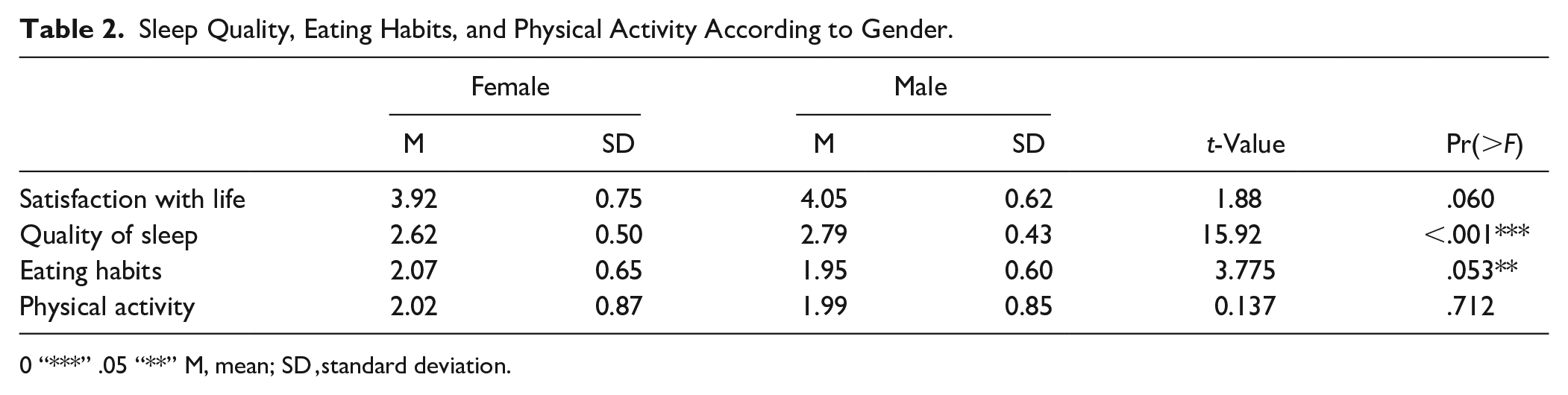
0 “***” .05 “**” M, mean; SD ,standard deviation.
Multivariate Regression Analysis
Multivariable regression analysis (Table 3) shows that age (β = −.938, P < .01) and perception of poor health status (β = −4.743, P < .001) are associated with lower life satisfaction. However, higher university education level (β = 1.667, P < .001), absence of smoking habit (β = 3.202, P < .01), absence of depressive symptoms (β = 3.390, P < .001), interest in daily activities (β = 3.503, P < .05), good sleep quality (β = 1.027, P < .01), a high frequency of physical activity (β = 1.056, P < .01) and a very healthy diet are variables associated with higher life satisfaction. The variables analyzed in this model significantly explain 31.1% of the variability of life satisfaction (R 2 = .311, F = 19.96, P = < .001).
Multivariate Analysis of Factors Related to Life Satisfaction.

= Dummy coded, dependent variable = satisfaction with life, t = test statistic, P = probability, Signif. codes: 0 “***” .001 “**” .01 “*”
Discussion
This study aimed to examine the factors associated with life satisfaction in Peruvian health professionals. The main findings of the study indicate that sociodemographic aspects such as age and the perception of poor health are associated with lower life satisfaction. On the other hand, higher university education level and healthy behaviors such as absence of smoking, absence of depressive symptoms, interest in daily activities, good quality of sleep, high frequency of physical activity, and a very healthy diet were associated with higher life satisfaction.
In this study, it was found that women have a higher prevalence of sleep disturbance than men. These findings are similar to results reported in previous studies,48,49 where poor sleep quality is due to work conditions, lifestyle, shifts, stress, depression, and anxiety. 50 Increased arousals and sleep fragmentation cause arousal of the sympathetic catecholamine system and elevate cortisol levels making insomnia persistent. 51
Likewise, the results of this study indicate that the age range of 38 to 46 years has a negative influence on life satisfaction. Similar results have been described previously, where life satisfaction decreases until middle age and increases thereafter toward retirement. 52 That is, as age increases, satisfaction increases, and it has also been observed that adulthood and aging are associated with greater satisfaction with life, since they are considered exposed to positive emotions and greater emotional stability. 53 This is suggestive because the elderly generally have lower incomes and are less healthy. On the other hand, it is possible that adulthood is associated with greater stress, lower quality of sleep, family and financial problems, especially in the population of health care workers, who constantly face situations of work stress and depression, 54 which could be influencing their perception of life satisfaction.
Similarly, personnel who were married have a positive influence on life satisfaction. Marriage is considered a normative achievement, leading to greater happiness and life satisfaction. 55 However, older adults, such as those who are widowed or divorced, may experience negative effects in the medium and long term, because in marriage, tensions and conflicts with a spouse cause them to have less satisfaction with life. 56
Not smoking had a positive influence on life satisfaction. Smoking habits increase significantly over the years. Smoking is a negative factor in increasing satisfaction with care. 39 Healthcare personnel should be role models in remaining tobacco-free for their patients. 38 Effective interventions involving a series of health strategies for smoking cessation are necessary. Counseling will allow for better follow-up and knowledge of smoking cessation guidelines.
The results also indicate that not smoking had a positive influence on life satisfaction. Similar results mention that smoking is a negative factor that impedes the increase of satisfaction with care, 39 in addition, exclusive smokers are more likely to have low life satisfaction. 57 Although there is a small percentage of workers who smoke in this study, healthcare personnel should be role models of healthy behavior for their patients in terms of tobacco use. 38 In this sense, effective interventions involving a series of health strategies for smoking cessation are necessary. On the other hand, based on the strong association between these variables, it is suggested that life satisfaction may play important roles in smoking, which should be incorporated into behavioral interventions to reduce smoking.
Life satisfaction has strong interactive effects on mental health, as one of the main dimensions. In that sense, this study evidences that not perceived depression has a positive influence on life satisfaction. A previous study indicated that the absence of depression is an important determinant of life satisfaction in health personnel. 40 In addition, work overload, recurrent and prolonged exposure to suffering, and increased levels of depression tend to promote greater dissatisfaction with their lives. 58 During the pandemic, a large proportion of health care workers reported increased symptoms of depression. 59 In addition, healthcare workers are at high risk of developing depressive symptoms during the COVID-19 pandemic, especially those working on the front line. 60 Strong associations have also been established between depression and poor quality of life in caregivers of COVID-19 patients,60,61 which would be affecting their life satisfaction. It is therefore necessary to monitor the mental health of health care workers and develop strategies to adapt to pandemic conditions. On the other hand, it is evident in this study that perceiving poor global health has a negative influence on life satisfaction. This is probably due to the fact that health professionals experience burnout. In this sense, a negative correlation between burnout and life satisfaction was verified in Peruvian health workers. 62 Therefore, organizational strategies must be found for adequate adaptation, maintaining good performance, and strengthening intrapersonal resources to ensure the overall good health of health care providers. 63
In relation to sleep quality, the results of this study indicated that this variable has a positive impact on life satisfaction. Previous studies indicate that the better the quality of sleep, the better the quality of life of health personnel. 64 This is because poor quality sleep causes nurses to have more fatigue, circulatory problems, or back, shoulder, and neck pain, resulting in a poor quality of life. 65 The importance of sleep quality and its disorders lies in the fact that it is a health indicator that influences quality of life and allows for better care, avoids the risk of procedural errors, better teamwork, and a lower risk of occupational accidents. 66 Sleep quality is also associated with eating imbalance patterns, since sleep quality facilitates the control of excessive intake and facilitates weight loss. 28 Additionally, poor sleep quality is associated with mood disorders, 67 which would intensify a poor perception of satisfaction. It is suggested to educate health care workers about the importance of proper sleep hygiene and the consequences of poor sleep hygiene practices.
Greater physical activity positively influences life satisfaction in healthcare workers, as evidenced by our findings. Similar results indicate that habitual levels of physical activity are associated with better satisfaction in middle and late adulthood. 68 In workers, physical activity such as running, exercising, cycling, or walking regulates sleep disturbances and other stressful stimuli that lead to sleep deprivation and reduced satisfaction. 69 Physical activity improves cardiovascular fitness, functional capacity, and strength, increases self-efficacy, and decreases depression and anxiety. 70 During the first waves of the COVID-19 pandemic in Peru, there was a notable decrease in the practice of physical activity in the population, including health workers, due to restrictions imposed by the government. 71 This decrease would also be affecting health personnel satisfaction, which remained at low regular levels during the pandemic. 72 Therefore, it is important to promote physical activity in health care workers, which would help to improve their satisfaction and indirectly their job performance. 62
Finally, healthy eating has been found to be associated with higher life satisfaction. Previous studies state that nurses who engage in unhealthy eating behaviors end up with a lack of life satisfaction, contrary to nurses with healthy eating. 73 In another study, life satisfaction was found to affect nurses’ level of emotional eating. 73 Not only in healthcare personnel but also in the general population, diet quality is associated with life satisfaction. 74 The health crisis due to the pandemic generated changes in the dietary patterns of the population; it was shown that the Peruvian population was the least likely to make healthy changes in food consumption compared to other Latin American countries. 75 In view of this change in eating habits, it is necessary to orient the population and health workers toward a healthy diet that includes vegetarian diets and abstaining from alcohol, tobacco, or other addictive substances. 76
Implications
Health problems faced by health professionals need to be adequately addressed because it has a negative impact on job performance by hindering patient care response and decision making. If we want to have a high performance of health professionals, we must take care of their satisfaction and the factors that affect it or are strongly associated with it. Both mental health and physical health must be addressed, therefore, administrators/managers should develop programs that address unhealthy eating behaviors, sedentary behaviors, and poor sleep quality. It is important that health care workers find ways to include exercise or healthy eating to improve their well-being. Healthy eating behaviors of health care workers can improve quality of care and professional performance. Hospital managers should not only provide advice for the practice of their profession, but also develop strategies to maintain a healthy lifestyle; for workers to have a sense of responsibility for their health. This is particularly important considering that high workloads affect healthy behaviors. Also, it is necessary to implement policies that prioritize greater hiring of health professionals as staff resources to cushion high work demands and promote personal growth. It is also necessary to understand the essential aspects associated with sleep disturbance in order to deal with them. Strategies with preventive measures to combat insomnia, behavioral counseling, support groups, information sessions, and professional teams to assess mental health are recommended to help them with the disorders caused by their work. It should also ensure adequate time for workload, increased staffing to improve care, teamwork and communication, and reduced risk of attrition. Therefore, it is important to have well-being programs that teach and provide the necessary elements for a better lifestyle and mental health. As well as interventions for smoking cessation or alcohol consumption as it increases physical activity and improves psychosocial health.
Limitations
There were some limitations in this study. First, our study was based on cross-sectional data, which did not determine the causal effect between life satisfaction, sociodemographic aspects, and healthy behaviors (sleep quality, physical activity, healthy diet). Second, some other important smoking information (such as number of cigarettes per day, number of days used in the last month, and how long they have been smoking) were not included in the study, which could introduce some biases in our final results. In addition, in this study, there was no information on the use of other tobacco products. Therefore, our study only considered whether or not you smoke, which could bias our results. Finally, in this study, we grouped the survey participants into 4 age groups. However, the level of life satisfaction depended on age. Within the same age group, participants of different ages may have different levels of life satisfaction. Therefore, our method of grouping by age might introduce some biases.
Conclusions
The main findings of the study indicate that sociodemographic aspects such as age and the perception of poor health are associated with lower life satisfaction. On the other hand, healthy behaviors such as absence of smoking, absence of depressive symptoms, interest in daily activities, good quality of sleep, high frequency of physical activity, and a healthy diet were associated with higher life satisfaction. Life satisfaction is a key determinant of improved mental and physical health. These results provide preliminary evidence of causal relationships between life satisfaction and age, educational level, smoking, depression, health status, interest, sleep quality, physical activity, and eating habits.
Footnotes
Declaration of Conflicting Interests
The author(s) declared no potential conflicts of interest with respect to the research, authorship, and/or publication of this article.
Funding
The author(s) received no financial support for the research, authorship, and/or publication of this article.
Ethical Considerations
The study was approved by the Research Ethics Committee of the Postgraduate School of a Peruvian university (Registration number: EPG-00093) and was conducted from from April 1 to May 28, 2022, in accordance with the guidelines stipulated in the Declaration of Helsinki.
