




Abstract
Objectives:
To investigate the effect of COVID-19 on food access and security in Bexar County, located within San Antonio, TX.
Methods:
To assess food insecurity levels and severity, we distributed a 10-min Qualtrics survey to San Antonio Food Bank (SAFB) clients. The survey was distributed between 19 October 2020 and 24 May 2021. Twenty-four survey respondents also participated in virtual focus group sessions over Zoom. Seven virtual focus group interviews were held between 15 January 2021 and 5 March 2021.
Results:
Survey results revealed that following COVID-19, 20.2% of SAFB clients were newly food insecure. 31.3% of survey respondents reported reduced wages and 28.8% reported job loss. Households experiencing job disruption from COVID-19 were 7 times at greater odds of being food insecure (OR 7.05; 95% CI, 1.61-30.88), as compared to those with stable employment. Major subthemes across focus group interviews included “excessive amounts of a single food item distributed,” “long wait times for food,” and “not receiving the type of food needed.”
Conclusions:
Our study found evidence to support early studies’ findings that COVID-19 has negatively impacted food security for many Americans. 70% of all unique Bexar County zip codes appeared in our survey analysis. Even beyond COVID-19′s effect on food security, many other major societal changes were identified such as the increased reliance on technology, decreased in-person social gatherings, and greater mental health needs.
Background
The pandemic has intensified food insecurity for many people already previously affected. 1 Even prior to COVID-19, food insecurity in Bexar County was 14.1% (2018), 2.6% greater than the national average. 2 Bexar County is located in San Antonio, TX with a population of 2 009 324 as of April 1, 2020. 3 The San Antonio Food Bank (SAFB) is the primary food bank that serves Bexar County, located at 5200 Enrique M. Barrera Pkwy, San Antonio, TX, 78227. The hours of operation of the food bank are M-F 8 AM-5 PM. Prior to the pandemic, the SAFB fed approximately 60 000 people each week. In April 2020 following unprecedented job disruption due to COVID-19, the number of individuals served by the food bank tripled to 180 000 people per week. Other food assistance programs that also serve Bexar County include those operated by local church organizations like the Society of St. Vincent DePaul and St. Paul’s Episcopal Church. However, these food distribution services do not operate at nearly the scale at which the SAFB is able to function in Bexar County.
Early studies revealed that individuals who experienced job loss or disruption due to COVID-19 were less likely to purchase fresh food items as compared to those who did not experience a change in employment. 4 Food affordability has become a major concern and more people either currently purchase cheaper foods or plan to in the future. 5 These findings highlight the close relationship between unemployment due to COVID-19 and reduced nutritional intake. Effective food access and education outreach programs are essential to mitigate negative health outcomes.
In addition to assessing changes in food security and behavior related to socioeconomic factors in Bexar County following COVID-19, our study added qualitative data on participants’ food access barriers. The qualitative focus groups allowed participants to discuss sensitive topics not usually covered in previous food access studies.
Methods
Through this study, we sought to answer the following questions:
“How has COVID-19 affected the rates and severity of food insecurity in Bexar County?”
“What food access barriers have emerged in Bexar County as a result of COVID-19?”
“How have food purchasing behaviors changed since COVID-19?”
“How has mental health been affected by COVID-19?”
“What resources would food insecure residents of Bexar County most benefit from?”
This study utilized a mixed methods approach; quantitative data was collected through a 10-min Qualtrics survey distributed to SAFB clients. Participants were recruited through flyers that displayed a QR code redirecting participants to the Qualtrics survey. The Qualtrics survey was distributed between 19 October 2020and 24 May 2021. One of every 10 survey respondents was randomly selected to receive a $20 HEB gift card for their participation.
Qualitative data was collected through virtual focus group sessions held over Zoom. Seven virtual focus group interviews were held over Zoom between 15 January 2021 and 5 March 2021. Each focus group session ranged from 30 min to an hour (2-5 participants attended each session) and received a $45 HEB gift card.
Based on preliminary survey responses, focus group questions were created to further explore issues identified in addition to assessing more sensitive topics difficult to fully capture with survey questions:
72% of survey respondents did not know where to receive help getting food when they needed it at least some of the time. What has been your experience with finding help for food and has it been more or less difficult since Covid?
63% of respondents stated that they would find assistance enrolling in SNAP helpful or very helpful. Can you tell us about your experience with enrolling into programs like SNAP?
70% of participants said they would find extended pantry hours helpful. If you have experience with the pantry, can you please share more about this and how the Food bank can better serve your family?
39% of survey respondents sometimes felt stigmatized for using SA Food Bank services and that 8% of respondents always felt stigmatized for using SA food bank services. How do you think receiving food from the food bank affects what others think of you and your family?
What are some other challenges that have come up in your life since COVID-19? How have these challenges affected you and your family’s mental or emotional health?
80% of participants would like to pre-select the food they desire from the food bank. Are there issues you are currently facing with the food that you do receive, and if so what are they?
Statistical Analysis
Quantitative data analysis of survey data including demographics, odds ratio (OR) calculations, and determination of statistically significant differences was completed using Excel. ANOVA tests and one-tailed T-tests were performed on Likert-scale questions Q21-Q24. Chi-square analysis was performed on food access barrier questions Q17-Q20; Q28, mental health questions Q25-Q27, and purchasing behavior questions Q29-Q45.
Nvivo transcription services were used to transcribe the focus group audio files. Qualitative data analysis was performed both by hand and using Excel. Coding of responses was performed by the first author and reviewed by the fourth author along with UT Health San Antonio’s Department of Family & Community Medicine Division of Research team.
Survey Results
Demographics
A total of 243 survey responses were collected and analyzed. Survey respondents averaged 43.6 years old; 89.6% were women. The majority reported being of Hispanic, Latino, Mexican American, or Spanish origin, and spoke only or mostly English. The average household size was 4.7 with 2.2 children under the age of 18 (Table 1).
Characteristics of Survey Respondents’ Demographics.

Changing Climate of Food Insecurity
Of the participants surveyed, 92.2% were food insecure following COVID-19, 20.2% of whom were newly food insecure. 70.0% and 77.6% of participants who reported losing their job or a reduction in earned wages were found to be severely food insecure, respectively. In comparison, 48% of participants who reported no change in their employment were severely food insecure. The odds of a household experiencing food insecurity increased 7-fold among respondents who reported job loss (OR 7.05; 95% CI, 1.61-30.88) and 5.7-fold among respondents who reported reduced wages (OR 5.68; 95% CI, 1.45-22.20) from loss of hours when compared to with no job disruption.
Food insecure participants were significantly more likely (P < .01) to not know where they could receive food assistance as compared to food secure participants (OR 17.09; 95% CI, 4.79-60.87). The odds of food insecure participants having to choose between paying for medical expenses versus food (OR 4.61; 95% CI, 1.73-12.25) and not having adequate/reliable transportation to get food (OR 1.42, 95% CI, 1.33-12.83) was also significantly greater than those who were food secure (P < .05) (Figure 1).

Barriers to food access faced by survey respondents due to COVID-19.
Level of concern or worry for COVID-related food access barriers was assessed using Likert scale questions. ANOVA demonstrated statistically significant differences according to food security status for all 4 surveyed Likert-scale statements (Table 2).
Descriptive Statistics on the Level of Concern Toward COVID-Related Food Access Barriers.
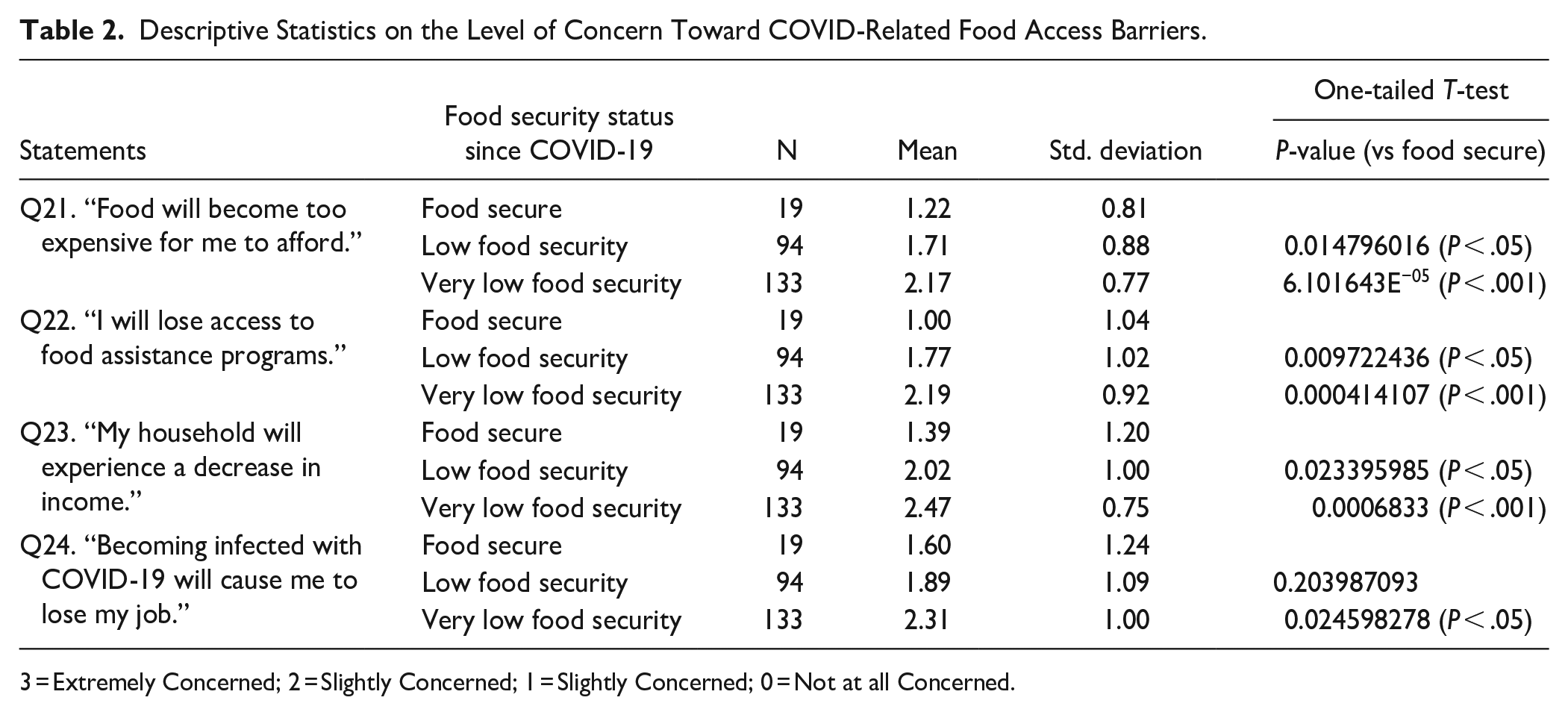
3 = Extremely Concerned; 2 = Slightly Concerned; 1 = Slightly Concerned; 0 = Not at all Concerned.
Mental Health
Survey respondents who were food insecure since COVID-19 had nearly 4.5 times greater odds of having PHQ-9 scores indicative of major depressive disorder (MDD) than those who were food secure (OR 4.415; 95% CI, 1.25-15.58). The odds of having “excessive stress that interfered with daily living or was difficult to manage” was over 3 times higher among respondents who have been food insecure as compared to those who have been food secure (OR 3.245; 95% CI, 1.22-8.59).
Focus Group Results
A total of 24 survey respondents participated in the focus group sessions. Nine major categories were identified, each of which contained several subthemes (Table 3).
Major Categories and Subthemes Identified Across Focus Groups.

Inefficient Food Distribution and Insufficient Advertisement
Survey results suggested that although all survey respondents used SAFB services in some capacity, the vast majority remained food insecure. The primary emergent category from the focus groups, inefficient food distribution offered evidence to support this finding. Specifically, SAFB clients across all 7 focus group interviews reported receiving excessively large quantities of single food items as a major barrier. One focus group participant noted:
“Last week, I think they gave me three big boxes of tomatoes. What am I going to do with all these tomatoes?”
A second participant stated:
“. . . It’s kind of hard. . . they even gave us a whole box of sippy cups for babies. I’m like, ‘We don’t even have a baby.’ Why didn’t they ask if you have kids, ‘Okay. Here’s sippy cups.’”
Still, others reported not receiving enough fresh vegetables or many items that were near or past their expiration date. In contrast, several participants preferred receiving excess food items, and even relied on the excess to help family or neighbors lacking transportation. While the food bank takes into account family size, these conflicting experiences demonstrate a need for further improvements to food allotment strategies.
Most focus group participants stated that they tried to minimize wasting any food items by distributing the rest to their family, friends, and neighbors. Other strategies used included freezing the excess for later use and using different recipes to use up the excess food item.
Not only did some participants often continue to struggle to meet their basic food needs, many reported “long lines” as a major barrier to receiving food assistance from the food bank. Even following the initial surge in demand for food bank services in March and April of 2020, clients in nearly all focus group interviews continued to report long lines between 2 and 6 hours long into the spring of 2021.
“I mean, I have children and I can’t be sitting in a car for six hours just to get a small box of food. Some other time, they give you food that we don’t even eat.” -female participant
The long wait times for some participants meant choosing between waiting in line for food or going to work. Additionally, because most food banks operated on a “first come, first serve” basis, several other participants reported frustration with the lack of measures taken to prevent “line skipping/cutting.” A couple participants noted positive experiences with sites that required pre-registration, noting faster lines and greater organization of the food distribution. Participants also reported positive experiences at smaller local food distributions through their children’s schools.
A large number of the focus group participants also reported that they did not know how to seek out food assistance on their own. While many participants discovered the food assistance programs by word of mouth, the participants felt that this was insufficient advertising for food assistance programs:
“My experience finding help, it’s been sometimes difficult because there’s a lot of times that I don’t know where I’m able to get help. I have to hear from people letting me know they’re helping out here and you’re able to go.”
Although all the participants in the focus group study were current clients of the SAFB, many felt that the food bank itself could have done a better job advertising their services directly to them. The focus participants suggested social media posts, emails, and notices in the mail. Notwithstanding these challenges, all focus group participants expressed gratitude to the SAFB for working to meet their family’s needs.
Persistent Food Insecurity
Additionally, numerous focus group participants reported persistent food insecurity and greater difficulty finding food since COVID-19. One mother notably reported:
“When I do cook, if I make a piece of steak or meat, I tend to give it to my children and they tell me, ‘Mom, aren’t you going to eat any?’ I’m like, ‘No, I’m okay. I don’t want any. I don’t feel like eating steak today.’. . . I wait until they’re done eating and then I get my plate. Whatever’s left, I serve it, and I eat it.”
Others reported similar experiences since COVID-19 in which they would have to cut down the size of their meals, and/or would have to choose between paying for services like their phone bill or purchasing food. These statements in combination with other comments made related to current food distribution methods and survey findings offer evidence to support that the way food is currently distributed is insufficient to addressing food insecure families’ needs.
Other Barriers to Food Access
Stigma
The large majority of focus group participants make an effort to ignore stigmatizing comments related to receiving food assistance. Others felt that they received less stigma for using SAFB services during the pandemic because many families began newly seeking out food assistance. One participant stated:
“With COVID, I think a lot of people have maybe changed the way they think because those that were stigmatizing are probably in the position of the ones they were stigmatizing before.”
Although participants did not deny receiving stigmatizing comments, stigma did not appear to deter participants from seeking food assistance.
Technology
While some participants were happy to see an increased use of technology following COVID-19 because it enhanced their ability to find food, others felt it was a new barrier that they needed to overcome. The latter group cited a lack of technological literacy and costs associated with purchasing reliable internet as reasons for their less positive view on increased technology use.
SNAP-related barriers
When asked about barriers to SNAP enrollment, participants commonly reported “complicated paperwork/documentation necessary” and “difficulty with reaching a real person at Texas Health and Human Services to help with SNAP enrollment.” One participant went on to say that she believed SNAP did not do an adequate job of identifying families who truly require food assistance. While some participants reported receiving help from the SAFB with completing the paperwork, a few said they were unable to enroll and did not know where else to seek help.
Mental Health
Fear of COVID-19 emerged as a major influence on participants’ mental health. Many reported that their fear of the virus deterred them from engaging in their pre-COVID-19 day-to-day activities such as gathering with friends and family, going to church, etc. Fear of COVID-19 also placed a strain on parents’ and children’s mental health. Children’s fear of the virus or difficulty with understanding social distancing guidelines was noted by several participants.
“In their minds, because they’re children. . .you can’t see them together in a park or anywhere because they’re just not wanting to go out there. They’re afraid of every little thing. They’re afraid of other kids. They want to wear their masks.”
In contrast, another parent shared about their adolescent child:
“The problem is with my younger son. . .. He didn’t want to listen– understand the rules like you got to wash your hands, you got to wear a mask, you can’t be going out, you can’t see your friends. He never understood, he’s never on the same page as me. He left home.”
With regards to the participants themselves, many stated that they lacked social support and felt isolated due to social distancing guidelines. The loss of physical displays of affection further exacerbated feelings of stress and anxiety.
Relationships within families dramatically shifted for some participants as a result of COVID-19. While some participants reported improvements to their relationship with family members, others reported that their family began experiencing more difficulties which were also taxing on their mental health:
“On top of having major marital problems on its own, I have twins that have just been diagnosed with autism, so I have special needs kids. That’s a whole another journey, a whole new path that I’ve just started. It has been emotional. It has been emotionally draining. It’s been stressful. It’s been depressing. It’s been sad. It’s been a lot of things.”
Discussion
Our study found evidence to support early studies’ findings that COVID-19 has negatively impacted food security for many Americans. 70% of all unique Bexar County zip codes appeared in our survey analysis, potentially reflective of the rates of food insecurity and job disruption among all Bexar County residents. The widespread loss of employment felt by an unprecedented number of county residents forced many to seek out food assistance services like those offered by the SAFB, some for the first time ever. Even beyond its effect on food security, COVID-19 has led to many other major societal changes such as the increased reliance on technology, decreased in-person social gatherings, and greater mental health needs.
The major strength of our study was our mixed methods approach to investigate the impact COVID-19 had on food insecurity which prior similar studies had not utilized. This study was able to identify broader issues impacting Bexar County residents’ ability to meet their food needs due to the pandemic. However, the relatively small scale of our study in addition to limitation of study participation to SAFB clients reduced both the power and generalizability of this study. These 2 limitations likely explain why statistically significant differences in food security level according to job disruption status were not found despite other similar studies documenting a statistically significant relationship.6,7 Another limitation was the inclusion requirement that participants at least have internet access which potentially excluded individuals at the greatest risk for food insecurity.
Our study’s identification of several emergent food access barriers provides evidence to support greater resource allocation to the following potential interventions:
Ability to preview or preselect available food items to minimize food waste and wait times
Ability to opt out of undesired foods so another family may benefit from the food item
Greater advertising of available food assistance resources both on and off the internet
Inclusion of recipes with provided food
Extension of food pantry hours (evening or weekend hours)
Although implementation of these interventions may prove very challenging, many participants felt that these changes would better address their food-related needs while also helping to minimize food waste and wait times. Greater understanding of current food distribution methods at the SAFB and other similar food assistance centers will need to be made prior to pursuing these goals. Important factors to consider during the future design of such interventions will be the current method of obtaining donated food, sourcing of vast quantities of food, and seasonal changes that influence the types of food available.
Future studies investigating other greater societal impacts COVID-19 has made may benefit from review of our study. Major subthemes that would benefit from continued investigation are the effect of COVID-19 on technology use, children’s mental health, and stigma related to use of food assistance programs. Further research on the impact of COVID-19 in Bexar County is needed to continue documentation of the long-term effects on food insecurity.
Supplemental Material
sj-docx-1-jpc-10.1177_21501319221147253 – Supplemental material for An Investigation of the Impact of COVID-19 on Food Access and Security in Bexar County: A Mixed Methods Approach
Supplemental material, sj-docx-1-jpc-10.1177_21501319221147253 for An Investigation of the Impact of COVID-19 on Food Access and Security in Bexar County: A Mixed Methods Approach by Olivia Chen, Corina Badillo, Dirk Wristers and Fozia Ali in Journal of Primary Care & Community Health
Supplemental Material
sj-docx-2-jpc-10.1177_21501319221147253 – Supplemental material for An Investigation of the Impact of COVID-19 on Food Access and Security in Bexar County: A Mixed Methods Approach
Supplemental material, sj-docx-2-jpc-10.1177_21501319221147253 for An Investigation of the Impact of COVID-19 on Food Access and Security in Bexar County: A Mixed Methods Approach by Olivia Chen, Corina Badillo, Dirk Wristers and Fozia Ali in Journal of Primary Care & Community Health
Footnotes
Declaration of Conflicting Interests
The author(s) declared no potential conflicts of interest with respect to the research, authorship, and/or publication of this article.
Funding
The author(s) disclosed receipt of the following financial support for the research, authorship, and/or publication of this article: Funding for this research was provided by UT Health Science Center at San Antonio’s Center for Medical Humanity and Ethics Department.

Supplemental Material
Supplemental material for this article is available online.
References
Supplementary Material
Please find the following supplemental material available below.
For Open Access articles published under a Creative Commons License, all supplemental material carries the same license as the article it is associated with.
For non-Open Access articles published, all supplemental material carries a non-exclusive license, and permission requests for re-use of supplemental material or any part of supplemental material shall be sent directly to the copyright owner as specified in the copyright notice associated with the article.
