




Abstract
Background:
Ascribed traditional gender role has rarely been examined in the topical area of protected sex.
Objective:
The purpose of this study was to examine the relationship between HIV knowledge, ascribed cultural gender roles of machismo and marianismo, acculturation, attitudes toward risky sexual behaviors and sexual self-efficacy on protected sex, and the mediating effect of sexual self-efficacy between these predictors and protected sex.
Methods:
Part of a larger study, Hispanic college students from a Hispanic-serving institution in a U.S. southern border city were recruited.
Results and Conclusion:
Sexual self-efficacy was found a significant mitigating factor against sexual risks associated with machismo as well as a positive reinforcing element on attitudes toward protected sex. Study findings have implications toward the development of culturally sensitive evidence-based interventions that promote sexual self-efficacy skills among Hispanic males who strongly identify with culturally ascribed gender roles.
Keywords
Hispanics have higher HIV and sexually transmitted infection (STI) rates than any minority group. 1 In 2019, about 1.2 million people in the United States (US) were living with HIV. Although Hispanics only make 18% of the US population, this group accounts 25% of individuals who live with HIV. New HIV infections heavily affect Hispanic and Latino gay and bisexual men and Hispanic and Latina heterosexual women. 2 This minority group is most likely to report on never having done HIV testing resulting in the widening of HIV infection disparity. 3 In order to end the HIV epidemic, the nation must enhance HIV testing, link people living with HIV to treatment, and ensure access to HIV prevention such as Pre-Exposure Prophylaxis (PreEP). One of the known causes of HIV transmission and other sexually transmitted diseases is unprotected sex. Lack of HIV knowledge, acculturation, and personal attitudes were cited as predictors of risky sexual behaviors4-6; however, findings from these disparate investigations are conflicting. It is possible that sexual self-efficacy defined as a sense of self-control and self-regulation may be an important mediating factor toward protected sexual practices.7-9
On the other hand, protected sex examined within the context of ascribed Hispanic cultural gender roles such as machismo and marianismo has rarely been investigated. The Hispanic ascribed gender roles of machismo and marianismo may influence the power balance of a relationship exposing the couple to high sexual risks. Machismo cites men as the decision makers4,10 while marianismo portrays women as a follower to their partner in a sexual relationship. 11 To date, no studies can be found investigating the influence of ascribed Hispanic cultural gender roles including HIV knowledge, acculturation, attitudes, and sexual self-efficacy on protected sex in one single study. Given the high HIV infection and STI rates among Hispanics, it is critical to understand how sexual self-efficacy plays a role in attenuating the sexual risks associated with gender roles ascribed in this culture. Thus, the purpose of this study was to: (1) examine the mediating effect of sexual self-efficacy between predictors HIV knowledge, cultural influence of traditional Hispanic gender roles of machismo and marianismo, acculturation, and attitudes on protected sex and (2) examine the direct and indirect effect of these predictors on protected sex. It is critical to gain an understanding on the mechanism on how sexual self-efficacy influence safe sex behaviors to inform the development of culturally sensitive evidence-based interventions that promote sexual self-efficacy skills.
Factors Associated With Protected Sex
HIV Knowledge
Increased knowledge about sexually transmitted infections (STIs) and their known risks were positively associated with optimistic attitudes toward condom use and increased couple’s communication about condom use.12,13 Receipt of interventions relating to enhancing HIV and STI related knowledge was associated with consistent condom use among Hispanic gay, bisexual, and men who have sex with men at 3 months and at 6 months post intervention. 12 Similarly, other studies corroborate that receipt of interventions leading to increased HIV knowledge was significantly associated with HIV testing and HIV serostatus among Hispanic men who have sex with men.14,15 Other studies conducted among Hispanics however contradict the above findings indicating that abundance of HIV knowledge does not necessarily curtail risky sexual behaviors.11,16-18 Given the conflicting results in this topical area, it is possible that other factors other than increased HIV knowledge alone may explain safe sexual practices.
Cultural Influence on Gender Roles
Ascribed gender roles such as marianismo and machismo/caballerismo of the Hispanic culture may influence relationship dynamics, decisions, and negotiations and therefore the practice of protected sex. The cultural value of marianismo assumes women to be naive, submissive, nurturing, selfless, self-sacrificing, family-centered, chaste, and sexually pure.10,19 Female virginity is emphasized. The submissive nature of marianismo perpetuates inhibition of expression and poor direct communication about sex protection between partners 11 which puts women at high sexual risks. Although marianismo was associated with fewer sexual partners, it was also linked with inconsistent use and non-use of condoms and less decision-making power in a sexual relationship.11,19
The cultural value of machismo has both negative and positive ascriptions to male masculinity in the Hispanic culture. In one aspect, machismo expects men to be strong, apathetic, dominant, and the decision maker in a relationship.4,10,20 On the other hand, the traditional role expects men to demonstrate chivalry, bravery, and be a good provider of the family or caballerismo.21,22 It is possible that a strong identification with the traditional gender roles of marianismo and machismo may tilt relationship dynamics leading to unprotected sex.
Sexual Self-Efficacy
Sexual self-efficacy is described as a sense of self-control, self-regulation, and the ability to refuse a partner with engaging in risky sexual behaviors. 23 It is defined as an individual’s assertiveness and confidence in communicating condom use and intentions to discuss condom use with a partner. 24 Sexually self-efficient individuals are confident about their sexuality; they negotiate condom use and threaten to withhold sex on resisting partners. 7 Insisting on condom use even to unwilling partners was found an effective negotiation strategy.8,9 Thus, sexual self-efficacy may mitigate the sexual risks among women who adhere to the ascribed Hispanic cultural gender role of marianismo. Sexual-self efficacy may be a crucial factor to curb the potential sexual risks associated with machismo. The literature indicates that individuals who engaged in frequent and direct communications about protected sex resulted in less resistance from partners, which in turn led to lowered perceptions of contracting HIV. 9 On the contrary, individuals with low sexual self-efficacy experience difficulties in denying unprotected sex and therefore placing themselves at high risks. 11
Acculturation
Acculturation refers to the changes in personal beliefs, behaviors, and ways of living because of adapting to the mainstream or host culture.25,26 The balancing act that occurs between maintaining true to one’s original culture and adapting to the host culture often results in acculturative stress. 27 Depression was found associated with acculturative stress due to difficulties in navigating between the original and the host culture.28,29
Psychological stress and depression may develop as one begins to identify with the host culture but at the same time maintain expectations to remain true to the mores and values of the original culture. Risky behaviors were reported consequences from attempts to cope with psychological stress borne from the acculturation process. 29 Alcohol and other forms of substance use were often used as means to cope with depression, acculturative stress, and identify confusion 28 which in turn led to unprotected sex. While past investigations point to the association between acculturative stress and risky sexual behaviors,29,30 the role of sexual self-efficacy as it relates to protected sex has rarely been examined. It is possible that sexual self-efficacy may have a positive mitigating effect on risky behaviors associated with ineffective coping relating to acculturative stress. Sexual self-efficacy may be a protective factor against risky sexual behaviors by way of self-inhibition and self-regulation which may influence safe sex behaviors.
Attitudes Toward Risky Sex
Attitudes pertains to one’s overall perceptions whether a behavior is favorable or unfavorable 31 and therefore is endorsed or demonstrated. Attitudes toward risky sex behaviors are influenced by peers and one’s social network. Past investigations indicate that peer norms supporting safe sex were linked to consistent condom use, reduced number of sexual partners, and avoidance of risky behaviors.32-34 Support from family was associated with reduced risk of early sexual initiation.35,36
In addition, personal attitudes against risky behaviors were predictive of protected sex. Past investigations showed that a positive personal attitude toward condom use were more predictive of greater intentions to use safe sex than peer norms.37,38 Others claimed that together with motivation, attitudes affect refusal skills against unprotected sex which in turn influence sexual behaviors.8,9 While past findings indicate the influence of social norms on attitudes5,28,34 regarding protected sex other studies claim that attitudes, self-efficacy, and motivation are more predictive of safe sex behaviors.9,23 It is possible that sexual self-efficacy may have a supporting effect on attitudes against risky sexual behaviors. In other words, self-regulation, and self-control in addition to personal attitudes against risky sexual behaviors could lead to protected sex.
Method
Part of a larger study, Hispanic college students aged 18 to 24 were recruited from a Hispanic-serving institution located in a U.S. southern border city. Socio-demographic variables such as age, gender, primary language spoken, and employment were collected to gain some understanding about the profile of the sample. Age was measured as a continuous variable while gender, language, and employment were treated as dichotomous/categorical variables. HIV knowledge was measured using the sum score of 5 questions pertaining to participants’ knowledge about HIV. 39 Questions to assess participants HIV knowledge included: Only people who look sick can spread the HIV/AIDS virus; Only people who have sexual intercourse with gay (homosexual) people get HIV/AIDS; Birth control pills protect women from getting HIV/AIDS; There are drugs available to treat HIV that can lengthen the life of a person infected with the virus; There is no cure for AIDS.
The Marianismo Belief Scale (MBS) 40 and the Machismo and Caballerismo Scale (MCS) 21 were used to measure ascribed Hispanic traditional gender roles. The MBS is a 24-item instrument that was used to measure a traditional gender role for Hispanic females. The items were measured in a 4-point Likert scale ranging from 1 = strongly disagree to 4 = strongly agree; a total score was obtained; a high score indicates adherence to the Hispanic tradition’s female gender role.
The MCS is a 20-item instrument that was used to measure ascribed gender roles for Hispanic males. 21 There are 2 constructs of machismo: one aspect relates strongly on masculinity (machismo) and the other aspect is about connection with the family and chivalry (caballerismo). 21 To determine which question items belonged to which construct, principal components type factor analysis using varimax rotation was initially conducted on the MCS instrument using SPSS PROCESS. The analysis yielded a Kaiser-Myer Olkin (KMO) of 0.732 indicating sampling adequacy.41,42 The Bartlett’s test of sphericity was significant χ2(91) = 1883.598, P ≤ .001 indicating there were significant large correlations among the question items.41,42 Factors with eigenvalues greater than 1.00 rule and factor loading greater than 0.30 were retained. A 2-factor solution was obtained, machismo and caballerismo. To increase the Cronbach’s alpha, question items with less than .30 correlation were removed (MCS items 12, 13, 15, 16, 19, 20). Cronbach’s alpha of the current study is .68. The total score for each construct, machismo and caballerismo, were used as predictors in the succeeding Pearson and logistic regression analyses.
ARSMA-II Scale 1 was used to measure acculturation43-45; this instrument was specifically designed for the Mexican American population. The instrument has 30 items measured in a 5-point Likert scale ranging from 1 = not at all to 5 = almost/extremely often. The instrument has 13 question items pertaining to Anglo Orientation Subscale (AOS) and 17 question items pertaining to Mexican Orientation Subscale (MOS). To obtain the acculturation score, the sum of the AOS was divided by 13 to obtain the mean of the AOS subscale while the sum of the MOS was divided by 17 to obtain the mean of the MOS subscale. Then, the MOS mean was subtracted from the AOS mean to obtain the acculturation score—which is the individual’s score on the continuum of acculturation—from very true Mexican to very assimilated or Anglicized. 43
Attitudes toward risky sex was determined in 3 question items measured in a 4-point Likert scale ranging from 1 = no risk to 4 = great risk. The total score of these items were used in the analysis. Sexual self-efficacy was measured using the total score of 6 question items that were rated in a 4-point Likert scale ranging from 1 = not at all to 4 = very much. The outcome variable, protected sex, was measured as a dichotomous variable (1 = yes; 0 = no). Permission to use all instruments was obtained.
Analysis
Measures of central tendency and dispersion were examined prior to addressing the purpose of the study. Descriptive statistics were conducted on analyzing the demographic profile of the participants. Pearson correlation was used to analyze continuous variables, scale, or interval data such as HIV knowledge, machismo, caballerismo, acculturation, attitudes toward risky sex, and sexual self-efficacy. Spearman rho was used to analyze binary, categorical, or dichotomous data such as “use or none use” of protected sex in correlation with the independent variables. Logistic regression was used to examine the mediating effect of sexual self-efficacy between protected sex and the predictors and their covariates. All analyses were conducted using SPSS PROCESS macro v3.5. 46 The PROCESS macro provides estimates of the path coefficients in the mediation model with a bootstrapped 95% confidence interval. The PROCESS macro allows testing of direct and indirect effects of mediating variables.
Results
One hundred percent of the participants (n = 342) identified themselves as Hispanic; 69.9% of the participants were females while 30.1% were males. More than half of the participants or 62.3% were between 21 and 24 years of age. Fifty-eight percent spoke English while 42.4% were more proficient in Spanish language. More than half of the participant were full-time college students (Table 1). The mean acculturation score is −0.20 which indicates that the participants belonged to the “slightly Anglo oriented bicultural” or Level III 43 (Table 2). This indicates that the sample had a slight acculturation toward the Anglo orientation.
Socio-Demographic Data.

Descriptive Results.

The correlation analysis among the predictors revealed that machismo was negatively correlated with sexual self-efficacy (r = −.237; P < .01) while sexual self-efficacy was positively correlated with attitudes toward risky sex (r = .119; P < .05) (Table 3). Sexual self-efficacy had a positive correlation with protected sex (r = .124; P < .05). Using the correlation results, a preliminary path analysis was conceptualized. The preliminary path model was used to determine the closest model that could predict protected sexual practices (Figure 1).
Correlation Results.
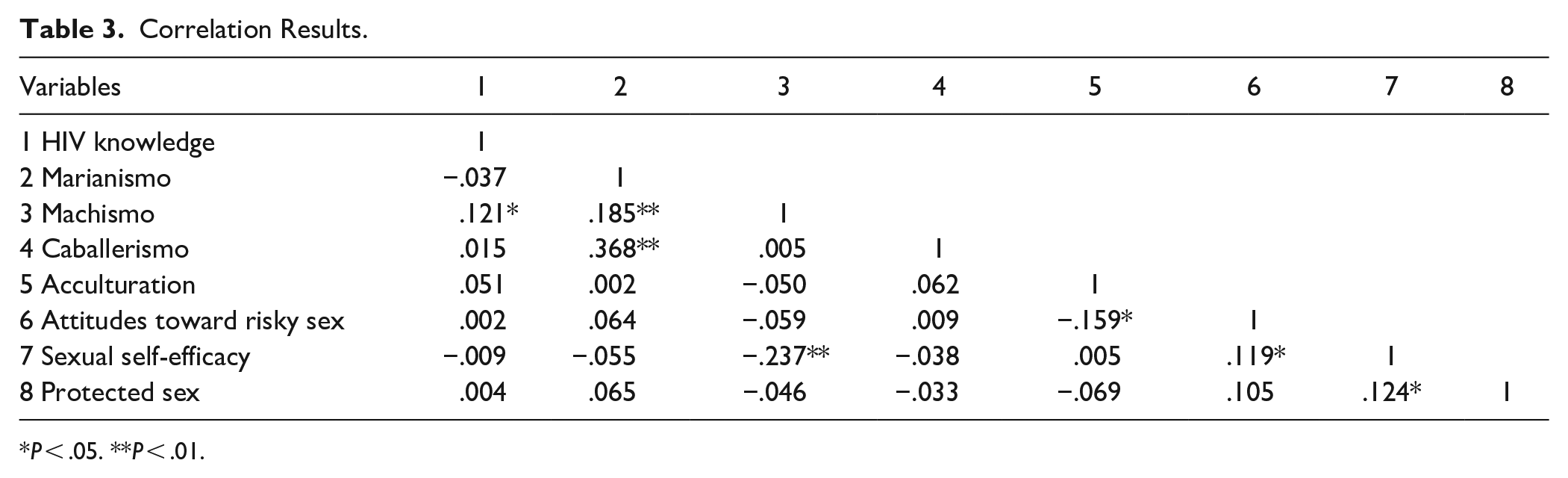
P < .05. **P < .01.

Preliminary path diagram of predictors on protected sex.
Cognizant of the preliminary path analysis, 2 models (Model 1 and Model 2) were generated to determine the best model that predicted protected sex. In these path diagrams, we tested 2 models, the paths of machismo and attitudes toward risky sex or those paths that showed a significant correlation with protected sex in as shown in Figure 1. The aim was to examine whether mediation exists using path analysis (direct and indirect effects). Path Model 1 shows machismo, HIV knowledge, and marianismo as predictors of protected sex with sexual self-efficacy as a mediating variable (Figure 2). In this model machismo, HIV knowledge, and marianismo showed multicollinearity. In step 1 of Path Model 1, sexual self-efficacy was treated as an outcome variable while HIV knowledge, machismo, and marianismo were treated as predictors. A significant negative relationship was found between machismo sexual self-efficacy (β = −.06, P < .001; R 2 = .057, P < .001) while the rest of the predictors showed no significance (Table 4). In step 2 Path Model 1, sexual self-efficacy together with the other variables were treated as predictors of protected sex to test for mediation. A positive and significant positive relationship was found between sexual self-efficacy and protected sex (β = .085; P < .05; Model Summary P = .050) (Table 5). No significant direct effect was found between machismo on protected sex (β = −.018, P = .192). The results mean that the high sexual risks associated with machismo are attenuated by sexual self-efficacy which in turn relate to protected sex.

Path Model 1 diagram: HIV Knowledge, Machismo, Marianismo as predictors for protected sex with sexual self-efficacy as a mediating variable.
Machismo, HIV knowledge, and Marianismo predicting sexual self-efficacy.

P < .001.
Logistic Regression Results: Sexual Self-Efficacy Mediating the Relationship Between Machismo, HIV Knowledge, Marianismo, and Protected Sex.

P < .05.
Path Model 2 represents attitude toward risky sex and acculturation as predictors for protected sex with sexual self-efficacy as a mediating variable (Figure 3). In step 1 Path Model 2, sexual self-efficacy was treated as an outcome variable. Attitude toward risky sex was found a positive and significant predictor toward sexual self-efficacy (β = .441, P < .05) (Table 6). In step 2 Path Model 2, sexual self-efficacy was entered as a predictor together with the other variables. Sexual self-efficacy had a significant and positive relationship with use of protected sex (β = .080, P < .05; Table 7). No significant direct association was found between attitudes toward risky sex on protected sex (β = .182, P = .15). The results indicate that sexual self-efficacy reinforces attitudes against risky sex which then leads to protected sex. Attitudes alone do not lead to protected sex; sexual self-efficacy drives one’s agency toward protected sex.

Path Model 2 diagram: Attitude toward risky sex and acculturation as predictors for protected sex with sexual self-efficacy as a mediating variable.
Attitudes Toward Risky Sex and Acculturation Predicting Sexual Self-Efficacy.

P < .05.
Logistic Regression Results: Sexual Self-Efficacy Mediating the Relationship Between Attitudes Toward Risky Sex, Acculturation, and Protected Sex.

P < .05.
Discussion
This study found that sexual self-efficacy mediates the relationship between machismo and protected sex. Machismo had a significant direct inverse relationship with sexual-self efficacy and an indirect relationship with protected sex. The current study findings suggest that Hispanic males who strongly identify with the culturally ascribed gender role of machismo are likely to practice unprotected sex unless one has developed a keen sense sexual-self efficacy. It is through sexual self-efficacy that one maintains self-control and self-regulation from engaging in risky behaviors. 23 It appears that sexual self-efficacy mitigates the risky sexual behaviors associated with machismo. Such finding has implications toward the importance of developing of evidence-based interventions that emphasize on sexual self-efficacy skills for those who have a strong identification and adherence to the traditional gender role of machismo.
In addition, a significant mediating effect of sexual self-efficacy was found between attitudes against risky sexual behaviors and protected sex. Attitudes toward risky sexual behaviors had a significant direct positive relationship with sexual self-efficacy and an indirect positive relationship toward protected sex practices. Attitudes toward risky sex have no direct relationship with protected sex practices. The current findings suggest that attitudes against risky sexual behaviors may not necessarily translate into safe sex practices unless one has strong sexual self-efficacy skills. Sexual self-efficacy fortifies decisions for safe sex practices especially when these are based on strong psychological convictions and attitudes against risky sexual behaviors. It is through sexual self-efficacy that one develops confidence and self-regulation not to engage in risky sexual behaviors.8,9
The general literature describes individuals with low self-efficacy and low self-confidence will not persist in executing a desired action in the face of obstacles 47 for example, convincing a resistant partner to use a condom.8,9 Sexual self-efficacy enables an individual to negotiate and navigate a relationship with a partner to use protection even if the latter is resistant, and even the power balance in a relationship. The current findings support past investigations citing sexual self-efficacy as a key factor in predicting perceived personal behavior control.7-9
The current study findings have significant implications toward the promotion and development evidence-based interventions geared toward the development of sexual self-efficacy skills. Interventions to enhance confidence, self-regulation, and refusal skills could be emphasized in these interventions. Self-efficacy could be learned through vicarious experiences such as group sessions 47 implemented among the Hispanic youth. Role-playing in group sessions to enhance self-confidence to refuse unprotected sex could be implemented. 48 In group sessions, individuals can gain knowledge and skills from peers who model confidence in engaging sexual communication with their partners. Greater confidence to use condoms was gained through interactions with peers who encouraged, discussed, and practiced safe sex. 34 Role-playing targeting on how to assert the use of protection with a resistant partner can be practiced in group sessions to gain mastery of skills. Likewise, making condoms freely available in college campuses yet discretely through condom dispensers could increase self-confidence in partner negotiation especially when the device is available at hand. Embarrassment and stigma were reported among women who purchased condoms at grocery store counters.33,49 It is recommended that institutions of education implement interventions that promote self-efficacy relating to sexual behavior early at the high school level.
Findings from investigations conducted in countries wherein machismo is embedded within the culture indicate that male partner involvement in promoting sexual and reproductive health led to positive gender role transformations and positive health and social care outcomes not only for themselves but also for their female partners in Sub-Saharan Africa.50,51 Men who participated in HIV and STI interventions improved in their sense of self-efficacy and condom use; they were more willing to get tested for HIV which resulted to increased uptake of HIV counseling. Involving male partners in reproductive health programs reduced the harmful effects of gender norms in these countries leading to improved women’s autonomy in terms of spousal communication and shared decision making.50,51 Similarly, a program in the Philippines that emphasized on male responsibility in contraception, which is typically relegated to females in a relationship, was linked to sustained condom use and therefore preventing unintended pregnancies and STIs/HIV. Actively engaging men in interventions promote self-efficacy and gender equity within the context of sexual and reproductive health. 52
Verbal persuasion is one way to develop self-efficacy 47 ; therefore, reproductive health education from nurses and other health care providers need to target parents at each well-child visit. Familismo, in the context of the Hispanic culture, has a strong influence on decision making especially if such advice is coming from parents and wise elders in the community. Latino youth who received support from their families on safe sex showed favorable attitudes toward safe sex35,53; better parent-child communication about sex was associated with youth’s intentions to practice safe sex. 54
Contrary to past findings, the current study did not find HIV knowledge a significant predictor of safe sexual practices.11,55 Although HIV knowledge is particularly high among college students, recognition of the known risks of unprotected sex does not translate into safe sexual behaviors.16,55 Bandura 47 theorized that knowledge alone is not enough, an individual must have the confidence to execute the desired behavior effectively.
The traditional gender role of marianismo and caballerismo were not found significant predictors of protected sex. Although the participants in this investigation were geographically close to their families in Mexico and may be aware of these ascribed traditional gender roles, these may not necessarily have any influence into sexual decision making. One study indicated that Hispanics are aware of cultural norms however these do not necessarily dictate sexual behaviors. 4 Contrary to past studies no significant association was found between acculturation and risky sexual behaviors.29,56 It is possible that other facets of acculturation were not captured with the instrument used in this investigation. Acculturation is a fluid process; the instrument used may not have captured other important aspects of the concept.
Conclusion
Sexual self-efficacy is a significant mitigating factor against sexual risks associated with ascribed cultural gender roles as well as a positive reinforcing element on attitudes toward protected sex. Self-regulation and self-control in sexual self-efficacy mitigate the risks associated with machismo. Protected sex is achieved when attitudes toward safe sex are fortified with sexual self-efficacy skills. The findings of this study are significant because it adds information regarding the attenuating effect of sexual self-efficacy on sexual risks borne from culturally ascribed gender roles. Likewise, the reinforcing effect sexual self-efficacy on attitudes against risky sexual behaviors help explain the mechanism toward protected sex adding information to the current knowledge on this topic. However, the generalizability of the study findings is limited to similar populations who adhere to similar traditional gender roles. Also, the results of this investigation may be influenced by sampling bias and the limitations of the instruments used in the study. Longitudinal research designs are recommended in future studies to examine sexual self-efficacy, attitudes toward risky sexual behaviors, and adherence to traditional gender roles in the continuum of acculturation and how these evolve over time and influence safe sex behaviors.
Footnotes
Author Contributions
All authors approve the content of this manuscript, and had equal contribution in the planning, data analysis, and writing of this manuscript.
Declaration of Conflicting Interests
The author(s) declared no potential conflicts of interest with respect to the research, authorship, and/or publication of this article.
Funding
The author(s) disclosed receipt of the following financial support for the research, authorship, and/or publication of this article: This program received grant funding from the U.S. Department of Health and Human Services Substance Abuse and Mental Health Services Administration (SAMHSA), funding award # 5H79SP021349-01 REVISED FAIN: SP021349.
Ethical Approval
Institutional Review Board approval (# 2016-01-20-R) and informed consent from participants were obtained prior to data collection.
