




Abstract
Introduction/Objectives:
The health of elderly individuals is known to benefit from maintaining societal involvement and relationships with other people, such as through social participation. We aimed to determine trends in the percentage of Japanese elderly people who engaged in social participation before and during the coronavirus disease 2019 (COVID-19) pandemic in one municipality in Japan, and compared differences in this status by gender.
Methods:
We conducted a cross-sectional questionnaire survey. Questionnaires were sent by mail to 3000 people aged 65 to 85 years who were randomly selected by the administrative staff of the city. Participant characteristics (age, gender, working status, residential status) and their economic status, daily physical activity, and social participation status were obtained at 3 time points: (1) before the COVID-19 pandemic in January 2020; (2) immediately prior to the declaration of a state of emergency in April 2020; and (3) in January 2021, 1 year after (1).
Results:
A total of 1301 people responded to the survey. The mean age was 73.3 (SD 5.5) years, and 690 (53.0%) were women. There were significant gender differences in terms of living alone, employment status, and amount of physical activity. The number of people reporting social participation gradually decreased from 543 respondents (41.7%) at (1) to 319 (24.5%) at (2) and 251 (19.3%) at (3). Women were more likely to demonstrate reduced social participation.
Conclusions:
Elderly individuals, particularly women, reported decreased social participation during the pandemic.
Background
It is critical that super-aged societies support the elderly to enable them to live healthy and purposeful lives. Preserving social participation is known to be important for maintaining health in the elderly.1,2 Previous studies have reported that a poor social network is associated with the development of dementia, decreased physical function, and undernutrition.3,4 In Japan, it was also found that social participation was positively correlated with instrumental activities of daily living 5 and healthy life years, 6 and inversely correlated with mortality risk. 7 Thus, social participation and related activities help maintain healthy lives among the elderly in local communities, and municipalities, volunteer groups, and other organizations have played a central role in providing venues for social participation among community-dwelling elderly persons.
However, due to the coronavirus disease 2019 (COVID-19) pandemic, 8 many venues that supported social participation activities for the elderly ceased operations or were closed in order to secure social distancing, 9 which thereby worsened social isolation. 10 The amount of physical activity among elderly individuals reportedly decreased by approximately 30% following the spread of the infection. 11 Since social participation by elderly persons was found to aid in the prevention of conditions requiring long-term care, 12 the current closure of venues providing social participation activities and a decreased amount of physical activity may have negative outcomes in the elderly, including both short- as well as medium- and long-term increases in the number of people who require care and who develop dementia.
Looking forward, it is important to determine how to restore social participation among the elderly and to reopen venues that facilitated it. Identifying specific measures will require evaluating the amount of physical activity 13 and the status of social participation in elderly individuals,14,15 since both factors are subject to gender differences, and how each has changed during the pandemic. Previous studies of older adults during the pandemic have reported that they experienced emotional difficulties even though they lived in different cultures and contexts, 16 had decreased physical activity, 11 and had decreased satisfaction with participation in social roles. 17 However, few reports have described status and gender differences in social participation before and during the pandemic. Since the impact of social participation on health differed by gender, 18 we considered that examining status and gender differences in social participation before and during the pandemic would provide useful information about the types of venues for social participation that should be reopened or newly established.
Here, we determined trends in social participation among Japanese elderly individuals before and during the pandemic in one municipality in Japan, and compared these trends by gender.
Methods
Setting and Participants
We conducted a cross-sectional questionnaire survey in Kitaibaraki City in Ibaraki Prefecture, Japan, approximately 160 km north of Tokyo, in January 2021. The city has a population of 40 689, and 35% of citizens were aged 65 or older as of April 1, 2022.
The target population was approximately 9000 residents aged 65 to 85 years who were not certified to require long-term care under Japan’s long-term care insurance system; in other words, these people had relatively few barriers to social participation because of physical or cognitive decline. The questionnaires were sent by mail to 3000 people who were randomly selected by the administrative staff of the city. Responses were collected by mail.
The first COVID-19 case in Japan was reported in January 2020. The government declared a state of emergency from April to May 2020. The government declared a second state of emergency in Tokyo and other major cities (not including Ibaraki Prefecture) in January 2021 due to a re-emergence of cases. Many activities in Kitaibaraki City that involved social interaction were temporarily suspended in April 2020, and some of these were resumed in July 2020 after infection-prevention measures were instituted.
In Kitaibaraki City, the first COVID-19 case was reported in October 2020, and a total of 12 cases were reported as of January 2021. The prefectural governor of Ibaraki Prefecture declared a state of emergency that month due to the spread of infection in the prefecture.
Measurement
The questionnaire survey inquired about basic participant characteristics (age, gender, working status, residential status), economic status (degree of satisfaction with this status), daily physical activity, 19 and social participation status at 3 time points, namely (1) before the COVID-19 pandemic in January 2020; (2) immediately prior to the declaration of a state of emergency in April 2020; and (3) in January 2021, 1 years after (1).
The amount of physical activity was assessed using the Short Version of the International Physical Activity Questionnaire (IPAQ). 20 The IPAQ asks about the amount of high-, moderate-, and low-intensity physical activity performed during the preceding week.
Based on previous studies,21,22 social participation in this study was addressed by the following question: “Do you participate in any community activities or volunteer activities?”
Statistical Analysis
Given previous findings of differences in social participation between men and women,13,14 we compared basic attributes, daily physical activity, and social participation before and during the pandemic by gender. Analyses were performed with the t-test or chi-square test using the Statistical Package for the Social Sciences (SPSS), Windows version 27.0, with statistical significance set at the 5% level for all analyses.
Results
Of the 3000 citizens selected, 2963 received the questionnaire and 1307 returned it (response rate 44.1%). We excluded 6 respondents who did not describe their gender (Figure 1). The mean age of the respondents was 73.3 (SD 5.5) years, and 690 (53.0%) were women. In January 2021, 178 participants (13.7%) lived alone and 379 (29.1%) were working. Physical activity was self-reported as low by 660 (50.7%) individuals, moderate by 333 (25.6%), and high by 308 (23.7%). Comparisons of basic attributes and amount of physical activity by gender revealed significant differences in living alone (P < .001), employment status (P < .001), and amount of physical activity (P < .001) (Table 1).
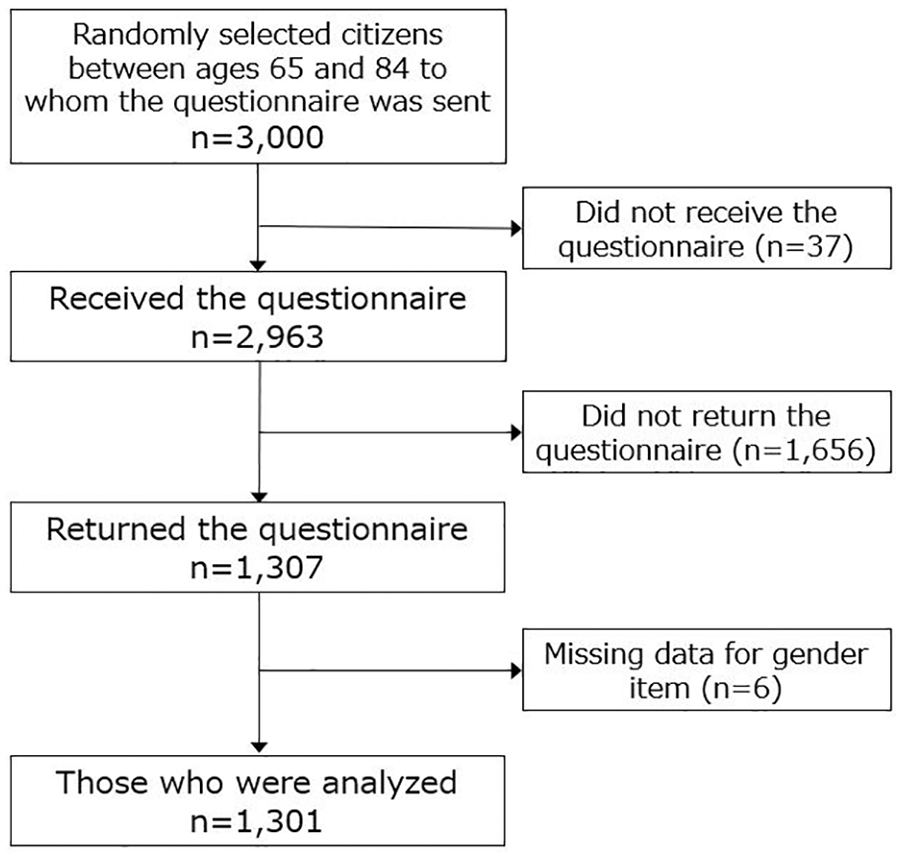
Flow chart of subjects.
Comparison of Basic Characteristics by Gender.

Abbreviation: SD, standard deviation.
P value for comparing men and women using the chi-square test or the t-test.
Low: This is the lowest level of physical activity. Individuals who did not meet the criteria for “moderate” or “high” were considered to have a “low” physical activity level.
Moderate: “Moderate” activity meets any of the following criteria:
(a) 3 or more days of vigorous-intensity activity of at least 20 min per day OR (b) 5 or more days of moderate-intensity activity and/or walking of at least 30 min per day OR (c) 5 or more days of any combination of walking or moderate- or vigorous-intensity activities achieving a minimum total physical activity of at least 600 MET-minutes/week.
High: “High” activity meets either of the following criteria:
(a) vigorous-intensity activity on at least 3 days achieving a minimum total physical activity of at least 1500 MET-minutes/week OR (b) 7 or more days of any combination of walking or moderate- or vigorous-intensity activities achieving a minimum total physical activity of at least 3000 MET-minutes/week.
Social participation was reported by 543 participants (41.7%) in January 2020, 319 (24.5%) in April 2020, and 251 (19.3%) in January 2021, showing a gradual decrease over time (Figure 2). Furthermore, 37.5% of men and 45.5% of women engaged in social participation in January 2020, versus 25.4% and 23.8% in April 2020 and 18.3% and 19.9% in January 2021, showing a particular decrease in the proportion of women engaged in social participation (Figure 3). In comparisons by gender, these differences in participation were significant in January 2020 (P = .002) but not in April 2020 (P = .707) or January 2021 (P = .348)

Changes in social participation.

Comparison of social participation by gender.
Discussion
This study of social participation among the elderly during the COVID-19 pandemic showed that the proportion of socially active elderly subjects decreased compared to the pre-pandemic level. In addition, although the proportion was higher in women than in men before the pandemic, there was no difference during the pandemic. We consider that the gender differences and changes in social participation among the elderly that were revealed in this study will facilitate future assessment of the infrastructure required to support social participation by community-dwelling elderly.
Previous studies have shown that social participation among the elderly is associated with health maintenance,6,23 feelings of happiness, 24 and involvement in local communities. However, the present results indicate that social participation has decreased due to the COVID-19 pandemic. Yamada et al 25 reported that the amount of physical activity among the elderly decreased during the first state of emergency in Japan (April 2020) and returned to the pre-pandemic level after the state of emergency was lifted (June 2020). We expected that social participation would show a similar increase after the state of emergency was lifted, but in fact the rate decreased. We consider that this decrease can be explained as follows. While physical activity can be maintained in a number of ways, such as through hobbies or by exercise alone or with others, social distancing was emphasized by the mass media as a social norm, 26 and concern about infecting others increased. 17 This led people to avoid social participation. Men have a higher participation rate in outdoor activities such as sports and volunteer activities, whereas women have higher participation rates in hobbies and cultural activities, 14 and these differences may have influenced the social participation of each gender. Moreover, the previous report stated that “most of the additional housework and childcare associated with COVID-19 falls on women.” 27 It is therefore possible that women have taken on additional family roles and have therefore had difficulty continuing social participation.
Even before the COVID-19 pandemic, people’s decreased activity was a health problem in many countries. The proportion of individuals with decreased activity is reported to be particularly high among women.28 -30 Our present results, obtained during the pandemic, also indicate that low-intensity physical activity was more common among women than men. A previous study reported that “one way to explain sex differences in activity is to assess male and female participation in different domains of activity (activity at work or in the household, for transport, and during leisure time).” 29 Since the present study also found differences between men and women in terms of employment status and the proportion of individuals living alone, we consider that different domains of activity influence the difference in physical activity between men and women. Although it is possible that the decrease in social participation activities caused by the COVID-19 pandemic is linked to decreased physical activity, we cannot determine this on the basis of the present results alone, and further investigation of this putative association is needed. In this regard, we demonstrated decreased social participation among the elderly during the COVID-19 pandemic, as well as differences between men and women in terms of physical activity. These findings suggest the need to identify new social gathering places based on a consideration of gender effects 31 and the characteristics of each local area and its residents, rather than simply resuming a pre-pandemic approach to local social participation activities.
The present study has some limitations. First, since the subjects were elderly people living in an area with a lower rate of COVID-19 infection than urban areas, our results are not directly generalizable to other locations, including cities. Second, since the subjects were asked to recall the status of their social participation 1 year before the survey was administered, a degree of recall bias may be present. Finally, the measurement of social participation used in this study may not be reliable as this concept may not be commonly understood in the Japanese context. In addition, the concept is broad, and a more detailed investigation of specific activities is required to determine which are associated with decreased involvement.
Conclusions
Social participation levels among elderly people living in a single community in Japan were lower during the COVID-19 pandemic than before it. The rate of decrease was particularly large among women.
Footnotes
Acknowledgements
We would like to express our sincere gratitude to the staff of the Elderly Welfare Division in Kitaibaraki City who cooperated with the survey, and to the residents who responded to the survey.
Declaration of Conflicting Interests
The author(s) declared no potential conflicts of interest with respect to the research, authorship, and/or publication of this article.
Funding
The author(s) received no financial support for the research, authorship, and/or publication of this article.
Ethical Approval
All participants were informed about the study orally and in writing, and they provided written informed consent prior to enrollment in the study. This study was approved by the Ethics Committee of the Faculty of Medicine, University of Tsukuba (approval number: 1602).
