




Abstract
Recent advances in mobile technology have ushered in a new era for family medicine practice settings. Tablets are becoming common place and can be especially useful to support and improve the delivery of health services. Medical information is readily available online. Clinicians have more than 20 000 medical apps available on iTunes and there are 8000 medical apps available on Google’s store. 1
The first iPad was designed and marketed by Apple, Inc and was released in April 2010. The iPad runs on Apple’s iOS operating system. In November 2012 the fourth-generation iPad was released and by October 2013 the iPad Air was released with a 24% reduction in volume compared with the fourth generation and a weight of only 1 pound. Key features of the iPad are a multitouch screen, virtual keyboard, and built in Wi-Fi capability. iPads can shoot video, take photos, play music, perform online functions such as Web browsing and e-mail, provide references and GPS navigation, and allow for various apps to be installed. The fourth-generation iPad’s size is 9.5 by 7.3 inches and weighs a little less than 2 pounds.
iPads are being adopted increasingly in all health care settings to support the information and communication needs of clinicians. From a study conducted by Manhattan Research, of 3015 physicians across 25 specialties, 62% are using tablets with Apple’s iPad the dominant platform. 2 Personal digital assistants and laptops are limited in use in the clinical setting by small screen size and portability, respectively. 3
Anderson et al 3 conducted a study focused on the use if iPad tablets to enhance rural physician practice. Five physicians were provided an iPad 2, a subscription for wireless service, and $800 to purchase medical apps and information resources. A year later, through a survey and follow-up telephone interviews, 4 of the 5 physicians completed the study, but 1 of the 4 did not use the iPad because he could not figure out how to print from the iPad. Overall, all aspects of the iPad device characteristics were perceived positively. Apps downloaded by the physicians were Epocrates and UpToDate. Three of the 4 physicians used the iPad in direct patient care for reviewing radiology films or lab results and with patients accessing information resources. Participants felt iPad apps were limited for medicine and better graphics and video were warranted.
Another study conducted a national survey of all residency and fellowship programs to query 6134 physicians about their use of mobile technology devices via e-mail. 4 With a 48% return representing 28 different specialties, 40% of respondents reported using a tablet, with the iPad being the most popular. 4 Forty-five percent of the tablet owners reported using their device in the clinical setting. 4 In a physician practice, videoconferencing was conducted via 2 iPads to offer remote foreign language interpretation. 5 Both patients and clinicians were satisfied with videoconferencing, which appeared to be flawless. 5
No research literature was found on the use of tablets or iPads in practice-based research networks. The purpose of this study was to determine the use and applications of iPads in Iowa Research Network family physician offices who were provided an iPad from a cancer infrastructure building grant.
Methods
Through a National Institutes of Health request for applications, a community cancer infrastructure program was funded with the support of the Iowa Research Network (IRENE), a practice-based research network of family physicians and the University of Iowa Holden Comprehensive Cancer Center in collaboration with the Iowa Cancer Consortium (ICC). These collaborating entities developed a comprehensive program that provides the infrastructure to support community-based, cancer control research across Iowa. As a component to build infrastructure for future research, health care providers (physicians and nurses) who attended primary care education sessions, hosted lunch and learn sessions, or participated in previous IRENE colorectal cancer screening research, were given an iPad for use in their respective offices. The education sessions were four hours long and included information on the use of an iPad, testing for fecal occult blood, human subjects training certification, IRENE colorectal cancer research summaries, and the ICC education resources, including appropriate apps relative to cancer. The 1-hour lunch and learn sessions omitted the human subjects training and testing for fecal occult blood.
IRENE was established in 2001 through the joint efforts of the members of the Iowa Academy of Family Physicians (IAFP), the University of Iowa Department of Family Medicine, and the IAFP Foundation. IRENE’s mission is to create new knowledge and improve clinical practice, especially in rural communities.
To facilitate iPad user’s time, the research team searched for appropriate online resources and apps to recommend for family physician practices. On the ICC Web page, http://www.canceriowa.org/family_practice_info_resources.aspx, items deemed relevant include cancer education for patients, cancer resources, educational videos, and iPad/iPhone apps for health care providers and appropriate apps for patients. When iPads were given out at various Lunch and Learn meetings or education sessions, participants were encouraged to tell the research team about worthwhile apps, videos, or Web sites for the ICC’s Web page.
Research for this study was approved by the university’s institutional review board and found to be exempt status. An online questionnaire was distributed to all individuals who received an iPad through the infrastructure grant.
Instrument
An initial questionnaire was developed by the authors. The draft iPad Questionnaire was reviewed at a weekly research faculty meeting. Physicians at the meeting revised the questionnaire and an important question regarding the barriers to using an iPad in the office was added. The resulting 17-item questionnaire included whether the subject used the iPad, whether office personnel used the iPad, reasons for use, whether the iPad was used with patients, use of ICC Web page, installation of apps, Internet availability in office, security issues, and access to electronic medical record through iPad. Four Likert-style questions were asked regarding ease of use, teaching patients, confidence in teaching patients with the iPad, and usefulness of the iPad for the office. The Likert-type scale had 5 choices ranging from strongly disagree to strongly agree. Two open-ended questions asked about the barriers to using the iPad in the office and any other comments about the iPad. Demographic questions included gender and year of birth. The questionnaire was built in Qualtrics and it took less than 5 minutes to complete.
Recruitment
An exempt institutional review board letter and link to the Qualtrics questionnaire was e-mailed to 81 health care providers who had been given an iPad. The health care providers had received the iPad 9 to 12 months prior to receiving the questionnaire. Within 2 weeks of the first e-mailing, a second duplicate e-mail was sent to the nonresponders. Two weeks after the second e-mailing, a paper copy was mailed to the remaining nonresponders with a postage-paid return envelope. In the exempt letter, individuals were informed they could opt out of the questionnaire if they chose and not receive the follow-up e-mail or mailed copy of the questionnaire. The final response rate was 59%.
Data Analysis
Questionnaire responses in Qualtrics were exported into SPSS. Questionnaire paper copy results were entered into the same SPSS file. Descriptive statistics, such as means and frequencies were calculated and chi-square was used to compare the frequencies between age group (2 groups: 25 through 50 years of age and 51 years of age and older) and gender of respondents. Fisher’s exact test was used when 50% or more of the cells had expected counts less than 5.
Results
Of the 81 individuals sent the questionnaire, 31 (38%) completed it by Qualtrics, 17 (21%) by paper copy, for an overall return rate of 48 (59%). Forty-one (85%) respondents reported they have used the iPad and 26 (54%) said any employee in the office can use it. Thirty (63%) of respondents were female. Respondents had a mean age of 51 years with an age range from 25 to 68 years.
Forty-one (85%) respondents reported they had wireless Internet in their office and have an electronic medical record. No differences were noted in questionnaire responses for those whose office had an electronic medical record and those offices that did not. One respondent reported there had been a security issue with the iPad. That person interpreted the security issue as their Information Technology services did not support the iPad. Sixteen (33%) reported they can access their office’s electronic medical record from the iPad.
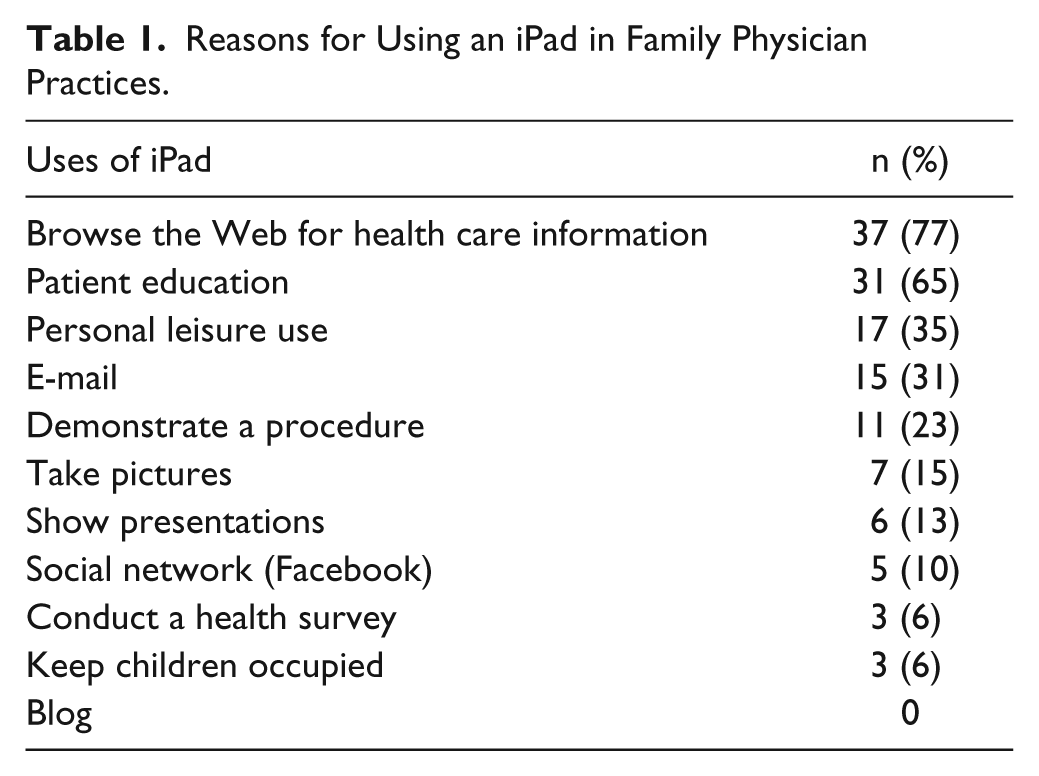
Respondents reported that the iPad is used for many reasons. The main reason was browsing the World Wide Web for health care information. See Table 1 for other uses. Of the 31 providers using the iPad for patient education, 26 reported that a mean of 9 patients per month were provided with medical education using the iPad (range 1-50 patients).
Reasons for Using an iPad in Family Physician Practices.
Twenty-five (52%) of the respondents reported using the online resources found on the ICC Web page with 8 of the 25 reporting they had downloaded an app from that Web page. Twenty-six persons (54%) downloaded apps from online sources on their iPad with a mean of 8 apps per user. Of the 216 apps installed, 69% were medical apps and 31% were leisure/nonmedical apps.
Forty-one (85%) respondents reported the iPad was easy to use, while 25 (52%) reported it had been helpful to teach patients. Twenty-nine (60%) respondents were confident in their ability to teach patients with the iPad. Six (13%) respondents reported the iPad had not been useful for the practice.
The main barrier to using the iPad cited by 6 (13%) respondents was not having Internet access. Two stated that the Internet speed was not adequate. Other barriers for iPad use were (a) fear of damaging it, (b) locating appropriate topic information, (c) too much time for patients to look at and then have to explain what they saw, (d) having personal items on the iPad that they do not want everyone to have access to, and (e) applications that cost money can only be downloaded by 1 person.
Other comments about the iPad included the following: (a) “we have used it to take photos of wounds and put into our electronic medical record,” (b) “helps me stay on top of American Academy of Family Physician information,” (c) “research medical questions during the course of the day in the clinic,” (d) “colorful pictures on the Web make patient teaching more compelling,” (e) “has sped up the clinic flow as it is easier to put orders in the system through the iPad at the point of care,” and (f) “would like to have more patient education apps.” Some respondents wrote in that they had downloaded the medical references, Epocrates and UpToDate.
Significantly younger persons used the iPad for social networking than the older respondents, (26% vs 0%, P = .012). No other significant differences were found by gender or age group.
Discussion
In July 2013, Apple press reported having sold 14.6 million iPads in the past quarter. 6 Use of tablets such as iPads in the health care setting will continue to grow. In the family medicine practices for this study, iPad use was higher at 85% compared with the 40% of respondents reporting use of a tablet in the residency survey. 4 Our questionnaire was targeted to individuals who were given an iPad compared with the residency questionnaire, which queried individuals who had purchased an iPad for their own use. It is of interest to note that 15% of those provided an iPad did not use it by the time of the questionnaire. Many factors could be associated with not using the iPad, such as never having one before, being too busy to learn, fear of losing it, or not interested in information technology.
Patient education is important and the Internet can provide a rich source of medical facts. Providing patient education in a busy family physician office is time consuming and overwhelming to determine what materials are appropriate for any given topic. 7 In a pilot study, 94% of the 50 patients using a developed hypertext Web page directory of patient education material found the information helpful, and 77% said they would change their behavior based on the information they read. 8 Providing health care information items relevant for family physician offices proved worthwhile. During the education sessions where the providers were given the iPads, they were instructed about an ICC Web page that had a link to iPad apps and education material for patients. This Web page seemed worthwhile and about half of the respondents used the resources. It is time consuming as a health care provider to find reliable and valid Web resources for patients. In 1995, a not-for-profit international organization, Health on the Net Foundation (HON), was created to set ethical standards for medical and nonmedical Internet users to obtain reliable online medical and health information. If a Web site was evaluated as credible, a HON code icon is located on the site. More than half of the respondents using the iPad for patient education said they had used it with an average of 9 patients per month. The average number of patients that a physician sees per day is 20. 9 Taking that into consideration and based on the reported mean number of patients provided education, approximately 2% of patients were being educated with the iPad by the respondents.
Patients do benefit from family physician’s use of information from an electronic knowledge resource that answers clinical questions. In determining the number of patients needed to benefit from an information search, 41 family physicians conducted searches on a handheld computer and in 715 of 1193 searches, the objective was to find information relevant to a patient. 10 Of those 715 searches, 188 were considered to be cases and in 53 of those cases, physician associated the use of information with at least 1 patient health benefit. This suggests the number of searches needed to benefit a patient is 14 (715/53). 10 Tablet availability in a physician office can only enhance patient health.
Barriers noted by the family physician practice respondents are evident in other health care settings. Security of the device is a main concern and some institutions have placed iPads in kiosks with a securely mounted touchscreen. 11 Others have turned on the GPS tracking device in the iPad to locate it if stolen or misplaced. Having a patient use the iPad in an office room, a confined area helps to keep the device in a secure setting. Another problem with security is that personal account information for purchasing apps is set-up on the iPad. Anyone using the iPad could download apps that have a cost if they figure out the apple identification number.
Fifty percent of doctor’s office receiving Medicare and Medicaid incentive payments use electronic medical records. 12 Electronic medical record use was not asked of the respondents, but 34% reported they were able to access their electronic medical record via the iPad. Access to an electronic medical records program enhances the need for adequate security of protected patient information.
Unfortunately, Internet connection is still a problem for many family physician practices. Also, for a few, the speed of the Internet connection was slow. Forty-nine percent of US residents’ Internet connections fall below the Federal Communications Commission’s broadband speed of a minimum of 4 megabits per second download and 1 megabits per second upload. 9 Main areas in Iowa with adequate speed are where the population density is larger and Iowa ranks 28th in the nation in Internet speed. 13
Our findings indicated that younger persons used the iPad for social networking rather than the older respondents. This is similar to the survey Pew Research Center’s Internet and American Life Project findings that found that 67% of any social networking site and Facebook users are women aged 18 to 29 years. 14 Older age groups are less likely to use social networking sites; in the age group 65 years and older for this study, no one used the social networking sites.
Limitations of this study were that only members of IRENE were given an iPad. Its use was limited to Iowa, a predominantly rural state. The findings from this study were only a snapshot of the iPad’s use at one time and place. As use of tablets become more common in households, usage in the medical office will also increase. As Internet and wireless coverage is expanded and improved in rural areas, tablet use will also increase.
Another strong application for the family physician office is FaceTime, a video calling service that provides the opportunity of the health care providers to communicate with patients or other health care providers at a distance. With appropriate security configuration, FaceTime can be Health Insurance Portability and Accountability Act compliant. An example of FaceTime use would be visualization of wound on a more frequent basis than the routine office visit.
IRENE has 313 members in 190 family physician offices in 76 of Iowa’s 99 counties. Many of these offices have participated in our practice-based research. Those members who have an iPad are now positioned to participate in research with the device. Tablet uses are variable in physician offices with provider’s gathering health care information from the Internet and securing education material for patients as the frequent usages. The variety of tablet uses is endless and will benefit the busy family physician office, staff, and patients.
Footnotes
Declaration of Conflicting Interests
The author(s) declared no potential conflicts of interest with respect to the research, authorship, and/or publication of this article.
Funding
The author(s) disclosed receipt of the following financial support for the research, authorship, and/or publication of this article: This study was supported by National Institutes of Health grant RC4 CA153493 (Principal Investigator: Barcey T. Levy).