




Abstract
Keywords
In 2006, a vaccine to prevent human papillomavirus (HPV) infection was approved by the US Food and Drug Administration. 1 The vaccine was first approved for girls and young women aged 9 to 26 years to prevent cervical, vulvar, and vaginal cancers.1,2 In 2009, the vaccine was approved for HPV infection prevention in boys and men 9 to 26 years old and later for prevention of anal cancer among men. 3 Effective vaccination requires 3 injections over a period of several months.
Despite the proven benefits of the vaccine, its implementation has been less than complete. Most US parents (70%-80%) are supportive of the vaccine for girls but less so for boys, probably in part because the vaccine was approved more recently for boys.4-7 Most studies have focused on parental acceptance rather than adolescents and young adults themselves, particularly males. In addition, much of the existing literature has focused on hypothetical HPV vaccination before US Food and Drug Administration approval. Two recent large studies examined vaccine uptake and completion rates among girls. From 2006 to 2010, acceptance rates at the University of Maryland Medical Center were 91% initiation and 33% completion among 9- to 13-year-old girls and 35% initiation and 11% completion among 9- to 26-year-old females. 8 In the North Carolina state immunization registry, 55% of 9- to 26-year-old females completed the vaccine series between 2006 and 2009. 9 Few studies have yet reported on uptake among males. Most of these studies have focused on hypothetical acceptance among gay and bisexual men because this population is at higher risk of HPV infection and anal cancer than are heterosexual men. 10 In a small study of men who have sex with men up to age 55 years, 64% of the sample completed the vaccination series offered off-label by a surgical practice between 2007 and 2009. 11
Although most prior studies have focused on demographic factors and attitudes toward vaccination and health care in general, it may be important to consider how health behavior patterns may be associated with vaccine uptake. Research has shown that health behaviors tend to co-occur; indeed, several parental behavioral factors (including physical activity and smoking) have been found to be associated with parental acceptance of the HPV vaccine for their daughters. 12 The only available study that explored the association between HPV vaccination and another health behavior found HPV vaccination to be associated with injectable contraceptive use by females. 13 The purpose of the current pilot study was to examine potential relationships between HPV vaccination and other health behaviors among adolescent girls and boys, focusing on other behaviors known to be associated with adult cancer development. We hypothesized that positive HPV attitudes and vaccine uptake would be associated with other healthy behaviors such as not smoking, healthy eating and body weight, sunscreen use, and safer sex.
Methods
Subjects
Participants in the current pilot study were 59 (41 girls, 18 boys) high school students recruited from science classes at a public school in the suburbs of Philadelphia, Pennsylvania. Mean age was 16.75 years (SD, 1.22). The majority of participants (93%) were non-Hispanic white. Participants were fairly equally divided among sophomores, juniors, and seniors, with only 7% being freshmen.
Measures
Girls were asked whether they had gotten the HPV vaccine with the following response options: all 3 shots, 1 or 2 shots, I am in the process of getting an appointment, and no shots. Boys were asked how likely they would be to get the HPV vaccine from 1 (not at all likely) to 5 (very likely). Additional measures included behavioral health items adapted from the well-validated US Centers for Disease Control 2007 Youth Risk Behavior Survey. 14 The topics of these items included height and weight to calculate body mass index; number of days physically active in the past week; intake of fruit, vegetables, sugar, and fat in the past week; sexual history including intercourse, oral sex, and unprotected sex; smoking; and skin protection, ultraviolet radiation exposure, and sunburns.
Procedure
This study was institutional review board approved, and parental and student consent/assent and Health Insurance Portability and Accountability Act of 1996 (HIPAA) authorization were obtained before the paper-and pencil survey.
Data analysis
Girls who reported having received all 3 shots were coded as having been vaccinated. Boys who reported being likely or very likely to get the vaccine were coded as willing to be vaccinated. Exploratory χ 2 analyses were used to examine potential associations between HPV vaccination and other health behaviors.
Results
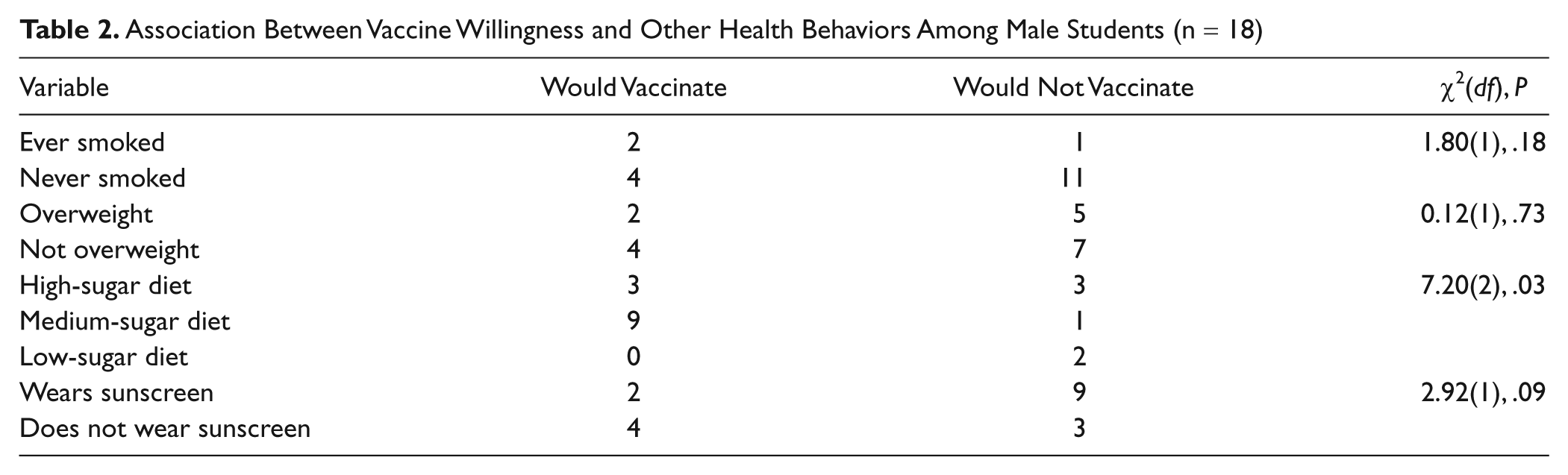
Overall, 54% of the female respondents reported having received the full HPV vaccine, 15% had received 1 to 2 shots, and only 1 girl reported being in the process of making an appointment. Among boys, 33% reported vaccine willingness. Associations between health behaviors and HPV vaccination for adolescent girls and boys are reported in Tables 1 and 2, respectively. We found that girls were significantly more likely to have been vaccinated if they had never smoked (P = .02) and a trend toward being more likely to have been vaccinated if they did not have a body mass index in the overweight range (P = .08). We found that boys were significantly more likely to be willing to be vaccinated if they had a higher sugar diet (P = .03) and a trend toward higher willingness to be vaccinated if they did not wear sunscreen (P = .09). None of the other associations between health behaviors and vaccination was statistically significant. In particular, there was no significant association found between sexual history (eg, vaginal intercourse, oral sex, unprotected sex) and vaccine acceptance.
Association Between Vaccination and Other Health Behaviors Among Female Students (n = 41)

Association Between Vaccine Willingness and Other Health Behaviors Among Male Students (n = 18)
Discussion
In the present study, more than half of the female respondents reported completing the 3-shot vaccination series. Uptake and awareness of the HPV vaccine have been increasing over time, likely related to widespread marketing efforts and mass media campaigns. Our preliminary data suggest that HPV vaccination may be associated with health-promoting behaviors among girls, but in contrast, our data suggest that vaccine willingness may be associated with risky health behaviors among boys. Specifically, adolescent girls who did not smoke were more likely to have received the vaccine, and girls who were not overweight showed a trend toward being more likely to have been vaccinated. One plausible explanation for this finding may be the parental monitoring hypothesis, 15 which postulates that high parental monitoring is associated with lower prevalence of risk behaviors such as smoking and drinking. It is possible that high parental monitoring is also associated with greater uptake of other illness prevention strategies such as vaccination. Indeed, given current medical guidelines that typically require parental consent for minors to receive the vaccine, it is acknowledged that any such associations between adolescent health behaviors and vaccine uptake will be directly affected by parental acceptance of the vaccine.
Among boys, diet (higher sugar intake) was associated with willingness to accept vaccination. However, it should be noted that most boys (and girls) did not have a low-sugar diet. In addition, boys who did not use sunscreen showed a trend toward being more willing to accept vaccination. Given that the HPV vaccine has not been available or marketed for as long to boys and men as to girls and women, it is likely that awareness of this vaccine is lower among adolescent boys than girls. Finally, sexual risk behaviors were not found to be associated with vaccination among either girls or boys. Such findings may help to ease parental concerns that vaccination will alter adolescent sexual behavior.
The study’s strengths are that it addresses the novel topic of the association of other health behaviors with HPV vaccine acceptance among both girls and boys. Of course, this pilot study is limited by the use of a small convenience sample and assessing hypothetical vaccination among boys. One of the major reasons for the small sample size was the requirement to obtain both a signed parental consent and HIPAA as well as student assent and HIPAA. We believe that the low consent rates are not indicative of active study refusal. In addition, the sample was from a suburban public high school, likely similar to many others in the United States, and we obtained some significant results despite the small sample size. Although we cannot rule out the associations that were not found to be significant due to the small sample size, the significant and nearly significant findings are promising. Finally, future research should investigate the relationship of other health behavior to actual vaccine uptake among boys.
Despite these limitations, these preliminary findings suggest that among adolescent girls, HPV vaccination may be associated with some other health-promoting and cancer prevention behaviors. Whether health risk behaviors continue to be associated with vaccine willingness among boys as HPV vaccine awareness increases among boys and their parents should be examined. Vaccination was not found to be associated with sexual risk behaviors in either girls or boys. In light of recent study findings that parental health behavior patterns may contribute to parental uptake of the HPV vaccine for daughters, 12 it may be informative to examine in more depth whether similar behavioral patterns are observed for adolescent vaccine acceptance. Recent studies have demonstrated that simultaneous interventions for multiple health behaviors can be more efficacious than are interventions focusing on single or sequential behavior change.16-18 Interventions tailored to each individual’s personal characteristics, including interventions to increase vaccination, and those tailored by gender have also been found to be more efficacious than are nontailored programs. 19 This pilot study provides an initial look at health behavior patterns related to HPV vaccine acceptance among adolescents and offers hypotheses and directions for future research.
Footnotes
Acknowledgements
The authors thank Jeanne Pomenti, Sara Filseth, and the participating science students and teachers for their assistance with this project.
The author(s) declared no potential conflicts of interest with respect to the research, authorship, and/or publication of this article.
The author(s) disclosed receipt of the following financial support for the research, authorship, and/or publication of this article: The investigators were funded by NIH grants K07CA108685 (PI: CH) and P30CA006927 (Fox Chase Cancer Center).