




Abstract
Since the release of the Opinions on Strengthening the Governance of Science and Technology Ethics by the General Office of the Central Committee of the Communist Party of China (CPC) and the General Office of the State Council in 2022, ethical governance has gradually become an integral part of national science and technology (S&T) governance and has received high attention from the CPC and the state. Scientific, technical and medical (STM) journals, as an important subject in the ethical governance of S&T, should abide by the consensus and norms of the publishing industry and play their own roles in the collaborative governance of S&T in the new era. On this basis and in view of the problems and challenges faced by STM journals in the new era, this paper proposes that Chinese STM journals should change their minds to further promote their function and introduces specific measures to realize such changes.
Keywords
Introduction
In 2018, Harvard Medical School announced that Piero Anversa, who once served at the institution, had 31 papers that needed to be retracted due to fraud. The ‘use of cardiac stem cells in heart repair’, a technology highly sought after in the medical field, turned out to be an academic scam, and some called it the biggest scandal in academia. In fact, retractions in scientific, technical and medical (STM) journals have always been a central issue in research ethics, attracting widespread attention from the government, the public and academia (Zhang, 2017). As the main platform for showcasing the scientific and academic achievements of the day, STM journals have always played the role of gatekeeper, with the task of preventing potential misconduct in scientific research. However, journal practitioners often face an awkward situation. On the one hand, STM journals are incapable of stopping research that violates the principles of scientific ethics at the source. As former Science editor-in-chief Donald Kennedy has said, journals can do very little to spot research misconduct. On the other hand, STM journals are deeply tied to academic papers. Once a problem occurs with a published paper, the journal must make a retraction decision. Paper retractions are not just a waste of journal resources but also negatively affect the journal's academic reputation and evaluation. People may think that journals that have failed the task of gatekeeping and allowed problematic papers to be published also bear an inescapable responsibility. Therefore, only by clearly understanding the responsibilities and boundaries and clarifying the limited goals of STM journals in the ethical governance of science and technology (S&T) can they escape the dilemma and truly play a primary role in the ethical governance of S&T.
STM journals are a crucial component in the governance system of S&T ethics
S&T ethics represent the values that guide the interactions between humans, between humans and society and between humans and nature during S&T activities. They encompass the philosophies and behavioural norms that reflect these values (Liu and Li, 2023). The germination of S&T ethics can be traced back to ancient China, when the idea of ‘governing techniques with the Dao’ was prevalent, meaning that technological actions and applications should be guided and constrained by ethical and moral norms (Wang, 2006). With the introduction of modern science to China and the breakthrough of emerging technologies in the mid-to-late twentieth century, people started to take note of and pay attention to the social risks and ethical challenges triggered by S&T. Topics such as how the values represented by S&T ethics can be implemented through a series of behavioural norms and how to construct a framework that ensures the sound development of S&T in accordance with ethical standards have evolved into an independent field of study. Consequently, contemporary research on S&T ethics and their governance has moved beyond the paradigms of traditional ethics and management science and received growing attention from academia, governments and scientists themselves. Some research outcomes, distilling academic insights, also serve a governance function by shaping policy texts, paving the way for the establishment of an S&T ethics governance system.
In July 2019, the ninth meeting of the Central Commission for Comprehensively Deepening Reform adopted the Plan for the Establishment of the National Science and Technology Ethics Committee and pointed out that the purpose of establishing the committee is to strengthen overall coordination, standardization and guidance and to promote the construction of a comprehensive, clearly oriented, standardized and well-coordinated S&T ethics governance system. This was the first time that the concept of ‘S&T ethics governance’ was cited in a national policy document. In March 2022, the General Office of the Central Committee of the Communist Party of China (CPC) and the General Office of the State Council issued the Opinions on Strengthening the Governance of Science and Technology Ethics, laying out the overall requirements and principles of S&T ethics governance in China, as well as the main content and measures for building S&T ethics governance systems and mechanisms. As a programmatic document for national S&T ethics governance, its promulgation is significant for promoting S&T ethics governance in China. This is a clear indication that S&T ethics governance is now high on the agenda of the CPC and the state. In September 2023, the Ministry of Science and Technology (MOST), the Ministry of Education (MOE), the Ministry of Industry and Information Technology, the Ministry of Agriculture and Rural Affairs, the National Health Commission, the Chinese Academy of Sciences (CAS), the Chinese Academy of Social Sciences, the Chinese Academy of Engineering (CAE), the China Association for Science and Technology (CAST) and the Science and Technology Commission of the Central Military Commission jointly issued the Measures for Sci-tech Ethics Review (for Trial Implementation), completing another piece of the national S&T ethics governance system.
With the continuous improvement of the national policy system for S&T ethics governance, the entities involved in S&T ethics governance become clearer: S&T ethics governance is a process of collaborative participation by multiple entities, including government-funded social organizations, scientific communities and the public. As a scientist-led vehicle and medium for recording the results of scientific practices, STM journals are functional in recording academic achievements, promoting academic exchanges and inspiring innovative ideas, making them an important link in the chain of S&T activities. Against the backdrop of the growing global focus on S&T ethics governance, STM journals are inherently motivated to actively participate in the governance process. At the same time, Chinese STM journals bear the natural responsibility and mission of contributing to China's S&T ethics governance and promoting China's position on S&T ethics. In the new era, Chinese STM journals need to think more deeply about the role they should play within the multifaceted system of S&T ethics governance and clarify their responsibilities and boundaries in carrying out and participating in S&T ethics governance, so as to play their role more effectively and efficiently. In this process, there is an intersection between the traditional ethics of the publication industry and the S&T ethics required by the current times, which gives STM journals greater space between observing publication industry standards and exercising greater initiative.
Publication ethics are the industry standards that STM journals must follow
As participants in the governance of S&T ethics, STM journals must adhere to the consensus and standards of the publishing industry in terms of the degree of their involvement, the functions they perform and the roles they assume. Therefore, the operation of STM journals must first and foremost strictly follow the basic norms of publication ethics and meet the industry's mandatory requirements.
Publication ethics are value guidelines and industry standards formed over a long course of history
In 1665, the Royal Society founded Philosophical Transactions, marking the birth of STM journals as a new form of literature. STM journals originated from the need for academic exchanges within the academic community and are a product of human progress and S&T development. The original purpose of launching STM journals was to promote academic exchanges and disseminate scientific knowledge to a larger audience through publishing activities. Along with the development and maturity of the scientific establishment, STM journals have undergone more than 350 years of development, and their functions have expanded to include the certification, refinement, dissemination and preservation of scientific knowledge through publishing activities and providing a platform for information exchange. Publication ethics of STM journals refer to the value guidelines that should be followed by various entities in their publishing activities, which include value concepts and behavioural norms that reflect these aspirational values. Publication ethics reflect the core values of STM journals: disseminate and exchange scientific knowledge more widely through publishing activities, promote S&T for good, and better serve human welfare and the advancement of civilization. These values are internalized into people's cognition and judgement of the fundamental purpose and significance of scientific publishing activities and shaped by various factors such as politics, economics, culture and the level of social development in different periods (Hu, 2020). It can be said that the evolution of the concept of publication ethics is the result of cognitive accumulation over an extended period, and it keeps evolving with the changing times.
International industry associations and organizations use the values of publication ethics to guide academic publishing activities and impose necessary constraints through the establishment of behavioural norms at different levels to ensure the healthy development of academic publishing. Through extensive long-term practice, the international community has gained a wealth of experience in publication ethics, and the associated system has become increasingly refined and perfected. For example, the Committee on Publication Ethics (COPE) aims to address issues that violate research and publication rules globally, and its main goal is to explore and find practical methods and good strategies to deal with these issues. In 2017, COPE consolidated the Code of Conduct and Best Practice Guidelines for Journal Editors and the Code of Conduct and Best Practice Guidelines for Journal Publishers into a new document entitled Core Practices to guide and assist journals, research institutions, publication groups and other stakeholders in jointly maintaining and promoting publication ethics (Zhao and Liu, 2022). Against the backdrop of the deep integration of artificial intelligence (AI) and academic publishing, the International Association of Scientific, Technical, and Medical Publishers (STM) is actively exploring the impact of new academic publishing paradigms on research integrity, as well as the application of AI technology in academic publishing, its positive effects and its potential risks (STM, 2021).
The institutional framework of publication ethics for Chinese STM journals has gradually improved
Introduced to China alongside modern science, STM journals have inherited the core spirit of the Invisible College. With the founding of the People's Republic of China, and particularly since the onset of the reform and opening up policy in late 1978, STM journals have answered the call of the CPC Central Committee, providing a vital platform for academic debate and serving as a robust foundation for national revitalization and enhancement through science and education. In the early stage of reform and opening up, China's academic community went through a period of exploration and reconstruction, and the issue of academic integrity was not yet visible. Compared to its international peers, China's STM publication industry was rather late in studying publication ethics and developing ethical norms. With the advance of S&T, cases of academic misconduct have notably increased and triggered worries and concerns globally. In this process, both STM journal planners at the top and practitioners on the ground have gained deeper understanding of the concept and connotations of publication ethics.
Table 1 outlines a series of documents related to the norms of publication ethics. As early as 2007, CAST issued the Code of Ethics for Science and Technology Workers, which defined the boundaries of misconduct in academic exchange. A series of paper-retraction incidents in 2015 served as a wake-up call for the Chinese academic community. To address the serious problems of academic impatience and academic misconduct, government departments in charge of STM journals issued a series of policy documents. That year, CAST, in conjunction with MOE, the State Administration of Press, Publication, Radio, Film and Television, CAS and CAE, jointly issued Several Opinions on Accurately Harnessing the Role of STM Journals in Academic Evaluation, which stressed the importance of developing ethical standards to make STM journals a pure and fertile land for advocating scientific ethics and sound academic practices.
Documents on publication ethics released by China.
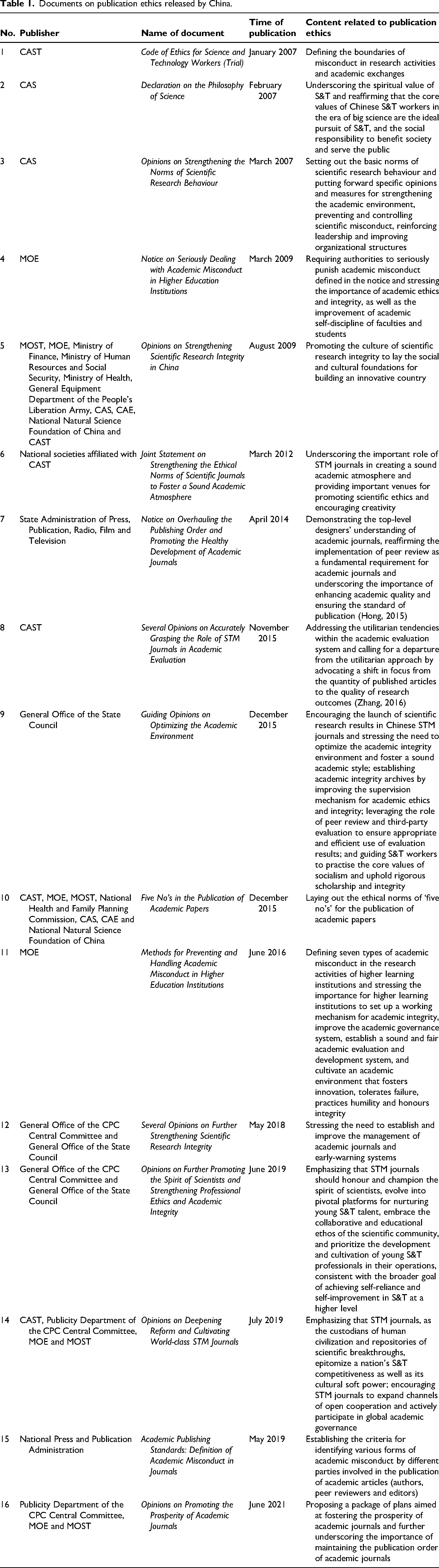
Documents on publication ethics released by China.
In 2018, the General Office of the CPC Central Committee and the General Office of the State Council issued Several Opinions on Further Strengthening Scientific Research Integrity, emphasizing that STM journals should fully play their role in the development of scientific research integrity, improve the quality of peer review and strengthen the review of academic papers.
In 2019, the General Office of the CPC Central Committee and the General Office of the State Council issued the Opinions on Further Promoting the Spirit of Scientists and Strengthening Professional Ethics and Academic Integrity, calling on S&T workers to consciously practise and vigorously promote the spirit of scientists in the new era and requiring that S&T workers strictly observe the norms of research ethics and honour the fundamental principles of academic morality. In the same year, CAST, the Publicity Department of the CPC Central Committee, MOE and MOST jointly issued the Opinions on Deepening Reform and Cultivating World-class STM Journals. The document underscores the importance of strengthening and improving the principle of ‘triple review and triple proofreading’, anonymous peer review and other content-production mechanisms for STM journals, improving the early warning and investigation mechanism for academic misconduct and reinforcing the foundation of academic integrity and publication ethics. In addition, the National Press and Publication Administration issued the Academic Publishing Standards: Definition of Academic Misconduct in Journals, which established criteria for identifying various forms of academic misconduct by different parties involved in the publication of academic articles, setting these standards within the publication industry framework.
In 2021, the Publicity Department of the CPC Central Committee, MOE and the MOST jointly issued the Opinions on Promoting the Prosperity of Academic Journals, further stressing the need to establish good publication order for academic journals.
As can be seen from the key policy documents summarized in Table 1, with the increasing public scrutiny of academic misconduct in China, the scope of academic misconduct has been refined and updated. Concurrently, the regulatory bodies overseeing scientific research have become more explicit in their punitive measures against such misconduct and intensified their efforts in investigation and management. The publication of S&T achievements is an important aspect of scientific research activities. Both the academic and publication communities have set higher requirements for publication ethics, clearly defining the criteria for misconduct that may be involved in the publication process and providing specific and systematic guidelines for case investigation and handling. It can be observed that, despite a late start in the development of publication ethics, China's academic publishing sector has made swift progress in establishing an institutional framework for publication ethics, thanks to the dedication of relevant authorities to research integrity. This has allowed China to gradually align with international standards within the academic community (Ren et al., 2021).
China's journal industry also started later in research on and the practice of publication ethics than its international counterparts. In recent years, due to an emphasis on publication ethics, significant improvements have been achieved in both research and practice. In particular, academic associations in the publishing sector have played an active role in leading by example. In 2019, the China Editology Society of Science Periodicals (CESSP) published the Guidelines on the Publication Ethics of STM Journals, which is the first systematic guide addressing ethical and moral issues related to the publication of STM journals in China. In the same year, the society issued the CESSP Statement on Promoting Research Integrity and Ethical Standards in Academic Publications, clarifying the ethical responsibilities of the four key players in the publication of STM journals: authors, editors, reviewers and funders. An increasing number of Chinese STM journals are now answering the call of the government and the CESSP to improve the development of publication ethics. English-language journals published by Chinese publishers have also taken into account publication ethics guidelines practised around the world. According to data posted on the official website of COPE, as of April 2022, there were 493 journal members from China's mainland (Gao et al., 2022)—a figure that has continued to rise in recent years. Academician Zhu Zuoyan, former chief editor of Science China and Chinese Science Bulletin, suggested that a prerequisite for a journal to achieve world-class status is its widespread recognition within the international scientific community (Yan et al., 2021). Such recognition must, first and foremost, encompass the values observed by the journal during the publication process. The growing influence of Chinese STM journals in the international academic community attests to the efforts and achievements that China has made in recent years to enhance publication ethics.
The boundaries of Chinese STM journals’ participation in the governance of S&T ethics
Although STM journals are entities with clear responsibilities, their role in the governance of S&T ethics involves a more complex division of labour. In terms of specific social functions, STM journals are, in fact, an organizational division of labour based on the fundamental principles and systems of the modern scientific community, backed by a collective mechanism for the review of research outcomes in the form of academic papers. During the collective review process, these research outcomes are being corrected and examined at different stages and by different groups to ensure that their publications comply with integrity and ethical norms. In the review process, journal editors first need to control paper quality at the front end (before publication), including by verifying ethical statements and organizing stricter scrutiny for sensitive papers; at the back end (after publication), they need to supervise the papers, including by organizing expert reviews for controversial papers and making serious decisions on whether to retract papers based on expert opinions. The responsibility for the intermediate stages should lie more with others than with the editors.
Take paper retraction, the most commonly used method by STM journals in governing S&T ethics, as an example. Statistical data shows that 50%‒60% of article retractions may be due to academic misconduct. However, there is still a notable proportion of article retractions caused by honest errors, including errors in research methods, irreproducibility and new discoveries. For example, not long ago, a review article titled ‘Detecting human diseases through the iris of the eye’ was published and then retracted by the Institute of Electrical and Electronics Engineers (IEEE) (Bu, 2024). The reason was that 18 out of the 30 references cited in the paper had been retracted, and IEEE concluded that, given the large number of retracted references, the paper did not meet IEEE's publication standards. Things like this have happened frequently in recent years, and some affected authors believe that the retraction of references happened after the publication of their papers, and it is thus unfair to label their research as problematic.
As academician Yang Wei mentioned in an interview with China Science Daily, even for retractions caused by academic misconduct, two issues need to be clarified: one is the issue of responsibility, and the other is the issue of capability (Liu, 2021). The editorial departments of STM journals often lack the capability to discover certain problems of academic misconduct in a timely manner during the review and publication process. However, although the editorial departments need to continuously improve their capabilities, the real responsibility still lies with the authors themselves. After all, the author shall always be responsible for his or her own writing. Li Dangsheng, editor-in-chief of Cell Research, proposed that scientific research is an exploration of the unknown, and no one knows whether newly discovered phenomena and laws are the ultimate truths (Li, 2021). Therefore, the testing of existing scientific hypotheses and the correction of established conclusions are a normal part of scientific research. Retraction, as a normal corrective action, is itself blameless. On the contrary, what is truly despised by the global community is any reluctance to admit mistakes, and even the cover-up and indulgence of potential academic misconduct—an act that also brings shame upon research institutions. This shows that understanding the complex mechanisms behind the simple act of retraction is an important prerequisite for STM journals to accurately perform their duties and find the right boundaries in the governance of S&T ethics.
Ethical governance of S&T in the new era raises new demands for Chinese STM journals
Chinese STM journals have always played a major role in promoting the ethical values of S&T
Modern science was born in the West, and its fundamental values are the pursuit of rationality and the free exploration of laws governing the objective world. Chinese intellectuals introduced modern science to China, not only pursuing pure knowledge of the objective world but also closely linking this pursuit with the goals of erasing national humiliation and achieving national prosperity and the happiness of the people (Han, 2019). In 1915, the Chinese Scientific Society launched the journal Science, which stated in the inaugural editorial that a civilized nation must have academic societies, and these societies must have journals to report the progress of their academic research and the invention of new theories. The establishment of early Chinese STM journals reflected the common will of Chinese intellectuals at the time and carried forward the valuable spirit that guided the nation's forefathers in saving the nation and the people through science. These ideas have shaped the ethical values of S&T in China.
Following the establishment of the People's Republic of China, Chinese STM journals, in response to the country's developmental needs and the broader goals of national economic growth and social advancement, have published numerous significant scientific achievements, thereby laying a solid foundation for the substantial progress of S&T in China. In the early stage of reform and opening up, STM journals played a leading role in the nationwide discussion on the standards of truth. Intellectuals used their theoretical thinking to influence public opinion, transforming the internal values of the academic community into social values. Since the 18th National Congress of the CPC, China has deeply implemented an innovation-driven development strategy and adopted self-reliance and self-improvement in S&T as a strategic underpinning for national development. By publishing significant scientific achievements in key strategic fields, Chinese STM journals have introduced the rational and empirical spirit of science to society and integrated this spiritual force into the cultivation and shaping of socialist core values, subtly and progressively guiding and infusing scientific values into mainstream societal values. At the social level, the positive role of S&T is now widely recognized, and there is a positive public attitude towards accelerating the development and application of S&T.
The trend of S&T development in the new era requires Chinese STM journals to have a stronger sense of ethics
S&T ethics, as shared values among those engaged in S&T endeavours, are universal yet marked by distinct temporal and cultural traits. As humanity advances from the post-industrial to the big-data era, the drawbacks of emerging technologies’ development and application have sparked reflection and critique. As China's S&T progress shifts from trailing to matching, and now leading in certain domains, it encounters increasingly complex ethical dilemmas and challenges in the uncharted territories of technological innovation (Dong and Jia, 2022). The original ethical value system can no longer judge and examine new technological applications; the construction of a new technological value system requires the wisdom and consensus of the Chinese academic community. Take life sciences as an example. In November 2018, the announcement of the first genetically edited human infant immediately triggered widespread attention and controversy in both academia and society. Soon after that, in January 2019, Medicine and Philosophy, a social science journal in the medical field, published an article titled ‘The ethical and governance challenges of heritable genome editing’, giving a timely response to the concerns of academia and society. The article mainly discussed the ethical and governance challenges of heritable genome editing, transmitting the voice of the Chinese academic community and providing a valuable theoretical framework and governance recommendations for the ethical governance of human gene editing technology in China (Qiu et al., 2019).
Although S&T activities are fundamentally guided by the value of ‘seeking truth and pursuing ultimate virtue’ (Luo et al., 2021), variations in the ethical values of S&T are an undeniable reality. These differences are caused by the interplay of multiple factors, including politics, economics, culture and the level of social development (Hu, 2020). China's deep participation in the global governance of S&T ethics is consistent with international ethical consensus and norms and grounded in the prevailing features and cultural customs of China's scientific, technological and socioeconomic development. As global scientific activities become more deeply collaborative, and academic achievements are more widely disseminated across languages and cultures under the banner of open science, STM journals have become an important channel for countries to proactively export their S&T values (Zhang et al., 2020). Securing the discourse on S&T ethics will enable countries to occupy the moral high ground in the global governance of S&T ethics.
In 2021, President Xi Jinping stressed in a reply letter to the editors of Literature, History and Philosophy that high-quality academic journals should help the world better learn about China and gain a deep understanding of Chinese civilization and should use the combined perspectives of history and reality, theory and practice to give a thorough interpretation on how to stay on the Chinese path, promote the Chinese spirit and gather Chinese strength. The CPC and government leadership have pointed the direction for Chinese academic journals to participate in the global governance of S&T. While upholding China's ethical values in S&T, they are encouraged to sustain exchanges and dialogue and foster cooperation and mutual understanding, based on an attitude that seeks common ground while respecting differences, values harmony in diversity and practises inclusiveness. In recent years, programmes such as the Plan to Enhance the International Influence of Chinese STM Journals and the Excellence Action Plan for Chinese STM Journals have been launched to encourage the ‘going global’ of China's high-quality English-language STM journals. Moreover, under CAST's STM Journal Bilingual Communication Project, bilingual abstracts are being produced and translated for articles carried in top Chinese STM journals. By showcasing China's academic achievements, these projects aim to boost China's S&T image on the world stage and to build and promote China's image as a responsible country.
The intersection between industry standards and demands of the current times gives STM journals the space for active exploration
With the release of successive policy documents on the governance of S&T ethics, the issue of S&T ethics is attracting growing attention. Key players, including research institutions, scientific societies and relevant authorities, have all sensed the new demands of the era and are eager to define their roles in the latest round of governance of S&T ethics. Against this backdrop, STM journals, which have been the primary communication platforms for the scientific community and the media for showcasing scientific achievements, can maintain their reasonable and moderate involvement in the governance of S&T ethics only by finding their proper place. They must perform their duties diligently to fulfil the mission of collaborative governance. In defining the role of STM journals in this governance, publication ethics (as the industry's baseline standards) and the evolving demands of the times (driven by advances in S&T) act as the ‘floor’ and ‘ceiling’, respectively. It is only by actively and boldly exploring within this framework, in accordance with their unique circumstances, and continuously accumulating experience, that STM journals can maximize their impact and effectively play their part (Chi and Zhang, 2010).
First and foremost, publication ethics, developed and refined over centuries, form the industry standards that all journals are obliged to uphold and not transgress. Since the inception of Philosophical Transactions, the relentless efforts of scholars and professionals have shaped a robust and mature set of behavioural norms for STM journals, in which publication ethics are a crucial component. Ongoing evolution and innovation within this tradition imbue the establishment and implementation of publication ethics with a distinctly temporal character. The substance of contemporary publication ethics has been vetted through scientific rigour and the practical trials of journal operations, representing a historical culmination of the relentless exploration, synthesis and accumulation by journal professionals across generations. The regulatory influence of this historical legacy on today's STM journals is evident in two key respects. On the one hand, the journal industry has cultivated a consensus and shared experience over centuries, which serves as a foundation. When faced with new challenges, it is essential to propose bold hypotheses and verify them meticulously. A new consensus should emerge gradually, without hastily dismantling the established one. On the other hand, the continuous emergence of new situations and phenomena over the centuries has endowed industry standards with a degree of adaptability and openness. These standards are not inherently averse to embracing novelties. Therefore, taking all aspects into account, the modern evolution of STM journals must be anchored in strict compliance with industry-recognized publication ethics. These norms should act as safeguards for the healthy progression of journals and as an essential component of their involvement in the governance of S&T ethics.
At the same time, the rapid evolution of technology has led to a surge in research outcomes, while also rendering the by-products of technological achievements more unpredictable and potentially perilous. Navigating the centuries-long history of STM journals with precision is essential for understanding the historical context. During the depths of the Dark Ages, the inhabitants of the European continent often wondered whether the darkness was about to lift, unaware that eight or nine more centuries of gloom lay ahead. Likewise, while the development history of STM journals provides us with the experience to engage in S&T ethics, we must not overemphasize the inertia of the past or neglect the demands of the new era. The evolution of STM journals has always been accompanied by the progress of science itself. Historically, STM journals, originating in the ‘small science’ era, experienced explosive growth with the advent of the ‘big science’ era, successfully adapting this venerable mode of communication to meet new demands amid evolving S&T landscapes. Today, as the values of S&T gain increasing attention from both academia and society, technological development is entering a new phase in which ethical considerations lead the way. While the new demands on STM journals in this phase are not yet clear, proactively adapting to these demands is crucial for journals to continue writing their own history and embarking on a new chapter.
Regarding the ethical values of S&T, STM journals need to stay current with the times and evaluate whether the content that they publish adheres to the principle of using technology for the greater good, in line with the industry's initial vision. As for the behavioural norms of S&T ethics, STM journals must uphold publication ethics and explore the formulation of new standards. In fact, there is often considerable room for exploration between these two domains, as each ethically contentious event introduces a novel situation that poses a fresh challenge to the knowledge and actions of STM journals. With limited historical precedents and the continuous emergence of novel entities, STM journals must keep looking for their rightful place while avoiding errors and must collaborate with other stakeholders to jointly conduct the governance of S&T ethics and promote the benign and responsible development of S&T.
New questions and challenges facing Chinese STM journals as they strive to better play their role in the new era
In today's world, STM journals are at a pivotal moment, transitioning from a paradigm in which technological advancement takes precedence to one in which ethical considerations lead the way. Historically, such shifts have often signalled opportunities for STM journals to achieve new growth, yet they also undoubtedly present a multitude of new questions and challenges. To strike a balance between upholding publication ethics and embracing the spirit of scientists, STM journals have a multitude of decisions and compromises to make within the realms of both theory and practice.
First, there is a tension between the original mission of STM journals and the evolving landscape of S&T development. The history of STM journals offers a rich and valuable body of empirical evidence for current practices. However, within the cycle of inheritance, development and innovation, understanding historical patterns requires an increasingly macro-historical and comprehensive perspective. A myopic view can oversimplify the understanding of historical experiences, confining it to partial phenomena. The identity of STM journals should be understood through the lens of centuries of historical evolution to grasp their essence, gradually forming a dynamic concept of STM journals through holistic comparison and judgement, rather than rigidly adhering to established definitions. Thus, in the implementation of the new development philosophies, it is crucial to understand the journals’ original mission of facilitating academic exchange, as it is the only way to truly grasp the underlying social functions of STM journals amid their changing forms and stay firmly on course in the face of sweeping S&T revolutions.
Second, there is a tension between the core functions of STM journals and the elevated demands of upholding the spirit of scientists. The Opinions on Further Promoting the Spirit of Scientists and Strengthening Professional Ethics and Academic Integrity issued by the General Office of the CPC Central Committee and the General Office of the State Council in 2019 put forward, for the first time, the concept of the ‘spirit of scientists’ and the requirement of promoting that spirit. Subsequently, the National Action Plan for Scientific Literacy (2021‒2035) issued in 2021 and the Opinions on Further Strengthening Science Popularization Work in the New Era issued in 2022 both stressed the importance of fostering the spirit of scientists. STM journals constitute an integral part of the scientific community, and advocating and promoting the spirit of scientists is in line with their longstanding values. Yet, the precise manner and degree to which these efforts are carried out remain areas that require further exploration. It is only by identifying approaches that are effectively and efficiently integrated with their core functions that STM journals can ensure that these efforts augment their development without imposing an undue burden.
Third, there is a tension between the essential and additional aspects of STM journals’ involvement in the governance of S&T ethics. While publication ethics establish the fundamental standards for journals’ engagement in ethical governance, the proliferation of ethical disputes that arise with S&T advances offers STM journals extra opportunities to advance through reflection and action. The advent of new technologies often sparks ethical debates, such as those surrounding assisted reproductive technology, organ transplantation and biological cloning, which all caused significant controversy at their inception but have since become widely accepted in our daily lives. In the face of cutting-edge technologies that bring considerable uncertainty, STM journals must keep an open attitude towards new perspectives and findings while reducing ethical risks. They must present diverse academic viewpoints in a fair and proper manner and contribute to the cultivation of an inclusive scientific culture in their unique way.
Finally, there is a tension between the historical patterns of STM journal development and the inherent uncertainty of S&T advances. Although new developments in S&T are eventually assimilated into existing frameworks, STM journals, as the vanguard for presenting research findings under current paradigms, bear unparalleled and immense pressure during this protracted process. Given the intrinsic uncertainty of scientific research, determining whether a new result complies with ethical standards requires both a comparison with historical precedents and a departure from simplistic analogies based on past experiences. Therefore, a comprehensive understanding of the history of S&T development, in addition to the journal's own evolution, is necessary to profoundly grasp the shared roots of the scientific and humanistic spirits and to navigate the interplay between historical patterns and uncertainty.
Countermeasures and suggestions for Chinese STM journals to play a better role in the new era
Establish a platform for exchange to promote theoretical study of S&T ethics, take action as the foundation and lead with concepts
The fundamental goal of S&T ethics governance is to make technology a force for good. To truly put ethical considerations at the forefront of the governance process, it is essential to have a solid, adaptable and dynamically evolving theoretical foundation and intellectual safeguards for S&T ethics. STM journals should take on the academic mission of promoting the development of discipline ethics and fully leverage their role as theoretical platforms and academic leaders to forge stronger consensus, address real-world concerns and contribute to the building of a discipline‒academic‒discourse system with Chinese features and character. In 2023, the National Leading Group for Promoting Science Ethics and Academic Integrity launched the inaugural national essay competition on ‘Frontiers of S&T Ethics’, which successfully attracted a plethora of high-quality academic papers to be published in prestigious STM journals, effectively leveraging the platforms’ advantages. The academic community convened to engage in discussions on pivotal ethical frontier issues and to chart future courses for the governance of S&T ethics. However, theoretical research is not a temporary task; STM journals should persist in their efforts and continue to provide theoretical solutions to ethical dilemmas and values that guide the development of S&T.
Enrich the education and publicity of S&T ethics and carry forward the spirit of Chinese scientists
Since their inception, STM journals have undertaken the dual responsibilities of facilitating exchanges within the academic community and disseminating knowledge to the public, and these two functions proceed in parallel. The dissemination of the spirit of scientists is the foundation for its promotion, and understanding and acknowledging scientific values is the key to its communication. Faced with a public that holds diverse cognitive perspectives, STM journals should delve into the spiritual essence of scientific endeavours, concretely articulate the values and behavioural standards for S&T workers based on scientific rigour, objectivity and precision, and adopt narratives that are popular among the public to construct a sound image of scientists and present their unique spiritual temperament and values. When the spirit of Chinese scientists becomes an integral and advanced component of leading social culture and successfully fosters a culture of ‘technology for good’ within society, the public will be able to approach issues of S&T ethics with a heightened sense of ethics.
Cultivate an open and inclusive attitude and respect diverse views in S&T ethics governance
The expansion of S&T activities has led to new dimensions and diverse views on S&T ethics. Traditional value systems no longer fit the new problems emerging in the new era. It is therefore imperative to build an open value system—a process that requires a deep understanding of scientific practices and an accurate grasp of ethical values. This understanding and grasp are part of proactive and creative endeavours, and the open, transparent and interactive nature of journal platforms provides the stage for these activities. STM journals have a role in fostering a positive ethical outlook among the public regarding the advent of new technologies. They should establish a flexible constraint mechanism for managing diverse perspectives based on extensive discussions to provide a necessary supplement to the legal and policy constraints within the governance framework of S&T ethics. In the rigorous manuscript-review process, the journals should enhance pre-publication vigilance and post-publication tracking of ethically sensitive papers to make sure that the professional editors undertake their limited responsibility and, at the same time, organize and encourage the participation of experts to facilitate the involvement of the scientific community in the governance of S&T ethics.
Maintain humanistic contemplation of S&T progress to tackle frontier issues in S&T ethics governance
S&T progress has always been a double-edged sword. It is both a potent instrument for driving growth and a source of potential risks. The distinctive risks in technological advancement bring complex and deep challenges to humanity's long-term development and have a profound impact on our dignity and the future of our species. Amid the unstoppable tide of technological progress, STM journals must maintain a vigilant and humanistic contemplation of the latest advances. They must take a human-centric view of scientific knowledge and activities, as well as the institutionalized development of S&T, to reveal the humanistic significance, context and implications of S&T. While some may challenge this approach with notions such as ‘value-neutral science’ or ‘science has no borders’, it is crucial to remember that S&T are, at their core, human endeavours. The guiding principle of S&T activities should always be people-centric. Only by balancing the scientific spirit with the humanistic spirit can we steer S&T towards a positive trajectory that better serves human welfare and the progress of human civilization.
Footnotes
Declaration of conflicting interests
The authors declared no potential conflicts of interest with respect to the research, authorship, and/or publication of this article.
Funding
The authors disclosed receipt of the following financial support for the research, authorship, and/or publication of this article: This work was supported by the National Social Science Fund of China (grant number 22BZX025).
