




Abstract
In the final decades of the eighteenth century and the first decades of the nineteenth century, there was a phase of cultural effervescence in Europe that impacted the progress of philosophical and scientific thought. In addition to making their mark in their fields of knowledge, key figures in Western culture, such as Kant, Humboldt and Goethe, contributed greatly to the advancement of natural sciences, particularly atmospheric science. Goethe stands out for his work on barometric measurements, his knowledge of clouds and his ideas on the movement of the air. His justification of atmospheric dynamics based on internal causes of the Earth was quickly dismissed in light of the air physics discoveries taking place at the time. He was passionate about the shapes of clouds and the form of the sky, which he described and drew. His literary work is replete with references to the atmosphere. This study analyses the meteorological writings of Goethe, examining his contributions to the atmospheric sciences of his day and how his passion for the skies and clouds permeated his literary works. Goethe's relationship with the fields of meteorology and climate science is not well known, but his studies constituted a valuable contribution to the cultural and scientific context of the Europe that was taking shape at that time.
Ich suchte mich von dieser Lehre zu durchdringen, befleißigte mich einer Anwendung derselben zu Hause wie auf Reisen, in jeder Jahreszeit und auf bedeutend verschiedenen Barometer-Höhen.
Introduction
The end of the eighteenth and beginning of the nineteenth centuries witnessed highly significant contributions to scientific progress, particularly with respect to knowledge of the weather and climate. In Europe, the Enlightenment had given way to Romanticism with implications for all fields of knowledge; interpretations of the nature and relationship of humans with the physical environment were proposed, ranging from the environmentalist ideas that preceded the nineteenth century's determinism to the rationality and scientism that impregnated the methods and results of the experimental sciences. It was the era of authors essential for Western thought, such as Kant, Linnaeus, Laplace and Humboldt. Within this context, Johann Wolfgang von Goethe (1749–1832), a unique proponent of German Romanticism, published several texts on the importance of nature and its constituent elements for human life as part of his early works (Bollmann, 2023). Goethe contributed a theory of nature that sought to bring together the ideas of rationalism and empiricism at the time, imbuing the interpretation of the facts with a component of subjectivity derived from the observer's capacity to contemplate and admire (Bortoft, 2020).
These ideas were manifested in Goethe's writings related to meteorology and climate. Goethe's passion for these fields led him to publish texts, participate in conferences and elaborate a meteorology treatise. This zeal for atmospheric matters was also demonstrated in his literary works, which contained references to climate phenomena and elements, particularly clouds. Goethe disseminated the classification of clouds that Luke Howard (1772–1864) proposed in 1802 and even dedicated a book of poetry to the different types of clouds proposed by Howard in his essay on clouds (Olcina Cantos, 2013).
Goethe was a humanist with very extensive knowledge. The education he had received enabled him to follow an exceptional scholarly path, on which he met with people with a diverse range of intellectual training, including scientists from different fields with whom he established fruitful correspondence based on the constructive criticism of ideas. His interest in scientific topics reflected his intellectual curiosity and was linked to a personality that was out of the ordinary (Bollmann, 2023). He shared this exceptionality with other scholars of his time, such as Alexander and Wilhelm von Humboldt. Goethe did not lead any scientific movements, nor was his legacy in the history of universal thought related to his scientific writings; however, his contributions to the theory of nature, with respect to the weather and climate in particular, are worth analysing and reflecting on due to the depth of his little-known ideas in these areas. This study presents Goethe as an essential link in the conceptual and epistemological evolution of climatology in the final decades of pre-scientism until the consolidation of meteorology and climatology as scientific disciplines throughout the nineteenth century.
The framework: The theory of nature in Goethe
In his early years, Goethe lived his life with passion within a favourable and cultured family context in a city that experienced political and cultural flourishing at the end of the eighteenth century and the beginning of the nineteenth century. His interests and intellectual passion went beyond literature and the fostering of the ideas of Romanticism. One of the principal centres from which the Romanticism movement projected its literary and philosophical ideas was, in fact, Germany, through Schlegel and Schelling. Nature, as a host to human beings and an environment for the development of existing creatures, constituted an important part of his writings, and he even proposed a ‘theory of nature’ replete with interpretations of environmental facts, phenomena and processes.
Goethe alternated his literary texts and professional activity with writings on nature-related topics, which had interested him since his youth. As early as 1790, he published his Metamorphosis of Plants, in which he defended that the archetypical form of the plant was found in the leaf (Bortoft, 2020). Goethe says, ‘From first to last, the plant is nothing but leaf, which is so inseparable from the future germ that one cannot think of one without the other’ (Lavernia, 2020; Mas, 2004). In 1791, he wrote his Theory of Colours, which he published in 1810. This theory interprets colour as something that emerges from the dynamic interaction between darkness and light (Park and Song, 2018). Goethe was convinced that Newton was wrong when he assumed that white light could be broken down into different colours. He proposed his own approach (González, 2019), that colour should be seen as a mixture of light and darkness. At first, he attempted, not very convincingly, to propose these ideas as new, alternative laws of physics (Beiträge zur Optik, 1791–1792; Optical Essays, commented in Bortoft, 2020). Later, he observed that the essence of colour requires cooperation between the physical behaviour of light and the perceptive apparatus of the human being. Goethe's theory of colour is certainly original as a theory of vision rather than as a theory of light.
After being translated into English in 1840 by Charles Eastlake, his Theory of Colours was adopted widely in the world of art by masters of colour, such as JMW Turner (Bockemuhl, 1991; González, 2019). Schopenhauer, however, considered that his own manuscript ‘On vision and colours’ was the correct theory and that Goethe's book was a mere compilation of data. Goethe's work also inspired the philosopher Ludwig Wittgenstein when writing his Remarks on Colour (2013). Goethe vehemently opposed Newton's analytical treatment of colour, committing himself to compiling a complete description of a wide variety of colour phenomena. Although the precision of Goethe's observations does not raise much criticism, the fact that his theory did not demonstrate significant predictive validity renders it scientifically irrelevant. However, Goethe was the first to systematically study the physiological effects of colour. His observations of the effect of opposing colours gave rise to a symmetrical arrangement of his colour wheel: ‘the colours diametrically opposed to each other […] are those that reciprocally evoke each other in the eye’ (Bortoft, 2020).
In his interpretations of nature, Goethe opted for what we could call a more subjective science. This was clearly influenced by the philosophy of Kant, who had by then completely transformed the German intellectual panorama. Goethe's contact with the poet and playwright Friedrich Schiller was also decisive. Schiller requested that Goethe collaborate on the journal Die Horen, which became an influential channel of communication for all the new manifestations of German Romantic literature. Goethe's ideas on the interpretation of nature coincided with Kant's but incorporated his own concepts. For Goethe, nature was not a system composed of determinable parts but an ‘organism’ in constant mutation, the observation of which can never be exhausted. In nature, the parts and the whole are not related structurally but follow a morphological paradigm that presupposes a notion of ‘form’ as formation (Bildung) and transformation (Verwandlung) (Mas, 2004).
Several prominent visions of nature prevailed at the turn of the eighteenth century into the nineteenth. The physicist Laplace suggested that nature is mathematically organized and it should be explained using the celestial mechanics method without the intervention of human beings. The geographer Alexander von Humboldt claimed that nature was a system (world) made up of physical and human facts (all phenomena are considered mutually dependent). In line with Humboldt's ideas and also with an analytical perspective, Goethe noted that nature is a whole in which facts cannot occur separately but are interconnected. For Goethe, human beings exist within nature, the interpretation of which brings together science and imagination, in what he called a ‘double vision of science’ (Arraes, 2018). He considered nature to be a formative drive (Urform) provided by science and a series of vital forces (environment) corresponding to art that could only be understood by combining these subjective experiences with the reasoning capacity of the observer.
Goethe was also passionate about the figures and forms of nature in the environment and landscape, even providing a definition of this concept: ‘I had focused my attention on nature as it is shown through landscape’ (Arnaldo Alcubilla, 2008); that is, landscape is an expression of nature. He considered landscape in the double sense, as a pictorial genre and as a fragment of that part of nature that can be seen. Therefore, he valued sight as the first action by which we might understand nature and landscapes: ‘The eye was above all others the organ by which I apprehended the world’ (Arnaldo Alcubilla, 2019: 384). In short, for Goethe, science and art are closely related. He based the intentionality of his natural science studies on empirical principles that were backed by aesthetic experience.
Goethe applied the relationship between the real form and subjective emotion to his interpretation of atmospheric phenomena. He was passionate about meteorological observation, particularly barometry and the interpretation of clouds. He drew the different states of the sky and promoted the classification of clouds proposed by Luke Howard in 1802 as the most ideal way to learn about these bodies floating in the sky. He even proposed a theory of atmospheric dynamics to explain the movement of the air in different regions of the world, with a special focus on mid-latitudes. This study analyses and contextualizes Goethe's contributions to weather and climate sciences based on the study of different texts he wrote in the early decades of the nineteenth century, particularly his treatise on meteorology, which he published in 1825. Additionally, this contribution is assessed within the framework of a consolidation of the meteorological and climate disciplines that experienced a decisive boost in the nineteenth century.
Goethe and his writings on meteorology: From hobby to passion
Goethe's interest in atmospheric phenomena and barometric measurements emerged at an early age. In Weimar, Goethe installed a barometer to make daily records of the changes in atmospheric pressure. Turner (1983) noted that ‘Goethe's barometer’, corresponding to the French name Le baromètre Liegeois, followed the principle established by Torricelli in the sixteenth century, which was based on the dilation of a liquid with changes in environmental temperature (inverse relationship between temperature and pressure). This model was a ‘thunder glass’ (Donderglas) of the day and was very popular in the Netherlands in the seventeenth century. It consisted of a closed glass vessel with a narrow tube in the opening in the form of a spout. The barometer was filled with coloured liquid (usually water) through the narrow tube and was hung vertically on the wall with a support. When the air pressure was low (or when the temperature increased), the level of the liquid in the neck of the spout increased and, conversely, decreased when the air pressure was high. This type of barometer enabled the measurement of changes related to atmospheric pressure occurring over a sequence of a few days.
In the autumn of 1786, Goethe made three meteorological observations in the Travel Diary (Reise-Tagebuch)—today considered a prelude to his weather theory—in which he attributes the atmosphere with elasticity. 1 In 1805–1806, he collected some physics data that he disseminated at conferences (Vortragsaufzeichnungen Physikalische Vorträge schematised 1805–1806) and that winter, he gave talks at the so-called Mittwochsgesellschaft (Wednesday Society). This material included his records on the term ‘air’ (Luft) and the following items regarding the attraction of the Earth and the elasticity of the air in a case seen in the Tyrol.
In the second decade of the nineteenth century, he began to study the topic in depth. In 1811, Duke Carl August of Sachsen-Weimar-Eisenach (1757–1828) decided to establish an Observatory in Jena for astronomical and meteorological observations, which was opened in 1813. In 1815, the Duke promoted the installation of a meteorological station in Schöndorf, on the Ettersberg mountain to the north of Weimar. At this time, Goethe began to study Howard's classification of clouds, which impacted him positively, as indicated in Tag- und Jahreshefte (1815). Between 1815 and 1819, both continuously and following a method, Goethe began observing the clouds, which he characterized and dated according to Howard's terminology.
Goethe was also profoundly attracted to the Aurora Borealis. On 11 February 1817, he wrote a description of the northern lights (Nordlicht) that was never published. Goethe made other observations of the northern lights in 1783, 1818 and 1831 in correspondence with Marianne von Willemer. In 1831, the author S Dittmar gave him a copy of his book Der Polarschein oder das Nordlicht. Das Licht war weiß, eher bläulich; keine Spur von gelber oder gar roter Farbe. […] Diese Wolken erstreckten sich weder rechts noch links weiter […] Der weiße Schein war, sobald die Wolken sich trennten, vollkommen rein und gleich, gegen den Zenit endigte er mit Strahlen, bis dahin auch aufsteigende Wolkenstreifen ihn begleiteten. Die Sterne sah man deutlich durch den Schein, durch die Wolken aber nicht. Die dichteste Wolkenversammlung war gegen Osten, nach Westen hin die leichteste, weswegen auch nur an dieser Seite große Lichträume gesehen wurden. Manchmal glaubte man Wolkensäume und Seiten durch jenes Licht erhellt zu sehen, doch blieb dies bei immer fortdauernder Bewegung nicht zu bestimmen. (Goethe, 1989: 197)
The essay Camarupa, dated 17 December 1817, contains the first detailed examination of Howard's classification of clouds. This text is one of Goethe's first systematic representations based on Howard's terminology (Die verstehenden Darstellung der Howardischen Lehre, ward durch Gilberts Annalen veranlaßt, Goethe, 1989: 205). He used the following types in his descriptions: Stratus, Strato-kumulus, Kumulus, Zirro-kumulus, Zirrus, Strato-zirrus, Nimbus, Paries. This essay on clouds, which he called Wolkenlehre, includes a table detailing the changes in atmospheric weather in accordance with cloud categories. He noted times and elements such as the lunar change, barometer, thermometer and hygrometer measurements, cloudiness, precipitations and wind. The name Camarupa is highly significant: it symbolizes a ‘cloud messenger’ and an Indian deity from the epic poem Megha Duta by the author Kalidasa (translated into English in 1814). In this case, it is applied as the principal term or guiding concept of the form of the clouds. The original text contains several of Goethe's handwritten transcriptions, which were subsequently rewritten, and includes a total of six manuscripts written by his scribes. Three of these manuscripts are also included in the instructions for observers (Instruktionen für Wetterbeobachter) compiled by Goethe and also appear in his subsequent essay on the morphology of clouds (Wolkengestalt nach Howard). Goethe expressed that the development of these volatile and passing phenomena led to their natural contemplation and attentive artistic reproduction. The beauty of all of these phenomena aroused his amazement and admiration, leading to a symbiotic relationship. Der Name einer indischen Gottheit, die an Gestaltsveränderung Freude hat: Diese Benennung wird auch aufs Wolkenspiel bezogen und steht billig diesem kleinen Aufsatz voran. […] Howards Terminologie wird hier aufgestellt, in der Ordnung wie die verschiedenen Wolkenformen Bezug auf die Erde, oder auf die höhern Regionen haben mögen. […]. Zum Schlusse will ich noch eines der schönen Phänomene gedenken, welche den Wolkenbeobachter zur Bewunderung nötigen. Ich sah zur Winterszeit eine Wolkenwand in Osten, von der Abendsonne beschienen. […]. Die symbolische Darstellung der Wolkenformen bringt die verschiedenen Umwandelungen wie sie vorgetragen worden, zum Anschauen. […] Dieser flüchtige Entwurf kann in der Folge zarter, natur- und kunstgemäßer ausgeführt werden. (Goethe, 1989: 199‒205)
The essay Farben des Himmels (‘The colours of the sky’) contains a description of the manifestation of colours in the atmosphere: blaulich, hochblau, violett, rot, röter, rubinrot, blutrot, gelb-rot, gelb, weiß. It also contains drawings. Goethe applied his ideas on colour, outlined in 1791 and published in 1810, in his Theory of Colours. There, he contrasts his conception of colour with the ideas of Newton, considering colour to emerge from the cooperation between the physical behaviour of light and the perceptive apparatus of human beings. Auf beigelegter Zeichnung hat man den Blaumesser mit dem Gelb- und Rotmesser verbunden, jener hat nur die Hälfte seiner Stufen, die nicht einmal alle bei uns vorkommen, dieser ist ganz durchgeführt, obgleich das höchste Rot bei uns wohl selten sein möchte, in Italien kommt es vor zu Zeiten des Scirocco. (Goethe, 1989: 206‒207)
Goethe dictated the essay Disposition der Atmosphäre to his scribe Färber on 5 May 1818, with the subtitle Concentrische Wolkensphären. Although he used Howard's categories of clouds in this essay, he proposed two new categories, namely the cirrocumulus and the cumulus-stratus (Die Wolkenlehre hingegen fordert eine höhere Aufmerksamkeit, wir haben zwar eine Terminologie, an die wir uns im ganzen halten können, die aber mit noch so viel Nebenbestimmungen nicht ausreichen ja vielmehr nur verwirren dürfte, Goethe, 1989: 208). He mentioned the Chimborazo peaks and the Himalayas that surpass 4000 toises and are completely covered in ice, suggesting the need to make a comparative analysis of the mountains of the old and new continents. Die Darstellung der Wolkenformen zugleich mit den Berghöhen der alten und neuen Welt soll eigentlich nur im allgemeinsten den Begriff geben, daß die untersten Wolken sich mit der Erde horizontal legen, die höheren sich selbständig ballen, die höchsten nicht mehr von der Luft getragen sondern aufgelöst werden. Die Disposition der Atmosphäre, die dies bewirkt kann auf- und absteigen so daß auch zunächst an der Erde Dunst und Nebel aufgelöst und in den Luftraum verteilt warden. (Goethe, 1989: 208‒209)
The text Karlsbad, Anfang September 1819, also known by the title Karlsbader Beobachtungen 1819 and dated 15 September 1819, contains a meteorological diary corresponding to a stay of several weeks in the spa at Karlovy Vary. It is preserved in the form of two manuscripts written by scribes with corrections made by Goethe and others. In this text, Goethe defined himself as a guest of the springs in the spa, as a geologist and a hiker. He described the sky over the distant mountains of Fichtelberg, Egerkreis, Elbognerm, the Saxon Erzgebirge and the nearby valleys, ravines and peaks. Goethe noted that the atmospheric phenomena in this rugged region were much more defined than in other regions. The text includes a theoretical introduction on the ‘conflict existing in the atmosphere with mist, fog and all types of clouds’ (Unsere ganze Wetterbeobachtung überhaupt bezieht sich allein auf den Wettstreit der Atmosphäre den sie mit Dunst und Nebel und Wolken aller Art zu bestehen hat, Goethe, 1989: 210), expressing the idea that two atmospheric layer movements (conflicts) exist between them. Goethe also described the degree of air elasticity, humidity, water vapour and fog, the wind currents, rain, the features and shapes of clouds, the good weather and the use of the barometer. He narrated the behaviour of the clouds in the atmosphere and referred to the existence of long strands of individual clouds that melted into walls of rain, while other cloud forms produced a soft and imperceptible rain. Goethe described a marvellously remarkable rainbow of colours, observed the apparently pure and clear whiteness of the sky and referred to the pure colours of the sky before and after sunset. These sky colours influence his mood, ‘and the most beautiful blue, without a trace of clouds filled the sky from the morning until dusk’: Zu Anfang September zogen lange Reihen einzelner Wolken […], wo sie augenblicklich zu Regenwänden zerflossen. […] eine, zwar nicht geballte, aber feste Wolkenmasse, sie hielt sich ganz ruhig, nur von ihrem Gipfel löste sich manche leichte Flockenherde los, die aber lange unbewegt am blauen Himmel verweilte, […]. Es donnerte einigemal, und diese Streifen müssen sanft unmerklich abregnen: denn ich sah einen Farbebogen, nicht allein in ihrer Region, sondern auch, was wundersam auffiel, unterwärts, auf der ganz reinen und ungetrübt scheinenden Bläue des Himmels. Vor und nach Sonnenuntergang zog ein ganz leichtes, abenteuerliches Gewölk in gleicher Richtung daher, gefärbt wie man es nur in Italien sieht. […] und das schönste Blau, ohne eine Spur von Wolke sich am ganzen Himmelsgewölbe von Morgen bis zum Abend zeigen könnte. (Goethe, 1989: 211‒212)
In July 1820, on a trip from Jena to Winzerla, Goethe observed and later wrote a brief one-page meteorological note on a special cloud formation, which he called Wetterbaum, also referred to analogously as a ‘tree of wind’ or ‘of the air’ (Luftbaum). It was a cirrus formation with fine stripes that was considered an omen. It is said that the wind that arrives a little later comes from the direction towards which the peak of the clouds points. Goethe compared this formation to an ostrich feather without the nerve. He described the beauty of the images from the horizon to the zenith and beyond, representing the displacement of the two arches of dense but not concentrated clouds, some light and others heavy. […] Straußenfeder ohne Rippe zu vergleichen. Jener von dem wir handeln zog in zwei Bogen dichter doch nicht geballter, einzelner leichter aber doch derber Wolken vom Horizont bis in den Zenit und drüber hinaus. (Goethe, 1989: 213)
Among his writings on atmospheric issues, the essay Wolkengestalt nach Howard (1820) (‘Cloud shapes according to Howard’, Goethe, 1989: 214‒234) was fundamental. When he wrote this twenty-page long text, the copper engraving that contains different cloud formations by Ludwig Heß was famous in Germany. The essay is a detailed description of the trip to Karlovy Vary between April and May 1820 and includes his constant observations of the meteorological phenomena. This description comprises passages with long sentences that include many adjectives (blässern Himmelsblau, zarte horizontale Streifen, zirröse Tendenz, prächtiger Windbaum, getürmtes Amphitheater, kräftigen Sonneschein, laue Luft, fortdauernder Wolkenkonflikt, dichter Schneesturm). Goethe used the diminutives Wölkchen and Schäfchen abundantly. He focused his skills as a writer on producing this beautiful essay. The text contains Howard's doctrine on the need for precise fortnightly measurements with thermometers and barometers, to which he added the complementary specialized bibliography that he acquired when becoming a professional: these were the studies by Thomas Forster (Researches About Atmospheric Phaenomena, London, 1815) and the Dutch meteorologist HW Brandes (Beiträge zur Witterungskunde, Leipzig, 1820).
After returning to Jena, he wrote an introduction to the essay. He also ordered the librarian Compter to copy the meteorological records and commissioned the final drawings to F Preller. In this way, he established the definitive format of the text and published it. The introduction refers to his personal interest, held since childhood, in observing the sky and drawing atmospheric phenomena, recording everything in his diary. Goethe identified the immediate causes of this interest: the construction of an observatory in Etterberg and the essential contribution of Howard (Ich ergriff die Howardsche Terminologie mit Freuden […] und gewöhnte mich die Bezüge der atmosphärischen und irdischen Erscheinungen mit Barometer und Thermometer in Einklang zu setzen, Goethe, 1989: 215). He mentions the phenomena of the Windbaum and the Luftbaum, already referred to in the previous text, the appearance of the moon and Venus and the metamorphosis of clouds (Bewegung und Verwandlung, Goethe, 1989: 228), rain clouds, lightning, thunder and rainbows.
Some of Goethe's descriptions of the atmospheric weather are highly significant in the essay. He indicated that after the hail and snowfalls caused by the conflict of the air in the higher and interior areas (Wolkenkonflikt, Phänomene des Wettstreits, Goethe, 1989: 222), on Ascension Day, there was a change in the weather (Mit jedem Tag eröffnen sich neue Knospen und die eröffneten entwickeln sich weiter, Goethe, 1989: 225). He described spring with its many flowers and the green leaves of deciduous trees. In this passage referring to the flowering, the roosters crow at dawn (die Hähne krähten, Goethe, 1989: 219), the moon shines and the stars twinkle (der Mond schien hell und die Sterne funkelten, Goethe, 1989: 219). He characterized the cloud phenomena using categories of diversity, uniqueness, connection and transition (Mannigfaltigkeit, Abgesondertheit, Verbindung und Übergangen, Goethe, 1989: 219) and expressed emotions of positive empathy (Der Himmel war mit Wolken aller Art bedeckt, jedoch der Abend freundlich, Goethe, 1989: 221; Es war merkwürdig und seltsam anzuschauen, Goethe, 1989: 222). Meteorological aspects impregnate all of his writings. Der Kumulus kann seiner Natur gemäß vorerst in einer mittlern Region schwebend angesehen werden, eine Menge desselben zieht in langen Reihen hinter einander hin, oben ausgezackt, in der Mitte bauchig, unter geradlinig, als wenn sie auf einer Luftschicht auflägen. (Goethe, 1989: 220)
In the conclusion of the essay, he proposed to write about the basic doctrine in honour of Howard in order to improve and broaden the dissemination of his work. He did this using rhyme, given that poetry was always considered the best way to summarize and convey the essence of a topic. Und nun, da man von jeher die Poesie als wohlgeschickt zu summarischen Darstellungen gehalten, so folge noch zum Ehrengedächtnis unsers Meisters die Grundlehre, damit sie sich immer mehr verbreite, in wohlmeinende Reime verfaßt. (Goethe, 1989: 234)
Two years later, in 1822, Goethe translated the biographical draft that Howard had sent to him as a document. It was a cordial letter including a detailed family history—an educational and intellectual biography titled
In 1821, Goethe wrote the poem Howard's Ehrengedächtnis: In honour of Howard (Goethe, 1989). It was published bilingually in German and English. Goethe rightly considered Howard's work to be pioneering because of his defence of the empirical method as a fundamental procedure for understanding natural processes. Goethe felt truly enthusiastic about Howard's work, whose ideas on meteorological phenomena had influenced his own thoughts. In his classification of clouds, Howard systematized four basic forms that he assigned to different levels of altitude of the atmosphere on a vertical scale following the laws of physics. The poem begins by alluding to the goddess Camarupa, who takes the folds of her veil and rearranges them, converting the indeterminate into determinate and referring to her whims and power over the clouds. This was a poetic symbol of the metamorphosis of the clouds, their morphological change, their systole or diastole polarity and their growth.
Goethe also reproduced the atmospheric cycle of water in the sequence of the clouds: Wie Streife steigt, sich ballt, zerflattert, fällt, a cycle that is also mentioned in the original writings of Howard.
He dedicated a verse of the poem to each of the four principal classes of clouds, with an effective aesthetic quality: Stratus, Kumulus, Zirrus and Nimbus. Following Ossing (1999) in his comparison, Howard scientifically described the layer cloud as ‘a widely extended, continuous, horizontal sheet, increasing from below’; the cumulus as ‘convex or conical heaps, increasing upward from a horizontal base’; the cirrus or feather clouds as ‘parallel, flexuous, or diverging fibres, extensible in any or in all directions’ and the nimbo as ‘the rain cloud. A cloud or system of clouds from which rain is falling. It is a horizontal sheet, above which the cirrus spreads, while the cumulus enters it laterally and from beneath’. Howard's definition here does not seem very secure. The rain cloud can be a storm (cumulus-nimbo), a rain cumulus cloud or a layer cloud with rain. It is a cloud or cloud system from which rain falls; a horizontal sheet above which the cirrus forms, while the cumulus enters it laterally and from below. Howard also referred to the nimbostratus cloud. Goethe also saw rain fall from a nimbo, which he clearly referred to as an electric storm. These are clouds that accompany the frontal systems characteristic of the Atlantic storms that cross Europe and contain rain sections on both the warm front (stratus, nimbos) and the cold front (cumulus, cumulus-nimbo). These artistic definitions, presented with Goethe's lyrical seal, are listed below:
Goethe also included the verses in honour of Howard in the bilingual edition Goethe zu Howards Ehren—Lines by Goethe in honour of Howard. This text also includes a first verse that refers to the Indian goddess Camarupa forming, transforming and remodelling the clouds indiscriminately (nach eigener Lust, die Gestalten beliebig verwandelt, die Wolken bildet und umbildet, Goethe, 1989: 242–243). In the second verse, the human capacity to fantasize converts clouds into different animals and fortresses. One line of the third verse contains the definition of each of the four classes of clouds according to Howard—Wie Streife steigt. Sich ballt. Zerflattert. Fällt (Goethe, 1989: 242)—and refers to the four principle types of cloud—stratus, cumulus, cirrus and nimbos. 2
Goethe published a review of Howard's The Climate of London, written by JF Posselt, the director of the Observatory of Jena. Goethe completed the review with a few pages on his idea of ‘pulsating gravity’ (pulsierende Schwerkraft). The text is illustrated with a table by L Schrön. In Über die Ursache der Barometerschwankungen (Goethe, 1989), also titled In vorstehendem Aufsatz and Meteorologische Nachschrift, Goethe recorded the results of his stay at the spa in Marienbad in 1822. He began the text by justifying the need to publish global results, given the criticism of the abundance of tables that are, at first sight, unconnected. He emphasized the essential role of the barometer and considered that his previous hypothesis of the influence of other planets on meteorology should be eliminated. Therefore, he suggested that the causes of barometric changes should be sought within the Earth, as they are not cosmic or atmospheric causes, but earthly causes (wir suchen nun also die Ursachen der Barometer-Veränderungen nicht außerhalb, sondern innerhalb des Erdballes; sie sind nicht kosmisch, nicht atmosphärisch, sondern tellurisch, Goethe, 1989: 256). The text has a particular aesthetic quality in its annotations, with descriptions of ‘an army of rising cumulus’, ‘the rain had an external appearance that slipped slightly with striped and misty forms’ and ‘coloured cumulus’. He again contextualized these observations with profound emotions (ein Heer von Kumulus hochgehend […] Der Regen hatte einen leichtvorüberziehenden, streifen- und dunstartigen Habitus […] gefärbte Kumulus […] Es war ein sehr erfreulicher Anblick, Goethe, 1989: 258). Finally, he outlined his famous theory explaining atmospheric phenomena, according to which earthly forces are the cause of barometric changes, and topical causes, that is, local causes, give rise to storm features (Wie wir nun oben die Ursachen des Barometers-Veränderungen tellurisch genannt haben, so möchten wir hinwieder die Gewitterzüge topisch, d.i. örtlich nennen, Goethe, 1989: 264).
In Über die Gewitterzüge in Böhmen (1823) (Goethe, 1989), he dedicated three passages to the storms in Bohemia from the work of LA Dlask, Versuch einer Naturgeschichte Böhmens mit besonderer Rücksicht auf Technologie, with annotations by Count K Sternberg. He assessed the features of the storms in accordance with their origins from each of the cardinal points.
In his meteorological comments in Bemerkungen zur Witterungskunde (Goethe, 1989), he included a series of texts in which he verified the references to clouds, particularly the importance of barometric measurements. Between 1823 and 1825, Goethe wrote several brief notes on meteorology based on readings, observations and reflections titled Meteorologische Beobachtungen. They were meteorological reports on atmospheric characteristics on 8 June 1823, on the clouds on 8 July 1823 (Arten von Zirrus, Flocken und Streifen überzogen, Goethe, 1989: 267) and on the concentric rings of the cirrus clouds and the weather in Weimar on 9 May 1824. The brief text Witterungskunde (1823) compares the oscillations of the barometer readings at the Stift Tepl Abbey (close to Marienbad) and the St Bernhard Abbey (Switzerland). In Bisherige Beobachtungen und Wünsche für die Zukunft (1825), Goethe provided a general overview of the climate element of the atmospheric pressure based on the barometric observation notes of informers established in different regions and continents (e.g., those of Humboldt from the Spanish Viceroyalties). Meteorologische Beobachtungsorte (1824) addresses the work and activity of the meteorological stations of the Grand Duchy of Saxony-Weimar-Eisenach. Under the supervision of Goethe and the direction of Schrön, these stations constituted one of the first state measurement networks in Germany, forming a basic part of the European meteorological observation network that operated between 1781 and 1792, called Societas Meteorologica Palatina. In Feuerkugel (1825) (‘Ball of Fire’), Goethe included the observation of this luminous phenomenon in Berliner Nachrichten by JH Mädler, who later became the director of the Observatory of Berlin.
The text summarizing all of his knowledge on the atmosphere is titled Versuch einer Witterungslehre (1825). This essay on a meteorological theory represents the central treatise of Goethe and was published posthumously. It includes all of Goethe's achievements, although the experts did not pay him much attention. The text provides a summary of approximately ten years of effort and meticulous observations in meteorology and provides a theory of all these phenomena. It is fundamentally based on the work of many collaborators and is a systematic record and explanation of meteorological phenomena. The presentation of his points of view, the observations and descriptions of the clouds and the known meteorological instruments are considered exhaustive. In the text, Goethe linked the barometer readings with the meteorological patterns of the changes in weather. He highlighted that the principal cause of atmospheric movement is earthly and that atmospheric phenomena can be attributed to the variable of the ‘pulsating gravity’ of the Earth (pulsierende Schwerkraft). The text was inspired by the studies of JF Daniell (Meteorological Essays and Observations, London, 1823), CFP von Martius (Die Bildung der Wolken, 1825) and Count Sternberg. In this text, Goethe writes objectively and avoids the literary use of adjectives. Therefore, it can be considered a scientific doctrine on meteorology.
After this theoretical and definitive work, Goethe only wrote three further brief notes on meteorology. The first was Professor Meinecke in Halle (Goethe, 1989), which describes his position with respect to the text by JLG Meinecke on the role of the Earth in meteorological processes presented at a conference held by the Natural Science Society of Halle (Ueber den Antheil, welchen der Erdboden an den meteorischen Processen nimmt. Eine Vorlesung, gehalten in der öffentlichen Sitzung am Stiftungsfeste der naturforschenden Gesellschaft zu Halle den 3.7.1823). The second, Zur Winderzeugung, written in 1829, addresses his observation of the warming of air masses during his trips to the Belvedere Valley (Goethe, 1989). The third, Wirkung der Sonne auf Bergeshöhen, in 1830, analyses the effect of the sun on the high mountains on sunny and shady slopes and includes several examples of the treatise of F Ramond de Carbonnières on solar radiation in the Pyrynees and C Hansteen's expedition to Siberia (1828) (Goethe, 1989). Goethe maintained an interest in meteorology until his death in March 1832.
Principal contributions of Goethe to the evolution of the atmospheric sciences
Goethe's contributions to meteorology can be summarized in three aspects: 1) highlighting the need to perform meteorological measurements, paying particular attention to atmospheric pressure; 2) his passion for the clouds and the decisive boost that his work gave to the dissemination of Howard's classification of clouds (Goethe's passion for the skies and the atmosphere is also embodied in his literary work, which is replete with manifestations of this enthusiasm); and 3) the elaboration of ideas on atmospheric dynamics that are included in his treatise.
Goethe was a fervent defender of the empirical requirement for atmospheric measurements to give the meteorological discipline scientific credibility, to the point of making his own records at his house in Weimar. In Versuch einer Witterungslehre (1825), translated as ‘Essay on meteorology’ (Goethe, 2022) or ‘Attempt at a weather theory, 1825’, Goethe affirmed that all atmospheric phenomena are integrated and belong to a greater whole (the whole of nature). Among these phenomena, he described the importance of atmospheric pressure as the principal climate element on which other atmospheric factors and phenomena depend, such as temperature and the state of the sky. Goethe suggested that rising mercury in the barometer means clear, cloudless and dry weather. Conversely, a falling mercury level indicates cloudy, wet and stormy weather. This is the meteorological pattern characteristic of the climates with the oceanic influence of Western Europe.
With respect to his ideas on the influence of atmospheric pressure on atmospheric weather, Goethe suggested that barometric rises and falls indicate a subsequent meteorological change. He also described a relationship between pressure and altitude: ‘there is higher pressure close to the sea and lower pressure in the mountain’ (Goethe, 2022: 66). He claimed that it is impossible to predict changes in pressure; however, he acknowledged that ‘the ebb and flow of the atmosphere must be one of the causes of the barometer movements’ (Goethe, 2022: 67). In the first few pages of his treatise, he introduced ideas on the ultimate cause of the barometric changes that he had wrongly attributed to Earth's gravity. This is one of his important contributions, which, however, was proven incorrect by advances in meteorological science throughout the nineteenth century. For Goethe, ‘the gravity of the force of attraction of the Earth is not independent; the air, which is corporeal, exercises a gravitational force and a vertical pressure due to this general attraction; if the pressure increases or decreases, the result is that the general force of attraction also increases or decreases’. He adds: ‘The force of attraction of the whole of the Earth is gradually diminishing from its depths, which have yet to be researched, to the seashore and from the limits of the surface of the land known to us to the highest peaks and even beyond, which causes certain increasing and decreasing movements’ (Goethe, 2022: 69).
With respect to his passion for the shape of clouds, we have already described the relationship between Goethe and Howard, who proposed the classification of clouds, which, with some subsequent changes, has become universal. In his atmospheric texts, Goethe described himself as a fervent defender of Howard's classification of clouds (Olcina Cantos, 2013), which is based on the position of certain types of cloud in the atmospheric column (altitude), and he praised the system:
Goethe associated the transition from one type or genre to another with the changes in atmospheric pressure and position throughout the length of the atmospheric column. However, unlike Howard, he introduced an anthropomorphic and biological metaphorism based on the idea of the progressive metamorphosis of the clouds. Goethe was interested in the harmonious situation of the clouds in nature and the more ‘human’ conception of their classification (Goethe, 2022). According to Goethe, the classification of clouds represented an accommodation between a physionomic order that is able to discern types (cloud genres) and a contemplative disposition that is able to differentiate unique forms. He defended the need to relate the ‘idea’ (theory) with the ‘vision’ (practice). For him, clouds became animated beings reacting in accordance with the conditions of the Earth and its force of attraction; they were constantly changing forms. He believed that the observation of clouds and other atmospheric phenomena always had both an empirical and scientific dimension and a symbolic and literary dimension.
Goethe related the principal types of clouds of Howard's classification to their location on the atmospheric column and to the existence of frequent barometric systems in this altitudinal position, which can be seen below (Figure 1).
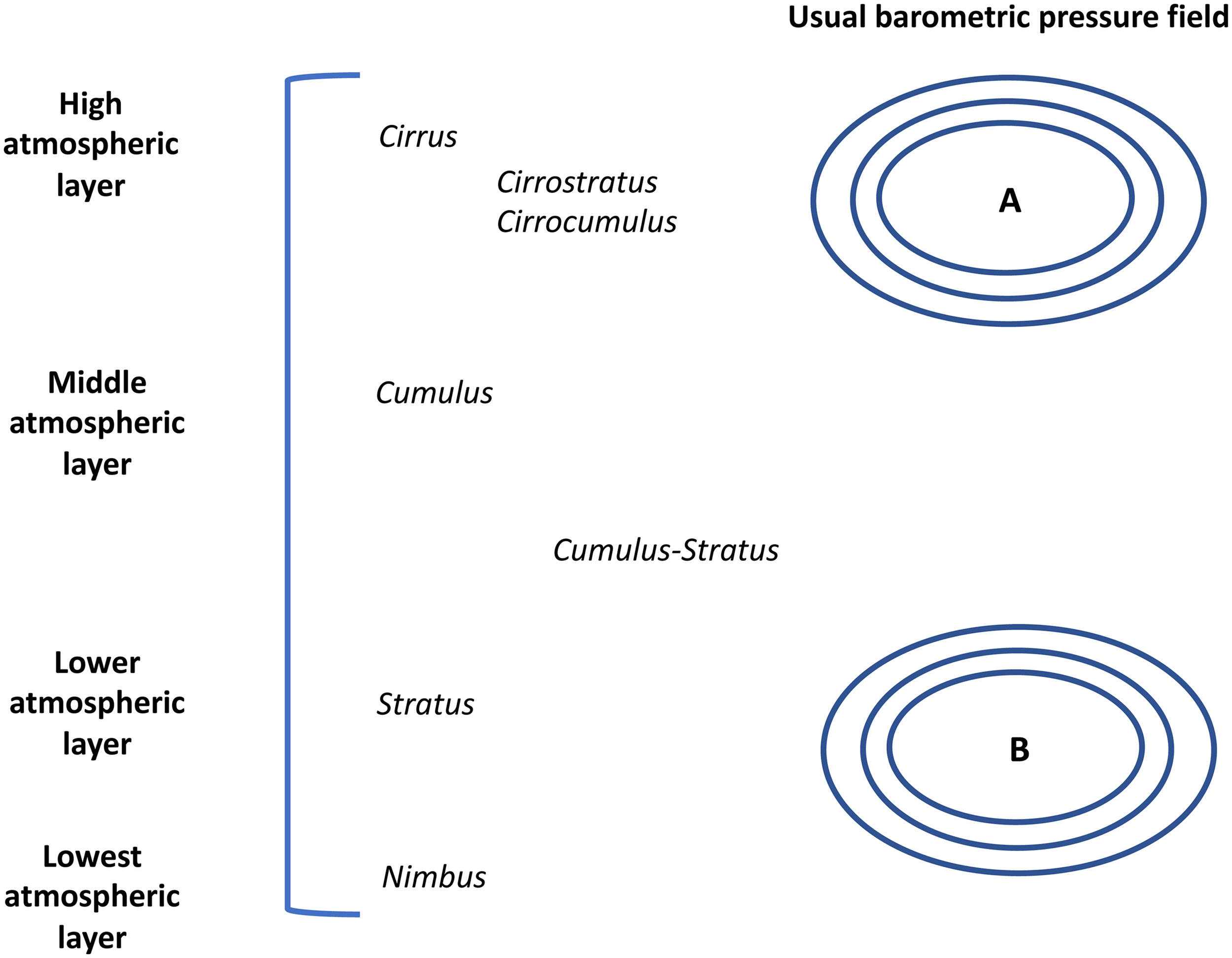
The altitudinal distribution of the principal cloud types established in Luke Howard's classification and its relationship with the pressure fields, according to Goethe.
Finally, it is necessary to highlight Goethe's ideas on atmospheric dynamics as the ultimate cause of meteorological phenomena, paying particular attention to the causes of barometric changes.
The first aspect of his meteorological theory is related to his ideas about the characteristics of the ‘form’ of the Earth's atmosphere. For Goethe, the atmosphere surrounding the Earth constantly loses density, gravity and elasticity from sea level upwards and gains them in the opposite direction. According to Goethe, as is the case with the land surface, the atmosphere is organized in concentric circles that hide ‘secrets’ (Goethe, 2022); that is, it is organized into different levels unequally related in the form of water and droughts and in terms of the shape of clouds. Goethe suggested a relationship between atmospheric concentric circles (corresponding to different climate zones from the equator to the poles) and the presence of different living beings within them. This idea originated in the study of the organization of the organic nature of the Earth conducted by Ferdinand August Ritgen and Johann Bernhard Wilbrand in 1821. Based on this research, the erudite naturalist Charles Hamilton Smith elaborated a famous diagram presenting the organization of nature in concentric circles from the maximum solar point (equatorial line) to the line of perpetual snow. This diagram was accompanied by a translation of the text into English and was published in 1828.
Goethe dedicated a section of his treatise on meteorology to the condensation of water vapour, which, as he indicated, is a process closely related to atmospheric pressure. For Goethe, there are two layers in the atmosphere: a lower one with denser air and a higher one with more diluted air. He believed that the condensation process takes place due to changes in the atmospheric pressure; that is, a fall in pressure favours condensation while a rise in pressure hinders it (Figure 2).
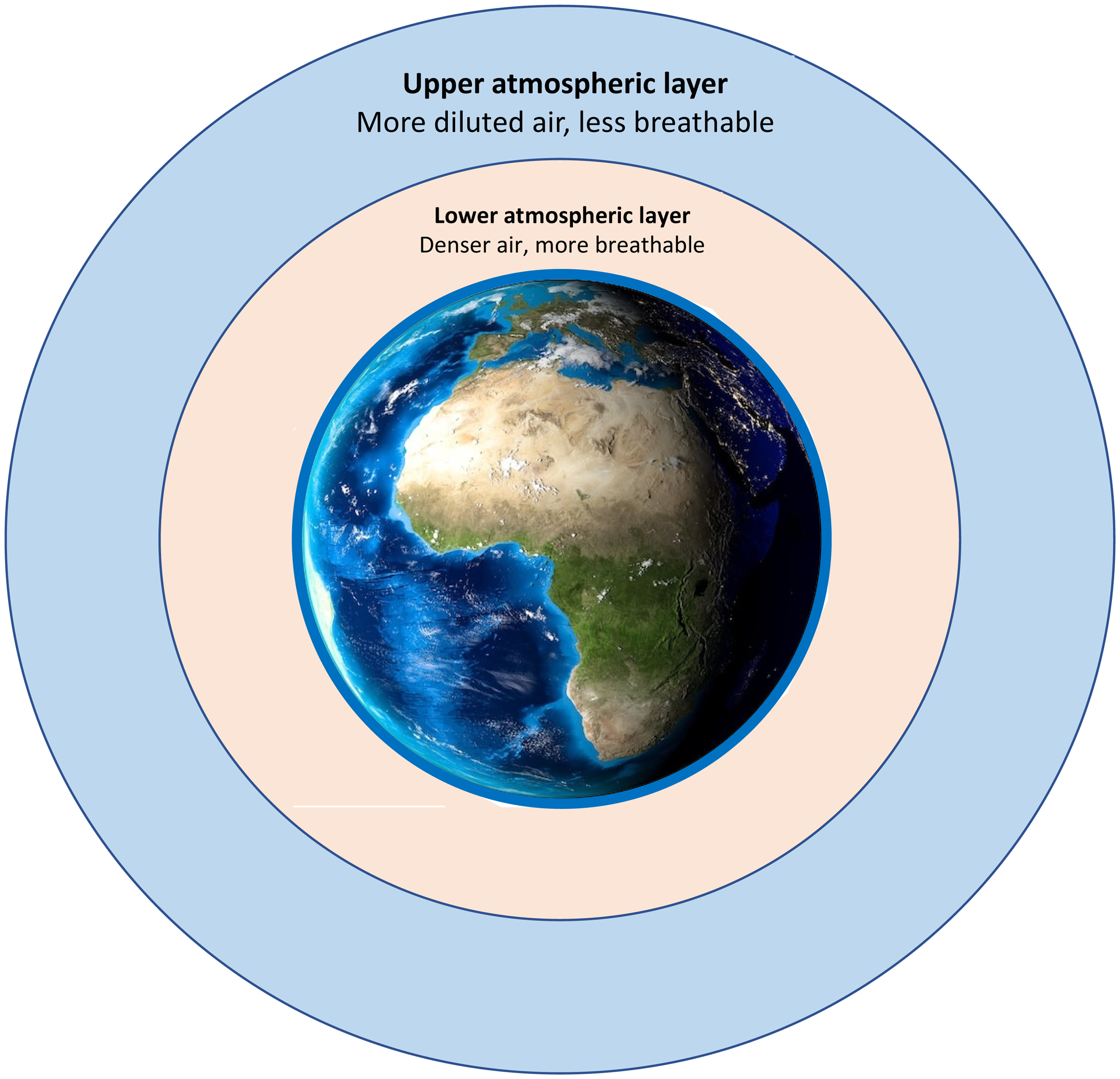
The two atmospheric layers according to Goethe.
The culmination of Goethe's meteorological treatise was a compilation of his ideas on general atmospheric circulation and the movement of air in the Earth's atmosphere. His theory suggests that two principal causes explain the movement of air. The principal cause would be the Earth's force of attraction. He pointed out that ‘the high force of attraction of the Earth, which we know about due to the rises in the barometer, is the force that regulates the atmosphere and sets a limit to its elements; it resists the excessive formation of water, the most powerful movements of air; and thanks to this force, it even seems to remain indifferent to electricity’ (Goethe, 2022: 100). This force has two basic movements that occur daily due to the rotation of the Earth: two inhaling movements, related to the Earth's attraction, and two daily exhaling movements, caused by the Earth's detraction. Goethe indicated that this oscillation is more perceptible close to the equator because ‘the Earth's mass is higher’ there and lower at the poles. This latter theory has been proven incorrect, given that the gravitational force of attraction of the Earth is greater at the poles than at the equator (inversely proportional to the square of the distance).
A second complementary force that generates atmospheric circulation is, for Goethe, the force of warming, which favours the expansion of the air. These two forces have an effect on atmospheric pressure. Goethe indicated that when the barometer is in a high position, the atmosphere regulates, resisting the formation of water and air movements. Conversely, when the barometer is low, ‘it bids farewell to the elements’ (humidity, floods, waves) and moves them ‘from West to East’ (Goethe, 2022: 100).
Goethe's interpretation of air movement, the dynamics of the atmosphere and, therefore, the overall circulation of the atmosphere, does not adequately relate the centres of action of the Earth's surface with the barometric and atmospheric weather changes. Although Goethe referred to the dynamics in the inter-equatorial zone, he interpreted the phenomenon of air movement and its relationship with atmospheric pressure to the ideas of mid-latitudes (circulation zone of the West). Today, we know that this interpretation was also wrong. His ideas were already considered out of date by the specialists of his day (Wenzel and Zaharia, 2012).
Goethe made some final reflections on atmospheric circulation in which he reaffirmed his belief in the ‘internal’ Earth cause that could explain air movements and changes in atmospheric pressure, but he left the door open for future researchers to better refine the issue: ‘I try to explain the principal conditioning factors of meteorology as earthly and attribute the atmospheric manifestations to the gravitational, alterable and latent force of the earth’. He added: ‘The enormous mistake of attributing these constant phenomena to the planets, the moon or an unknown ebb and flow of the circle of air was becoming more and more evident each day. Now I have simplified the ideas in this respect and the real importance of the issue can be seen more clearly’ (Goethe, 2022: 105). He ended the treatise with these words: ‘Although I do not believe that with this everything is seen and known, at least I am convinced that if the research continues along these lines and the conditioning and determining factors are analysed with precision, we can arrive at something that I cannot even imagine, but it will bring with it both the solution for this problem and that of many others related to it’ (Goethe, 2022: 106).
In a letter addressed to his secretary Johann Peter Eckermann in 1829, Goethe expressed his overall religious beliefs, bestowing a superior power to the Deity in his explanation of natural phenomena, compared to the capacity of human beings, which is limited. Sometimes he did not understand or correctly approach the knowledge of natural processes and phenomena: Man should be able to elevate himself to the highest level of reasoning to touch the Deity, which is revealed in the primary, physical and moral phenomena. […]. The Deity […] is active in the living […] it is in the process of conversion and change. The objects of meteorology are, in fact, alive and we see them working and creating every day, they presuppose a synthesis; but the contributions are so varied that man does not measure up to this synthesis and, therefore, wastes time in his observations and research. We are led to hypotheses, imaginary islands, but the real synthesis will probably remain an undiscovered land. (Eckermann, 1950: 74)
The first phase lasted until 1819–1820 and is known as the ‘morphology of the clouds phase’, in which there is a strong reference to Howard's terminology in his essays on and descriptions of the shape of clouds. In these years, Goethe considered clouds to be an independent phenomenon that acted alone and was subject to the principles of metamorphosis and increment; they could transform from a primitive form to many different shapes and give rise to different cloud manifestations in the atmosphere (selbständiges, selbst agierendes Phänomen, das den Prinzipien der Metamorphose und der Steigerung unterliegt, Goethe, 2022: 208). In this period, he wrote Camarupa, in which he described clouds with the name of this Indian goddess who is pleased by the changes in form.
The second phase is known as the ‘sky as a zone of conflicts’ phase. In the treatise Wolkengestalt nach Howard (1820), Goethe considered the metamorphosis and transformation of the manifestations of the sky to be caused by a situation of conflict, given the constant fight for supremacy of the external forces. For him, the formation of clouds is subject to a zoning of the celestial regions in which conflicts arise between the superior and inferior regions, between dry and wet/hydrating phenomena, as he affirmed in a letter to Charlotte Stein (6 November 1779) during his ascent of the Col de Balme in Switzerland (wie die Geister der Luft sich unter uns zu streiten schienen). In addition, Goethe was highly interested in the barometer, the essential instrument and primordial source of information on the conflict in different areas of the sky and in meteorological phenomena. The barometer was the instrument that revealed nature's greatest secrets, a mediator that objectively indicated the facts and their circumstances by determining the increase or decrease in atmospheric pressure.
The third phase is known as the ‘pulsating gravity’ (pulsierende Schwerkraft) phase. Goethe affirmed that the processes occurring inside the great organism of Mother Earth possess a great force of attraction (Anziehungskraft). In his text Versuch einer Witterungslehre (1825) (‘Attempt at a weather theory, 1825’), he adopted purely earthly explanations and rejected the influence of other planets and the moon in meteorological phenomena. In this text, he expressed the importance of the dual or polar concepts for which he used pairs of terms such as inhalation and exhalation (Ein- und Ausatmen).
Goethe's skill as a naturalist cannot be separated from his skill as a poet. The clouds, as a formal phenomenon, uniquely captivated his attention. The mobile phenomenon of the clouds in the sky awakened emotions in him and gave him marvellous moments. And, due to his enthusiasm for observation and his aesthetic sensibilities, cloud formations became the object of both his scientific and artistic production. His interest was in the shape of clouds in particular, which he addressed artistically in drawings and poems. Thanks to the influence of Duke Carl August de Weimar, he indirectly contributed predictive value to the shape of clouds for meteorological development. In this respect, in a letter to Zelter on 16 February 1818, Goethe expressed his desire to interweave words and images with the shapes of clouds and the colours of the sky (Wolkenformen und Himmelsfarben mit Wort und Bild einzuweben). Due to this interest, clouds and atmospheric and meteorological phenomena acquired a new dimension in his poetry during this creative period. His relational capacity led him to incorporate chemical affinity in the title of his novel Elective Affinities (Die Wahlverwandschaten).
Goethe wrote other texts and poems about clouds other than those contained in Reflections on Nature. With these, he built a bridge between poetry and science, fields that cannot be isolated. It should be noted that he strove to follow both individual phenomena and general phenomena. For the poet, clouds are the epitome of conflict in which the informed, deformed or amorphous are transformed into shapes, the floating dissolution into sharp contours and sometimes turbulent clouds are driven away. His work is replete with passages in which the clouds symbolically represent divinity or carriers of beauty and the sublime. In a letter to Charlotte von Stein (November 1779), during his second trip to Switzerland, he frequently referred to meteorological phenomena and the clouds in the mountain landscape, which he illustrated with a sublime feeling (das Erhabene). In his poetical language, the clouds metaphorically represent positive and divine aspects—love, inspiration and poetry—although they also express negative elements such as worry. Therefore, the clouds generally symbolize abstract concepts. Ever since his youth, clouds had awakened a feeling of sublimity, which was later replaced by the interest of a scientific observer within the framework of the exploration of the complexity of the planet. In his later work, the moon, sun and stars became more prominent.
In the second part of his greatest work Faust, composed in 1830, Goethe developed ideas that could correspond to his theory of clouds when he described the phases of Faust's ascent to heaven (Himmelfahrt) and the meteorological regions. In Act IV, at the beginning of the passage titled ‘High Mountains’ (Hochgebirg), in an area of fierce, jagged rocky peaks, we find Dr Faust contemplating a cloud—a cirrus—as it approaches the mountain, rests and stops beside it, descending onto a plateau, a rock slope or overhang that juts out; the cloud stops and then opens or divides. Goethe expressed this in prose form, translated by AS Kline (2003):
In Act V in the song of ‘Want, Guild and Necessity’ (Mangel, Schuld and Not): ‘The clouds there are moving and cover the stars! Behind us, behind us! From far, oh, from far, He's coming, our Brother, he's coming, he's—Death’ (Es ziehen die Wolken, es schwinden die Sterne! Dahinten, dahinten! Von ferne von ferne, Da kommt er der Bruder, da kommt er der—Tod, Schöne, 1994: 438). To this Faust responds: ‘Earth's sphere's familiar enough to me, The view beyond is barred eternally: The fool who sets his sights up there, Creates his own likeness in the air!’ (Der Erdenkreis ist mir genug bekannt. Nach drüben ist die Aussicht uns verrannt: Tor! Wer dorthin die Augen blinzelnd richtet, sich über Wolken seines gleichen dichtet, Schöne, 1994: 441). The angels carry Faust while the choir of angels sing that cloud garments carry him upwards (Irdischer Flor, Wolkengewande tragt ihn empor, Schöne, 1994: 454).
In the final scene of the Act, ‘Mountain Gorges, Forest, Rock, Desert’ (Bergschluchten, Wald, Fels), Pater Seraphicus describes the middle regions: ‘What a mist of morning hovers / Through the pine-trees’ swaying hair!’ (Welch ein Morgenwölkchen schwebet durch der Tannen schwankend Haar, Schöne, 1994: 457). Finally, after Faust dies, the angels take his soul: ‘Rise upwards to the highest sphere’ (schwebend in der höhern Atmosphäre, Schöne, 1994: 459), while they sing: ‘These clouds are vanishing’ (Die Wölkchen werden klar). Doctor Marianus responds, alluding to the Virgin Mary: ‘Such light cloud fragments / Wind all around her, They are the penitents, Women so tender, All around her knees, Breathing the air, free, Desiring her mercy’ (Um sie verschlingen Sich leichte Wölkchen, Schöne, 1994: 461). Finally, the choir of female penitents sings: ‘You soar, on high, now, Towards the eternal realm, Hear our pleading, though, You, the peerless one, Oh, merciful one!’ (Du schwebst zu Höhen der ewige Reiche). In this text, Goethe blended science and belief. As Goethe indicated to Eckermann, human beings attempt to interpret natural phenomena, but the ultimate explanation resides in Almighty God; that is, elevating to a maximum level to attempt to reach the unreachable divine knowledge that is manifested in the primary phenomena of nature itself (e.g., clouds, thermal convection) (Eckermann, 1950).
In the poem Ganymed (Schöne, 1994: 205), which was written in the early period of Sturm und Drang and which illustrates the pantheism prevailing at that time, the cloud has a symbolic function.
In the poem Zahme Xenien (Eibl, 1998: 608), addressed to Ulrike von Levetzow (1823), we can find verses that describe barometers.
Goethe often expressed the symbol of love through the clouds in different poems and other brief texts (Blum, 2017; Eibl, 1994).
Finally, Goethe contemplated the manifestations of the sky with interest in his Diaries (Tagebücher) and observed the atmosphere closely, particularly during his trips (Badereisen) to the spa in Bohemia from April to May 1820 and from June to September 1823 and to the spa in Karlovy Vary at the beginning of September 1819. These texts have been partially translated into Spanish by Hernández in the work El Juego de las Nubes (Goethe, 2022), cited in this study. The authors have made their own translations of these citations into English.
Conclusions
The end of the Modern Age saw a period of flourishing ideas about nature, which also included reflections on explanations for the phenomena and processes that occurred in the air (e.g., meteorology, climatology). This was the time of environmentalism (Urteaga, 1993), led by prominent figures such as Buffon and Montesquieu. It was also the context in which contributions from physics and botany were made by Laplace and Linnaeu. These were the years in which Kant's courses on Physical Geography and Alexander von Humboldt's contributions to the knowledge of natural sciences were developed.
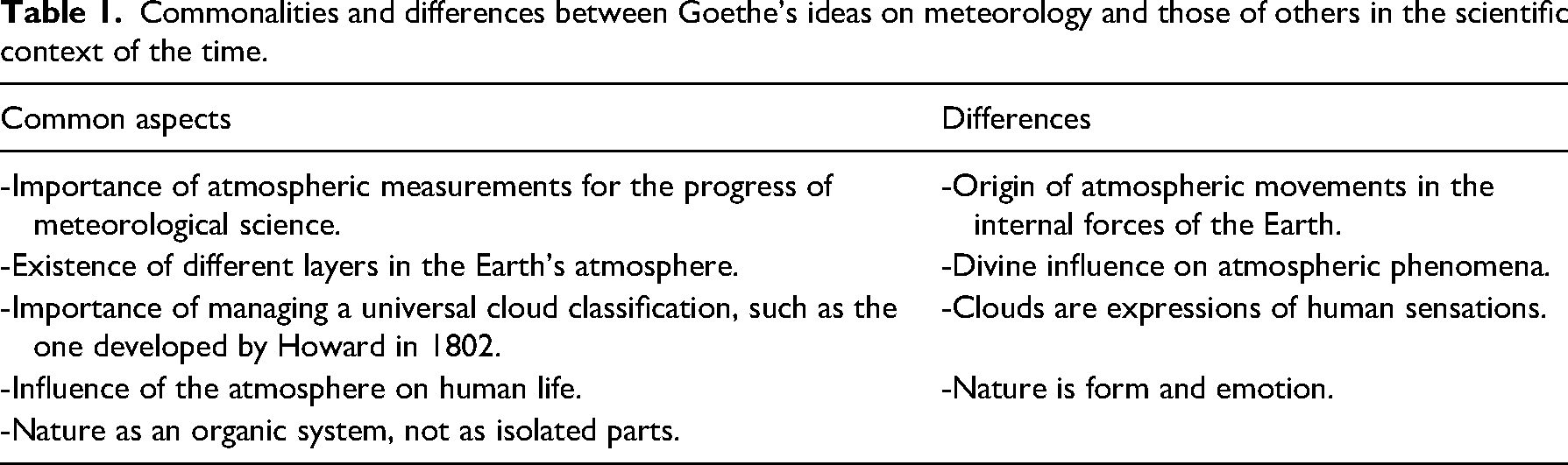
Goethe also developed his contributions within this context. Together with his prolific literary work, he elaborated a theory of nature and a small treatise on meteorology (Goethe, 2022) that contains reflections of interest for the evolution of the sciences of time and climate. Goethe was a polymath. He liked to participate in meetings with personalities from diverse backgrounds, including scientists of various specialities, but above all, with philosophers and writers because he was a protagonist of the cultural-literary movement of German Romanticism at the time. His fondness for scientific subjects was a personal matter of intellectual concern and was therefore linked to an out-of-the-ordinary personality. He shared this exceptionality, based on personal erudition, with Humboldt, another unparalleled personality in the historical context of the first decades of the nineteenth century. Table 1 shows a comparison of Goethe's scientific ideas and those of his peers.
Commonalities and differences between Goethe's ideas on meteorology and those of others in the scientific context of the time.
It should be remembered that the relationship between different prominent authors of the European intellectual world at this historical moment was very fruitful, reflected in both direct personal contact and exchange of ideas during their participation in meetings and gatherings. A good example of this is the Jena Circle, which reflects the close link between Goethe and Humboldt (Buttimer, 2001). Furthermore, Goethe's interest in meteorology transcends his literary work since there are numerous allusions to atmospheric phenomena in his prose.
Although not all of Goethe's theories related to nature are valid today, we should highlight the importance of the contributions he made to advancing the atmospheric disciplines, given his skill as an observer of natural phenomena and a promoter of scientific measurements, together with his literary work and commitment to high-quality artistic reproduction. This study presents his essays that specialize in this subject matter and analyses his greatest work Faust, together with his poems that refer to meteorological aspects.
The presence of different atmospheric phenomena, particularly clouds, is reflected in the concepts and many terms that he used in his texts, such as volatility, transformation, elasticity, transition and so on. Goethe tried to empirically apply the advances made by the English pharmacist Luke Howard and other experts in meteorological science at the start of the nineteenth century and compared places in Germany with other parts of the planet (Chimborazo, Himalaya). The result is an abundant production of text based on the experimental dimension of observing the sky, taking measurements using instruments that were advanced at the time, and using literary expression through metaphors, similes and symbols and with a beauty and emotion that characterize this canonic genre of universal literature. The texts blend scientific advances with literary cadence and reveal a curious and open personality that strove to understand atmospheric phenomena and knew how to capture and reflect on them in a uniquely sensitive discourse.
For the advancement of weather and climate science in the latter part of the eighteenth century and the first decades of the nineteenth, Goethe established the necessary intellectual link between the Kantian ideas of reason and the beginnings of climatic scientism that Humboldt would defend, based on his efforts to manage data on atmospheric variables obtained through observation. Goethe also defended the need to record data using different meteorological instruments necessary for different elements of the climate but leaves room for the subjective interpretation of the facts of the air and of the theories explaining atmospheric phenomena. It is an internal struggle between empiricism and the prevailing rationalism of his time, which is imbued with the romantic subjectivism that would then be forged in Germany.
In his meteorology book, Goethe noted the possibility that his interpretations of atmospheric facts, and in particular of the dynamics of air, might be improved in the wake of future scientific approaches. These improvements would take place in the second half of the nineteenth century and especially in the first half of the twentieth century, when knowledge of the upper layers of the troposphere would improve, thanks to improvements in aerological observations, meteorological equipment and especially the development of aviation. The relationship that Goethe proposed between the movements of air and the internal behaviour of the Earth would be rejected by meteorological science, but his efforts to find an explanation for the circulation of air in the Earth's atmosphere—a question that has concerned human beings since ancient times—should be valued.
Footnotes
Declaration of conflicting interests
The authors declared no potential conflicts of interest with respect to the research, authorship, and/or publication of this article.
Funding
The authors received no financial support for the research, authorship, and/or publication of this article.

Notes
Author biographies
Jorge Olcina Cantos is a full professor of regional geographic analysis at University of Alicante (Spain), where he teaches on spatial planning, climatology and natural hazards. His research has been focused on various geographical issues (climate change, water resources, spatial planning, natural risk, history of geographical ideas). He is author or co-author of more than two hundred publications (scientific papers, book chapters and book editor). He was a main speaker at the International Year of Planet Earth (2008) declared by UNESCO. He is also a visiting professor at universities in Spain, Europe and Latin America and Member of Editorial Board of various scientific journals on geographical and environmental issues. He has been the main investigator of the Competitive Research Group of the University of Alicante in ‘Climate and Spatial Planning’ since 2002. He was President of the Spanish Association of Geography (2017‒2021).
María Rosario Martí Marco is a full professor of German philology at the University of Alicante (Spain), where she teaches on literature, language and culture. She has enjoyed several research-stays at the Berlin-Brandenburg Academy of Sciences, Alexander von Humboldt Institute and Wilhelm von Humboldt Institute, from whom she has translated and studied several texts. One of her lines of research is the history of science in the ‘Spanish Universalist School’ around the scholar Juan Andrés.