




Abstract
Scientists are increasingly asked to publicly engage with wider audiences, but such actions require specific training. However, the perceived training needs of researchers have not been widely studied, and the impact of disciplinary cultures has not been assessed. Enhanced knowledge on how different disciplinary communities view training could assist in better tailoring training programmes. With the purpose of analysing training needs reported by scientists, a survey was administered to researchers from three scientific disciplines in Portugal, and the results confirm an association between scientific disciplines and training needs. Previous science communication practice is also related to perceived needs, and training is associated with enhanced self-efficacy.
Introduction
Increasingly, leaders of political, academic and research organizations are urging scientists to open up their work to the general public. Various reasons have been put forward to justify this call for public engagement: to enhance accountability for publicly funded research, to increase societal support for science and to combat increasing mistrust in science. These actions require specific training, as communicative skills are not part of undergraduate or postgraduate science courses or a regular component of scientific training. Several scientific and academic institutions are making efforts in this regard (Miller et al., 2009), although consensus on what this training should consist of is lacking (Baram-Tsabari and Lewenstein, 2017). Given that science communication is currently considered to be a social duty of scientists, the importance of training is undeniable, and much scholarly research has addressed the topic in terms of its content and efficacy (Dudo et al., 2021; Rodgers et al., 2020). However, there is no extensive research about scientists’ perceived training needs, which reflect the role of scientific cultures.
The call for more training in the field is based on the fact that training in science communication can have a positive impact on public engagement (Copple et al., 2020; Stylinski et al., 2018). In public discussions on public engagement, scientists are normally considered a homogeneous group. However, scientific disciplines play a role in shaping scientists’ values and cognitive approaches (Becher and Trowler, 2001), which are significant elements of the scientific and technical human capital of researchers (Corley et al., 2019). Thus, disciplinary cultures may be relevant dimensions for explaining researchers’ views and practices regarding science communication, which include their participation in training programmes and their reported needs.
Some studies have addressed specific communities (Anjos et al., 2021; Entradas et al., 2019; Rodrigues et al., 2023), under the assumption that understanding scientific cultures is important for understanding experiences relating to science communication. Also, other findings have suggested that differences at the disciplinary level can be expected in public engagement (Entradas and Bauer, 2017; Jensen, 2011; Jensen and Croissant, 2007). Nonetheless, scientific disciplines have not been widely considered in the context of public-engagement training, although they may play an important role in determining professional needs and impact the prospects of training efforts.
Training is a topic attracting growing scholarly attention and an issue in need of conceptualization and organization (Lewenstein and Baram-Tsabari, 2022). The purpose of this article is to discuss the impact of scientific cultures by assessing scientists’ views on the need for training. Enhanced knowledge on how different disciplinary communities view training can inform policies on public engagement, allow the targeting of benefits for each group of scientists and assist in better tailoring training programmes.
This research advances knowledge on this topic by analysing the results of a survey that sought to identify researchers’ perceptions of their training needs from a comparative perspective between different scientific communities. Researchers were surveyed on their communication practice and on their needs for training. This exploratory study focuses on three scientific communities (Engineering and Technology, Medical and Health Sciences, and Social Sciences and Humanities) from nine relevant scientific institutions and groups of researchers in Portugal, surveying a total of 524 scientists. Even though the study does not aim to be representative of Portuguese scientists, it aims to contribute to better knowledge of the specific needs of the vast community of researchers working in Portugal, on which literature is scarce (Delicado, 2014).
This research contributes to a better understanding of scientists’ perceived training needs by assessing the influence of previous training and experiences in public engagement. Moreover, the results of this work provide evidence of the influence of disciplinary cultures on training needs reported by scientists and on perceived self-efficacy, thus contributing to the literature on science-communication training.
Training in science communication
As the pervasiveness of science in modern societies continues to grow and impact the day-to-day life of regular citizens, there is an increased need to bring citizens and science closer together. This entails a higher demand for better-quality communication between them, and scientists need to be prepared for this through specific training. Therefore, a more robust conceptualization of science communication training is needed (Baram-Tsabari and Lewenstein, 2017; Rodgers et al., 2020). The quality of science communication is nowadays at the top of the agenda (Pilt and Himma-Kadakas, 2023) and should be actively sought by evidence-based training programmes, as most training in scientific careers does not include communication skills (Rodgers et al., 2020).
Literature is emerging worldwide on training issues (Lewenstein and Baram-Tsabari, 2022), showing the benefits of training for improving communication skills (Copple et al., 2020; Gascoigne and Metcalfe, 2019; Stylinski et al., 2018) and enhancing the quality of interactions with the public (Besley and Tanner, 2011; Newman, 2019). There is thus a recognized understanding that specific training in science communication is needed. Various organizations, such as research institutes, universities and governmental agencies, offer such opportunities. There is a great diversity in science-communication training programmes in terms of formats, duration and content (Baram-Tsabari and Lewenstein, 2017). Training in the development of communication skills is needed to support scientists in increasingly demanding circumstances: namely, to improve scientists’ perceived ability to deal with science controversies, to assess the effectiveness of communication strategies and to manage science-communication projects (Koswatta et al., 2022).
Scientists are increasingly aware of the need to communicate with different publics, but they tend to think about science communication in rather simplistic terms (Dudo et al., 2021). They normally struggle to communicate with the media (Gascoigne and Metcalfe, 2019) and seem less interested in engaging with the public in terms of ethics and framing their messages to resonate with audiences (Besley, 2015). Studies in this field have shown the importance of training programmes to instil reflection on the importance of connecting with an audience and approaching it ethically, while providing scientists with tools that allow them to set up objectives for their engagement that go beyond educating citizens (Bennett et al., 2019).
Although scientists are now mostly aware of the need for public engagement, most of them still face some difficulties in engaging. Following a model of the theory of planned behaviour, Poliakoff and Webb (2007) found that scientists are more willing to publicly engage if they have done it before and feel capable of such engagement, especially if their past experiences were positive and if their colleagues are also participating. Extrinsic motivation seems not to play a relevant role in predicting public engagement, since career recognition or other rewards (such as prizes) have not been found to be predictors of engagement in communication activities (Bauer and Jensen, 2011; Entradas et al., 2019). Scientists’ unwillingness to communicate has been associated with lack of time (Dunwoody et al., 2009; Royal Society, 2006) and also with a lack of self-perceived ability to do so. Thus, action to eliminate such barriers may have a positive impact on science-communication practices and frequency. While lack of time can be addressed only at the institutional level, for instance by assigning specific time for communication or diminishing the burden of administrative tasks (Besley, 2015; Koswatta et al., 2022), other barriers, such as lack of self-efficacy, can be more easily overcome at the individual level with training.
Self-efficacy, which refers to scientists’ perception of their skills and ability to communicate, has been associated with higher levels of public engagement (Dunwoody et al., 2009; Gascoigne and Metcalfe, 1997), meaning that, if a scientist has confidence in their communication skills, they will be keener to participate in public engagement. Copple et al. (2020) found that training in science communication can have a positive impact on self-efficacy and, through this indirect effect, increase scientists’ willingness to engage. Thus, this study suggests that training programmes should specifically address ways of promoting self-efficacy and positive views of the intended audience. Stylinski et al. (2018) found similar evidence. Valinciute (2020) also suggests that scientists’ lack of confidence should be addressed by continuous training. Scientists value communication training (Besley, 2015), but they do not share the same vision on the type and format of training (Bennett et al., 2019). This calls for another approach to communication training, one that identifies and integrates the perceived needs of scientists (Copple et al., 2020).
Perceived needs are important to tailoring training programmes, as different scientists experience different difficulties or gaps in their performance as communicators (Rodgers et al., 2020). Also, as some scientists are reluctant to receive such training or do not perceive it as necessary, it is important to understand the scientists’ perspective on the value of communication training. On the one hand, this information could help to increase the attractiveness of such training by directly targeting their concerns or reluctance and crafting messages that respond to these constraints (Besley et al., 2015). On the other hand, understanding and responding to perceived needs is essential to induce motivation (Ryan and Deci, 2000) and to increase the prospects of success of such training. Perceived needs result from individual traits but may also result from contextual factors. Disciplinary cultures may be relevant, but research on this issue is lacking.
Disciplinary cultures
The idea that scientific disciplines are more than simple categorizations of science has been consolidated in research since the seminal work of Becher (1989; Becher and Trowler, 2001), who argues that these different groups may be considered as ‘academic tribes’. The taxonomy of sciences thus gives rise to groups of professionals who share a particular set of ‘intellectual values and their own patch of cognitive territory’ (Becher, 1994). Disciplinary cultures can impact higher education institutions at different levels and therefore influence the work of professionals in teaching and scientific research because they impact scientists’ human capital (Corley et al., 2019); this is a concept that encompasses the ideas and technical, cognitive, methodological and social skills needed to participate in science (Bozeman and Corley, 2004). In line with this argument, ‘academic tribes’ have been associated with different strategies underlying authorship in scientific publications and collaboration (Lewis et al., 2012), different research orientations (Hakala and Ylijoki, 2001) and adaptation to innovation in the scholarly communication system (Fry et al., 2016).
Given the differences in research practices according to disciplinary cultures, it should also be expected that such variation impacts the way scientists communicate their research. Some evidence on this issue has been already presented. The work of Chikoore et al. (2016) on UK academics has established that differences in the views and practices of public engagement with research can be explained by differences in scientific disciplines. Although some studies found the scientific field to be a minor predictor of public engagement (Besley et al., 2013), the topic has not been dismissed, and research has continued to address this premise, since the initial results were not consistent. Several studies have provided evidence on the differences between scientists from different fields, in terms of motivations, practices and views on science communication (Besley et al., 2018; Kreimer et al., 2011; Silva and Pinto, 2023; Yeo and Brossard, 2017). Different levels of engagement can be found in diverse disciplines (Koswatta et al., 2022) and cannot be attributed solely to personal traits (Jensen, 2011; Jensen and Croissant, 2007).
Burchell (2015) found noteworthy differences among researchers from different academic fields in their understanding of participation in public engagement: science communication was considerably higher in the arts, humanities and social sciences communities than in STEM (science, technology, engineering and mathematics) fields. Also, Kessler et al. (2022) reported differences in mental models of science communication: respondents from the humanities, social sciences and life sciences are more likely to follow the Public Engagement with Science and Strategic Science Communication models than natural scientists. Natural sciences were found to have less active and more educational practices than the social sciences, which seemed to focus on civic-related activities (Entradas and Bauer, 2017; Jensen, 2011).
These two major scientific fields have also been found to have different motivations and priorities for public engagement. While STEM researchers are more preoccupied with funding agencies, researchers of the arts, humanities and social sciences more frequently note social duty as a reason for science communication (Ho et al., 2020). Differences between scientific fields influence practices of both science communication and public engagement. Simis et al. (2016) discuss the persistence of the deficit model and present evidence that scientific cultures play an important role in showing that scientists with less positive attitudes towards the social sciences are more likely to follow a deficit model paradigm. Some studies have provided insights into specific communities (Anjos et al., 2021; Entradas et al., 2019, Rodrigues et al., 2023), working under the framework that scientific cultures matter when it comes to understanding experiences of science communication.
Jensen (2011) argues that specificities in terms of social and epistemological dimensions of scientific disciplines, in line with the argument of Becher (1989), may explain the differences found in science-communication practices. However, even if disciplinary cultures seem to be increasingly acknowledged as an important factor in explaining science-communication views and practices, their possible impact on training has not been widely studied. For instance, Besley et al. (2015) provided an overview of American scientists’ views on communication training but failed to assess differences between scientific fields due to the fact that representation across fields in their sample was limited.
Some of the studies cited here were conducted in different parts of the world, thus suggesting that, although disciplinary cultures are possibly influenced by national contexts, they nonetheless are international in nature. Silva and Pinto (2023) have also found that the impact of internationalization on Portuguese scientists’ communication practices is mediated by scientific cultures, meaning that they may overlap with national particularities. There are not many studies that compare scientific cultures across countries, but the ones that are available tend to stress the importance of disciplinary cultures. For instance, Heen (2002) studied research training in economics in France and Norway, concluding that there are strong disciplinary identities and that they are more binding than national priorities. In a worldwide comparative study of the communication activities of more than 2000 research centres, Entradas et al. (2020) provide evidence that the level of communication is explained by country and available resources, but also by disciplinary cultures.
Thus, studying the role of disciplinary cultures is relevant, as they seem to be driving forces for research and science communication, above national specificities. Although evidence suggests that discipline-specific training should also be considered (Yuan et al., 2019), the topic is still in need of scholarly attention. For instance, having established that scientific cultures do matter in science communication, we can expect that different scientific communities may have specific training needs that need to be acknowledged.
Purpose and methodology
This research intends to address the gap found in the literature in terms of the impact of disciplinary cultures on reported training needs. If the scientific field of researchers influences their training needs, then trainers and institutions delivering training programmes should be aware of this impact. Such knowledge is highly relevant because it could be used to formulate messages delivered to promote training programmes and serve to design training in ways that meet perceived needs (Besley et al., 2015), thus increasing its relevance to scientists and improving its effectiveness in attracting participants. Also, studies in this field have shown the importance of training programmes to highlight the need to connect with an audience and approach public engagement in an ethical manner that goes beyond merely educating citizens (Bennett et al., 2019). Therefore, knowing scientists’ needs can help trainers of specific disciplines to use the perceived needs as a starting point to move towards wider engagement.
Our main purpose in this study was to test the hypothesis that scientific fields influence perceived needs in science training. Moreover, and considering the literature review, other factors related to training were assessed. We looked at self-perceived ability (Dunwoody et al., 2009; Gascoigne and Metcalfe, 1997) and previous experiences in training (Bennett et al., 2019) and public engagement (Poliakoff and Webb, 2007) to test whether these factors impact perceived needs. Perceived needs in training may also be dependent on external rewards, such as career objectives and the social environment of scientists (Bauer and Jensen, 2011; Poliakoff and Webb, 2007).
An attitudes-based survey was formulated, aiming at collecting data on Portuguese scientists’ views, training needs, and training and engagement experience. Using a direct measurement approach, the survey assessed frequency of engagement with different publics (the general public, legacy and social media, and undergraduate students), reasons to communicate, self-efficacy, external reasons and training needs using a 5-point Likert scale ranging from 0 (Do not know) and 1 (Strongly disagree) to 4 (Strongly agree). Drawing on Besley et al. (2018), Besley et al. (2019) and Entradas et al. (2019), but expanding the scope to include training needs, the survey presented the following dimensions: sociodemographic information, previous experience in engagement and training, skills and reasons to communicate, and training needs (Table 1).
Dimensions and variables assessed by the survey.
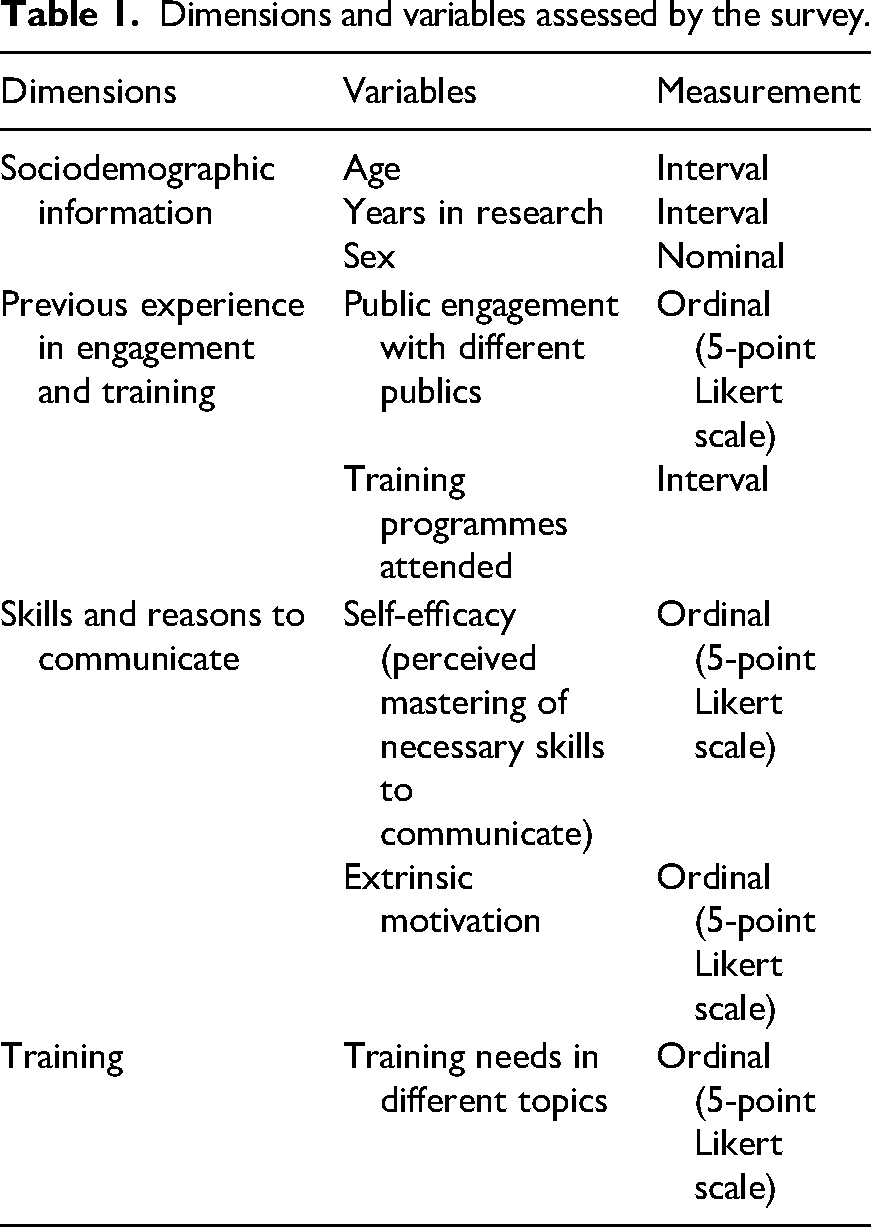
Dimensions and variables assessed by the survey.
An online survey was distributed from 2019 to 2021 (with a delay to the initial planned schedule due to the outbreak of the COVID-19 pandemic) to researchers of nine research institutions and scientists’ groups in Portugal. The survey was disseminated through their managerial teams or communication and public outreach offices, which sent them two emails (a first request and a reminder). We decided on non-probability convenience purposive sampling of research institutes and groups of researchers, constituted by those whose communication offices or responsible researchers agreed to distribute the survey. Of the scientific areas considered by the Organisation for Economic Co-operation and Development, only three were covered, with three groups each (to mitigate possible effects of the organizations’ institutional policies): Medical and Health, Engineering and Technology, and Social Sciences and Humanities. The data was gathered, treated and analysed with SPSS.
We performed chi-square tests to assess the independence between the variables mentioned above and the scientific discipline. Chi-square tests were used to analyse differences among groups for categorical (age, research field, frequency of public engagement and public engagement training) and ordinal variables (attitudes towards training). Variables were considered dependent if the significance level was equal to or less than 5%.
The survey returned 524 valid answers, distributed as follows: 29% from the Engineering and Technology subject area, 45.5% from Medical and Health and 25.5% from Social Sciences and Humanities. Response rates varied between 15% and 31.5%, which is in line with the response rates obtained in similar studies. The sample mostly consists of females (64.1%), which means a slight overrepresentation of women, considering the sex distribution of scientists in Portugal (Eurostat, 2022). Concerning age and years of research, the sample analysed here is balanced (Table 2 and Table 3). Most researchers who responded to the survey were between 31 and 50 years old.
Sample distribution by age of respondents.
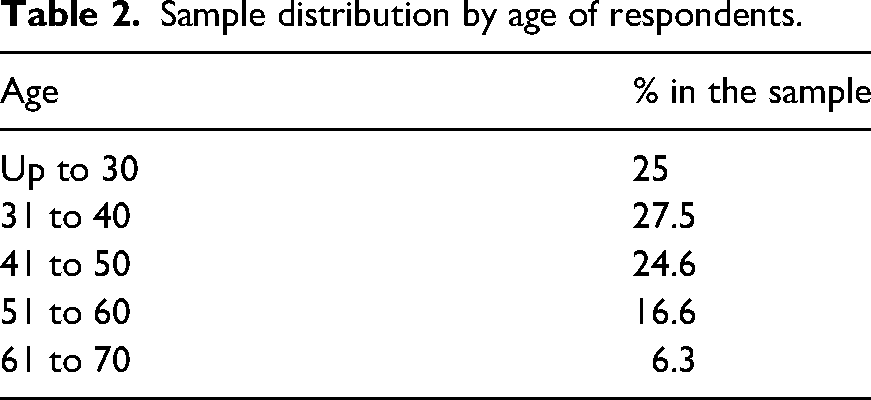
Sample distribution by age of respondents.
Sample distribution by respondents’ years of research.
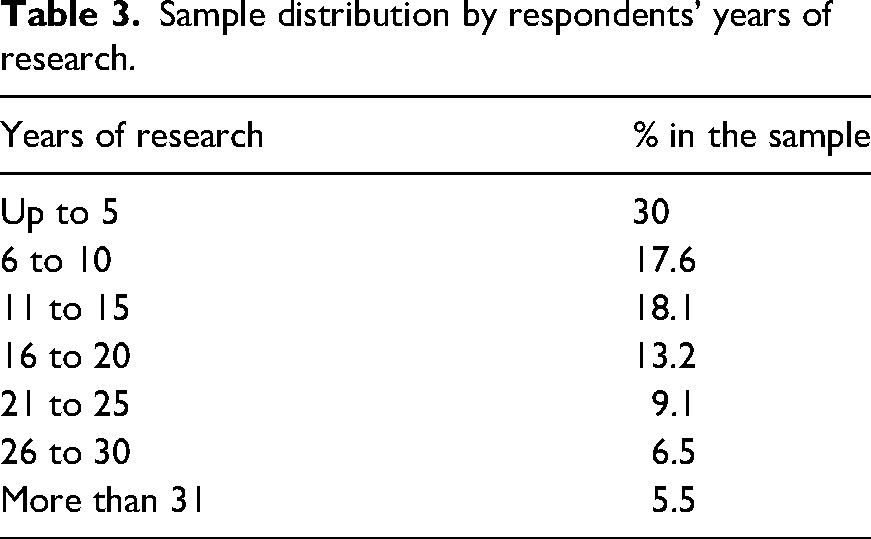
Accordingly, most respondents had under 10 years of experience in research, and a little more than 30% had been researchers for 10 to 20 years.
Concerning public engagement, most of the respondents had been involved at least once: 73.9% reported having already engaged in science communication but not on a regular basis. This result is similar to those obtained by surveys in Lithuania (Valinciute, 2020), the UK (Chikoore et al., 2016) and Spain (Alonso-Flores and Moreno-Castro, 2018). Scientists were mainly involved with non-specialized publics (57.6% being involved occasionally or regularly) and undergraduate students (49.6% being involved occasionally or regularly). Communication via the media, mainstream or social networks was less frequent: 67.6% of the scientists never or rarely interacted with journalists, and 64.7% never or rarely interacted via social media. Again, these results are in line with those obtained by Chikoore et al. (2016).
Training in science communication is not such a widespread activity: 58% had not done any training, and about 25% of those who had been trained had done one or two training activities. The surveyed researchers were, however, mostly aware of the need for such training. Only 32% of respondents stated that they did not need training in communication models or theories, and 35% stated that they did not need training to enhance their communication with the public. About 40% stated they did not need training to understand the media, although only 27% stated they did not need training to deal with the media.
In response to our research question considering the possible impact of different factors on training experience and needs, we tested the association between training (previous experience and needs), public engagement experience, self-efficacy and extrinsic motivations. Associations between the variables were assessed with chi-square tests, and significance was determined at a p-value under 0.05 (measuring the probability of any difference between groups being due to chance).
Previous training is not a relevant variable in our study to explain training requests: reported needs in several of the dimensions considered were not related to already having participated in science communication training. This may indicate that researchers, even if they have attended training programmes, recognize the need for continuous or more in-depth training in science communication, which is increasingly part of their regular activity. However, previous training is related to researchers’ public engagement (p-value of 0.00) and the frequency of their engagement with the media (p-value of 0.00). Thus, those who had been part of a training programme were more likely to have done public engagement and to have done it more often. This highlights the importance of training to foster public engagement and is a reason why organizations should provide opportunities for training.
Given that perceived training needs have not been widely studied, there are not many other studies to which our results could be compared. However, studies have been conducted on the impact of training on self-efficacy, and our results are in line with the finding of those studies: previous training is related to perceived communication skills (self-efficacy). While 30% of those who had not attended any training programme stated that they did not know whether they had the necessary skills, only 14% of those who had been trained admitted some difficulty in gaining the necessary skills. Moreover, 77% of those who had attended training agreed or strongly agreed that they had the necessary skills, compared with 57% of those without training. Thus, those who had attended training programmes were more likely to say that they felt prepared to communicate and to have more regular public engagement. Self-efficacy was likewise associated with more regular engagement with mainstream and social media, and with the non-specialized public. All these associations have statistical significance.
Previous experience in public engagement is relevant for training needs. The less experienced researchers were in media relations, the more demand there was for training to understand communication theory and engagement practices and to deal with the media (but not to understand the media). For those who had already been involved with journalists, no more training seemed to be necessary. This seems logical: if someone already has experience in media relations, they have acquired the necessary skills in context. The same association was found for engaging through social media and the need for more training in communication models and theory: the perceived need was inversely related to previous experience. However, the same dynamics did not occur with public engagement with non-specialized publics: the more experienced researchers were in engaging with the general public, the more demand there was for training in understanding communication models and theory, especially for those who engaged only occasionally. This suggests that experience of public engagement is not, by itself, sufficient for scientists to feel prepared for this kind of practice.
Also, there is an association between reported needs for training and external incentives to communicate, but with mixed results. Those who believed that they had to publicly engage in order to evolve professionally were more likely to agree that they needed training in the several dimensions considered. But there was not such a clear association between training needs and the belief that communication is important to get funding, since training needs in communication models and dealing with the media were not related to perceiving public engagement as relevant. Also, there was no association between training needs and the belief that peers value science communication. However, those who believed that co-workers valued science communication were more likely to say that they needed training in all the dimensions considered (Table 4).
Association between training needs and external incentives to communicate (p-value).
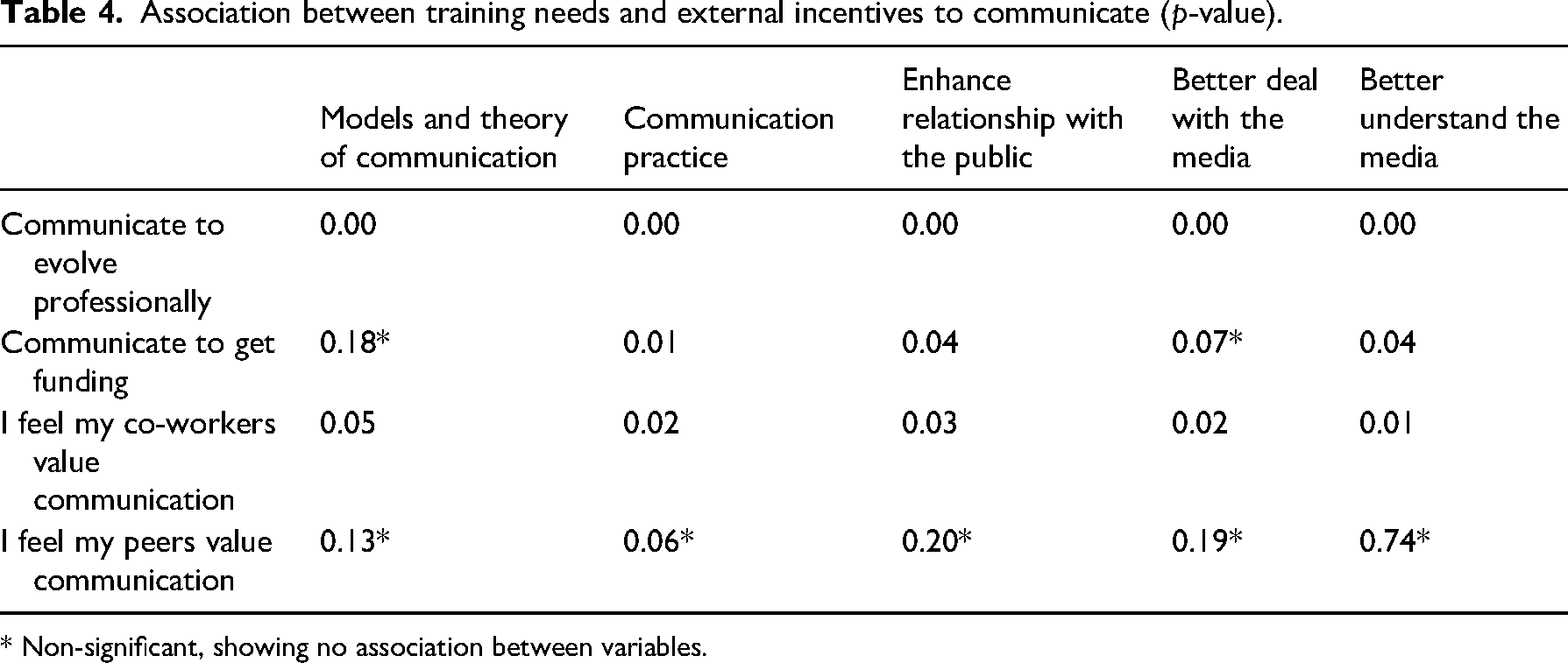
Association between training needs and external incentives to communicate (p-value).
* Non-significant, showing no association between variables.
Before assessing the impact of scientific cultures on training and considering the effect of seniority on public engagement (Chikoore et al., 2016; Entradas et al., 2019; Jensen, 2011), we tested whether there was an association between the number of years researchers had been working and their scientific discipline to eliminate the possibility of our results being biased by an underlying association. The p-value (0.41) shows no association, meaning that there is no difference between the surveyed communities in terms of the seniority of the researchers that could influence the results.
Regarding the association between training and scientific disciplines, the results of this study confirm that scientific disciplines are related to different needs in terms of science-communication training and previous training experience. Researchers working in the Engineering and Technology area were less likely to have done any training and were the ones who had attended fewer training programmes. By contrast, Medical and Health researchers were the scientists who had done more training in science communication. Social Sciences and Humanities researchers were more likely to say that they had the necessary skills and were more confident about science communication (Table 5). All the differences are statistically significant, as shown by the p-value (below our significance level).
Participation in training programmes, frequency of training and self-efficacy by scientific field.
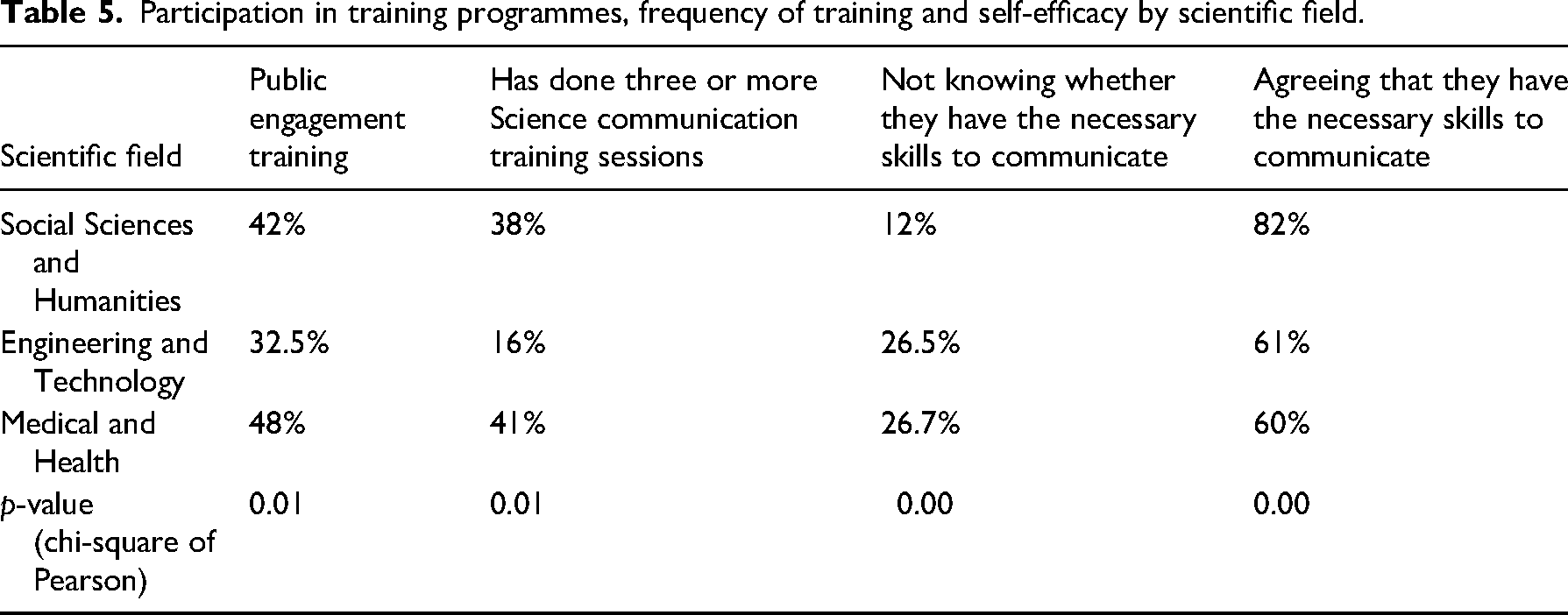
Participation in training programmes, frequency of training and self-efficacy by scientific field.
As already established in previous studies (Chikoore et al., 2016; Silva and Pinto, 2023), scientific cultures are related to public engagement in terms of the targeted audiences and frequency: Engineering and Technology researchers were less likely to have been involved with the media (mainstream and social networks) and with the non-specialized public, while Social Sciences and Humanities researchers were involved more frequently. Different subject areas are also important to explain the reported needs for science communication training (Table 6).
Reported training needs by scientific discipline.
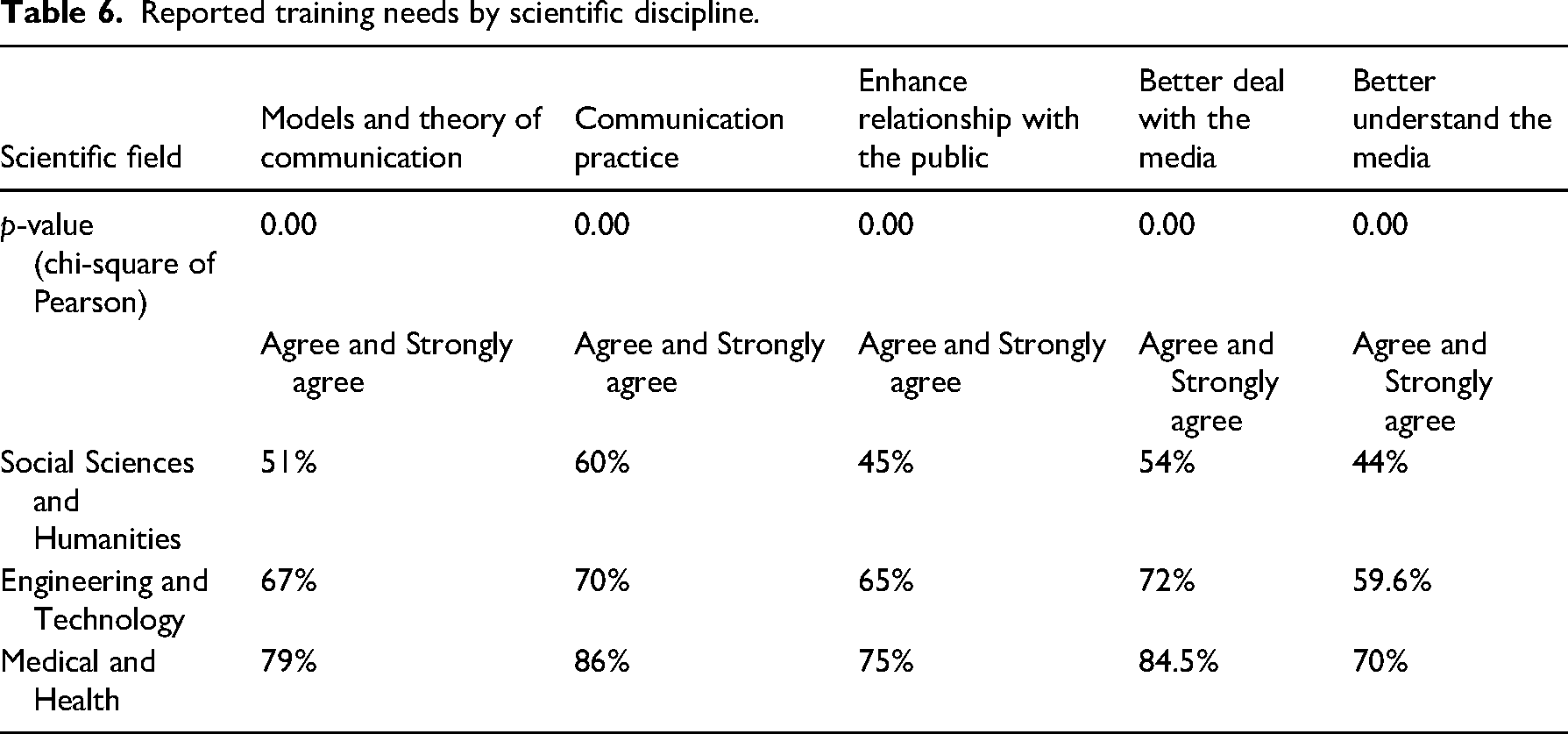
Medical and Health researchers were the ones who most strongly recognized the need to attend training programmes that cover communication models, theory and practice and how to enhance the relationship with the non-specialized public. Also, they had the highest level of agreement on the need to better understand and deal with the media. In all of these variables, Social Sciences & Humanities researchers were the ones who were more likely not to request training (Table 6).
Given the growing importance of public engagement, scientists’ efforts in science communication are expected to increase. Institutions are increasingly called on to support this effort through the offering of training opportunities and programmes. Designing these programmes requires evidence-based knowledge on what kind of training should be offered and what kinds of needs scientists present. The actual needs of training (to achieve what is established by scientific evidence in terms of quality in science communication) and the perceived needs of scientists might not coincide. As seen in this research, scientists are more likely to value practical aspects in science communication and tend to dismiss the need to understand communication theory and models. However, such knowledge is considered essential for situating science communication within broader paradigms of public engagement and for approaching communication ethically and reflexively.
If scientists are to attend training programmes, they must see the value in such training, and knowing what they expect can help institutions to design and advertise training policies. As argued by Besley et al. (2015: 200), knowing how scientists feel about training is important because ‘it could be used to craft messages to attract science communication training participants or pro-actively address potential participants’ concerns’, while supporting the design of programmes in a way that fulfils scientists’ perceived needs. Therefore, and considering that some institutions, such as universities and other higher education institutions, are multidisciplinary, it is important to assess whether a unique training policy is the best solution. The findings presented here add to the field by highlighting the importance of outlining specific learning objectives according to different environments (Lewenstein and Baram-Tsabari, 2022), in this specific case as defined by scientific cultures.
In our sample, training was not yet a widespread part of scientists’ experience, since only 42% of respondents had participated in training programmes, mainly in just one or two programmes. About one-third of our sample, a significant proportion, did not feel the need to have training. This is also significant, considering that, although most scientists have at some point been engaged with the public, it is not a regular activity for most of them. Training could be of relevance to enhancing science-communication opportunities, given the impact that it has on public engagement. In line with other studies (Copple et al., 2020; Stylinski et al., 2018), this study found evidence that training and self-efficacy are related, meaning that training increases the probability of researchers engaging in science communication and doing so more often. There is a positive association between having participated in training programmes and being publicly engaged, meaning that those who have been trained feel more confident and communicate more frequently.
Our findings also suggest that previous training is not a relevant variable in explaining training requests: the reported needs in several of the dimensions considered are not related to previous participation in science-communication training. This may be because training is not yet a systematic activity in Portugal (Lewenstein and Baram-Tsabari, 2022). Instead, training programmes are provided mainly through small or one-off programmes or workshops and do not cover all the different dimensions of science communication.
When explaining training needs, it is also relevant to note that previous science-communication experience is associated with training needs: researchers who had been involved with the media stated that they did not need training to interact with journalists, but those who had been involved with the non-specialized public requested further training to understand how communication works. This may be a recognition that dealing with different audiences is more demanding (Bennett et al., 2019) and that communication science is not as simple as initially expected (Dudo et al., 2021). However, there is still a somewhat ‘instrumental’ view of science communication that tends to neglect the reasoning about the process: training needs of ‘understanding’ the media and enhancing the relationship with the public were less likely to be cited by researchers. These results are important for defining targets for science-communication training programmes because they reveal that researchers are mostly not aware of the complexity of the science-communication process and that more modules on these topics should be added to programmes.
Regarding the importance of external incentives to communicate, our results also present interesting findings. For those who felt that science communication is important for career development, training needs were also in demand in aspects such as communication practice and theory, dealing with the public and dealing with and understanding the media. The association between training needs and the importance attributed to public engagement for fundraising was not so clear: training in handling the media and in understanding communication theories and models was unrelated to the belief that science communication is important for funding. It appears that the scientists in our sample did not agree that the media can be instrumental in attracting funding, which may result from the current grant-application structure. However, this should be further researched in order to provide an understanding of the issue.
While the importance of the opinions of peers (which we may consider as the wider community of academics and researchers of a given institution or the community of scientists in general) was not associated with training needs, those of co-workers were related to researchers agreeing to undertake more training. Given that co-workers share the cultural environment of researchers, contrary to peers, it seems that this closer context, or what Becher (1989, 1994; Becher and Trowler, 2001) would call ‘territory’, has an impact on training needs. This finding highlights the importance of the social disciplinary environment, which is further verified by the analysis of data concerning different disciplines.
In our sample, scientific cultures were found to be relevant to assessing the demand for training, thus confirming our hypothesis that disciplines should be considered when designing and implementing training programmes, as the reported needs of scientists differ according to their fields. It seems that the idea of ‘academic tribes’ (Becher, 1994) also has relevance in science communication, including scientists’ willingness to participate in training programmes and to agree to undertake different types of training.
In this study, Social Sciences and Humanities researchers, perhaps because they feel this field to be ‘close to home’, were less likely to demand training and more likely to perceive their skills to be adequate. However, a significant proportion of researchers had done training and had attended more than one or two programmes. Medical and Health scientists were more open to training perspectives in all of the dimensions considered. They were also more likely to have done training in science communication and to have attended more training programmes. Engineering and Technology scientists were less likely to have done training and, for those who had, to have attended more than one programme. However, and even though they reported similar levels of self-efficacy to the Medical and Health researchers, those researchers tended to agree less that they need training. In this case, it is not just necessary to provide training but also to convince them that the training is needed. Thus, in institutions working in different areas of scientific research, a one-size-fits-all training programme for all researchers may tend to produce different levels of success.
The relevance of this research for knowledge on science-communication training is based on its contribution to a better understanding of scientists’ motivations and needs. And, while it involved Portuguese scientists, it has a broader appeal because, as the literature suggests, disciplinary cultures are not country-based traits but ‘tribes’ that go beyond national frontiers, possibly due to the international nature of science production, which ends up influencing how disciplines are perceived.
A major limitation of this work is that only three different scientific communities were surveyed. A wider scope of areas could add more insightful knowledge on the impact of scientific cultures on various dimensions of science communication, including training. However, even if the results are not representative of all scientific disciplines or of all Portuguese researchers, they are meaningful for the communities surveyed and can help to target not only training programmes but also the promotion of these programmes and incentives within scientific communities.
Footnotes
Declaration of conflicting interests
The authors declared no potential conflicts of interest with respect to the research, authorship, and/or publication of this article.
Funding
The authors disclosed receipt of the following financial support for the research, authorship, and/or publication of this article: This work was supported by the Fundação para a Ciência e a Tecnologia (grant number UIDB/00736/2020).

Author biographies
Elsa Costa e Silva is a professor and researcher at Minho University. She co-coordinates the Observatory of Science, Communication and Culture Policies at the Communication and Society Research Center. She was a journalist for 10 years. Her research focuses on the political economy of communication, media regulation and science communication, and she has published papers in national and international high-ranked journals.
Sandra Pinto graduated in media communication (1997) and received a master's degree in science communication (2010) from the University of Minho. She started her professional career in 1998 at Portugal Telecom (now called Altice). In 2000, she started working at INESC TEC as a communication specialist where she established the Communication Service. In 2006, she became the Head of the Communications. She also worked as the Head of Communications of the UT Austin Portugal Program (2018–2020). She is now a communication officer at the BIAL Foundation.
Olga Estrela Magalhães holds a PhD in science communication. She coordinates the Communication Management Unit of the Medicine Faculty of Porto, in addition to being dedicated to her areas of specialization—press office and media relations, especially with regard to news content of a medical-scientific scope. She has published papers in national and international journals.