




Abstract
The rise of digital technology, as represented by artificial intelligence, blockchain technology, cloud computing, big data, edge computing and 5G, is not only leading a new round of economic and industrial transformation, but also reshaping society and fundamentally transforming state governance. In retrospect, almost every recent catastrophe in China has been followed by substantial advances in the Chinese internet. While the COVID-19 pandemic poses a daunting challenge for the country, it has provided an opportunity for digital technology to be deployed in the fight against it. After COVID-19, it will be important to establish a model of governance that is compatible with digital technology, so a government with digital leadership will be a standard component of a digital society. Digital leadership and state capacity are theoretically based on the same foundation. Both are organic bodies supported by digital insights, digital decision-making, digital implementation and digital guidance, with digital thinking as the basis. All aspects collaborate throughout the process of state governance to assist its modernisation. Digital competence, platforms, government and talent should be improved as part of digital leadership.
Driven by digital technology and the so-called data explosion, human society is rapidly evolving from the era of information technology to that of digital technology. In China, the internet-based society is moving into a new phase that can be characterised by the integration of six technologies–artificial intelligence (AI), blockchain, cloud computing, big data, edge computing and 5G (A, B, C, D, and E + 5G) – with 5G – serving as the catalyst to accelerate the integration of those technologies into society. In this new phase, the asset dimension of data will manifest itself by enabling scenario exchanges, universal connectivity and immersive communication in a trend that will not only lead another economic and industrial revolution but will also reshape society and enable the modernisation of state governance. Against this backdrop, digital leadership has become a key element in the effort to modernise state governance and the capacity for such governance. It is thus an issue worth considering in detail.
1. The transformation of governance and challenges to it in the era of digital technology
Over recent decades, the internet, with connectivity as its core function, has become the most powerful instrument in Chinese society. As a new communication technology centred on information technology, the internet has changed the means of dissemination of information and communication among people and reshaped the structure of and social relations in modern society (Liu and Wei, 2018). By March 2020, the number of internet users in China had reached 904 million (compared with only 620,000 in 1997), and the rate of internet use was 64.5% (versus only 0.05% in 1997). Of those users, 897 million were mobile internet users, up from 79.92 million at the end of 2018. Mobile internet has become the most commonly used channel for internet users. The number of rural internet users in March 2020 was 255 million, accounting for 28.2% of all users in the country and an increase of 33.08 million from the end of 2018 (China Internet Network Information Center, 2020). That staggering growth reflects the all-encompassing reconstruction of Chinese society by the internet.
After mass online communication in the era of weak connectivity based on 1G, 2G and 3G technologies, mass self-communication enabled by strong connectivity in the era of 4G and the hyper-connected model underpinned by 5G technology, an era of mass intellectual communication began, fundamentally changing the structure, operational mode and power mechanisms of Chinese society (Fang and Chen, 2019). However, China is still in the early stage of the information age in certain fields and has not fully addressed the challenges that have emerged in the previous phases of the internet. It therefore needs to try to catch up with developed countries in the new phase of the internet (Peng, 2019a).
COVID-19, which broke out at the end of 2019 and evolved into a global pandemic, is a public health emergency of global concern that is testing human society. China was the first to enter the battlefield to combat the pandemic. As the contagion spread, regions across China imposed measures such as quarantines and shutdowns that dealt an unprecedented blow to the economy. At the same time, the shifting tide of public opinion became more pronounced. All those factors created new requirements for state governance.
In order, in the words of President Xi Jinping, ‘to open up new prospects in changing circumstances’ (China News Agency, 2020a), it is necessary for humankind to make full use of the latest advances in science and technology to effectively combat the pandemic.
Digital technology has played an important role in that effort by maintaining meaningful connections among people as they were forced to socially distance, and by helping in diagnosis, treatment, pandemic control, the maintenance of livelihoods, the resumption of work and production, online education and digital transformation. This has enabled China to gradually bring the pandemic under control and return to some semblance of normality.
At the same time, digital technology has benefited from its widespread application in the anti-pandemic effort. Karl Marx argued that the contradiction between the needs of society and the means of technology is the direct driving force behind technological development, and Friedrich Engels noted that ‘there is no great historical evil without a compensating historical progress’. Efforts to fight the pandemic have offered wide-ranging prospects for rapidly emerging digital technology to play an important role in the post-pandemic era, marking the formal entry of the Chinese internet into the era of digital technology. Just as the founder of Bridgewater Associates, Ray Dalio, said in a live LinkedIn interview in April 2020, ‘While the coronavirus outbreak is devastating, it may also be a turning point in history – one that could pave the way for greater societal progress . . . understanding your thinking skills, or using digital support mechanisms for thinking, would be the most valuable [skills]’ (CNBC, 2020).
In this new era of the technological revolution, improving digital leadership has emerged as an important and urgent task for China.
The COVID-19 pandemic has strengthened the confidence of all sectors of Chinese society in the application of digital technology and their determination to develop it. This will help lay the foundation for accelerating the development of the technology. However, digital technology must be adapted to the appropriate model of governance and the mindset of Chinese society. At present, it has yet to systematically change the operating logic of the administrative system, and its use in social governance is not yet diffuse enough to create overall synergies. To solve those problems, governments at all levels need to adopt a digital mindset and upgrade their digital capabilities to adapt to the new phase and new requirements. This will help to establish a model of governance compatible with digital technology and enable a government with digital leadership to become a standard component of a digital society.
2. Theoretical origin of digital leadership
2.1 State governance: Power, capacity and leadership
Since China’s reform and opening-up, the country has enjoyed a golden period during which it has rapidly modernised and undergone a dramatic economic and social transformation. Social problems at all levels have inevitably emerged during this period of transition, including uneven development of urban and rural areas and of different regions; a widening wealth gap between different social strata; a sluggish social security system and redistribution policies; and ecological, resource and environmental problems. Despite China’s overall harmony and continual development, it is facing increasingly prominent social contradictions and conflicts. As it attains a higher level of modernisation, China’s reform has also entered ‘a deep-water zone’. This will have a direct impact on its economic, social and political security and stability and poses a major challenge to the country’s governance capacity. Therefore, the Fourth Plenary Session of the 19th Central Committee of the Communist Party of China (CPC) called for upholding and improving the social governance system based on collaboration, participation and common interests, as well as maintaining social stability and defending national security (People’s Daily Online, 2019). This is an important direction that the country is taking to consolidate and promote leadership in the new era.
The primary purpose of state governance is to maintain political order, which is consistent with David Easton’s assertion that the essence of public policy is ‘the authoritative allocation of values for a society’ (Easton, 1971). The allocation of values for a society must be sustainable and implies the need for stability in the political system. Therefore, state governance is closely linked to the legitimacy, organisation, effectiveness and stability of the state and government. The Third Plenary Session of the 18th CPC Central Committee stated that the overarching goal of comprehensively expanding in-depth reform is to refine and develop socialism with Chinese characteristics, and to modernise the national governance system and capacity, and that position was reaffirmed at the Fourth Plenary Session of the 19th CPC Central Committee. This reflects China’s consistent orientation in the self-adjustment of its system of governance, and its ability to adjust and adapt is reflected in the ongoing push for political and economic reform as well as its gradually steady approach to reform (Xu, 2015). Its goals point to the steady improvement of the government’s governing capacity; that is, leadership.
Huntington (1989: 1) argued that effective state governance requires political institutions that are strong, adaptable and coherent. He took the quest for political stability as the starting point of his theory and claimed that the primary concern of politics is the establishment of a legitimate public order. He also emphasised that:
The most important political distinction among countries concerns not their form of government but their degree of government. The differences between democracy and dictatorship are less than the differences between those countries whose politics embodies consensus, community, legitimacy, organization, effectiveness, stability, and those countries whose politics is deficient in these qualities.
By incorporating Huntington’s ideas, Michael Mann, in his discussion of the sources of social power, distinguishes between basic powers of the state: despotic power and infrastructural power. Despotic power is the extent to which state elites can act on their own without having to engage in routine and institutionalised discussions with various groups in civil society; that is, their power to impose their will on society, which is related to the autonomy of the state. Infrastructural power is the de facto ability of the state to penetrate civil society and implement political decisions within its territorial boundaries; that is, the power acquired through society. The distinction made by Mann between the two meanings of state power, and in particular his analysis of infrastructural power, can help us to examine the concrete operation of state power in order to empirically observe and understand the capacity of the state to govern and the means by which it does so, rather than stopping at normative debates about the type of state polity and the nature of its power (as cited in Liu, 2016).
The concept of infrastructural power also encompasses the infrastructural facilities of state power. In a society, there is a need not only for physical infrastructure, such as roads and bridges, but also for the institutional infrastructure of power, and the capacity of the state to govern is primarily reflected in its ability to provide institutional infrastructure. In Mann’s theory, infrastructural power is a collective power that permeates society and coordinates social life through the infrastructure of the state, and it is that infrastructural power that defines the state as a central, radial set of institutions permeating its vast jurisdiction. The size of the infrastructural power of the state reflects the extent to which state power reaches, controls and regulates social relations and must not be equated simply with the degree to which power is centralised. Infrastructural power emphasises the ability of the centralised state to control and to rely on institutional infrastructure to coordinate social life (Mann, 2007: 5–42). It is clear that Mann is focused on the capacity of the effective state, which permeates the role of governmental leadership.
By contrast, Huntington’s student Francis Fukuyama differs from Michael Mann in specific expressions, although they echo the same core concepts. For Fukuyama, true political development is a balance between the three dimensions of state building, the rule of law and democracy. He argues that, since the end of the Cold War, too much attention has been paid to democracy and the rule of law to the neglect of the crucial role of state building. According to him, state building has two main aspects: the neutrality and autonomy of the bureaucracy, and the capacity of the state (Fukuyama, 2017: 13–50). State building can be used to explain the major political problems of the world today. It is the lack of state building that has led to the failure of many countries in Africa, the debt crises in Greece, Italy and other developed countries in Europe, and the political deadlock of the United States in recent years.
The COVID-19 outbreak has exposed the inadequacies of state structures in various countries and the dilemmas they have created. Fukuyama’s latest view is that:
When the pandemic subsides, I suspect that we will have to discard simple dichotomies. The major dividing line in effective crisis response will not place autocracies on one side and democracies on the other . . . The crucial determinant in performance will not be the type of regime, but the state’s capacity and, above all, trust in government. . . What matters in the end is not regime type, but whether citizens trust their leaders, and whether those leaders preside over a competent and effective state. (Fukuyama, 2020)
This is instructive in breaking down regime theory, as the performance of different countries in the face of COVID-19 and the social crisis it has brought about has once again demonstrated the fundamental underpinnings of state capacity for social stability and development, where that fundamentally means government leadership.
Based on the views about state capacity mentioned above, we may conclude the theoretical origin of digital leadership (Figure 1).
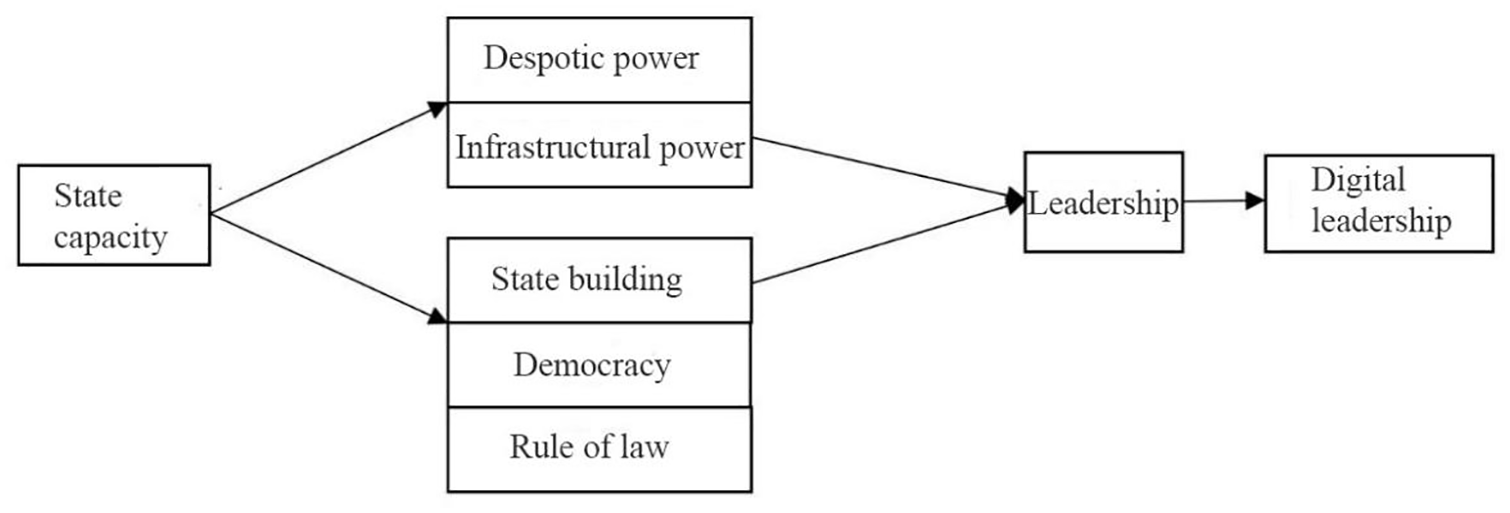
Digital leadership: theoretical origin.
2.2 Internet governance and digital leadership
The transformation of governance in the era of digital technology has the internet as its infrastructural platform. We should be clear about the concept of internet governance and how it has developed.
In 1998, the 19th Plenipotentiary Conference of the International Telecommunication Union in Minneapolis formally proposed the concept of internet governance (Goldsmith and Eggers, 2008: 6–7). 1
In a general sense, internet governance is an umbrella term for how content and behavioural processes related to the internet are coordinated, managed and responded to, although its definition has expanded over time. If internet governance is divided by layer, it includes at least an infrastructure layer, a technical standards layer, a content application layer and a social issues layer (Zhang and Miao, 2015). In view of the high complexity of internet governance at the layer of social issues, its subjects of governance are necessarily diversified. But, in recent years, state actors, among the subjects of governance, have played an increasingly important role in global internet governance. The concept and practice of state sovereignty have begun to dominate the system of political discourse on the internet in countries with large numbers of internet users.
The centrality of states, or governments, to internet governance can be traced back to the World Summit on the Information Society in Geneva in 2003. The Geneva Declaration of Principles adopted at that summit divided internet governance into technical and public policy issues, with the latter reflecting the scope of state sovereignty. Overall, the summit confirmed that sovereign states are at the top of the pyramid of internet governance and have the authority to set the agenda, formulate policies and reform institutions (Wang, 2015). To deal with the problem of the security of cyber information, better protect citizens’ rights, strengthen the legal system of the internet and promote social governance, it is crucial to highlight the leadership of the state and the government.
In the post-COVID-19 period of the digital era, the concept of digital leadership is necessary to establish the centrality of the state and government in a pluralistic system of governance in the face of major reforms in systems of national governance and the possible restructuring of the public power of the state. Leadership is the ability of an individual or organisation to lead others, a team or the organisation as a whole to ensure that its goals are achieved. Leadership is closely related to the goals expected to be achieved.
Research on leadership began with research on leaders and has gradually expanded from studies on the personality traits and behaviours of individual leaders to the effects of interactions across organisational contexts – moving from the trait theory of leadership in the late 19th and early 20th centuries to the behavioural theory of leadership in the 1940s, the contingency theory in the 1960s, and later to the attribution theory of leadership.
In the face of digital transformation and the global fight against the COVID-19 pandemic, digital leadership represents an enrichment and improvement of the concept of leadership. From the perspective of the origins of the theory of governance, the purpose of governance is precisely to solve problems and achieve stability (Wang, 2018). Therefore, the modernisation of state governance refers to the state’s adaptation to and mastery of a series of problems arising in the process of modernisation (Zhang et al., 2017). Further, if the goal is to modernise state governance, leadership can be defined as the ability possessed by the subjects of governance to ensure that they can adapt to and master a series of problems arising from the process of modernisation. In an era in which digital technology has penetrated all areas of the economy and society, that ability should be based on the empowerment of digital technology and should cover all aspects of identifying problems, proposing solutions, solving problems, and avoiding secondary problems. This is the prerequisite for ensuring that the goal of modernising state governance is achieved in this new global situation.
3. Theoretical construction of digital leadership
3.1 Digital leadership and thinking
3.1.1 From internet-based thinking to digital thinking
Thinking is a function of the brain and a subjective reflection of the objective world that arises from social practice and is rooted in the spirit of the times. Internet-based thinking and digital thinking are the main ways of thinking in today’s information-based society.
Internet thinking is a new way of thinking in the era of mobile internet and consumer internet. It is summarised by internet entrepreneurs on the basis of their practices and is different from industrial thinking. While industrial thinking has a centralised, specialised and closed pyramidal structure, internet thinking has an open, decentralised, flattened and cross-boundary structure. Compared with internet thinking, digital thinking not only has the characteristics of decentralisation, flatness and cross-boundary openness but also features high efficiency, precision and intelligence. For example, the virtual station programme – using a green dot on the map to indicate the most convenient boarding location based on AI algorithms – launched by Didi Chuxing is a typical product of digital thinking. It eliminates the need to build a physical station, saves the cost of communication for drivers and passengers, and solves their communication-related issues when confirming their boarding locations.
The formation and evolution of digital thinking can be considered at two levels: first, it is supported by digital technology; second, it is nourished by digital technology. Considering it as being supported by digital technology represents the support provided to the intellectual dimension by the material dimension. Being nourished expresses the reaction of digital technology to human capabilities. For example, humans develop machines to act like them through AI and deep learning technologies; in that process, machines are also affecting the way humans behave. With the development of digital technology, the ways in which humans think are being profoundly changed. In this sense, if the industrial revolution is considered to have maximised humans’ physical strength, then the information revolution could be maximising humans’ brainpower.
3.1.2 The meaning, characteristics and dimensions of digital thinking
Digital thinking, as the way of thinking in the digital era, has three main characteristics and dimensions.
(1) Interconnection, integration and intelligent sharing (the ecosystem at the macroscopic level): From information technology to digital technology, the real environment will be digitally reconstructed in cyberspace in a holographic way to deliver interconnection, integration and intelligent sharing. Digitalisation has created a new sociopolitical, economic, military, cultural, educational and living environment that can be summed up as, according to Peng (2019b), ‘the digital era’: ‘This is an era of innovation in the integrated application of such digital technologies as the internet, cloud computing, big data, the Internet of Things, sensor technologies, touch technologies and artificial intelligence, an era in which people and technology evolve together’. The human mind is collectively integrated into digital virtual space–time, uniting opposites by connecting the virtual and physical worlds to deliver intelligent sharing.
(2) Equality, openness, evolution and innovation (the platform at the mesoscopic level): According to Habermas, communication is the interaction of symbols. In the digital era, human communication will become more equal and open, creating an infinitely expanding space for communication through digital infrastructure. With the emergence of 5G technology, we are about to enter a transcendent world of ‘ubiquitous connectivity’, breaking through the dual dimensions of time and space, facing history and the future at once, and blending virtuality and reality, all the while as digital thinking helps society continually innovate and evolve.
(3) Human centricity and individual freedom (individuals at the microscopic level): According to Marx, the fully developed individual is not a product of nature but a product of history. It is in the course of history that the free individuality of human beings is constantly expressed and gradually grow. The digital society is different from traditional society. With the development of equality and inclusiveness, which provide the premise for free thinking and a return to the authentic self, individuals will be subject to far less control and intervention in virtual reality and will experience the ‘self-progression of free thinking’. Thus, the digital era could give rise to the fullest display to individual thinking.
These three characteristics are the core elements that make up digital thinking. They form an organic whole encompassing the ecosystem at the macroscopic level, the platform at the mesoscopic level and individuals at the microscopic level.
3.1.3 Digital thinking as a way of thinking and acting in the era of digital technology
The era of digital technology has built a wonderful world for human beings to live in, and an inherently generative logic and path based on ‘scenarios, relationships and algorithms’ (Liu, 2018) indicate a profound revolution in the way we think, with digital thinking serving as its symbol. This revolution of thinking not only expands the developmental space for human thinking but also deepens the ‘presence’ of digital individual thinking that the digital era facilitates, moving, as Heidegger said, ‘from inauthentic existence to authentic existence’.
Digital thinking has now become the most important way for human beings to understand and transform the world. Moreover, we cannot attribute the emergence of the digital era to technological determinism because it has occurred not only through technological breakthroughs but also through the transcendent inner power of human thinking. Human beings are eternally oriented towards self-actualisation, self-improvement and self-transcendence. That is why, in the course of history, humans have constantly sought to understand the world, obtain the truth (the objective laws of things) and use it to transform the world, and realise the unity of epistemology and methodology. Correspondingly, human thinking has evolved and developed in the constant quest to transcend the limitations of the external world. At the current stage, digital thinking, as a new tool of human understanding and practice, is an important tool on the road to freedom for human beings. It no longer simply points to the understanding and transformation of nature but is based on an internal breakthrough in the thinking and life of human beings. It is determined by human nature and people’s pursuit of self-transcendence, complete emancipation and all-round development.
Digital thinking answers to the needs of human society as it enters a new era in which cyberspace dominates the physical space. It is a global, open system that influences and dominates the development of human society and reconstructs the social order and the capacity for state governance.
3.2 Attributes of digital leadership
The concept of digital leadership is a rethinking, reconceptualisation and renovation of the concept of leadership in the context of technological revolution, which takes digital technology as its centre, and is reshaping society and the international landscape. Digital leadership is the ability that individuals or organisations should have in the era of digital technology to lead others, teams or entire organisations to give full play to digital thinking by leveraging digital insight, digital decision-making, digital implementation and digital guidance to ensure that their goals are achieved. It is also the ability to effectively implement international, state, social and corporate governance with the support of digital technology.
This paper focuses on issues related to state governance. The prerequisite for ensuring the modernisation of state governance is for the government to adopt digital thinking and the four digital leadership-related attributes: digital insight, digital decision-making, digital implementation and digital guidance (Figure 2). Digital thinking requires a basic knowledge of digital technology and awareness of the need to proactively apply it to work; it is both the premise and the foundation. Without digital thinking, there can be no digital leadership. The four attributes indicate how to exercise leadership when using digital technology and should be the focus of efforts to enhance leadership and work-related performance. The four attributes are interwoven and run through the entire leadership process.
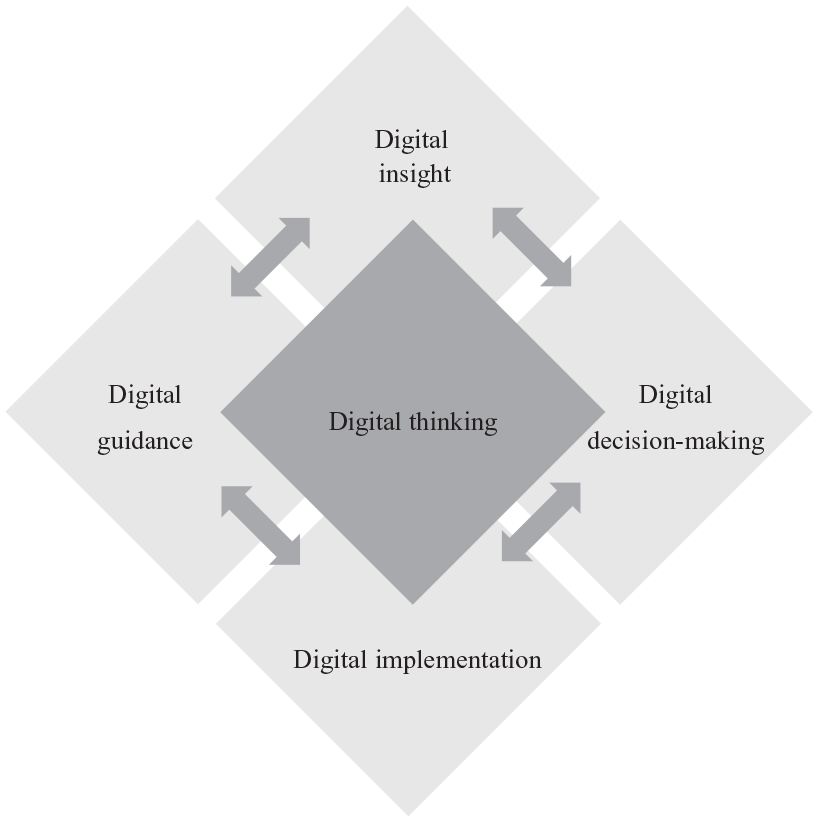
Digital leadership: digital thinking and four attributes.
3.2.1 Digital insight
Identifying a problem correctly is a prerequisite for solving it. As Ackoff (1974) noted, ‘We fail more often because we solve the wrong problem than because we get the wrong solution to the right problem’. That failure is not only a failure to solve the real problem, but also a drifting away from the crux of the problem because we think we have solved it. Therefore, insight can be understood as the ability to find the right problem or, to put it colloquially, the ability to see a thousand miles, to hear faraway sound, to identify correlations among different variables like a super-precise radar, and to predict trends and possible consequences like a supercomputer.
Problem identification involves three steps: problem perception, problem definition and problem transformation.
(1) Problem perception: This represents the perception of an objectively existing problem. Because problems are generally subjective in nature, problem perception requires that the actor enter the context of a problem. If a small problem exists objectively but is not perceived in time, it may develop into a big problem. In this regard, we can leverage digital technology to identify emerging problems that might otherwise go unnoticed and nip them in the bud.
(2) Problem definition: Not all problems need to be solved by the government. Some involve only private interests of individuals and others involve the shared interests of organisations, but none of them requires government intervention. Moreover, intervention that goes beyond the scope of the responsibilities and authority of the government might not only increase administrative costs but also be counterproductive. Only issues of public interest should be addressed by the government. In addition, the government is not omnipotent. Some problems, although involving the public interest, are too complex for the government to solve and require the cooperation of multiple entities. Therefore, it is necessary to differentiate among and define problems on the basis of problem perception.
(3) Problem transformation: This means the transformation of social problems involving the public interest into problems of public policy, and that of contextualised problems arising from the gap between reality and the ideal state into problems for which a policy-based solution can be explored. Problem transformation includes classifying contextualised problems by areas of policy, extracting the essence from those complex and interrelated problems, and modelling that essence.
To enhance insight, digital technologies should be used, including the application of big data technologies for real-time social monitoring, the use of early warning information from professional users on social networks, and the use of big data technologies to reveal correlations between important variables to identify problems and extract the essence of the problems. For example, of the big data generated by the daily activities of society, that generated by internet search engines and e-commerce platform searches and transactions are two major categories of data that have high early warning value for major events that threaten public safety.
According to Baidu’s big data, the early phase of the COVID-19 outbreak saw a surge of searches for information about the virus as well as its spread and prevention, and for a time topped one billion searches a day. The most searched topics were related to the spread of the pandemic and pandemic prevention knowledge, such as infection maps, updates on the situation in Wuhan, progress in vaccine development, the use of masks, and differences between COVID-19 and the seasonal flu. The number of online searches for pandemic information tended to first peak in Wuhan before peaking in other areas, and the search trends tended to first appear in regions more affected by the pandemic before appearing in other regions. The time lag between different regions could have served as an important reference of the early warning system for resource allocation and guiding public opinion.
During the COVID-19 outbreak, China’s highly developed e-commerce and logistics infrastructures played an important role, so searches on e-commerce platforms could also reveal important information. According to big data from JD (China’s leading online retailer), compared with searches and public opinion data on major social media platforms, JD had a lead of approximately 48 hours over social media platforms in data changes as indicated by online purchases and searches. This could have also helped better assess the pandemic and early warning.
3.2.2 Digital decision-making
Once a policy problem is put on the policy agenda, the next step is to work out a policy solution to the problem.
Decision-making is a response to how to solve problems as well as a guide for actions to solve them. It is both a political activity and a technical activity that needs to follow a certain procedure by adopting a scientific approach. Therefore, decision-making competency is the ability to make the right decisions. Decision-making involves setting objectives, designing policy options and choosing policy.
(1) Setting policy objectives: Objectives are established to indicate the extent to which the policy problem is to be solved and serve as a basis for the design and selection of policy options, a guideline for policy implementation and a frame of reference for the assessment of the effectiveness of the policy. Policy objectives should be clear, forward looking, feasible and coherent. In general, the main difficulties in setting policy objectives are twofold: first, the value bias of the policymakers, which may run counter to the public interest; and second, the difficulty of making trade-offs in the face of multiple conflicting objectives.
(2) Designing policy options: The policy options should be rich, pluralistic (avoiding Hobson’s choice; that is, no choice), mutually exclusive and innovative (problems arise largely because old solutions fail, which is why innovation is needed to solve problems that cannot be solved by the available solutions).
(3) Choosing the optimal option: Faced with a number of options, policymakers should assess the options’ effectiveness, risk and feasibility (including technical, economic and political feasibility) in order to choose the optimal option. It should be noted that an optimal option is optimal under bounded rationality, and not under unbounded rationality (Simon, 1989). In choosing from different options, it is important to avoid self-serving bias caused by such factors as the decision-maker’s personal preference overriding public interest, which leads to cheap decision-making (choosing the easiest and least costly solution) and rent-seeking. It is also important to avoid technical bias attributable to subjective factors on the part of the decision-maker, such as short-sightedness, indolence and stereotyped thinking.
To enhance decision-making competency, digital technology should be used. This includes the use of computer simulation technology to represent the effects of different policy options to help compare them and choose the best one and the use of AI and cloud computing to aid in decision-making. For example, during the COVID-19 pandemic, the Ministry of Industry and Information Technology organised the relevant institutions to conduct telecommunications-based big data analysis to compile statistics on the movement of people across the country, especially in key areas such as Wuhan and other parts of Hubei Province, to analyse and predict the dynamic movement of key populations, such as confirmed and suspected cases and people in close contact, and to support the deployment of pandemic prevention and control measures. The pandemic prevention and control departments fitted the big data analyses to the model theory of infectious diseases related to COVID-19 to identify the patterns of spread of the pandemic, understand its trends of distribution and development and provide support to the relevant authorities in determining the priority areas, groups and scenarios for pandemic prevention and control as well as in decision-making on the reasonable distribution of supplies and the imposition of controls.
3.2.3 Digital implementation
Implementation is the only way to translate policy ideals into policy realities and policy objectives into policy benefits. The fact that a policy is made does not in any way mean that it is automatically implemented; there is a gulf between the two. For policy science to be a science of action and not just a theoretical science, attention must be paid to the issue of policy implementation: not only to implementation itself, but also to establishing close links between implementation and policy formation (Pressman and Wildvasky, 1973). Therefore, implementation competency is the ability to implement policies and accomplish the intended goals.
Implementation consists of three stages: preparation, implementation and summarisation.
(1) Preparation: This consists of intellectual preparation, organisational preparation, material preparation and plan formation. Intellectual preparation means strengthening the understanding of the policy to ensure that the approach taken corresponds to, and does not conflict with, the objectives of the policy and the solution ultimately chosen. It also means understanding the spirit of the policy and its internal provisions as well as the external environment. This is a prerequisite for exercising discretion in the implementation process. Organisational preparation includes the establishment of organisational, coordination and command mechanisms as well as staffing and human investment. Material preparation includes funding, equipment and technology. Plan formation should take into account the objective situation, the flexibility allowed (to ensure that there is room for adaptation to the circumstances) and the coordination of efforts (taking care of all issues).
(2) Implementation: First, a policy may be experimented with (that is, piloted) before full implementation with a view to reducing risks, lowering costs and gaining experience. However, the premise is that the representative pilot units should be reasonably selected to achieve the goal of ‘leading by examples’ (Zhang and Xie, 2017). Second, it is important to scientifically and objectively summarise and analyse the results of policy experiments and to use the insights thus gained to improve the policy. Third, the policy should be disseminated. This requires both flexibility and compliance with the basic principles. Those principles include giving full play to the role of policy experimentation, where beneficial experience should be adopted and lessons should be learned to avoid repeating the same mistakes. Flexibility means adapting to local conditions and emphasising learning and understanding the spirit rather than blindly copying the form. In addition, there is a need for monitoring and control: problems arising in the course of implementation should be identified and corrected in a timely manner to follow the solutions already formulated, and to prevent the implementation from going astray and delaying the achievement of the policy objectives due to the influence of interests or the incompetence of the implementers.
(3) Summarisation: This involves the assessment of the policy in terms of efficiency, effectiveness and legitimacy, among other criteria. Policy assessment needs to follow scientific procedures and be objective. The results of the assessment are an important basis for deciding whether to continue, amend or terminate the policy. If necessary, additional decisions are made; that is, timely adjustments are made through new decisions to avoid further losses owing to previous decision-making errors.
Digital technology should be used to enhance implementation competency, such as by using e-government to achieve cross-departmental collaboration and blockchain technology to monitor the implementation process. For example, in the early stage of the COVID-19 pandemic prevention and control work, grass-roots units in Changsha received massive amounts of data in varying formats and of variable quality from different departments and channels. They had to not only re-verify the data but also aggregate and fill in reports in various forms, which put them under a lot of pressure. In view of that situation, the Changsha Municipal Epidemic Prevention and Control Command set up a data analysis group responsible for summarising and processing information from different channels and using big data to empower pandemic prevention and control. It achieved excellent results. The group quickly developed a mapping and feedback-reporting system, established and improved the workflow for the verification of key incoming personnel and implemented the orderly distribution, verification, tracking and aggregation of data through collaborative data collection, data processing and analysis, and data verification and feedback. For hard-to-reach people who could not be contacted by the grass-roots workforce, or refused to provide addresses or answer phone calls, the public security organs adopted technical means to accurately profile their addresses, vehicles and social information, analysed and assessed their activity trajectories, and cooperated with the grass-roots staff to manage such people. The public security organs analysed the relationships between confirmed cases and their contacts, accompanying persons and family members and analysed the behavioural trajectories of the confirmed cases and their close contacts by inquiring into information on their accommodation, internet access, public transport, mobile phone location trajectories and Skynet images. Once the confirmed cases or close contacts were found to have ‘suspicious’ trajectories outside their homes or the hospital before or after the onset of the disease, the officials reported the key data to the health and disease control departments as soon as possible, thus providing accurate data support for the departments’ epidemiological investigation and control of the close contacts.
3.2.4 Digital guidance
The environment constrains the actors’ decisions and actions and, in turn, is shaped by them (Anderson, 2009). The environment includes the political, economic, social and international environments. Influences from the environment include the support for or constraint on material resources, the democratic participation of the public, the pressure from public opinion, the influence of social customs, and the influence of the international environment. The essence of guiding is the shaping of the environment.
Guiding competency (that is, the ability to shape the environment) involves using strategic goals to gather support and strengths, put messages across and shape the intended images through information release, policy interpretation and public opinion monitoring and guidance. It is mainly geared towards building resonance, increasing cohesion, delivering effective communications and expanding influence. Guidance can avoid secondary problems and contribute to solving them.
First, decision-making and implementation aimed at solving problems are like imposing new variables on the environment and may lead to uncertain results, such as violent reactions and secondary problems caused by inappropriate decisions or poor implementation. Therefore, to avoid the occurrence of such secondary problems, it is necessary to provide the appropriate guidance while solving problems and to maintain the stability of the external environment by appropriately shaping it.
Second, appropriate guidance can also neutralise resistance from the environment and enhance the effectiveness of implementation-related activities. The target audience is mainly the public. Guidance takes the form of political advocacy, persuasion and education, including consultation, public hearings and the publication, explanation and clarification of a policy. The aim is to strengthen the target audience’s understanding of the policy so that it understands why and for whom the policy is made and the goals, possible uncertainties, legitimacy, rationality and necessity of the policy. This helps the target audience accept the policy and comply with it.
Digital technology should be used to enhance guiding competency, including by using big data to portray the target audience to achieve accurate delivery of information, using visual technology to help the public better understand policy and using VR/AR (virtual reality / augmented reality) technology to increase the audience’s sense of presence and enhance the effectiveness of guidance. For example, the COVID-19 response in New York put Governor Andrew Cuomo in the global media spotlight. Despite steadily rising infections and inadequate pandemic containment measures, Cuomo gained increasing support from the public owing to his personal performance in the effort. And that in large part can be attributed to his effective use of digital guidance, including:
Candour – To convey the full extent of the crisis.
Detail – To paint a detailed picture of the pandemic and the workings of the government, which won it credibility.
Data – To be informed of the situation in all quarters based on massive data, which contributed to a substantial rise in the politician’s personal charisma.
Presence – The governor personally went to the front lines, communicated with residents face to face and held a press conference in a warehouse.
Agenda – Knowing how to set and push the agenda in favour of the government with a view to winning people’s support and avoiding public opinion risks.
In China, the evolution of public opinion on the country’s COVID-19 response has provided lessons on both ineffective guidance in the early stage and successful guidance in the middle and late stages. In prevention and control efforts for COVID-19, it is important, as President Xi Jinping said, ‘to coordinate efforts online and offline, both in and outside of China, with regard to major and minor issues, so as to boost confidence, keep people’s spirits up, and rally popular support’ (People’s Daily, 2020). Making full use of digital leadership is the foundation for effective public opinion guidance in the era of digital technology.
4. Strategies and recommendations for improving digital leadership
The CPC will continue to face and respond to novel challenges as it advances its historical mission in a new era. This has kept the party abreast of the times and helped maintain its fighting spirit. Before the founding of the People’s Republic in 1949, Mao Zedong reminded his colleagues and the party of this; and at the beginning of China’s reform and opening-up in the late 1970s, Deng Xiaoping repeatedly issued such warnings about facing new tests. Today, digital technology has driven a major transformation in China’s state governance. In the context of the COVID-19 pandemic, the system of social governance has experienced a preliminary digital transformation, and a number of traditional social governance issues, such as asymmetric information, slow response and low effectiveness of governance, are being gradually solved. As President Xi Jinping has noted, ‘This epidemic is a major test of China’s system and capacity for governance. We must make sure that we sum up our experiences and draw lessons from them’ (China News Agency, 2020b). An important subject of this major test is precisely digital leadership. Making good use of big data to trace the source of the pandemic to support precise prevention and control, using big data, 5G, AI and other levers to reconstruct the industrial landscape, promoting targeted social governance, and preventing and responding to the ‘post-pandemic syndrome’ have become the centrepiece of China’s goal of modernising state governance.
4.1 Initiate digital literacy training to adapt to the era of digital technology
It has been 26 years since China obtained full functional access to the internet, and governments at all levels have gone through a process of first struggling to adapt to e-government by setting up their official websites, and then easily adapting to social media. During the fight against the COVID-19 pandemic in 2020, Wuhan, as a new first-tier city with strong technological capabilities, exposed problems in information dissemination as well as supply management and distribution. The reason was not a lack of technical capacity, but rather backwardness in digital leadership that led to inadequate and limited application of the available technology. At present, although all provinces and cities have spent large sums of money on hardware platforms, recognising and tapping into the value of data fundamentally reflects the philosophy and ability of policymakers and the government to keep pace with the times.
Various phenomena have shown that, in the era of digital technology, governments at all levels are faced with the arduous task of ‘re-adapting’ to the internet. As President Xi Jinping noted, it is important to leverage big data to improve state governance modernisation; and the ability to obtain, analyse and use data is the basic skill for leading officials to perform their duty (Xinhua News Agency, 2017). It is therefore necessary to launch a campaign of digital literacy training in government departments across the country to spread knowledge of digital technology, foster digital thinking and enhance digital leadership.
4.2 Leverage digital technology to tackle data silos and establish a national integrated big data platform
Today, big data provides the richest material for systems of decision support, consultation, evaluation, supervision and feedback, and has become a powerful support for scientific and democratic governmental decision-making. Among a full range of mobile apps that generate valuable data, Weibo, WeChat and Toutiao reflect the Chinese people’s information-related preferences; Douyin and Kuaishou reflect Chinese people’s aesthetic preferences; Taobao, JD and Pinduoduo reflect Chinese people’s spending power and product preferences; and DiDi Little Green Dot, Umetrip, Ctrip and LY.com reflect Chinese people’s activity trajectories. Data from those sources combines to present a holographic view of China’s economic and social operation.
President Xi Jinping has pointed out that we must have a deep understanding of the role of the internet in national and social governance; promote e-government and build a new type of smart city; centralise and share data by connecting data held by various government departments and building a national integrated data centre; promote technology integration, business integration and data integration; and realise cross-level, cross-regional, cross-system, cross-sector and cross-business collaborative management and services (Xinhua News Agency, 2016). By combining the big data on internet cloud platforms with that of various government departments, it is possible to grasp and use data in a more comprehensive, diversified and efficient manner, better identify public opinion and understand the current status and laws of economic and social operations. This enables better informed and more effective measures in public opinion guidance, industry policymaking and macroeconomic regulation.
4.3 Redefine the ‘digital government’ and strengthen ‘middle-office’ functions
China has been advocating digital government and smart cities for many years, but, when the COVID-19 pandemic hit, it was found that digital insight into the transmission routes of the pandemic and its severity was lacking. That led to such problems as an overburdened health-care infrastructure in the early stages of the pandemic. It was only in the later stage that pandemic tracking and community control work received effective support from big data from telecommunications. In this sense, 2020 will be the real first year of the construction of the digital government and the smart city. According to the developing situation, it is important to re-examine the goals and tasks of digital government, reformulate its standards and requirements and clarify its timetable, road map and inspection methodology.
The operation and maintenance of the digital government system needs to enter the ‘middle-office’ era after the stage of piloting and superficial applications. Middle office means the digital transformation and adoption of comprehensive intelligent applications in large and medium-sized cities across the country. As President Xi Jinping pointed out on 31 March 2020, during an inspection tour in Zhejiang:
Advancing the modernization of China’s system and capacity for governance requires stepping up the modernization of the urban governance system and capacity. We can use big data, cloud computing, blockchain, AI and other cutting-edge technologies to innovate in the methods, models and visions of urban management, and to make cities smarter. This is an inevitable path to push the modernization of the urban governance system and capacity and it has a vast potential.
Only with a strong middle-office support can the digital government system efficiently connect the needs of the public with the services of various government departments. The middle office is an infrastructural and revolutionary project that can connect the data ‘silos’ of various government departments, establish an effective and smooth system connecting the central government, the provincial governments, and counties and towns, and thus enhance the modernisation of social governance.
4.4 Foster digital leadership to win the international competition
Digital leadership is an important element of a country’s international competitiveness. The outcome of future competition between countries will be inextricably linked to their levels of national digital leadership. At present, the digital transformation of the world economy is a major trend in which many countries have identified the digital economy and digital transformation as parts of a major national strategy to seize the next window of global economic development and improve their international competitiveness.
In May 2017, US President Trump set up the Council of Advisors on Science and Technology to push the digital transformation of the US Government. In February 2019, Trump launched the American AI Initiative to guide the development of American AI technology and keep the United States at the forefront of the world’s future technological development.
In November 2019, Singapore launched its National AI Strategy, which aims to promote the application of AI technology in five major areas, including transport and logistics, to facilitate the digital transformation of the economy.
In January 2020, France announced a new version of its Production Pact, which aims to give the French production sector the competitiveness to respond to digital changes and challenges and to pave the way for the digital transformation of French industry.
Gaps in China’s digital competitiveness in comparison with developed countries need to be urgently addressed. The key to improving China’s digital competitiveness lies in enhancing the country’s digital decision-making capacity, and thus it will promote digital transformation and digital industrialisation, foster the new economy, achieve high-quality economic development and enhance its comprehensive national strength. More leading officials should be trained in digital leadership as soon as possible to prepare China to further accelerate the digital transformation of its industries and win this international competition.
When reflecting more than 40 years after China’s reform and opening-up, which paved the way for the industrial and information revolutions, and embracing the digital technology and digital society in the era of digital technology today, it is important for China to leverage this technology to reconstruct the government’s digital leadership, bringing into full play the greatest values of digital governance and technology by combining the rule of law, the role of government, the responsibility of platforms, social co-governance and humanistic ethics, thus comprehensively improving social governance and service capabilities and enhancing the digital literacy of society as a whole. Only by seizing the historic opportunity brought by digital technology can the country achieve a historic leap forward in the modernisation of the national governance system and governance capacity.
Footnotes
Declaration of conflicting interests
The author declared no potential conflicts of interest with respect to the research, authorship, and/or publication of this article.
Funding
The author disclosed receipt of the following financial support for the research, authorship, and/or publication of this article: This study was funded by the Internet Communication Transformation and Governance in the 5G Era research project, supported by the National Social Science Fund of China (no. 19@ZH044).
1.
It should be noted that this concept is different from so-called network governance, which is a concept in the field of public administration. Network governance is based on the interdependence of resources. Governments rely on a network of partnerships, agreements and alliances to do public business, and this represents the confluence of four influential trends that are altering the shape of public sectors worldwide: third-party government, joined-up government, the digital revolution, and consumer demand.
Correction (November 2022):
This article has been updated with author biography since its original publication.