




Abstract
Remarkable strides have been made in science ever since the scientific revolution in the 17th century, and the scientific community continues to prosper today. In its professional activities and social life, this community has created a scientific culture that is increasingly prosperous and is having a significant impact on the development of human culture. The scientific culture has distinctive features that are different from those of the literary culture. For example, it emphasizes the decisive role of objective examination in the course of enquiry to reduce the impact of the subjectivity of researchers on the results. It also stresses the objectivity of knowledge and testing that objectivity through reproducibility. It favours experimental and mathematical approaches while underestimating the roles of imaginal and intuitive thinking, and advocates the values of utilitarianism. This paper concludes that the distinctive features of the scientific culture should be examined in the course of its current development to eliminate the negative impact of utilitarianism.
Keywords
Introduction
Since the scientific revolution in the 17th century, science has developed remarkably, and our knowledge in the scientific disciplines has grown to form a significant part of human knowledge. Scientific research methodologies featuring experiments and mathematical deduction have evolved into fundamental approaches used by humans to understand the world. Whether it is in the exploration of nature or in research on human society and human awareness, scientific approaches are used extensively. Science has become a remarkable symbol of modern society.
With the development of science and the growing number of scientific professionals, the scientific community has become a strong force in social development in the 21st century. The scientific culture, which has been developed by the scientific community in its professional activities and social life, is becoming more conspicuous. It is different from the other subcultures of human society but also integrates with them to promote the progress of human culture.
This paper is intended to illustrate the special qualities of the modern scientific culture, with a focus on key points of concern in promoting the progress of the scientific culture in China today.
The separation between the two cultures
The scientific culture is different from the literary culture, which has been created by scholars in the field. The differences have resulted in separation between practitioners of the two cultures. The earliest statement noting that was made by British scholar Charles Percy Snow (1905–1980).
Snow had undergone rigid scientific training and, upon receiving his PhD in 1930 from the University of Cambridge, was engaged in research, teaching and administrative duties. As he loved literature and had a strong passion for great writing, he maintained close contact with both scientists and researchers in the humanities. During World War II, Snow was in charge of scientific resource administration in a committee under the British Royal Society. He once also served as director of technical personnel at the British Ministry of Labour, helping select professionals for the Manhattan Project. More importantly, he was a scientific adviser to the British Government for a long time. From 1964 to 1966, he served as a parliamentary secretary in the House of Lords to the Minister of Technology. In recognition of his outstanding contribution and extensive social influence, Snow was awarded the title of Baron of Leicester in 1957.
Snow's academic and professional experience enabled him to nurture a deep understanding of the cultural separation between the communities of science and the humanities. He found that scientists and humanities scholars often disagreed with each other about concepts, failed to understand each other, had a poor opinion of each other's area of research, and even engaged in verbal attacks. He described this separation as follows:
For constantly I felt I was moving among two groups—comparable in intelligence, identical in race, not grossly different in social origin, earning about the same incomes, who had almost ceased to communicate at all, who in intellectual, moral and psychological climate had so little in common that instead of going from Burlington House or South Kensington to Chelsea, one might have crossed an ocean … by and large this is a problem of the entire West. (Snow, 2012, p. 2)
Regarding the degree of separation, Snow (2012, p. 4) said:
Between the two a gulf of mutual incomprehension—sometimes (particularly among the young) hostility and dislike, but most of all lack of understanding. They have a curious distorted image of each other. Their attitudes are so different that, even on the level of emotion, they can't find much common ground. Non-scientists tend to think of scientists as brash and boastful.
In 1956, Snow published an article in the New Statesman titled ‘The two cultures', which pointed out for the first time the separation between the scientific culture and the literary culture and prompted considerable discussion. In 1959, he expanded on the article and delivered a lecture titled ‘The two cultures and the scientific revolution’ at the University of Cambridge, making the separation between the two cultures a hot topic.
Lionel Trilling (1962) from Columbia University and Frank Raymond Leavis (2013), a literary critic from the University of Cambridge, subsequently expressed their views on the issue. They stressed that science and the humanities are different in approach and discourse. The statement of ‘two cultures’ simplifies the complexity of the humanities, they noted, and does not hold water.
John Brockman promoted the concept of the ‘third culture'. He claimed (1996) that the wide dissemination of scientific knowledge has led to a change in the role of intellectuals in modern society, as more and more scientists assume the role of general intellectuals. Science has an increasingly profound influence in policymaking and philosophical argumentation, and both government and society value it more than ever. In Brockman's view, the ‘third culture’ acknowledges the rapid development of the scientific culture and its quickly growing influence on social culture since the mid-20th century.
Thus far, the discussion of the two cultures has continued for about six decades. During that period, because of developments in science and technology and significant changes in social life, the meanings of the two cultures have undergone enormous changes. Due to globalization and the ubiquity of science, the separation between the two cultures is no longer typical of Western society but a common phenomenon worldwide. Over a span of 60 years, the two cultures have integrated and clashed with each other.
The Sokal affair showed the separation between the communities of science and the humanities. In November 1996, New York University quantum physicist Alan Sokal submitted to Social Text, a famous journal of cultural studies, a disingenuous article titled ‘Transgressing the boundaries: Toward a transformative hermeneutics of quantum gravity' to test the editors’ academic ability, but none of the five editors identified that it was a parody. Within a month of the publication of the article, Sokal published another article titled ‘A physicist experiments with cultural studies’, revealing that the article in Social Text was a hoax. This event shocked the academic community and sparked a global ‘science debate’ between self-proclaimed guardians of science, who included scientists and positivist philosophers, and postmodernist thinkers.
During the debate, scientists declared to humanities intellectuals that ‘I can read your paper, but you can't read mine.' In the face of this arrogant challenge, some humanities intellectuals evinced a lack of confidence, while others went to the extreme of attacking the authority of science in the name of the humanities. The conflict between the two sides then evolved into a matter of ‘pride and prejudice’ in which each side defied the other.
The debate reveals that, by the end of the 20th century, a vast separation persisted between the two cultures. On the one hand, some humanities intellectuals misused concepts and knowledge from natural science, while some others devised unreasonable and surprising theories. This practice aroused the doubt and scorn of scientists. On the other hand, some followers of science hoped to expand the use of scientific approaches to the more complex phenomena of society at large. They expected to include all earthly activities in science and convert science into a new type of belief. Science, which should be based on rationality, is thus misusing the authority of rationality and turning into a new sort of superstition. Friedrich August Hayek (1982, p. 176) claimed that ‘In this sense the twentieth century was certainly an outstanding age of superstition… where the application of the techniques which proved so helpful with essentially simple phenomena has proved to be very misleading’.
Modern science made a late start in China but, once it had established itself in the 20th century, a separation between the scientific culture and the literary culture appeared here as well. This can be seen from the debate between scientists and metaphysicians in the 1920s. After the First Opium War, progressive Chinese intellectuals turned for inspiration to Europe, which had advanced science and technology and developed industries. In 1918, under the leadership of Liang Qichao, a group of seven, including Zhang Junmai and Ding Wenjiang, travelled to Europe in order to learn. However, their hope of Europe representing the triumph of science, and a path for the future for China, was destroyed when they saw the violence and destruction of World War I. In 1923, Zhang Junmai gave a lecture titled ‘The outlook on life’ at Tsinghua University. The lecture ignited a widespread science–metaphysics debate between conservative cultural forces and the Westernized school that was then prominent.
The conservative school, headed by Zhang, held that science concerns physical things, and thus cannot satisfy the spiritual needs of humankind. Therefore, it cannot help with the spiritual life of humanity in any way. It was the progress of science that had resulted in the evils of modern civilization in the West and the enormous damage of World War I. The Westernized school, headed by Ding Wenjiang, claimed that science promotes spiritual life and intellectual development; science can train people's intellect, enhance spiritual contentment and, moreover, serve as an important instrument for personal cultivation and moral edification.
Since the 20th century, China has made tremendous progress in science, and the scientific culture has come to have an increasing impact on society. But we have not managed to bridge the divide between the scientific culture and the literary culture. Technology-minded governance and scientific hegemony are evident sometimes in the course of national policymaking and social governance. This separation hinders the development of science and prevents humankind from making social progress. It is thus important for China to develop a positive culture of science.
The distinctive features of the scientific culture
Created by men and women of science, the scientific culture constitutes the form of life and attitude towards life consciously or unconsciously followed by people involved in scientific activities. It is a type and an important element of human culture, and one of the subcultures of humankind. As Snow (2012, p. 9) said:
At one pole, the scientific culture really is a culture, not only in an intellectual but also in an anthropological sense. That is, its members need not, and of course often do not, always completely understand each other; biologists more often than not will have a pretty hazy idea of contemporary physics; but there are common attitudes, common standards and patterns of behaviour, common approaches and assumptions. This goes surprisingly wide and deep. It cuts across other mental patterns, such as those of religion or politics or class.
The scientific culture embodies the spirit of the scientific community. Compared with other subcultures, such as those of art and religion, it has a shorter history, but it has experienced rapid development and has an increasingly significant impact on modern society. The meaning of the scientific culture concerns both cognitive principles (such as logical consistency, simplicity and testability) and social norms for scientific activities (such as Robert K Merton's universalism, communism, disinterestedness and organized scepticism and John Ziman's innovation ethos). Starting from the 20th century, the scientific culture has unconsciously shaped the thought and mentality of humankind, fostering the modes of thinking and psychological patterns of people, and has become an indispensable element of a person's basic qualities.
However, the distinctive features of the scientific culture are relative to other forms of subcultures, especially the literary culture. The following is a comparison between the two cultures.
The historical origin of the separation between the two cultures
According to Snow (2012, p. 17), a major factor in the separation between the two cultures is ‘our fanatical belief in educational specialisation’. Knowledge of nature, society and humans themselves is a prerequisite for understanding the living environment and for controlling and harnessing environmental factors. Humankind in primordial times gradually accumulated knowledge in life and production activities before developing cities and civilizations.
At present, human civilization is thought to be roughly 8,000 years old. During that period, humans' cognitive activities gradually became independent from other production activities, allowing the emergence of intellectuals engaged in cognitive work. The history of cognitive workers is only more than 2,000 years long, if we calculate from the time of the classical Greek intellectuals and the scholars of China's Spring and Autumn period.
Later, the Renaissance in the 16th century accelerated further division and segmentation of cognitive work, eventually bringing about the scientific revolution. So far, large-scale scientific cognitive activities have a history of no more than 500 years, but in that period humankind has experienced an exponential growth in knowledge.
The division and segmentation of cognitive work is a requirement for the growth of knowledge, because of which specialized education has grown into a necessary means of training intellectuals for modern society. This is the historical origin of the separation between the two cultures.
The epistemological origin of the separation between the two cultures
From the perspective of philosophy, David Hume's fact–value dichotomy in An Inquiry Concerning Human Understanding can be viewed as the epistemological origin of the separation between the scientific culture and the literary culture. Science deals with facts, while the humanities deal with values. When answering the scientific question of ‘yes or no', the value-based answer of ‘should or should not’ can hardly be satisfactory for people. In making value judgments about ‘should or should not’, the scientific answer of ‘yes or no’ can be invalid as well. Furthermore, Immanuel Kant's division between natural law and moral law in The Critique of Pure Reason strengthened the differentiated modes of thinking of the two cultures. The former concerns the question of ‘what is it’, which belongs to the problem of natural philosophy of the ‘fact world’, while the latter concerns ‘how should we act’, which is a problem of moral philosophy of the ‘value world’.
The differences between the two cultures
The two cultures have significant differences in their epistemology and methodology.
Differences in epistemology
The scientific culture is based on knowledge of nature and focuses on the objective external world. Science is about discovering the truth. Scientific activities are ideally experimental, logical and neutral. Scientific theories should be reproductions or reflections of the objective world, with a focus on the uniformity of subjectivity and objectivity. Such a representationalist view of science shows that scientific activities are one type of objective practice, and thus scientific knowledge generated from that practice is objective.
By contrast, the ideas advocated by the humanities, such as a ‘people-oriented ethos’ and ‘man as yardstick for everything’, constitute a warm and friendly cultural system created by humankind that is different from the natural order. Although the objects of research in the literary culture are also from the natural world, they are personified. Under the framework of human subjective consciousness, the system of knowledge in the humanities exhibits a stronger degree of subjectivity, casualness and conventionality and falls into the relativist standpoint in terms of epistemology.
Differences in methodology
Typical scientific methods are experimental and mathematical. The experimental method involves observing and analysing the regularity of changes pertaining to the object of study by controlling and purifying its status. This method seeks to eliminate differences brought about by individual senses and to ensure the objectivity of the research findings by repeated experiments. The mathematical method uses quantified expressions to accurately describe the features of the object of study. This method makes scientific knowledge systematic, theoretical, more generaliz-able, and predictive, and renders logical reasoning and prediction more procedural, strict and accurate.
The literary culture favours imaginal, intuitive and logical thinking. For example, art, literature and history are mostly perceptual, because of which knowledge of those areas is acquired through description, experience, reflection and intuition; philosophy emphasizes logical thinking, with a focus on the analysis of concepts and propositions. The literary culture does not exclude individual subjective factors, and does not stress the reproducibility of findings or knowledge.
The features of the scientific culture
In summary, the scientific culture possesses three distinctive features. First, it stresses the decisive role of objectivity in the course of cognition, avoiding the impact of individual subjectivity on the results of cognition. Second, it focuses on the objectivity of knowledge and emphasizes testing that objectivity with reproducibility. Correspondingly, it favours experimental and mathematical methods, downplaying the roles of imaginal and intuitive thinking. Third, it advocates utilitarianism, which subscribes to the basic principle that if one kind of behaviour is conducive to enhancing happiness, then it is correct; if it leads to something contrary to happiness, it is wrong. Here, happiness involves not only the actor but also every individual affected by the relevant behaviour.
The scientific sociologist Robert K Merton noted that utilitarianism had ignited the propagation of modern science. In the 17th century, many Protestants broke away from the restraints of the church to explore natural laws and mysteries. They regarded this as a new approach to understanding the omniscient God and fulfilling their duty of self-redemption. With utilitarian purposes, such activities of natural exploration became accordant with Protestant values, attracting more people to join the ranks of scientific researchers.
Later, there was a growing trend of secularization in science, which is closely related to the utilitarian assessment of science (Merton, 1938). As an advocate for modern science, Francis Bacon heralded the advancement of learning to benefit humankind. The idea of making use of scientific knowledge to benefit humankind reflects the utilitarian value of the scientific culture. The utilitarian assessment of science allows science to be more widely accepted by members of society and thus acquire large amounts of social resources and developing further. Utilitarianism has thus made it possible for humankind to make immense progress in modern science while also shaping the nature of the modern culture of science.
The cultivation of the contemporary scientific culture
It is an inevitable trend in today's social development to cultivate a positive culture of science and promote its progress. To achieve this goal, it is necessary to understand the distinctive features of the scientific culture and to promote mutual exchange and benefit between the cultures of science and the humanities.
Combinations of methodologies of science and the humanities
The gap between scientific methodology and the methodology of the humanities can be bridged. In the 20th century, scholars in some areas of the humanities and social sciences used mathematical and experimental methods to ensure the popularity, accuracy and stability of knowledge. For example, the study of happiness is a typical study of ethics, but the mathematical method has been used in a popular research topic—happiness index. Figure 1 shows the 20 happiest countries based on the happiness index recorded in the World Happiness Report 2019 published by the United Nations. The index was obtained by weighted calculation of the points of respondents' assessment of 33 indicators in nine aspects: education; health; environment; management; time; cultural diversity and inclusiveness; community dynamism; inner sense of happiness; and living standards. Notably, this quantified index reflects the differences among countries in terms of people's sense of happiness. However, it shows only the average situation rather than the situation of each person.
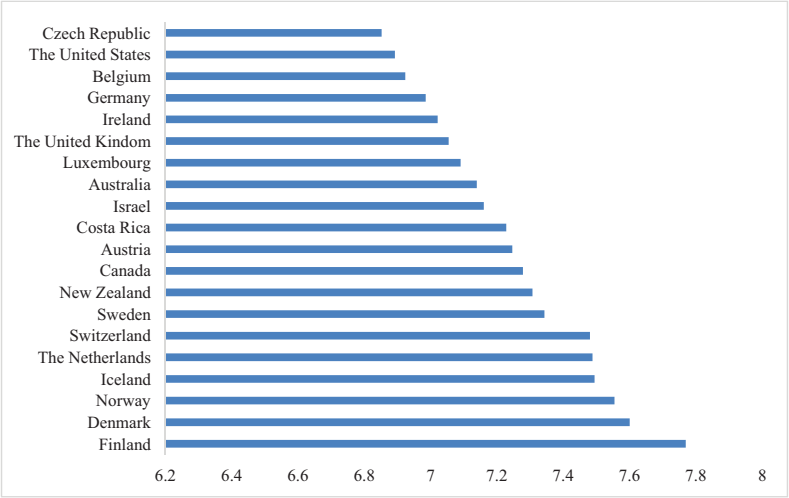
The 20 happiest countries in 2018, based on the happiness index
However, the experimental and mathematical methods used in scientific research are not always rational; and, in human cognitive activities, the scientific methodology has no priority. During the development of scientific philosophy in the 20th century, scientific philosophers sought rational scientific methodology.
Logical positivism, as represented by Moritz Schlick and Rudolf Carnap, favours the scientific methodology of positivism, which means that only results directly or indirectly proven through logical analysis and testing can be regarded as scientific and rational. It denies subjective thinking and speculation in conventional philosophy that has no experimental basis.
Starting from the critical rationalism represented by Karl Popper, scientific methodology has transformed from the conventional empirical method into one that proves falsehood, uses guesses and refutation as means of argumentation, and is more practical.
In historicist philosophy of science, Thomas Kuhn developed the concepts of the scientific methodologies of historicism and relativism. According to him, in specific historical contexts, the scientific community adopts various paradigms of research, thus resorting to various kinds of scientific method. Imre Lakatos tried to avoid Kuhn's relativism, developing historicism into the methodology of scientific research programmes. He claimed that the research methodology should be changed according to the research programme. Paul Feyerabend claimed that science is an anarchistic undertaking and has no universal methodology.
The postmodernist philosophy of science represented by Larry Laudan and Richard Rorty seeks to surpass modernity by transforming scientific methodology from monism to pluralism, from rationality to irrationality, and from linguistic analysis to contextual analysis. To the scientific philosophers, scientific methodology transcends mathematical and experimental methodologies with the possibility of adopting any rational or irrational methodology. Thus, scientific research may also draw upon imaginal and intuitive thinking from the literary culture, for science not only concerns objectivity but also needs to rely on individual subjective factors and social factors to play its role.
It is important to understand the utilitarian values of the scientific culture to avoid the misuse of utilitarianism. In today's society, the utilitarian assessment of science has become a sort of institutional requirement, and is usually found in large-scale science. During World War II, the United States Government began nuclear technology research by launching the Manhattan Project. Since then, large-scale science has gradually emerged as the major mode of science development; notable examples have been the Apollo Program, the Human Genome Project and China's Chang'e Lunar Exploration Mission.
Sponsored by a nation, large-scale science involves enormous amounts of funds, giant devices and the concerted efforts of numerous personnel to conduct scientific research in the service of national missions and interests. This stands in sharp contrast with scientific research driven by the curiosity of scientists, which is small-scale science. However, the latter is often included in the former. The concept of large-scale science was first proposed by Alvin M Weinberg (1961). He found through comparisons that modern science was different from its predecessor in that it was large in scale and involved a large amount of money, so he called it large-scale science. Through scientific computation, Derek John de Solla Price subsequently discovered that some indices had shown exponential growth in publications in modern science, science journals, scientific discoveries, research funds and scientific researchers. This means modern science has gone beyond the conventions and entered a new era:
Not only are the manifestations of modern scientific hardware so monumental that they have been usefully compared with the pyramids of Egypt and the great cathedrals of medieval Europe, but the national expenditures of manpower and money on it have suddenly made science a major segment of our national economy. (Price, 1965, pp. 2–3)
Modern scientific discoveries are being used in technical theories and products at an increasing rate. For example, optical imaging theory was proposed in 1727, but it took 112 years before the first camera was manufactured in 1839. By contrast, laser beams were discovered in 1960 and functional lasers were invented only a year later in 1961.
Today, one scientific finding is often applied in multiple areas, and each area may produce various new products and even bring about radical changes in technology or a technological revolution. In some areas, fundamental research and application development mostly go hand in hand. For example, genetic research and research on the structure of matter are application based and, when fundamental theories have been established, the development of related new technologies and new products begins immediately. Therefore, science has become a useful tool for driving national economic growth and social progress, and the utilitarian assessment has been accorded top priority as large-scale science becomes part of national programmes of scientific development.
Vannevar Bush (1945) noted in his famous report ‘Science: The endless frontier' that ‘Fundamental research is the foundation of research and development for the United States, driving economic growth and serving to improve life quality.’ In 1994, this was clearly stated in a scientific policy white paper by the Clinton administration: ‘The return from our public investments in fundamental science has been enormous … The principal sponsors and beneficiaries of our scientific enterprise are the American people’ (Clinton and Gore, 1994). Moreover, fundamental research should reflect the requirements of national goals, for science serves national interests. In America, national core interests involve public health, social prosperity, economic growth, national security, environmental responsibilities, and improvement of the quality of life (Clinton and Gore, 1994). The development goal of science is like a road map that both matches the national goals of social prosperity and people's happiness and ensures support for and investment in fundamental scientific research.
The negative impact of utilitarianism is that people are concerned more about the application of scientific research, so many other factors are ignored during its development and application, including ethical restraints and the value of people and human society itself. This upsets harmonious relationships among people and between humans and nature and is contrary to humankind's pursuit of truth, kindness and beauty.
A case in point is the controversial birth of the world's first genetically edited babies in 2018. Chinese scientist He Jiankui claimed on 26 November 2018 that the world's first genetically edited human babies—twin girls given the pseudonyms Lulu and Nana—had been born in China. One gene of the twin babies was edited so that the babies would have natural immunity to acquired immune deficiency syndrome (AIDS) after birth. Yet reproduction in humans is a natural process, and the ethics of humankind do not allow artificially designed processes of reproduction. Although He's original purpose was to prevent diseases through medical solutions, the scientific community and many circles in society currently believe that his behaviour has seriously violated human ethics and scientific integrity. To eliminate the negative impact of utilitarianism in scientific research, peer reviews of science and technology and broad ethical, legal and social assessments should be conducted.
The report of the 18th National Congress of the Communist Party of China proposed an innovation-driven development strategy. The report of the 19th National Congress further stressed that innovation is the primary driving force of development and provides strategic support for building a modernized economic system. It is the historic mission of contemporary China to further socio-economic development via scientific and technological innovation. To develop a positive culture of science, we should advocate the spirit of science, spread scientific knowledge and methodology, and promote exchange and mutual benefit between the cultures of science and the humanities. This is the duty of contemporary scholars and has a bearing on the historic mission of creating a prosperous society in all aspects, the success of developing socialism with distinctive Chinese features in the new era, and the destiny and prospects of the Chinese nation as well as the rest of humankind.
Footnotes
Author biography
Zhicong Shang, PhD, is a professor at the University of Chinese Academy of Sciences. His research interest is the philosophy of science.