




Abstract
Translation is a critical element in the innovative theory of inventive problem solving (TRIZ) methodology. It entails three levels: translating specific practical problems into general TRIZ problems, translating general problems into methodological problems using TRIZ's innovation principles, and practically applying theoretical solutions. Moreover, translations of the same technical problems and TRIZ innovation principles may differ. We applied actor–network theory to explain significant differences in TRIZ translation mechanisms that could account for differences in problem-solving results in different regions. We found that variations in innovation elements among different scientific cultures directly influence TRIZ translation mechanisms.
Keywords
The theory of inventive problem solving (TRIZ) is an innovative and well-established methodology that has been used to solve numerous technical problems. 1 Its application by technical experts generates continuous innovations, leading to technological breakthroughs and greater economic efficiency within enterprises. However, our study shows that TRIZ's innovative approach does not simply entail technical innovations; it also demonstrates social attributes of innovative networks composed of different users, processes, cultures and environments. We applied actor–network theory (ANT) in a study to examine the influence of scientific cultures on translation mechanisms entailed in TRIZ's innovative approach.
Translation in TRIZ innovation mechanisms and actor–network theory
Unlike some initiatives that come into vogue and then decline, those relating to innovation and creativity have enduring appeal. Individuals, companies and even countries have invested substantially in this area, but in most cases a lack of practical innovation tools is a critical issue. In this section, we introduce TRIZ, considered as a useful, practical and systematic innovation approach, applying an ANT framework to examine its innovation mechanism and translation system.
What is TRIZ?
TRIZ was introduced by Genrich Altshuller, a Russian scientist and engineer, and his colleagues in 1946. In the light of their summarization and examination of thousands of technology patents, they succeeded in identifying certain principles and developing models that offered systematic approaches for solving technical problems, fostering new ideas and promoting innovation. The resulting TRIZ system was originally applied primarily in the fields of technology and engineering, but its use has been extended to a number of other fields, such as the arts, advertising and management (Ilevbare et al., 2013).
The underlying premise of TRIZ is that the invention process and the evolution of technology are predictable and governed by the operation of particular laws (Eversheim, 2009). TRIZ has been described and defined in various ways. For example, Savranksy (2000) claimed that it is a systematic methodology for knowledge-based, inventive problem solving. Gadd (2011) suggested that TRIZ is a toolkit with methods covering all aspects of problem solving, while Livotov (2008) defined TRIZ as the most comprehensive and organized toolkit for promoting creativity and invention. Despite these different descriptions of TRIZ, scholars agree that an integral feature is its provision of systematic methods for fostering creativity and innovation.
TRIZ is a unique innovation tool that differs from other innovation tools, such as brainstorming and lateral thinking. Whereas most other tools entail brain-stimulating exercises that can help to clarify problems, generate new ideas and provide innovation through a combination of what is already known, they do not offer a sufficiently powerful problem-solving toolkit. By contrast, TRIZ provides some valuable concepts and tools. They include, for example, the concepts of contradiction, ideality and evolution patterns; 40 inventive principles; 76 standard solutions; a contradiction matrix; and evolution patterns of technical systems, all of which advance understanding and enable problem solving through analytical processes and selected solutions.
Moreover, individuals can apply TRIZ principles or solutions that fit their problems to create their own TRIZ toolkits (Gadd, 2011). Another unique feature of TRIZ is that it provides general problem-solving methods. By contrast, most other problem-solving methods entail trial-and-error approaches and do not include generalized problem-solving methodologies. Thus, although they can be effective for solving simple and routine problems, they do not offer effective and efficient solutions for non-routine and complex problems (Savranksy, 2000). In sum, TRIZ provides a systematic and practical problem-solving toolkit with valuable concepts and tools.
Applications of TRIZ in the West and in China
Given its unique characteristics and effectiveness, TRIZ has emerged as a very useful and powerful tool for fostering innovation and creativity in the science and engineering fields. Since the 1990s, it has gained considerable popularity in the United States, Japan and Europe. It is widely used by many Fortune 500 companies seeking creative ideas or solutions to increase their productivity or to solve difficult engineering problems.
Samsung is probably the best known example of a company that has invested substantially in TRIZ, which is applied throughout the company's operations. In 1997, Samsung adopted TRIZ and established an internal committee to learn about the methodology and how it could be applied within the company, with the aim of increasing corporate productivity. From 1998 to 2002, the company won 17 industrial design awards, and ‘in 2003, TRIZ led to 50 new patents for Samsung and in 2004 one project alone, a DVD pick-up innovation, saved Samsung over $100 million. TRIZ is now an obligatory skill set if you want to advance within Samsung’ (Shaughnessy, 2013). Besides Samsung, Rolls-Royce and GE are notable TRIZ users, and Mars has acquired a patent for its chocolate packaging developed through the application of TRIZ (Gadd, 2011).
In addition to its application within companies, TRIZ has been mainstreamed within the European TRIZ Association, headquartered in Germany, which was launched in 2000 to support research and development on TRIZ and associated innovation techniques.
The application and development of TRIZ have, however, lagged somewhat in China in comparison to its advancement in the above-mentioned countries. Nevertheless, in recent years, it has become increasingly popular and has received considerable support from the Chinese Government.
In April 2008, China's Science and Technology and Education ministries, its National Development and Reform Commission and the China Association for Science and Technology jointly issued a document titled Opinions on Strengthening the Work of Innovative Methods (hereafter referred to as the Opinions). The Opinions aimed at promoting the introduction and development of innovative methods integrating advanced international innovative methods, such as TRIZ, with domestic needs; encouraging the adoption of TRIZ within Chinese companies; and promoting TRIZ through training. Subsequently, in October 2008, the Interministerial Joint Committee on Innovative Methods was established in Beijing to promote the development of innovative methods that could serve as key resources for independent innovation (MST, 2008).
In 2016, the TRIZ Promoting Committee of the China Association for Quality was established to popularize and promote the application of TRIZ in China. In November 2018, a decade after the publication of the Opinions, the first national contest on innovative methods was held to assess the effectiveness of efforts to promote innovative methods. In the competition, TRIZ gained a lot of attention, and ‘university students working on TRIZ’ was especially set up as one of the competition topics (DRP, 2018).
In recent years, many Chinese provinces and cities, such as Heilongjiang, Beijing, Anhui, Guangdong, Hubei and Xiamen, have promoted training on the TRIZ innovation methodology and its application. The models for promoting TRIZ used in Heilongjiang and Xiamen are typical of those efforts, comprising government-organized training sessions and lectures. As a result, thousands of technicians and administrators have received training in TRIZ, and hundreds of companies have applied TRIZ in their production processes. Moreover, these provinces and cities have established connections with TRIZ professionals from Taiwan Province and other countries, such as Russia (Zhang and Yu, 2012).
Translation as the core of TRIZ's innovation mechanism
As the above discussion shows, TRIZ has attracted considerable attention from governments and companies and has been widely applied across many different fields. The question then is: why has TRIZ risen in popularity above other problem-solving methods?
As previously discussed, TRIZ has its own unique advantages over other problem-solving methods; it not only enables problem identification but it also provides general problem-solving tools and solutions for those problems. As an innovative toolkit, TRIZ has its own unique innovation mechanism. Figure 1 depicts the TRIZ problem-solving approach.
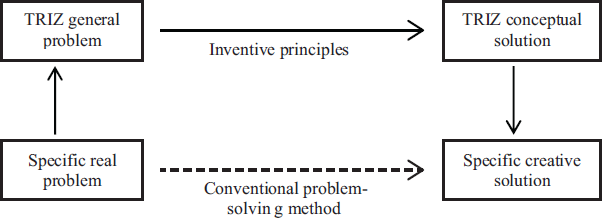
The TRIZ systematic problem-solving approach
As Figure 1 shows, the TRIZ problem-solving approach differs from conventional problem-solving methods that are exclusively focused on finding direct solutions to real-world problems. By contrast, TRIZ offers a four-stage problem-solving model. First, a real problem is analysed and translated into a TRIZ general problem. Subsequently, an appropriate conceptual solution for the given problem is found among the TRIZ tools, which include 40 inventive principles. If this solution is identified, it will be translated by the individuals concerned, applying relevant knowledge, into a targeted solution for their specific problem. When implementing this process, individuals can avail themselves of specific TRIZ tools to generate and compile their creative ideas or experiences. At first sight, the TRIZ problem-solving approach appears considerably more complicated than the conventional method. However, in reality, the translation process entailed in the TRIZ approach constitutes the key difference between these two problem-solving approaches.
TRIZ can provide specific tools for each stage of translation. For example, the contradiction matrix can facilitate the redefinition of a specific problem and its translation into an abstract general problem. A conceptual solution for a general problem can subsequently be found using TRIZ tools, such as the inventive principles. Ultimately, the ideal machine tool can be used to evaluate the conceptual solution, and the most appropriate conceptual solution can be translated into a specific solution.
Although TRIZ, along with other problem-solving methods, contributes to understanding and solving problems, TRIZ is the only methodology that includes summaries of past solutions and successful cases, thus providing a systematic approach for future problem solving and enabling the location of specific solutions to problems along with their unique translation mechanisms (Gadd, 2011).
As Figure 1 shows, unlike other problem-solving tools, TRIZ offers a unique innovation mechanism through a systematic problem-solving approach that entails a four-step translation process. However, there are still challenges relating to the application of TRIZ. For example, although TRIZ is widely considered an effective innovation toolkit, some find its methodology difficult to grasp (Ilevbare et al., 2013). Here, we describe the TRIZ mechanism using an ANT framework to develop a better understanding of the TRIZ innovation methodology.
Latour, Callon and Law developed and applied ANT to illuminate the process of scientific and technical innovation (as cited in Cressman, 2009). Actors in ANT are not limited to humans. Latour provides a semiotic definition of an ‘actor’ in ANT as an actant; that is, something that acts or is granted action by others. This definition implies that individual human actors, or human beings in general, have no special motivations. An actant can be anything provided that it is acknowledged to be the source of an action (Latour, 1996). Not only is it possible for an actor to be anything, but any entity can be both an actor and a network ‘reducible neither to an actor alone nor to a network … An actor–network is simultaneously an actor whose activity is networking heterogeneous elements and a network that is able to redefine and transform what it is made of’ (Callon, 1987).
ANT has been described as a ‘sociology of translations’ (Law, 1992). Law (1992) posited that translation is at the core of innovation within ANT, and Latour (1996) explained how ‘chains of translation’ could transform a problem (for example, from a global problem into a local problem, and vice versa). Moreover, Callon et al. (1983) noted that an actor could identify other actors and apply strategies of translation to articulate them with each other. Translation, as it is applied in ANT, describes what is happening during the process of technical innovation (Cressman, 2009). It has also featured widely in studies of successful examples of technological innovation. Latour (1991, 1996), for example, has applied ANT to examine the invention of the Kodak camera and the photography market, as well as the development of the public transportation system in Paris.
ANT shares its core principle of translation with TRIZ's innovation approach. From an ANT perspective, TRIZ tools and principles can all be considered as ‘actors’ that can identify and articulate with each other within TRIZ's innovative mechanism. The actions of each actor in the chain promote innovation, and each actor attempts to foster innovation to meet its own ends, which is conceived as an ‘ideality’ in TRIZ.
A technological innovation does not emerge by itself; nor can it exist outside of the social world, as it has many social and cultural components. Translation ‘appears as the process of making connections, of forging a passage between two domains, or simply as establishing communication’, and it is ‘an act of invention brought about through the combination and mixing of varied elements’ (Brown, 2002).
TRIZ's innovation toolkit includes numerous innovative principles, which are actors that can relate to or combine with other actors. Through processes of translation, those actors work together as a network to transform problems, find solutions and promote innovation.
Case studies of Tesla and NIO, focusing on TRIZ's innovative mechanism
As previously discussed, TRIZ's problem-solving tools have proved effective for many high-tech companies. Here, we engage in a more detailed exploration of how TRIZ's innovative principles are applied in the electric vehicle industry, specifically in Tesla and NIO in relation to their battery problems.
The application of TRIZ principles in the case of electric vehicles
With the substantial increase in vehicles using traditional fuel, exhaust-related pollution has become a global problem, and many manufacturers have begun to shift to the new energy vehicle industry. However, vehicles that are completely electric still have many shortcomings, and the associated technologies are immature. We selected two electric vehicle companies—one in the United States and one in China—evidencing strong commonalities to compare their technological innovations:
Tesla, led by an almost legendary CEO, is an American electric car and energy company that has evolved over more than a decade. The company's technology is relatively mature, and it manufactures electrical cars with a higher endurance mileage than the average.
NIO, which is considered to be China's equivalent of Tesla, was founded in 2014 by a conglomeration of several internet barons and well-known investors.
We applied the TRIZ principles to analyse technological innovations relating to electric vehicles. The TRIZ methodology, which is a systematic toolkit encompassing 40 inventive principles, was established on the basis of an evaluation of more than 2.5 million documents relating to high-standard invention patents. As shown in Table 1, almost all technological paradoxes and management conflicts can be solved using one of its principles.
The 40 TRIZ inventive principles
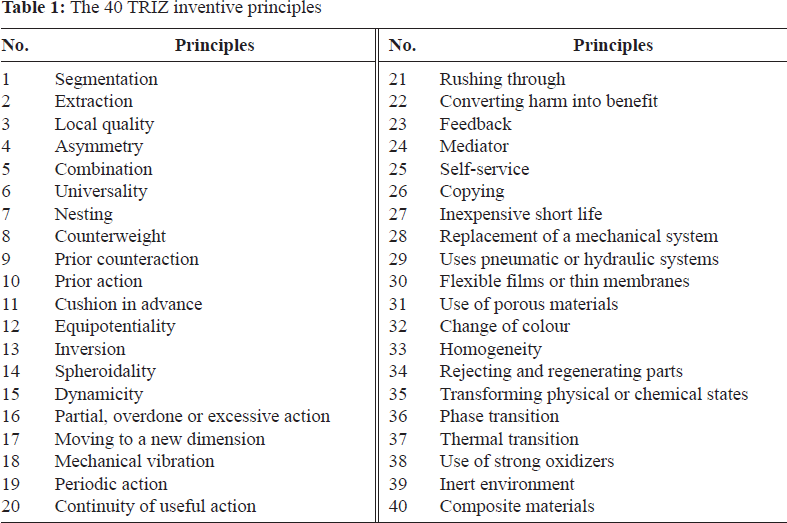
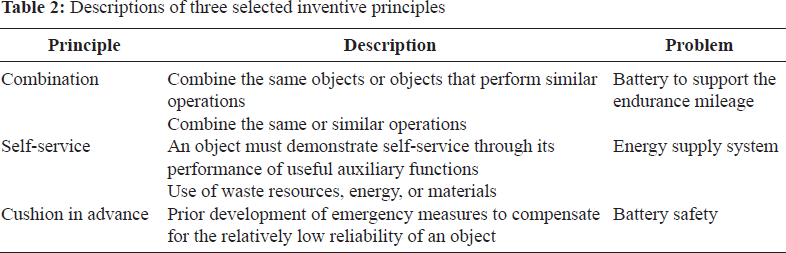
Here, we focus on three key elements of technological innovation in electric vehicles relating to the application of the TRIZ innovative method: endurance mileage, energy supply and battery safety. We compared differences in Tesla's and NIO's applications of innovative problem-solving methods, applying ANT to assess differences in their innovative solutions in the context of the different scientific cultures in China and the United States. Table 2 shows the three TRIZ principles that were applied in our case studies of problem solving.
Descriptions of three selected inventive principles
The TRIZ combination principle has been part of Tesla's and NIO's innovation systems, but the two companies have translated it in different ways, leading to different solutions to problems.
Combination principle and the problem of short endurance mileage
It is widely acknowledged that the key to the sustainable development of electric vehicles in the future lies in battery technologies and charging systems. The main factor affecting sales of electric cars is their short endurance mileage, which has deterred many consumers who fear running out of power on the road.
The battery, which is the crux of electric vehicle technology, is the first important problem encountered in electric vehicle innovation. It is common to combine individual batteries into a pack. The TRIZ combination principle has two meanings: to combine the same objects or objects that perform similar operations and to combine the same or similar operations. When applied to solve practical problems, this principle can be understood as combining separate parts to form a merged entity that constitutes an entire system and performs new functions.
Tesla's complex management of battery packs
Tesla attempted to solve these issues from the outset using a core technology of combining ordinary batteries into a powerful, stable and large-capacity battery pack. Instead of developing a dedicated large battery, Tesla used a large number of mass-produced lithium batteries developed for laptops that have a well-developed supply system, are low in price and are of consistent quality.
Tesla's battery is the Panasonic 18650 cylindrical battery produced by Panasonic Japan. The greatest advantage of this battery system is that the single battery is small in size but demonstrates a high level of controllability that can reduce the impacts of the failure of a single battery. Even if one unit of the battery pack fails, that will not affect the overall performance of the pack. Tesla has boosted the car's endurance mileage by combining a large number of small single cylindrical batteries into a battery pack. For example, the range of Tesla's Slong model is 594 kilometres, which is above that of other cars.
NIO's battery packs with a cross-frame structure
NIO uses lithium battery packs that have a patented cross-frame structure. The modular design can be applied to produce lithium battery packs of different capacities that can be adapted to different configuration models. This flexibility enhances the advantages of managing square batteries. Unlike Tesla, which applies a sophisticated management system for cylindrical battery packs to improve the battery technology, NIO's objective is to separate the car from the battery. Moreover, the power exchange design is fully incorporated into the interface between the vehicle's undercarriage and the lithium battery pack. The NIO sales model requires customers to buy the car and the battery separately. They pay a monthly battery rental of almost Ұ1,280 and acquire ownership of the battery after six and a half years.
Different translations of the combination principle
Tesla and NIO have evidently translated the combination principle in different ways in relation to the design of the battery pack. To solve the short endurance mileage problem, Tesla combined more than 7,000 ordinary cylindrical batteries to create a large-capacity pack requiring a complex battery management system. NIO applied a battery-switching model using a cross-frame structure for the battery pack and then improved the endurance mileage (Table 3). Thus the innovation processes, entailing the use of TRIZ principles, were translated differently by Tesla and NIO: whereas Tesla sought to maximize the battery pack capacity, NIO's approach was to swap batteries.
Differences in Tesla's and NIO's translations of the combination principle
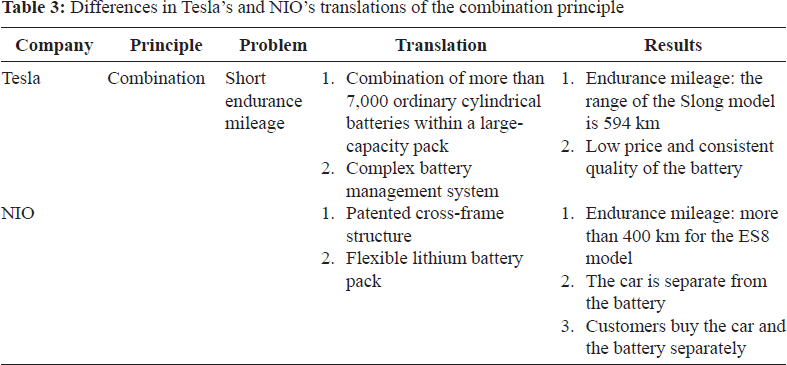
Differences in Tesla's and NIO's translations of the combination principle
Another important problem relating to electric vehicle innovation is the energy supply issue, which has impacts on the effective use of electric cars. The principle of self-service reflects the entity's capacity for self-service through the functions of self-complementarity and self-recovery. An object must be able to meet its own requirements through the performance of auxiliary functions that are of value using waste resources, energy or materials. It is important that the electric vehicle company itself is able to supply the energy system, and the principle of self-service is the key to solving the problem of charging and supplying power.
In the era of traditional fossil energy, the automobile industry has generated a vast diesel and gasoline industry as well as petrol stations distributed throughout the world. To rise to prominence within this market, electric cars would have to challenge not just the traditional automobile industry but also the entire power industry that serves the industry.
Tesla's superstations
To address the above problem, Tesla is developing a new energy supply ecosystem. Since the project's initiation, Tesla's CEO, Elon Musk, has been establishing ‘superstations’ across the United States at which cars can be charged at high speeds, enabling them to cover long distances stretching from Los Angeles on the west coast to New York on the east coast. Crucially, instead of relying on local power companies for energy supplies, Tesla has installed solar panels at charging stations across the country that generate their own electricity for charging electric cars. Musk aims to build the world's first vertically integrated energy company, in which SolarCity, which is one of his many companies, is responsible for supplying electric cars with energy.
NIO's charging stations
NIO has developed a different approach of building its own charging systems, applying a battery rental business model that bypasses national power companies. The State Grid Corporation of China is responsible for pricing and dispatching power, making it almost impossible for automobile companies to violate the rules of the power supply system. NIO's solution entails a navigation system that automatically guides a car that is low on power to an electrical charging station, where the depleted battery can be switched for a fully charged one. The company is even attempting to develop a three-minute battery charging system that is more efficient than rapid gasoline fuelling.
Different translations of the self-service principle
Tesla has solved the energy supply problem by applying the self-service principle in combination with the establishment of super-stations that produce their own energy and charging stations distributed across the country. By contrast, NIO has opted for a battery rental business model and focuses on establishing battery-switching stations (Table 4).
Differences in Tesla's and NIO's translations of the self-service principle
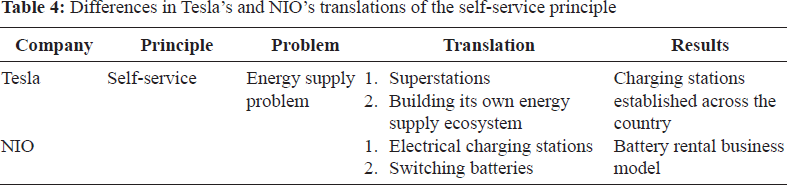
Differences in Tesla's and NIO's translations of the self-service principle
Another important issue is battery safety, which relates to the need for an automatic system for powering off an electric vehicle, especially when an accident occurs. The cushion-in-advance principle is the emergency measure that addresses this problem and requires preparation in advance for an entity that demonstrates a relatively low level of reliability. In this context, many companies are attempting to achieve a balance between battery capacity and safety.
Tesla's cut-off solution
In the event of an accident, there is a strong likelihood that Tesla's high-density battery will catch fire or explode. Tesla uses 7,000 single lithium cobalt oxide batteries to power its cars; the batteries produce twice the amount of energy compared with lithium iron phosphate batteries but are relatively unstable at high temperatures. Consequently, a high level of technical support is essential for maintaining safety.
To address the safety issue, Tesla has implemented a hierarchical battery management system in which a specially designed device monitors each battery. There are fuses at either end of the battery, which cut off a battery that overheats so that it does not affect the entire battery package. Both battery cells and battery packs have associated safety devices; if there is a problem in one unit, the safety device will cut it off from other battery units to avoid a situation in which the entire pack is affected. In addition, there is some extra space between battery pieces, and they are separated by a firewall. Consequently, even if a fire occurs within a single battery piece, it can be brought under control and will not rapidly engulf the entire battery pack. In addition, an alarm system uses various sounds and diagrams to alert the driver to leave the vehicle as soon as possible.
NIO's heat dissipation solution
NIO has independently invented the cross-frame structure to solve the battery safety problem. This solution entails developing the capacity of cells within each module of the lithium battery pack to dissipate heat effectively. Consequently, the structure's strength is increased and the battery is protected. The results of lithium battery pack tests released by NIO revealed that the entire lithium battery pack had passed the fire retardant, drop, seawater corrosion and thermal shock tests. Evidently, the patented cross-frame structure contributed significantly to these successful results.
Differences in the translation of the cushion-in-advance principle
Tesla has applied the cushion-in-advance principle to solve the battery safety problem by cutting off one unit from other battery units to avoid a situation in which the entire pack is affected. By contrast, NIO has invented a cross-frame structure that enables effective heat dissipation, improving the safety of the battery pack (Table 5).
Differences in Tesla's and NIO's translation of the cushion-in-advance principle
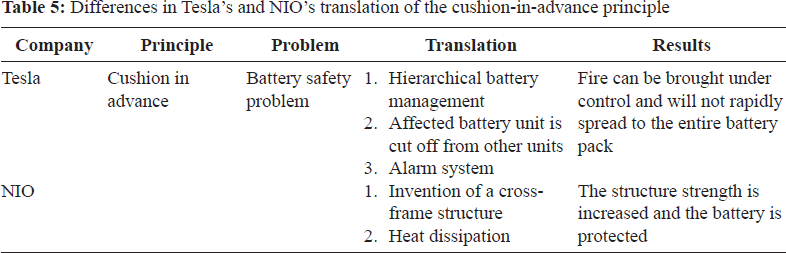
Differences in Tesla's and NIO's translation of the cushion-in-advance principle
In the light of the above exploration of the application of TRIZ principles to solve electric vehicle problems, we now apply an ANT perspective to propose a dynamic mechanism. This mechanism, which is influenced by different scientific cultures, illuminates the interactions of the innovation elements and the ‘translation’ acts in TRIZ innovation.
The innovation elements and ANT translation
Michel Callon (1986a) proposed the concept of an actor network in an article titled ‘The sociology of an actor-network: The case of the electric vehicle’. The article was based on his study of a project initiated in 1973 by two French electric companies to develop a new electric car. One company was tasked with developing battery engines and second-generation batteries, and the other company was responsible for assembling the chassis and building the body of the vehicle. The project also included a consideration of consumers, government departments, lead batteries, and other social and non-social factors. All of those factors were considered ‘actors’ that together composed an interdependent network world (Zhang and Ni, 2011). The basic premise of ANT is that the practice of science and technology entails a dynamic process in which multiple heterogeneous components are connected and co-constructed (Guo, 2008). The ‘actor’, ‘translation’ and ‘network’ concepts in ANT subvert the traditional meanings of those concepts, offering new insights. Specifically, the ‘actor’ concept in ANT brings mobility to innovation elements, while ‘translation’ denotes the dynamic innovation mechanism and ‘network’ is a metaphor for the ecosystem constituted by innovation elements (Shen and Li, 2018).
In the light of the TRIZ innovation mechanism introduced in the first part of this paper, along with case studies of the different technically innovative solutions to problems of electric vehicles, it is apparent that specific practical problems relating to electric vehicles can be transformed into general TRIZ problems relating to technological innovation. A TRIZ innovation principle can then be applied to transform the general problem into a conceptual TRIZ solution to resolve the problem theoretically. In a final step, the theoretical solutions are transformed into practical creative solutions.
Crucial differences in transforming problems and connecting various elements evidently result in different approaches to TRIZ problem-solving. From an ANT perspective, this important transformation can be termed a ‘translation’, wherein cooperation among the innovation elements is emphasized: mediators transform, translate, distort and modify the meaning of the elements they are supposed to carry. No matter how complicated an intermediary is, it may, for all practical purposes, count for just one—or even for nothing at all because it can be easily forgotten. No matter how apparently simple a mediator may look, it may become complex; it may lead in multiple directions, which will modify all the contradictory accounts attributed to its role (Latour, 2005).
Many studies suggest that the translation process is critical for linking innovation elements, which include people, finance and technology as well as elements such as thought, markets, policy, systems, culture, strategies and management. Innovation elements are incommensurable and also demonstrate initiative from an actor perspective. Thus, their performances and connections need to be translated. In the case of electric vehicles, ideas, cultures, technologies and policies all constitute innovation elements, and differences in the extent of cohesiveness of those innovation elements account for the different solutions developed by Tesla and NIO when faced with the same technical problem. Thus, variations in cohesion can be attributed to different translation processes. The question is: why do different translations occur? We argue that different scientific and cultural contexts lead to different translation behaviours and that translation reflects the adaptability of innovative activities to different contexts.
Translation in different scientific cultures
Callon (1986b) identified four steps entailed in translation processes within a network of actors: problem presentation, bestowing benefits, recruitment and mobilization. ‘Problem presentation’ is a process in which each innovation element clarifies its own problems and seeks common ground while reserving differences. ‘Benefit giving’ is the distribution of benefits among all parties constituting the innovation elements after they have reached a consensus. ‘Recruitment’ is the balance of interests among all parties involved in innovation. ‘Mobilization’ is the synergy of innovation elements and the translation of core interests.
A micro-examination of the translation process revealed that, in the practice of translation, the infiltration of a scientific culture influences the presupposition. Li Zhengfeng suggested that a ‘scientific culture’ refers to a concept of value and a behavioural mode and to its institutionalization within a scientific community and a social system occurring through the production and application of scientific knowledge. Considering a scientific culture as encompassing the concept of value, a mode of behaviour, a scientific system and local characteristics of scientific practice, we analysed the translations entailed in the TRIZ innovation process relating to electric vehicles under the influence of different scientific cultures.
Our case study of Tesla revealed the key role played by Elon Musk in the technological innovation process. He represents the scientific culture of Tesla, and of Silicon Valley, and is hailed as a genius and entrepreneurial adventurer. He built the SpaceX, Tesla and SolarCity companies, all of which demonstrate remarkable innovation. As previously discussed, Tesla uses high-density cylindrical batteries that can increase the range of electric cars by storing more power than other batteries, thus lowering the battery cost. However, it is necessary for such a battery to meet advanced technical requirements, especially those relating to electronic control technology. Attempts to connect single batteries in parallel continue to pose a challenge. To improve endurance mileage, which is one of the most important performance criteria for electric vehicles, Tesla uses more than 7,000 batteries that together constitute a battery pack and applies the combination principle. It has simultaneously developed a highly complex battery management system. Moreover, to solve the problem of securing an energy supply to support the power of the automobiles, Tesla has established its own energy supply system. Relying on SolarCity, Tesla now has 1,386 supercharging stations and 11,583 supercharging piles distributed worldwide. The advanced supercharging technology is not only ahead of the technologies applied by Tesla's competitors but it also challenges the assumed peak within traditional physics. Tesla has ensured that 99% of Americans are located within 240 kilometres of the superchargers by rolling out a network of superchargers, most of which are free.
In the case of Tesla's TRIZ problem-solving, the scientific culture in Silicon Valley influenced the translation process and resulted in a different outcome from NIO's. An innovation culture is at the core of Silicon Valley's high-tech industrial development. The Silicon Valley culture is essentially entrepreneurial and characterized by an innovative spirit, as evidenced in the openness of its production structures, the substantial inflow of talent and a high tolerance of failure. This culture can be seen to be derived from the academy, which is fully integrated within the industry, which depends on academic advances. Unrestrained academic development is the catalyst that propels the development of high-tech industries. The democratic, relaxed and free academic environment is conducive to the exchange of ideas and information and, in the process of this information exchange, the collision of ideas sparks new ideas and thoughts. Those new ideas often constitute the bud of high technology and the starting point of new industries. It can be argued that there would be no Silicon Valley in the absence of an academic culture of science. In the case of Tesla, the culture of moving fast, accomplishing the ‘impossible’ and constantly innovating has driven the company to build its complex battery management system and to develop its own energy system, enabling it to become a leader in the electric vehicle industry.
Drawing on the specific market environment and prevailing scientific culture in China, NIO has developed a unique way of translating two TRIZ principles—combination and self-service—to solve the battery and energy supply problem. NIO's battery exchange system is actually a mode of battery sharing, which is derived from the once-popular sharing economy in China. Given its relatively late start in this field, NIO prioritized an innovation-driven business model rather than an innovation-driven technology in translating TRIZ's innovation method to enable rapid progress and was also easily influenced by existing policies, such as the macro-control of electricity. Contrasting with Tesla's complex battery management system, NIO uses high-quality shell batteries and relies on its patented technology to enhance heat dissipation. Given the modular characteristics of the lithium battery pack and the application of a battery-switching system, different models can be configured with lithium batteries of different capacities. Moreover, the battery-charging design fully accounts for the interface between the car's undercarriage and the lithium battery pack. Further, NIO offers a charging plan that encompasses exclusive charging piles, fully automatic three-minute electrical changing stations, mobile charging vehicles, a supercharging network and a valet charging service.
The translation mechanism in different scientific cultures
The following insights emerge from these case studies of differences in the translation mechanisms of Tesla and NIO (Figure 2):
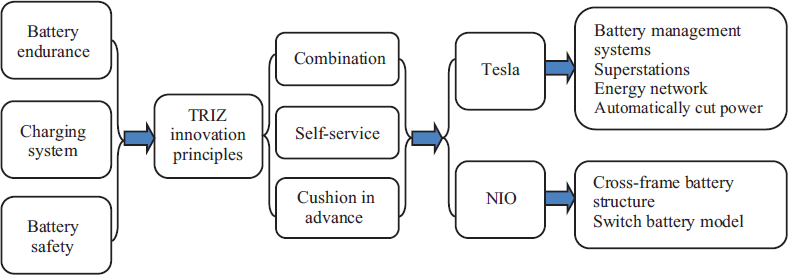
Differences in Tesla's and NIO's translations of TRIZ innovation (TRIZ translation mechanisms)
The electric vehicle companies faced the same technological problems: battery endurance, the charging system design and battery safety.
They applied the same TRIZ innovation principles: the combination, self-service and cushion-in-advance principles.
Their translations from the principles to the innovation activities differed.
Figure 3 shows the mechanism by which scientific cultures influence TRIZ translations. The principles underlying this mechanism are as follows:

The mechanism through which scientific cultures influence TRIZ translations
A scientific culture may cultivate different innovation elements, such as scientists and entrepreneurs, markets and policies.
Those different innovation elements influence the TRIZ translation mechanism.
TRIZ offers innovation tools that can help to solve problems through its problem-translation processes, which enable real problems to be translated into TRIZ general problems. Subsequently, conceptual solutions can be identified for those general problems. In our case study, both Tesla and NIO faced a battery problem in their electric vehicles and successfully applied inventive principles to develop conceptual solutions for that problem. However, the application of the same inventive principles does not necessarily result in the same specific solutions. As our case studies have shown, Tesla and NIO applied the same inventive principles to address their problems, but their specific ultimate solutions differed. The question raised is: what causes these differences? Our findings revealed that the translation processes could differ, given the participation of a multitude of different actors in those processes. Apart from the problems themselves and the inventive principles, there are also other actors, such as cultural or social elements, involved in the translation process. Our findings showed that technological innovations cannot emerge by themselves; rather, they are prompted by a combination of various actors.
ANT posits that all entities can be related and exist within networks of relationships. Accordingly, technological innovation can articulate with social and cultural elements. In our case studies, we posited that differences in scientific cultures can elucidate the causes of differences in specific solutions when the same inventive principles are applied. The two leading companies in our case studies are located in two countries—the United States and China—which to a great extent are representative of Western and Eastern cultures, respectively. The application of TRIZ tools within different scientific cultures may vary, given that individuals belonging to those cultures may adopt different innovative principles.
In the light of our findings, we suggest that a scientific culture comprises two dimensions: the social and the individual. At the social level, a scientific culture is more concerned with overall values, beliefs and practices relating to science. Those wider values and beliefs are shared and expressed by individuals within that scientific culture. At the individual level, a scientific culture is more concerned with the pursuit of science through, for example, innovative individual initiatives or creative thinking.
Each country has its own particular scientific culture, and different scientific cultures can affect innovation in different ways. Innovations in science and technology in the United States are closely aligned with individual initiatives, such as individuals' problem-solving motivation and creativity capacities, which are exemplified by Elon Musk. We would term this kind of innovation model as an individual creativity-led model. In China, the innovation model is somewhat different and more akin to a business-led model, given that capital or investments usually play a dominant role in these creative activities. According to ANT, there must be some other factors apart from individual initiatives and financial support that influence innovative activities, as all actors within the social and natural worlds are related and innovative activities cannot exist outside of the social world. However, here we have confined our attention to our case studies and have not considered other related actors, as such considerations could generate another discussion that is beyond the scope of this paper.
Funding
The study is funded by the Influence of Scientific Culture on Economic and Social Development research program of the China Association for Science and Technology (no. 2018YSXH1-4-1-2).
Footnotes
1
TRIZ = teoriya resheniya izobretatelskikh zadatch (Russian, meaning ‘theory of the resolution of invention-related tasks’).
Author biographies
Yuan Xu is a postdoctoral student at the School of Social Sciences, Tsinghua University, China. Her interests are in the philosophy of science and technology and the sociology of science.
Yuanyuan Liu is a PhD student at the School of Philosophy, Psychology and Language Sciences, University of Edinburgh, United Kingdom. Her interests are in the history of philosophy and creativity.
Zhengfeng Li is a professor at the School of Social Sciences, Tsinghua University, China. His interests are in the policy of science and technology and the sociology of science.