



Abstract
Spreading scientific temperament and communicating science to the public at large is a cultural and political undertaking. This article looks at a recent transition in Indian politics, the nexus between majoritarian religious leadership and political leadership, and its impact on science, science communication and scientific temper. 1 In the first section, the focus is on an unfolding three-pronged attack on science and scientific temper. First, those in power, including the Prime Minister of India, have publicly attacked established norms for distinguishing science from fiction. Second, the strengthening of the nexus between political leaders and ‘god-men’ has led to a blurring of the boundaries between religious and scientific discourses. Third, an effective cut to science and technology research expenditure has made the scientific community restless. The second section explores how religio-mythical culture affects scientific institutions. The third section shows how scientific output (scientific publications in reputable journals) has been affected in the recent past, when the political balance shifted in favour of blatant anti-science discourse.
Introduction
The debate on compatibility or incompatibility between science and religion is as old as science, or even older if we include the discourses that ancient materialist philosophies offer us (Hardy and Rudebusch, 2014). There is much historical evidence that organized religion has had clashes, at times violent, with scientific discoverers and inventors. Since the Copernican revolution, science and religion have for the most part followed trajectories in which scholarly clashes have been subdued and negotiable. However, recent violence perpetrated in the garb of religious acts across the globe has again caught the imagination of scholars, who are busy re-evaluating the nature of religion, its relationship with science (Coyne, 2015), its role in modern society (Turner, 2011) and its impact on international relations (Troy, 2012). Even a cursory look at the literature tells us that the camps are sharply and vertically divided into two: those who approach the problem from various angles but essentially argue that ‘religion is the opium of the masses’, as was articulated by Karl Marx, and those who think that religion still has a positive role to play and can be reconciled with science.
Many scholars have asserted that the recent resurgence of religion in various forms is rooted in the fall of Soviet Union. For example, Stephen Bevans (2010) observed that what became startlingly evident in the mid-1990s was a resurgence of religion in many parts of the world, rather than a decline. It took many forms, from a revitalization of religious practices to narrow fundamentalism. Because it coincided with a sharp rise in armed violence during the fall of the Soviet empire (1988–1991), opponents of religion asserted that religion was the major cause of the violence. Bevans conceded that ‘there were connections to be sure’, but went on to assert that ‘the connections between religion and violence are not principally causative ones; rather, religion is often enlisted to legitimize violence in order to cloak other motives, such as desire for dominance, greed for precious goods and settling old scores.’ One could add to Bevans's list, but that there is a strong correlation between politico-economic factors and religious resurgence cannot be denied in a ‘unipolar world’. 2 Although there have been incidents of religious violence in the developed world, this specific character of recent religious resurgence is far more pronounced in developing countries.
A long history of public debate on the scientific temper
India occupies a special place among the developing countries. It remains a deeply religious country, yet the public at large has debated notions of secularism, scientific rationality and modernity for more than a century. For more than 50 years, the state has supported that debate (DST, 1958, 2013). However, recent developments have shown a resurgence of religion, and that has included violence.
The debate on the scientific temper in India is rooted in the nation's struggle against the dominance of British imperialism (Raza, Singh and Kumar, 2012). Pandit Jawaharlal Nehru, the first prime minister of independent India, lauded the ‘scientific temper as the temper of a free man’ and praised a ‘scientific attitude beyond [the] four walls of [the] laboratory’ a year before India achieved independence (Mahanti, 2016). A widespread consensus was built around this notion, and, in 1976, the Indian Constitution was changed to include ‘spreading scientific temper, humanism and spirit of inquiry and reform’ as one of the fundamental duties of every citizen (Constituent Assembly, 1949). By the late 1980s, anti-science Hindu right-wing forces had enlarged their politico-religious bases and turned violent. They mobilized Hindu rightists to demolish a mosque (Noorani, 2014). Large numbers of Hindu ‘god-men’ had established ashrams (places for worship, sermons or other religious activities) and amassed enormous wealth, and their mass following had increased exponentially. By 1999, when the first Indian Government led by the right wing was formed, the nexus between the right-wing political leaders and the god-men had been cemented. In 2014, a second right-wing government came to power when Narendra Modi led the Bharatiya Janta Party (BJP) into office. Modi had served three terms as Chief Minister of Gujarat Province. From a tender age, he was trained as a worker of Rashtriya Swayamsevak Sangh (a nationalist paramilitary group) and remained one all along. In his first term as Chief Minister, he presided over a pogrom in Gujarat in 2002 (Khare, 2014).
This article looks at Indian experiences of the recent past. We attempt to probe the relationship between seemingly harmless, irrational, at times laughable statements made by the political leadership and a far more serious onslaught on scientific rationality. We show how the nexus between right-wing political forces and violent religious organizations makes science communication a life-threatening project in India. We also try to show how anti-science religious statements by political leaders translate into policies, invade scientific spaces and affect scientific output.
Glimpses of bigotry in the politico-religious arena
This section examines demonstrably false statements made by BJP ministers and assesses whether they were honest mistakes or part of a planned offensive against science and rationality.
Blurring the boundaries of science and fiction
In 2014, the Indian National Congress was defeated in general elections by the BJP, led by Narendra Modi. Soon after Modi became Prime Minister, he addressed a gathering of medical experts in Mumbai. The meeting set the government's ideological agenda, deciding how science and scientific knowledge were going to be treated in the years to come. 3 Modi said that Lord Ganesha is a proof that we had mastered plastic surgery in ancient India and that the birth of Karna (a character in the epic Mahabharata) is evidence that we practised reproductive genetics thousands of years ago (Rahman, 2014). Ganesha, with an elephant's head mounted on a human body, is one of the most popular gods in India. 4 Clearly, there were two messages in his statement. First, from now on, Hindu religion would be mixed with scientific facts; and second, the boundary lines between science and myths and superstitious beliefs would blur. The speech was a frontal attack on the scientific temper.
The reaction was equally sharp. Scientists and even common citizens, not only in India but all over the world, ridiculed the statement. Jokes making fun of the speech were circulated on social media, cartoonists worked overtime and made fun of it, and many serious articles have since referred to it. Shekhar Chandra wrote in Scientific American (2018): ‘Shortly after his landslide victory in 2014, Prime Minister Narendra Modi startled India's scientific community by mentioning the elephant-headed Hindu god Ganesha as evidence that ancient Indians had knowledge of plastic surgery.’
On the one hand, this was a loud and clear signal to the policymakers that in times to come they would have to work to change the nature of science and technology syllabuses and science communication (Vijetha, 2016), spread myths and superstitions with impunity, and withdraw from projects that aim to spread the scientific temper. The statement was also an instruction to funding agencies to support projects that ratify myths and superstitions and establish causal relationships between scientific facts and mythical stories. On the other hand, it was also a ratification, instigation, encouragement and approval of past and future outrageous anti-science statements by ministers, members of parliaments, party leaders, bureaucrats, media channels and even judges (Bedi, 2017).
When a prime minister, completely disregarding historical and scientific scholarship, precision and correctness, makes such statements repeatedly, that translates into a policy that encourages the spreading of myths and superstitions to suit the political agenda (The Times of India, 2013). The list of Modi's repeated faux pas is long. Earlier, while addressing a gathering of young school students, in response to a question posed by a student about his opinion on global warming, he explained that people grow old and cannot tolerate heat or cold, and therefore blame the seasons. He declared that there is no climate change happening. 5
Taking their cue from the Prime Minister, the ministers and chief ministers of his party have gone much further. One of the ministers issued the statement that the Vedas (ancient texts) had revealed the ‘laws of motion’ long before Newton (The Times of India, 2018). The same minister publicly denounced Darwin's theory of evolution and said that no one had ever seen a monkey transforming into a human being (Safi, 2018). Business Standard reported that ‘earlier this year, Rajasthan's education minister (no less), Vasudev Devnani had given another “scientific” theory when he claimed that the cow was the only animal that inhaled and exhaled oxygen. (They don't.) The same claims were repeated by Rajasthan HC judge as well’ (Bhardwaj, 2017).
A newly elected chief minister has proved to be more zealous than many others. He declared that in ancient India we had invented TV and the internet, thousands of years ago. Anyone can elaborate on this: if ancient India invented the internet, then, logically, India had mastered satellite technology, which also means that rocket science was also developed in ancient India (Zhao, 2018). Laughable as these statements are, it must not be forgotten that they hit at the root of rationality.
Are these statements harmless mistakes?
Such statements made in public by the political leadership are not slip-ups. Each one is well thought out and appeals to right-wing religious nationalists' anti-rationalist and anti-science consciousness. A scientist may laugh at such assertions, rejecting them as idiotic attacks on the scientific temper and rationality, but they are not naive statements made by mistake. They constitute the bedrock of religious nationalism, on which fundamentalist organizations are formed.
Encouraged by the opinions openly expressed by those in power, religious zealots took up the task of silencing science communicators, rationalists and scientists. In the recent past, four rationalists and science communicators have been murdered in India. Dr Narendra Achyut Dabholkar—a medical doctor, a rationalist, a communicator of science and a prolific writer—was killed by a Hindu terrorist organization on 20 August 2013, just before BJP came to power. Dr Dabholkar was the architect of the Anti-Superstition and Black Magic Ordinance (India Today, 2013). However, once the new government came to power, the number of rationalists who were killed for holding and voicing their views trebled.
The Prime Minister's and other ministers' statements had already created an anti-science environment. For the first time, a session on ‘Ancient science through Sanskrit’ was forced upon the Indian Science Congress, which has been an annual event for the past 106 years. In that session, all kinds of ridiculous claims were made. One paper, among six presented, claimed that during the time of the Vedas ancient Indians had invented ‘two-hundred-foot planes that could fly forwards, backwards and sideways, hover in mid-air, with up to 30 engines and 20 systems for wartime purposes’ (Chari, 2015). The incumbent Health Minister, Dr Harshvardhan, claimed in his inaugural session that ‘Pythagoras’ theorem was invented in India' (India Today, 2015).
Within a month after the conference, gun-wielding terrorists attacked Govind Pansare and his wife. Pansare was an anti-superstition activist. He died on 20 February 2015. The outrage expressed throughout the country was intense, yet it did not deter the anti-science zeal of either those who were in power or those who operated through underground terrorist outfits.
MM Kalburgi was the next victim of the anti-rationality terror network. The former vice-chancellor of Kannada University, a rationalist and anti-superstition voice, had to be silenced. Kalburgi was attacked inside his house on 30 August 2015, allegedly by the same Hindu extremist group that had killed Narendra Dabholkar. Among others, three organizations closely associated with the BJP (Vishva Hindu Parishad, Bajrang Dal and Sri Ram Sena) had earlier threatened to kill him for his lectures and books.
More recently, Gauri Lankesh—a female journalist, an editor of a weekly magazine, a rationalist and a loud voice against fundamentalists—was killed on 5 September 2017 as she was about to enter her house. The same Hindu fundamentalist organization had threatened her repeatedly. In fact, they celebrated her brutal murder on social media. Reportedly, the investigation showed that there were at least 36 other rationalists and science communicators on the hit-list of the Hindu terrorist organization that killed Gauri Lankesh (Sharma, 2018).
While reporting these attacks, Asia Times noted, as early as in October 2015, that attacks on rationalists and progressive writers and artists reflect the expanding influence of Hindutva (Hindu nationalism) and also undermine India's democracy. Freedom of expression, which is central to the health of a democracy, is under severe threat in India today. Drawing a parallel between attacks in Bangladesh and India, the report noted: ‘However, unlike in Bangladesh, where the Ansarullah Bangla Team, which masterminded the killing of several secular bloggers, was banned under the country's anti-terrorism laws, in India, organizations that are behind the killing of rationalists run free’ (Asia Times, 2015).
The killings in India are not isolated incidents. They are strategically planned attacks executed with precision, and every rationalist and science communicator in the country is on the radar. A rationalist, KS Bhagwan, received a letter threatening him with death for his remarks on the Bhagavadgita. Narendra Nayak, who for decades campaigned against superstitions, exposed god-men as fraudsters and campaigned for the separation of state and religion, was also targeted, but escaped an attempt on his life. He later wrote: ‘It is not that the atmosphere of India has become intolerant, but those intolerant people have got ways of eliminating us, probably with tacit support from people above’ (IHEU, 2017). H Farook, a young boy, was also killed for writing rationalist messages critical of religion. Indian Cultural Forum reported: ‘Chetana Thirthahalli received threats to her life, and of rape and murder for supporting the right to eat beef or any food of choice by the people of our country’ (Vidhya, 2017).
Pseudoscientific attacks on institutions
In this section, we look at the religio-political assault unleashed to change the nature of scientific institutions. A cursory look at a few projects that have been initiated during the past four years gives an indication of the anti-science objectives pursued by the government.
The Holy Cow
In the Hindu religion, the cow is considered to be a sacred animal. Slaughtering a cow or even possessing beef is a punishable crime in most parts of India. In the recent past, lynch mobs have accused individuals of slaughtering cows and have killed them in public view (Reuters, 2017). While this was happening in social spaces, without any explanation, apology or expression of remorse, the Indian Government set up a 19-member national steering committee for the scientific validation of research on five bovine derivatives (cow urine, cow dung, cow milk, curd and ghee made of cow milk), which together are known as panchgavya (The Indian Express, 2017). The Science and Technology Minister, Dr Harshvardhan, heads the panel. The purpose of the committee is to select projects that can help scientifically validate the benefits of these derivatives (The Hindu, 2017). Subsequently, in order to carry out the research, the Indian Institute of Technology (IIT) Delhi was asked to seek projects from various organizations.
In response to the call, IIT Delhi received 50 proposals from institutions to study the benefits of cow urine and milk. The programme presumes that the scientific community does not know enough about the properties of these products, and the political leadership forces scientists to validate an already drawn conclusion that ‘You don't know something that our ancestors knew.’
Ram Setu
The underwater ridge between the coasts of Tamil Nadu (India) and Sri Lanka has been at the centre of controversy since planning for the Sethusamudram Shipping Canal Project began. The project required dredging in the area (Pandy, 2017). Although there are geological theories on the natural formation of the ridge, many devout Hindus believe that it was built by an army of monkeys led by Lord Rama to go to Sri Lanka to wage war with its king, Ravana.
In July 2014, the Indian Government began a project to undertake an archaeological exploration to determine whether the Ram Setu is a natural formation or a man-made— or perhaps monkey-made—bridge (Pathak, 2017). The utterly unscientific project was worked out to the last detail. The scientific community, historians, archaeologists and palaeontologists reacted sharply, but the project was kept alive. In March 2017, it was announced that the Indian Council of Historical Research ‘will undertake this exploration in the months of October and November’ (Pathak, 2017). The project was finally withdrawn due to pressure from experts. It should be noted that the project was not discontinued due to its unscientific nature, but because it had embarrassed India among the international community.
The mythical Saraswati River
In 2014, newspapers reported that Indian water resources minister Uma Bharti, a Hindu fundamentalist, said that finding a missing mythological river was one of the priorities of the Modi government. She had previously said that ‘There is enough scientific evidence on the presence of the river Saraswati in some parts of the country through which it flowed about five to six thousand years ago, and so Saraswati is not a myth’ (Moudgil and Mohan, 2018).
The project's website declares:
The acronym Saraswati is based on the Hindu goddess of knowledge, music, arts and science. In Hinduism, Saraswati is also the name of the lost holy river in India. Thereby, the acronym draws attention to the importance of rivers and at the same time of knowledge and science to protect and recover rivers. 6
In our opinion, the project is not based on any scientific understanding and can be categorized only as a politico-religious undertaking based on a mythical story.
Sanjeevani Booti
The Department of Ayurveda, Yoga, Naturopathy, Unani, Siddha and Homoeopathy in Uttarakhand formed a committee for the purpose of finding why the Hindu god Hanuman moved a mountain. The alleged reason was to acquire the mythical, all-curing Sanjeevani Booti—a herb referred to in the epic Ramayana (Abraham, 2016). As the story in Valmiki Ramayana narrates, the herb is believed to have cured Rama's younger brother, Laxmana, and was brought by Hanuman from the Himalayas.
The panel, comprising four Ayurveda (Indian traditional medicine) experts, began work in August 2016. Uttarakhand's BJP government granted an initial budget of Rs 25 crore (250 million rupees) for the project.
IIT Kharagpur introduces course on Vastu Shastra
The country's oldest and largest IIT, at Kharagpur, was forced to introduce a course on Vastu Shastra (traditional Hindu architecture) for first- and second-year undergraduate architecture students (Pandey, 2017). The course was introduced in graded modules to the students, who are taught basic design and the history of architecture.
At the postgraduate level, students are taught solar principles, sacred diagrams, nine circuit placements (the Navagraha Mandal), sacred altars, and design semiotics and semantics. However, it was claimed that the rationale for introducing Vastu Shastra rests on the feeling that since students are being taught concepts prevalent in the West, there is no reason why they should not be conversant with ancient Indian architectural traditions. It was argued that Vastu Shastra has its beginnings in the Rig Veda (one out of four of the Vedas) and is scientific in its tenor.
Convoluted pseudoscientific arguments are being used to justify unscientific projects. This is how religio-mythical culture is being introduced in scientific institutions all over the country. In the long run, such projects will weaken the scientific and technological foundation of the country.
India's performance in science from 1990 to 2017
The important question is whether the assertions made above hold water or are just unsubstantiated, unmeasurable claims to malign four years of ‘good governance’. Do the BJP's policies and rhetoric have any impact on science and technology? More often than not, policy shifts do not have an instantaneous and measurable impact on science. However, to our surprise, we found that the discontinuities introduced in the past four years have affected India's national scientific output.
In this section, we scrutinize data related to scientific publications, which is the strongest indicator of the health of a country's science and technology. As far as possible, we make suitable comparisons with selected other countries (only countries that had comparable outputs were chosen for data analysis).
Publications
After a period of stagnation during the period from 1989 to 2002, when fewer than 20,000 scientific papers were published per year, India tripled its science publications to more than 60,000 per year by 2013, as measured using the Science Citation Index, which is currently a part of the Web of Science. The Web of Science is a database of scientific publications in more than 12,000 journals. The journals are all peer reviewed and are largely in English (more than 5,000 of the journals are published in the United States).
In the number of publications, India, which was close to South Korea for more than a decade, showed a sharp rise around 2014 to pass Spain and became equivalent to Italy by 2017. While almost all the countries surveyed showed a jump in publications around this time, that was most likely due to the growth of the database to include many new journals, rather than a real increase in productivity. China, which started out in the same way as the selected countries, started to rapidly publish more around 1995 and had more than 140,000 publications annually by 2010 (see Table 1 and Figure 1).
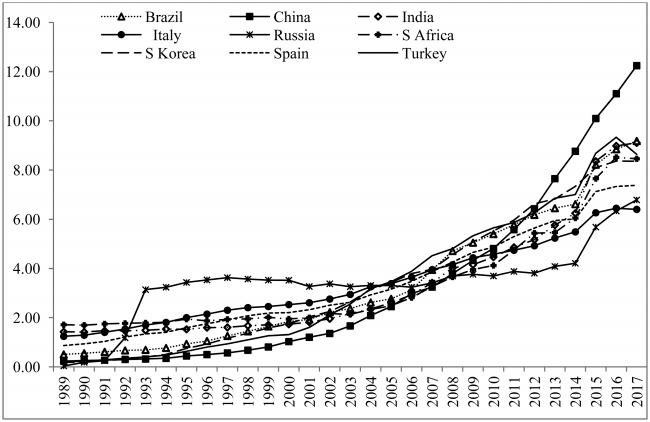
The percentage of occurrence per year of all scientific papers published by selected countries in Web of Science, 1989 to 2017. Only countries with comparable output were chosen for the analysis. X-axis shows year of publication; Y-axis shows percentage of occurrence of publications.
Scientific papers from selected countries in Web of Science, 1989 to 2017
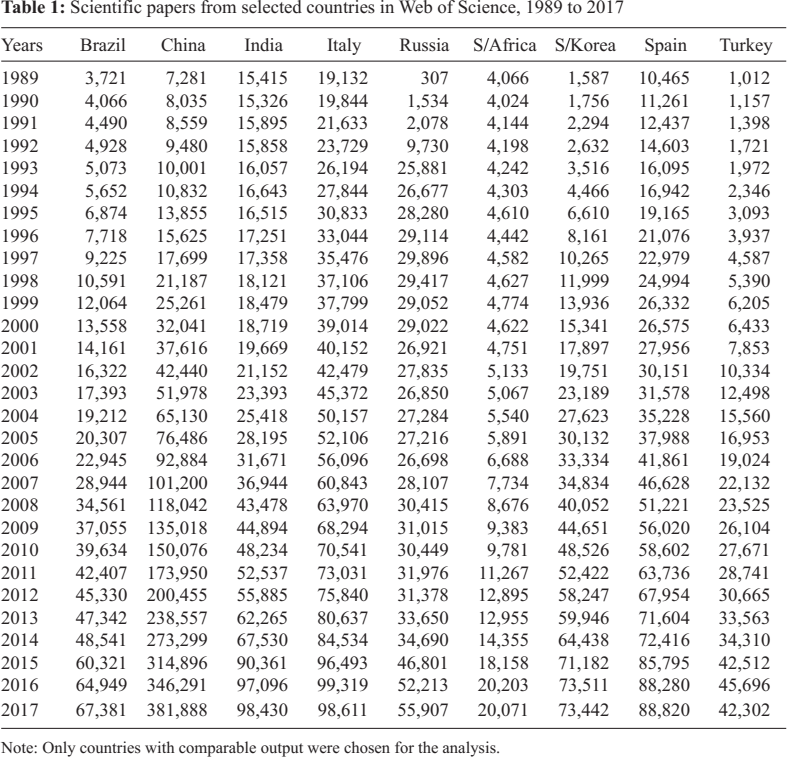
Note: Only countries with comparable output were chosen for the analysis.
We examined the year-on-year growth of scientific publications from India and other countries reported by the Web of Science.
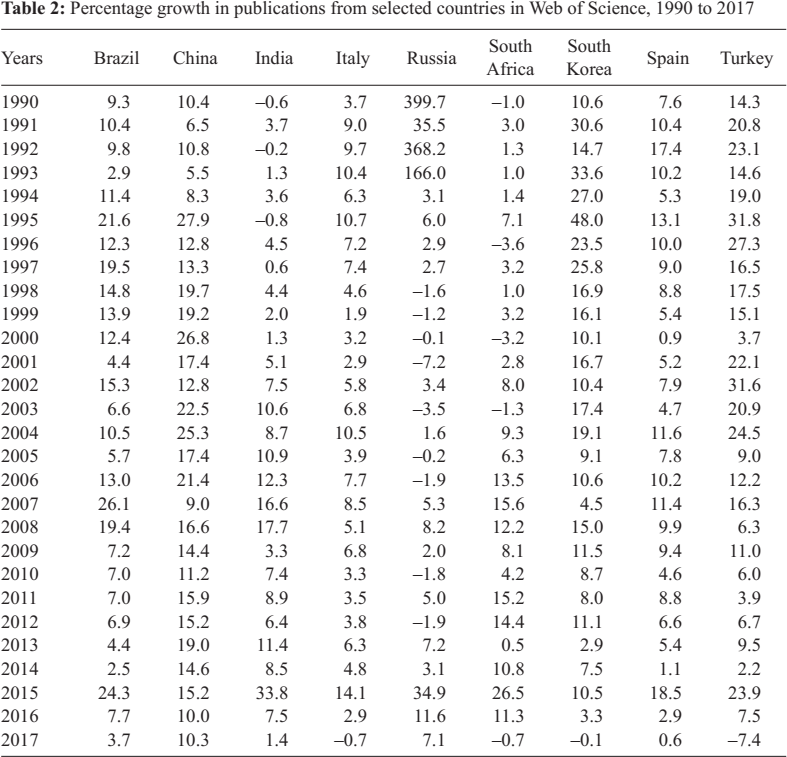
The yearly growth rates for selected countries are shown in Table 2 and Figure 2. Most have shown positive, if fluctuating, growth. Russia's growth was very high (around 400%) in 1990 and 1992, plummeted to zero, and then fluctuated around zero for the entire period between 1995 and 2015. At that point, all countries had a synchronous one-time rise in growth. This can be marked as a database effect; that is, the database increased the total number of journals covered, which shows as a sudden increase in growth for all countries simultaneously.
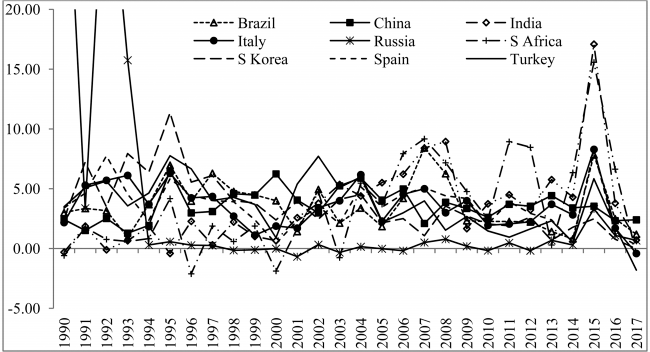
Percentage growth per year in total publications from selected countries in Web of Science, 1990 to 2017. X-axis shows year of publication; Y-axis shows % growth in publications.
Percentage growth in publications from selected countries in Web of Science, 1990 to 2017
South Africa also had low growth until 2000 but fluctuating growth thereafter, the trend rising and remaining positive till 2014. In 2011 and 2012, its growth was higher than India's.
Countries that had higher growth were South Korea, Turkey, Brazil and China. China produces the second largest number of publications, and its overall publications are also the highest in this group.
India (data points indicated in Table 2) started out with very low growth (close to zero) around 1990, and low growth continued for a decade from 1990 to 2000. From 2000 to 2009, growth showed an increasing trend. Afterwards, there was a sudden drop in growth, but there followed another spell of steady growth from 2010 to 2013, although the rate was less than that in the period before 2013. In 2014, there was again a sudden spurt in growth, which we have already identified as a database effect. This was followed by a sharp fall; by 2017, growth had slowed to pre-2000 rates.
In summary, the record of scientific publications, which is an indicator of the health of mainstream scientific activities, shows that India's publications grew slowly up to 2000, rose steadily to 17.7% in 2008, fell suddenly to 3.3% in 2009, recovered to 11.4% in 2013, were masked by a change in database coverage in 2015, and then fell to 1.4% in 2017.
This is a matter of concern, as such small growth in Indian science publications (which is now roughly equivalent to growth 20 years ago) does not bode well for science in India.
Physical attacks on rationalists and science communicators, as ghastly and condemnable as they are, are only a symptom of a much deeper social and structural disease that spreads like a plague when favourable breeding grounds are provided by the state. In the past four years, attacks on rationality, scientific vision, the scientific temper and those who are trying to fulfil their constitutional obligation to spread the scientific temper and spirit of inquiry have increased exponentially. The alarming rise in attacks on the scientific temper forced the Inter Academy Panel on Ethics in Science, constituted by the three Indian academies of science, to issue a strong statement (IASc, INSA and NASI, 2017):
We note with sadness and growing anxiety several of the statements and actions which run counter to this constitutional requirement of every citizen of India. It is important that exemplary punishment be given to such trespassers of reason and rights. We also appeal to all sections of Indian society to raise their voices against such violent acts, so that they are nipped in the bud. 7
The statement was issued in October 2015. It did not deter the right-wing ministers from issuing outlandish statements. Minister of State for Human Resource Development, Satyapal Singh, delivered a statement:
Nobody, including our ancestors, in writing or orally, have said they saw an ape turning into a man. Darwin's theory (of evolution of humans) is scientifically wrong. It needs to be changed in school and college curricula.
Quoting the minister's statement, once again the three science academies reacted sharply. In unequivocal terms, they asserted:
The three science academies of India wish to state that there is no scientific basis for the Minister's statements. Evolutionary theory, to which Darwin made seminal contributions, is well established. There is no scientific dispute about the basic facts of evolution. This is a scientific theory, and one that has made many predictions that have been repeatedly confirmed by experiments and observation … It would be a retrograde step to remove the teaching of the theory of evolution from school and college curricula or to dilute this by offering non-scientific explanations or myths.
Conclusion
During the past four years, there has been a systematic, well thought-out and meticulously orchestrated attack on the scientific temper in India. None other than the Prime Minister, Narendra Modi, has led this attack. Just after he took his oath of office, he initiated what can be called ‘Project Assault on Scientific Rationality’. Soon the entire team of ministers, chief ministers, members of parliament and party leaders joined him in trying to erase the boundaries of scientific rationality.
This attack was multipronged, revealing itself in reductions of expenditure on science and technology research and the diversion of funds to pseudoscientific ideas and projects. The rhetorical attack translated itself into physical assaults on science communicators and rationalists and a strengthening of Hindu terrorist and fundamentalist organizations. The assault forces scientific institutions to take up projects of a religious, superstitious or quasi-religious nature.
In our opinion, the anti-science environment created in the country, the forcing the institutions to give up genuine scientific projects in favour of quasi-religious or pseudoscientific projects, and the reduction in funds for science have resulted in a steep fall in Indian scientific output during the tenure of the Modi government.
Footnotes
Acknowledgements
We are thankful to Dr Aparna Basu and Sumit Banshal for analysing the data and substantially contributing to the fifth section of this article.
1
This article is a revised version of Raza G and Singh S (2018) Attack on scientific temper and rationality. In: Dayal J, Dabiru L and Hashmi S (eds) Dismantling India: A 4-Year Report. Delhi: Media House, pp. 52–59.
2
The phrase ‘unipolar world’, which depicted victory of capitalism over socialism, has gone out of currency in public as well as scholarly debates.

4
As the legend goes, Ganesha is the son of the god Shiva and the goddess Parvati. His father chopped off his head by mistake. Realising the blunder, he slaughtered an elephant and placed its head on Ganesha's body. Ganesha is supposed to have written the epic Mahabharata, dictated by Rishi Ved Vias, with one of his teeth that he broke specifically in order to write the text. Ganesha is the god invariably invoked by Hindus at initiations and inaugurations. Karna is a character in Mahabharata who was born to an unwed mother, Kunti.
5
Author biographies
Gauhar Raza is a former Chief Scientist of CSIR, India, and is presently an Honorary Fellow of HSRC, South Africa.
Surjit Singh has worked with CSIR, India, in the area of public understanding of science for more than 25 years. He is also involved in science communication among schoolchildren and public understanding of HIV/AIDS.