




Abstract
Purpose
This study aims to analyze the blueprint for China's future education development outlined in China's National Education Conference of September 2024 and to examine the role of conference speeches in shaping China's education policymaking.
Design/Approach/Methods
This study thematically analyzed both the conference speech and the related press releases.
Findings
Regarding the speech content, five key tasks outlined in the conference speeches for building a strong education system by 2035 were identified. These tasks address the public's demand for high-quality education and the needs of national development. Regarding the speech structure, the conference speeches were structured into four main parts, each serving a distinct function in shaping education policy.
Originality/Value
This study contributes to a deeper understanding of China's recent policy directions for education development. It also sheds light on the discursive blueprinting function of conference speeches in China's education policymaking process.
In established research focusing on Chinese education policy, most studies have focused on formal policy papers (e.g., Dello-Iacovo, 2009; Li et al., 2016; Li & Zhang, 2024; Zhu, 2019). Such formal, textual policy papers often articulate specific political decisions. In contrast, there is a less-explored aspect of China's political landscape, namely the speeches delivered by state leaders at important junctures. The analysis of these speeches can offer valuable insights into the trajectory and evolution of education in China (Fang & Guo, 2018).
China's national conferences can be broadly categorized into two types: regular and irregular. The former include the People's Political Consultative Conference, the National People's Congress, the annual Central Economic Work Conference, and others. The latter are primarily national conferences convened at significant junctures, such as the National Health and Wellness Conference held in 2016, which underscored the strategic importance of prioritizing people's health in development. Participants in these conferences included key members of the Communist Party of China and provincial leaders responsible for relevant sectors. Within the realm of education, there have been only six such large-scale national education conferences in the 75 years since the establishment of the People's Republic of China (see Table 1). The six national education conferences can be summarized, respectively, by the keywords “system,” “investment,” “concept,” “goals,” “essence,” and “leading country,” revealing the fundamental direction of China's education reform: a shift from focusing on external systems to the core functions of education and from the basic goal of “education for all” to the advanced goal of “quality education for all.”
List of national education conferences since the founding of the People's Republic of China.
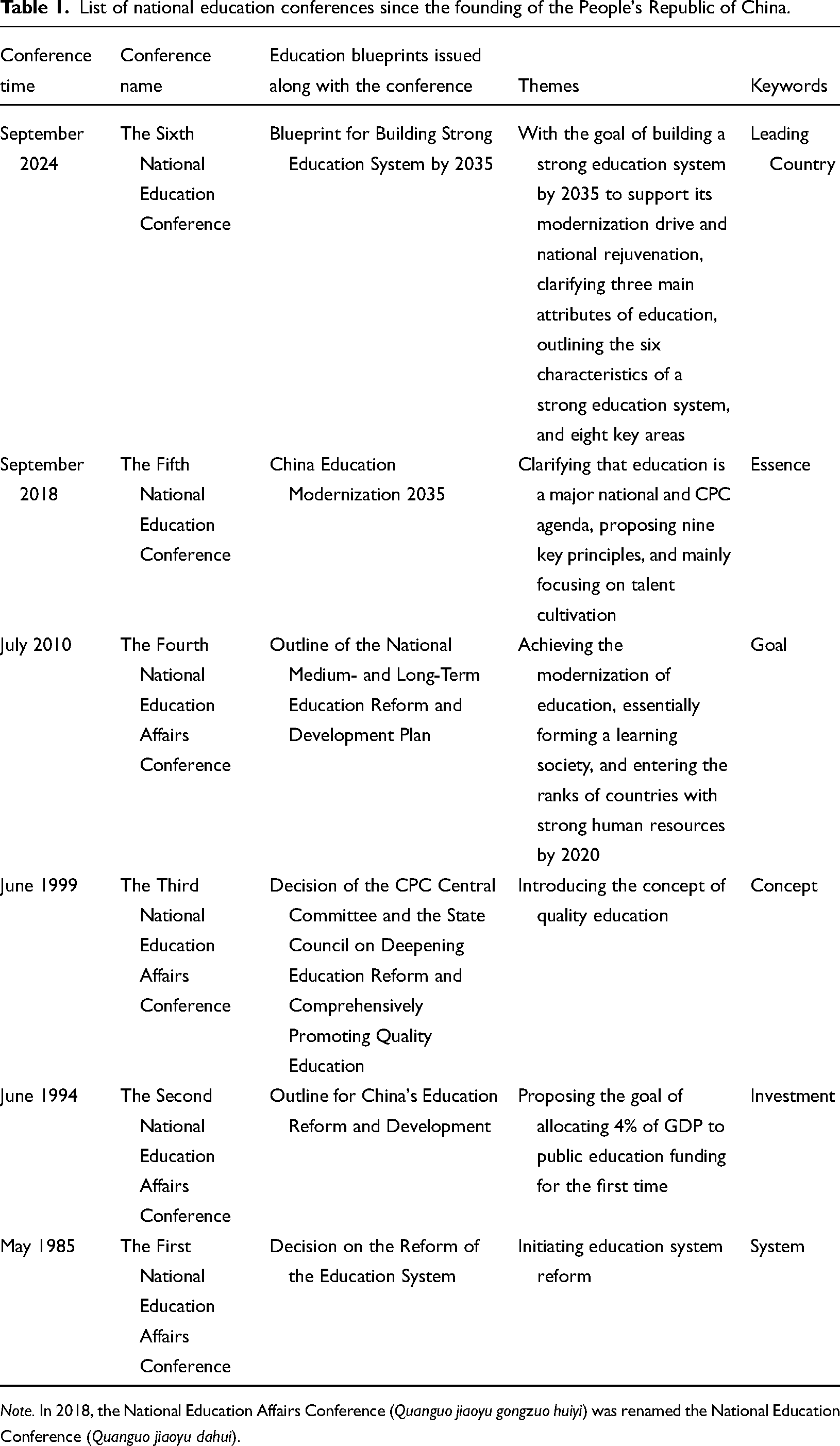
Note. In 2018, the National Education Affairs Conference (Quanguo jiaoyu gongzuo huiyi) was renamed the National Education Conference (Quanguo jiaoyu dahui).
Whereas the first four conferences addressed relatively discrete topics, the fifth and the latest conferences have exhibited a more focused and strategic approach. Both conferences have set the ambitious goal of building a strong education system, but the latest conference has refined and expanded upon the policies outlined in 2018, with a particular emphasis on achieving this goal by 2035.
In this context, this paper focuses on the recently convened China's National Education Conference in September 2024, summarizing its background and main content to clarify the core direction and focal points of China's future education development. At the same time, it analyzes the function of speeches as expressions of political discourse with Chinese characteristics, further revealing the distinctive features of China's education policymaking.
Conference background: Vision for China's education in 2035
On September 10, 2024, the central government of China convened a National Education Conference, outlining a new blueprint for the future development of China's education. This blueprint aligns with the nation's goal of becoming a leading country in education by 2035 and serves as the foundation for the subsequent issuance of the Blueprint for Building Strong Education System by 2035.
Notably, shortly after the preceding National Education Conference, China issued the China's Education Modernization 2035, a comprehensive plan outlining the strategic objectives, tasks, and pathways for China's education development up to 2035. Over the past 6 years, a series of advancements have been made. For example, with the goal of expanding access to quality preschool education, China's gross enrollment rate for preschool education reached 91.1% by the end of 2023, compared to 64.5% in 2012.
However, by 2024, China's education sector faces new challenges, including intensified international competition, updated national strategic goals, changing population trends, and new expectations from the public. This calls for a reorientation of education development toward 2035. In response, China reconvened the National Education Conference, emphasizing even more the pivotal role of education in promoting the well-being of the people and the development of the nation (Ke, 2024).
Rationale for the new blueprint
From an educational development perspective, the Communist Party of China has consistently prioritized education, which is evident in its development planning, financial investment, and public resource allocation (Yuan, 2018). Based on that, the public expectations for education have always been central to China's education policy. Moreover, China boasts the world's largest education system. According to statistics from the Ministry of Education of the People's Republic of China (MOE), there are currently 518,500 schools of various types and levels in China, with 293 million students enrolled in formal education, 18.8 million full-time teachers, and a total enrollment of 46.55 million in higher education (MOE, 2023a). The coverage of preschool and compulsory education has reached the average level of high-income countries, and higher education has entered a globally recognized stage of popularization. At present, the biggest challenge facing the development of education in China is how to transition from “ensuring quantity” to “improving quality,” shifting from scale expansion to high-quality development.
From the perspective of national development, education has always been a key factor in the modernization and competitiveness of a country. Particularly, by analyzing the historical patterns of the transfer of five global scientific centers since the 16th century and the evolutionary processes of three industrial revolutions, it can be found that the prioritization of education is closely related to national competitiveness (MOE, 2023b). Talent has increasingly become a strategic resource driving economic and social development, effectively promoting social productivity and national development. In other words, by enhancing and accumulating human capital, education can effectively serve economic and social development.
Goal of the new blueprint
Transforming from a major education nation to a leading country in education requires systematic planning and innovation. Ultimately, there are two core goals to achieve.
First, it is to provide education that meets the needs of the general public. In discussions about building strong education system, General Secretary Xi emphasized a people-centered approach to education development, advocating for lifelong learning, a learning society, and equitable access to quality education for all children. There are several core dimensions in this regard, such as promoting well-rounded education, making educational equity a fundamental policy of national education, and increasing support for vocational education in rural, ethnic, and impoverished areas.
Second, it is to foster comprehensive national development and enhance international competitiveness. Currently, with the deepening of a new round of technological revolution and industrial transformation, international competition surrounding high-quality talent and technological supremacy is unprecedentedly fierce. Countries have proposed a series of policies for cultivating innovative talents, such as Germany's “Strategy for Future Research and Innovation” and the “Skilled Labor Strategy,” which emphasizes actively cultivating high-skilled talent and broadly selecting and attracting international talent. To foster scientific and engineering talent, Australia launched the “National Innovation and Science Agenda” in 2015, allocating 112 million Australian dollars to increase public participation in these fields. In 2019, the government further outlined its talent development goals for the next decade in the “STEM Workforce Strategic Vision 2019–2030” plan. This vision included shaping national science and engineering policies and promoting student engagement in related careers. Against this backdrop, the Chinese government also hopes to cultivate talents that can support the country's future development through the construction of a leading country in education, thereby gaining an advantage in the current technological competition.
To effectively achieve these goals, the 2024 National Education Conference comprehensively reviewed the experiences, accomplishments, and shortcomings of the past 6 years, while also providing timely guidance and ensuring the successful implementation of key tasks.
Main content of the conference: Core tasks in the new blueprint
At the National Education Conference, General Secretary Xi proposed five core tasks for the future development of China's education, that is, fostering virtue through education (立德树人, lide shuren), ensuring educational equity, integrating education with technology and talent, building a strong teaching workforce, and promoting educational opening-up.
The first is to foster virtue through education. The fundamental principle of nurturing talent lies in fostering virtue. Accordingly, the primary task is to enhance ideological, political, and moral education in schools, nurturing socialist builders and successors with strong moral character who are committed to serving the country. In fact, since 2012, lide shuren has been listed as the fundamental goal of educational development in China (Deng & Peng, 2023).
The second is to ensure educational equity. Ensuring that every Chinese child has access to a fair and quality education is essential for a populous country like China, serving as a cornerstone for social equity and a prerequisite for building strong education system. To ensure educational equity, it is crucial to uphold the public nature of education, address pressing educational challenges, accelerate the development of a high-quality education system, and promote balanced compulsory education to foster a lifelong learning society. Additionally, it is essential to prioritize rural education, reduce dropout rates in rural areas, particularly in impoverished regions, improve the quality of rural schools and teaching, leverage digital technology to provide rural areas with better educational resources, and invest in strengthening the rural teaching workforce. In fact, education has always been an important means for China to eliminate poverty. For this reason, China has eliminated absolute poverty in 2020, achieving the goal set in the United Nations 2030 Agenda for Sustainable Development ahead of schedule.
The third is to foster the integration of education, technology, and talent to enhance China's competitiveness in both talent and science and technology. In global competition, there are typically two key indicators to assess a country's competitiveness: the extent to which it can cultivate the majority of the talent needed to lead and support its participation in global competition, and its ability to produce significant ideas and technological achievements that drive human civilization (National Institute of Educational Policy Research, 2023). Achieving these two goals is indicative of a leading country in education. In this regard, several main pathways have been further clarified for the coordinated planning and integrated promotion of educational development, technological innovation, and talent cultivation, including highlighting the important role of higher education as a driving force for technological innovation and a source of major technological breakthroughs, establishing mechanisms for technological innovation in higher education, and comprehensively improving the quality of talent cultivation to foster top-notch innovators; strengthening university–enterprise cooperation, deepening the mechanism for scientific and research findings commercialization, and promoting vocational education reform to enhance its adaptability and attractiveness.
The fourth is to strengthen the construction of the teaching workforce. The National Education Conferences held on Teachers’ Day underscore General Secretary Xi's emphasis on teachers. At this conference, he emphasized cultivating the educational spirit of teachers—teachers should have a passion for education, along with a high moral standard, educational wisdom, and a spirit of dedication. To foster a high-quality teaching workforce, it is essential to elevate the political, social, and professional status of teachers, enhance their remuneration, safeguard their professional dignity and legal rights, reduce their non-teaching workload, and recognize and publicize outstanding teachers.
The fifth is to enhance China's international influence in education based on opening-up. In recent years, countries including the United States, the United Kingdom, and Singapore have prioritized the opening-up and internationalization of education as key reform directions, actively promoting their educational philosophies and products globally to gain recognition and imitation from other countries and attract more international students. As an active participant in the United Nations 2030 Agenda for Sustainable Development, China's educational opening-up not only aims to enhance its international influence, but also contributes to building a global community with a shared future. To this end, China has also actively participated in various educational aid initiatives, adhering to the principles of win–win, friendship, and non-interference (Dreher et al., 2021; Nordtveit, 2011).
The discursive blueprinting function of conference speeches in China's education policymaking
Conference speeches serve as a pivotal discursive blueprint, laying the groundwork for subsequent policy documents. In this context, conference speeches typically follow a structured format, which can be broadly divided into four main sections: historical context, theoretical perspectives, current realities, and future tasks. These sections serve distinct functions.
First, at the beginning of the speech, the General Secretary usually adopts a macro perspective from the national level, comprehensively reviewing and summarizing the measures, progress, and historic achievements of China's education sector over a certain period. This review serves to construct collective historical memory (Jo, 2022), comprising three key elements: (1) the narrative and characterization of the historical development, providing a comprehensive overview of past developments, (2) a summary of historical achievements, highlighting the effectiveness of existing policies, and (3) the extraction of historical lessons, informing future educational development and policy formulation (Fang & Guo, 2018).
Second, new perspectives and propositions are advanced to drive theoretical innovation. The Communist Party of China has always placed great emphasis on the development of ideological theory, stressing the importance of building consensus, pooling wisdom, and achieving theoretical innovation (Shi, 2021). Therefore, the General Secretary typically presents new theoretical summaries on important issues during the conference. For example, at this National Education Conference, General Secretary Xi systematically elaborated on the scientific definition and fundamental approaches to building strong education system, addressing the characteristics of a leading country in education and the necessary steps for its realization:
The strong education system we aim to build is one with Chinese socialist characteristics, which should have strong ideological leadership, talent competitiveness, scientific and technological support, livelihood security, social synergy, and international influence, and provide strong support for building a leading country and advancing the national rejuvenation in an all-round way through Chinese modernization. (China Education News, 2024)
Additionally, he emphasized the importance of effectively balancing various key relationships in building strong education system, including national strategic support to meet people's livelihood needs, knowledge acquisition with comprehensive development, talent cultivation with societal needs, orderly regulation with stimulating vitality, and grounding in Chinese realities while drawing on international experiences (People's Daily, 2024).
To a large extent, the introduction of new theoretical perspectives in conference speeches reflects two key characteristics of China's approach to promoting the Party's innovative theory: emphasizing collective wisdom and theorization. After continuously soliciting opinions and engaging in repeated discussions, the theory of building strong education system may be further optimized.
Third, a comprehensive analysis of the current situation and identification of pressing challenges are essential. “Starting from reality” is the basic logic of China in making education decisions. To this end, the General Secretary typically conducts an objective and evidence-based analysis of the current situation during the conference, providing a sound foundation for setting subsequent goals and tasks. For example, the increasing demand for high-quality education from the general people and the need for the country to enhance its competitiveness in a new round of global technological competition are currently the main challenges facing China's educational development. This translates into the core goal of building strong education system.
Fourth, based on historical summaries, theoretical innovations, and situational analyses, strategic tasks and major initiatives are subsequently deployed. China's education department typically conducts 5-year educational planning, characterized by its systematic and ongoing nature (Poo, 2021). In addition, China has also developed some more long-term strategic plans, which contribute to the continuous adjustment of educational development (Tan & Wang, 2012). In contrast, the convening of the conference is more aimed at announcing major decisions that are about to be finalized, outlining the goals, routes, and tasks for educational development in the near future. For instance, at this National Education Conference, with the construction of a leading country in education by 2035, fostering virtue through education (lide shuren), ensuring educational equity, integrating education with technology and talent, building a strong teaching workforce, and promoting educational opening-up will be the main focal points for China's educational development in the coming period.
It is noteworthy that the influence of conference speeches does not cease at the end of the conference. China has a long-standing tradition of “meeting politics,” which is considered essential for effective organizational operation and serves functions such as information dissemination, consensus building, political mobilization, and policy implementation. In contrast, conference speeches have a more powerful and influential dissemination capacity. In other words, due to the immediacy, flexibility, and communicative nature of conference speeches, they can further exert an inspiring and reinforcing effect after the conference, sparking related discussions nationwide. This not only mobilizes the entire nation to work in unison but also fosters consultative democracy by gathering diverse perspectives and feedback, leading to further adjustments and refinements of relevant assertions and measures. Therefore, the convening of this National Education Conference also aims to facilitate the implementation and smooth execution of the Blueprint for Building Strong Education System by 2035. Prior to this, the MOE had already undertaken a series of preparatory steps for the blueprint, including commissioning the National Institute of Educational Policy Research, a think tank from East China Normal University, to draft an academic version of the blueprint. Consequently, leveraging the promotional and feedback effects of this conference, the MOE released the national version of the blueprint in January 2025.
