




Abstract
Purpose
Educational technology (“EdTech”) served a pivotal role in keeping schools functioning during the beginning of the COVID-19 pandemic. Little is known about EdTech leaders’ roles in shaping this response. This study explores EdTech leaders’ perspectives and backgrounds, their response to the pandemic, how they envision their roles as educators, and their perspectives about how technology facilitates educational innovation.
Design/Approach/Methods
This study uses a qualitative, phenomenological approach to understand how 11 EdTech leaders experienced the pandemic. Participants were recruited for interviews in summer 2021 via purposive sampling to include diverse backgrounds and perspectives. Data were analyzed inductively.
Findings
The findings show that a four-category typology can be used to describe EdTech leaders’ diverse backgrounds and experiences. Leaders emphasized equity and open collaboration in their pandemic responses, by expanding access to their tools and adapting their products as users’ needs evolved. EdTech leaders anticipate streamlined user experiences, improvements in online learning, and increased adoption of artificial intelligence and simulated learning environments.
Originality/Value
This study addresses a gap in the research concerning EdTech leaders’ perspectives on their efforts to support educators and their experiences during the pandemic. We hope this study sparks additional research on EdTech leaders’ experiences and roles in education.
The COVID-19 pandemic created unprecedented, global change across educational sectors. Prior to the pandemic, most formal education took place in-person. In early 2020, schools around the world were forced to shut their physical doors and transition to the largely unfamiliar space of virtual, remote learning. This change brought stress but also sparked teaching and learning innovations. Innovations are “fresh ways of meeting outstanding challenges in a spirit of openness to disciplined experimentation” (OECD, 2017, p. 17). However, with respect to education, the OECD (2017) cautions adopting technology is not necessarily innovation. Innovation requires a change in both the elements (e.g., learning content, resources, individuals included in the learning and teaching process) and the dynamics (e.g., when and how learning occurs) of pedagogy (OECD, 2017). Education leaders play a crucial role in shaping educational innovation.
With schools functioning primarily online during the early months of the pandemic, educational technology (“EdTech”) played a key role in keeping schools operational. National data collected in the United States indicated that during spring 2020, when the pandemic started, 77% of public elementary and secondary schools moved instruction online (NCES, 2022b). Eighty four percent of undergraduate students in the United States had all or some of their courses transitioned online (Cameron et al., 2021). Before the pandemic, EdTech was growing and bringing useful innovations (Weller, 2018), but the pandemic brought intense acceleration.
Ganimian et al. (2020) define EdTech as “the introduction of information and technology tools in teaching and learning” (p. 5). Others have suggested a broader perspective. Huang et al. (2019) define EdTech as any instructional design approach, learning technique, or tools that supports instruction and facilitates student learning.
The potential downside of growth in EdTech is, as Weller (2018) says, “in EdTech, the tech part of the phrase walks taller” (p. 47). In other words, technology drives educational practice, while the needs of educators and students should instead be driving technological innovation. Williamson et al. (2021) refer to EdTech as both a “disruptive and transformative force in education” (p. 117). In most cases, EdTech is perceived positively (Selwyn et al., 2020), but it is up to both educational and technology leaders to uphold its promise.
Little is known about how EdTech leaders view their roles, however. In 2011, McLeod and Richardson (2011) observed that there was a “dearth of technology leadership coverage” (p. 216). The articles that they review focus on technology leadership from the school's standpoint—for example, technology integration, staff development around technology, and technology-related ethical issues. We know little about how EdTech leaders outside school settings view education, and we know almost nothing about their views of technology and education during the pandemic. But many EdTech leaders played important roles, collaborating with educators to keep schools functional. Collaboration in educational environments involves three components: “ways of being” (e.g., caring for members of the group and about the project, openness to alternative perspectives, voluntary engagement), “ways of doing” (e.g., sharing leadership responsibilities, engaging in dialogue, making meaning from experiences), and “ways of becoming” (e.g., developing a sense of collective knowledge among team members, striving toward equity, empowerment) (Goulet et al., 2003, p. 330).
The current preliminary study examines the perspectives of 11 diverse EdTech leaders, using sociocultural theory as a lens (Vygotsky, 1978). Sociocultural theory emphasizes the importance of social tools and social environments in learning and development (Vygotsky, 1978). These leaders came from 10 organizations, including higher education, educational media, video editing, and companies making products for subpopulations like visually impaired students. We foreground the voices of EdTech leaders and address three research questions:
RQ1. What perspectives and backgrounds do EdTech leaders bring to their work? RQ2. How have EdTech leaders responded to the COVID-19 pandemic and how do they envision their roles as educators in the early months of the COVID-19 pandemic and beyond? RQ3. How is the technology industry evolving to facilitate educational innovation?
We examine how these leaders reacted during the early months of the COVID-19 pandemic, when there was tremendous demand for their products. Technology was critical, and students’ educations were in jeopardy (Dorn et al., 2020). Successful collaborations between EdTech companies and schools were essential. We need to know how these increasingly important EdTech leaders envision their roles in the broader educational enterprise.
Literature review
The current study is informed by prior work on the EdTech sector and education during the COVID-19 pandemic.
The EdTech sector
Technologies are increasingly important in education. EdTech encompasses instructional design methods, learning approaches, and tools that support teaching and learning (Huang et al., 2019). HolonIQ (2022) found that global investments in EdTech were 40 times higher in 2021 compared to 2010. Further expansion was driven by the pandemic, as global EdTech investments were three times higher in 2021 compared to 2019 (HolonIQ, 2022).
Huang et al. (2019) trace the beginning of EdTech to the use of audiovisual aids and Computer Assisted Learning. EdTech now includes mobile devices, smart technologies, cloud computing, and virtual and augmented realities, among other tools that move beyond the computer and beyond two-dimensions (Huang et al., 2019). Going forward, Herritage (2022) predicts seven trends in EdTech: continued expansion, growth in artificial intelligence (AI) and machine learning, increase in augmented reality (AR) and virtual reality (VR), increased adoption of game-based learning, increase in data and its use in organizations, increased attention to data privacy, and growth in EdTech for educating employees.
One ongoing challenge with EdTech is the interplay between the “education” and “technology” components. Weller (2018) observes that often the technology component tends to “walk taller,” meaning that new products are often not built from a guiding educational theory (p. 47). Instead, an organization builds a new technology and then searches for a suitable application. Furthermore, the technology component may be driven by commercial interests that do not always align with educational goals.
EdTech experts caution against viewing all technologies as neutral or positive (e.g., Selwyn et al., 2020; Williamson et al., 2020). Williamson and colleagues (2020) argue that “Technology is not a neutral entity that simply does good when people have access to it—it is a complex and social cultural artefact” (p. 111). HolonIQ (2022) describes EdTech as having “an ambitious vision to transform the way the world learns” (para. 3). Educational technologies impact nearly every aspect of the teaching and learning environment, including how content is delivered, how students are evaluated, and how students and teachers interact (Ganimian et al., 2020). Grajek (2021) interviewed about two dozen leaders in higher education and 80% indicated that technology was critical to fulfilling their goals.
Despite their important role in education, there is little literature about EdTech leaders’ experiences and traits. Some articles focus on how technology leaders in schools integrate technology (McLeod & Richardson, 2011), but they do not discuss the qualities of these leaders and do not mention EdTech leaders in industry.
Education during the global COVID-19 pandemic
During times of crisis, such as the global COVID-19 pandemic, successful leadership is especially important. In March 2020, the pandemic disrupted the educational experiences of almost all teachers and students. Only 3% of public primary and secondary schools in the United States made no changes to their course delivery in spring 2020 (Berger et al., 2022). Seventy-seven percent of public schools in the United States moved all or some courses online; 41% moved all or some courses to a remote delivery format using paper materials; 9% had all or some classes canceled; and 9% made other course delivery modifications (Berger et al., 2022). At the postsecondary level, 84% of undergraduate students in the United States had some or all their courses moved online (Cameron et al., 2021).
In response, many teachers and students experienced tremendous stress. In a 2020 RAND study, many teachers in the United States indicated that health concerns (75%), caregiving responsibilities (59%), feelings of burnout (54%), paying bills (35%), loneliness (34%), and job security (30%) were “major” or “moderate” concerns (Hamilton et al., 2020). Teachers were also very worried about their students’ well-being, with nearly all (96%) reporting that this was a “major” or “moderate” concern (Hamilton et al., 2020). University students in the United States faced a range of threats to well-being including homelessness, housing insecurity, food insecurity (Goldrick-Rab et al., 2020), and mental health problems (Healthy Minds Network & American College Health Association, 2020). It was also challenging to balance family responsibilities with schoolwork and find a quiet place to study (Means & Neisler, 2021).
Part of the stress was related to challenges accessing and utilizing technology. Educational inequality remains a large global problem (Lewis-McCoy, 2014). In the United States, students and teachers in economically under-resourced schools have less access to technology, and teachers have fewer opportunities for technical-related professional development (Chapman et al., 2010), putting them at a disadvantage in virtual schooling. Dorn et al. (2020) predicted that students in the United States would experience significant learning loss equivalent to about 7 months if they did not return to in-person classes by January 2021, due to inadequate remote learning environments. Teachers in the United States also reported gaps in training for online learning (Hamilton et al., 2020). While over half of these teachers received training on virtual learning platforms and technology (62%), less than half received training on promoting academic learning (42%), supporting students’ social and emotional well-being in a virtual environment (28%), providing accessible distance learning instruction to all students (28%), and engaging families in remote instruction (24%) (Hamilton et al., 2020). At the postsecondary level, students reported that Internet access and hardware problems made it challenging for them to participate in their classes (Hart et al., 2021; Means & Neisler, 2021; Quezada et al., 2020).
In this pandemic context of diminished student and teacher well-being and inequitable technology access, EdTech companies played a crucial role in keeping schools operational. Many companies provided their products to schools for free during the pandemic (Williamson et al., 2020). “To a significant extent, these charitable offers have provided many tools and resources to enable educators to meet the high demands of switching to online teaching under extremely tense conditions and in tightly compressed timelines” (Williamson et al., 2020, p. 108). From the perspective of the EdTech companies, this also created future business opportunities.
Methodology
This qualitative study used interview data to understand how EdTech leaders experienced the COVID-19 pandemic. The study employed a qualitative, phenomenological approach (Creswell, 2007; Merriam, 2009; van Manen, 2016) to gain insight into the shared experiences and perspectives of EdTech leaders. Specifically, our goal was to understand the “essence”—that is, the “complex array of aspects, properties, and qualities”—of EdTech leaders’ experiences during the early stages of the pandemic (van Manen, 2016, p. xv). Eleven participants were recruited via purposive sampling (Merriam, 2009). The sampling process began with us creating a list of tech companies that have been used in our own experiences as professors, teachers, and students. These included Zoom, Blackboard, Kahoot, and Class Dojo. We identified company leaders from their websites. Recruitment emails were sent to all candidates, and interviews were scheduled with those who expressed interest.
Data collection took place in summer 2021 after receiving research ethics approval by the Institutional Review Board. All participants provided informed consent to participate in the study. At this time the pandemic was over a year old, and this allowed our participants to reflect on recent difficulties while being hopeful about the future.
Participants
The study included 11 participants, in a variety of leadership roles in EdTech companies. Most represented smaller companies, based on annual revenue and number of employees. Small business in the United States typically have $1 million to over $40 million in revenue and 12 to over 1,500 employees (US Census Bureau, 2023). The majority of the 10 companies were based in the United States (n = 9), but one (e-future) was based in South Korea. One of the companies (Perusall) had two interviewees, since both co-founders agreed to participate in the study. On average, participants had worked at their current organization for 8 years. Information about each participant is in Table 1.
Participants’ names and characteristics.
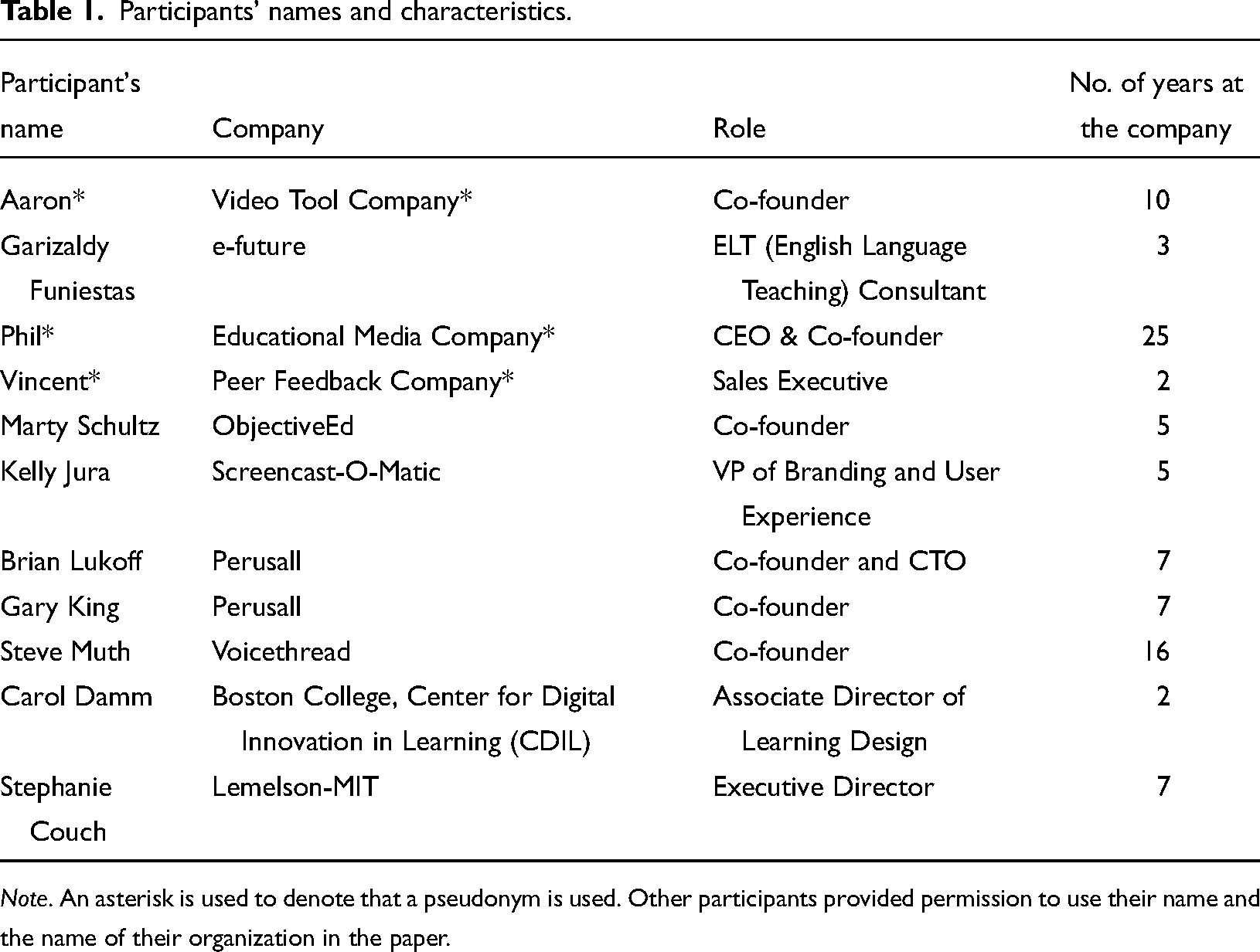
Note. An asterisk is used to denote that a pseudonym is used. Other participants provided permission to use their name and the name of their organization in the paper.
Data collection
The primary source of data were semi-structured interviews with each participant. All interviews took place on Zoom and lasted 45–60 min. The interview followed a 20-question protocol. The questions were in the following categories:
Background information about the participant (e.g., “What is your educational/work background?”; “What is your current role?”), responsibilities of their leadership role (e.g., “What do you see as the most important part of your job”?), information about the company (e.g., “If you were describing your company to someone with no knowledge of your work, what key features of your company would you highlight to them?”). Understanding the company's role in supporting education (e.g., “What is the target population for your company?”; “In what ways does your company's technology support students?”). Understanding how the COVID-19 pandemic affected the company (e.g., “What particular programs/features/changes did you make to enhance technology during the pandemic?”; “Did your company experience growth during the pandemic?”). Future directions for the participant's company (e.g., “In what ways do you see your company evolving in the future?”) and the EdTech field in general (e.g., “In what ways do you see the educational technology sector, in general, evolving in the future?”).
All interviews were recorded and transcribed for further analysis. Participants had an opportunity to review transcripts.
Data analysis
Data were analyzed using an inductive approach (Lincoln & Guba, 1985), focusing on how themes were presented in the data (Braun & Clarke, 2006). The first step involved a close reading of transcripts to increase familiarity with the data, followed by initial coding—at this stage, codes included “learning communities,” “effects of the COVID-19 pandemic,” “role of EdTech,” “supporting students,” and “company mission/purpose.” Codes were aligned with the three research questions. Following a comparative approach (Charmaz, 2006), after completion of the initial coding, all transcripts were revisited and additional codes were added where necessary. Key themes were identified based on patterns within initial codes. Two team members reviewed and coded every transcript independently. Consistent with a phenomenological approach, we identified what Creswell (2007) refers to as “significant statements” (p. 60) or excerpts from the data that meaningfully reflected the nature of participants’ experiences, and we incorporated these into our descriptive narrative.
Results
Perspectives and backgrounds of EdTech leaders
The first research question is: “What perspectives and backgrounds do EdTech leaders bring to their work?” We have developed a typology to capture EdTech leaders’ perspectives and backgrounds, as a way of characterizing those working in the field. This typology can serve as an initial point from which further research could be conducted.
Our typology of EdTech leaders’ perspectives and backgrounds includes four groups: Technology Inventors (n = 3), Targeted Education Market Inventors (n = 5), Creative Learning Inventors (n = 2), and Education Technology Facilitators (n = 1).
Technology inventors
The first group is the Technology Inventors (with three of our participants falling into this group). These leaders typically have backgrounds in business, marketing, or other fields outside education and have experience with technologies like web development. Leaders from Screencast O-Matic, VoiceThread, and an unidentified Video Tools Company are in this group.
These leaders view their companies as creating technologies that solve a specific problem, such as addressing limitations in asynchronous communication. The tools at these companies were not designed for education specifically, but they have gained traction among educators. Some technologies serendipitously became EdTech tools, as educators searched for diverse tools to support learning.
Leaders in this group focused on keeping technology as simple and easy to use as possible. For example, Steve (VoiceThread) remarked, “We try desperately to keep the interface as simple as we can make it.” Changes are typically made only after consideration and with attention to the user. Technology Inventors highly value the perspectives of educators, who provide important feedback about how they use the tool and what is not working as intended. As Kelly (Screencast-O-Matic) noted: Never make assumptions. I am not a teacher or professor. I can certainly use empathy. I can certainly put myself in someone's shoes. And that's what our team does every day. But there's really nothing that compares to talking with an educator, watching how they interact with something, feeling their pain, and seeing what they’re doing. In technology, assumptions move us into making products that people don’t use.
Targeted education market inventors
The second group is the Targeted Education Market Inventors (n = 5). These leaders have varied backgrounds, but, unlike the Technology Inventors, these leaders have used their experience in education to understand areas where teachers and students needed support and have designed tools to address these specific needs. These technologies were not co-opted for education, but were designed specifically for education. This group includes leaders from ObjectiveEd, which designs tools for visually impaired students; e-future, which designs tools for English language learners; Perusall, which focuses on online collaborative and interactive reading in higher education; and an unidentified company which focuses on facilitating productive feedback among students.
The Targeted Education Market Inventors view EdTech as purpose-driven tools. Vincent noted that technology should be “used for more purpose, rather than for the sake of using.” Moreover, “we need to keep in mind why we are here before pushing any sort of new ways of thinking, new ways of using technology, new ways of engaging with students.” Similarly, Marty (ObjectiveEd) described how his desire to make positive change led him to technology support for visually impaired students: “If we were going to go back into special [education] [i.e., educational instruction designed for students with disabilities], we would actually do something to help kids…. And we realized that there was very little being done for kids with visual impairments. We could do something there.” ObjectiveEd uses game-based learning to supplement instruction and expedite skill development. The Perusall leaders, Brian and Gary, noticed that university students were not engaged by their course reading assignments. Perusall was developed in-house at Harvard to make reading more collaborative and interactive, thus facilitating engagement.
Like the Technology Inventors group, Targeted Education Market Inventors valued educators’ opinions. As Marty noted: “Listen to the teachers. Teachers will tell you pretty much what they need.” In the case of Perusall, the EdTech leaders are university educators and leverage their own teaching experience.
Creative learning inventors
The third group of leaders are Creative Learning Inventors (n = 2). These include Stephanie from Lemelson-MIT, which focuses on developing and inspiring K-12 inventors, and Phil, from an unidentified educational media company. Both organizations break down barriers to students’ interest in technology and STEM through creative and game-based ventures.
Lemelson-MIT works with local elementary schools to facilitate invention education using toy design. Invention education can also break down gender stereotypes about STEM education, while providing opportunities in lower-income school districts and rural areas. Lemelson-MIT provides opportunities for children to see themselves as inventors through hands-on experiences. In Phil's case, it was an educator during his college years who sparked an interest in integrating arts and technology in his emerging educational media career. Phil created a game that “would get kids using mathematical language, just in the course of their play.” Technology provided an avenue to make learning enjoyable for children.
Education technology facilitators
The final group is Education Technology Facilitators (n = 1). In our study, this group included one technology leader, Carol at the Boston College Center for Digital Innovation in Learning (CDIL). Rather than viewing herself as an expert in education or technology, Carol views her expertise within EdTech itself. From her perspective, EdTech should push pedagogy further. Carol seeks technologies that support teaching and learning across the university by: [Taking] the initiative here to identify gaps in the current technology, things that aren’t meeting faculty's needs. And we then go look for what does work and do some research. And then if it looks feasible, we will pilot it and then be able to propose it for adoption.
Leadership during the global pandemic
The second research question is: “How have EdTech leaders responded to the pandemic and how do they envision their roles as educators in the early months of the COVID-19 pandemic and beyond?” EdTech leaders responded to the pandemic in three main ways, with significant implications for their business trajectories. First, leaders responded to the increase in technology adoption. Second, given the increase in the number of schools using technology, EdTech leaders increased access. Third, EdTech leaders created new tools and programs to respond to changing user needs during the pandemic.
Responding to increased EdTech adoption
Despite the many challenges of the COVID-19 pandemic, EdTech leaders were excited to see an increase in the adoption of their tools. Aaron (from unidentified Video Tool Company) noticed an increase in the number of videos being recorded, while Marty noticed that demand for ObjectiveEd also increased. Kelly from Screencast-O-Matic described use as “skyrocketing.” This increased demand contributed to an “all hands on deck” approach throughout EdTech organizations. At Boston College, Carol explained how CDIL staff were dedicated to ensuring that faculty members had tools to succeed, and how the university provided extra resources.
Technology became central to keeping schools functioning during the COVID-19 pandemic. ObjectiveEd, serving visually impaired students, also noticed an increase in the number of school districts seeking support during the COVID-19 pandemic. Marty elaborated: The whole concept of practicing their skills at home managed by their specialized teacher is the same concept as distance learning. So a lot of schools became familiar with what we had because of that. […] COVID kind of opened an opportunity for us to become much more prevalent in our marketplace.
Brian (Perusall) described how the COVID-19 pandemic encouraged professors to “rethink things about their teaching,” which contributed to growth in technology adoption. Similarly, Kelly (Screencast-O-Matic) noticed that teachers who were initially hesitant to adopt EdTech pre- COVID-19 pandemic adapted to the new reality by incorporating technology. EdTech tools also facilitated social connections among students, while simultaneously encouraging academic engagement. Gary described Perusall as: Students are going to be reading two to three times as much and getting two or three times as much knowledge from the materials you assign them than they would without Perusall. So when people found out about that, at the beginning of the pandemic, yeah, there was a very big uptake in use.
Increasing accessibility
In the early stages of the pandemic, many EdTech companies did not so much change their product as change their business model. These changes centered increasing accessibility. Aaron (from a Video Tool Company) summarized this: “It was kind of just a smooth transition [during the COVID-19 pandemic]. Yeah, so we didn’t change the product at all. The only thing was really the business model around it to facilitate access.”
Increasing access often involved reducing the price. Phil (from an Educational Media Company) explained his decision to offer the product at no cost: And in the middle of COVID last year […] because there was so much disruption and uncertainty in the marketplace—we decided to just give our software away. So we gave the software away to over 375,000 students in the United States.
By increasing access to their products, EdTech companies facilitated more equitable learning environments. Stephanie from Lemelson-MIT explained the importance of increased attention to the technology divide that was highlighted by the pandemic: I don’t turn a blind eye to the many problems that we have to overcome to make distance learning effective. And one of the problems we’ve all known from day one is the digital divide. … And what was beautiful about the pandemic is we had to stop pretending that it was something on the side and didn’t really matter when, in fact, it has been impacting the ability of a lot of kids to perform well in school.
Developing new tools or programs
Many companies responded to the pandemic by increasing the level of technology support that they provided to educators. For example, Kelly from Screencast-O-Matic said: “In those early days [of the COVID-19 pandemic], it was undoubtably operational. We were just trying to get people into the tools and helping them in any way we could.”
Some companies did create new tools or programs, in addition to expanding access. Gary described how Perusall added a video feature at the start of the pandemic. Perusall used what they learned about social motivation in reading and applied it to videos. “Students now can watch videos in Perusall. They can stop the video. They can ask questions. They can annotate the timeline. Other students can respond in threads to the original question on the timeline.” This company extended their product from one modality to another—that is, from online text to online video. Similarly, Kelly (Screencast-O-Matic) described recently developed mobile apps that facilitate asynchronous video communication: I think students being creators is essential and having a mobile experience seemed like a natural fit for student creators. […] The ability for students to download free apps and be content creators and share their feedback and their assignments in a new medium is important.
The pandemic allowed EdTech companies to reimagine their business operations and to become more proactive in meeting stakeholders’ needs. Gari from e-future described moving in-person teacher training programs to an online webinar format. One challenge was accommodating teachers’ schedules across multiple time zones, but the company addressed this by posting lesson videos on YouTube.
At Boston College, CDIL created a Fast Track cohort program that helped faculty rethink curricula and move courses online. Each cohort included 10 faculty, one learning designer, one media producer, one librarian, and one project manager. The cohort met weekly to check in and hold one another accountable, while the learning designers also met with faculty 10 hours per week to create their online courses. This program was possible through additional university resources. Carol explained that: Faculty are very collegial and enjoy hearing what others are doing, working together, and giving each other ideas. So that really works well in this cohort model. So we changed the way we worked with faculty in order to better meet this, but the university also invested in the support the faculty needed to make it happen. And it made all the difference.
Facilitating educational innovation
The third research question is: “How is the technology industry evolving to facilitate educational innovation?” The COVID-19 pandemic sparked various changes in EdTech. These fell into three broad categories: (1) streamlining users’ experiences to make technology easier to use; (2) growing adoption of AI, VR, AR, and other simulated learning experiences; and (3) facilitating innovative online learning.
Streamlining users’ experiences to make technology easier to use
EdTech leaders emphasized the importance of streamlining users’ experiences by making tools easier to use. Aaron focused on “simplicity” and “just making things more accessible, easier to use, not bloated with features and buttons and that require a ton of training or support.” He explained that EdTech should make daily operations easier for educators rather than simply transferring tasks from one platform to another or making the task more difficult. When integrating new tech, Carol emphasized, it is best when “faculty and students feel like they [don’t] have to do anything to figure it out.” Even technology that initially seems exciting will have little utility if it is too challenging to incorporate.
EdTech leaders focused on improving current tools first, before creating new ones, and then only creating tools that really serve an unmet need. As Steve (VoiceThread) explained: We have a core belief of no change for change's sake. … Because speaking for users, users don’t actually like change. They want new features in a sense, but they require a lot of relearning. And so there's a high cost to that sort of change, particularly in education, where people hone these skills over years. And so they don’t want massive change.
Growing adoption of AI, VR, AR, and other simulated learning experiences
EdTech leaders were excited about the growth in AI, VR, AR, and other simulated learning experiences. These tools provide new opportunities for students to practice skills.
For example, without access to in-person education during the early months of the COVID-19 pandemic, it was difficult to simulate science laboratory experiences. Stephanie from Lemelson-MIT described collaborating with a virtual simulations company, Labster, to use a “virtual reality video game.” The tool simulates the experience of completing a lab.
Carol explained the promise of VR as follows: You don’t have to worry about students, say in an anatomy class, dissecting a real cadaver. Maybe at some point you do, but you want to wait till they’re further along. So here you can create where they actually feel the resistance. … You can dissect the body in virtual reality as opposed to in real life.
VR tools allow students to practice skills and feel more comfortable in real settings. Gari from e-future described how AI tools, especially when gamified in some way, can also be used to support second language development by providing an avenue to practice speaking.
Facilitating innovative online learning
In addition to an increase in online education, EdTech leaders anticipate further innovation in online teaching and learning. Carol summarized the opportunities as follows: There is a real value to the face-to-face setting for teaching. It's a different dynamic. […] That's why you have to design differently for online. Because you’re not going to replicate that face-to-face experience. But it can be equally transformational in the online space, if it's designed in a way that brings about that transformation.
Deliberate design for the online environment is necessary. EdTech leaders in industry can work with EdTech leaders in traditional academic settings to shape transformative and innovative online learning.
The pandemic sparked innovation among educators as they adapted to their new online environments. More faculty in higher education started seeing the benefits of online learning, especially for working professionals and others who could not easily come to campus. Talking with us in summer 2021, Gary (Perusall) observed more innovation in education “in the last 16 months than the last 100 years.” Even though every innovation was not successful, faculty were pushed to be creative.
EdTech leaders have been identifying ways to create a more “hybrid” online environment (Park & Kim, 2011), by modifying some in-person activities for the online environment. One goal is facilitating virtual collaboration in synchronous and asynchronous formats. For example, Kelly described how a teacher can use Screencast-O-Matic to review assignments and give students personalized feedback while visually walking through the assignment so the students can jointly review it. This is like sitting down with a student in person and reviewing an assignment together. Perusall's leaders recognize the importance of student–student interactions in the classroom and their technology can reduce the isolation that students may feel online, something which was especially critical during the pandemic. As one explained: If we can get students connected with each other in kind of an organic, meaningful way, then I think students will feel less isolated. They feel like they can get help when they need it. If I’m reading [and] I get stuck on something, there's a good chance there's someone else online at the same time […] that maybe can help me out right now, and I can get unstuck really quickly. And then maybe I can help them out on something else that they’re sort of struggling with. [… This will] help them feel like they’re part of a learning community instead of being kind of just sort of an isolated pod by themselves.
Online learning can also be transformational when quieter students find their voices in online environments. Stephanie noted: We saw kids in the back of the class who didn’t talk, and all of a sudden their teachers were amazed at how much they were sharing and exchanging online. There is a magic that can happen with online learning.
Online learning also has the advantage of allowing guest speakers from around the world. For example, Dr. Peter Bergathon, vice president of quantitative medicine for Biogen, presented to students in the Lemelson-MIT summer program. While online learning cannot replace in-person learning, it has its own unique strengths.
Discussion
The COVID-19 pandemic brought tremendous challenges to educators, students, and families worldwide, and it led to a spike in EdTech investment (HolonIQ, 2022). In the early stages of the pandemic, it also challenged EdTech leaders, confronting them with what Kerrissey and Edmondson (2020) call the “coronavirus leadership test” (para. 3). Our exploratory study has described several ways in which leaders met this test. In this section, we summarize three key insights: (1) Edu-Inventors vs. Tech-Inventors: categorizations and comparison between two key groups, (2) EdTech's collaboration with educators, and (3) Pedagogical adaptation of Edu-Inventors: unique strengths.
Two groups of EdTech leaders: Edu-Inventors and Tech-Inventors
EdTech leaders fall into two groups, Edu-Inventors and Tech-Inventors, based on their background and how they started their companies. These cultural backgrounds and social positions shaped their approaches to technology development and leadership. Edu-Inventors were initially educators, then created tech tools. For instance, Brian and Gary from Perusall, Stephanie from Lemelson-MIT, and Carol from Boston College belong to this group. They have extensive experience as educators, and they used this to develop products. Tech-Inventors have backgrounds in technology and work with educators to apply their tools. VoiceThread, ObjectiveEd, and Screencast-O-Matic are examples.
Edu-Inventors have a broader perspective on the educational landscape. Vincent explained how it is important for EdTech companies to think about “education as a whole” when creating products. Stephanie from Lemelson-MIT, for example, was able to focus on broader concerns about equity in STEM, drawing on her experience in schools. Because they already know a lot about education, they recognize needs and have practical insight.
Tech-Inventors acknowledge that education is not their area of expertise and seek guidance from educators to address this—pursuing what Goulet et al. (2003) describe as “collaborative mentoring” (p. 333) and “openness” (p. 331). This was particularly true for ObjectiveEd, whose leader explained that the product could only be used in partnership with an educator trained to work with visually impaired students. This group often focused on specific functions, like creating videos. Both Edu-Inventors and Tech-Inventors value teachers and students’ feedback, but Tech-Inventors are more dependent on it. The feedback they seek also focuses on how to apply their tools, instead of a broader view of educators’ work.
Both groups strive for simplicity in the user experience. Technology consumers often want the latest features and gadgets. But many of the EdTech leaders emphasized simplicity. Leaders want to bring “value-added” to their customers, rather than just something new. They think that most educators are not looking for something fancy, but instead for something that will seamlessly support students’ learning (Huang et al., 2019). This finding provides a small qualification to Weller's (2018) claim that “in EdTech, the tech part of the phrase walks taller” (p. 47). EdTech leaders deliberately focused on the educational needs of students and teachers.
Collaborating with educators
Both Edu-Inventors and Tech-Inventors recognize that their primary stakeholders are students and educators. Tech-Inventors are more dependent on feedback from students and educators, so they are good listeners. Edu-Inventors focus more on the pedagogical implications of their tools and deeper interactions with the content they are teaching. Embodying components of successful collaboration described by Goulet et al. (2003), both groups (1) seek users’ feedback and reflection (i.e., openness); (2) build empathy through interaction (i.e., caring); and (3) empower collaboration (i.e., voluntary participation).
Edu-Inventors and Tech-Inventors are both committed to improving learning experiences and curating better learning environments by understanding students’ and educators’ perspectives. This was especially important during the pandemic, given the high level of stress reported by educators (Hamilton et al., 2020) and students (Goldrick-Rab et al., 2020; Healthy Minds Network & American College Health Association, 2020; Means & Neisler, 2021).
Kelly (Screencast-O-Matic), for example, described how her conversations with educators about their experiences with technology provided a valuable opportunity for feedback that could facilitate product improvement. Both Kelly and Steve (VoiceThread) emphasized that empathy served a pivotal role in how they interacted with educators, and they demonstrated the high level of empathy that Kerrissey and Edmondson (2020) argued was essential during the COVID-19 pandemic. They did not assume they understood what educators needed, but instead asked questions and tried to imagine themselves in educators’ roles. As ObjectiveEd framed it, educators are the “experts.”
Edu-Inventors: incorporating educational pedagogy in teaching and learning
Edu-Inventors tended to foreground accessibility and equity. While educational inequality is not a new problem (e.g., Lewis-McCoy, 2014), inequalities in access to high-quality education were exacerbated by the COVID-19 pandemic (Dorn et al., 2020). In response, many EdTech companies started to give away their products, meeting the challenges of the pandemic by dramatically expanding access. As Williamson et al. (2020) point out, these charitable efforts did potentially contribute to long-term partnerships between schools and EdTech companies. However, leaders also adjusted their business models in response to the pandemic, focusing on access at the expense of developing new products—and this indicates that their charitable efforts were not motivated primarily by self-interest.
Edu-Inventors also focus on increasing students’ academic motivation through meaningful interaction and by reducing their isolation. The COVID-19 pandemic was itself stressful, and many teachers also experienced considerable uncertainty about teaching online. Teachers did not receive adequate support for online teaching and were concerned for their students’ well-being (Hamilton et al., 2020). Postsecondary students also encountered an increase in mental health challenges (Healthy Minds Network & American College Health Association, 2020) and found it difficult to balance schoolwork with family responsibilities (Means & Neisler, 2021). In addition to making their product more accessible—by providing it free or at reduced rates—EdTech leaders also used their products to facilitate community interactions that were often lacking during the pandemic. The pandemic brought dramatic social change, and this provided new tools and opportunities for learning and development to EdTech leaders themselves (Vygotsky, 1978). Through such efforts, EdTech leaders played a significant role in helping educators and students manage challenging situations.
Conclusion
EdTech served a pivotal role in keeping virtual schooling running during the early stages of the COVID-19 pandemic. Given ongoing growth in online learning (NCES, 2022a, 2022c) and tremendous investments in EdTech (HolonIQ, 2022), the industry will likely expand further. These organizations are “disruptive and transformative” (Williamson et al., 2021, p. 117), and this has both positive and negative affordances (e.g., Selwyn et al., 2020; Williamson et al., 2020). Understanding how EdTech leaders think about EdTech in general and about their collaborations with educators is critical, given the growing importance of technology in educational environments.
Our study offers three main insights. First, we provide a four-category typology to capture EdTech leaders’ perspectives and backgrounds, a framework that can facilitate further conversation and empirical research: (1) Technology Inventors, (2) Targeted Education Market Inventors, (3) Creative Learning Inventors, and (4) Education Technology Facilitators. Second, we show how EdTech leaders increased access to their tools, designed new tools, and developed new programming to meet the spike in technology adoption during the pandemic and to address evolving user needs. Third, we describe EdTech leaders’ projections for the future using three main categories: (1) continued focus on improving online learning; (2) streamlining users’ experiences; and (3) educators’ increased adoption of simulated learning experiences through AI and VR/AR.
In addition to various strengths, this study has two important limitations. First, the data collection took place during the summer of 2021, a unique point in the pandemic. This moment may have provided enough distance for EdTech leaders to reflect on their early responses, but we might not have fully captured their initial anxieties and emotional reactions as we could have done in spring or summer 2020. Second, the sample of EdTech leaders was relatively small (n = 11), and some perspectives may be missing. Nevertheless, we believe that our study captures a range of perspectives both in terms of company type and the interviewee's position in the company.
The 11 EdTech leaders in the study articulated how EdTech can be harnessed for good—for example, to increase access, to build online learning communities, to make learning fun for children, and to support teachers. By amplifying the voices of these 11 EdTech leaders, the current study begins to address the “dearth of technology leadership coverage” that was identified by McLeod and Richardson (2011, p. 216). Future research on EdTech leaders can explore further the affordances of this increasingly important sector.
Footnotes
Contributorship
Deoksoon Kim designed and directed the study. She recruited participants, interviewed them, and analyzed the data together with research team members. She also wrote segments and edited the manuscript. Katrina Borowiec wrote most of the first draft. She recruited participants, interviewed them, and analyzed the data together with other team members. Drina Kei Yatsu wrote the first draft of the methods section. She helped with some of the interviews, analyzed data, and helped build the typology of participants for the first research question. Stanton Wortham edited the entire paper and polished the manuscript.
Declaration of conflicting interests
The authors declared no potential conflicts of interest with respect to the research, authorship, and/or publication of this article.
Ethical statement
The study was approved by the Institutional Review Board (#21.256.01) at the researchers’ university. Since the study was conducted online, all participants provided informed consent via an online consent form.
Funding
The authors received no financial support for the research, authorship, and/or publication of this article.
