



Abstract
Purpose
This study re-examines the relationship between jiao (lit. teaching) and xue (lit. learning)—the foundational education concepts in the traditional Chinese cultural context—to enlighten our contemporary understandings of education and educational research.
Design/Approach/Methods
This study first lays its foundation on an etymological investigation. It then integrates two mutually connected approaches—the classics and the self as method—to present a comprehensive analysis. Finally, it critically reviews the methodology used in this study.
Findings
The interdependency of xue and jiao has an etymological foundation, supported by canonical doctrines and verified by individualized experiences. The interpretation of xue as xiao (to imitate) describes the origin and process of education in which the junior imitated and followed the elder, while the extended interpretation of xue as jue (to awaken) stresses the effects and functions of education. In the classical Chinese context, greater significance was placed on xue—the keyword concurrently connoting the meaning of teaching and learning in the modern sense. It is misleading to narrowly render the originally meaningful word group xuexi as learning in modern English.
Originality/Value
This study consults sources in multiple languages and integrates both the classics and the self as method. Based on this, the etymological investigation, canonical analysis, and experiential reflection are collated to provide a rich and deep discussion. By focusing on the core characteristics and the concepts they imply, this study also touches on the key characteristics of the hieroglyphic system and the unique way of thinking it represents.
John Dewey (1859–1952) wrote in his influential work, How We Think, first published in 1910: Teaching and learning are correlative or corresponding processes, as much so as selling and buying. One might as well say he has sold when no one has bought, as to say that he has taught when no one has learned. And in the educational transaction, the initiative lies with the learner even more than in commerce it lies with the buyer. (Dewey, 1910, p. 29)
In this context, Dewey addresses teaching and learning as “correlative or corresponding processes,” which is an understandable analogy. However, later philosophers of education challenged and further developed this equation of “selling-buying” (Buckley, 2021; Noddings, 1995). In retrospect, we find questions and relevant debates hidden in this equation—Who is the seller? How do they perform their role effectively? Why does the buyers’ angle matter? What if no responses come from buyers? What else is meaningful for sellers and buyers beyond the mere “transaction”? All the questions lead to the primary question: What are the true relationships between teaching and learning? This question occupies a central position in education and refreshes its implications over time.
With more than three millennia of recorded history of school education, the Chinese have uniquely addressed this question. Inspired by this intellectual tradition, this study approaches this classical question by re-examining the relationship between jiao (教, lit. teaching) and xue (学, lit. learning), the foundational elements and concepts of education in the Chinese cultural context. First, from an etymological perspective, the author investigates the keywords jiao (教) and xue (学), showing how ancient Chinese correlated these two words/activities even at the hieroglyphic level. Second, the author discusses the doctrines preserved in Confucian texts, examining how scholars have discussed and practiced these pedagogical concepts and how these are echoed at different times. Third, the author engages in self-reflection—periodizing and problematizing his experiences in learning and teaching to examine the core theory of reciprocity further. Finally, the author extends the discussion through reflections on the literature, methodology, and reflective thinking in this study and concludes how it may enlighten contemporary understandings of education and educational research.
The research methodology bridges three dimensions—textual interpretation, educational practice, and experiential reflection—with constituent tasks applicable to each dimension. The overall methodological framework of this study is conceptualized as follows:
The author employs classics as method and the self as method as the core analytical approaches for this study. The conceptualization of classics as method is based on the precept that Confucian classics are significant sources of professional knowledge in educational history. Second, the author treats the classics as “constructed grand mansions of meaning” to be carefully analyzed, as “the wisdom that one finds in the ancient texts was uncovered in layers over layers of rearranged materials” (Lee, 2000, p. 364). Finally, wherein applicable this study also employs the classics as the guidance for practice and the reference for education and educational research. The self as method is a concept borrowed from the anthropologist Biao Xiang (1972–), who exhorts the youth “to examine their selves, not as consumers, not as profit-maximizing individualists, and not as part of a particular political or social movement” (Xiang & Wu, 2022, p. 17). In this study, the author draws on his experiences in studying the classics and in practicing his teaching and learning—developing an embodied dialogue between the classics and an individual experience. While acknowledging the risk of “egocentrism” in the second approach, the author argues that the grand classical discourses matter to individual concrete teachers across time—including himself. The integration of conscious reflection connects the realm without self to the realm with self in academic writing and returns the frequently absent human to the humanities scholarship.
Homology of Xue (学) and Jiao (教): An etymological review
From a modern pedagogical perspective, there are several approaches to delineating the relationship between teaching and learning. They are: (1) two kinds of mutually dependent activities, (2) two aspects of the same process, and (3) the “same thing” contained in each other. The early Chinese ideographs of these two words imply all these aspects. For a clear presentation, Table 1 provides the representative forms of these two characters in the Oracle (jiaguwen, 甲骨文), Bronze (jinwen, 金文), and Seal (zhuanwen, 篆文) inscriptions in chronological order (Chen, 1992, pp. 393–394; Xu, 2014, p. 347; Xu & Xu, 1919).
Representative forms of xue and jiao in early Chinese inscriptions.
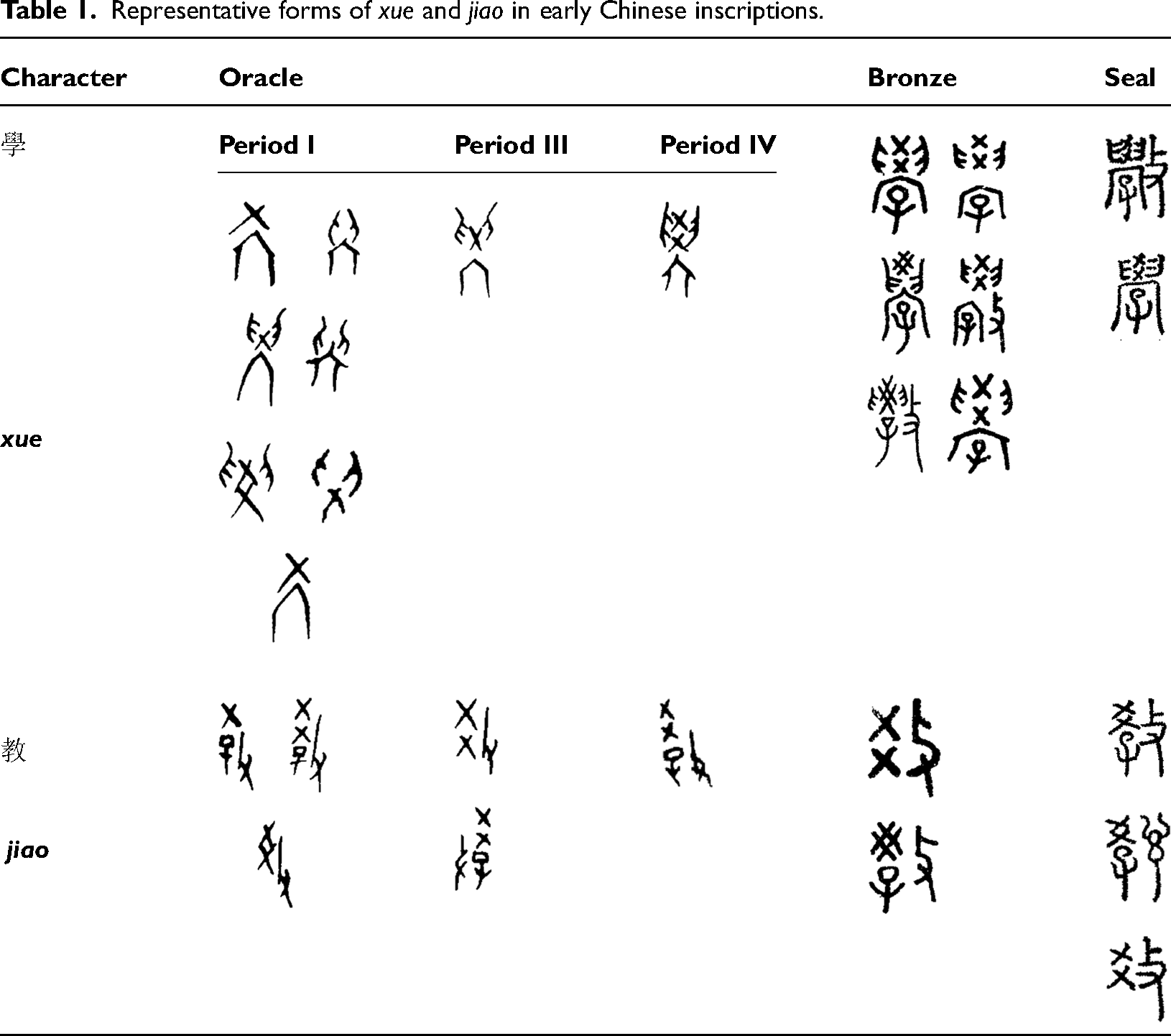
As Table 1 indicates, we must begin with the common basic form 爻 (yao, trigram) to decipher the etymology of 学 and 教. The character 爻 chiefly symbolizes crossed counting rods. It is thus first related to elementary mathematics education, which was significant in daily life. Second, it reveals the mystic method of a very old tradition of divination by a kind of yarrow (shizhan, 蓍占), which was equally important in political and spiritual life. Later, it was involved as the components for each hexagram (gua, 卦) in The Book of Change (yi, 易). Hence, the 爻 in the Shang dynasty might also refer to “an outdoor sacrifice” (Zhang, 2016, p. 81). A recent investigation re-affirms 爻 as “the activity that the officer used to generate military strategies based on History and Numerology,” and such origination “shaped the core philosophical spirit of 学 and established its important position in traditional Chinese social culture” (Huang, 2022, p. 196). Moreover, the endless duplication of its basic form 㐅 (wu, originally meaning five) may be associated with its extended meaning of “simulation/imitation.” Another exegesis is to consider  as two hands knitting a fishnet and
  as two hands weaving the
  (mesh) together with
  (a headrope) because fishing and netting were necessary living skills in early societies (Zhu, 1962, p. 128). Such an association seems interesting but requires more substantial etymological evidence.
While 爻 mainly indicates the content of education, the added shape 臼 represents the hands—which suggest the actions and processes of education. Moreover, the part 宀 is widely accepted as the shape of a building or its roof (a few scholars hold that  means the number, six, and not a building) (Xu, 1996, p. 82). In this scenario, the essential elements of education—the location, contents, and processes—were all connoted in this character. Notably, in the identified oracle inscriptions, the part 子 (zi, child) indicating people who received instruction were not included in this character. This only appeared later, in the bronze inscription stage (Chen, 1992, pp. 394–395). This further proves the integration of teaching and learning as represented by the same character
  in the oracle inscriptions. As previous research explains: “If seen from the perspective of instruction 学 indicates teaching by verbal instructions and exemplary actions, with mouth and hands involved; if seen from the angle of learning, it means ‘to imitate and follow’” (Shen, 2020). Conversely, the character corresponding to today's 教 seems to appear later, with the part 攴 added as
  or
or  , symbolizing “a person's hand holding a teacher's pointer (攴) when one teaches a child (子) to use counting rods (爻)” (Lu, 2015, p. 1060). Clarification of these origins paves the way for the ensuing investigation. This also shows the unique potential of thinking through a hieroglyphic system.
Scholars have summarized that 学, in oracle inscriptions, was used both as a noun referring to a person's name, the training venue, and the sacrificial place and as a verb meaning to study, to instruct, and to divine (Lefeuvre, 1997, pp. 408–409). Speaking of “the training venue,” it is unsuitable to understand it merely as a “school” in a modern sense. It bore multiple functions as applied to sacrifice, war-pledging, and trying captives. Such affairs were considered of great significance for the kingdom. Even when it refers to the location for education, it includes both academic and military training. This legacy can also be verified by the meaning of 师 (shi, teacher), which was originally related to military affairs. It is also understandable that people who mastered such mystic knowledge and skills assumed the duties of divining, keeping records, and teaching at the time.
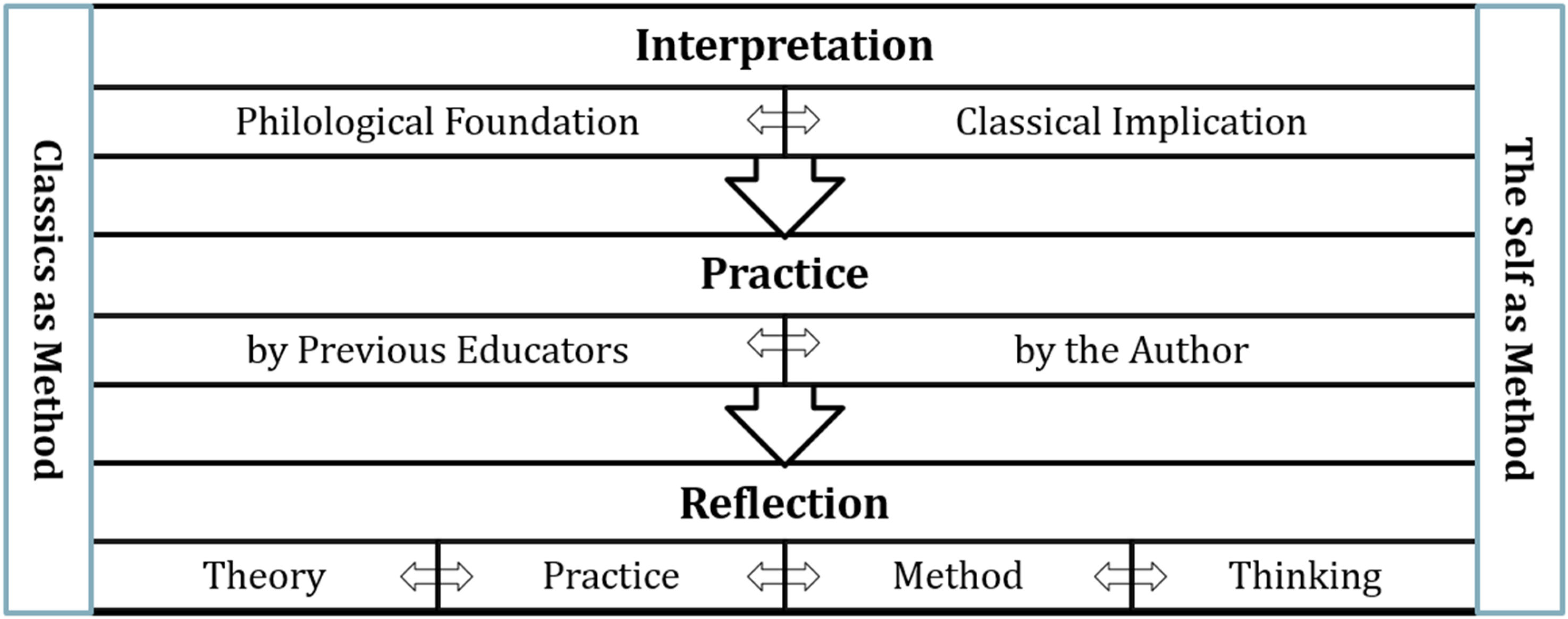
The overall methodological framework applied in this paper.
To further clarify the original meaning of 学 and 教 and their transformation, it is necessary to carefully analyze the contribution and limitation of the explanations in Shuowenjiezi (The Origin of Characters) by Xu Shen (c. 58–c. 147). An image from a representative annotated version of this lexicon by Duan Yucai (1735–1815) is presented in Figure 2 to show the strokes of these characters (Duan, 1981, p. 127). The texts in a larger size are Xu's original definition, and the smaller, Duan's annotations.
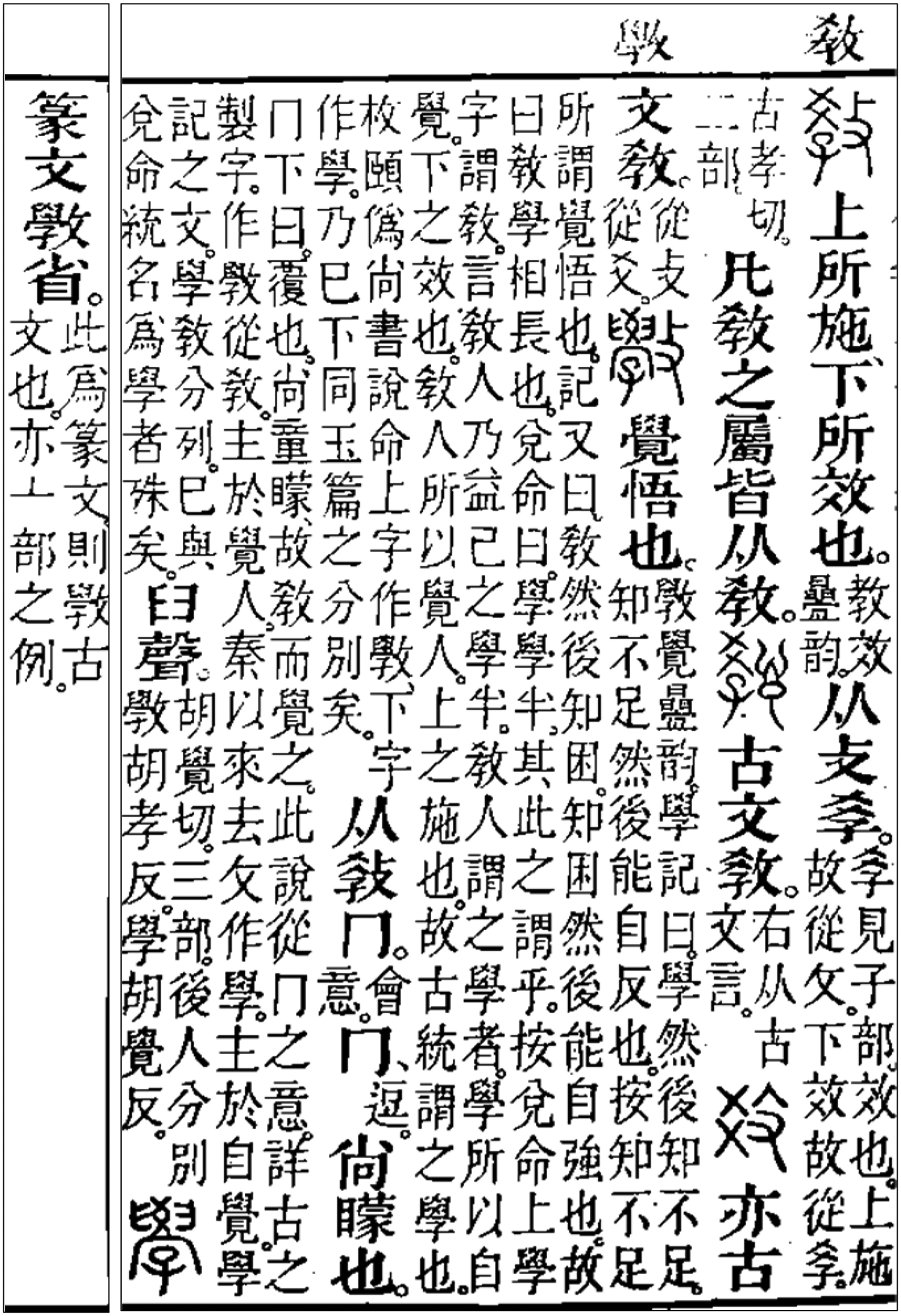
Jiao (教) and xue (学) as defined and annotated in Shuowenjiezi.
Shuowenjiezi is widely recognized as the most authoritative lexicon for early Chinese characters and exerts a far-reaching, yet possibly misleading, influence on the accurate understanding of the original meanings of 学 and 教 in the following respects. First, Xu Shen categorized both 教 and 斅 under the same 教 radical, and claimed that 學 is an abbreviated form of 斅. This implies that 教/斅 appeared first and connoted the original meaning, but the reality is the opposite. Second, Xu Shen—probably as a result of the specialized distinction between 教 and 学 activities in his time—explained 教 as “… Those implemented by the superior and followed by the inferior” (上所施下所效也), emphasizing the top-down direction of tutelage. Third, instead of tracing back to the meaning of “imitation/simulation,” he defined 学 by stressing its result/function as “awakening/enlightenment.” To support this, he further explained the shape 宀 as “still being covered/ignorant” (尚矇), deviating far from its original meaning as a building (or the number six).
In early Chinese grammar, the words for a pair of actions for receiving (shou, 受) and giving (shou, 授) were not separated. This is also the case with 学 and 教. They were originally the same character but were later divided (Yang, 1952, p. 191; Zhao, 2009, pp. 367–368). 学 and 教 etymologically originated from the same core character 爻; they were recorded in different forms, but all had the same core part in the oracle inscriptions at different times. On the identified oracle inscriptions, characters recognized as 学 by modern paleographers were significantly more than those recognized as 教 and 教, in many cases, were used as place names. Even later, in the bronze inscriptions, 教 was mainly used as the designation of an official title (Chen, 1992, pp. 393–394). Moreover, for the same sorcerer's name 学戊, the character 学 was written in different forms, signifying that they were indeed the same character. The following chart illustrates the evolutionary relationships among these hieroglyphic variants (Yu, 1996, p. 3263).
Teaching as learning: Early Confucian doctrines and echoes of later scholars
The etymological homology of xue and jiao was inherited in later Chinese scripts and partly recorded in the extant literature, so it is possible to trace further the development of the connotations from characters to texts. The Book of Documents (Shangshu, 《尚书》) preserves some examples (Legge, 1879, pp. 105, 117, 190–191).
Pan-kǎng, in making the people aware of his views, began with those who were in (high) places and took the constantly-recurring circumstances of former times to lay down the right law and measure (for the present emergency) (盘庚斆于民,由乃在位以常旧服,正法度). You, in whose behalf the above order is issued, must give me your assistance with sincere earnestness. Truly display the record of merits, for it is you who must in everything teach the officers (汝受命笃弼,丕视功载,乃汝其悉自教工). Teaching is the half of learning; when a man's thoughts from first to last are constantly fixed on learning, his virtuous cultivation comes unperceived (惟斆学半,念终始典于学,厥德修罔觉). ①However fine the viands be, if one do [sic] not eat, he does not know their taste; however perfect the
The above analysis shows that in the early stages, the use of xue/jiao and the function of education as a whole were not merely confined to school. Later, a more specialized and synthesized discourse on this matter appeared in Xueji (Record on the Subject of Education)—one of the worldwide earliest monographs on education and pedagogy—that inspired abundant annotations and applications throughout the Chinese history of education (Sun, 2021).
①虽有嘉肴,弗食,不知其旨也;虽有至
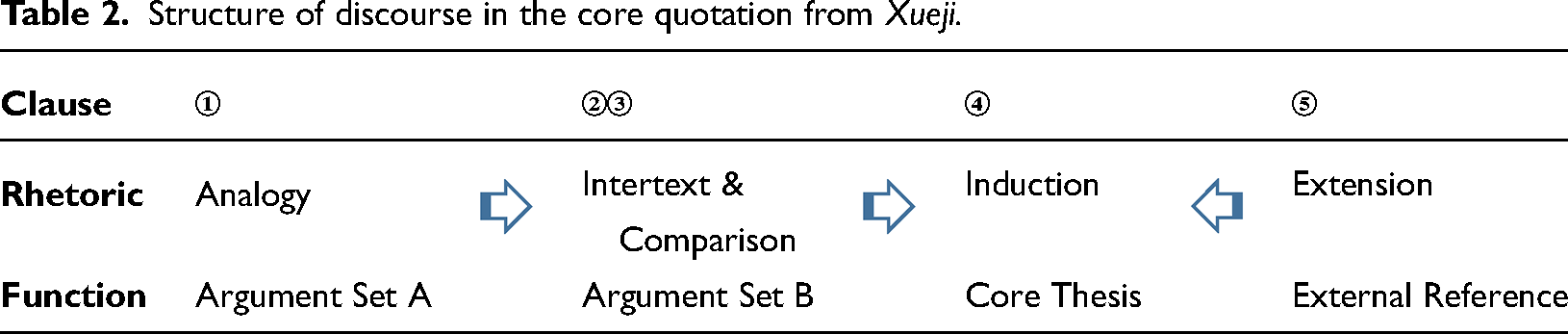
Although these materials are imperfectly preserved, we can glimpse how sophisticated the ancient Chinese education theories were. In this core quotation translated by James Legge, learning is depicted as an embodied experience like tasting the viands. It is further deepened through overcoming the difficulties in learning and understanding “teaching as learning.” An extended citation from The Book of Documents is included to support this core argument. Table 2 presents the internal logic of the quoted discourses. The core thesis is comprehensively presented and supported by analogy, intertext, comparison, induction, and extension.
Structure of discourse in the core quotation from Xueji.
Though erudite in Chinese classics, Legge's rendition seems to suffer from the following issues (underlined in the original quotations above). First, rendering of Tao (道) simply as a “course” may reduce the richness and neglect the ontological or even “transcendental” aspect of this term. Second, equaling kun (困) with “difficulties” may ignore the profound inner status in learning, so it is better to associate this word with the context of “turn to study after having been vexed by difficulties” (困而学之) in The Analects (Lau, 1992, p. 165), for which Zhu Xi (1130–1200) annotated kun as internally “with something obstructed” (有所不通) (Zhu, 2012, p. 174). Third, it is particularly questionable to translate 教学相长 as “teaching and learning help each other.” The prevalence of such an extended interpretation has long overshadowed its original connotation—a teacher's teaching and learning help each other.
Periodization of the author's experiences in learning and teaching.
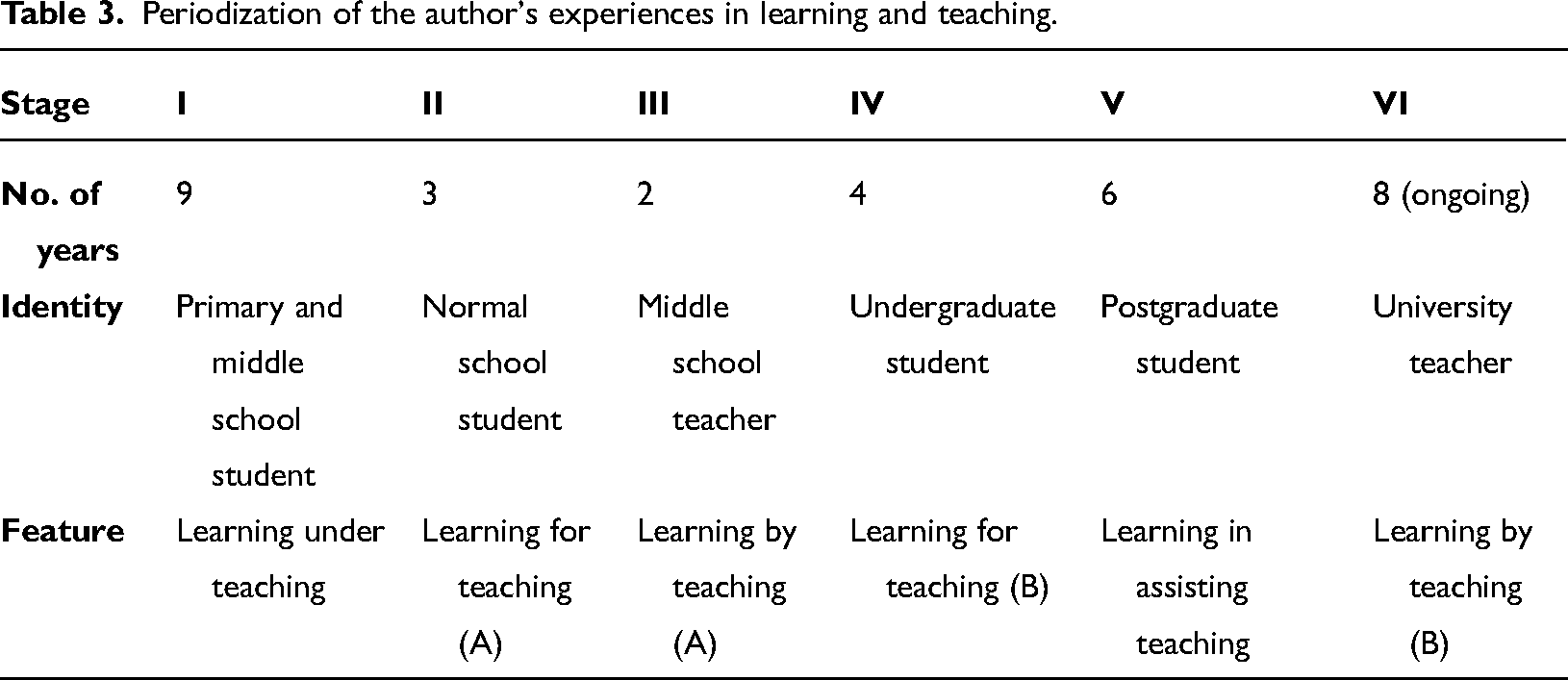
This clarification helps to unveil the meaningful aspects of traditional Chinese pedagogy. For example, in discussing the role of a teacher, Confucius said, “A man is worthy of being a teacher who gets to know what is new by keeping fresh in his mind what he is already familiar with” (温故而知新,可以为师矣) (Lau, 1992, p. 13). This quotation is so familiar that we often do not “chew it for the true taste of its meaning” (yiwei, 意味), let alone learning via experiencing. Herein, presented for further elaboration, is the annotation by Zhu Xi, an influential Neo-Confucian scholar in the 12th century: The word “wen” means to infer and deduce. Here “the old” refers to what has been heard before, and “the new” refers to what is acquired now. This is to say that if in learning one can whenever possible review and practice on what he formerly heard and can continually acquire the fresh, then his learning will be firm with him so that [when being inquired] he can respond mechanically without expressions becoming exhausted; he is thus worthy of being a teacher. As for the learning of rote memorization for the questions, it is not truly acquired “by heart” and the ken of knowledge is but limited, so in Xueji it was satirized as “not fit to be a master,” and this can be precisely cross-referenced to the meaning here [in The Analects]. (Zhu, 2012, p. 57; translated by the author)
温,寻绎也。故者,旧所闻。新者,今所得。言学能时习旧闻,而每有新得,则所学在我,而其应不穷,故可以为人师。若夫记问之学,则无得于心,而所知有限,故《学记》讥其“不足以为人师”,正与此意互相发也。
Zhu Xi further enriched the connotations of the principal texts, which describe the qualities of an ideal teacher: They should be an effective and reflective learner and practitioner versed in dealing with unprecedented inquiries. As the work of a teacher is repetitive, the acquisition of “the new” through reflectively practicing “the old” ensures that their teaching is updated and facilitates inner enlightenment. In this way, a teacher can “learn without flagging and teach without growing weary” (学而不厌,诲人不倦) (Lau, 1992, p. 57). For a teacher, the lack of inner motivation for learning—like water without a fresh source—will likely produce “job burnout,” which can adversely affect the students.
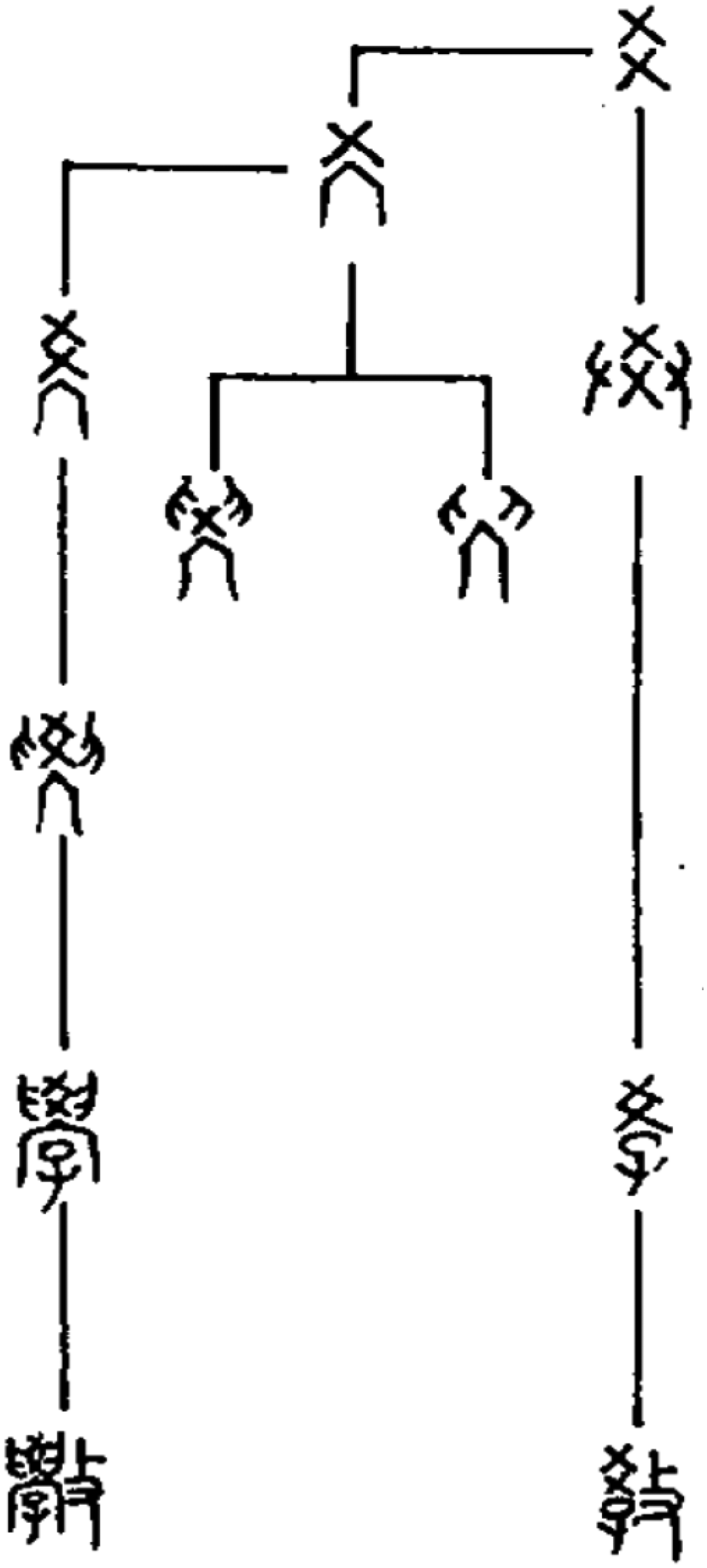
A hypothetical synthesis on the evolution of variants for 学 and 教.
Moreover, teaching as learning implies that a teacher can learn from his students. Truly as Han Yu (768–824) put it, “A student is not necessarily inferior to his teacher, nor does a teacher necessarily be more virtuous and talented than his student” (弟子不必不如师,师不必贤于弟子) (Han, 2010, p. 140). Then, why and how should a responsible teacher properly manage this? Wang Shouren (1472–1529), another representative Neo-Confucian scholar, confessed when indoctrinating his students: Those who charged out my faults are all my teachers, then how cannot I delightedly accept with heartfelt gratitude? In Tao (the Way) I have not yet fulfilled, so fulfillment, signifying that my learning is but unpolished. Inappropriately, I am here followed by your fellow students. Quite often when I introspect all night long, [I found that] my evilness has not yet been completely expelled, let alone the faults. People hold that in attending upon their master one should neither offend nor conceal and thus concealing nothing, leading some to think there is no need to offer remonstrance to the master; this is wrong. The way of remonstrating the master should just be straightforward but not offensive, euphemistic but not concealing. If I am correct, taking the remonstrance, I will be able to understand what correctness is; if incorrect, by which the incorrectness can be eliminated. [This matters] because teaching and learning help each other. (Wang, 2011, p. 1023; translated by the author)
凡攻我之失者皆我师也,安可以不乐受而心感之乎?某于道未有所得,其学卤莽耳。谬为诸生相从于此,每终夜以思,恶且未免,况于过乎?人谓事师无犯无隐,而遂谓师无可谏,非也。谏师之道,直不至于犯,而婉不至于隐耳。使吾而是也,因得以明其是;吾而非也,因得以去其非:盖教学相长也。
Due to such interdependency, later when translating the chapter of Xueji into Manchu—an agglutinative language in the Altaic-Tungusic language family—the same etyma “taci” was used to render both xue and jiao. As shown in Figure 4 (with the key lines circled), while “tacimbi/tacire” (to learn) was used for xue, its causative “tacibumbi/tacibure/taciburengge” (to make to learn) was used for jiao. A special annotation was also inserted to remind that in the phrase of “學學半,” the first “學” should actually be “斅” (Ortai et al., 1982, vol. 186, p. 447). Crossing times and languages, the original meaning of this classical quotation manifests itself subtly and accurately.
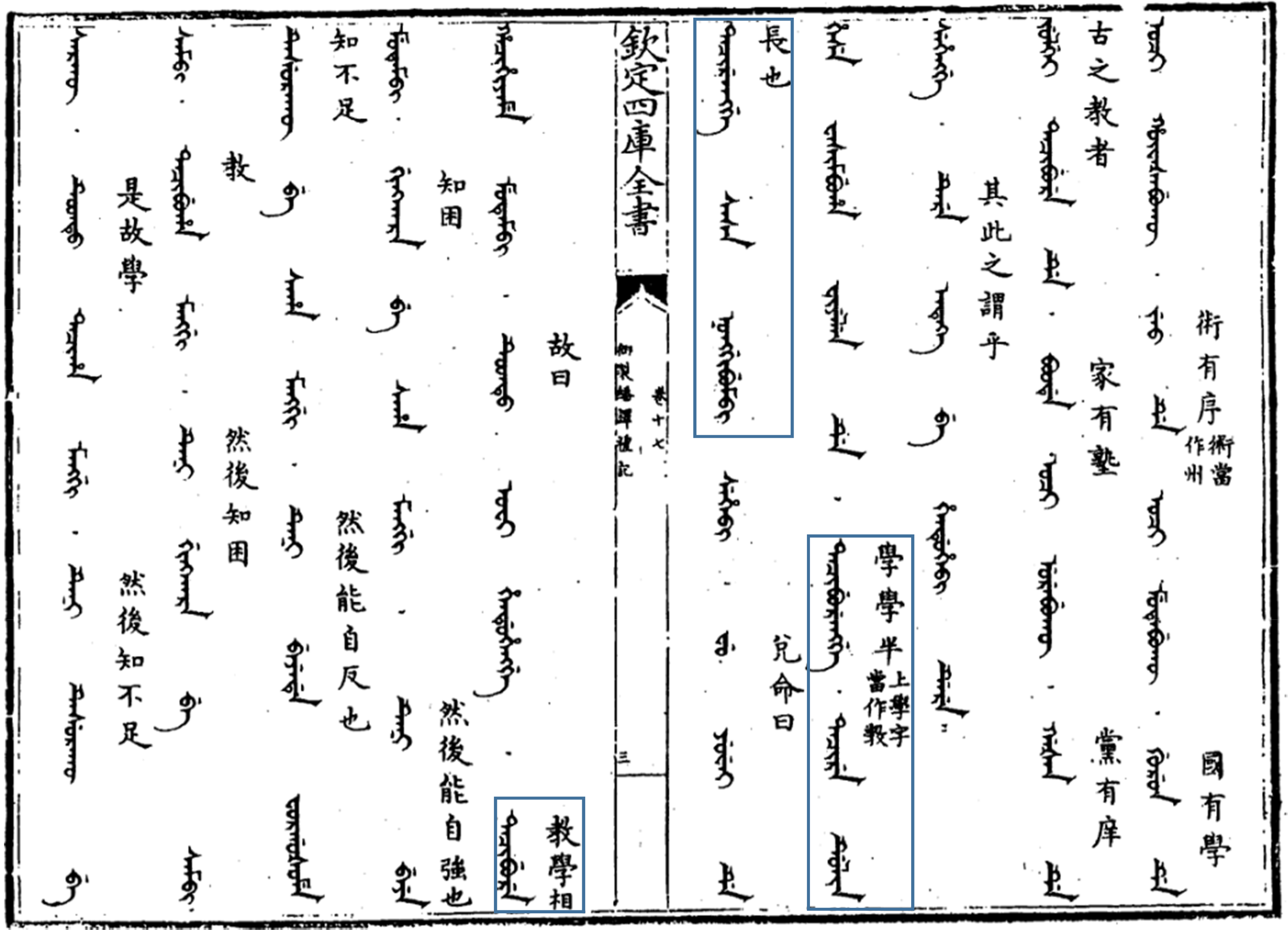
Details of the core quotation in the Manchu–Chinese bilingual version of Xueji.
Concise in expression but profound in practice, this fundamental principle of Chinese traditional pedagogy subtly bridges an ideal harmony between learning for self (weiji, 为己) and learning for others (weiren, 为人). In the modern era, the Chinese educational legacy encountered an unprecedented impact from the Western world and was regarded as obsolete. Despite radical iconoclastic movements, some scholars persistently valued intellectual traditions and tried to renew the pedagogical wisdom preserved in Xueji (Sun, 2021, pp. 55–63). Mainly by self-learning and without holding a tertiary degree, Qian Mu (1895–1990), a renowned scholar in Chinese culture and history, excelled in his career in different prestigious universities. In a letter to Xu Fuguan (1903–1982), a representative scholar of the contemporary Neo-Confucian school, he confessed: Indeed, teaching requires spiritual energy. For decades in my teaching career, I have been dedicating without reservation when lecturing in class and, certainly, I prepared well before class. I humbly hold that teaching with dedication is indeed greatly beneficial to the advancement of my learning. [In teaching] there is the objective standard and norms, so we would be deeply benefited when accumulated for a long time. (Qian, 2020, p. 200; translated by the author)
教课实须精神,弟任教数十年,上堂总是用全力,课前亦必有准备,窃谓尽心教课,于自己学问实是大有进益。因有一客观程范,积久得益始深。
Echoed by the contemporary theory from other cultures, teachers can learn in many ways in which learning “from their own practice” particularly matters. They “gain new knowledge and understanding of their students, schools, curriculum, and instructional methods by living the practical experiments that occur as a part of professional practice” (Bransford et al., 2000, p. 191). Unfortunately, pursuing “global standardization” diverts researchers from the vivid experiences and theoretical visions of education at hand, driving academic work toward a monotonous end. Essentially, education is a social activity with distinctive features—of the human, by the human, and for the human—that differs remarkably from any other undertaking. Education can hardly promote meaningful growth for teachers or students without a true understanding of the indigenous cultures it represents and the individual experiences it presents.
Finally, the issue of methodology implied in this section must be further clarified. If early principal texts are analogous to the framework and pillars, the commentaries of later scholars are the decorations. Together, they form a “magnificent mansion” of canonical meanings in which a subtly inter-referred paradigm of “interpreting cannons by referring to other cannons” (以经解经) was created. Therefore, textual exegesis and analysis of the layers of this “mansion” constitute an integral part of classical studies. Whenever the author chewed and discussed such quotations and annotations with the students, they obtained fresh perceptions of the classical texts and their practices. What the classics teach is immediately verified by the participating activities. Such embodied experiences inspired the author to propose the expression of “classics as method” in this paper.
Shift between learning and teaching: Self-narrative and experiential reflection
The discussion above reveals the interdependency between xue and jiao from the etymological and canonical perspectives. However, the following questions remain: How does the author really know that this works? Are such “teachings from antiquity” helpful today? What else is meaningful when this principle matters in specific cases? To extend the discussion, the author supplements his personal experiences of learning and teaching and projects such experiences onto a broad educational screen.
This section is based on the fundamental belief that education is an embodied process in which theories are produced, modified, and verified (or falsified) through living educational practices. Without drawing “the whole picture,” this “atypical narrative” is employed partly to fulfill the methodological attempt of this study—the integration of the classics as method and the self as method. For better contextualization, the following (and ongoing) stories are periodized and problematized in six successive stages:
Stage I. Learning under teaching
Born to a rural family in southwest China, the author had no choice but to skip kindergarten and go directly to a village primary school run by several local teachers without formal teaching qualifications; he then entered the town's only public middle school—mainly staffed by graduates from the county's “normal school” (shifan xuexiao, teacher-training school)—to which the author also later went. During the first 3 years, students in different grades were arranged to sit in the same shabby classroom and could learn from each other's curricula. Such a scene was a microcosm of elementary education in rural China before the early 1990s. As extracurricular readings were extremely scarce, a teacher's knowledge and authority mostly relied on their exclusively possessed teaching reference books (jiaocanshu). Such materials provided “standard answers” for textbook exercises—from the writing sequence of a character's strokes to the main idea of a passage, from calculating the area of an irregular polygon to the solution of an equation set. In the traditional model, a student's learning was mostly determined by the teaching, and good memorization was rewarded in examinations.
Stage II. Learning for teaching (A)
The special normal school system (Cong, 2007; Ma, 2003) plays an important role in modern and contemporary China's educational and social transformation. These schools were free of charge and attracted students, mostly from non-elite families, by offering favorable appointments to the public school system. This promised the transformation of the household into the coveted non-agricultural category. These promises held significance until the early 21st century, and this explains why “normal education” could continually secure talented students. However, the practice experienced contradictions as time went on (Zhou, 2010). The curricula in normal schools were designed to train general teachers for primary schools. It often consisted of five categories: ordinary academic subjects with less depth than the same level of high school in the general education track, art-related subjects, educational-psychological foundations, and skills for teaching. This was followed by a one-semester teaching internship in a primary school. While peers in the high school were exhausting themselves preparing for the fiercely competitive college entrance examination, students in the normal school enjoyed an education for “all-round development” to prepare them for their careers. However, most students in the latter group were academically less advanced than their peers in the general education track.
Stage III. Learning by teaching (A)
At the age of 16 years, the author graduated from a normal school and became a middle school teacher in his alma mater. He was physically and academically immature and others jokingly called him a “child laborer.” However, the lack of qualified teachers pushed him into the position. He even needed to serve as the class head teacher (banzhuren). Challenges prevailed but did not overwhelm him. In this scenario, “learning by teaching” was not a consciously theory-based practice like that at stage VI. Instead, it was an urgent, pragmatic strategy for securing jobs for junior teachers. Relaxed, the students could sit and choose whether to participate in the class; however, as a teacher, one must first systematically master the teaching content. This soon proved to be a more effective learning method than “learning for teaching,” which was practiced at the previous stage. During these 2 years at stage III, the author taught many subjects when needed, but mainly Chinese language, Literature, and History, which later influenced his college majors and academic specialization. In turn, teaching shaped learning.
Stage IV. Learning for teaching (B)
Deviating from the general education track, the author could only further his studies via in-service training on the adult education track. While working as a teacher, he prepared for entrance examinations through self-learning. The following 4-year period of study at the Provincial Education College marked an advanced stage of “learning for teaching.” The curriculum in this adult college was not very different from that of regular universities, but there was a noticeable gap in academic resources between these institutions. Fortunately, the humanities, such as history, do not rely heavily on equipment like the natural sciences. A thorough reading is more important. What shocked him most was that few students enjoyed the class on “subject pedagogy” (xueke jiaoxuefa)—a core course aiming to teach the students how to teach. Such “pedagogy” still inspired him, but from an opposite perspective: Students dislike such a way of teaching and have their own criteria for quality teaching. Moreover, it was not until this stage that the author began to improve his English learning skills. This stage concluded with a bachelor's degree in history and postgraduate admissions issued by two universities based in Beijing and Hong Kong SAR. He chose the latter, eventually returning to the “mainstream track” of education after going through many zigzags.
Stage V. Learning in assisting teaching
Studying at the Chinese University of Hong Kong earned him master's and doctoral degrees in Chinese history, and good academic records further convinced him that restrictions resulting from external conditions could mostly be overcome by self-determination. The author benefited from the diverse curricula and rigorous academic training. He particularly valued the arrangement of “teaching assistance,” so this stage is characterized as “learning in assisting teaching.” The Chinese University of Hong Kong requires research-oriented postgraduate students to act as “tutors” for professors, as part of academic training and duties, because they receive non-taxable scholarships. In a typical mode, a teaching assistant needs to prepare teaching materials, moderate thematic discussions, and partly mark the students’ performance (accounting for 20%–40% of the marks). This design situates postgraduates into three roles: They can learn from the master professor, their own explorations, and their teaching-assistance duties.
Stage VI. Learning by teaching (B)
At the next and current stage, the author works at the Faculty of Education at East China Normal University—a prestigious university with particular strength in education—although he has never earned a degree in education. He teaches and publishes mainly on the Chinese history of education and culture. Interestingly, in some cases, he is the only “layman” in the classroom as the students are all pursuing their professional degrees in education. Such limitations hamper him from purely advanced academic explorations in education while providing him with a unique angle to observe teaching and learning. He understands why the “on-site learning ability” (xianchang xuexili) constitutes the most significant part of a teacher's learning abilities (Li, 2012). Through “learning by doing,” he also holds that teaching is a highly complicated and improvisational activity for intellectual innovation, and its primary purpose goes far beyond a “lossless transfer” of knowledge from the teacher to the students (Li, 2021). During this cross-disciplinary adventure, traditional Chinese classics greatly benefited him as a reference for teaching, a source of inspiration for research, and guidance in reflecting upon the above two.
To summarize the above six stages, the author went across China's contemporary education system hierarchically (from primary to graduate school) and geographically (village–town–county city–provincial capital–Hong Kong SAR–Shanghai) and he also tried to understand this from historical and comparative perspectives. With unique experiences in the “normal school”–“normal university” and shifting identities between student and teacher several times, he witnessed the transformation of China's teacher education in the past two decades. His experiences also echoed the idea of “learning how to learn”—the true “shared core” of various “core competency” formulas (Shen & Xu, 2019).
While much attention has been paid to the past prominent educators, scholars often ignore the value of their living professional practices. This section primarily offers an atypical and individualized story and avoids a “grand theory.” Such minor but “grounded” theories and experiences are dissolved “like salt in water” rather than “sand squeezed into the eyes.” However, we need to be cautious. This story is highly structured and contextualized, which may over-simplify the actual complexities, fabricate a linear narrative and thus impede the readers from obtaining a “full picture.” This will be discussed in the following section.
Discussion
In summary, the interdependency of xue (学, learning) and jiao (教, teaching) can be traced back to the etymological foundation, supported by canonical doctrines and verified by individualized experiences. Comparatively, in the classical Chinese context, greater significance was placed on 學—the keyword concurrently connoting the meaning of “teaching” and “learning” in the modern sense. A true understanding of the meaning and application of 学 is the key to unlocking Chinese educational traditions and those of East Asia to some extent.
When interpreting 学 as 效 (xiao, to imitate), it describes the origin and process of education in which people, especially the younger, imitated and followed the elder; when understanding 学 as 覚 (jue, to awaken) from an extended perspective, it stresses the effect and function of education. In traditional Confucian education, such jue should be further unfolded into three layers—self-awakening, awakening others, and making all “rest in the utmost kindness” (止于至善). This is the ultimate goal of “great learning” (Zhu, 2012, p. 3). For all the layers, both 学 and 习 (xi, to review/practice) are equally stressed, as 習 etymologically signifies “young birds practicing flight” (Giles, 1900, p. 3). This is plainly expressed in the opening sentence of The Analects, “Is it not a pleasure, having learned something, to try it out at due intervals?” (Lau, 1992, p. 3). Unfortunately, in modern Chinese, the originally meaningful word group 学习 was narrowly rendered as “learning” in English. Clarifying its origin contributes to enriching contemporary pedagogy and optimizing teaching–learning practices.
Moreover, this study addresses the propositions of “teacher as learner” and “pedagogy as an embodied learning,” enriching theories on teachers’ personal and professional development. It is beneficial to treat teaching as an effective way of learning while considering learning as a reflective way of teaching (leading to self-enlightenment). More importantly, in traditional Chinese philosophy, learning was considered as the way toward “internal transcendence,” as “beyond rationally translating experience into knowledge or gaining knowledge based on experience; learning leads students to immediately and consistently experience dao in which tian and ren harmoniously unite” (You, 2020). As Wang Shouren stresses, “knowing without action can be merely regarded as of unknowing” (知而不行,只是未知) (Wang, 2011, p. 4). If a scholar of education does not speak of his theories in practice, it will harm the scholar's reputation and the discipline he stands for. This might be one of the world's most ironic but prevalent things. Through experiential reflection, the author believes that how a teacher teaches is also what he teaches—the teaching method and process constitute the teaching content (curriculum).
Beyond reflection on research subjects, the need emerges for reflection on methodology and reflection itself. As stated in the introduction, this study adopts a comprehensive strategy of taking the classics as method and the self as method. Today, the “something as method” approach is popularly applied in academic research (Chen, 2010; Chu, 2017). It inspires insightful explorations by situating the research subjects into their indigenous contexts and developing frameworks from within. This nurtures scholarship from de-westernized and decolonized perspectives. In discussing education research in Asia as method, recent scholarships suggest “building up a new research imagination beyond the East and West dichotomy” and “repositioning researcher's subjectivity and identifications” while also reminding us of possible problems and difficulties in the application of such methodology (Zhang & Chan, 2023). Scholars must maintain a clear and critical awareness of what it stands for and how it works or not. Otherwise, it risks enhancing the existing westernization and colonization while declaring denial of it. This further confirms the significance of the habit and quality of conscious reflection.
Then comes the reflection-upon-reflection. The author should first remind the reader that this paper inevitably contains “orderly hindsight,” especially in the autobiographical section. When experienced as a subject, the picture was vague and the direction confusing; when recalled as a researcher, the meanings were revealed/reconstructed into seemingly reasonable layers. This shows both the subtleness and limitation of such “non-empirical studies,” as it does not work to approach embodied learning in a disembodied way. Then, is it possible to transcend such limitations? Yes, but it remains equally paradoxical because it touches the very realm of ideas in which we often inevitably encounter issues of “the unspeakable.” Toward a deeper perception, our thinking and words are better to be rested in silence (Li, 2020). The skills of teaching can be taught, yet the art in it can only be internalized as “tacit knowledge.”
Finally, the author supplements the discussion with observations and comments made 90 years ago. In 1932, an educational mission appointed by the League of Nations published a report after a three-month investigation of public education in China. Ironically, the foreign experts were critical of the Chinese educational officials identifying American education as the modern educational system: “The teaching programs and methods of the United States were made to supersede the centuries-old wisdom and learning of China.” Warning Chinese educators against the excessive but “superficial Americanization,” the mission made the following expostulation that still helps us make sense of theorizing education in and for non-Western civilizations today: We merely wish to emphasise our belief that no form of civilisation which has developed in another land, and in different conditions, can become the cultural tradition of the China that is now entering upon an era of reform. New China must mobilise its forces, and, from its own history, from its own literature, from all that is truly indigenous, extract the materials for a new civilisation that will be neither American nor European, but Chinese. (Becker et al., 1932, pp. 23–29)
Footnotes
Declaration of conflicting interests
The author declared no potential conflicts of interest with respect to the research, authorship, and/or publication of this article.
Funding
The author disclosed receipt of the following financial support for the research, authorship, and/or publication of this article: This research was sponsored by the “Shuguang Program” and supported by the Shanghai Education Development Foundation and Shanghai Municipal Education Commission.
