



Abstract
Highlights
We explore the context, pattern, and outcomes of floating schools in Bangladesh. Floating schools provide mobile education in geographically isolated areas. The floating school is an indigenous solution for a local problem. Replicable in other communities facing similar challenges. Findings will benefit education policymaking in flood-prone areas.
Education is a key tool for promoting socioeconomic development (Akbar, 2014). It is a critical investment made by individuals and society (Gabrial, 2004), and it provides the basis for the development of human potential and produces diverse benefits for a society, including the formation of social solidarity, cohesion, and integration (Edward, 2013).
After Bangladesh became an independent country in 1971, it prioritized the attainment of universal primary education. From January 1, 1993 onwards, primary education was made mandatory, with free primary education offered to every Bangladeshi throughout the country (Zaman, 2014). In 2013, the net enrollment rate reached 97.7%, while the dropout rate fell to 20.9%—a considerable decline from the 47.2% rate reported in 2005 (Chowdhury & Rahaman, 2015). However, children residing in flood-prone areas have been at a considerable disadvantage due to the difficulty of accessing educational opportunities. Floating schools were proposed to address this issue and realize the country's goal of providing “Education for All.”
Mohammed Rezwan, a Bangladeshi architect, was the first to propose the concept of a floating school. He theorized that since students in flood-stricken areas cannot attend school due to a lack of transportation, the school should reach them by boat instead (Ahmed et al., 2016; Rezwan, 2015). Consequently, he founded a nonprofit organization, “Shidhulai Swanirvar Sangstha” in 1998, and launched a floating school in 2002 (Islam, 2015) to address the disruption in education caused by floods in the Chalan Beel region in the northern part of Bangladesh (Martin, 2010). The floating school project was supported with financial contributions of $5,000 by the Global Fund for Children, $100,000 by the Levi Foundation, and $1 million from the Bill and Melinda Gates Foundation (Ibrahim, 2015). By 2016, approximately 2,000 students were enrolled in 22 floating schools across the Chalan Beel region (Karim, 2016). According to Ahmed et al. (2016), the introduction of floating schools had a significant socioeconomic and environmental impact on the region.
The floating school (see Figure 1) is recognized as one of the greatest innovations in education. Every floating school is equipped with a classroom, Internet access, a library, and a solar-powered computer, and can accommodate 30–35 students. Students board the schools from several riverbank communities, and are dropped off near their homes after class (Pimputkar, 2017). Significantly, students receive both tuition and study materials free of charge. Indeed, floating schools provide primary education to local students, covering an area of two square kilometers in the Chalan Beel region.
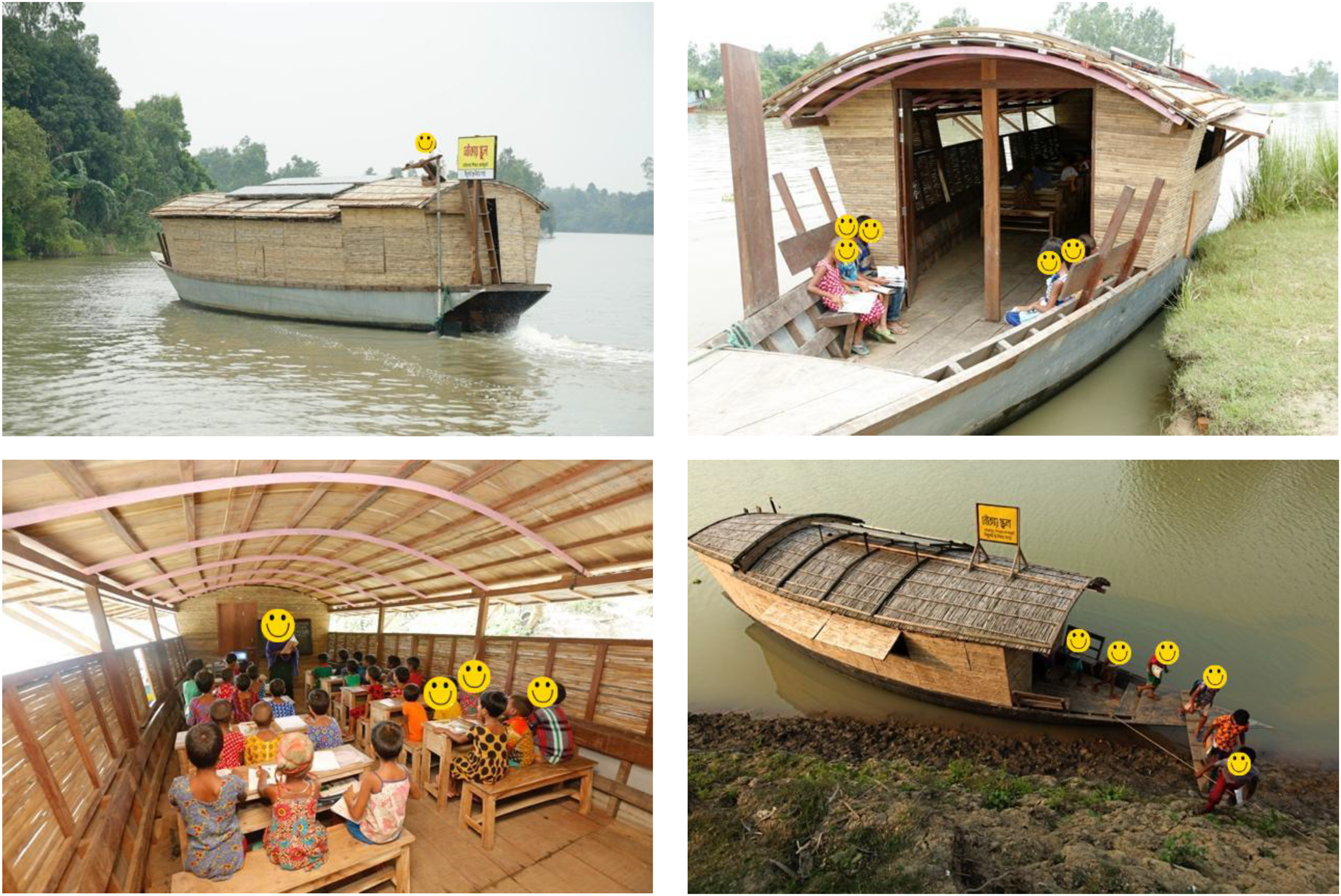
A floating school introduced by the Shidhulai Swanirvar Sangstha. (Photos provided by Abir Abdullah, Shidhulai Swanirvar Sangstha.)
Inspired by Rezwan's innovation, some countries have introduced their own versions of floating schools (Rezwan, 2015; Schiller, 2014). For example, in Vietnam, floating schools have been deployed to teach computer skills and financial literacy to disadvantaged youth living in the remote areas of the Mekong Delta Province, transforming the lives of the locals (Hanoi Times, 2014). In Nigeria, floating classrooms have been hailed as an innovative teaching method by the Makoko water community. Certainly, in view of climate change, initiatives such as floating schools have generated sustainable and ecological solutions capable of satisfying the social and physical needs of the community (Okeke et al., 2019; Riise & Adeyemi, 2015). In Zambia, the establishment of floating schools in the Malabo district had a discernably positive impact on the class attendance of students (Mateo, 2019). The floating school model has also been replicated elsewhere, including Indonesia
Building Resources Across Communities (BRAC), a Bangladesh-based international development organization, has developed its own version of a floating school to address “a local problem with a local solution” (Hosain, 2017). In the northeastern region of Bangladesh, the haor basin—a bowl-shaped natural wetland—has relatively fewer primary schools than other parts of the country, with many villages lacking primary schools altogether. Difficulties in communication and transportation have made it impossible for students to attend school regularly in these localities. The haor possesses unique hydro-ecological characteristics. The haor is submerged in water for six to seven months of the year (Suman et al., 2014). It is transformed into a massive body of water that generates powerful currents and waves from high rainfall and flash floods that occasionally capsize boats (Chowdhury et al., 2013). Understandably, parents are hesitant to send their children to schools located far from their homes. When dealing with extreme weather and flooding, they often pull their children out of school (Good Planet Foundation [GPF], 2013). In fact, seasonal flooding significantly contributes to irregular school attendance (Saleh, 2017), with some students leaving school altogether (Martin, 2010). Consequently, in comparison to the rest of the country, the hoar basin still has a disproportionately high primary school dropout rate of 44% (Bangladesh Haor and Wetland Development Board [BHWDB], 2012).
In partnership with Educate A Child (EAC), BRAC launched the shikkhatari (floating school) program on October 22, 2012, to provide mobile education to underprivileged children living in the haor basin (Ahmed et al., 2017). The shikkhatari is a steel-built, engine-driven boat measuring 42 feet in length, 10.5 feet in width, and 6.2 feet in height. Every shikkhatari has ten large windows to let in natural light and provide air circulation, and is equipped with toilets, handwashing facilities, and safe drinking water (Dhaka Tribune, 2017). Classrooms are adorned “with paintings, writings, handmade flowers, alphabets, word lists, and multiplication-tables” (Mehrin et al., 2014), the majority of which are collaboratively created by the students and their teachers (Mehrin et al., 2014).
After picking up students from their homes, the shikkhataris travel to an upland area, drop anchor, and conduct teaching and learning activities onboard. After classes end, the students are dropped off near their homes. Depending on the needs of the locals, the schooling hours can be flexible or fixed (HundrED, 2018). Adopting the “one teacher, one school” approach, every subject in the primary education syllabus is taught by a local female teacher. There are two reasons for this hiring preference. First, female teachers have been shown to devote more time and effort to students than male teachers (Nasreen et al., 2019). Second, local teachers can show up for work at school regularly and gain a genuine understanding of their students’ socioeconomic backgrounds, enhancing their sense of a community (HundrED, 2018).
Every shikkhatari can accommodate 30–35 students, at least half of whom are female (Nasreen et al., 2019). Although primary education in Bangladesh typically lasts five years, the BRAC has shortened this to four years. At the end of their fourth year, students are eligible to take the primary education certificate (PEC) examination, which allows them to be integrated into mainstream education (HundrED, 2018). Consequently, primary schooling is brought to students by a shikkhatari whenever and wherever the need arises. As children living in isolated areas cannot attend school, schools have responded by reaching out to them (Murphy & Sachs, 2013).
Following the initial success of the shikkhatari, the BRAC expanded the program to other flood-prone areas across the country. By 2017, 13,589 students—5,532 boys (40.71% of total) and 8,057 girls (59.29%)—were enrolled in 500 shikkhataris (Dhaka Tribune, 2017). Annually, shikkhatari students have outperformed their peers in the PEC examination with a pass rate of over 99%, which is higher than the national aggregate (see Table 1).
Pass rates of shikkhatari students and the national cohort in the primary education certificate examination, from 2017 to 2018.
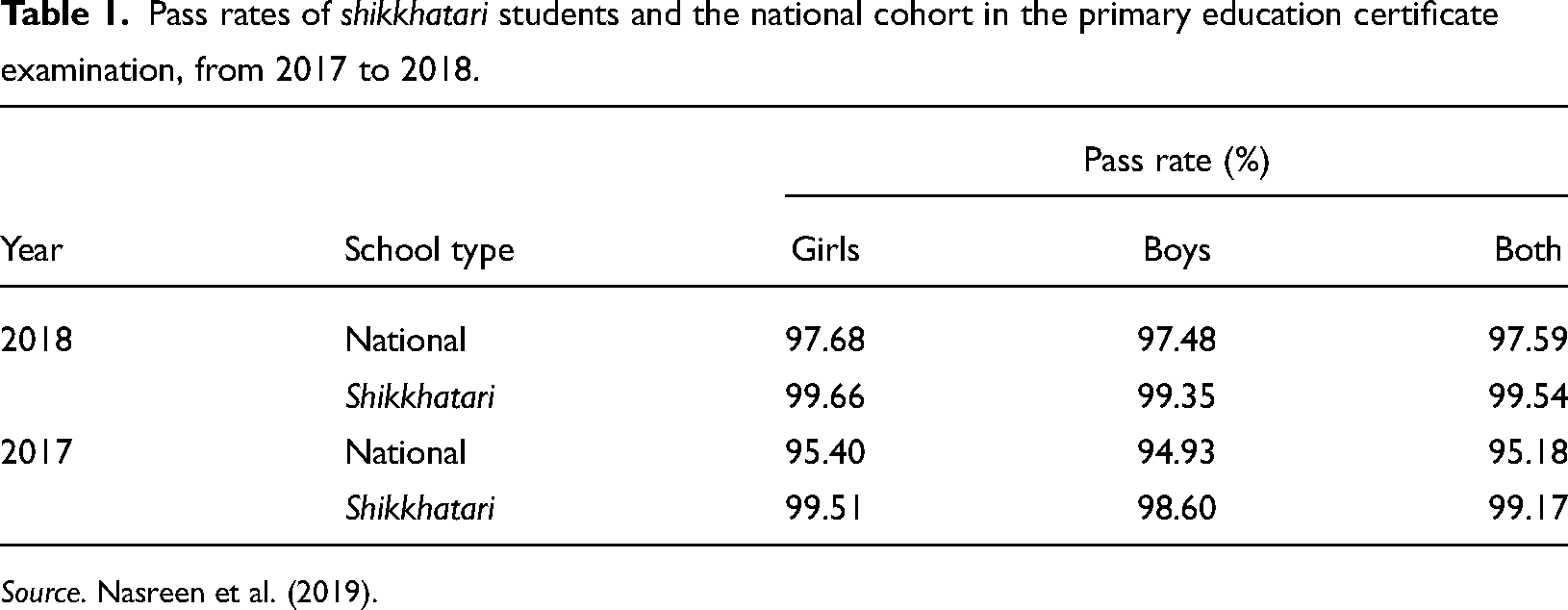
Source. Nasreen et al. (2019).
In the shikkhataris, students use textbooks developed by the BRAC until Grade 3; thereafter, the textbooks stipulated by the National Curriculum and Textbook Board for use in Grades 4 and 5 are used. As noted, students are not required to pay tuition fees and their study materials are supplied at no cost. Students are encouraged to participate in recreational or extracurricular activities, such as singing classes, recitals, dances, and art projects (Chowdhury, 2020). Teachers are trained to coach students on their physical and mental development, the impact of climate change, and various strategies to protect the environment (Anjum, 2020). Teachers and parents also meet regularly to discuss various social issues—including dowry, child marriage, child trafficking, and child sexual abuse—in order to raise community awareness of these matters (Chowdhury, 2020).
Although the shikkhatari was conceived of as a simple and low-cost solution to provide access to education in geographically challenging areas, it can be improved to create larger-scale initiatives. In 2017, the Finland-based nonprofit organization, HundrED, recognized the shikkhatari as one of the top 100 innovative projects in the world. Certainly, this indigenous initiative (Ibrahim, 2015) has significantly benefitted the haor basin by removing the constraints that children face “in accessing their basic right of education” (Ahmed et al., 2017). Students unable to attend traditional schools due to seasonal flooding or other water-based barriers can benefit from the year-round instruction provided by the shikkhataris, particularly because this initiative eliminates the cost, time, and safety concerns of parents in transporting their children to regular schools. Consequently, the enrollment rates in shikkhataris are significantly higher than the national average for school enrollment. Moreover, shikkhataris have greatly encouraged girls to pursue education (Mehrin et al., 2014).
Many isolated or marginalized communities rely on indigenous knowledge in order to survive (Loewen & Kinshuk, 2012). Throughout the world, the adoption of indigenous knowledge as a means of promoting development in rural communities is recognized as a viable option (Briggs, 2005). The floating school is a product of indigenous knowledge that aims to directly achieve educational equity. Floating schools allow rural children to avail their fundamental right to education. This approach can be replicated in other communities facing similar challenges caused by seasonal flooding, extreme weather, and climate change (Ahmed et al., 2016). The floating school model is a successful and sustainable solution to address a local problem. Therefore, more efforts should be made to explore economical indigenous solutions capable of achieving genuine change at the micro level. In flood-prone areas, the floating school has shown its potential to overcome socio-environmental vulnerabilities that cannot be addressed by traditional solutions. Essentially, the floating school model can serve as a reference for policymakers seeking to introduce and implement educational changes in flood-prone areas.
Footnotes
Contributorship
Md. Bayezid Alam conceived the idea of the study and drafted the manuscript. Zhiyong Zhu supervised the writing process, critically reviewed the entire manuscript, and provided comments and ideas. Both authors contributed to the finalization of the manuscript and responded to the reviewers’ comments.
Declaration of conflicting interests
The authors declared no potential conflicts of interest with respect to the research, authorship, and/or publication of this article.
Funding
The authors received no financial support for the research, authorship, and/or publication of this article.
