



Abstract
Purpose
This research is an interview-based study that captures the academics’ perspectives toward the planning and design of an interdisciplinary General Education Curriculum for undergraduate students in the Chinese context, using the Common Core Curriculum at the University of Hong Kong as a case study.
Design/Approach/Methods
A total of 28 academics with various levels of academic ranking, disciplinary context, proven teaching excellence, and research productivities were individually invited for and consented to a semi-structured and face-to-face interview.
Findings
This article suggests four fundamental and interrelated dimensions for consideration when structuring an interdisciplinary General Education Curriculum, namely, how to design, what is worth learning, how to learn and teach, and how to know students have learned. It is suggested that the ideal curriculum should remain coherent and coordinated, broad and balanced, as well as open and flexible, ensuring the capture of knowledge, skills, and attitudes, with the facilitation of active, authentic, and contextualized pedagogies and assessments.
Originality/Value
This article has the potential of providing insight for policymakers and educators around the world to better structure an interdisciplinary General Education Curriculum by creating an overall springboard for future discussion. They can also integrate these evidence-based elements and strategies into their everyday practices.
Keywords
Introduction
General Education Curriculum (GEC) can generally refer to the widening curriculum that aims at broadening students’ knowledge base and enhancing their fundamental competencies. Given its diverse and ambitious goals, many universities often employ an interdisciplinary approach in shaping their GEC. The inclusion of interdisciplinary elements in the university curriculum helps enhance students’ critical thinking, problem-solving, self-direction, meta-cognitive reflection, as well as other higher-order thinking skills (Ivanitskaya et al., 2002). This is particularly crucial for newly admitted undergraduate students since they are often surprised by the potentials and ways in which university education can transform their thinking, identity, and perspectives. Lamentably, given the organizational boundaries that have long divided universities into highly specialized and differentiated institutions, any interdisciplinary attempt to transgress them in order to facilitate the unity and synthesis of knowledge remains challenging (Holley, 2009). Students are often expected to observe connections, recognize commonalties, and assess disparities in values, assumptions, and methods among themselves, especially when the interdisciplinary GEC still appears to be merely a chain of loosely connected courses. Therefore, students’ experiences and demonstrations of learning may not always align with the faculty intentions (Hursh et al., 1983).
Curriculum is one of the many ways for academics to organize, structure knowledge, and make it meaningful to students. Meanwhile, the success of any curriculum development hinges on academics’ commitment and dedication, as well as participation and input since they are portrayed as the “change agents” (Fullan, 1993). Although critical to the construction of an interdisciplinary GEC, discussion from academics’ perspective remains scanty in the extant literature, especially in the Chinese context. Most of the existing discussions either offer generic descriptions of GEC (e.g., Jaffee, 2012, 2013) or incline students’ perspectives toward GEC (e.g., Shek et al., 2015, 2017). Therefore, this study contributes to the field by soliciting academics’ diverse responses so as to shed light on the favorable conditions, associated ways, and possible challenges when actualizing the interdisciplinary GEC. Meanwhile, this study specifically employs the University of Hong Kong (HKU)'s Common Core Curriculum (CCC) as a single-unit and embedded representative case study, which is an illustrative prototype of university-wide interdisciplinary GEC in Hong Kong. According to Yin (2017), a case study focuses on a phenomenon situated within its real-life context, which is important when the boundaries between the phenomenon and the surrounding contexts are unclear and implicit. This best illustrates the fundamental nature of the development of HKU's CCC, which is constantly interacting with and responding to the surrounding and changing contexts. This article aims to highlight the diverse ways that an interdisciplinary GEC has been perceived and practiced among academics in terms of four fundamental questions of curriculum studies, namely, how to design, what is worth learning, how to learn and teach, and how to know students have learned, as they underpin the various facets of every curriculum. In Bernstein's (2018) words, all these four key questions pinpoint the elements of curriculum, pedagogy, and assessment, which constitute the three key interlocking pillars that support any educational system or practice.
Literature review
Common Core Curriculum at the University of Hong Kong
Since the 2012/2013 academic year, there has been a transition from the British-style three-year to the United States-style four-year undergraduate degree structure across all eight publicly funded universities in Hong Kong (Jung & Chan, 2017). This additional year aims to allow students to receive the widening interdisciplinary GEC that complements their highly specialized academic majors (Chan & Luk, 2013). While such broadening curriculum varies in each university due to their different missions, histories, cultures, educational objectives, and future development plans, they are common in terms of offering interdisciplinary learning experience, highlighting the appreciation of diverse cultures, advocating active community involvement, and facilitating whole-person development (Lanford, 2016). Among all these eight universities, HKU's CCC is the most illustrative one in demonstrating Hong Kong's approach of delivering an interdisciplinary GEC. Unlike some institutions that allow for extending and expanding an existing GEC, the CCC is newly initiated by HKU as a complement to its long-standing status as a comprehensive research-intensive institution. As its name implies, the “common” part mainly refers to the sustainable process of delimiting the scope of rigid curriculum, while the “core” component draws students’ close and special attention to the commonality of human experiences of profound significance to humankind as core values. Meanwhile, there is a close alignment between CCC's four program learning outcomes, CCC's four goals, and HKU's six university educational aims (see Table 1). Basically speaking, HKU's CCC is a widely shared curricular instrument across all the ten teaching faculties and their associated departments or schools. All these courses are designed based on the broad array of current faculty interests and available academic resources, whereas academics are encouraged to build on their discipline-field expertise and offer interdisciplinary orientation in both scope and method. While most of these CCC courses are developed by individual academics, some are developed by faculty design teams or even involved with inter-faculty collaborations.
Alignments among the Common Core Curriculum’s four program learning outcomes, Common Core Curriculum’s four goals, and the University of Hong Kong's six university educational aims.
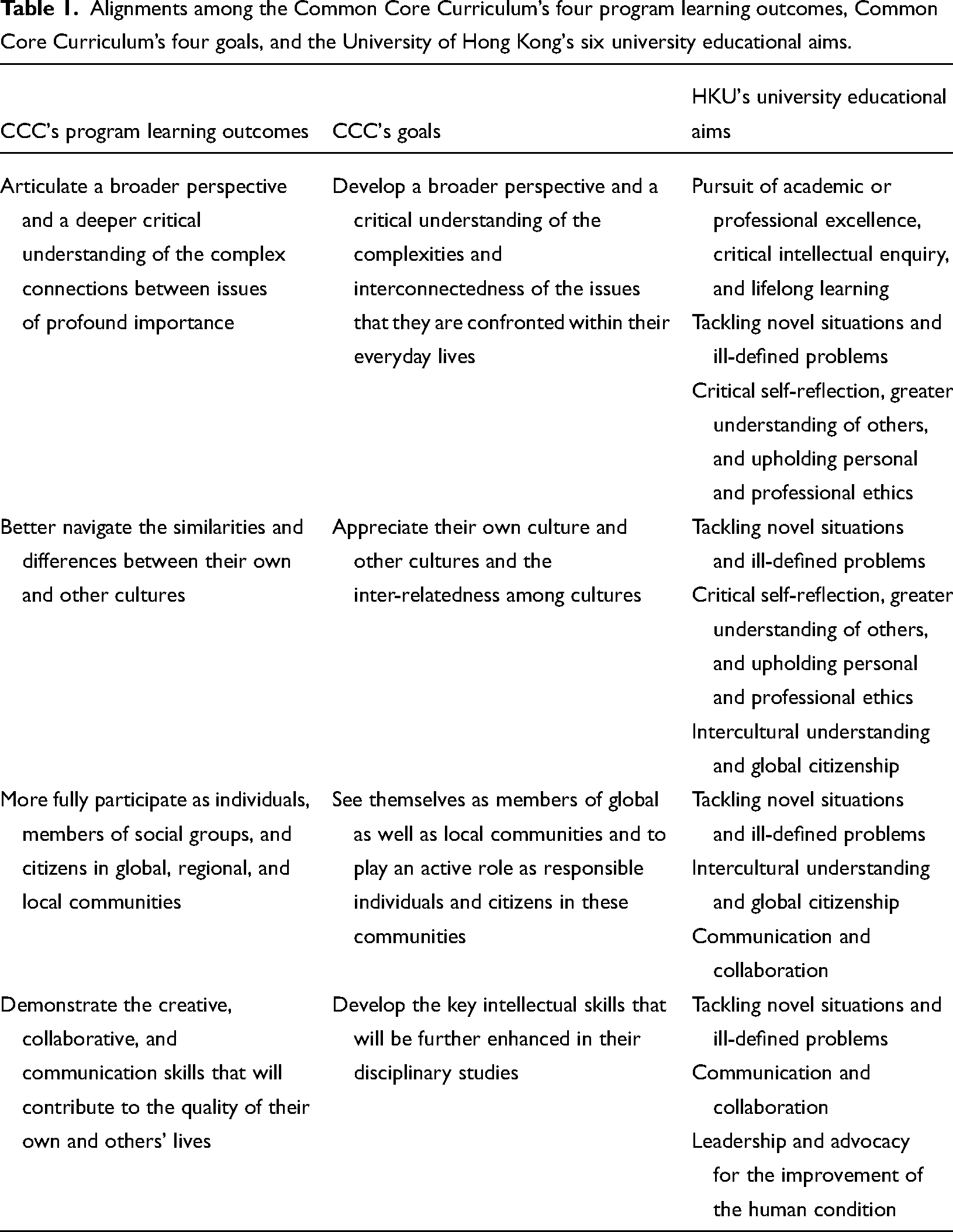
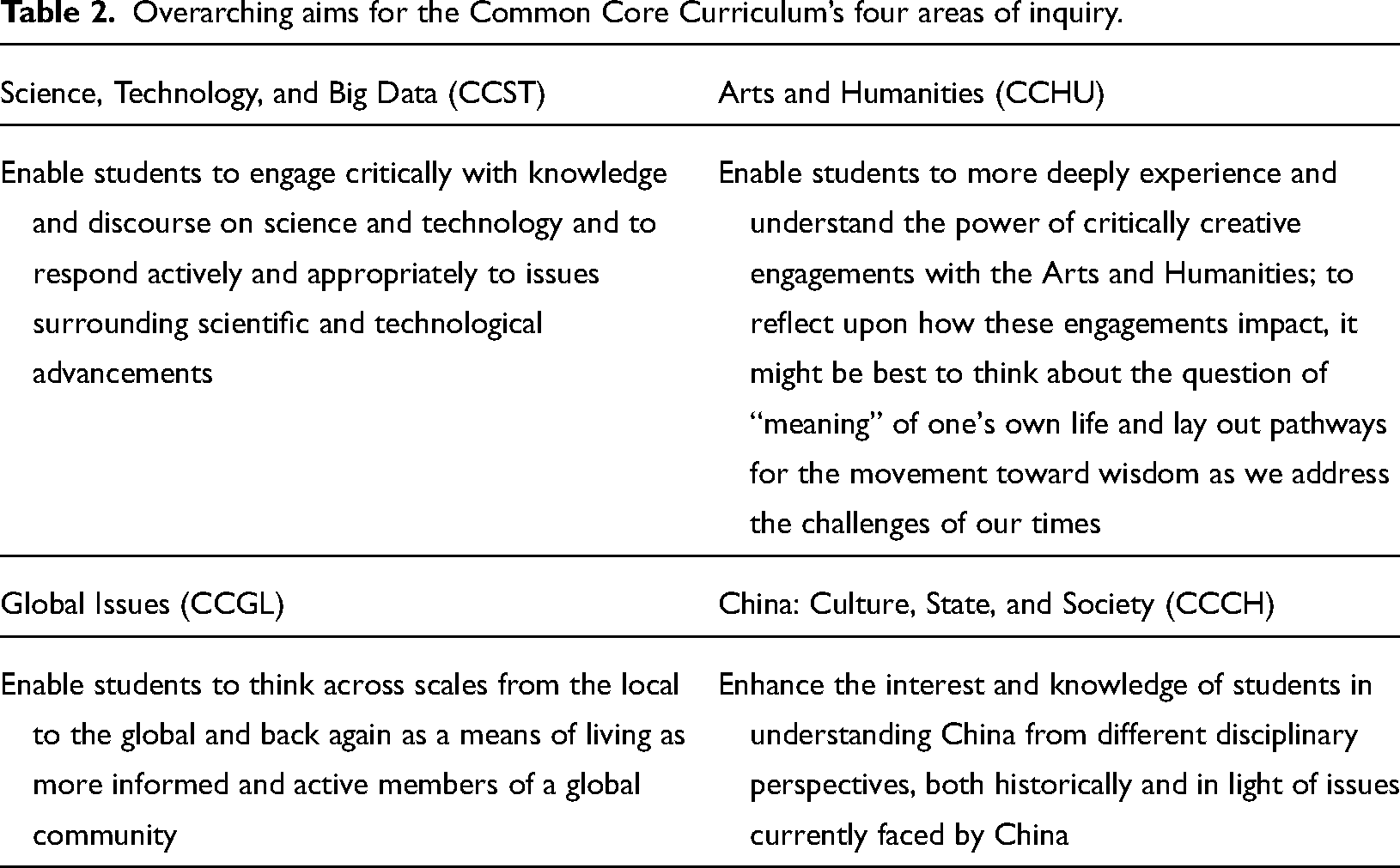
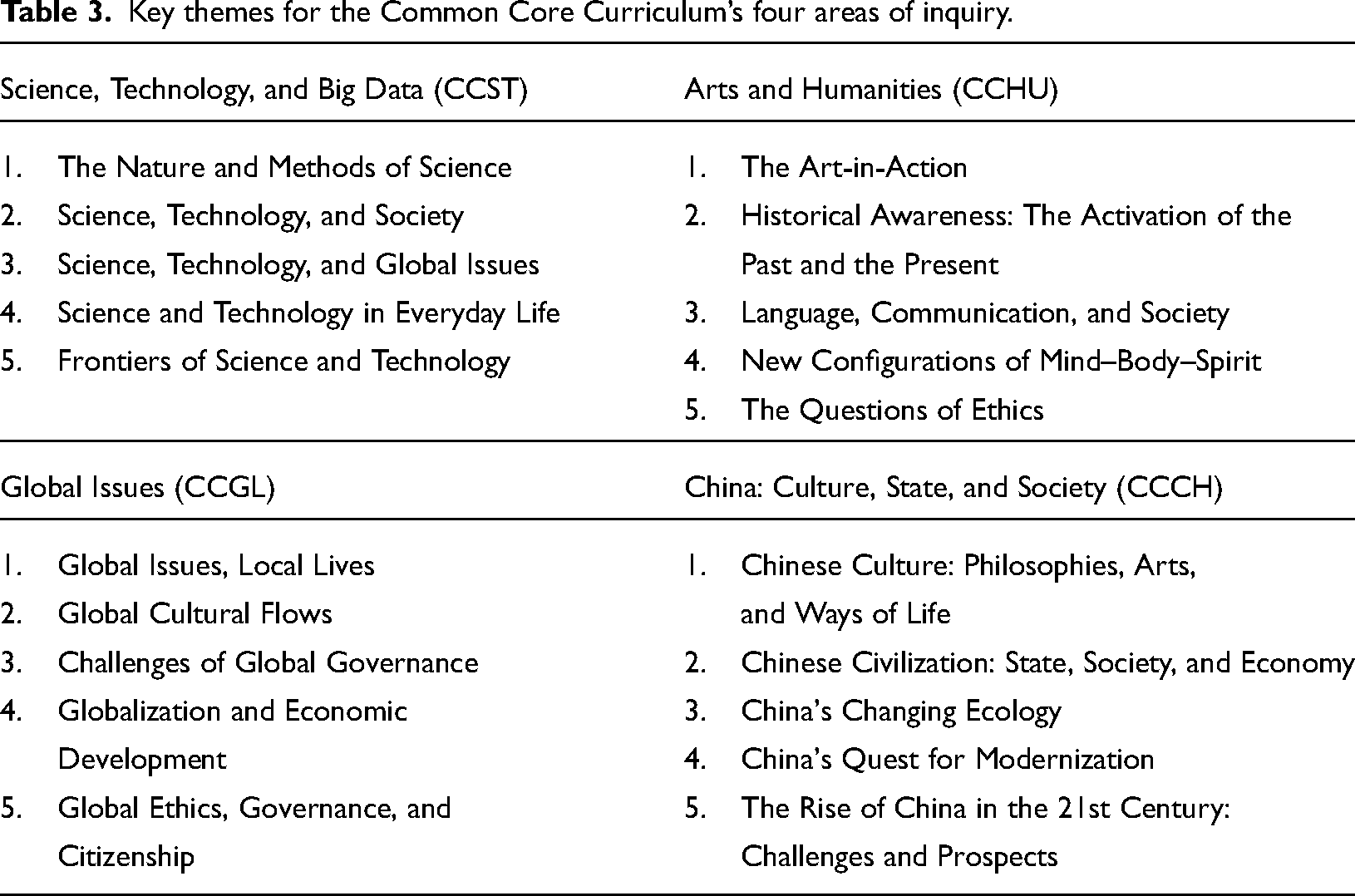
As one of the graduation requirements, all HKU undergraduates need to choose six CCC courses (or four for those studying double degree programs) out of a list of around 190 courses across four areas of inquiry (AoIs), including (1) Science, Technology, and Big Data; (2) Arts and Humanities; (3) Global Issues; and (4) China: Culture, State, and Society. Each of the four AoIs has its overarching aims and key themes (see Tables 2 and 3). In terms of student enrollment, almost all regular CCC courses are capped at 120, while the remaining few are either mega-courses capped at 288 or experiential learning courses capped at 80. Several courses are even designed in a flipped classroom format, whereby students need to prepare by watching videos before their interactive classes. Nonetheless, each CCC course will normally be further broken down into 10 to 24 small tutorial groups with 12 members. Generally speaking, all students need to take at least one course from every single AoI and two more self-selected courses from two different AoIs for those who need to study six CCC courses. A CCC course aims for a workload of around 120–140 hours, which normally consists of 36 contact hours, 12 tutorial hours, while the remaining hours are allotted for other learning activities. The normal arrangement is a two-hour lecture and a one-hour tutorial every week. In short, the total credits for the CCC account for around 15% of the total credits of HKU's undergraduate degree, implying that the interdisciplinary GEC is not a secondary and marginal component.
Overarching aims for the Common Core Curriculum’s four areas of inquiry.
Key themes for the Common Core Curriculum’s four areas of inquiry.
Curriculum conceptions of interdisciplinary general education curriculum
The most fundamental issues regarding curriculum organization are the use of scope, sequence, continuity, and integration to overcome any confusion and fragmentation (Leung, 2012). This is important for planning the interdisciplinary GEC, whereas a coherent and coordinated curriculum requires the vertical continuity and smooth progression between secondary and university education and freshmen and senior students. The same applies to lateral coherence among various courses within and even across the curriculum, given that there is a broad array of courses for students’ selection (Jin et al., 2019). GEC should remain as one of the fundamental pillars of a holistic and competent undergraduate education, instead of merely an “add-on” or a “plugged-in” without any explicit and clear focus (Weick, 1976). Moreover, an ideal curriculum should remain broad and balanced, as well as open and flexible. While it should cater to students’ diverse needs, interests, and abilities, it should simultaneously reflect and respond to the series of local, regional, and global contexts and changes. In order to achieve these ends, a curriculum is usually made up of three interlocking elements, namely, knowledge, generic skills, as well as values and attitudes (Stabback, 2016). Most crucially, GEC should stimulate, inspire, and guide students to broaden their knowledge, and cultivate a mature and analytical mind, on the basis of scholarly evidence and theoretical underpinning. Furthermore, teachers need to cultivate a repertoire of strategies and the ability to explore and employ a wide range of pedagogical approaches that can offer students varied, meaningful, and engaging experiences. These include direct instruction to develop students’ solid foundation of knowledge and skills, inquiry learning to cultivate students’ thinking skills and enhance their engagement in and ownership of learning, as well as co-construction to enhance students’ meaningful learning and learning partnerships (Wrenn & Wrenn, 2009). Therefore, academics take up crucial roles in facilitating interdisciplinary GEC learning and teaching. Lastly, it remains essential to align assessment design and methods and curriculum and learning objects so as to avoid any negative washback effect that hinders students’ learning quality and motivation. As learning processes and products are equally important, both assessment for and as learning, that is, formative assessment, are advocated especially in interdisciplinary GEC. The former emphasizes showing what and how students learn and helping students continuously improve, while the latter allows students to think about, monitor, and adjust their own learning (Carless, 2015).
Research methods
Research instruments
This interview-based study employed the semi-structured interview format to offer the author some structure and guidance. The interview protocol is essential in ensuring similarity in terms of topics and questions, which can ensure consistency and comparability across the series of interviews and allow smoother and more efficient subsequent data analysis. All interviews started with the author asking factual background questions as a quick warm-up, including the scope, content, and arrangement of CCC course(s) that academics have been teaching. The author subsequently moved on by asking much broader and more open questions that facilitated depth and reflection, such as (1) What do academics consider as the core values of interdisciplinary GEC and how do they adopt, and if so, to what extent such values in CCC course(s) they teach? (2) What do academics think are the strengths and limitations regarding CCC's design and implementation? (3) How do academics think the CCC can evolve to further strengthen or enhance interdisciplinary learning and teaching.
Research informants
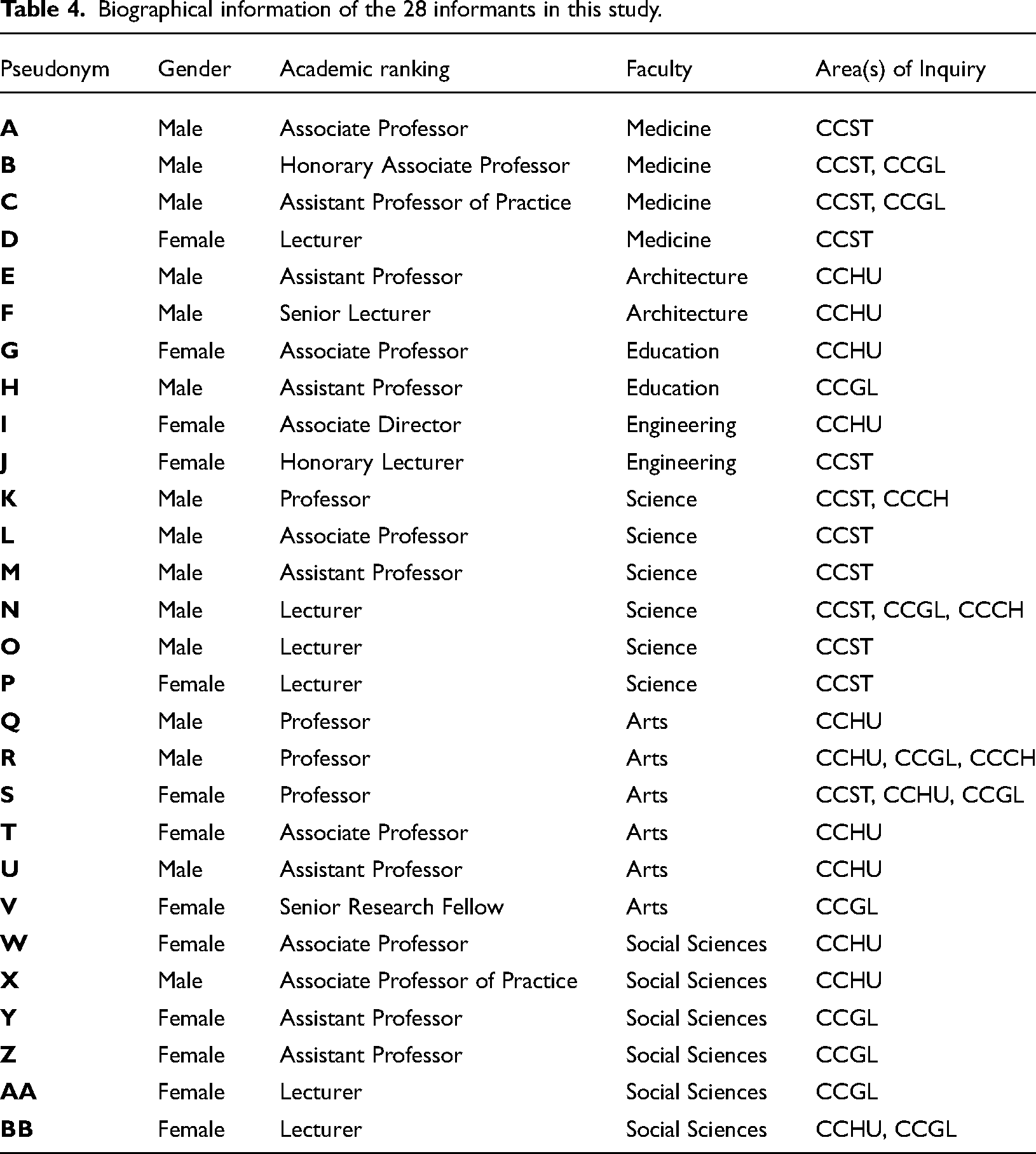
In this study, a total of 28 academics across different HKU faculties, departments, or schools were individually invited for and consented to the interviews, which were all assigned with alphabetized pseudonyms throughout this article. Although at first, it aimed at including at least two informants from each faculty to ensure a balanced picture, the voices of Faculties of Law, Business and Economics, and Dentistry could not be included eventually. Nonetheless, the use of small samples can facilitate the author to be closely affiliated with the informants, which helps increase the overall validity of in-depth and fine-grained inquiry in naturalistic settings (Crouch & McKenzie, 2006). All informants are selected for interviews based on four prominent criteria, namely, academic ranking, disciplinary context, proven teaching excellence, and research productivity (see Table 4). The use of maximum variation purposive sampling can find out mutually shared patterns cutting across different cases and derive their implications from having emerged out of heterogeneity (Palinkas et al., 2015). This deliberative and non-random method helps the author attain a deeper understanding of the context. Meanwhile, this can ensure the representativeness and diversity of the overall institution and individual academics, which is prevalent among many applied educational research studies. In the end, all interviews were conducted face-to-face in English between March and August 2019. All sessions were conducted in a conversational manner and lasted for around 20–80 min.
Biographical information of the 28 informants in this study.
Data analysis
Merriam and Tisdell (2015) advocated that qualitative researchers should carry out data analysis simultaneously with data collection, which allowed them to organize data chronologically for deeper analyses. All the interview data transcribed by the author have mainly gone through a four-stage systematic qualitative analysis. The transcripts are first familiarized by the author through searching different meanings in relation to the research questions and taking notes of the initial ideas repeatedly. Afterward, all the raw data are carefully digested and compared to be coded and organized into initial meaningful groups. The length of an analysis unit can vary from the informant's claim to short dialogues between the author and the informant. Through data coding with as many groups as possible, the preservation of different meanings can be maximized. At this stage, all these initial codes are labeled with a few keywords, phrases, or even shortened sentences. Thereafter, an axial coding method, which allows connections to be made across the initial codes, is utilized. The central categories that are most pertinent to the research questions and agendas are subsequently identified. This stage is guided by making sense of the concepts based on the proposed four fundamental questions of curriculum studies as discussed in the previous sections, which include how to design, what is worth learning, how to learn and teach, and how to know students have learned. This can guarantee that all categories remain authentic and appropriate. In the end, a systematic thematic analysis is conducted to determine all the properties and relationships of the distinct categories across a wide range of interview cases.
Research findings and discussions
How to design?
Explicit and clear overarching learning purposes. Situated in the university's foundational year, CCC is planned to assist incoming students in bridging the gap between senior secondary studies and undergraduate education. To ensure a smooth interface, CCC sets the appropriate tone for academic expectations and assists students in adapting to the new learning environment with different learning modes, academic expectations, as well as rules and regulations. Students can gradually cultivate ownership of their scholarly pursuits through a series of active learning tasks and multiple formative assessments. Moreover, CCC aims to build students’ fundamental competencies and capacities, and it contributes to their intellectual inquiry, career success, and lifelong learning, as reflected by the series of CCC's program learning outcomes and goals previously shown. Furthermore, CCC's implied function is empowering students to have more discretion in selecting various academic domains upon admission. This is important when students are now streamed and locked into an increasingly specialized and professionalized academic program with strict and specific paths, which might limit their opportunities for exploring more individual interests, career choices, or even further studies (Chan & Luk, 2013). Students need CCC's broadening intellectual experience, which helps fill up the current gap in early tracking and training them in designated disciplines. CCC also helps prevent their perspectives from remaining narrow and superficial, which might hinder them from becoming truly educated and cultured individuals as GEC's ideal mission. Informants I and K have succinctly captured the essence of CCC in the following manner: I think over here at the Asian region, we tend to have kind of streaming students very early onto different majors. But I think this is an instrumental view. However, my idea of education is really the whole-person approach that should be based on how you can help a person develop their potential fully and give them as many opportunities as possible. (Informant I)
1
CCC removes the blinkers by opening up students’ mind to very different ways of thinking, looking at things, perspectives, people of different backgrounds, and different knowledge base. It gives students the opportunity to actually think outside of their specialty and use different kinds of skills that they will develop as a result. (Informant K)
Concrete positioning of the curriculum within the university. Since CCC represents the interdisciplinary education system within HKU, academics need to have an explicit and clear picture regarding what the curriculum exactly is and should achieve, and all people involved in the CCC are responsible for shaping the curriculum. The recognition and acknowledgment of its positioning within the university should be the perquisite for CCC's success, followed by working out the specific strategies to realize the visions and goals. Without this, the curriculum would become slightly piecemeal and fragmented in orientation since academics have differing or sometimes conflicting viewpoints regarding what an interdisciplinary education should entail. To avoid this problem, CCC's purposes need to be further articulated by the university administration, which subsequently allows for a highly cohesive and aligned system with a mutual set of discourses and visions within and across various AoIs and a wide range of CCC courses. This important perspective is reflected by the claims made by Informant C: Unfortunately, what I learnt from those one or two retreat documents prepared by CCC Office is that they are primarily focused more on the variety of topics, such as classroom management and student engagement, rather than a clearer picture what interdisciplinary education should achieve. What picture would the institution and CCC like to draw is something that I cannot see from all these materials. (Informant C)
Coherent and integrated structural design. What underpins CCC's design is determining what is worth learning in the university's foundational year, meaning that provision and choice of modules are highly relevant. Although no detailed regulation and guidance are given on the nature and group of choosing courses, the purposeful inquiry across disciplines is already institutionalized into the curriculum structure (Staley & Trinkle, 2011). The four closely related rather than mutually exclusive AoIs are in place to organize the entire CCC, which allows students to bear representative and balanced exploration rather than partial and fragmented exposure across the intellectual spectrum. The CCC Committee will also review the overall course menu regularly and come up with some specific themes in a view to fill the existing gaps of the curriculum. Recently, there has been another initiative known as the Common Core Clusters and Transdisciplinary Minors, including (1) Sustaining Cities, Cultures, and the Earth; (2) The Quest for a Meaningful Life; (3) Creative Arts; (4) The Human Life Span; and (5) Gender, Sexuality, and Diversity, which aims to offer students a personalized experience of reinforcing and appreciating the specific thematic interconnectedness within the program. All these allow students to attain a consistent interdisciplinary learning experience, especially when they remain free and flexible in selecting a few courses out of the lengthy list under the distributional requirements. Informant H has praised CCC's rigorous design as follows: I think what is being a success is of course the strength and consistency of all the different CCC courses in all the four AoIs. The diversity of choice when students have amazing choice of courses for them. (Informant H)
Constructive alignment through the generic learning outcomes. When designing new CCC courses, all academics are required to consider and outline the fundamental issues that the course will address; the connection between the course objectives and the stated goals of CCC as a whole, as well as the chosen AoI; the key assessments, practices, and perspectives that will be utilized; as well as a detailed course syllabus, including what will be covered under each topic with a week-by-week schedule, readings, viewings, and fieldwork. Such a backward design approach requires academics to align all ideas, perspectives, and practices with the requirements imposed by the university (Wiggins & McTighe, 2005). This intentional integration of knowledge can prevent the potpourri hazard, whereas students perceive CCC as a bunch of random content or disconnected courses with the absence of inherent scope and sequence (Jacobs, 1989). The more abundant choices students receive, the more challenging and abstract for them to map out the underlying connections of content across various disciplines meaningfully. Therefore, such thorough and careful planning with the contextualization of the courses into the entire CCC landscape helps cohere all courses into a “common” or “core” experience among students. This also discourages students from treating CCC courses as opportunities to learn a bit about everything or satisfy another graduation requirement (Rutledge & Lampley, 2017). Nonetheless, there are some reductionist concerns among academics, whereas these learning outcomes are occasionally treated as something restrictive and prescriptive, which hinders one from trying out many new things throughout the continuous and non-linear CCC learning trajectory. This potential concern is raised by Informant H as follows: If I Google the CCC webpage, I notice that there is a teacher handbook with different themes and sub-questions. I would suppose those questions to help teachers to be creative. However, when I go through the application process, I will see those themes and sub-questions being restrictive and prescriptive. Instead of generating more possibilities, these questions somehow narrow the space I can create the course. (Informant H)
Follow-up interdisciplinary initiatives and seminars. Unlike disciplinary courses with sequential logics or vertical progression across modules, interdisciplinary GEC often suffers from the inherent problem of offering students a one-off and limited exposure to the beauty of the interdisciplinary world and leaving no subsequent continuities and coherence to further utilize and deepen them. In view of this, some advanced initiatives with CCC perquisites, such as the Common Core Research Seminars for on-campus research-oriented experiences and Common Core Global Experiences for students working away from Hong Kong, recently emerged for enriching some students’ interdisciplinary learning experiences. These are mechanisms to ensure linkage and impact on ensuing years, especially when CCC's value and influence may be long-term, given that students’ critical incidents, prior experiences, insightful inspirations, and personal reflections can be possibly remembered, retrieved, and utilized by students themselves upon the completion of CCC courses. Meanwhile, CCC's case shows that the curricular scaffolding on offering iterative chances for students to cultivate and consolidate their core interdisciplinary competencies should be thoughtfully staged and consistently supported, mainly because those influences of the students’ scholarly development are both multiple and cumulative (Graybill & Shandas, 2010). Informant E appreciates the delivering of more advanced interdisciplinary learning opportunities for students through CCC: I think it is interesting to allow some students having some CCC options in their third or fourth year so that students who are interested in a specific field maybe had done three of four CCC courses in that field can take a more advanced one, which could be smaller classes. (Informant E)
Coherent coordination with specialized disciplinary majors. Although it is not explicitly planned or communicated in the design, the CCC should be inherently integrated together with the rest of the programs as a comprehensive university education. Initiating an interdisciplinary curriculum like the CCC never aims at crowding out but instead complementing and facilitating the more structured foundations for deep understanding of the disciplinary knowledge. Under the bigger organizational problem of the loosely coupled system, the linking and looping narratives established between the interdisciplinary and other major-based curricula are often missing across many universities (Weick, 1976). Therefore, such a curriculum may become an arbitrary addition to the undergraduate degree. There should be more considerations of how the interdisciplinary learning acquired through CCC setting can be further transferred, reinforced, advanced, and refined within students’ specialized studies. Informant R mentions a potential linkage between CCC courses and other disciplinary major courses: We try to force people to think out of the box and then try to re-evaluate how to teach and try new things. And I think by and large that is what CCC courses became a kind of space that you do stuff that you did not dare experiment in major courses. And actually, years later what we found is that students would come up and say that this CCC is more engaging than my teaching major. What we would also find is that teachers who had experience in CCC teaching would restructure their disciplinary teaching to try to incorporate innovations that they had pioneered or piloted. (Informant R)
What is worth learning?
Optimal balance between disciplinarity and interdisciplinarity. Both disciplinarity and interdisciplinarity should be perceived and framed more from a symbiotic perspective, especially when academics and students engage with the complex and unstructured knowledge domains in the interdisciplinary CCC context. They need to resort to disciplines for elaborating on and justifying concepts, as well as revealing differing or even conflicting meanings expressed through some similar terms. Meanwhile, all the knowledge, theories, and methods that are found within the existing disciplines can be further integrated and combined, or even criticized and challenged, which contributes to new insights and transgression of existing ontological and epistemological boundaries (Stentoft, 2017). Therefore, one can gain insights into their disciplinary background's strengths and weaknesses and acquire the self-awareness to offer better outcomes. The inherent biases of a discipline can be resolved through adopting and adapting other disciplines (Wächter, 2012). Informants L and X have portrayed how to link disciplinarity and interdisciplinarity in a CCC context: It is important to think about putting themselves in the nexus of various disciplines, as that is where creativity will thrive and innovation exists. I think CCC is important for visualizing the nexus and considering what specialty can they bring into that area to create something. (Informant L)
Looking just the very fact that whoever developed this CCC in HKU campus had enough foresight to realize we have to cross boundaries, whereas there cannot be silos anymore between our individual faculties. We have to value what we do individually, but at the same time, you know there is no specialist that does not understand the greater world. (Informant X)
The rigor of interdisciplinary learning lies in what, why, and how materials and insights across different disciplines could be best integrated or even intersected. This is not only bringing various disciplinary elements together but also engaging with wider influences that affect the perception of producing and disseminating knowledge. Academics need to put their very advanced and focused subject area into the broader and more holistic thinking process, such as the implications in other aspects and impacts on the larger environment. This also prevents CCC courses from turning into a condensed version of introductory courses that present academic ideas in a lower level of complexity. Unlike Hong Kong that is capable of starting everything from scratch, many other so-called interdisciplinary GEC courses are more tokenistic as their former statuses are prerequisite introductions for respective majors. Instead of having the course design informed and guided by the prominent learning outcomes, the latter are retrofitted to the current curriculum, which can result in tenuous relationship and considerable tensions between the two. Informant N suggested how interdisciplinary learning could be attained through the comprehensive planning of CCC courses: So, your research may be very advanced or focused in a single idea. But I think CCC may help you to look forward to other perspectives, so maybe I am devising new materials and bringing into CCC, what I should do is actually explore the implications in the other aspect. (Informant N)
Nonetheless, the challenge of structuring an interdisciplinary GEC course is how to strike an appropriate balance regarding the specific disciplinary knowledge. On the one hand, any unreasonable demand of prior knowledge will increase the students’ workloads and subsequently kill their curiosity. On the other hand, academics also do not want students treating the CCC as a set of watery courses for them to learn a little about everything outside their fields. Therefore, although the CCC is framed as a foundational curriculum that emphasizes breadth more than depth, all the interdisciplinary mentalities should be learned on the basis of some specific content as the requisite foundation. This can sequence the learning tasks in a structured and progressive manner, thus cultivating the capacity of students to handle far more complex problems later on. Many CCC academics are devoted to balancing their commitment to their own discipline with the interdisciplinary conversation that they are supposed to have with their colleagues and students. Informant S describes that the design of the course content for CCC courses is always like maintaining a dynamic balance: Actually, it is always a balancing act. On one hand, you want to be technical enough so that they feel like I have encountered an expert and learnt something from this expert. On the other hand, you do not want them to be intimidated, or feel like this is really a disciplinary class that only people who are film people really need to know. (Informant S)
Creation of strong and unifying interdisciplinary themes. The employment of thematic areas helps tie interdisciplinary elements together throughout the entire course (Lam et al., 2014). This can offer authentic, meaningful, and purposeful learning experiences for students when the content is rooted in their daily encounters and real-world contexts. CCC academics first select and present a wide range of daily issues, examples, analogies, and illustrations, which resonate with students as comparisons and contrasts for their courses. They subsequently boil down the underlying intuition and logic, which allow students to consider what informed judgments and potential applications from their sides and disciplines might be out of their own reflections. The process starts with where individuals are, whereas the interests, experiences, and cultures are utilized to create bridges into the inquiry space. Meanwhile, this helps students to see that all inquiry questions never exist in a vacuum. They can also practice transferring the knowledge and skills among themselves, especially when one understands new ideas through the observation of relationships, as well as formulation of connections with their own prior knowledge and experience. Informants R and AA describe how their CCC courses are created through interdisciplinary themes: These are themes that will be as accessible and applicable to students from any kind of culture. Using these sort of big and broad themes gives us a lot of flexibility to tailor it in a way that I will speak to a general audience. And we do have some specific case studies, say practices, that are connect to the themes we are talking about. (Informant R)
Through understanding this rather global topic of sustainability, they can see how their own profession be connected to this central theme. And I think this is very important. Without that, it would be difficult for the student to stand outside of their own profession, and then see what are the respective contribution they can do to achieve this global agenda. (Informant AA)
Strong emphasis on generic skills and dispositions. The fundamental and intertwining ways of learning and employing generic skills and dispositions are considered as important throughout the CCC. Students are expected to learn their respective interdisciplinary content to strengthen the development of these skills and dispositions. Meanwhile, they are expected to use these learning strategies to construct their interdisciplinary content knowledge. According to DeZure (2010), interdisciplinary learning requires connecting skills and knowledge from various sources, applying theories to practices across different settings, reconciling diverse and competing perspectives, as well as comprehending issues in context, which all require the involvement of a wide range of generic skills and dispositions. Informants I and K share their perspectives on how the CCC helps students to strengthen their skills and dispositions: This is why I think why most CCC courses are project-based. You mix the students up, and then each of them is going to bring their own prior knowledge and experience in that subject. And they can kind of talk to each other to create dialogues, and appreciate how people have different views and how problems can be approached from different angles. And then if you are trying to address an issue or solve a problem, then you realize that I do need different types of knowledge and skills. (Informant I)
The goal of CCC is critical thinking skills for someone to be able to look at their world, understand why things happen, interrogate them, ruthlessly ask hard questions, use the scientific approach to get answers, but also creativity as well. I think the value of seeing their interconnectedness that ultimately will receive a truth to us becomes important. It is difficult to figure out and deconstruct in some ways without a template, especially things are different in each specific circumstance. (Informant K)
Thorough consideration of relevant values and dispositions. There are often concerns that learning in universities is minimized to a set of decontextualized skills and transferrable competencies, especially when the current educational pursuit in higher education is slightly more applied. As a result, students seldom undergo any systematic value analysis and reasoning by taking context into account. A sophisticated comprehension of the course concepts and materials is insufficient for an all-round learning experience as expected, let alone touching upon the core essence and intrinsic values of interdisciplinary learning. Students should thereby learn how to support, refine, or even modify their thinking and analysis with the aid of those associated values embedded in those issues raised throughout the classes. Another issue is that disciplinary courses focus on some very specific types of values with regard to their respective intellectual traditions. Therefore, the CCC is crucial in enabling students to process and undergo the applications of values across various contexts, which often determine what to think and how to act in the everyday reality. Informants T and Z illustrate the importance of incorporating the consideration of values and attitudes into CCC's learning trajectory: But nonetheless as human, and maybe we have been losing touch with those perspectives and values, and I really want to preserve all of them and get all those activated in a classroom. I think it is also enlightening both the past and the minds of students at the end of the day. (Informant T)
I do try to tell my students learning how to use their emotional responses to the heavy issues we are covering in the class, in a way to push their analysis or in a way to ask interesting questions. (Informant Z)
How to learn and teach?
Incorporation of interdisciplinarity into daily decisions and processes. Central to interdisciplinary thinking, one needs to make attempts in articulating a synthesized and an integrated distillation of content, theories, and methods, which prompts multi-domain or multilevel understanding under an inclusive framework of analysis. Throughout all processes involving navigation and intersection, individuals can facilitate their capabilities in communicating, comprehending, and innovating across various disciplinary borders. One accessible way is by departing in real-world problems and encouraging one to come up with some effective and feasible solutions, including both the desirable outcomes and means of achieving them. The emphases are on how concepts are interrelated and how students construct knowledge in complex and ambiguous circumstances. This illustrates why the less important and lower hierarchically ordered factual and theoretical knowledge as emphasized in the disciplinary learning is minimized in the CCC, which can leave out deliberate space for thinking and analysis. Nonetheless, some of the most essential ones still need to be delivered through direct instructions since they are the necessary pre-conditions to allow for the emergence of high-ordering skills (Roblyer et al., 2003). Informant R shows how the CCC can translate different bodies of concepts into perspectives shaping everyday reality: At the very beginning, one-third of the course is talk about the ideal situation and overview picture. And then afterward, you develop your own roadmap. This is why in the course we introduce the overview picture, they develop something, and in a certain part of the course, we bring them back to the original, like why you would like to initiate change, what change have you proposed, and are they consistent. This is a mixed and diverse learning experience. I want them to experience and to think about, and to appreciate what happened in society. (Informant R)
Mutually supportive learning among academics and students. Both the learning processes of co-construction between academics and students and among students themselves throughout classroom interaction and group work are evident in CCC classrooms. Many learning activities can barely be achieved via mere personal problem-solving but require collaborative meaning-making, especially when the nature of interdisciplinary learning remains authentic and contextualized. All interaction, exchange, and co-exploration can help expand students’ perspectives and possibilities. Meanwhile, many academics are guiding and facilitating knowledge construction among students within their CCC classrooms. They are always eager to put forward a wide range of open-ended and thoughtful debates and questions in their classes, which can challenge the prior conceptions and generate contradictions among students, and facilitate further and more in-depth discussion among them. Informant L illustrates how academics can support co-constructive learning through the design of effective collaborative learning environments in the CCC classroom: We had students worked on different sections of a seminar that they would construct. You know Google slides, and I was watching students populate with images, content, and ideas. And I could comment on it in real time or we could stop and talk about what people are doing. Because you are getting them to do the research in the classroom, they are populating and giving you an output right there. And then they have to kind of work together to see how a little piece of the puzzle fit in with a larger piece. (Informant L)
Delivery of intercultural learning opportunities. Many CCC academics go further by navigating issues from the micro and local to the macro and global levels for discussion. They often cite some universal values and offer comparisons with experiences or examples from other parts of the world. These allow students to think about the numerous ways in which a certain issue can be understood differently inside and outside of their immediate living environment. This is important when many students are used to communicating and interacting mostly with those coming from the same cultural background. The CCC is useful for customizing some questions to encourage continuous dialogues and facilitate local-national-global interactions among students’ highly diversified profiles. Academics can offer their students various intercultural learning opportunities, which help unleash their accompanying cultural capital and cross-cultural experience (Zou, 2017). As many international students are simultaneously taking CCC courses, they can contribute their unique knowledge and experience, while local students can in return learn about interpreting the world from their unique cultures (Yang, 2016). Informants H and X particularly mention how the CCC facilitates the provision of intercultural learning opportunities for students: You have a much more diverse CCC class in terms of experiences and backgrounds. I always accept international students, which are mainly exchange students, to my class, as they often bring important perspectives from outside, that not always Hong Kong students have. (Informant H)
We are beginning to see a greater and greater division among students from different geographic areas like mainland versus local versus international students. I think it is one of the most harmful things that can happen. We go to people that understand our cultures and our language probably first, but at the same time, challenging ourselves and forcing us to get out of our comfort zones, and engaging people with different perspectives and experience is what the university environment is supposed to be about. (Informant X)
How to know students have learned?
Creation of learning-oriented assessment tasks. Compared to the rigorous requirements imposed on preparing for course topics, the overall assessment design of many GEC courses is often more fragmented and less integrated. Therefore, these individual assessment tasks might not attain the intended cumulative learning outcomes as envisaged when added together. Nonetheless, many CCC courses set an ideal example of utilizing a wide range of interactive and creative assessment practices, which help contextualize the continuous and dynamic interdisciplinary learning among students (Taylor & Nolen, 1996). These assessment tasks are aligned with the CCC's learning objectives, which require students to master and demonstrate a wide range of higher-order core competencies. Meanwhile, the setup for these assessment standards and tasks is following the pace of the evolving levels of competence and understanding among students (Boud & Molloy, 2013). The high-stake tests and examinations are deliberately minimized and avoided in the CCC, given that they are more like unintentionally or intentionally driving students to sustain route memorization of all the theoretical knowledge content as in their disciplinary courses. Informants E and Z show the possibilities of designing authentic and contextualized assessment tasks in the CCC: I would also say that the assessments are much more geared towards getting them to understand by experience, for example, drawing or taking photos of some of the issues we are looking at. It is more about assessing the engagement with what they are thinking about. (Informant E)
In terms of the assessments, I really want to get students thinking about these issues in a real-world or real-life context. With the assessments that I have used in the past like photo essays or engagement with community projects, it is really to get them thinking about these global issues and where they actually see them in Hong Kong, which is everywhere. (Informant Z)
Time and space for assimilation and reflection. Given CCC's interdisciplinary nature, students will regularly encounter new and unique problem situations, and the process of coming up with novel solutions offers a fertile ground for reflection on their actions. Meanwhile, many of the ill-defined and ill-structured problems embedded into interdisciplinarity require one to undergo reflective thinking (Schraw & Dennison, 1994). Given that students’ sense-making processes often remain subconscious, academics need to offer them purposeful and focused reflections that make their own mental models and knowledge awareness transparent. By thinking with their own minds and engaging with some higher-order faculties, students can crystallize and document what and how various parts of their interdisciplinary learning trajectory are gathered together. This is crucial for interdisciplinary education since it is often challenging for students to spell out their interdisciplinary education, given that there is no explicit and rigorous curricular content as their specialized majors (Richter & Paretti, 2009). Informant G shows how the CCC helps students be aware of their own thoughts and changes: What I am telling them is sync with their own minds. If it is not a bit loose, it is not regarded as liberal education at all. And if they are not thinking by their own mind, and if they are not proposing something out of their own reflections and investigations, then it is not a CCC. (Informant G)
Implications and conclusion
The incorporation of interdisciplinary GEC into Hong Kong universities represents a transformative shift from the provision of specialized academic training to holistic educational experience for students. This interview-based study aims to shed light on how such an important curriculum can be better developed, shaped, and improved, with the aid of the academics’ perspectives in terms of experiencing, understanding, managing, and navigating the HKU's CCC as an interdisciplinary GEC. The discussion of the research findings in relation to the four fundamental questions of curriculum studies, including how to design, what is worth learning, how to learn and teach, and how to know students have learned, reveals the need for academics to plan and design their GEC with careful and detailed considerations of the interlocked issues of curriculum, pedagogy, and assessment. After all, an ideal interdisciplinary GEC should remain foundational, extensive, coherent, integrative, and rigorous so that students can discover and explore different ways of thinking, inquiring, and looking for patterns and relationships of meanings, which are incorporated within and across disciplines (Hursh et al., 1983). Although this study attempts to make the composition of informants as diverse as possible, the picture presented by them might not be statistically significant. They serve more as preliminary insights for the design of future studies rather than as conclusive evidence. In the future, more sophisticated studies can be conducted by other researchers focusing on a more specific dimension of the curriculum covered in this study, offering some more interesting research methods like classroom observations and document analysis to consider how a CCC is implemented in the everyday reality when compared to the idealistic planning and design, or even comparing and contrasting the CCC with other similar GEC constructs introduced by other Hong Kong universities.
Footnotes
Declaration of conflicting interests
The author declared no potential conflicts of interest with respect to the research, authorship, and/or publication of this article.
Funding
The author received no financial support for the research, authorship, and/or publication of this article.
Ethical statement
Ethical approval for this study was obtained from the Faculty Research Ethics Committee of the Faculty of Education, the University of Hong Kong, on February 20, 2019. The written informed consent was obtained from all the informants involved in this study.
