




Abstract
Around the world, early childhood teachers are recognized as playing a crucial role in improving children’s everyday lives and strengthening their learning abilities. Consequently, explicating the professional standards of educational practice is receiving growing attention from both stakeholders—including governments, educational authorities, and parents—and early childhood teachers themselves (Campbell-Barr & Bogatić, 2017; Chen et al., 2016; Havnes, 2018; Hordern, 2016; Oberhuemer, 2005). However, despite the long recognition of children’s education as an ethical task based on the values, motivation, and responsibility of teachers (Afdal & Afdal, 2019; Campbell, 2008; Chen et al., 2016; Forster, 2012; Webster & Whelen, 2019a), current discussions of standards for professional practice appear to neglect ethical aspects (Malone, 2020). Moreover, despite growing public interest in and expectations of the role of teachers in early childhood education and care (ECEC), the profession is still struggling to achieve professional status (Havnes, 2018, p. 659; Oberhuemer, 2005).
In the move toward the professionalization of teaching and caring for children, many countries, districts, or local areas have introduced professional codes of ethics for the teaching profession (Golubeva & Kaniņš, 2017; Schwimmer & Maxwell, 2017; van Nuland, 2009). Ethical codes serve as a formal contract between the profession and society. They also serve to strengthen the professional identity of members and newcomers, guide professional conduct, and sanction misconduct (Abbott, 1988; Banks, 2003; Campbell, 2000; Frankel, 1989; Schwimmer & Maxwell, 2017; van Nuland, 2009). Ethical codes typically take the form of written guidelines, statements, or platforms produced by a professional association, occupational regulatory body, or other professional body (Banks, 2003). They can vary in their level of detail, degree to which they rely on sanctions, and extent to which professional and external stakeholders are involved in their development, implementation, and review (Golubeva & Kaniņš, 2017; van Nuland, 2009).
Ethical codes for teachers are hindered by several overlapping terms. Indeed, the terms “code of ethics,” “code of conduct,” “ethical principles,” and “ethical standards” are used interchangeably. Ethical codes can also be implicit or explicit in curriculum documents or other guidelines for early childhood education (Melasalmi et al., 2022). Although global influence and communication have resulted in more common values and ethical codes across countries (Gunnestad et al., 2022), cultural, societal, and political conditions and understandings of professionalism play a key role in how ethical codes and values are perceived and contextualized (Golubeva & Kaniņš, 2017; Gunnestad et al., 2022; van Nuland; 2009).
Aims of this introductory chapter and the Special Issue
Against the backdrop of the ongoing international discussion on ethical codes for teachers, this introductory chapter explores the main characteristics of ethical codes and their theoretical basis. Accordingly, this chapter serves as a springboard for the five articles in this Special Issue, which focus on ethical codes and core values for early childhood teachers from different countries. It is our hope that this Special Issue contributes to our awareness and knowledge of ethical codes and the challenges of working in compliance with ethical codes and values. Hopefully, this Special Issue and its contributors can inspire further discussion in the early childhood profession about ethical codes, their functions, and challenges in developing and applying them in practice, both nationally and internationally.
This introductory chapter provides a brief overview of the purposes of professional ethical codes. We then present the research focus of the five articles comprising this Special Issue and some of the core values they highlight. We also explain the various characteristics of ethical codes and the type of ethics upon which they are based. Finally, this chapter reflects on the international challenges to ethical codes and practice, specifically with respect to the arguments of this issue’s contributors.
Articles in this Special Issue
This Special Issue comprises five articles. In the first, Gunnestad et al. (2022) conduct a comparative document analysis of the values in ECE policy documents from 13 countries across the globe. The authors identify which values are common among the selected countries and which are unique to just one or a few countries.
In the second article, Melasalmi et al. (2022) explore how ethical codes and regulations are articulated in ECE and pre-primary education curriculum documents (FNAE, 2014, 2018) in Finland. The authors analyze these curriculum documents through the lens of the ethical codes developed by Shweder and colleagues (Shweder et al., 1997; Shweder & Haidt, 1993) and by considering professional ethics (Principles of the Comenius Oath; Sirotnik, 1990; Strike & Soltis, 2009).
In the third article, Rothuizen (2022) addresses the question of whether there is a need for a code of conduct in ECEC in Denmark, exploring the internal relationship between ethics and pedagogy in ECEC. Employing a hermeneutic methodological approach, the study is a combination of theoretical and empirical research, the latter drawing on a narrative research project involving approximately 200 stories from early childhood teachers. The research was theoretically grounded in value-based human science pedagogy.
The fourth article, authored by Eidsvåg (2022), asks how the theory of care ethics can be developed in ECEC settings as a sustainable and fair means of ensuring care for children. He investigates the applicability of the ethics of care in ECEC as a catalyst for care as a communal practice. In this article, Eidsvåg draws on in-depth interviews with seven experienced early childhood teachers regarding their care for children in early childhood institutions in Norway.
Authored by Zhang et al. (2022), the fifth article similarly focuses on early childhood teachers’ ethics of love and caring for children in kindergartens in China. Loving and caring for children is considered part of the basic ethical code and responsibility of teachers. Zhang et al. interviewed eight early childhood teachers at six selected kindergartens with a particular focus on free play. The findings reveal how observing children in free play has changed their understanding of the ethics of love and caring for children.
Core values and professional ethics for the early childhood teaching profession
In teaching, professional ethics typically comprise a set of beliefs based on core values for the upbringing and education of children. The values identified in ethical codes are intended to guide teachers in their relationships with students, colleagues, employers, and others as public stakeholders (Frankel, 1989; van Nuland, 2009; Webster & Whelen, 2019a). Although the values and principles of the teaching profession reflected in various codes differ from one country to another (Golubeva & Kaniņš, 2017, p. 38), ethical codes tend to identify the concepts of “trust, justice, honesty, right and fairness” (Campbell, 2000; Forster, 2012) as “good” and “correct” values. Many ethical codes for teachers also seem to accentuate core values ensuring the protection and respect of, and care for children (Maxwell & Schwimmer, 2016, p. 470) in accordance with human rights and their best interest (Golubeva & Kaniņš, 2017; van Nuland, 2009).
Core values promoted in this Special Issue
In most of the 13 policy documents they analyze in their study, Gunnestad et al. (2022) find direct or indirect references to the Universal Declaration of Human Rights (1948) and Convention on the Rights of the Child (1989). Indeed, nine countries refer to values related to democracy, such as personal freedom and equal rights. As a result of globalization and international communication in the field of ECE, many of the most central values are shared across several countries. That said, such common values are interpreted and contextualized within a given historical and cultural context. The value of democracy is an obvious example of how the same concept is understood and applied differently across various countries and cultures. Gunnestad et al. (2022) also point out that there are often different terms for the same values; for instance, the values of compassion and empathy are shared by most countries, but terms include “love,” “care,” or “support” for children. Moreover, seven of the countries Gunnestad et al. (2022) examine mention play as a value.
In line with Gunnestad et al. (2022), Melasalmi et al. (2022) identify democracy and human rights as a common denominator across Finnish National Core Curriculum for Early Childhood Education and Care, using the ethics of autonomy as their analytical lens. The authors note that early childhood teachers in Finland have an ethical duty and responsibility to cultivate democratic agency and citizenship in children’s learning and development, but also freedom and autonomy in how they do so in a holistic pedagogy. Furthermore, early childhood teachers are responsible for children’s well-being, care, and protection. Although care is extended to more than basic physical care to include social and emotional care and the cultivation of positive relationships, Melasalmi et al. (2022) call for a more explicit focus on care itself as well as in relation to learning in both curriculum documents. Through the lens of ethics of divinity, the right to one’s own language, culture, religion, and worldview are acknowledged in Finland’s curriculum documents, but the authors call for more focus on inclusion. In terms of the ethics of community, collaboration with colleagues is an overarching value. Nevertheless, the ECEC curricula pay little attention to the mentoring of newcomers in the profession.
Meanwhile, Rothuizen (2022) examines the narratives of early childhood teachers. He reveals that they are focusing on good pedagogy as promoting children’s emancipation and participation, which are considered the most fundamental values of professional practice. As only the children themselves can realize these values, the teachers provide relevant activities and support and observe their students in order to promote their agency. According to Rothuizen (2022), teachers do this in accordance with human science pedagogy, which is based on the value of cherishing the humanity and uniqueness of each child. This value requires pedagogical tact and a pedagogical relation to each child. Accordingly, Rothuizen (2022) argues that there is no need for ethical codes in ECE in Denmark if early childhood teachers base their knowledge and practice on value-based human science pedagogy.
Similarly drawing on ECEC teachers’ reflections of care and about themselves as caregivers, Eidsvåg (2022) argues for sustainable care. In this respect, the teachers considered collective support and care for one another as colleagues as the basic premise for their ability to care for children. More specifically, caring for children is not only an individual duty but one requiring collective virtue and judgment. The teachers also noted that because children have different needs, care cannot be distributed equally. Therefore, they reflected on the importance of collective judgements of how to care for children. Eidsvåg (2022) argues that sustainable care is not just about practical skills and an intersubjective attitude based on ethical virtues. Rather, the teachers considered care a personal commitment and key aspect of their professional identity and pride.
In the final article, Zhang et al. (2022) reveal that all the early childhood teachers interviewed considered the ethics of loving care for children as their core professional responsibility. As Zhang et al. (2022) explain, teachers once considered the ethic of love and care burdensome, perceiving children as vulnerable and in need of protection and teaching. However, by observing and listening to the children as they engaged in free play, the teachers came to realize that children are capable and active learners with genuine personalities. Instead of trying to change them, the teachers discovered that the children had their own ideas and perspectives and began appreciating the inner regulations of each individual child’s learning and development. According to Zhang et al. (2022), observing and listening to children in free play led to a deeper and richer understanding of the professional ethic of loving care as involving: (1) genuine mutual respect, (2) the teacher’s sympathy in loving care, and (3) equality implied by individuality. Based on such experiences, Zhang et al. (2022) suggest that children’s right to free play should become a distinctive ethical code for early childhood teachers.
Ethical codes relevant to kindergarten teachers
In their analysis of policy documents from 13 countries, Gunnestad et al. (2022) find that some values appear to be very concrete and practical, while others are more abstract and aspirational. The degree of concretization of values is related to the “social fabric of the respective countries” (Gunnestad et al., 2022, p. 14). According to Schwimmer and Maxwell (2017, p. 143), the “tone” of a written ethical code is decisive in how it is viewed and implemented, providing the reader with both direct and indirect signals about the code’s purpose and function (also see van Nuland, 2009, pp. 40–41). In this regard, Frankel (1989) identified three tones of ethical codes: aspirational, educational, and regulatory. More specifically, an “aspirational” code of ethics is inspirational in tone, stating ideals, overarching values, or principles as the motivating and guiding path for the profession. Meanwhile, a “regulatory” tone typifies a code of conduct, which is usually formulated as a set of standards or regulations for behavior and conduct and sometimes adopts a negative or prohibitive tone (Maxwell, 2017, p. 327; van Nuland, 2009, pp. 7, 40–41). This type of code often provides more detailed and enforceable rules and regulations (Golubeva & Kaniņš, 2017, p. 8) and is also referred to as a code of deontology, that is, as one expressing duties (Banks, 2003, p. 134). Such a code can be used to standardize and define misconduct when regulations are broken (Schwimmer & Maxwell, 2017, p. 142). Finally, an “educational” tone is characterized by the provision of explanations and comments about how to approach professional practice aligned with the profession’s values and practices (Banks, 2003; van Nuland, 2009).
Aspirational, regulatory, and educational codes and standards of teaching and practice can be utilized and overlap in the same formal document (Schwimmer & Maxwell, 2017; van Nuland, 2009, p. 23). That said, most codes of ethics for teachers appear to be regulatory (Banks, 2013; Maxwell, 2017; Maxwell & Schwimmer, 2016; van Nuland, 2009). However, despite regulative codes being used more frequently, researchers recommend aspirational formulations (Banks, 2003; Forster, 2012; Schwimmer & Maxwell, 2017). Aspirational codes are based on trust in a professional teacher’s ability to make good moral decisions in the interests of students and society. These codes focus on overarching goals and values, allowing space for professional autonomy and judgment (Banks, 2003; Forster, 2012; Maxwell, 2017). The contributors to this Special Issue also emphasize the importance of using an aspirational tone in values and ethical codes. In this regard, they advance the importance of professional autonomy to interpret ethical codes in relation to culture, context, and the specific situation.
Theoretical foundations of codes of ethics
While different interests and considerations influence the development of ethical codes, they are also shaped by various ethical logics or theoretical frameworks. It is necessary to recognize and understand these frameworks to analyze the intent and operation of ethical codes (Banks, 2003). Afdal and Afdal (2019) identify four ethical theories in which ethical codes for teachers tend to be rooted: deontological, teleological (consequentialism), virtue, and relational ethics.
Deontological ethics
A deontological approach focuses on what the right thing to do is or entails. This approach is rooted in Kant’s deontological duty ethics, “where the universal categorical imperative of acting is to make the maxima principle rules of action into a universal law” (Afdal & Afdal, 2019, p. 109). This approach emphasizes duties, such as children’s right to care and education, as abstract principles of justice and equality. In this respect, teachers justify their choices regarding students’ rights independent of the outcomes. Teachers frequently use principles, norms, and rules to create professional ethics (Afdal & Afdal, 2019; Hjort, 2015). A deontological approach is also used to formulate specific rules and regulations that restrict a teachers’ actions, and are thus referred to as standards, regulations, or codes of deontology (Schwimmer & Maxwell, 2017). A deontological approach can also be formulated in strict regulative ethical codes, such as those prohibiting misconduct like child abuse and corruption, which are still significant issues around the world (Feng et al., 2009; Ji, 2017; Malone, 2020; Maxwell, 2017; Poisson, 2009; van Nuland, 2009).
Teleological ethics (consequentialism)
Teleological ethics refers to the possible consequences or outcomes of special action. This ethical approach has a utilitarian ethical logic centered on the question of what the most effective action and practice entails (Afdal & Afdal, 2019, p. 109). For instance, in education, teleological ethics can seek to identify the most effective means of developing children’s competencies using the fewest resources possible (Hjort, 2015, p. 14). This instrumental logic is used extensively in education, where teaching or learning activities have no intrinsic value (Afdal & Afdal, 2019; Hjort, 2015). As Afdal and Afdal (2019, p. 109) explain, “This means that a teacher is justified in prioritizing resources such as time, attention, and care unequally, and not according to a principle of solidarity or recognition but one that secures an outcome as close to the given aim as possible.” Often the formulations of ethical codes for teachers use a combination of the deontological approach and consequentialism. As such, teachers are situated in utilitarian and rule-based practices to varying degrees (Forster, 2012, p. 6).
Virtue ethics
Virtue ethics is anchored in the Aristotelian tradition, broadening the ethical perspective from centering on what is right or effective to questions like “what is the good life?” and “what is the good thing to do in this situation?” However, what is good is neither a given nor static and cannot be operationalized or quantified; rather, it is specific to every situation. Therefore, the space for professional autonomy and judgment presupposes phronesis (personal wisdom) and professional knowledge. Furthermore, virtue and goodness are interwoven. In this ethical logic, there is no instrumental separation between means and ends (Afdal & Afdal, 2019; Banks, 2013; Biesta, 2015; Campbell, 2013).
Relational ethics
Some attention has been paid to a fourth approach, namely, relational ethics (Afdal & Afdal, 2019). Kostogriz (2019, pp. 50, 58) refers to this approach as the ethics of responsibility—that is, the ability to respond to others—based on Bakhtin’s dialogical approach. This dialogical approach emerges as a critique of the aforementioned approaches with respect to their premise of a rational and autonomous individual, making carefully considered decisions in different situations based on a set of normative principles. As an alternative, the Bakhtinian relational and care-based logic holds that every ethical utterance is an appropriate response to another and that normativity is dependent on the specific relation to the other (Afdal & Afdal, 2019, p. 109; Kostogriz, 2019). According to Afdal and Afdal (2019), “The situated, particular and adequate response to the student gives priority to actions of efficiency, abiding by rules and justice, and upholding one’s own and the profession’s concept of the good” (pp. 109–110).
All ethical theories are at play, but virtue ethics are prominent
All four logics can be reflected in ethical codes for teachers to varying degrees (Afdal & Afdal, 2019). Several of the contributors to this Special Issue note the value of children’s rights as a deontological ethical code. Moreover, the duty to care for children is a common value and ethical code for early childhood teachers. That said, in attempts to work in line with the ethics of duty, there is a tendency to focus on virtue ethics, which presupposes professional knowledge, autonomy, and judgment. The authors also examine teleological ethics (consequentialism), albeit less directly. In particular, Rothuizen (2022) highlights external knowledge requirements based on an instrumental logic as a challenge with consequences that can threaten core values, including children’s emancipation and participation. Meanwhile, Eidsvåg (2022) argues that care for children can produce unfair outcomes and challenge equality and fairness, which also are duties for practice.
Both Rothuizen (2022) and Melasalmi et al. (2022) highlight children’s participation and mutual relations as values in accordance with relational ethics. Although Zhang et al. (2022) do not use a relational ethics framework, they do refer to the importance of observing and listening to children, resulting in a shift in the perspective toward children. In Zhang et al.'s (2022) study, the teachers began cultivating a respectful relationship with their students and became interested in their ideas. Consequently, they discovered each student’s unique personality, thought process, and motivation for learning and development. Accordingly, loving and caring for children become based on mutual relations between the teachers and the children.
As both Eidsvåg (2022) and Zhang et al. (2022) note, the ethics of love and care as a professional duty can be exhausting for teachers. They represent two different approaches toward how the ethics of caring for children can be meaningful and result in professional pride (Eidsvåg) or professional happiness (Zhang et al.) According to Eidsvåg (2022), colleagues’ caring for one another and their students and implementing common virtues can be considered sustainable and justifiable care. This perspective corresponds to that of Melasalmi et al. (2022) insofar as the ethics of community reflected in the Finnish curriculum documents for ECEC identify collective professional collaboration as decisive for ethical practice.
Indeed, several of the articles in this Special Issue illustrate how different values and ethical codes can be at play at the same time, making ethical considerations complex in practice. More than one deontological duty can be challenged and duties often need to be considered in light of consequence, relational, and virtue ethics.
Thin and thick ethics
In the literature on ethical codes for the teaching profession, there is an ongoing debate on “thin” or “thick” ethics. Thin ethics focuses on special ethical dilemmas, usually separated from daily educational practices. In this regard, ethical questions address teachers’ micro-relations with students, colleagues, and other stakeholders. As such, discussions of thin ethics do not address questions about what good education or a good society entails (Afdal & Afdal, 2019, p. 109; Biesta, 2015). Correspondingly and in accordance with a thick description of ethics, all the articles in this Special Issue emphasize that professional ethics pertain to education at all levels, from the political and societal to the sociocultural, including economic and material factors as well as daily practice (Afdal & Afdal, 2019, p. 108; Banks, 2013, p. 601). More specifically, Rothuizen (2022), Eidsvåg (2022), and Zhang et al. (2022) argue that professional ethics cannot be “added on” to teaching or educational practice because ethical considerations imbue all aspects and activities of a teacher (Campbell, 2008; Kostogriz, 2019, p. 52; Webster & Whelen, 2019a, p. 3). From a thick perspective on ethics, an ethical code for teachers is insufficient if it restricts the focus to reflecting on ethical choices connected to ethical dilemmas or the simple following of rules and regulations. In line with thick ethics, all contributors hold that professional judgment or discretion is crucial for the ethical practice of education and care.
The degree to which ethical codes for early childhood teachers presuppose or are open to thick ethics and professional judgments is reflected by the development of aspirational or regulative codes and the level at which they are formulated (Forster, 2012; Schwimmer & Maxwell, 2017). Based on Afdal and Afdal (2019) and Schjetne et al.’s (2016) account for thick ethics, Figure 1 illustrates how all four ethical value logics (the four differently colored parts of the circle) are constantly at play (white arrows) and constitute ethical perspectives for all educational activities (Afdal & Afdal, 2019; Banks, 2016; Schjetne et al., 2016). Combining ethical analysis at different levels—namely, an early childhood institutional level (green dotted circle), a local and national level (blue dotted circle), and an international level (yellow dotted circle)—enables an approach considering ethical codes with ethical values and logics as well as social and political interests. Dialogue and negotiations are decisive for the application of thick ethics, making such actions a prerequisite for early childhood teachers’ everyday ethical autonomy and judgments.
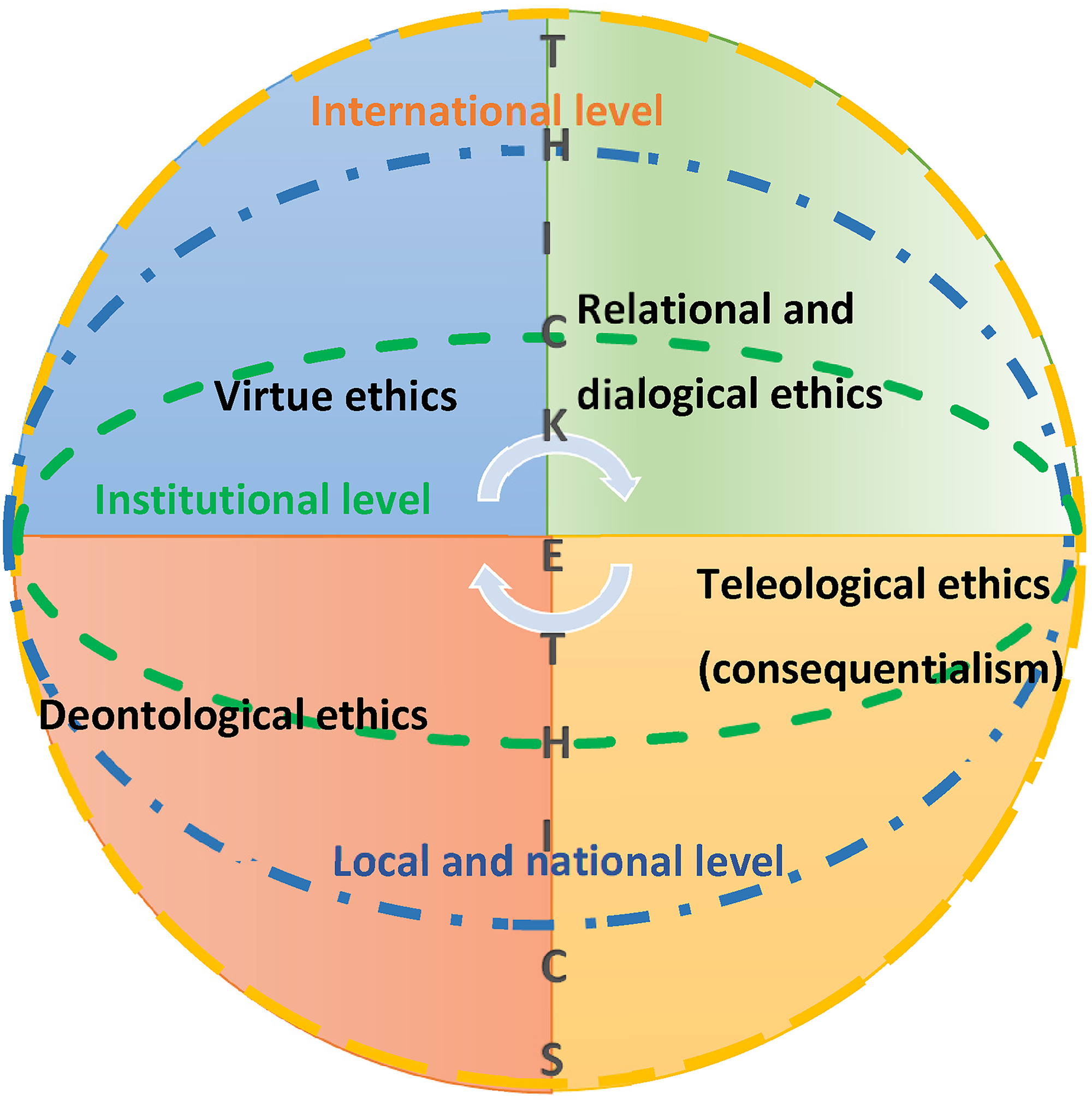
Four theoretical approaches to teacher ethics applied as thick ethics in educational practice at institutional level, local and national level, and international level (see dotted circles in different colors).
New public management as a global challenge for professional autonomy
Noting that values can be operationalized at different levels, Gunnestad et al. (2022) argue that the standardization of ethical values appears to be occurring globally because of the growing international influence of education systems formulated under the new public management regime (NPM). NPM is a neoliberal approach based on efficiency and outcomes (Banks, 2011, 2013; Shortt et al., 2012; Skourdoumbis & Bennett, 2019). This trend is partially informed by concerns about evidence-based practice focusing on “what works” (Webster & Whelen, 2019a; Rothuizen, 2022). Justification is typically based on acting in accordance with procedures and regulations, as well as on efficiency from an instrumental and utilitarian perspective (Afdal & Afdal, 2019; Banks, 2013).
In this regard, Rothuizen (2022) argues that whether the decision of what kind of knowledge early childhood teachers need comes from outside or within the profession is a key factor. More specifically, he asserts that human science pedagogy is inherently based on fundamental values, like freedom and emancipation that are internalized values in professional practice. Both Rothuizen (2022) and Zhang et al. (2022) warn against an instrumental practice, which can prevent focusing on children as agents and unique in themselves. Here, Rothuizen (2022) claims that ethical codes will be necessary if the knowledge outcomes are based on the expectations of outsiders. In contrast, no such ethical codes will be necessary if the knowledge comes from well-educated and experienced ECE professionals who base their practice on value-based human science pedagogy. This raises the important question of who should be responsible for the development of ethical codes. If the ethical codes are produced to acquire external control, external authorities will have the greatest influence on the development and enforcement of ethical codes (Forster, 2012; Schwimmer, & Maxwell 2017; Shortt et al., 2012; van Nuland, 2009; Webster & Whelen, 2019b; Wu, 2014).
Based on their analysis of Finnish curriculum documents, Melasalmi et al. (2022) argue that ethical codes are important for framing the socialization of newcomers and students as members of the profession. Ethical codes are important because they inform students and teachers of the values and norms of the profession. If the ethical codes are developed by the profession itself, they can strengthen the teachers’ professional identity (Banks, 2003) and provide a common vocabulary and rationale to reflect on ethical practice (Banks, 2003; Schjetne et al., 2016). However, both the literature on ethical codes for teachers in general and the articles in this Special Issue appear to neglect the potential of specific educational ethical codes. Educational ethical codes can serve to explain and frame discussions of ethics in everyday practice with colleagues, student teachers, parents, and external stakeholders. An example of what we understand as an educational ethical code can be found in the Norwegian ethical platform for teachers at all educational levels: “The professional community: initiates ethical reflection and dialogue with all employees at the workplace; cooperates to further develop knowledge, competences and ethical judgment, both internally and in interaction with relevant institutions in higher education and research” (Union of Education Norway, 2012, p. 2).
Given the impact of NPM in ECEC, the teaching profession needs to develop an ethical language enhancing the discussion of ethical codes and judgments with colleagues and enabling the negotiation of core values with external stakeholders, thereby securing children’s rights. Providing the early childhood teaching profession with the opportunity to suggest and develop their own ethical codes, as Zhang et al. (2022) do in their article, will strengthen the profession’s ethical practice, identity, and pride.
Concluding remarks
Examining ethical codes and values for early childhood teachers from different countries, the articles in this Special Issue make important contributions to the field insofar as they highlight ethical codes and the values upon which they are based. The articles reveal that many of the core values for ECEC are shared globally, especially values based on human rights and those pertaining to the duty to protect and care for children. With the growth of globalization and the standardization of ethical values (Gunnestad et al., 2022), it is important to recognize that professional autonomy is necessary to strengthen the profession. Early childhood teachers are dependent on knowledge about core values and ethical theories. Therefore, ethical codes can help early childhood teachers to reflect on and judge how best to act in order to secure children’s rights and quality of life in practice. As the Finnish and the Norwegian articles underscore, ethical responsibility is not only individual responsibility, but a collective and professional one. Common ethics are decisive for conducting ethical practice based on the profession’s knowledge and discussions, as well as negotiations and conflict resolution. Given the challenges arising from NPM, early childhood teachers need the professional competence to argue for and negotiate ethical practice.
As the editors of this Special Issue on current ethical codes and values for early childhood teachers, we hope that the selected articles stimulate further research and discussion about values and ethical codes for early childhood teachers. We consider international attention to and research on ethical codes as crucial to strengthening children’s education in ECEC in accordance with their rights to be unique, have agency, and play and learn in safe and caring environments.
Footnotes
Declaration of conflicting interests
The authors declared no potential conflicts of interest with respect to the research, authorship, and/or publication of this article.
Funding
The authors disclosed receipt of the following financial support for the research, authorship, and/or publication of this article: This work was supported by the International Joint Research Project of Faculty of Education, Beijing Normal University (ICER202002). The work with this article and work as guest editors have been supported by Western Norway University of Applied Sciences and KINDknow-Kindergarten Knowledge Centre for Systemic Research on Diversity and Sustainable Futures (Project Number: 275575).